Indigenous lactobacilli as well as lactobacillus strains involved in homemade or industrial fermented food have shown beneficial effects on gut health (Fernández et al. Reference Fernández, Boris and Barbes2003; Parvez et al. Reference Parvez, Malik, Ah Kang and Kim2006). High viable counts and survival rates during passage through the stomach are necessary to allow probiotics to take part in the biological role in the human intestine. Survival against the acid conditions of the stomach and bile salt are, therefore, of prime importance. In addition, adherence of probiotics to intestinal epithelium and temporary colonization of the gut are probably of crucial importance for their beneficial health effect (Ouwehand et al. Reference Ouwehand, Kirjavainen, Grönlund, Isolauri and Salminen1999; Servin & Coconnier, Reference Servin and Coconnier2003). Association of probiotic action with surface bacterial properties can be considered in almost all mentioned mechanisms (Pérez et al. Reference Pérez, Minnaard, Disalvo and De Antoni1998; Cesena et al. Reference Cesena, Morelli, Alander, Siljander, Tuomola, Salminen, Mattila-Sandholm and Von Wright2001). Characteristics ascribed to a probiotic are in general strain specific and individual strains have to be tested for each property.
A reliable probiotic product requires a complete identification of the bacterial species. In this context, molecular techniques have emerged in recent years as a complement to traditional phenotypic tests for comparing strains or species of probiotic bacteria. Amongst these methodologies, analysis of the 16S rRNA gene (Kullen et al. Reference Kullen, Sanozky-Dawes, Crowell and Klaenhammer2000) and 16S–23S rRNA internal spacer region (Leblond-Bourget et al. Reference Leblond-Bourget, Philippe, Mangin and Decaris1996; Tannok et al. Reference Tannok and Tannok1999) have proven to be useful tools for identification. For typing purpose, RAPD technique is reported to be simple and rapid to perform, and to provide good levels of discrimination; they are therefore considered the most suitable when a large number of strains must be analysed (Seseña et al. Reference Seseña, Sanchez and Palop2004).
Kefir is fermented milk obtained by the use of kefir grains, which contain a cluster of microorganisms held together by a polysaccharide-protein matrix. A vast variety of different species of organisms forming the kefir grains, comprising yeast and bacteria, have been isolated and identified (Garrote et al. Reference Garrote, Abraham and De Antoni2001; Witthuhn et al. Reference Witthuhn, Schoeman and Britz2004). Several health promoting properties are associated with kefir consumption (Farnworth, Reference Farnwoth2005; Lopitz-Otsoa et al. Reference Lopitz-Otsoa, Rementeria, Elguezabal and Garaizar2006). The beneficial action of this fermented milk can be partially attributed to the inhibition of pathogenic microorganisms by metabolic products such as organic acids produced by kefir microflora (Garrote et al. Reference Garrote, Abraham and De Antoni2000). Recent studies also demonstrated stimulation of immune system by this fermented milk (Thoreux & Schmucker, Reference Thoreux and Schmucker2001; Vinderola et al. Reference Vinderola, Duarte, Thangavel, Perdigón, Farnworth and Matar2005).
The aim of this study was to apply established in vitro assay tests to evaluate the probiotic potential of homofermentative lactobacilli isolated from kefir grains. Also, in the present work, molecular identification and genotypic diversity were performed.
Materials and Methods
Microorganisms and growth conditions
Eleven homofermentative lactobacilli (CIDCA 8312, 8313, 8323, 8327, 8331, 8334, 8336, 8337, 8338, 83114, 83210) were isolated from kefir grains and identified previously as Lactobacillus plantarum (Garrote et al. Reference Garrote, Abraham and De Antoni2001; Bosch et al. Reference Bosch, Golowczyc, Abraham, Garrote, De Antoni and Yantorno2006). Reference strains employed were Lb. plantarum DSM 20174, Lb. rhamnosus ATCC 7469, Lb. alimentarius ATCC 29643 and the heterofermentative Lb. kefir JCM 5818, for out-of-group comparison. Lactobacilli were grown in MRS broth (Biokar Diagnostics, Beauvais, France) during 24 h at 30°C. Escherichia coli, Salmonella enterica serovar Enteritidis, Sal. enterica serovar Tiphymurium, Sal. gallinarum and Shigella sonnei were grown in nutritive broth (Biokar Diagnostics) during 18 h at 37°C.
Molecular identification and genotypic diversity
DNA extraction, amplified ribosomal DNA and restriction analysis (ARDRA), 16S–23S rRNA internal spacer region analysis (ISR), random amplified polymorphic DNA (RAPD) and typing by RAPD-PCR patterns were performed according to Delfederico et al. (Reference Delfederico, Hollmann, Martínez, Iglesias, De Antoni and Semorile2006).
Hydrophobicity and Autoaggregation assay
Two millilitres of lactobacilli suspension in phosphate buffer saline (PBS) at OD550 nm=1·0 (OD0) were mixed with 0·5 ml n-hexadecane for 2 min and after phase separation, the optical density at 550 nm (OD1) was measured. The hydrophobicity was calculated as %H=(OD1−OD0)/OD1×100.
Aggregation coefficient (AC) was calculated at t=30 min according to Kos et al. (Reference Kos, Šušković, Vuković, Šimpraga, Frece and Matošić2003) as: AC t=[1−(ODt/OD0)]×100, where OD0 is the initial optical density of the microbial suspension at 550 nm and ODt is the optical density after 30 min.
Resistance of lactobacilli to simulated gastrointestinal conditions
Lactobacilli were resuspended in HCl pH 2·5 to a concentration of 108 CFU/ml and incubated at 37°C. Aliquots were taken immediately (0 h) and after 1 and 3 h. Serial dilutions using 0·1% tryptone were prepared and plated on MRS agar in order to determine the number of survivals. Measurement of bile resistance was performed by modified ecometric method according to Kociubinski et al. (Reference Kociubinski, Pérez and De Antoni1999).
Adhesion to Caco-2 cells
Caco-2 cells were routinely grown following the procedure described by Minnaard et al (Reference Minnaard, Delfederico, Vasseur, Hollmann, Rolny, Semorile and Perez2007). For adhesion assay, Caco-2 monolayers were incubated with 0·25 ml Lactobacillus suspension (2×10⁸ CFU/ml) and 0·25 ml DMEM (GIBCO BRL Life Technologies Rockville, USA) for 1 h at 37°C in a 5% CO2 – 95% air atmosphere. Then, monolayer was washed three times with PBS and lysed by adding sterile distilled water. To determine the number of viable cells associated with Caco-2 cells, appropriate dilution in 0·1% tryptone were plated on MRS and colony counts were performed. Experiments were performed per triplicate in three consecutive cell passages.
Antimicrobial activity assay
The Esch. coli, Sal. enterica serovar Enteritidis, Sal. enterica serovar Tiphymurium, Sal. gallinarum and Sh. sonnei inhibition was screened by using spot test assay. Lactobacillus cultures at pH 3·9–4·2, were centrifuged for 15 min at 10·000 g and filtrated through 0·22 μm membrane filter (Millipore Corporation, Milford, USA) to obtain spent culture supernatants (SCS). A suspension of 108 CFU/ml of target bacteria was swabbed over nutrient agar (3 g meat extract/l, 5 g peptone/l, 15 g agar/l, pH 6·7) and 10 μl lactobacilli SCS were spotted onto the agar surface. The plates where incubated at 37°C and the growth free inhibition zone around the spotted area was recorded. Inhibition of Esch. coli was also assessed by determining the growth kinetic in nutrient broth in presence of lactobacilli SCS. Artificially acidified MRS was prepared adding 120 mm-DL-lactic acid to MRS and adjusting to pH 4·0. Assays were performed in duplicate in three independent experiments.
Determination of organic acids concentration
Lactic acid concentration of SCS was measured by HPLC as described by Garrote et al. (Reference Garrote, Abraham and De Antoni2000).
Statistical analysis
Results were expressed as means±standard deviation (sd) of at least three separate duplicate experiments. For statistical comparisons, Student's t test was performed at P value of <0·05.
Results and Discussion
Molecular identification and genotypic diversity of lactobacilli kefir grains
Today, microbiologists agree that a reliable classification can only be achieved by the exploration of each group of isolates by a set of techniques, generally known as the polyphasic approach. This approach implies that two sources of information must be investigated: genomic and phenotype data (Rosselló-Mora & Amann, Reference Rossellò-Mora and Amann2001). In this work, a large region of 16S rDNA was amplified from lactobacilli and fragments of approximately 1450 bp were obtained. ARDRA patterns generated with enzymes Nco I, Hinf I and Hae III of all isolates and the reference Lb. plantarum strain share the same profile for each enzyme (data not shown). On the other hand, Lb. rhamnosus and Lb. kefir showed a differential pattern for each enzyme (data not shown).
PCR amplification of a gene region including 16S–23S ISR was made from lactobacilli isolates and from reference strains. Four amplification fragments, with sizes of approximately 1400, 750, 700 and 500 bp, were obtained in all cases, showing absence of 16S–23S ISR size polymorphism among isolates and reference strains (data not shown). Minor fragment of four isolates were cloned and sequenced and ISR flanking regions were subtracted.
The absence of 16S–23S ISR length polymorphisms among lactobacilli isolates and reference strains agree with previously published data for other lactobacilli (Fortina et al. Reference Fortina, Ricci, Acquati, Zeppa, Gandini and Manachini2003). 16S–23S ISR sizes and absence of tRNA genes in minor length 16S–23S spacer, found in this work, are in good correlation with those reported by Nour (Reference Nour1998) for members of the Lactobacillus genus.
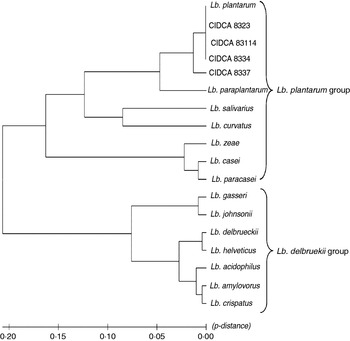
A multiple sequence alignment of 16S–23S ISR sequences, using CLUSTAL X Program, was made. This analysis showed a similitude value higher than 98·4% among homofermentative lactobacilli and the reference Lb. plantarum strain (data not shown). That similitude value was higher than the cut-off value of 97·5% purpose by Tannok et al. (Reference Tannok and Tannok1999) as a criterion to identify species. On the other hand, 16S–23S ISR sequences obtained from GenBank database, showed a similitude value lower than 98%, even the closely related Lb. paraplantarum (Fig. 1). According to molecular data obtained, we may point out that all homofermentative lactobacilli studied belong to the species Lb. plantarum, in good agreement with previous phenotypic identification (Garrote et al. Reference Garrote, Abraham and De Antoni2001, Bosch et al. Reference Bosch, Golowczyc, Abraham, Garrote, De Antoni and Yantorno2006).
Unrooted phylogenetic tree generated on the basis of 16S–23S ISR from four homofermentative isolates, and 14 reference strains obtained from GenBank data base.

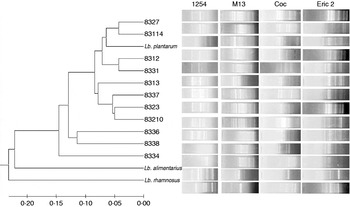
RAPD-PCR analysis was performed and patterns obtained are shown in Fig. 2 (right). Differences in discriminatory power of these primers became apparent after the analysis of several lactobacilli isolates. RAPD-PCR analysis showed primer Coc, specifically designed for lactic acid bacteria discrimination (Cocconcelli et al. Reference Cocconcelli, Parisi, Senini and Bottazzi1997), as the best for differentiation of lactobacilli isolates belonging to Lb. plantarum species. The UPGMA dendrogram was obtained by combination of Coc, ERIC-2, 1254, and M13 profiles (Fig. 2, left). The similitude value between the homofermentative isolates and the reference Lb. plantarum strain was higher than 70%. Based on an arbitrary similitude value of 82% to define clusters, this unrooted tree has five clusters. Reference Lb. plantarum strain, CIDCA 8327 and 83114 belong to cluster one. Cluster two contains the isolates CIDCA 8312 and 8331. In cluster three are grouped CIDCA 8337, 83210, 8313 and 8323. In cluster four, CIDCA 8336 and 8338 and finally cluster five only contains the isolate CIDCA 8334. The reference strains Lb. alimentarius and Lb. rhamnosus are in different and most distant branches of the tree.
RAPD-PCR obtained with Coc, ERIC-2, 1254 and M13 primers and combined dendrogram obtained from RAPD-PCR profiles.

In this study, RAPD-PCR analysis was used as a molecular typing method to group lactobacilli isolates from heterogeneities exhibited by their profiles. This approach has often been used with a similar propose (De Angelis et al. Reference De Angelis, Corsetti, Tosti, Ross, Corbo and Gobbetti2001; Vásquez et al. Reference Vásquez, Jakobsson, Ahrne, Forsum and Molin2002). RAPD analysis is also in good agreement with ARDRA and ISR results. In regard to species identification, five clusters obtained by RAPD-PCR analysis could be correlated with at least five different strains of species Lb. plantarum.
Probiotic properties of lactobacilli isolated from kefir grains
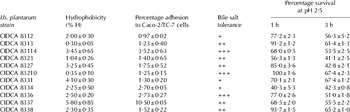
All lactobacilli studied showed a high resistance to bile and acid conditions (Table 1). Isolates CIDCA 83114, 83210 and 8336 showed highest resistance to bile. The highest resistance to acid conditions was observed for isolates CIDCA 8313, 83210 and 8338. The remaining isolates showed lower percentage of survival but none were lower than 40% after 3 h. It is important to point out that survival experiments were performed under the most unfavourable conditions. It is expected that in physiological conditions the complex food matrix could exert an additional protective action against acid damage.
Hydrophobicity, adhesion to Caco-2 cells and resistance to simulated gastrointestinal conditions of homofermentative lactobacilli isolates from kefir
Values are the mean±sd of three independent assays

The surface properties, such as aggregation and hydrophobicity, are thought to be linked to the ability to interact with epithelial cells and/or undesirable bacteria (Gusils et al. Reference Gusils, Pérez Chaia, González and Oliver1999). The aggregation coefficient at 60 min was zero in all Lb. plantarum studied (data not shown). Lb. plantarum isolates have a hydrophilic surface with a hydrophobic index from 0 to 5·8% and showed different capacities to adhere to Caco-2 cells (Table 1). In agreement with other reports (Ouwehand et al. Reference Ouwehand, Kirjavainen, Grönlund, Isolauri and Salminen1999; Schillinger et al. Reference Schillinger, Guigas and Holzapfel2005), no significant correlation could be observed between cell surface hydrophobicity of Lb. plantarum isolates and the adhesion to epithelial cells. Thus, hydrophobicity could contribute to adhesion, but it is not a prerequisite for an adherence capacity. Among Lb. plantarum isolates, the highest adhesion (10·5%) was observed with the isolate CIDCA 8337.
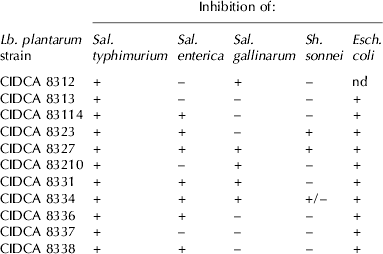
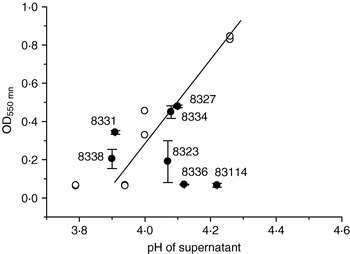
There are several reports about the antagonistic activity of lactobacilli against Gram-negative pathogens (Servin, Reference Servin2004; Tsai et al. Reference Tsai, Hsih, Chiu, Lai, Liu, Yu and Tsen2005). Over the last few years, studies of Lb. plantarum as a potential probiotic have been reported (de Vriesa et al. Reference de Vriesa, Vaughanb, Kleerebezema and de Vosa2006). All Lb. plantarum SCS studied in the present work have inhibitory power against Sal. typhimurium and Esch. coli (Table 2). Seven out of eleven isolates showed inhibition against Sal. enterica. Only five SCS tested were effective against Sal. gallinarum. A weak activity was observed against Sh. sonnei where only two isolates, CIDCA 8323 and 8327 were positive. Our results were in accordance with previous reports about in vitro assays for testing antagonist activity of Lb. plantarum (Çon & Gökalp, Reference Çon and Gökalp2000; Obadina et al. Reference Obadina, Oyewole, Sanni and Tomlins2006). No inhibitory effect of artificially acidified MRS (120 mm-lactic acid) was observed on any of the tested pathogens. This lactic acid concentration was used taking into account the average concentration of lactic acid in Lb. plantarum SCS which ranged from 118 to 130 mm.
Antimicrobial activity of homofermentative lactobacilli against gram negative pathogens
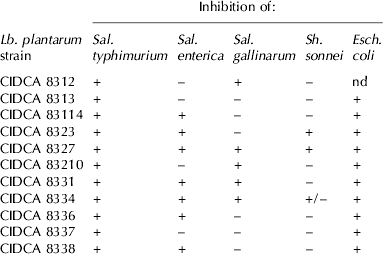
+: Clearly defined zone of inhibition, −: No inhibition zone, nd: Not determined
Growth kinetic of Esch. coli in nutrient broth was recorded in the presence of SCS or artificially acidified MRS (Fig. 3). Maximal OD reached by Esch. coli was affected by pH. A linear correlation was observed between pH 3·8 and 4·1 with data obtained from curves with acid MRS and some SCS. However SCS of isolates 8323, 8324, 8336 and 83114 produced higher inhibition at pHs between 4·1 and 4·3. This means that the inhibitory effect should be ascribed not only to the lactic acid produced by lactobacilli. It is known that some Lb. plantarum produce other metabolic compounds such as bacteriocins and/or bacteriocin-like substances, that are active against certain pathogens (Šušković et al. Reference Šušković, Kos, Matošc and Marić1997; Toksoy et al. Reference Toksoy, Beyatli and Aslim1999; Kostinek et al. Reference Kostinek, Specht, Edward, Schillinger, Hertel, Holzapfel and Franz2005). Further work will be necessary to determine molecule(s) involved in antimicrobial effect.
Growth inhibition of Esch. coli in nutrient broth supplemented with acidified MRS (○) or SCS of Lb. plantarum isolates (●). Values are the mean±sd of three independent assays.

In this work, we studied the possible relationship between the five clusters based on RAPD-PCR and the probiotic properties for each isolate tested. We did not find a correlation, suggesting that these isolates have unique characteristics and in each cluster there are isolates with different probiotic properties.
All the strains tested, showed good properties as potential probiotics, but considering the ability to inhibit in vitro all pathogens tested and its tolerance to lactic acid and bile salts, we believe that Lb. plantarum CIDCA 8327 could be proposed as a good probiotic candidate. Although Lb. plantarum CIDCA 8327 has low adhesion to Caco-2 cells compared with other strains such as CIDCA 8337, it is important to consider that studies with Caco-2 cells can be useful to collect background information of probiotic strains but adhesion is not always necessary for probiotic effect of lactobacilli in the gut.
The results obtained in vitro indicates the possible utilization of certain strains isolated from kefir as probiotics. Further studies on the capacity of Lb. plantarum isolates to colonize the intestine and their protective action against infections using in vivo experiment are needed.
M. Golowczyc, A. Hollmann and L. Delfederico are fellows and A. Abraham and G. Garrote are researchers of the Consejo Nacional de Investigaciones Científicas y Técnicas (CONICET). GL. De Antoni and L. Semorile are researchers of the Comisión de Investigaciones Científicas de la Provincia de Buenos Aires (CIC.PBA). The authors are grateful to A. Campana and C. Penaca for their assistance in organic acids determination. This work was supported by Agencia Nacional de Promoción Científica y Tecnológica (ANPCyT), CONICET, CIC.PBA and Universidad Nacional de La Plata (UNLP).