Pulmonary hypertension is a chronic condition, whether idiopathic or in association with conditions such as congenital heart disease. Children with pulmonary hypertension are usually asymptomatic initially, presenting late with breathlessness, fatigue, and in severe cases cyanosis, as heart failure develops. Recent advances in treatment have resulted in improved survival rates of 71.9% in 5 years.Reference Moledina, Hislop, Foster, Schulze-Neick and Haworth 1 Often children with congenital heart disease are known from an early age, but they may present late and have established pulmonary vascular disease occasionally.
Pulmonary hypertension is defined as a mean pulmonary artery pressure above 25 mmHg at rest.Reference Kovacs, Berghold, Scheidl and Olschewski 2 Although pulmonary pressure can be estimated using echocardiography, gold standard measurement is through “pulmonary vascular resistance studies” involving cardiac catheterisation, under general anaesthesia in children. As these investigations guide clinical management, minimal interference from anaesthetic drugs is essential.
Existing data indicate that, in adults with acute pulmonary hypertension, for example during one-lung ventilation, propofol reduces pulmonary and systemic vascular resistance,Reference Hammaren and Hynynen 3 whereas isoflurane has no effect on pulmonary vascular resistance but does affect pulmonary perfusion.Reference Loeckinger, Keller, Lindner and Kleinsasser 4 However, data from children with chronic pulmonary hypertension are lacking.
There is anecdotal evidence from senior anaesthetists to suggest that pulmonary vascular resistance varies whether propofol or volatile agents are used for anaesthesia. This pilot study aims to compare the effect on pulmonary vascular resistance of these two agents in children undergoing cardiac catheterisation.
Patients and methods
Children with clinical and echocardiographic evidence of pulmonary hypertension and with no history of allergy to propofol or isoflurane were included in the study. Ethical and regulatory approval was granted and the study was registered with the clinical trials database. Statistical analysis was performed using the Wilcoxon signed-rank test. Results are shown as median and range.
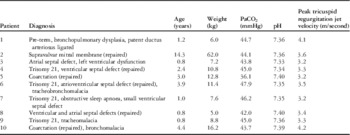
Children were selected for pulmonary vascular resistance studies if there was evidence of a raised pulmonary artery pressure – tricuspid regurgitant jet peak velocity of more than 3 m/second when awake and breathing spontaneously – and raised pulmonary vascular resistance. The complete clinical data of these children are shown in Table 1.
Demographic and anatomic data for each patient

PaCO2 (arterial partial pressure of carbon dioxide) and pH are recorded at the baseline in each patient.
The pulmonary vascular resistance studies were carried out using the standard cardiac catheterisation protocols. Each child was randomised to receive maintenance anaesthesia with propofol – end target concentration 3 mcg/ml – followed by isoflurane – age-related dose of 1 minimum alveolar concentration – or the reverse. Induction was performed using the first maintenance agent – sevoflurane was substituted for isoflurane – followed by fentanyl and rocuronium.
The clinician performing cardiac catheterisation was blinded as to which agent was being used, although the anaesthetist was aware. An initial blood gas sample was taken to ensure that the arterial partial pressure of carbon dioxide was in the normal range and that the child was stable before the study ensued. Measurements of pulmonary vascular resistance, haemodynamic parameters, bispectral index monitoring, and lung compliance were taken by the catheterising clinician at baseline – oxygen <35% – and at increasing concentrations of nitric oxide 10 ppm then 20 ppm – and then added oxygen (100%). Bispectral index is an empirically derived parameter based on electroencephalographic activity, which indicates the depth of anaesthesia.
Baseline measurements were repeated for the second anaesthetic agent after at least a 15-minute washout. Measures were also taken to ensure that haemodynamic parameters such as heart rate, blood pressure, and oxygen saturations were back to baseline. The total study time was ~2 hours.
Pulmonary vascular resistance was calculated from anonymised data using Darcy’s Law.Reference Freed 5 Mixed venous saturations were taken from the superior and inferior vena cava in the standard manner. Oxygen consumption was measured using a mass spectrometer. A decrease in mean pulmonary vascular resistance in response to nitric oxide of more than 20% was considered to indicate reactive pulmonary vasculature amenable to oral vasodilator therapy. As such, a 20% difference in pulmonary vascular resistance between anaesthetic agents was considered clinically significant.
Results
A total of 10 children were randomised. They had a median weight of 9.8 kg (range 5–62 kg) and age of 1.8 years (range 8 months to 14 years). Their underlying conditions included ventricular septal defects, coarctation of the aorta, and mixed syndromes (see Table 1).
Baseline measurements of pH and arterial carbon dioxide partial pressure from the beginning in each patient are shown in Table 1. These variables were rechecked before the initiation of the second anaesthetic agent; there were no significant changes.
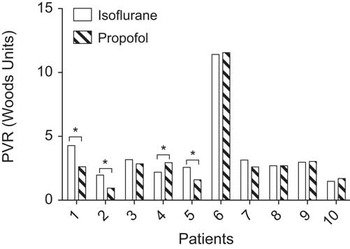
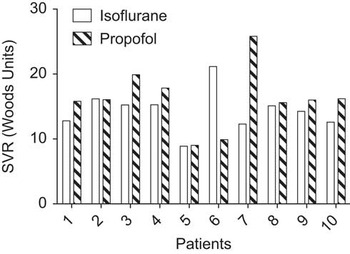
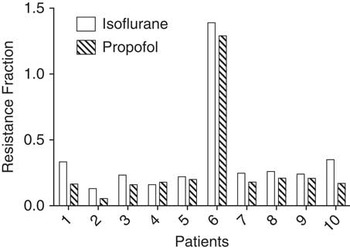
No significant difference in baseline pulmonary or systemic vascular resistance was seen between propofol and isoflurane (Table 2). In all, four children showed a difference in pulmonary vascular resistance of >20% between the two agents (Figure 1). Systemic vascular resistance and resistance fraction for each child with both anaesthetic agents are shown in Figure 2 and Figure 3. The resistance fraction – ratio of pulmonary to systemic vascular resistance – recorded with propofol was significantly lower than that with isoflurane (p=0.004). Pulmonary vascular responsiveness to nitric oxide, measured for the initial anaesthetic, was not significantly different between the agents (p=0.89). The depth of sedation, as measured using bispectral index, and lung compliance were similar in the two groups.
Pulmonary vascular resistance (PVR) (Wood units/m2) measured for each patient with each anaesthetic agent. *Difference >20%.

Systemic vascular resistance (SVR) (Wood units/m2) measured for each patient with each anaesthetic agent.

Resistance fraction – ratio of pulmonary vascular resistance to systemic vascular resistance – measured for each patient with each anaesthetic agent.

Measured physiological parameters with isoflurane and propofol anaesthesia

Rp=pulmonary vascular resistance; Rs=systemic vascular resistance.
Median (range).
Discussion
The effects of anaesthetic agents on the pulmonary vasculature of children with pulmonary hypertension are relatively unknown, and the choice of anaesthetic agent is largely based on individual preference and extrapolation of data from adult studies. However, as the results of pulmonary vascular resistance studies determine both prognosis and treatment, it is vital that the anaesthetic has minimal impact on measurements taken.
Children with pulmonary hypertension represent a significant anaesthetic challenge and it is important that preload, contractility, and systemic vascular resistance are maintained, while avoiding increases in pulmonary vascular resistance.Reference MacKnight, Martinez and Simon 6 Many factors can increase pulmonary vascular resistance, including hypoxaemia, hypercarbia, acidosis, pain, and hypothermia, all of which can be minimised through optimised anaesthesia.Reference Friesen and Williams 7
Existing data from adults indicate that volatile anaesthetics lessen hypoxic pulmonary vasoconstriction and impair ventilation–perfusion matching, while also impairing cardiac contractility and reducing systemic vascular resistance.Reference Loeckinger, Keller, Lindner and Kleinsasser 4 , Reference Fischer, Van Aken and Burkle 8 Propofol has been shown to significantly reduce pulmonary vascular resistance in adults,Reference Hammaren and Hynynen 3 whereas in children with congenital heart disease studies have demonstrated that propofol reduces systemic vascular resistance.Reference Oklu, Bulutcu, Yalcin, Ozbek, Cakali and Bayindir 9 , Reference Williams, Jones, Hanson and Morray 10
This study demonstrated no significant difference in pulmonary or systemic vascular resistance between propofol and isoflurane. However, the resistance fraction – ratio of pulmonary to systemic resistance – was significantly higher for isoflurane than propofol. This is partially explained by a tendency towards lower pulmonary vascular resistance with propofol compared with isoflurane, which is in line with existing adult data. However, the data also suggest that isoflurane has a more pronounced effect on lowering systemic vascular resistance compared with propofol. Previous studies show conflicting evidence in this regard,Reference Mishra, Pradhan and Pradhan 11 , Reference Keegan and Greene 12 and further research directly comparing these two agents is required to substantiate these results.
Elevations in resistance fraction are associated with worsening right-to-left intracardiac shunting in the presence of a residual shunt and with consequent hypoxaemia. A decrease in systemic vascular resistance also reduces coronary perfusion of the right heart. Therefore, these data provide some initial evidence to suggest that propofol may be a more suitable anaesthetic agent than isoflurane, although further evidence is needed.
This pilot study is limited by patient heterogeneity and a small sample size. However, efforts were made to account for possible confounders, such as hypoxia and hypercarbia, and blinding of the interventionalist to the anaesthetic-minimised measurement bias. The crossover design helps to account for any differences in the way the anaesthetics affected the circulation or in the effect of the anatomic variation of the children. The washout period used was limited for ethical reasons, and although all reasonable efforts were made to ensure complete drug elimination it is conceivable that there may have been some residual drug effect, especially when isoflurane was used first; propofol has a rapid distribution half-life of 2–4 minutesReference Kanto and Gepts 13 and isoflurane/sevoflurane has an early-phase elimination of around 10 minutes.Reference Behne, Wilke and Harder 14
Most of the patients included had only moderate elevations in pulmonary vascular resistance, and in some cases pulmonary pressure was normal when the child was intubated. This often indicates that pulmonary hypertension while awake is due to upper airway obstruction. However, these children were still included, as the primary purpose of this study was to assess the impact of anaesthetic agents, irrespective of the initial pulmonary vascular resistance.
In conclusion, this pilot study provides some preliminary evidence to suggest that propofol may be preferable to isoflurane for pulmonary vascular resistance studies, but a larger trial would add statistical weight. Given the multitudinous factors influencing pulmonary vascular resistance, balanced and closely monitored anaesthesia should remain the primary focus, although the anaesthetic agent used must be considered when treatment decisions are made.
Acknowledgement
The authors thank Drs Gareth Morgan and Richard Beringer for their help with this study.
Financial Support
None.
Conflicts of Interest
None.
Ethical Standards
The authors assert that all procedures contributing to this work comply with the ethical standards of the Medicines for Human Use (Clinical Trials) Regulations 2004 and with the Helsinki Declaration of 1975, as revised in 2008, and have been approved by the Central Bristol Research Ethics Committee.