




No CrossRef data available.
Article contents
- Extract
- Introduction
- The Original Publication of52It must be said at the outset that I am very hesitant to critique the work of one of the great papyrologists—the person who, quite literally, wrote the book on dating literary hands: Greek Literary Hands. 350 B.C.–A.D. 400 (Oxford: Clarendon, 1955). Two reasons suggest the undertaking is necessary: First, a sizeable amount of evidence has been published since 1935 that no one has brought to bear on the question of dating 52. Second, the publication of 52 occurred very early in Roberts's life; its publication predated his work on the remainder of the Rylands collection and the rest of his impressive career, although before 52 he had published individual papyri in the Journal of Egyptian Archaeology and Aegyptus. On the early career of the precocious Roberts, see the memorial in Proceedings of the British Academy 84 (1994) 479–80. Roberts maintained the second-century date for 52 in his later work, although he did not put forward new evidence. See his The Birth of the Codex, coauthored by T. C. Skeat (London: Oxford University Press, 1987) 40.
- Roberts's Dating of52
- Some New Comparanda
- Conclusion
- Appendix 2: P.Lond. 1.130
The Use and Abuse of P52: Papyrological Pitfalls in the Dating of the Fourth Gospel
Published online by Cambridge University Press: 02 August 2005
Article contents
- Extract
- Introduction
- The Original Publication of52It must be said at the outset that I am very hesitant to critique the work of one of the great papyrologists—the person who, quite literally, wrote the book on dating literary hands: Greek Literary Hands. 350 B.C.–A.D. 400 (Oxford: Clarendon, 1955). Two reasons suggest the undertaking is necessary: First, a sizeable amount of evidence has been published since 1935 that no one has brought to bear on the question of dating 52. Second, the publication of 52 occurred very early in Roberts's life; its publication predated his work on the remainder of the Rylands collection and the rest of his impressive career, although before 52 he had published individual papyri in the Journal of Egyptian Archaeology and Aegyptus. On the early career of the precocious Roberts, see the memorial in Proceedings of the British Academy 84 (1994) 479–80. Roberts maintained the second-century date for 52 in his later work, although he did not put forward new evidence. See his The Birth of the Codex, coauthored by T. C. Skeat (London: Oxford University Press, 1987) 40.
- Roberts's Dating of52
- Some New Comparanda
- Conclusion
- Appendix 2: P.Lond. 1.130
Extract
The thesis of this paper is simple: we as critical readers of the New Testament often use John Rylands Greek Papyrus 3.457, also known as P52, ininappropriate ways, and we should stop doing so. A recent example will illustrate the problem. In what is on the whole a superb commentary on John's gospel, D. Moody Smith writes the following about the date of John:
For a time, particularly in the early part of the twentieth century, the possibility that John was not written, or at least not published, until [the] mid-second century was a viable one. At that time Justin Martyr espoused a logos Christology, without citing the Fourth Gospel explicitly. Such an omission by Justin would seem strange if the Gospel of John had already been written and was in circulation. Then the discovery and publication in the1930s of two papyrus fragments made such a late dating difficult, if not impossible, to sustain. The first and most important is the fragment of John chapter 18 … [P52], dated by paleographers to the second quarter of the second century (125–150); the other is a fragment of a hithertounknown gospel called Egerton Papyrus 2 from the same period, which obviously reflects knowledge of the Gospel of John…. For the Gospel of Johnto have been written and circulated in Egypt, where these fragments were found, a date nolater than the first decade of the second century must be presumed.
Information
- Type
- ARTICLES
- Information
- Copyright
- © 2005 Cambridge University Press
Introduction
The thesis of this paper is simple: we as critical readers of the New Testament often use John Rylands Greek Papyrus 3.457, also known as

52, in inappropriate ways, and we should stop doing so.
1Colin H. Roberts produced the editio princeps as An Unpublished Fragment of the Fourth Gospel in the John Rylands Library (Manchester: The University Press, 1935). I shall discuss the circumstances of publication in some detail below.
For a time, particularly in the early part of the twentieth century, the possibility that John was not written, or at least not published, until [the] mid-second century was a viable one. At that time Justin Martyr espoused a logos Christology, without citing the Fourth Gospel explicitly. Such an omission by Justin would seem strange if the Gospel of John had already been written and was in circulation. Then the discovery and publication in the 1930s of two papyrus fragments made such a late dating difficult, if not impossible, to sustain. The first and most important is the fragment of John chapter 18 … [
52], dated by paleographers to the second quarter of the second century (125–150); the other is a fragment of a hitherto unknown gospel called Egerton Papyrus 2 from the same period, which obviously reflects knowledge of the Gospel of John…. For the Gospel of John to have been written and circulated in Egypt, where these fragments were found, a date no later than the first decade of the second century must be presumed.
2John (Nashville, Tenn.: Abingdon, 1999) 41–42. In the course of the discussion of
52, I shall also address the other papyrus to which Smith refers, Egerton Papyrus 2.
Moody Smith is not alone in his assessment of the situation.3
Indeed, such assertions began on the very day Roberts's monograph was published (12 November 1935). C. H. Dodd wrote in that day's edition of the Manchester Guardian: “There has been a great deal of controversy about the date to which the composition of the Fourth Gospel is to be assigned. One school of critics has long upheld the view that it was not written until about A.D. 135–140. Unless the experts are very far wrong in their judgement upon the new papyrus, this date becomes obviously impossible.” Dodd's remarks are reprinted in full in BJRL 20 (1936) 4–6. In the same issue, Roberts's An Unpublished Fragment is reprinted in full with minor changes (44–55).
The most conclusive argument against the late dating of John has been the discovery of several 2nd-century papyri texts of John. In 1935 C. H. Roberts published Rylands Papyrus 457 (
52)…. The dating of this papyrus to 135–150 has been widely accepted; and the latest attempt to date NT papyri by K. Aland … assigns to
52 a date at the “beginning of the 2nd cent.”
4The Gospel according to John (I–XII) (AB 29; New York: Doubleday, 1966) lxxxii–lxxxiii; Brown maintains this position in An Introduction to the Gospel of John (ed. Francis J. Moloney; New York: Doubleday, 2003) 209. The other papyri to which Brown refers are
66 (P. Bodmer II and other fragments, paleographically dated to the late second or early third century) and
75(P. Bodmer XIV and XV, paleographically dated to the third century). Similar statements of the import of
52 for the dating of John abound in the scholarly literature of the last sixty-five years, though few match the literary flair of Bruce Metzger, who writes, “Just as Robinson Crusoe, seeing but a single footprint in the sand, concluded that another human being, with two feet, was present on the island with him, so
52 proves the existence and use of the Fourth Gospel during the first half of the second century in a provincial town along the Nile, far removed from its traditional place of composition (Ephesus in Asia Minor)” (The Text of the New Testament: Its Transmission, Corruption, and Restoration [3rd ed.; New York: Oxford University Press, 1992] 39). See also Werner Kümmel's Introduction to the New Testament (rev. ed.; trans. H. C. Kee; Nashville, Tenn.: Abingdon, 1975) 246. Martin Hengel has made a similar argument with great vigor, claiming that with the discovery of
52, “which according to Aland is now ‘by general consensus put around 125' … the final redaction of the Fourth Gospel must be put at least a generation earlier than was usual in so-called critical scholarship. The Gospel of John in its present form (and the letters) was surely published a decade or so before the letters of Ignatius” (The Johannine Question [trans. J. Bowden; London: SCM Press, 1989] 88–89). Brown and Hengel both refer to Kurt Aland's dating of
52, on the problems of which see n. 22, below.
For Brown, this papyrological evidence is enough to mark 100 C.E. as the latest possible date of composition of John. While both authors mention other papyri paleographically dated to the second century, they both view
52 as the main evidence for an early dating of John. Many scholars have followed this judgment.
5See the literature in the previous note. In the entry for John's gospel in the Anchor Bible Dictionary, often a good barometer of widely-held scholarly opinions, Robert Kysar writes that “the latest possible date [of John] has been fixed by the discovery in Egypt of the Rylands Papyrus 457 (
52)” (ABD 3:918, my italics). The comments of J. K. Elliott are similar (“The Biblical Manuscripts of the John Rylands University Library of Manchester,” BJRL 81 [1999] 7). A few scholars, such as C. K. Barrett, have been somewhat more careful in their assessment of the evidence. Barrett wrote in the first edition of his The Gospel according to St. John: An Introduction with Commentary and Notes on the Greek Text (New York: Macmillan, 1957) that
52, “which cannot be dated more precisely than the middle of the second century,” established 140 C.E. as the terminus ante quem for the Gospel of John (p. 108). Though he adopted a more standard position in the second edition of his commentary (London: SPCK, 1978), he maintained that outside of Egerton Papyrus 2 and
52, “there is no other satisfactory evidence of the existence of the Fourth Gospel before A.D. 150” (p. 110).
This assessment is not, however, without problems. First, paleographic dating of papyri is never a simple matter,
6The assertion is commonplace. Paleography is a last resort for dating. See, e.g., Eric G. Turner, Greek Manuscripts of the Ancient World (2d rev. ed.; London: Institute of Classical Studies, 1987) 19–23. We would also do well to remember the standard rule of thumb for precision in paleographic dating. Turner writes, “For book hands, a period of 50 years is the least acceptable spread of time” (ibid., 20).
The flow of new evidence is constant. See Ann Ellis Hanson, “Papyrology: A Discipline in Flux,” in Disciplining Classics—Altertumswissenschaft als Beruf (ed. G. W. Most; Göttingen: vandenhoeck & Ruprecht, 2002) 191–206.
52 in 1935, when such debates, so scholars thought, had now become moot.
8In the last quarter of the nineteenth century, Johannine scholars' main interest in the writings of the Apostolic Fathers and Justin pertained to the issue of Johannine authorship of the gospel. James Drummond (An Inquiry into the Character and Authorship of the Fourth Gospel [New York: Charles Scribner's Sons, 1904] 351) had strongly argued that the evidence of Justin and the Fathers confirmed Johannine authorship of the gospel, ignoring the opinion of William Sanday (The Authorship and Historical Character of the Fourth Gospel [London: Macmillan, 1872] 3), who had (correctly) asserted that this external evidence on its own could not answer the question of authorship affirmatively or negatively. At the close of the nineteenth century, Paul W. Schmiedel sharpened the question, noting that while the external evidence could not determine authorship, it could shed light on the question of whether or not the gospel even existed in the late first and early second centuries. See his “John, son of Zebedee,” in Encyclopaedia Biblica: A Critical Dictionary of the Literary, Political, and Religious History; The Archaeology, Geography, and Natural History of the Bible (rev. ed. in one volume; New York: Macmillan, 1899–1903) cols. 2545–50. Benjamin W. Bacon provides a good overview of these debates in the essays collected in his The Fourth Gospel in Research and Debate: A Series of Essays on Problems Concerning the Origin and Value of the Anonymous Writings Attributed to the Apostle John (2d ed.; New Haven, Conn.: Yale University Press, 1918). To be sure, there has been subsequent debate in the twentieth century about the role of John in authors of the second century, but these inquiries have usually assumed the gospel's existence and been concerned with other matters, such as the old issue of the authorship of John. See, e.g., John S. Romanides, “Justin Martyr and the Fourth Gospel,” GOTR 4 (1958) 115–34; and D. M. Davey, “Justin Martyr and the Fourth Gospel,” Scr 17 (1965) 117–22.
This state of affairs calls for two responses. First, as Georg Strecker noted almost fifteen years ago, “there is an urgent need for a new analysis of
52 that would objectively set out the pros and cons of a possible dating.”
9The Johannine Letters: A Commentary on 1, 2, and 3 John (trans. L. M. Maloney; Minneapolis: Fortress, 1996) xli n. 78; trans. of Die Johannesbriefe (KEK 14; Göttingen: Vandenhoeck & Ruprecht, 1989) 27–28 n. 27. To my knowledge, the most recent examination of the early manuscripts of the New Testament is that of Philip W. Comfort and David P. Barrett, The Text of the Earliest New Testament Greek Manuscripts (Wheaton, Ill.: Tyndale, 2001), a problematic volume. (It is a “corrected, enlarged edition” of the same authors' The Complete Text of the Earliest New Testament Manuscripts [Grand Rapids, Mich.: Baker Books, 1999].) The editors display a very marked tendency to date manuscripts early. Of the 64 manuscripts they present, Comfort and Barrett depart from the original editors' dating on at least 27 manuscripts. For 25 of those 27 manuscripts, they propose their own earlier date or accept an earlier date advanced in scholarly discussion; they accept a later date from the scholarly discussions in only 2 cases. Their bias is clear. With slim and weak evidence (discussed in detail in n. 26, below), Comfort and Barrett push the date of
52 back to “the early second century (ca. 100–125)” or even “A.D. 100, plus or minus a few years,” 365–67.
52, namely, debates about the presence (or absence) of references to John in the writings of early Christian authors, both “orthodox” and “non-orthodox.”
10I should be clear about precisely which debates I mean to resurrect. “Late” dating of John (after ca. 130 C.E.) is most often associated with the work of F. C. Baur, who argued John was late because its theological development fell on the late end of his linear model of early Christian thought; see his Kritische Untersuchungen über die kanonischen Evangelien (Tübingen: L. F. Fues, 1847) 77–389. Such arguments are unconvincing, given that most scholars now accept that the early followers of Jesus demonstrated a wide variety of beliefs from the time very soon after Jesus' death. The debates that interest me are those of the late nineteenth and early twentieth centuries that focused on the “external evidence” for John's gospel (see n. 8, above). More recently, Melvyn Raymond Hillmer thoroughly examined the evidence in his Harvard dissertation, “The Gospel of John in the Second Century” (Th.D. thesis, Harvard Divinity School, 1966). While he rather uncritically accepted an early date for
52 and hence for the composition of John (1 n. 2), he nonetheless concluded that “there is no clear example of a literary relationship [with John's gospel] in any writing before 150 AD” (171). Titus Nagel has recently reopened some of these questions with his study, Die Rezeption des Johannesevangeliums im 2. Jahrhundert: Studien zur vorirenäischen Aneignung und Auslegung des vierten Evangeliums in christlicher und christlich-gnostischer Literatur (Leipzig: Evangelische Verlagsanstalt, 2000), which examines the possible use of John's gospel in all manner of Christian literature assigned to the second century. Another noteworthy contribution to this debate came into my hands just as this article went to press, Charles E. Hill's The Johannine Corpus in the Early Church (New York: Oxford University Press, 2004). While Nagel and Hill both loosen (without sufficient justification, to my mind) the criteria of what constitutes an allusion to John's gospel, their close examinations of authors of the second century is just the kind of study that is needed.
With regard to the first point, although Victor Salmon published in 1969 a short monograph with images of three of the six papyri first used to date
52, there is not to my knowledge a convenient and comprehensive collection of images of the papyri that have contributed to the discussion of the date of
52.
11See (with considerable caution) Salmon's Histoire de la tradition textuelle de l'original grec du quatrième Évangile (Paris: Letouzey et Ané, 1969) 19–21, published in English as The Fourth Gospel: A History of the Textual Tradition of the Original Greek Gospel (trans. M. J. O'Connell; Collegeville, Minn.: Liturgical Press, 1976) 15–16 and plates 6, 8, and 10. Plate 12 is what he calls “Berlin Greek Papyrus 173” (I believe this is actually B.G.U. 1.73), a text that Salmon claims Roberts used to date
52 (ibid., p. 16). I have not yet found such a citation in Roberts's work. Salmon himself suggests that P.Ryl. 3.544 (a fragment of the Iliad) is an illuminating parallel in terms of letter formation, but the parallels are not even close. (Incidentally, P.Ryl. 3.544 is plate 15 in Salmon's text, not plate 12 as the English translation indicates on p. 16, and the caption to plate 15 incorrectly states that this is a papyrus “certainly dating from the end of the first century.” It is assigned to the beginning of the second century on p. 16 of the text.) In any event, neither B.G.U. 1.73 nor P.Ryl. 3.544 is as close to
52 as Roberts's other comparanda.
52, as well as some of my own comparanda, I can highlight the uncertainty involved in paleographic dating and encourage caution when using
52 to assess the date (and thus the social setting) of the Fourth Gospel.
12Some more recent German scholarship has questioned the date of
52, creating an atmosphere quite distinct from that of Anglo-American scholarship. Andreas Schmidt has proposed that the similarities between
52 and P. Chester Beatty X and III might suggest a considerably later date of around 170 C.E. for
52. See his “Zwei Anmerkungen zu P. Ryl. III 457,” APF 35 (1989) 11–12 (for criticism of Schmidt's work, see nn. 49 and 51, below). Walter Schmithals has commented that
52was probably not written before the end of the second century and “es ist also für die Datierung des JohEv praktisch ohne Wert” (Johannesevangelium und Johannesbriefe. Forschungsgeschichte und Analyse [Berlin: de Gruyter, 1992] 9). Nagel even prefaces his study of the second-century reception of John's gospel with the following remark: “Wenn der
52 seine Funktion als sicherer terminus non post quem in der Diskussion verliert … ” (23). The work of R. Alan Culpepper is an exception within recent English-language scholarship in entertaining (albeit briefly) the idea of a later date for
52. See his John, the Son of Zebedee: The Life of a Legend (Columbia: University of South Carolina Press, 1994) 108. For similar caution about an early date for
52, see Stuart R. Pickering, “Short Notes,” New Testament Textual Research Update 2 (1994) 5–6; Bart D. Ehrman, “The Text as Window: New Testament Manuscripts and the Social History of Early Christianity,” in The Text of the New Testament in Contemporary Research: Essays on the Status Quaestionis (ed. Bart D. Ehrman and Michael William Holmes; Grand Rapids: Eerdmans, 1995) 371–72 and n. 49; and Larry W. Hurtado, “
52 (P. Rylands Gk. 457) and the Nomina Sacra: Method and Probability,” TynBul 54 (2003) 7 n. 20.
The Original Publication of 5213
It must be said at the outset that I am very hesitant to critique the work of one of the great papyrologists—the person who, quite literally, wrote the book on dating literary hands: Greek Literary Hands. 350 B.C.–A.D. 400 (Oxford: Clarendon, 1955). Two reasons suggest the undertaking is necessary: First, a sizeable amount of evidence has been published since 1935 that no one has brought to bear on the question of dating
52. Second, the publication of
52 occurred very early in Roberts's life; its publication predated his work on the remainder of the Rylands collection and the rest of his impressive career, although before
52 he had published individual papyri in the Journal of Egyptian Archaeology and Aegyptus. On the early career of the precocious Roberts, see the memorial in Proceedings of the British Academy 84 (1994) 479–80. Roberts maintained the second-century date for
52 in his later work, although he did not put forward new evidence. See his The Birth of the Codex, coauthored by T. C. Skeat (London: Oxford University Press, 1987) 40.
In 1920, Bernard P. Grenfell acquired in Egypt, for the John Rylands Library, the lot of papyrus fragments that included
52.
14Descriptions of this hoard of fragments are disappointingly vague. Roberts (An Unpublished (Fragment, 24) writes, “The group to which it belongs consists of some literary texts and documents of the Ptolemaic and Roman periods, all of which are stated to have come either from the Fayum or from Oxyrhynchos.” Even absent that statement of provenance, we would be on safe ground assuming one of those two locales simply given the relative numbers of papyri discovered at those locations. Comfort and Barrett's strange claim that
52 may have circulated in both Oxyrhynchus and the Fayûm (Text of the Earliest Greek New Testament Manuscripts, 365, 367), and their attribution of this view to Roberts (367), are, as far as I can tell, simply errors.
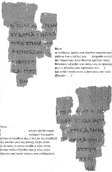
52 is reproduced in figure 1, along with an adapted version of Roberts's transcription.
15My transcription abstains from some of Roberts's reconstruction and leaves the spelling of

and

open. See n. 17, below.
Before comparing
52 with other papyri, I shall describe some of its important features. Roberts called the hand “heavy, rounded and rather elaborate.”
16An Unpublished Fragment, 13.

on line 3 of the verso) has an arched vertical stroke; the other (of the type in

on line 4 of the verso) is written in a single sequence with a loop. The upsilon is also sometimes written in two strokes (see

on line 2 of the recto) and sometimes with a loop (see
on line 4 of the verso). The center of the mu dips all the way to the baseline (see

on line 1 of the recto), and the delta has an arch much like that of the first type of alpha (see

on line 1 of the recto). These letters are the main points Roberts uses for comparison.
17Although none of the terms usually abbreviated in early manuscripts of the New Testament (the so-called nomina sacra) are present in
52, Roberts speculated, on the basis of the number of letters in each line, that
(which likely would have appeared on line 5 of the recto) and
(which would have likely appeared on line 2 of the recto) were not abbreviated. He argued that this conjecture provided “slight support for the early date” (An Unpublished Fragment, 19). Three scholars have very recently revisited this question of abbreviation. See Christopher M. Tuckett, “
52 and Nomina Sacra,” NTS 47 (2001) 544–48; Charles E. Hill, “Did the Scribe of
52 use the Nomina Sacra? Another Look,” NTS 48 (2002) 587–92; and Hurtado, “
52 (P. Rylands Gk. 457) and the Nomina Sacra,” 1–14. Tuckett gives reasons to believe the names were not abbreviated, and Hill counters those reasons and tentatively suggests that the names were indeed abbreviated. Hurtado presents a stronger case in favor of abbreviation. Either way, Roberts correctly noted that for the purposes of dating the fragment, “not much stress can be laid on this argument” (An Unpublished Fragment, 18–19).
In addition to these characteristics, I would add a few comments. In more general terms, the hand is upright with perhaps a slight tilt to the left (visible, for instance, in the iota of

on line 2 of the verso). The space between each line is about equal to the height of a line. There is an impression of a rough bilinearity,
18That is, while the letters do not maintain perfect regularity in height, the strings of letters give a fairly strong impression of the upper and lower notional lines that the scribe used to determine the heights of the letters. See Turner, Greek Manuscripts of the Ancient World, 3.

[ν] in line 7 of the recto; it also features hooks on its ends. The only fully preserved kappa was written like the looping upsilon, with the lower leg added in a second stroke. Finally, it is also worth noting the rather small size of the paleographic sample (111 fully visible letters, with 8 partially visible according to Roberts's transcription). Eighteen of the twenty-four letters of the Greek alphabet are represented. Lacking are letters that can extend above and below the line, such as phi and psi, whose presence would provide a better paleographic sample.

52 (P.Ryl. 3.457). 6.0 cm W × 8.9 cm H. Reproduced by courtesy of the Librarian and Director, The John Rylands University Library, The University of Manchester.
In 1935, this fragment was rushed into publication before the rest of the third volume of the Catalogue. It appeared in its own thirty-five-page volume, An Unpublished Fragment of the Fourth Gospel in the John Rylands Library.19
The publication of P.Ryl. 457 produced a small international sensation. See Adolf Deissmann, “Ein Evangelienblatt aus den Tagen Hadrians,” Deutsche allgemeine Zeitung 564 (3 December 1935; English trans. in British Weekly, 12 December 1935); Giuseppe Ghedini's review of Roberts in Aeg 15 (1935) 425–26; Hans Lietzmann, “Neue Evangelienpapyri,” ZNW 34 (1935) 285–93; August Merk, “De Fragmento Quarti Evangelii Vetustissimo,” Bib 17 (1936) 99–101; and Joachim Jeremias, “Das neugefundene Fragment des Johannesevangeliums,” TBl 15 (1936) 97–99. The fragment was later published as part of the third volume of the Catalogue of the Greek and Latin Papyri in the John Rylands Library (Manchester: The University Press, 1938).
An Unpublished Fragment, 16.
Ibid., 26.
Subsequent scholars have been bolder; they have tended to assign to
52 a date closer and closer to the early end of Roberts's tentative range, and without providing new evidence.
22The slippage in terminology here is remarkable. Most early commentators did not add anything to Roberts's analysis and maintained the exact wording of his fairly loose date of “the first half of the second century” (e.g., Wilhelm Schubart and H. Idris Bell, An Unpublished Fragment, 16). See Ellwood M. Schofield, “The Papyrus Fragments of the Greek New Testament” (Ph.D. thesis, Southern Baptist Theological Seminary, 1936) 330, 339; W. H. P. Hatch, The Principal Uncial Manuscripts of the New Testament (Chicago: University of Chicago Press, 1939) plate I; Frederic Kenyon, Our Bible and the Ancient Manuscripts (4th ed.; New York: Harper and Brothers, 1940) 128; Bruce M. Metzger, “Recently Published Greek Papyri of the New Testament,” BA 10 (1947) 39; and Georg Maldfeld, “Die griechischen Handschriftenbruchstücke des Neuen Testamentes auf Papyrus,” ZNW 42 (1949) 251. Ulrich Wilcken made a passing comment that
52 “könnte vom paläographischen Standpunkt aus gleichaltrig mit den Bremer Papyri [which date to around 120 C.E.] sein,” although he provided no specific examples. See his “Die Bremer Papyrus-Sammlung,” FF 12 (1936) 90. Deissmann asserted (with no new evidence) a more precise date in the time of Hadrian or possibly even Trajan (see n. 19, above). Kurt Aland appears to be the one guilty of popularizing this earlier dating. In his many lists of New Testament papyri, Aland describes
52 as “Anfang 2. Jahrhundert,” citing only the authorities listed above; see, e.g., Aland's “Zur Liste der neutestamentlichen Handschriften VI,” ZNW 48 (1957) 149. He has even come to speak of a “consensus” dating of the papyrus in the early part of the second century, transforming Roberts's “first half of the second century” to an overly specific “about 125”: “Er wird im allgemeinen Konsens in die Zeit um 125 n. Chr. angesetzt” (“Der Text des Johannesevangeliums im 2. Jahrhundert,” in Studien zum Text und zur Ethik des Neuen Testaments. Festschrift zum 80. Geburtstag von Heinrich Greeven [ed. W. Schrage; Berlin: de Gruyter, 1986] 1). He and Barbara Aland reassert this “consensus” in their standard handbook on textual criticism and (with absolutely no evidence) push the date still earlier: “The critical significance of
52, which preserves only a fragment of John 18, lies in the date of ‘about 125’ assigned to it by the leading papyrologists. Although ‘about 125’ allows for a leeway of about twenty-five years on either side, the consensus has come in recent years to regard 125 as representing the later limit, so that
52 must have been copied very soon after the Gospel of John was itself written in the early 90s A.D.” (The Text of the New Testament: An Introduction to the Critical Editions and to the Theory and Practice of Modern Textual Criticism [trans. E. F. Rhodes; 2d rev. ed.; Grand Rapids, Mich.: Eerdmans, 1989] 85). Finally, Eldon Epp has subsequently claimed that
52 was “written in the first quarter of the second century, but probably nearer 100 than 125,” and in a footnote adds, “Though at an earlier time dated 125–150, recent opinion moves it back into the 100–125 period, perhaps very early in that quarter century.” He cites only Roberts and the above quotation from the Alands as evidence (“The Significance of the Papyri for Determining the Nature of the New Testament Text in the Second Century: A Dynamic View of Textual Transmission,” in Studies in the Theory and Method of New Testament Textual Criticism [ed. E. J. Epp and G. D. Fee; Grand Rapids, Mich.: Eerdmans, 1993] 278–79 and 279 n. 10 [original article 1989]). This so-called “consensus” in “recent opinion,” as it rests on assertions with no evidence, is highly dubious.
52: “I have no evidence to invalidate the first editor's dating to the first half of the second century. But I should echo his warning about the need for caution.”
23The Typology of the Early Codex (Philadelphia: University of Pennsylvania Press, 1977) 100. Although Turner noted that for
52's format “there are no parallels among early papyrus codices, but there are among later parchment codices,” he pushed the date of
52 only slightly later than Roberts, and, on the whole, he approved of Roberts's work: “The Rylands papyrus may therefore be accepted as of the first half of the second century. It is the only codex in my list that I would place so early, for I would not be willing to admit any of the others to a date earlier than the second half of the century. While this appreciation removes to a slightly later period in time the particular manuscripts on which C. H. Roberts has built his account of the codex, I do not think it does any serious damage to his general theory. Indeed I should think that this independent critical assessment of the evidence has reinforced its acceptability” (ibid.). It is noteworthy, though, that in Turner's typology of codices,
52 actually falls into “Aberrants of Group 5” with five other examples, none of which are earlier than the late third or early fourth century (ibid., 18). In addition, the parchment codices that more nearly match Turner's estimated dimensions of the pages of
52 (18 cm W × 21.3 cm H) are from the fifth century (ibid., 27). H. Idris Bell, who generally approved of Roberts's edition of P.Ryl. 3.457, also emphasized caution in the dating, preferring “not later than about the middle of the second century” to Roberts's “first half of the second century,” though he later remained open to a date “considerably earlier than 150.” See Bell's review of Roberts in JEA 21 (1935) 266–67 and his Recent Discoveries of Biblical Papyri: An Inaugural Lecture Delivered before the University of Oxford on 18 November 1936 (Oxford: Clarendon, 1937) 21.
52 as any of those adduced by Roberts.
24I provide an image and discussion of P.Amh. 2.78 below (fig. 13, p. 42).
What is needed, then, is a re-examination of all Roberts's evidence and particularly an update of comparanda, preferably documentary papyri with dates,
25Turner (Greek Manuscripts of the Ancient World, 19–20) notes that the ideal situation would be to compare literary hands to other dated literary hands. Unfortunately, examples of literary papyri with firm dates are in short supply, especially relative to the number of dated documentary papyri (see further the discussion in Roberts, Greek Literary Hands, xii–xv). While the distinction between literary papyri, most often written in neat “book hands,” and documentary papyri, often written in “cursive hands,” has been fundamental from the inception of Greek papyrological paleography (see, e.g., Frederic Kenyon, The Palaeography of Greek Papyri [Oxford: Clarendon, 1899] 9), these designations do not imply that the handwriting of every papyrus falls neatly into one of the two groups. As Roberts (Greek Literary Hands, xi–xii) correctly observes, “No sharp line was drawn between book hands and the documentary hands used for offi cial, business, and private purposes.” Though the extremes of the literary type and the documentary or cursive type are distinctly different, “the gradations between the most elegant book hand and the most fluent cursive are almost infinite.” The comparanda I have chosen are (like Roberts's own documentary comparanda) legible with reasonably uniform style and some ligatures.
52, typifi ed by the recent work of Comfort and Barrett. In the latest edition of their collection of early manuscripts of the New Testament (2001), they bring only one new papyrus into the discussion of dating
52, P.Oxy. 31.2533, a fragment of New Comedy of unknown authorship published in 1966 and dated paleographically by its editors to the “second century.”
26Comfort and Barrett chose in P.Oxy. 31.2533 a difficult papyrus for comparative dating purposes. The original editors' full statement of dating is as follows: “The text of the recto of this papyrus is a document, written in a practised upright business hand, neat but employing cursive forms of varying size, all of which could be paralleled in first-century documents; the general impression, however, suggests the second century. [A transcription of this highly fragmentary document appears before the editors continue.] On the verso is written a passage of New Comedy in a semi-literary hand, upright, rounded, and clear; the letters are somewhat variable in size, and several (notably ε and κ) show cursive forms; ligature is common. The appearance of the recto and verso texts is superficially dissimilar, but examination of the letters shows so many identical forms that it seems likely that the writer was the same” (J. W. B. Barns et al., eds., The Oxyrhynchus Papyri XXXI [London: Egypt Exploration Society, 1966] 9 and plate II). The dating of the New Comedy passage is thus itself fairly questionable, and the similarities between
52 and either side of P.Oxy. 31.2533 are not particularly striking. An image of the recto and verso of P.Oxy. 31.2533 is nonetheless provided below in appendix 1, p. 47.
52!
27The Text of the Earliest New Testament Greek Manuscripts, 367. This kind of precision dating defies the realities of scribal activity. The productive writing life of a scribe was probably around thirty or thirty-five years. Add to that the fact that the scribal profession was an apprenticed trade, with students learning a particular style from a teacher, and we find that a given hand may be present over multiple generations of scribes. Thus the “rule of thumb” should probably be to avoid dating a hand more precisely than a range of at least seventy or eighty years. The evidence presented below bears out this reasoning.
Roberts's Dating of52
So that readers can judge for themselves, I have assembled images of all of Roberts's comparanda, and shall discuss them in the order Roberts presents them. Afterwards, I shall provide examples of more recently published papyri that show that many of the characteristics of Roberts's comparanda are present in papyri produced well into the third century.28
Strecker (The Johannine Letters, xli n. 78) makes a valid point about Roberts's choice of comparanda: “It is indicative that the editor adduced only older papyri for the handwriting comparison, without verifying whether other manuscripts, dated near the end of the second or in the third century, might reveal similarities.”
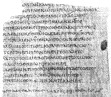
The closest parallels that Roberts presents are other literary texts that also lack firm dates. Figure 2 reproduces a portion of a scroll of the Iliad containing book 8, published as P.Berol. 6845, to which the original editor assigned a date (on paleographic evidence) in the early second century.
29Wilhelm Schubart, Papyri Graecae Berolinenses (Bonn: A. Marcus et E. Weber, 1911) XVII with plate 19c. Another description is available in Wilhelm Schubart and U. von Wilamowitz-Moellendorff, Berliner Klassikertexte V (Berlin: Weidmannsche Buchhandlung, 1907) 1. The text has been re-edited since Roberts's publication of
52, but its dating is essentially the same. See William Lameere, Aperçus de paléographie homérique à propos des papyrus de l'Iliade et de l'Odyssée des collections de Gand, de Bruxelles et de Louvain (Paris: Éditions Érasme, 1960) 81–83. The text is entry 831 in Roger A. Pack, The Greek and Latin Literary Texts from Greco-Roman Egypt (2d rev. ed.; Ann Arbor: University of Michigan Press, 1965).
52 are quite distinct from those of P.Berol. 6845. The epsilon of P.Berol. 6845, with its middle bar consistently approaching and frequently meeting the upper bar, is also different from that of
52. The rho of P.Berol. 6845 does not stretch below the other letters, as does the rho of
52. Overall, the hand is not dissimilar from
52, but, as we shall see, the similarities seen here persist in documents of the third century C.E.

P.Berol. 6845. 13.5 cm W × 13.0 cm H. Courtesy of the Staatliche Museen zu Berlin, Preußischer Kulturbesitz, Ägyptisches Museum und Papyrussammlung, Berlin.
The next text that Roberts mentions as a close overall parallel is the famous fragment of an unknown gospel, Egerton Papyrus 2.
30The fragments, also sometimes called “P.Lond. Christ. 1,” were first published in 1935. See H. Idris Bell and T. C. Skeat, Fragments of an Unknown Gospel and Other Early Christian Papyri (Oxford: Oxford University Press, 1935). The same authors produced a corrected and popularized edition later in the same year, The New Gospel Fragments (London: Trustees of the British Museum, 1935). Both the portion of the editio princeps dealing with the Egerton fragments and The New Gospel Fragments are available online at Wieland Willker's “The Papyrus Egerton 2 Homepage,” http://www-user.uni-bremen.de/~wie/Egerton/egerton-publicat.html (accessed 2 February 2005). An up-to-date bibliography of recent work on Egerton Papyrus 2 is also available there at http://www-user.uni-bremen.de/~wie/Egerton/egerton-biblio.html.
52.
31Bell and Skeat discuss P.Berol. 6854 (= B.G.U. 1.22), P.Lond. 1.130, and P.Fayûm 110; see Fragments of an Unknown Gospel, 1–2. Only P.Lond. 1.130, another literary text without a definite date, is absent from Roberts's discussion of
52. I have included an image of P.Lond. 1.130 below in appendix 2, p. 48.
52 is thus minimal. Also, in 1987, Michael Gronewald identified P.Köln 6.255 as an additional fragment of Egerton Papyrus 2.
32Kölner Papyri VI (ed. M. Gronewald et al.; Opladen: Westdeutscher Verlag, 1987) 136–45 and plate V.
Strecker has already brought this point to bear in reconsidering the date of
52 (The Johannine Letters, xli n. 78); so also Hurtado, “
52 (P. Rylands Gk. 457) and the Nomina Sacra,” 7 n. 20. Stuart R. Pickering is also appropriately cautious about the paleography of Egerton Papyrus 2 (“The Egerton Gospel and New Testament Textual Transmission,” in The New Testament Text in Early Christianity: Proceedings of the Lille Colloquium, July 2000 [ed. C.-B. Amphoux and J. K. Elliott; Lausanne: Éditions du Zèbre, 2003] 229–33). Even those scholars who argue that the gospel on Egerton Papyrus 2 is independent of the synoptics and John, such as Helmut Koester, endorse Gronewald's later dating of the papyrus at ca. 200 C.E. See Koester's Ancient Christian Gospels: Their History and Development (London: SCM Press, 1990) 206.

Egerton Papyrus 2 (Recto, Leaf 2). Complete fragment measures 9.7 cm W × 11.8 cm H. By permission of The British Library.
While Roberts notes that the similarities are not as close, he does provide some parallels from dated documentary papyri. Figure 4 shows P.Fayûm 110, from 94 C.E.34
Bernard P. Grenfell, Arthur S. Hunt, and David G. Hogarth, Fayûm Towns and Their Papyri (London: Egypt Exploration Fund, 1900) 261–64 and plate V (not plate VI, as p. 261 suggests). Roberts reprinted this image in his Greek Literary Hands and reasserted its resemblance to
52 (p. 11).

P.Fayûm 110. Complete fragment measures 10.2 cm W × 26.9 cm H. Courtesy of the Rare Book and Manuscript Library, Columbia University.
Roberts especially emphasizes the importance of P.Fayûm 110 because it “shows, as does our text, the simultaneous use of two forms of alpha.”
35An Unpublished Fragment, 15.

in line 8 is looped; the alpha of

- at the end of line 7 is not looped, but neither is it arched like the non-looping alpha of
52. The alpha of P.Fayûm 110 looks more like the alpha of

in line 2 on the verso of
52. The delta is also similar to that of
52.

Detail of P.Fayûm 110. Courtesy of the Rare Book and Manuscript Library, Columbia University.
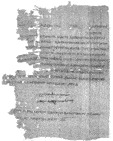
He next notes similarities with P.Lond. inv. 2078 (= SB 5.7987), a letter written under the reign of Domitian (81–96 C.E.).
36This papyrus was published in the New Palaeographic Society's Facsimiles of Ancient Manuscripts, etc. (London: Oxford University Press, 1913–1930) series ii, plate 98.
52 (and occasionally the rho, as in

in the middle of the penultimate line).

P.Lond. inv. 2078 (= SB 5.7987). 17.1 cm W × 21.6 cm H. By permission of The British Library.
Roberts then refers to P.Oslo 2.22, here figure 7, a petition to a strategus written in 127 C.E.
37Samson Eitrem and Leiv Amundsen, Papyri Osloenses II (Oslo: Norske videnskaps-akademi i Oslo, 1931) 48 and plate iii. The same editors published a new edition with slight changes, “Complaint of an Assault, with Petition to the Police,” JEA 40 (1954) 33.

and shows all three of those letters. The overall appearance is not terribly close to that of
52, but the letters that Roberts identifies are similar. Some letters, however, are very different, such as the sigma, which curves sharply downward in P.Oslo. 2.22.

P.Oslo. 2.22. Complete fragment measures 9.1 cm W × 20.5 cm H. Courtesy of the Oslo University Library.

Detail of P.Oslo. 2.22. Courtesy of the Oslo University Library.
The next papyrus Roberts mentions is now known as B.G.U. 1.22 (fig. 9), a document dated to 114 C.E.
38Aegyptische Urkunden aus den koeniglichen Museen zu Berlin (Berlin: Weidmannsche Buchhandlung, 1895) 36. There is no plate in the first edition, but a plate with transcription appeared in Wilhelm Schubart's Griechische Palaeographie (Munich: C. H. Beck'sche Verlagsbuchhandlung, 1925) 59, plate 34. The image reproduced here shows lines 6–21 of the 43-line papyrus.
52's two types of alpha. The vertical stroke of the tau of B.G.U. 1.22 often leans to the right. The upsilon is perhaps similar, but on the whole, this document is not an overly impressive parallel.

B.G.U. 1.22. Complete fragment measures 7.5 cm W × 25.5 cm H. Courtesy of the Ägyptisches Museum und Papyrussammlung, Berlin. Photo: Margarete Büsing.
The final papyrus Roberts mentions in his discussion of dating
52 is P.Flor. 1.1, a document from 153 C.E. brought to his attention by Frederic Kenyon.
39Girolamo Vitelli, Papiri greco-egizii, volume primo: Papiri fiorentini (Milan: Ulrico Hoepli, 1905) 1–4.
Guglielmo Cavallo et al., Scrivere libri e documenti nel mondo antico: Mostra di papiri della Biblioteca Medicea Laurenziana Firenze 25 agosto – 25 settembre 1998 (Florence: Edizioni Gonnelli,1998). Gabriella Messeri discusses P.Flor. 1 on pp. 197–98, and the images are on plates 113–14.
52.
41An Unpublished Fragment, 16.

P.Flor. 1.1. Complete scroll measures 100 cm W × 23 cm H. Image appears courtesy of the Ministero per i Beni e le Attività Culturali, the Biblioteca Medicea Laurenziana, Florence. Reproduction prohibited.
I agree with some of the similarities that Roberts points out in these papyri. The difficulty is that the features he isolates in papyri from the late first to mid second centuries persist into the late second and the third centuries. We can clearly see these examples in P.Amh. 2.78 and in more recently published papyri.
Some New Comparanda
Since Roberts downplayed similarities between
52 and P.Flor. 1.1, the latest document that he examined, I shall begin with a document from the same period. P.Mich. inv. 5336 (= SB 22.15782), reproduced in figure 11, is a petition from ca. 152 C.E.
42This papyrus was published by P. J. Sijpesteijn, “Known and Unknown Officials,” ZPE 106 (1995) 216–18 and plate VIIIa.
52, and the overall impression is similar. The vertical spacing of the lines is more compressed, but the spacing between letters is comparable, as is the rough bilinearity. Notice in particular the alpha forms in

at the beginning of line 2 and in the next word in line 2,

. Although the rho of
is like the rho of

of
52, the rho of SB 22.15782 generally does not dip below the other letters and often curves to the right. The delta of

at the beginning of line 5 is also noteworthy. The entire word

at the beginning of line 4 is remarkably close to the
in line 3 on the verso of
52. The two words are enlarged in figure 12. The tau-omega sequence in

of line 5 of SB 22.15782 also matches that of the

on the verso of
52. The affinities in letter forms between SB 22.15782 and
52 are as close as any of Roberts's documentary parallels.

P.Mich. inv. 5336 (= SB 22.15782). 18 cm W × 12.4 cm H. Courtesy of the Papyrology Collection, Graduate Library, The University of Michigan.

Detail of figure 11, SB 22.15782 (left), and figure 1, 52 (right).
The next document to consider is P.Amh. 2.78 (fig. 13), which Turner had put forth as an illuminating parallel.
43This papyrus is now in the collection of the Pierpont Morgan Library. The image reproduced here is from the original publication by Bernard P. Grenfell and Arthur S. Hunt, The Amherst Papyri II (London: Oxford University Press, 1901) 97–98 and plate xvii.
The Typology of the Early Codex, 100.

and the loop in

, both in line 6) and a very similar omega (e.g.,

in line 3). Turner notes a similar epsilon, pi, and iota as well. While the epsilon-iota combination in P.Amh. 2.78 is generally much sloppier than that of
52 (see, e.g., the second word of line 8 of P.Amh. 2.78,

), it sometimes resembles the combination in

in line 4 of the verso of
52 (see the
at the beginning of line 19 of the Amherst papyrus).

P.Amh. 2.78. Complete fragment measures 9.0 cm W × 26.6 cm H. Courtesy of the Pierpont Morgan Library and Oxford University Press.
A more cursive document that bears some resemblance to
52 is P.Oxy. 51.3614 (fig. 14). This piece records a judgment of Septimius Severus from 200 C.E., so the papyrus must date from sometime after that.
45J. R. Rea, ed., The Oxyrhynchus Papyri LI (London: Egypt Exploration Society, 1984) 35–38 and plate V.
52, but the vertical and horizontal spacing is similar. Several individual letters also show affinities. The long iota with hooks on top and bottom (such as those in

in the middle of line 4) recalls the iota in -[δ]
[ν] in line 7 of the recto of
52. The pi and eta, with their hooking right legs, also match those of
52. The rho has a small loop and extends below the line, but the rho of P.Oxy. 51.3614 displays a hook at the bottom of the vertical stroke that is absent from the rho of
52. While the kappa in lines 1 and 7 is distinctive because of its height, it was written in the same two-stroke manner as the kappa of
52. Looping and non-looping forms of alpha are both represented, although the non-looping alpha (as in the

after the first hole in line 5) lacks a clear hook and more closely resembles the alpha of,

in line 2 of the verso of
52. The sequence

in the

of line 9 closely matches the sequence in
52's

, though the tau leans in the opposite direction.

P.Oxy. 51.3614. 14.0 cm W × 9.5 cm H. Courtesy of the Egypt Exploration Society.
In terms of the individual letter forms that Roberts pointed out, it will be useful to look at a somewhat later document—P.Oxy. 52.3694, an invitation to a strategus that dates either between 218 and 225 C.E. or to 278 C.E. (fig. 15).
46H. M. Cockle et al., eds., The Oxyrhynchus Papyri LII (London: Egypt Exploration Society,1984) 144–46 and plate VIII. The name of the strategus, Aurelius Harpocration, is attested twice in the Oxyrhynchite nome. See J. E. G. Whitehorne, “A Checklist of Oxyrhynchite Strategi,” ZPE 29(1978) 167–89; and more recently, Guido Bastianini and John Whitehorne, Strategi and Royal Scribes of Roman Egypt: Chronological List and Index (Florence: Edizioni Gonnelli, 1987) 155.

at the end of line 1) and the arch (in

in line 3). The eta, such as the one in

in line 2, is also similar to those of our papyrus. The hand of P.Oxy. 52.3694 is obviously less well formed and less regular than that of
52, but it is to be expected that a document would be written more quickly and less deliberately than a literary text.

P.Oxy. 52.3694. Complete fragment measures 12.4 cm W × 11.1 cm H. Courtesy of the Egypt Exploration Society.
The same can be said about our next example, P.Oxy. 41.2968 (fig. 16), a receipt that is part of a group that dates to the later part of 190 C.E.
47G. M. Browne et al., eds., The Oxyrhynchus Papyri XLI (London: Egypt Exploration Society, 1972) 52–54.

of line 8 and the

beginning line 10; the arch is clear in the first letter of the name

at the end of line 3 and in the

of line 14). The upsilon of P.Oxy. 41.2968 (e.g., in the name

in line 1) is also very similar to those of
52, as is the mu (e.g.,

in the middle of line 4). The rho of the
that extends below the line is also fairly close to the rho of

at the beginning of line 5 on the recto of
52.
48In order to keep the length of this paper to a minimum, I will simply list some other third-century documentary texts that are worth comparing to
52: P.Oxy. 41.2997 (214 C.E.); P.Oxy. 67.4593 (a petition to a prefect dating from between 206 and 211 C.E.; note the two forms of alpha, the eta with a high horizontal, the delta, and the mu); and P.Mich. inv. 2789a+b (= SB 22.15775, between 203 and 206 C.E.), which was published in Sijpesteijn, “Known and Unknown Officials,” 208–9 and plate VIc (note the delta, mu, epsilon, and omega).

P.Oxy. 41.2968. 8.4 cm W × 16.4 cm H. Courtesy of the Egypt Exploration Society.
Conclusion
What emerges from this survey is nothing surprising to papyrologists: paleography is not the most effective method for dating texts, particularly those written in a literary hand.
49Even though some literary papyri have come to light that bear a resemblance to
52 (most notably P.Oxy. 64.4404 [now
104], a small fragment of Matthew's gospel dated by its editor to the second half of the second century), they are of no help in the present project since they are themselves paleographically dated. Although Turner recommends comparing literary hands with literary hands, such a process can become very circular without the inclusion of some firmly dated (usually documentary) manuscripts to act as a control. Thus, using other biblical papyri often regarded as early (
46,
66,
90, etc.) to date
52 (or vice versa) is also an unhelpful exercise. For this reason, Schmidt's arguments in “Zwei Anmerkungen” (pp. 11–12) are not very strong.
52.
50Roberts writes, “Any exact dating of book hands is, of course, out of the question” (An Unpublished Fragment, 13).
52, and even if I had done so, that would not force us to date
52 at some exact point in the third century. Paleographic evidence does not work that way.
51Schmidt's argument falters on this ground just as much as the arguments of those who want an overly specific early date for the papyrus. Schmidt claims (“Zwei Anmerkungen,” 11) that paleographic similarity between
52 and P. Chester Beatty X and III (each paleographically dated to the third century) would exclude a date of 125 C.E. for
52. This claim is untrue. Nor would paleographic similarities to documents from 40 C.E. in any way rule out a third-century date for
52. Such examples would simply increase the range of possible dates for
52and confirm my thesis that we should avoid building arguments on unrealistically specific dates proposed for papyri.
52 must include dates in the later second and early third centuries. Thus,
52 cannot be used as evidence to silence other debates about the existence (or non-existence) of the Gospel of John in the first half of the second century. Only a papyrus containing an explicit date or one found in a clear archaeological stratigraphic context could do the work scholars want
52 to do.
52The papyri of Herculaneum, which cannot postdate 79 C.E., would fall into this category.
I have incurred more than the usual number of debts in the course of this project. I happily offer my thanks to the numerous librarians and keepers of manuscripts who gave me access to various papyrus pieces or helped me to acquire such access. Also, for helpful advice and criticism on this project (more of which I probably should have heeded), I would like to thank Harold W. Attridge, Robert G. Babcock, Ann Ellis Hanson, and William A. Johnson, as well as the anonymous readers at HTR. Finally, thanks also to my colleague Tudor Sala for a couple of timely favors during the production of this piece.

P.Oxy. 31.2533. 7.5 cm W × 11.3 cm H. Courtesy of the Egypt Exploration Society.
Comfort and Barrett argue that P.Oxy. 31.2533, the fragment of New Comedy pictured here (verso), is a good parallel for
52. Aside from the looping upsilon, I do not see many similarities (although an argument could be made that the mu and rho are similar to those of
52). The delta is quite different. Of the few letters legible on the recto, the tau and eta occasionally resemble those of
52. In any event, the dating of P.Oxy. 31.2533 is itself so uncertain (see n. 26, above) that it can be of little use for dating
52.
Appendix 2: P.Lond. 1.130
Bell and Skeat suggest that the hand of P.Lond. 1.130 resembles that of Egerton Papyrus 2 (Fragments of an Unknown Gospel and Other Early Christian Papyri [Oxford: Oxford University Press, 1935] 2). Although there is some similarity in the upsilon and delta, I am not particularly impressed. P. Lond. 1.130 is a horoscope with an introductory letter attached. The editor dated the piece to the first or second century C.E. The text was published in 1893 in Frederic G. Kenyon's Greek Papyri in the British Museum: Catalogue, with Texts (5 vols.; 1893–1917; repr., Milan: Cisalpino-Goliardica, 1973) 1:132–39, but no images were included. This image comes from the top of column 4. A similar image was published in Wilhelm Schubart's Griechische Palaeographie (Munich: C. H. Beck'sche Verlagsbuch-handlung, 1925) 122, plate 81.
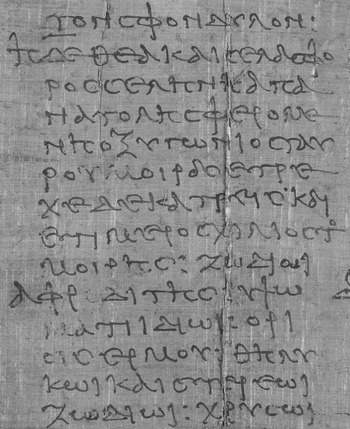
P.Lond. 1.130. Complete scroll measures 64.8 cm W × 25.4 cm H. By permission of The British Library.
52 (P.Ryl. 3.457). 6.0 cm W × 8.9 cm H. Reproduced by courtesy of the Librarian and Director, The John Rylands University Library, The University of Manchester.
P.Berol. 6845. 13.5 cm W × 13.0 cm H. Courtesy of the Staatliche Museen zu Berlin, Preußischer Kulturbesitz, Ägyptisches Museum und Papyrussammlung, Berlin.

Egerton Papyrus 2 (Recto, Leaf 2). Complete fragment measures 9.7 cm W × 11.8 cm H. By permission of The British Library.

P.Fayûm 110. Complete fragment measures 10.2 cm W × 26.9 cm H. Courtesy of the Rare Book and Manuscript Library, Columbia University.

Detail of P.Fayûm 110. Courtesy of the Rare Book and Manuscript Library, Columbia University.
P.Lond. inv. 2078 (= SB 5.7987). 17.1 cm W × 21.6 cm H. By permission of The British Library.
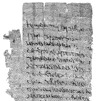
P.Oslo. 2.22. Complete fragment measures 9.1 cm W × 20.5 cm H. Courtesy of the Oslo University Library.

Detail of P.Oslo. 2.22. Courtesy of the Oslo University Library.
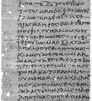
B.G.U. 1.22. Complete fragment measures 7.5 cm W × 25.5 cm H. Courtesy of the Ägyptisches Museum und Papyrussammlung, Berlin. Photo: Margarete Büsing.

P.Flor. 1.1. Complete scroll measures 100 cm W × 23 cm H. Image appears courtesy of the Ministero per i Beni e le Attività Culturali, the Biblioteca Medicea Laurenziana, Florence. Reproduction prohibited.
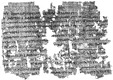
P.Mich. inv. 5336 (= SB 22.15782). 18 cm W × 12.4 cm H. Courtesy of the Papyrology Collection, Graduate Library, The University of Michigan.

Detail of figure 11, SB 22.15782 (left), and figure 1, 52 (right).
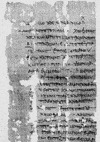
P.Amh. 2.78. Complete fragment measures 9.0 cm W × 26.6 cm H. Courtesy of the Pierpont Morgan Library and Oxford University Press.
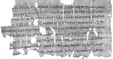
P.Oxy. 51.3614. 14.0 cm W × 9.5 cm H. Courtesy of the Egypt Exploration Society.
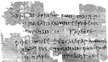
P.Oxy. 52.3694. Complete fragment measures 12.4 cm W × 11.1 cm H. Courtesy of the Egypt Exploration Society.
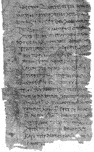
P.Oxy. 41.2968. 8.4 cm W × 16.4 cm H. Courtesy of the Egypt Exploration Society.
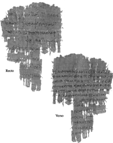
P.Oxy. 31.2533. 7.5 cm W × 11.3 cm H. Courtesy of the Egypt Exploration Society.
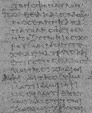
P.Lond. 1.130. Complete scroll measures 64.8 cm W × 25.4 cm H. By permission of The British Library.
 You have
Access
- 18
- Cited by