


Social media summary
Hereditarianism is inferior to established theories of human cognitive evolution.
Introduction
Hereditarianism is a loosely connected set of pseudoscientific views, notably including the notion that there are genetically determined differences in intelligence between human populations, and that differing selective pressures on ancestral groups explain these differences (Cofnas, Reference Cofnas2020b; Winegard et al., Reference Winegard, Winegard and Boutwell2017, Reference Winegard, Winegard and Anomaly2020). Researchers who defend hereditarianism, sometimes also called ‘race realism’ (Saini, Reference Saini2019), claim that standard views in evolutionary psychology cannot account for variance in cognitive ability between populations (for example, Frost, Reference Frost2011).
Though hereditarianism is a form of scientific racism, a minority of researchers in the humanities and social sciences argue that free inquiry necessitates empirical testing of its predictions (this is a common view among proponents of hereditarianism; see Cofnas, Reference Cofnas2020b). Critics, which include philosophers, social and biological scientists, developmental psychologists, and ethicists (among many others), note that pursual of the hereditarian claims around group-level differences in intelligence is unlikely to be a valuable scientific endeavour (Gardner, Reference Gardner2006; Sternberg, Reference Sternberg2005; see also Matthews et al., Reference Matthews, Tabery and Turkheimer2024); combined with the harm these works cause to society, we can diagnose them as abhorrent (Matthews et al., Reference Matthews, Tabery and Turkheimer2024).
Furthermore, owing to work by Richard Lewontin (Lewontin, Reference Lewontin, Dobzhansky, Hecht and Steere1972, Reference Lewontin1978), there is widespread doubt that it is possible to empirically evaluate claims about race and intelligence, owing to the broadness, if not meaninglessness, of these terms (Fuentes et al., Reference Fuentes, Ackermann, Athreya, Bolnick, Lasisi, Lee, McLean and Nelson2019; Pigliucci, Reference Pigliucci2013; Lewontin, Reference Lewontin1970; Shen & Feldman, Reference Shen and Feldman2022; Sussman, Reference Sussman2014; Wagner et al., Reference Wagner, Joon‐ho, Ifekwunigwe, Harrell, Bamshad and Royal2017). Finally, research in genetics has established unequivocally that genetic heredity – the transmission of phenotypic predispositions from an organism’s parents – does not imply between-group differences in traits: the possibility of a particular disposition for an ability, like analytic thinking, does not imply any expectations in group-level differences in that disposition (see Roseman & Bird, Reference Roseman and Bird2023).
Hereditarians continue to respond to (or ignore) these arguments with defences of the utility of the concepts of race and intelligence, and moreover the usefulness of the intelligence quotient (IQ) as a proxy for a person’s overall intellectual capacity (Cofnas, Reference Cofnas2020b). These debates have led to impasses at theoretical levels in philosophy, sociology, ethics, and the biological sciences, and are ongoing, with proponents of hereditarianism facing professional consequences for their positions (cf Larsen et al., Reference Larsen, De Cruz, Kaplan, Fuentes, Marks, Pigliucci and Schroeder2020).
The purpose of this paper is to evaluate the claims made by hereditarians about the selective forces they argue produced the between-group differences in intelligence that they claim exist today from the perspective of the evolutionary social sciences. (Note that in this paper I use ‘cognitive abilities’ and ‘intelligence’ interchangeably to highlight the wide cognitive toolkit common to humans; ‘intelligence’ and IQ are by contrast terms often used incorrectly by hereditarians to refer to an undefinable quality of general intelligence [see Hampshire et al., Reference Hampshire, Highfield, Parkin and Owen2012 for a discussion].)
While it is well-established in genetics that claims about group-level, genetically determined differences in intelligence are demonstrably false (see Roseman & Bird, Reference Roseman and Bird2023, inter alia), and further that concepts like ethnicity and race do not conform to data about genetic ancestry (Gouveia et al., Reference Gouveia, Meeks, Borda, Leal, Kehdy, Mogire, Doumatey, Tarazona-Santos, Kittles, Mata, O’Connor, Adeyemo, Shriner and Rotimi2025), there is no clear message from the social sciences regarding why established, evolutionarily driven hypotheses around the development of cognitive abilities across human populations undermine the between-group difference accounts defended by hereditarians. This article attempts to correct this gap by showing how one such established view – the social brain hypothesis – undermines hereditarianism by showing that social competition, which is ubiquitous in human groups, drove selection for intelligence across groups, rather than differentially between them. The need to build social capital is universal among humans, and consequently there is no expectation that differences in cognitive ability will appear between populations, even those that have been reproductively isolated for many generations.
This argument involves first an overview of the hereditarianism vs environmentalism debate and how it has developed over the past several decades; second, an overview of the premises of human behavioural ecology and cultural evolution relating to the social brain hypothesis; third, an argument showing that hereditarianism relies on a misunderstanding of contemporary work in human social evolution.
My goal is not to reject hereditarianism on ethical grounds, but rather to show that its proponents rely on a weak argument for their claims, which they use in turn to defend views that are unethical. The social brain hypothesis, and more broadly any theory in the human sciences that effectively captures the balance between cooperation, competition, and rule-following in humans, has greater explanatory power than the pseudoscientific views espoused by hereditarians.
Hereditarianism and its assumptions
Proponents of hereditarianism claim there are measurable, group-level differences in intelligence owing to variations in selective forces from physical environments on ancestral groups (Frost, Reference Frost2011, inter alia). While there has been some variation in premises, contemporary hereditarianism promotes ‘cold winters theory’, a pseudoscientific view suggesting colder environments necessitate a greater frequency of cultural innovation (see Anderson, Reference Anderson1991 for a critique of Rushton’s arguments from an ecological perspective; see also Livingstone’s (Reference Livingstone2024) discussion of the history of using climate to justify racist beliefs). When I refer to hereditarianism in this paper, I am referring to the cold winters view, which is at present the most widely circulated view among race scientists.
This view is, however, only the latest form of race science. Precursors of hereditarianism pseudoscience, for example eugenics, have been popular among people with racist ideologies for at least the past century, and probably longer (Lala & Feldman, Reference Lala and Feldman2024). A more recent resurgence of these views followed the publication of Jensen’s 1969 work suggesting a link between genetics and IQ (Cochran & Harpending, Reference Cochran and Harpending2010; Herrnstein & Murray, Reference Herrnstein and Murray1996; Jensen, Reference Jensen1969). Following the appearance of this publication, academics advocating for eugenics made broad claims about links between genetics, IQ, and intelligence more broadly, using Darwinian selection to suggest that differing ecological pressures can predict for group-level differences in intelligence (Lynn, Reference Lynn2010; Rushton, Reference Rushton, van der Dennen, Smillie and Wilson1999; Rushton & Jensen, Reference Rushton and Jensen2005); see Sear (Reference Sear2022) for an analysis showing the misuse of IQ data for hereditarian claims.
This debate has continued, in differing forms, over the subsequent half century, with hereditarianism sometimes ostensibly intertwining with sociobiology and evolutionary psychology (Winegard et al., Reference Winegard, Winegard and Boutwell2017). Proponents of hereditarianism rely on genetically predictable differences between ancestral groups of humans, and claim that the living descendants of these ancestral groups represent ‘races’ in ordinary language (Anomaly, Reference Anomaly2017), which are categories often also used by media and textbook sources (Condit, Reference Condit2007; Donovan, Reference Donovan2015).
These debates relied on a distinction between what hereditarians call genetic and environmentalist explanations for cognitive traits in humans (Rushton & Jensen, Reference Rushton and Jensen2005), which also infects work blending psychology and genetics (Plomin, Reference Plomin2018; Plomin & Von Stumm, Reference Plomin and Von Stumm2018; Wade, Reference Wade2014; see also Marks, Reference Marks2014). Yet following the controversies of Jensen’s publication, early work by Cavalli-Sforza and Feldman (Cavalli-Sforza & Feldman, Reference Cavalli-Sforza and Feldman1973; Feldman & Cavalli-Sforza, Reference Feldman and Cavalli-Sforza1976) showed that gene-culture co-evolution renders this binary distinction false: the environment and genetics interact in ways not accounted for by hereditarian models (Cavalli-Sforza, Reference Cavalli-Sforza1981; Richerson & Boyd, Reference Richerson and Boyd2005).
Hereditarianism nonetheless persists in academic discourse, with proponents using similar logic to that of Jensen’s initial work (Lynn & Vanhanen, Reference Lynn and Vanhanen2012). More recent works (for example, Frost, Reference Frost2011; Winegard et al., Reference Winegard, Winegard and Anomaly2020) focus on perceived shortcomings in the study of evolutionary psychology to defend group-level differences in complex traits, including intelligence, and use these claims to argue that more intelligent groups should act ‘paternally’ towards the less intelligent (Cofnas, Reference Cofnas2020a). These arguments take a consistent form that appears valid, and are structured with the following premises:
1. Human populations are diverse morphologically and behaviourally.
Modern hereditarian arguments open with the innocuous and arguably trivial premise that Homo sapiens exemplify diversity owing to cultural evolutionary processes (Foley & Mirazón Lahr, Reference Foley and Mirazón Lahr2011). Depending on the local ecological environment, cultural and biological adaptations permit persistence without speciation (Joseph Henrich, Reference Henrich2015; Henrich & McElreath, Reference Henrich and McElreath2003). Both cultural (for example, wearing clothing for warmth or to signal information to others, Boyd et al., Reference Boyd, Richerson and Henrich2011; see also Buckner, Reference Buckner2021) and biological (for example, adaptation to high altitudes or against skin cancer, see Beall et al., Reference Beall, Jablonski and Steegmann2012; Greaves, Reference Greaves2014, respectively) adaptations are accepted universally across fields as explanations for the uniquely human social conquest of the planet, so this is not a controversial claim.
2. Group-level diversity in humans is predictable based on the local environment.
Premise 2 may follow from 1 and assumes that we can predict human socioecological niches based on features of the environment. One example may be in the construction of homes: where weather is more likely to be severe, houses may be easily constructed using cheap materials to avoid the high costs of rebuilding with rare materials or in a time-consuming manner (Dunn et al., Reference Dunn, Kirby and Bowern2024). Similarly, skin colour may be predictable depending on the local average level of vitamin D a person may take in through sunlight annually or the risk of skin cancer (Greaves, Reference Greaves2014; Yuen & Jablonski, Reference Yuen and Jablonski2010).
3. Diversity in human populations may include cognitive as well as physical traits.
Winegard et al. (Reference Winegard, Winegard and Anomaly2020) suggest that if we find diversity in human morphology and culture in patterned ways that depend on socioecological factors, there is no reason to assume cognitive traits should not show similar diversity. The foundational pseudoscientific hypothesis supporting modern hereditarianism, known as ‘cold winters theory’, consequently holds that colder environments require more cultural innovation for humans to survive and reproduce effectively – and therefore that these environments select for more innovative people (Frost, Reference Frost2019; Lynn, Reference Lynn1987; Rushton, Reference Rushton2012).
4. (Conclusion) One causal pathway for group-level diversity in cognitive traits is genetics.
If natural selection exerts pressure for different cognitive traits depending on the local environment, we can assume that there will be group-level differences in cognitive abilities, and further that those differences are caused, at least in part, by genetic variation and inheritance. For hereditarianism to hold, according to these researchers, the proportion of a given person’s intelligence that must be explained by the genome is 20% (Winegard et al., Reference Winegard, Winegard and Anomaly2020).
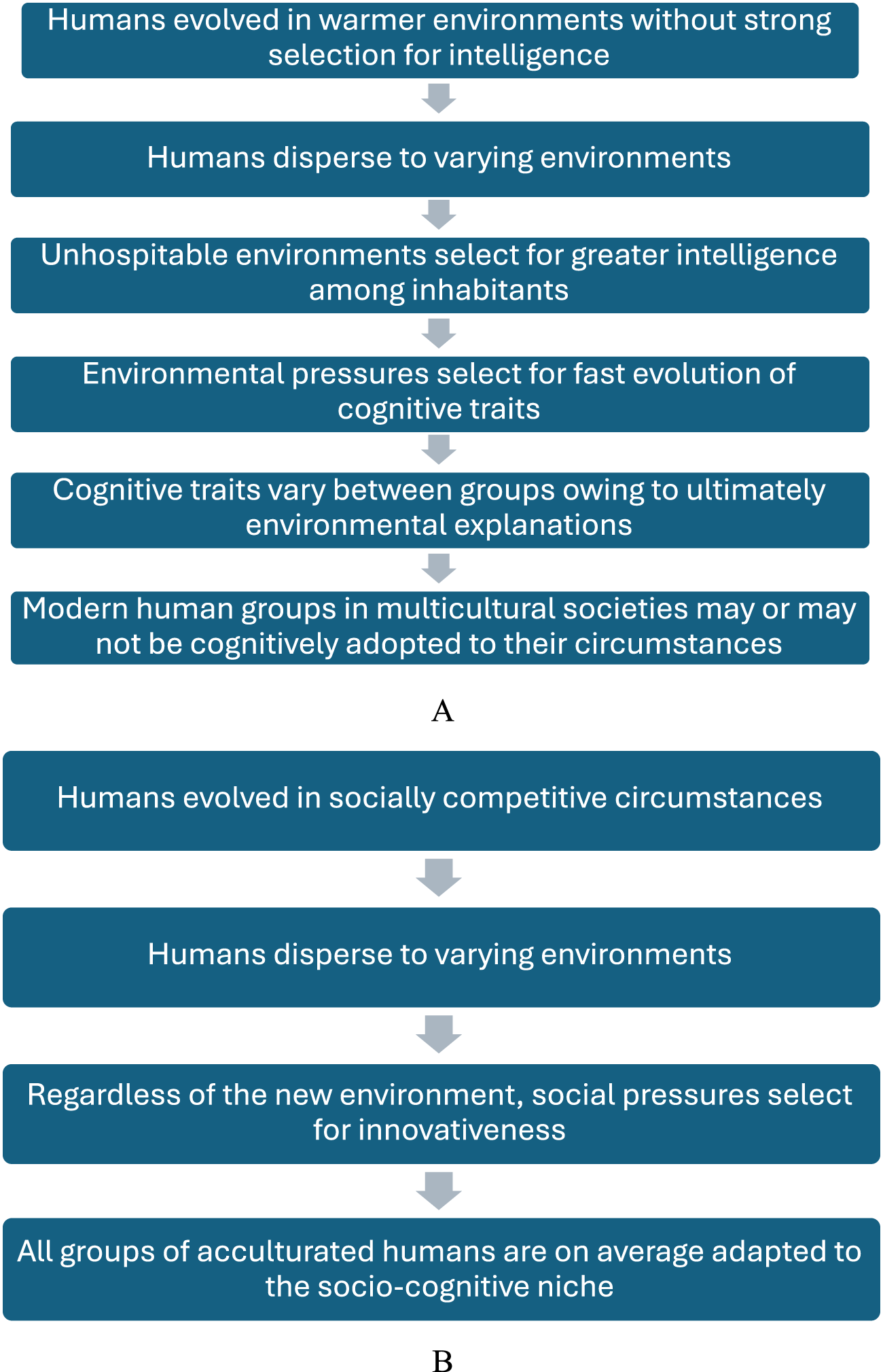
To defend this argument, summarized in Fig. 1a, contemporary hereditarians also suggest that genetically driven complex adaptations can evolve in short periods. This, in their view, contradicts claims in evolutionary psychology (for example, Cosmides & Tooby, Reference Cosmides, Tooby, Barkow, Cosmides and Tooby1992) that human cognitive faculties have not changed notably since the beginnings of agriculture, and consequently that some features of human minds are mismatched with modern socioecological environments (with relevance to the perception of race, see Cosmides et al., Reference Cosmides, Tooby and Kurzban2003). Evidence of fast evolution in other species (for example, lizards; Herrel et al., Reference Herrel, Huyghe, Vanhooydonck, Backeljau, Breugelmans, Grbac, Van Damme and Irschick2008, and other species that are notably much smaller than humans) is used by authors like Winegard et al. (Reference Winegard, Winegard and Boutwell2017) to substantiate this set of claims.
(a) The hereditarian account of human intelligence; (b) the social brain hypothesis. Hereditarianism focuses entirely on the physical environment as a selection pressure for innovation and intelligence; the social brain hypothesis assumes that intraspecific competition drives the evolution of the brain and intellect; both empirical and conceptual work supports only (b).

Finally, and as a corollary to point 4, these theorists borrow terminology from population genetics to claim that the heritability of cognitive traits within a given population translates to between-group heritability of the same traits (Jensen, Reference Jensen1975; Sesardic, Reference Sesardic2000); see Roseman and Bird (Reference Roseman and Bird2023) for a mathematical refutation. Positive selection for traits like innovativeness in a given environment, for example, implies greater average innovativeness than might be seen in other environments, according to these researchers (Lynn, Reference Lynn1987).
The principal target of this ostensibly innocuous syllogism leading to point 4 above is IQ differences in human groups based on ancestry. Contemporary hereditarians cite differences in IQ and educational attainment between ancestral human groups as evidence for their arguments. Given repeated IQ evaluations between groups, such as African Americans, Ashkenazi Jews, and White people of European descent, which suggest a measurable and consistent difference in scores, coupled with genome-wide association studies linking a proportion of educational attainment to genetics, we should, according to these theorists, accept a hereditarian explanation (Lynn, Reference Lynn2010; Winegard et al., Reference Winegard, Winegard and Boutwell2017).
One example repeatedly evaluated in the literature is the Minnesota Transracial Adoption Study (TRA), which was first reported in 1976 and reanalysed more than a decade later (Scarr & Weinberg, Reference Scarr and Weinberg1976, Reference Scarr and Weinberg1983; Weinberg et al., Reference Weinberg, Scarr and Waldman1992). As part of the TRA, researchers evaluated IQ outcomes following the adoption of 130 African American or mixed heritage children, White children, and Asian or Indian children to 101 host families in the US. At both evaluated time points, the adoptive parents’ biological children had the highest mean IQ scores (109.4 in 1986), followed by adopted White children (105.6), adopted children with mixed heritage (98.5), and African American children (89.4).
Proponents of hereditarianism claim the results from the TRA in both 1975 and 1986 support their suppositions (Levin, Reference Levin1994; Lynn, Reference Lynn1994). This is despite further stipulations from Weinberg et al. (Reference Weinberg, Scarr and Waldman1992) that African American children in the TRA were adopted later in life, had a greater number of placements prior to adoption, and were more likely to be placed in socioeconomically deprived homes. Hereditarians writing both presently and at the time of the TRA’s publications miss or ignore these factors in their interpretations.
The broader question implied by the TRA is whether, if the TRA were expanded to a much larger cohort and adoption occurred at birth, outcomes at the group level would resemble those at the individual level – a claim for which there is no evidence. If two infants were switched at birth, we could expect some differences in their success in education, accomplishment, and so forth to result partly from genetic predispositions; yet if we switched 10,000 infants, hereditarians would expect parallel, group-level differences.
Modern population genetics provides a clear and irrefutable rejection of this hereditarian claim, owing to the fact that between-individual genetically determined differences in cognition do not imply between-group differences, and further that these differences rest on a mistaken assumption applying biology to a socially constructed term (‘race’; see Roseman, Reference Roseman2018). The social brain hypothesis, by contrast, is consistent with established work in population genetics and makes predictions based on social, rather than physical, pressures. Contra hereditarianism, legitimate work in the evolutionary sciences suggests that humans’ behavioural flexibility allows for the transmission of social norms and cultural traits that make us able to navigate our local social and physical environments. In the following sections, I present an argument showing why this view is superior to hereditarianism.
The evolution of the socio-cognitive niche
In the years following Jensen’s early claims about race and IQ, researchers across the biological, social, and medical sciences have criticized the tenets of hereditarianism (for example, Guevara et al., Reference Guevara, Gopalan, Massey, Adegboyega, Zhou, Solis, Anaya, Churchill, Feldblum and Lawler2023; Ivey Henry et al., Reference Ivey Henry, Spence Beaulieu, Bradford and Graves2023; Lala & Feldman, Reference Lala and Feldman2024). These include models in gene-culture co-evolutionary studies showing that cultural transmission, particularly vertical transmission, makes it impossible to determine the degree to which genetics affect complex traits like intellectual capacity (Cavalli-Sforza & Feldman, Reference Cavalli-Sforza and Feldman1973; Feldman et al., Reference Feldman, Christiansen and Otto2013; Shen & Feldman, Reference Shen and Feldman2021). Other common strategies involve dismissing the concepts of ‘race’ or ‘intelligence’ altogether, and suggesting that analysis based on these concepts is unlikely to be scientifically useful (Fuentes et al., Reference Fuentes, Ackermann, Athreya, Bolnick, Lasisi, Lee, McLean and Nelson2019, inter alia). Social scientists also argue that it is implausible that any complex cognitive trait can be explained only through genetics (Charney, Reference Charney2012; Fuentes, Reference Fuentes2016, though see Roseman, Reference Roseman2018). And more recently, biologists have attacked the mathematics – or lack thereof – in hereditarian work supporting any link between within-group and between-group heritability (Roseman & Bird, Reference Roseman and Bird2023).
Moreover, the cold winters view has repeatedly been shown to rest on false assumptions and mischaracterizations of evolutionary ecology and archaeology (Anderson, Reference Anderson1991; MacEachern, Reference MacEachern2006; for a discussion of how misunderstandings around human reproductive strategies arise, see Sear, Reference Sear2020). Anderson (Reference Anderson1991) notes that Rushton’s (Reference Rushton1990) defences of differing ‘racial strategies’ based on environmental factors rest on a misconception of important concepts in ecology, specifically r vs K selection, which require a consideration of density-dependent or -independent agents of selection, rather than strategies for maximizing fitness in different ecological environments, as Rushton claims. Anderson (Reference Anderson1991) also notes that the entire notion of environmental predictability is vague, owing to the complexity of measuring predictability in a complex system – another critical detail that Rushton’s work ignores.
I am not here concerned with these arguments, or with the validity of IQ tests more broadly (see, for example, Hampshire et al., Reference Hampshire, Highfield, Parkin and Owen2012), but rather the explanatory power of hereditarianism (see Fig. 1) from the perspective of the social sciences. By compounding refutations of hereditarianism by geneticists and biological anthropologists with a clear message around established views from the social sciences, it will become clear that there is no backing, conceptual or empirical, for the claims made by this group of people.
In their central defence of hereditarianism, Winegard et al. (Reference Winegard, Winegard and Anomaly2020) give a misleading consideration of social pressures in the evolution of cognition, writing:
… many theories of human intelligence posit that social competition was a chief driver … These theories appear limited and unable to grapple with some data …
… Culture, a human niche, creates selective pressures on human intelligence because it rewards those who are cognitively sophisticated enough to learn rapidly and to innovate … From this perspective, cold winters may have selected for human intelligence, but then culture, especially after the invention of agriculture, did as well …
Here, they summarize about 50 years of work that, following the writing of N. K. Humphrey (Reference Humphrey1976), suggests the importance of sociality in the evolution of human cognition. An implicit assumption of this extract, however, is that human cultural niches are likely to vary owing to environmental circumstances, and therefore the selective pressures on the faculties underpinning cognitive ability are likely to vary between cultural groups. This implies a misunderstanding of the central tenets of modern human behavioural ecology, cultural evolutionary studies, and the social brain hypothesis, the last of which claims that human cognitive abilities are a consequence of the need to navigate the increasingly complex norms, institutions, and interpersonal relationships that characterized human and pre-human societies throughout history as groups grew in size, with established direct correlations between average group sizes and the neocortex (for a review, see Dunbar, Reference Dunbar2024). This is conspicuously absent, moreover, in Rushton’s defences of the cold winters view: while he mischaracterized r and K selection, he ignores entirely alpha selection (Krebs, Reference Krebs1978), which favours successfully competitive individuals in both a density-dependent and -independent fashion (Anderson, Reference Anderson1991).
The premises of the social brain hypothesis are as follows:
Human intellect is a socially derived trait that enables effective operation within a cultural group.
Humphrey’s seminal work on the social function of the intellect illustrated the importance of manoeuvring within populations for evolutionary success (Humphrey, Reference Humphrey1976). This insight has since been labelled (I think wrongly) ‘Machiavellian intelligence’ (Gavrilets & Vose, Reference Gavrilets and Vose2006; Byrne & Whiten, Reference Byrne and Whiten1988), owing to the emphasis on individuals who effectively predict how others will behave, much as a good chess player does (McNally et al., Reference McNally, Brown and Jackson2012). Yet Humphrey’s broader insight is that social interactions, which necessarily require planning and prediction about others, are more difficult to navigate than environmental interactions and require not only knowledge about the world, but about how people are likely to behave within the world – even years into the future.
There has since been a huge amount of research in primatology and psychology that broadly forms the social brain hypothesis: the need to effectively navigate society implies positive selection for intelligence, defined broadly or narrowly (Dunbar, Reference Dunbar1993; Dunbar & Shultz, Reference Dunbar and Shultz2017; Shultz & Dunbar, Reference Shultz and Dunbar2007; Tomasello et al., Reference Tomasello, Carpenter, Call, Behne and Moll2005; von Hippel & Trivers, Reference Hippel and Trivers2011; see also Bailey & Geary, Reference Bailey and Geary2009 for an analysis suggesting that social competition best explains the evolution of hominin brain size). For example, individuals who could effectively predict reciprocity in dyadic relationships (Cosmides et al., Reference Cosmides, Barrett and Tooby2010; Trivers, Reference Trivers1971), make predictions about others based on information received from third parties (Alexander, Reference Alexander1987; Leimar & Hammerstein, Reference Leimar and Hammerstein2001; Nowak & Sigmund, Reference Nowak and Sigmund1998, Reference Nowak and Sigmund2005), or use gossip to drive preferential treatment that maximizes benefits towards themselves and their kind (Giardini & Wittek, Reference Giardini and Wittek2019) would be likely to have higher inclusive fitness than others without these skillsets. There is also the possibility that selection against reactive aggression over our evolutionary history has led to an increase in tendencies towards proactive aggression, which involves planning (Wrangham, Reference Wrangham2021). Similarly, defecting in dyadic relationships or from public goods investment when recognition or sanctions against cheating are low is likely to be beneficial and cognitively costly to execute effectively (Goodman, Reference Goodman2023, Reference Goodman2025).
The complex relationship between cooperation and defection in social networks has repeatedly been shown to be an essential element of the evolution of intelligence, for example in mathematical models aiming to explain facets of cognition including deception and trust (Gavrilets & Vose, Reference Gavrilets and Vose2006; McNally et al., Reference McNally, Brown and Jackson2012; Panchanathan & Boyd, Reference Panchanathan and Boyd2003), and in primatology (Shultz & Dunbar, Reference Shultz and Dunbar2007; Byrne & Whiten, Reference Byrne and Whiten1992). Accordingly, scholars in cultural evolutionary studies, anthropology, and economics emphasize that social norms and markers evolve in part to maximize cooperation within groups through processes including cultural transmission and internalization (Archetti et al., Reference Archetti, Scheuring, Hoffman, Frederickson, Pierce and Yu2011; Fehr et al., Reference Fehr, Fischbacher and Gächter2002; Fehr & Schmidt, Reference Fehr and Schmidt1999; Henrich et al., Reference Henrich, Boyd, Bowles, Camerer, Fehr, Gintis and McElreath2001; McElreath et al., Reference McElreath, Boyd and Richerson2003; Nettle & Dunbar, Reference Nettle and Dunbar1997; Ostrom & Gardner, Reference Ostrom and Gardner1993).
The increasingly complex social, linguistic, and moral frameworks of human societies, on this view, places intense selection pressure on individuals to navigate them effectively (Alexander, Reference Alexander1987; Flinn et al., Reference Flinn, Geary and Ward2005; Dunbar, Reference Dunbar2022; Crespi et al., Reference Crespi, Flinn and Summers2022; Townsend et al., ); moreover, every element of human cognition is assumed to have social utility, including consciousness (Lahr & Foley, Reference Lahr and Foley2020; Humphrey, Reference Humphrey2022). The emergence of ethics is in particular both a hurdle for exploitation within society (Goodman & Ewald, Reference Goodman and Ewald2021; Alexander, Reference Alexander1987) and a product of the need to maintain cohesion for increasingly large groups to function (Ostrom, Reference Ostrom2000). Machiavellian – or more simply, just social – intelligence is therefore a fundamental feature of Homo sapiens, universal to all cultural groups, rather than a mismatched module left over in a ‘stone age brain’, which is how hereditarians prefer to understand evolutionary psychology, despite obvious evidence otherwise (for example, Cosmides et al., Reference Cosmides, Barrett and Tooby2010).
Humans evolved to maximize relative embodied, resource, and social capital.
Like any organism, humans aim to maximize capital relative to unrelated others, which in turn maximizes inclusive fitness (Kaplan et al., Reference Kaplan, Hill, Lancaster and Hurtado2000, Reference Kaplan, Lancaster and Robson2003; Kordsmeyer, Reference Kordsmeyer2022); a basic tenet of human behavioural ecology is, relatedly, that humans are on average adapted to their local sociocultural environments (Smith, Reference Smith2017). Embodied, resource, and social capital are, however, intertwined in human groups, and are each partially heritable (Mulder et al., Reference Mulder, Bowles, Hertz, Bell, Beise, Clark, Fazzio, Gurven, Hill, Hooper, Irons, Kaplan, Leonetti, Low, Marlowe, McElreath, Naidu, Nolin, Piraino and Wiessner2009). While body size (Mook-kanamori et al., Reference Mook-kanamori, Van Beijsterveldt, Steegers, Aulchenko, Raat and Hofman2012) and intellectual ability (Sauce & Matzel, Reference Sauce and Matzel2017) have genetic and environmental components, the inheritance of resource and social capital accords with local cultural norms.
Obvious cases of resource capital inheritance include land and finances, which vary according to, for example, whether transmission between generations is determined maternally or paternally. Less obvious cases, representing the inheritance of social capital, are the transmission of relational wealth, reputation, and commitments like debt (Graeber, Reference Graeber2013). Evidence from work with the Maasai, for example, suggests that need-based transfer bonds between individuals are often transmitted from parent to child (Aktipis et al., Reference Aktipis, Cronk and Aguiar2011).
Anthropological work has also conclusively demonstrated relationships among these three forms of capital. Successful turtle hunters among the Meriam, for example, maintain high social capital through generosity rather than high resource and embodied capital only through a greater intake of energy (Smith et al., Reference Smith, Bird and Bird2003). Among BaYaka hunter-gatherers, whether someone is liked within a camp is also predictive of whether others will donate excess resources to that person, and this relational wealth also positively correlates with body mass index and female fertility (Chaudhary et al., Reference Chaudhary, Salali, Thompson, Rey, Gerbault, Stevenson, Dyble, E Page, Smith, Mace, Vinicius and Migliano2016).
This universal need to maintain high social capital – which appears to broadly be predictive of reproductive success, though not independently of the other forms (Hill, Reference Hill1984) – accords with the social brain hypothesis and suggests that social intelligence may be linked with social capital. While local inheritance patterns will almost certainly affect a given person’s ability to develop a prominent reputation, high relational wealth, and so forth, the ability to navigate local social norms effectively must play an important, if not primary role.
Finally, the relationship between social capital and resource capital, and social capital and embodied capital, suggests that those best equipped to navigate local norms are also the most likely to know the most about their own cultural and social environments, or otherwise put to maintain a high amount of cultural information internally, to use the language of cultural evolutionary studies (Henrich & Muthukrishna, Reference Henrich and Muthukrishna2021; Henrich, Reference Henrich2015), and to be able to maximize economic payoffs in social relationships. Each relies on a high degree of social intelligence – and unlike the premises of the cold winters hypothesis, where natural phenomena are purportedly the driving selective forces for intelligence, social competition is universal in human groups and does not vary greatly depending on environmental considerations.
Humans evolved specialized kinds of intelligence to match needs in a socio-cognitive niche.
Tooby and DeVore (Reference Tooby, DeVore and Kinzey1987) originally formulated the concept of a cognitive niche to account for the human propensity for using information to exploit the environment. Pinker (Reference Pinker2010) builds on this concept to claim that the co-evolution of language, sociality, and intelligence explains the rapid evolution of each of these qualities: the needs of cooperation and problem solving created a pressure for greater intelligence, which brought with it more complex sociality and grammatical language (see also arguments in Dor et al., Reference Dor, Knight, Lewis, Dor, Knight and Lewis2014). This triad is specific to a given local ecological circumstance: the tools and cooperative behaviours humans develop to exploit the environment are consequences of features of that environment (Herzog & Demps, Reference Herzog and Demps2025). A further implication of the formation of the human cognitive niche is specialization in local socioecological circumstances: individuals maximize capital through local knowledge of both the environment and others around them, or what is called the socio-cognitive niche (Whiten & Erdal, Reference Whiten and Erdal2012).
Fundamental elements of the socio-cognitive niche, such as partner choice (Noë & Hammerstein, Reference Noë and Hammerstein1995), understood within social and sexual selection frameworks (see West-Eberhard, Reference West-Eberhard1983), place a high cognitive burden on individuals in knowing how and with whom to form cooperative bonds, and when to leave them (Aktipis, Reference Aktipis2004). Trust, a cognitive trait unique among all known species to humans, requires a theory of mind, the ability to predict a partner’s future behaviours, and the ability to deceive or convince others about one’s own trustworthiness (Goodman, Reference Goodman2025).
Relatedly, given that the success of cooperative groups depends on specialization – we do not all perform the same tasks in societies – a hypothesis about multiple intelligences (Gardner, Reference Gardner2006) is more plausible than is the view that humans evolved generalized intelligence to solve local ecological problems. Differences in cognitive abilities may have allowed and selected for specialization in different kinds of tasks, though the greatest pressures will still be on social ability (Herrmann et al., Reference Herrmann, Call, Victoria Hernàndez-lloreda, Hare and Tomasello2007). (There is, moreover, no reason to assume that specialized cognitive traits are not heritable, though this is a distinct claim from saying that general intelligence is heritable.) What matters from a Darwinian perspective is only that individuals maximized some form of capital through specialization, which in turn helps to maximize inclusive fitness.
Cumulative cultural transmission and behavioural flexibility negate the need for local cognitive adaptations.
A fundamental claim underlying cultural evolutionary models is that the gene/environment distinction misses the co-evolutionary relationship between genes and culture (Cavalli-Sforza & Feldman, Reference Cavalli-Sforza and Feldman1973; Lala & Feldman, Reference Lala and Feldman2024, inter alia). Models from this field of study suggest, for example, that humans evolved biases around what cultural traits to internalize, which include conformity, prestige, and even homophily (Boyd & Richerson, Reference Boyd and Richerson1987; Cavalli-Sforza, Reference Cavalli-Sforza1981; Henrich, Reference Henrich2001; Henrich & Henrich, Reference Henrich and Henrich2007; Richerson & Boyd, Reference Richerson and Boyd2005).
The need to absorb large amounts of information through cultural transmission necessitated first a change in life history patterns, notably a longer childhood and adolescence, and second larger, more costly brains for retaining and synthesizing this information (Herrmann et al., Reference Herrmann, Call, Victoria Hernàndez-lloreda, Hare and Tomasello2007; Muthukrishna et al., Reference Muthukrishna, Doebeli, Chudek and Henrich2018). The complexity of cumulative culture in human groups precludes the possibility that this information can be processed in any other way, and implies group-wide specialization in local culture (Muthukrishna et al., Reference Muthukrishna, Doebeli, Chudek and Henrich2018).
The established genetic diversity within groups (Lewontin, Reference Lewontin, Dobzhansky, Hecht and Steere1972) further supports the notion that collective knowledge and aptitude-based divisions of labour maximize the potential any given group has to survive in varying and changing local environments (see Potts, Reference Potts1998). Behavioural flexibility – another fundamental attribute of H. sapiens entirely ignored by proponents of hereditarianism – precludes the need for anything but simple genetic adaptations to the local environment. Instead, by obtaining local knowledge through cultural transmission and canalizing behavioural flexibility towards local needs, human groups can maintain high average fitness even in unfavourable or unpredictable environmental circumstances (Flinn et al., Reference Flinn, Geary and Ward2005). Diversity in genetics, cognitive attributes, and behavioural strategies within groups favours individual-level success through interdependence (Roberts, Reference Roberts2005).
All socioecological environments impose a selection pressure for cultural innovation.
Multiple papers in cultural evolutionary theory highlight the critical difference between individual and social learning (Mesoudi et al., Reference Mesoudi, Chang, Dall and Thornton2016, inter alia), a distinction also notably absent from works published defending hereditarianism. The distinction has the consequence that individuals cannot develop complex technologies or cultural traits more broadly in a single lifetime from nothing; they must start with innovations already in use. Critically, in games of humans vs the environment, individual learning only is not a reliable strategy (Henrich, Reference Henrich2015). Instead, individuals must rely on cultural transmission of local knowledge to interact successfully with the environment, innovating on top of cumulative cultural traits (Henrich, Reference Henrich2015, inter alia). By contrast, in competitive social games, humans must not only rely on cultural transmission of cultural traits and norms, but effectively predict how others will behave – employing competitive or cooperative strategies as necessary in a given setting (Goodman, Reference Goodman2025).
Consequently, it is the balance between cooperation and competition, both within and between groups and across the socio-cognitive niche, that creates a consistent need to innovate in social games, through (for example) biased transformation (see Mesoudi, Reference Mesoudi2021) of existing traits, for cultural evolution to result in the advent of large-scale, stratified societies (Henrich, Reference Henrich2015). To the degree that humans differentially work with or against one another with the aim of maximizing capital and as specialists at local tasks, there will continue to be this need.
The local context in which people subsist is therefore the landscape on which different types of human cognitive ability are tested (Roseman, Reference Roseman2018). Environmental unpredictability – rather than the predictability of cold winters – is one factor that may have necessitated greater innovative abilities among early humans (Lahr & Foley, Reference Lahr and Foley2020), but the relative need to maximize capital of any form in increasingly competitive social environments was not a greater driver of brain size (Bailey & Geary, Reference Bailey and Geary2009) and diversity in cognitive abilities (Flinn et al., Reference Flinn, Geary and Ward2005; Townsend et al., Reference Townsend, Ferraro, Habecker and Flinn2023; Flinn, Reference Flinn2021). Understanding how to create clothing or new tools for cooking must require the ability to innovate, whether defined as building on previous cultural traits or as a driving psychological act of creativity, but the need to tell cooperator from defector (Cosmides et al., Reference Cosmides, Barrett and Tooby2010), liar from truth-teller (Fonseca & Peters, Reference Fonseca and Peters2021), member of one’s own cultural group or an invader (Cohen, Reference Cohen2012; Goodman et al., Reference Goodman, Crema, Nolan, Cohen and Foley2024; Goodman & Foley, Reference Goodman and Foley2025; McElreath et al., Reference McElreath, Boyd and Richerson2003; Nettle & Dunbar, Reference Nettle and Dunbar1997; Goodman et al., Reference Goodman, Caines and Foley2023) in a social environment where deception will evolve culturally, rather than genetically, will create a strong selection pressure to innovate defences against deception and exploitation, both at the individual and group levels (Alexander, Reference Alexander1990; Flinn et al., Reference Flinn, Geary and Ward2005; Flinn, Reference Flinn2021).
Importantly, finally, the strong selection pressure implied by the social brain hypothesis – alpha selection, which favours competitive ability (Krebs, Reference Krebs1978) – does not preclude the possibility of local, genetic adaptations to the environment where traits are simple, for example skin pigmentation or differential abilities for processing oxygen. No such differences are necessary for cultural transmission of local norms, or for playing social games: complex cognitive traits are always under strong selection for navigating local social norms, and by consequence the social brain hypothesis makes no claim that any differences should be expected in competitive ability across groups. Disputing the universality of alpha selection on human populations requires a comparative socioecological analysis of the circumstances in which human groups have lived over the last 10,000 years – data which are probably impossible to obtain, and which hereditarians have not attempted to collect (Anderson, Reference Anderson1991).
The models’ relative explanatory power
We now have two potential models (Fig. 1) that purportedly explain the evolution of the cognitive suite unique to humans. The first (hereditarian) model presupposes an ongoing difference in cognitive abilities resulting from a combination of historic divergences in ancestral lineages and local environmental pressures, ostensibly paired with cultural evolution.
The second maintains that human groups face internal social pressures that select for cultural innovations that allow for exploiting others or promoting social cohesion; this requires not only a theory of mind but the ability to effectively predict how others will behave in a signalling framework characterized by flexible behavioural strategies and the ubiquitous importance of cultural transmission.
Here I review the models’ relative explanatory power for studies such as the TRA. Both models also offer explanations for the study’s findings, and make predictions about what would happen if infants born within cultural groups were exchanged at a small or large scale. Hereditarians claim that IQ average–differences by group are in line with predictions from their model, but ignore the cultural factors that the study’s authors note played a role during the adoption process, such as later adoption – and adoption into more deprived households – of Black children (see Weinberg et al., Reference Weinberg, Scarr and Waldman1992 for a discussion of these points, which were not quantified).
By contrast, the social brain hypothesis admits the heritability of cognitive traits but also assumes that gene-culture co-evolution, coupled with behavioural flexibility and unyielding social competition, predicts an environment-attenuated signal in differences in subjective measures like IQ following adoption, but with decreasing loudness as the cohorts become larger – and moreover with the understanding that cultural factors must be removed entirely for empirical work to show any signal at all. The social brain hypothesis accounts for individual-level differences while recognizing the critical role that the social environment plays in canalization. Hereditarianism lacks this flexibility.
Winegard et al.’s (Reference Winegard, Winegard and Anomaly2020) claim that
The claim that Blacks face ubiquitous prejudice and discrimination in the contemporary United States is more often repeated then experimentally demonstrated. Blacks certainly might face some discrimination, but we are skeptical that it is as pervasive as is often claimed …
is evidence that they believe the statistical signal seen in the TRA reflects the notion that the groups evaluated were each adopted to identical (or close enough) cultural circumstances. Yet this reflects a bias in premise, rather than a rigorous empirical evaluation of their claims. Any experiment aiming to effectively test hereditarianism, instead, would need to have the following qualities:
- Sample sizes for each group large enough to remove any signal of individual-level variation in intelligence (the TRA included only 143 biological children from 101 participating families spread across 3 groups);
- Similar adoptive circumstances such that the experimenters could realistically assume no divergence in cultural norms or traits transferred between the groups being investigated;
- Evidence of group-level differences in capital maximization past what can be predicted by IQ alone;
- Evidence that individuals composing groups are not differentially prejudiced against, in any way, in their adoptive circumstances.
These are obviously unrealistic expectations of any experiment, and the conclusions drawn by hereditarians from the TRA data reveal obvious preferences in interpretation (see Roseman, Reference Roseman2018). By contrast, the social brain hypothesis makes no predictions about outcomes like IQ, but rather how individuals will use varying qualities to exploit their local circumstances, which may or may not translate into differences in subjective measurements like IQ, depending on the cultural traits, such as social norms, transmitted to them during their upbringing. Human behavioural ecology and the social brain hypothesis make the simple assumption that humans are adapted to their circumstances, though success in capital maximization depends on luck and any match, or lack thereof, between abilities and locality. Group-level differences, on this view, will disappear for any outcome with a sufficiently large sample – or in other words, greater statistical power than would be convenient for hereditarianism. Hereditarianism is consequently a weak, biased pseudo-hypothesis that cannot capture statistical inconveniences such as the flexibility of human behaviour and development. The social brain hypothesis – a widely accepted view in the social sciences – by contrast, can.
Other considerations
The social brain hypothesis, while established and influential in the evolutionary sciences, is not the only popular candidate aiming to explain the evolution of human cognitive ability (see Lahr & Foley, Reference Lahr and Foley2020; Dunbar & Shultz, Reference Dunbar and Shultz2017). For this reason, it is worth considering whether others, stemming from research into cultural evolution and human mating and rearing practices, show any compatibility with hereditarian pseudoscience. In this final section, I consider two of these hypotheses and also briefly discuss the human capacity for morality. (For a more detailed discussion of these candidate hypotheses for primate brain evolution, and their potential compatibility, see Dunbar & Shultz, Reference Dunbar and Shultz2017.)
The cultural brain hypothesis
One candidate for explaining human brain size and, accordingly, cognitive evolution is the cultural brain hypothesis (Muthukrishna et al., Reference Muthukrishna, Doebeli, Chudek and Henrich2018). This hypothesis places emphasis on the need for hominids to have greater capacity for storing cultural information, creating a selection pressure for larger brains functioning as cognitive storage vehicles. A high capacity for social learning has, accordingly, repeatedly been shown to demarcate human from non-human learning strategies (Henrich, Reference Henrich2020).
There is, however, no evidence for any difference in social learning capacities among human groups, and the selection pressures, as with the social brain hypothesis, would not differ between groups for the ability to store cultural information about social norms, rituals, and so on (see Lala et al., Reference Lala, Brown, Twyman and Feldman2025 for a broader discussion of the incompatibility of cultural evolutionary theory and hereditarianism). Accordingly, hereditarianism faces a similar incompatibility with the cultural brain hypothesis as it does with the social brain hypothesis.
Cooperative breeding/pair bonding
Pair bonding, mating, and rearing strategies, similarly, are candidates for explaining brain size evolution (Roberts et al., Reference Roberts, Dunbar and Roberts2022; Shultz & Dunbar, Reference Shultz and Dunbar2007). For example, birds who display pair-bonded monogamy have larger brains than the average noted in their orders (Shultz & Dunbar, Reference Shultz and Dunbar2007). Dunbar and Shultz (Reference Dunbar and Shultz2017) suggest that pair-bonded monogamy, following a broader interdependency framework (Roberts, Reference Roberts2005), may best explain the complex coordination considerations between partners that consequently constitute a selection pressure for cognitive evolution. The demands of mate choice, investment decisions, and rearing considerations in increasingly large social groups characterized by cooperative breeding and/or alloparenting may have created the conditions necessary for a larger brain in hominids.
Again, this emphasis on mating, rearing, and investment patterns is incompatible with hereditarianism: there is no evidence in these studies that non-social environmental pressures would have created variable selection pressures on cognitive evolution. Flinn et al. (Reference Flinn, Geary and Ward2005), drawing on Richard Alexander’s (Reference Alexander1990) work, moreover, claim that an intragroup competition model stemming from human ecological dominance best explains the available data from across anthropology and biology. Notably, Flinn and colleagues argue that pair bonding accords with this model.
Moral capacities
Finally, Darwin claimed in The Descent of Man that the moral sense follows from the development of greater cognitive power (Darwin, Reference Darwin1871). The capacity for morality, and relatedly ethical debate, is therefore an integral quality of the human intellect, though it is not a quality that a crude metric like IQ is likely to capture effectively, owing to the fact that – among other problems with this measurement – there are only rarely clear solutions to ethical problems, and further that ethical debate can be used to justify unfair practices just as it can promote fairness (Dana et al., Reference Dana, Weber and Kuang2007). It is ironic that this quality of the intellect is not discussed by hereditarians, who instead claim that their realistic views about race should inform policy around major issues like inclusivity and globalization (Cofnas, Reference Cofnas2024).
Because the social brain hypothesis is agnostic about how individuals maximize capital, it is left to policies within a given society to help individuals develop their own set of abilities (see, for example, Harden, Reference Harden2021). Whether this translates into a high IQ is irrelevant: what matters is that societies have the tools and knowledge necessary for the development of a range of types of cognitive potential.
Concluding remarks
The aim of this paper was to show that established theories for the evolution of human cognition are superior to hereditarian pseudoscience, and specifically ‘cold winters theory’. Despite widespread condemnation of this view from academics and clear refutations of race science from population genetics, social scientists have not given a cohesive view for why hereditarianism is pseudoscientific from an evolutionary point of view. This article offers a path for addressing this gap. It should, however, be noted that hereditarian publications are not just pseudoscientific defences of an indefensible view, but rather shrouds offering legitimacy to a group of people engaging in illegitimate work. Hereditarianism offers people with racist views tools for promoting their views across the digital sphere (Panofsky et al., Reference Panofsky, Dasgupta, Iturriaga, Koch, Johnston, Dolan, Pacia, Lee and Cho2024; Rodriguez-Louette, Reference Rodriguez-Louette2026). Confronting these views and delegitimizing them from a scientific point of view is therefore a pressing issue and will help to slow a growing resurgence of scientific racism across the world (Sear, Reference Sear2025).
Data availability statement
Not applicable.
Research transparency and reproducibility interest
Not applicable.
Acknowledgements
I am grateful for helpful comments from Rebecca Sear and the other editors of this special issue, as well as Jo Wolff, Alessia Costa, Pieter Beck, the attendees of the 2025 Human Evolution Conference at the Wellcome Genome Campus, and two anonymous reviewers.
Author contributions
Not applicable – sole author.
Financial support
This work was supported by the Wellcome Trust under grant 220540/Z/20/A to the Wellcome Sanger Institute.
Competing interests
I have no conflicts to disclose.

 Open access

