1. INTRODUCTION
The interaction of charged particles with plasma in the presence of radiation field (RF) has been a subject of great activity, starting with the work of Tavdgiridze, Aliev, Gorbunov, and other authors (Tavdgiridze & Tsintsadze, Reference Tavdgiridze and Tsintsadze1970; Aliev et al., Reference Aliev, Gorbunov and Ramazashvili1971; Arista et al., Reference Arista, Galvão and Miranda1989; Akopyan et al., Reference Akopyan, Nersisyan and Matevosyan1997; Nersisyan & Akopyan, Reference Nersisyan and Akopyan1999). A comprehensive treatment of the quantities related to inelastic particle–solid and particle–plasma interactions, like scattering rates and differential and total mean free paths and energy losses, can be formulated in terms of the dielectric response function obtained from the electron gas model. The results have important applications in radiation and solid–state physics (Ritchie et al., Reference Ritchie, Tung, Anderson and Ashley1975; Tung & Ritchie, Reference Tung and Ritchie1977; Echenique, Reference Echenique1987), and more recently, in studies of energy deposition by ion beams in inertial confinement fusion (ICF) targets (Arista & Brandt, Reference Arista and Brandt1981; Mehlhorn, Reference Mehlhorn1981; Maynard & Deutsch, Reference Maynard and Deutsch1982; Arista & Piriz, Reference Arista and Piriz1987; D'Avanzo et al., Reference D'Avanzo, Lontano and Bortignon1993; Couillaud et al., Reference Couillaud, Deicas, Nardin, Beuve, Guihaume, Renaud, Cukier, Deutsch and Maynard1994). On the other hand, the achievement of high–intensity laser beams with frequencies ranging between the infrared and vacuum–ultraviolet region has given rise to the possibility of new studies of interaction processes, such as electron–atom scattering in laser fields (Kroll & Watson, Reference Kroll and Watson1973; Weingartshofer et al., Reference Weingartshofer, Holmes, Caudle, Clarke and Krüger1977, Reference Weingartshofer, Holmes, Sabbagh and Chin1983), multiphoton ionization (Lompre et al., Reference Lompre, Mainfray, Manus, Repoux and Thebault1976; Baldwin & Boreham, Reference Baldwin and Boreham1981), inverse bremsstrahlung and plasma heating (Seely & Harris, Reference Seely and Harris1973; Kim & Pac, Reference Kim and Pac1979; Lima et al., Reference Lima, Lima and Miranda1979), screening breakdown (Miranda et al., Reference Miranda, Guimarães, Fonseca, Agrello and Nunes2005), and other processes of interest for applications in optics, solid–state, and fusion research. In addition, a promising ICF scheme has been recently proposed (Stöckl et al., Reference Stöckl, Frankenheim, Roth, Suß, Wetzler, Seelig, Kulish, Dornik, Laux, Spiller, Stetter, Stöwe, Jacoby and Hoffmann1996; Roth et al., Reference Roth, Cowan, Key, Hatchett, Brown, Fountain, Johnson, Pennington, Snavely, Wilks, Yasuike, Ruhl, Pegoraro, Bulanov, Campbell, Perry and Powell2001), in which the plasma target is irradiated simultaneously by intense laser and ion beams. Within this scheme several experiments (Frank et al., Reference Frank, Blažević, Grande, Harres, Hessling, Hoffmann, Knobloch-Maas, Kuznetsov, Nürnberg, Pelka, Schaumann, Schiwietz, Schökel, Schollmeier, Schumacher, Schütrumpf, Vatulin, Vinokurov and Roth2010; Hoffmann et al., Reference Hoffmann, Tahir, Udrea, Rosmej, Meister, Varentsov, Roth, Schaumann, Frank, Blažević, Ling, Hug, Menzel, Hessling, Harres, Günther, El-Moussati, Schumacher and Imran2010) have been performed to investigate the interactions of heavy ion and laser beams with plasma targets. An important aspect of these experiments is the energy loss measurements for the ions in a wide-range of plasma parameters. It is expected in such experiments that the ion propagation would be essentially affected by the parametric excitation of the plasma target by means of laser irradiation. This effect has been supported recently by particle-in-cell (PIC) numerical simulations (Hu et al., Reference Hu, Song, Mišković and Wang2011).
In this paper, we present a study of the effects of intense RF on the interaction of nonrelativistic projectile ions with an electron plasma. Our objective is to study two regimes of the ion energy loss, which have not been considered in detail. For the first part of our study, we consider energy loss of a slow ion. In particular, this is motivated by the fact that the alpha-particles resulting from the nuclear fusion in a very dense plasma with temperature in the keV range, display a velocity mostly below electron thermal velocity. The second objective of our study is to investigate the energy loss in high–velocity regime. Previously, this has been done for a classical plasma (Tavdgiridze & Tsintsadze, Reference Tavdgiridze and Tsintsadze1970; Aliev et al., Reference Aliev, Gorbunov and Ramazashvili1971; Nersisyan & Akopyan, Reference Nersisyan and Akopyan1999) treating only the collective excitations as well as in the range of solid–state densities (fully degenerate plasma) and at the intermediate intensities of the RF (Arista et al., Reference Arista, Galvão and Miranda1989) when the electron quiver amplitude is comparable to the screening length of the target. To gain more insight into the RF effect on the energy loss process, we consider here the regime of intense RF when the quiver amplitude largely exceeding the typical screening length of the fully degenerate electron plasma.
The plan of the paper is as follows. In Section 2, we briefly outline the RPA formulation for the energy loss of a heavy ion uniformly moving in a plasma in the presence of an intense RF. The limiting case of a weak RF is also considered. In Sections 3 and 4, we have calculated the effects of the RF on the mean energy loss (stopping power) of the test ion considering two somewhat distinct cases with slow (Sec. 3) and fast (Sec. 4) projectiles moving in a classical and fully degenerated electron gas, respectively. In the latter case, the degenerated electron gas is treated within a simple plasmon–pole approximation proposed by Basbas and Ritchie (Reference Basbas and Ritchie1982). It has been shown, that besides usual stopping in a plasma, it is possible to accelerate the charged particles beam through RF. This effect is expected for fast projectiles and in the high–intensity limit of the RF, when the “quiver velocity” of the plasma electrons exceeds the projectile ion velocity. The results are summarized in Section 5, which also includes discussion and outlook.
2. RPA FORMULATION
The whole interaction process of the projectile ion with plasma involves the energy loss and the charge states of the ion and — as an additional aspect — the ionization and recombination of the ion driven by the RF and the collisions with the plasma particles. A complete description of the interaction of the ion requires a simultaneous treatment of all these effects including, in particular, the effect of the ion charge equilibration on the energy loss process. In this paper, we do not discuss the charge state evolution of the projectiles under study, but concentrate on the RF effects on the energy loss process assuming an equilibrium charge state of the ion with an effective charge Ze. This is motivated by the fact that the charge equilibration occurs in time scales, which are usually much smaller than the time of passage of the ion through target.
The problem is formulated using the random–phase approximation (RPA) and includes the effects of the RF in a self–consistent way. The electromagnetic field is treated in the long–wavelength limit, and the electrons are considered nonrelativistic. These are good approximations provided that (1) the wavelength of the RF (λ0 = 2πc/ω0) is much larger than the typical screening length (λs = v s/ωp with v s the mean velocity of the electrons and ωp the plasma frequency), and (2) the “quiver velocity” of the electrons in the RF (v E = eE 0/mω0) is much smaller than the speed of light c. These conditions can be alternatively written as (1) ω0/ωp ≪ 2πc/v s, (2)  , where W L = cE 02/8π is the RF intensity. As an estimate in the case of dense gaseous plasma, with electron density n 0 = 1018 cm−3, we get
 . Thus the limits (1) and (2) are well above the values obtained with currently available high–power RF sources, and so the approximations are well justified.
We consider the time–dependent Hamiltonian for the plasma electrons in the presence of both a RF with vector potential A(t) = (c/ω0)E0 cos(ω0t), and a self–consistent scalar potential φ(r, t) (Arista et al., Reference Arista, Galvão and Miranda1989; Nersisyan & Akopyan, Reference Nersisyan and Akopyan1999), i.e.,

where c p, c p+ are annihilation and creation operators for electrons with momentum p, respectively, and φ(k, t) is the Fourier transform of φ(r, t).
The potential φ(k, t) is produced by the external charge and by the induced electronic density, viz.,

being ρ0(k, t) the Fourier transform of the external charge density ρ0(r, t), and N p(k, t) = (c p−k+c p)t is the electrons number operator.
The time evolution of the operator N p(k, t) is determined by the equation

In particular, for an oscillatory field A(t) and within random–phase approximation, Eq. (3) has the solution (Arista et al., Reference Arista, Galvão and Miranda1989; Nersisyan & Akopyan, Reference Nersisyan and Akopyan1999)
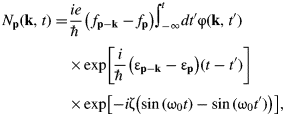
where ζ = k · a, a = e E0/mω02 is the oscillation amplitude of the electrons driven by the RF (quiver amplitude), ɛp = p 2/2m is the electron energy with momentum p. Here f p is the equilibrium distribution function for the electron plasma.
Finally, using Eq. (2) and making a further Fourier transformation, we obtain a solution for the potential φ in the form
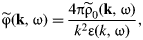
where we have introduced the frequency transforms  of the quantities

and ɛ(k, ω) is the RPA dielectric function (Lindhard, Reference Lindhard1954; Lindhard & Winther, Reference Lindhard and Winther1964).
We consider a heavy point–like particle with mass M and effective charge Ze, which moves with rectilinear trajectory with constant velocity v. We thus neglect the effect of the RF on the particle assuming that the quiver velocity of the ion in the laser field v q = ZeE 0/Mω0 ≪ v s, v. Here v s is the mean velocity of the target electrons. The charge density of the point–like ion is then given by ρ0(r, t) = Zeδ(r − vt). Inserting the Fourier transformation of this formula with respect to r into Eq. (6) and making a further Fourier transformation we obtain

where J n is the Bessel function of nth order. Using Eqs. (5)–(7) for the self–consistent potential φ(r, t) we finally arrive at

This result represents the dynamical response of the medium to the motion of the test particle in the presence of the RF; it takes the form of an expansion over all the harmonics of the field frequency, with coefficients J n(ζ) that depend on the intensity W L ∝ a 2.
From Eq. (8) it is straightforward to calculate the electric field E(r, t) = −∇ φ (r, t), and the time average (with respect to the period 2π/ω0 of the laser field) of the stopping field Estop = 〈E(vt, t)〉 acting on the particle. Then, the averaged stopping power (SP) of the test particle becomes
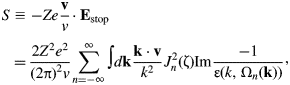
with Ωn(k) = nω0 + k · v.
To illustrate the effects of the RF it is convenient to take into account the symmetry of the integrand in Eq. (9), with respect to the change k, n → −k, −n. Using also the property of Bessel functions, J −n2(ζ) = J n2(ζ), we obtain
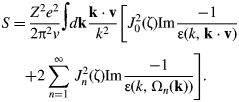
Hence, the SP depends on the particle velocity v, the frequency ω0 and the intensity W L = cE 02/8π of the RF (the intensity dependence is given through the quiver amplitude a). Moreover, since the vector k in Eq. (10) is spherically integrated, S becomes also a function of the angle ϑ between the velocity v, and the direction of polarization of RF, represented by a.
By comparison, the SP in the absence of the RF is given by Deutsch (Reference Deutsch1986) and Peter and Meyer-ter-Vehn (Reference Peter and Meyer-ter-Vehn1991)

In the presence of the RF, the SP S B is modified and is given by the first term in Eq. (10) (“no photon” SP)

Next we consider the case of a weak radiation field (a < λs, where λs is the characteristic screening length) at arbitrary angle ϑ between v and E0. In Eq. (10), we keep only the quadratic terms with respect to the quantity a and for the stopping power S we obtain
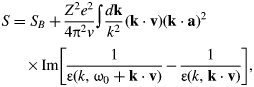
where S B is the field-free SP given by Eq. (11). Note that due to the isotropy of the dielectric function ɛ(k, ω) the angular integrations in Eqs. (10)–(13) can be easily done.
It is well known that within classical description an upper cut-off parameter k max = 1/r min (where r min is the effective minimum impact parameter) must be introduced in Eqs. (11) and (13) to avoid the logarithmic divergence at large k. This divergence corresponds to the incapability of the classical perturbation theory to treat close encounters between the projectile particle and the plasma electrons properly. For r min, we use the effective minimum impact parameter excluding hard Coulomb collisions with a scattering angle larger than π/2. The resulting cut-off parameter k max ≃ m(v 2 + v th2)/|Z|e 2 is well known for energy loss calculations (see, e.g., Zwicknagel et al. (Reference Zwicknagel, Toepffer and Reinhard1999); Nersisyan et al. (Reference Nersisyan, Toepffer and Zwicknagel2007) and references therein). Here v th is the thermal velocity of the electrons. In particular, at low projectile velocities this cut-off parameter reads k max = T/|Z|e 2, where T is the plasma temperature given in energy units.
3. ENERGY LOSS OF SLOW IONS
In this section, subsequent derivations are performed for the classical plasma and in the low–velocity limit of the ion. In this case, the RPA dielectric function is given by Fried and Conte (Reference Fried and Conte1961)
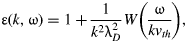
where λD is the Debye screening length, and W(z) = g(z) + if(z) is the plasma dispersion function (Fried & Conte, Reference Fried and Conte1961) with

Consider now the SP determined by Eq. (10) in the limit of low–velocities, when v ≪ v th. As discussed above, we also assume that v ≫ v q and neglect the effect of the RF on the ion. In the limit of the low–velocities from Eqs. (10)–(15), we obtain

where

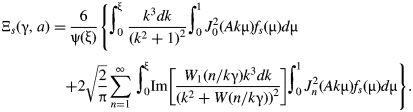
Here s = 1, 2 , and  . Note that at the absence of the laser field (i.e., at a → 0) Ξ1 (γ, a) → 1, Ξ2 (γ, a) → 0. In this case, the SP is determined by the quantity S B in Eq. (11) (Deutsch, Reference Deutsch1986; Peter & Meyer-ter-Vehn, Reference Peter and Meyer-ter-Vehn1991)
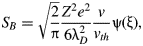
where
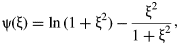
is the Coulomb logarithm with ξ = k maxλD. Also in Eqs. (16)–(18), we have introduced the angle ϑ between the velocity v and the polarization a vectors, W 1(z) = dW(z)/dz, A = a/λD, γ = ωp/ω0 < 1. Note that while the k integral in Eq. (11) diverges logarithmically in a field–free case, Eqs. (12) and (18) are finite and do not require any cut-off. The Bessel functions involved in these expressions due to the radiation field guarantee the convergence of the k–integrations. However, since in the sequel we shall compare Eqs. (16)–(18) with field–free SP S B, for consistency the upper limits of the k–integrals in Eq. (18) are kept finite with the same upper cutoff parameter as in Eqs. (11) and (19).
In many experimental situations, the ions move in plasma with random orientations of ϑ with respect to the direction of the polarization of laser field a. The stopping power appropriate to this situation may be obtained by carrying out a spherical average over ϑ of S(γ, a, ϑ) in Eqs. (16) and (17). We find

The study of the effect of a radiation field on the SP is easier in the case of low-intensities W L when a < λD. Then considering in Eqs. (16)–(18) only the quadratic terms with respect to a for the SP S(γ, a, ϑ) we obtain

where
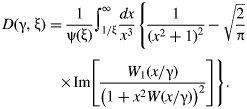
Taking into account that γ < 1 and ξ ≫ 1 from Eqs. (22) and (23) we finally obtain D(γ, ξ) ≃3/4γ2. It is seen that at low–velocities the SP S(γ, a, ϑ) decreases with the intensity of radiation field.
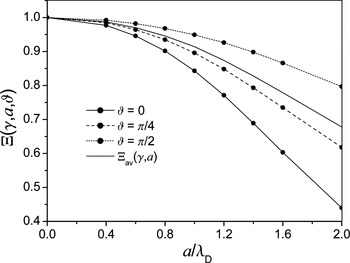
In Figure 1, the quantities Ξ(γ, a, ϑ) and Ξav(γ, a) are shown vs the intensity parameter a/λD of the laser field for three values of angles ϑ = 0, ϑ = π/4, ϑ = π/2 and for ω0 = 1.2ωp. It is convenient to represent the intensity parameter a/λD in the form  , where the wavelength (λ0) and the intensity (W L) of the laser field and the density (n 0) and the temperature (T) of plasma are measured in units μm, 1015 W/cm2, 1020 cm−3 and keV, respectively. As an example, consider the case when the electron quiver amplitude reaches the Debye screening length, a = λD. For the values of the RF and plasma parameters with λ0 = 0.5 µm, n 0 = 1018 cm−3, T = 0.1 keV, the above condition is fulfilled at the radiation field intensity W L = 4.94 × 10¹⁸ W/cm2.
The dimensionless quantities Ξ(γ, a, ϑ) (the lines with symbols) and Ξav (γ, a) (the solid line without symbols) vs the intensity parameter of the laser field a/λD for ϑ = 0 (solid line), ϑ = π/4 (dashed line), ϑ = π/2 (dotted line) and for ω0 = 1.2ωp.

From Figure 1 it is seen that the intense laser field may strongly reduce the SP of the low–velocity ion. And as expected, the effect of the radiation field is maximal for ϑ = 0. Note that in this case and at a = λD the radiation field reduces the energy loss S B approximately by 15%. For explanation of the obtained result, let us consider a simple physical model. The stopping power of the ion is defined as S = −(1/v)〈dW/dt〉, where 〈dW/dt〉 is the averaged (with respect to the period of the radiation field) energy loss rate. We assume that the frequency of the radiation field ω0 is larger than the effective frequency of the pairwise Coulomb collisions νeff. Also assuming that in the low– velocity limit the energy loss of the ion on the collective plasma excitations is negligible and is mainly determined by the Coulomb collisions we obtain 〈dW/dt〉 ~ νeffW. On the other hand νeff ~ 1/v eff3, where v eff is the averaged relative velocity of the colliding particles. At v < v th and for vanishing radiation field v eff ≃ v th. However, in the presence of the radiation field, the averaged relative velocity of the collisions is v eff ≃ (v th2 + v E2)1/2 and increases with the intensity of the laser field. Thus the effective collision frequency νeff and hence the stopping power of the ion are reduced with increasing intensity of the radiation field.
At the end of this section we consider a practical example. Let us consider the stopping of the α–particles in the corona of the laser plasma. Although the thermonuclear reactions mainly occur far below the critical surface the stopping length of the α–particles is larger than the characteristic length scale of plasma inhomogeneity and some part of the α–particles transfer the energy to the plasma corona before they reach the critical surface (Max, Reference Max1982). In the vicinity of the plasma critical density, the intensity of the radiation field is very large and the stopping capacity of the plasma may be strongly reduced. In this example, the typical temperature is T = 10 keV and therefore v α/v th = 0.22 (E α = M αV α2/2 = 3.5 MeV, where E α, M α, v α are the energy, the mass and the velocity of the α–particles). For λ0 = 0.5 µm, W L = 2 × 10¹⁷ W/cm2, and  (the plasma density is n 0 = n c/2, where n c is the plasma critical density) we find a ≃ λD. In this parameter regime the radiation field reduces the SP of the α–particles by 20%.
4. ENERGY LOSS OF FAST IONS
In this section, we consider the energy loss of a fast heavy ion moving in a fully degenerate plasma (which means that the partially degenerate case could be postponed to a further presentation) in the presence of a radiation field. The longitudinal dielectric function of the degenerated electron gas is determined by Lindhard's expression (Lindhard, Reference Lindhard1954; Lindhard & Winther, Reference Lindhard and Winther1964). However, here we consider the simplest model of the dielectric function of a jellium. Previously, a plasmon–pole approximation to ɛ(k, ω) for an electron gas was used for calculation of the SP (Basbas & Ritchie, Reference Basbas and Ritchie1982; Deutsch, Reference Deutsch1995; Nersisyan & Das, Reference Nersisyan and Das2000). In order to get easily obtainable analytical results, Basbas and Ritchie (Reference Basbas and Ritchie1982) employed a simplified form that exhibits collective and single–particle effects
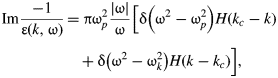
where H(x) is the Heaviside unit–step function,  , and ωp is the plasma frequency. The cut-off parameter k c is determined by equating the arguments of the two delta–functions in Eq. (24) at k = k c. The first term in Eq. (24) describes the response due to nondispersive plasmon excitation in the region k < k c, while the second term describes free–electron recoil in the range k > k c (single–particle excitations). Note that this approximate dielectric function satisfies at arbitrary k the usual frequency sum rule (Basbas & Ritchie, Reference Basbas and Ritchie1982; Deutsch, Reference Deutsch1995; Nersisyan & Das, Reference Nersisyan and Das2000).
In contrast to the previous section, we consider here the fast projectile ion with v≳v c (where v c = ωp/k c =  ), which justifies the approximation (24) valid only in this specific case (Basbas & Ritchie, Reference Basbas and Ritchie1982).
It is constructive to consider first the case of a weak radiation field (k ca < 1) at arbitrary angle ϑ between v and a. In this case, the SP is determined by Eq. (13), where the field– free SP S B in the high–velocity limit is given by (Lindhard, Reference Lindhard1954; Lindhard & Winther, Reference Lindhard and Winther1964; Deutsch, Reference Deutsch1986, Reference Deutsch1995)
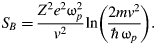
Inserting Eq. (24) into (13) for the stopping power we obtain

where  , a 0 is the Bohr radius, Φ1 = Φ1c + Φ1s, Φ2 = Φ2c + Φ2s, λ = v/v c, γ = ωp/ω0 < 1. Also
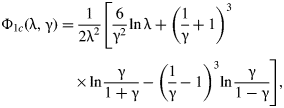

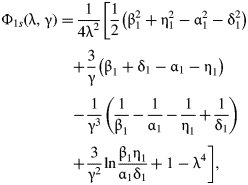
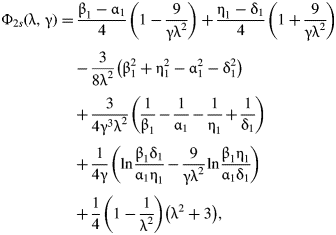
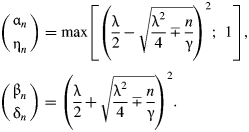
In Eq. (31), n is a positive integer (n = 1,2,…). The first term in Eq. (26) corresponds to the field–free SP (25) represented in a dimensionless form. The remaining terms proportional to the intensity of the radiation field (a 2), describe the collective (proportional to Φ1c; 2c (λ, γ)) and single–particle (proportional to Φ1s; 2s (λ, γ)) excitations. It should be noted that the stopping power Eq. (26) is not vanishing only at high–velocities when  .
Consider next the angular distribution of the SP at low– intensities of the RF. An analysis of the quantity P = (S − S B)/S B (the relative deviation of S from S B) for the proton projectile shows that at moderate velocities ( ) the angular distribution of P has a quadrupole nature. At
 , where ϑ0(λ, γ) is some value of the angle ϑ, the excitation of the waves with the frequencies ω0 ± ωp leads to the additional energy loss. At ϑ0 (λ, γ)≤ϑ≤π/2 the proton energy loss changes sign and the total energy loss decreases. When the proton moves at angles ϑ = ϑ0 (λ, γ) with respect to the polarization vector a the radiation field has no any influence on the SP. However, at very large velocities (
 ) the relative deviation P is negative for arbitrary ϑ and the radiation field systematically reduces the energy loss of the proton.
Let us now investigate the influence of the intense radiation field on the stopping process when v is parallel to a. It is expected that the effect of the RF is maximal in this case. From Eqs. (10) and (24) we obtain
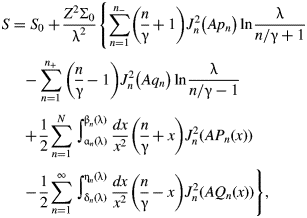
where A = k ca, P n(x) − (1/λ)(n/γ = x), Q n(x) = (1/λ) (n/γ − x), p n = P n (1), q n = Q n(1), and

is the SP without emission or absorption of the photons. Also we have introduced the notations
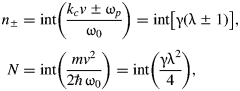
where int(x) is the integer part of x. The quantities αn(λ), βn(λ), δn(λ), ηn(λ) in Eq. (32) are determined by Eq. (31). We note that in Eq. (32) the terms involving n ± and N photons are not vanishing at λ ≥ 1/γ ∓ 1 and  , respectively. Similarly the SP (33) is not vanishing at λ ≥ 1.
The first term in Eq. (33) describes the collective excitations while the second term corresponds to the single– particle excitations. From Eq. (33) it is seen that S 0 oscillates with the intensity of the laser field. However, the radiation field suppresses the excitation of the collective and the single–particle modes and the SP S 0 is less than the field–free SP S B. As follows from Eq. (33) at high–intensities of the RF the SP S 0 is close to zero when A/λ ≃ μm (or alternatively at γ (v E/v) ≃ μm) with m = 1,2, …, where μm are the zeros of the Bessel function J 0 (μm) = 0 (μ1 = 2.4, μ2 = 5.52, μ3 = 8.63…). Then the energy loss of the ion is mainly determined by the other terms in Eq. (32) and is stipulated by excitation of plasma waves with frequencies nω0 ± ωp. The first and the last pairs of terms in Eq. (32) describe the excitation of the collective and single–particle modes, respectively, with emission or absorption several photons. The number of photons (n ±, N) involved in the process of the inelastic interaction are determined by the energy–momentum conservations (see the arguments of the delta–functions in the dielectric function (24)).
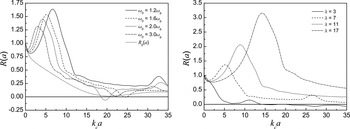
The results of the numerical evaluation of the SP (Eqs. (32) and (33)) are shown in Figure 2, where the ratio R(a) = S(a)/S B is plotted as a function of the laser field intensity (k ca = 5.38W L1/2ω0−2r s−3/4, where r s is the Wigner– Seitz density parameter and W L and ω0 are measured in units 1015 W/cm2 and 1016 s−1, respectively). For instance, for Al target with r s = 2.07, ħωp = 15.5 eV, and v c = 1.2 × 108 cm/s. From Figure 2 it is seen that the SP exceeds the field–free SP and may change sign due to plasma irradiation by intense (k ca≫1) laser field. Similar properties of the SP has been obtained previously for a classical plasma (Nersisyan & Akopyan, Reference Nersisyan and Akopyan1999). However, due to the higher density of the degenerate electrons (in metals typically n 0 ~ 1023 cm−3) the acceleration rate of the projectile particle is larger than similar rate in the case of a classical plasma. The acceleration effect occurs at v E/v ≃ μm/γ (with m = 1,2, …) when the SP S 0 nearly vanishes. It should be noted that in the laser irradiated plasma a parametric instability is expected (Silin, Reference Silin1973) with an increment increasing with the intensity of the radiation field. This restricts the possible acceleration time with stronger condition than in the case of a classical plasma. Finally, let us note that the effect of the enhancement of the SP of an ion moving in a laser irradiated plasma is intensified at smaller frequency (Fig. 2, left panel) of the radiation field (ω0 ≃ ωp but ω0 > ωp) or at larger incident kinetic energy of the projectile ion (Fig. 2, right panel) when the numbers n ± and N of the photons involved in the inelastic interaction process are strongly increased (Eq. (34)).
(Left panel) the ratio R(a) = S(a)/S B as a function of dimensionless quantity k ca at v = 8.6v c, ω0 = 1.2ωp (solid line), ω0 = 1.6ωp (dashed line), ω0 = 2ωp (dotted line), ω0 = 3ωp (dash–dotted line). Thin solid line corresponds to R 0(a) = S 0(a)/S B (see Eq. (33)). (Right panel) same as in left panel but at ω0 = 1.2ωp, v = 3v c (solid line), v = 7v c (dashed line), v = 11v c (dotted line), v = 17v c (dash–dotted line).

5. SUMMARY
In this paper, within RPA we have investigated the energy loss of a heavy point–like ion moving in a laser irradiated plasma. In the course of this study, we derived a general expression for the SP, which has been also simplified in the limit of weak RF. As in the field–free case, the SP in a laser irradiated plasma is completely determined by the dielectric function of the plasma. We have considered two somewhat distinct cases of the slow– and high–velocity ion moving in a classical and fully degenerate electron plasma, respectively. At low–velocities the RF leads to the strong decrease of the energy loss. Physically, this is due to the strong reduction of the effective frequency of the pairwise Coulomb collisions between projectile ion and the plasma electrons. At high velocities the RF may strongly increase the SP. This effect is more pronounced when the laser frequency approaches the plasma frequency in agreement with PIC simulations (Hu et al., Reference Hu, Song, Mišković and Wang2011). Moreover, at high–velocities and in the presence of the intense RF an ion projectile energy gain is expected when the quiver velocity of the plasma electrons exceeds the ion velocity. The analysis presented above can in principle be extended to the case of a partially degenerate plasma as well as to the case of light ion projectiles and also electrons and positrons when the effect of the intense RF on the ion cannot be neglected anymore. We intend to address these issues in our forthcoming investigations.
ACKNOWLEDGMENTS
The work of H.B.N. has been partially supported by the State Committee of Science of Armenian Ministry of Higher Education and Science (Project No. 11-1c317).