INTRODUCTION
The banded murex, Hexaplex trunculus (Linnaeus, 1758), is distributed along the entire Mediterranean Sea, whereas in the adjacent Atlantic Ocean it only occurs from the southern Portuguese coast southward to Morocco and to the Madeira and Canary Archipelagos (Poppe & Goto, Reference Poppe and Goto1991; Houart, Reference Houart2001). Presently, H. trunculus is a commercially valuable species in several Mediterranean countries, being regularly or occasionally fished in Spain (Anon, Reference Anon2001), Italy, Cyprus, Turkey (Gaillard, Reference Gaillard, Fischer, Bauchot and Schneider1987), Croatia (Peharda & Morton, Reference Peharda and Morton2006) and Tunisia (Gharsallah et al., Reference Gharsallah, Zamouri-Langar, Missaoui and El Abed2004). In Portugal, the banded murex is commercially exploited mainly in the Ria Formosa lagoon (Algarve coast, southern Portugal), where it constitutes the target species of a locally important artisanal fishery (Vasconcelos et al., Reference Vasconcelos, Carvalho, Castro and Gaspar2008a). However, no reliable official statistics on the catches of this species in the Ria Formosa are available, because much of the trade is conducted through a parallel economy.
In Portugal, the banded murex is a greatly appreciated shellfish, frequently found in local markets and consumed in seafood restaurants. As local demand for seafood products has been increasing in the last years, the commercial value of H. trunculus has risen markedly in recent times, reaching an average price of approximately 10–15 €/kg (for first sale). Moreover, during summer (the tourist season) the growing demand for shellfish in the seafood market leads to a rising commercial value of H. trunculus, whose price can triplicate or quadruplicate for final consumers in seafood restaurants and festivals. The progressively higher commercial value of the banded murex has inclusively generated expectations about the potential of H. trunculus as a candidate species for molluscan aquaculture (Lahbib et al., Reference Lahbib, Trigui El-Menif, Le Pennec and Boumaiza2004; Vasconcelos et al., Reference Vasconcelos, Gaspar, Joaquim, Matias and Castro2004; Peharda & Morton, Reference Peharda and Morton2006).
The information on meat yield, proximate composition and energy value of seafood products is important, both as general information for the consumers and as specific data for the processing industry. Proximate composition (relative amounts of protein, fat, moisture and ash) is traditionally used as an indicator of the nutritive properties of seafood (Stansby, Reference Stansby, Heen and Kreuzer1962). In addition, the energy content of the edible portion is highly useful in calculations of the nutritional value of diets in which a determined species is included. However, despite the existence of a vast literature on the world's seafood (e.g. Sidwell et al., Reference Sidwell, Foncannon, Moore and Bonnet1974; FAO, 1989; Favier et al., Reference Favier, Ireland-Ripert, Toque and Feinberg1995), the nutritional data are still incomplete for several shellfish species. In the particular case of gastropods, this type of information is relatively scarce and restricted to a few commercially valuable species (either exploited by fisheries or produced in aquaculture).
In this context, the present study aimed to estimate the meat yield and analyse the proximate composition of H. trunculus from the Ria Formosa lagoon (Algarve coast, southern Portugal), as well as to assess the influence of the species growth and reproductive cycle on both parameters. To the authors' best knowledge, this work presents the first data available on the biochemical composition and energy value for the banded murex. Overall, this kind of information is useful to support the marketing, processing and consumption of H. trunculus products.
MATERIALS AND METHODS
Commercial samples of banded murex (≈120 individuals/month) caught in the Ria Formosa were purchased in a local shellfish supplier during a one-year study period (March 2003–February 2004).
Fishing operations and handling procedures frequently damage H. trunculus shells, and fouling by boring/drilling polychaetes weakens and erodes some shells (Vasconcelos et al., Reference Vasconcelos, Cúrdia, Castro and Gaspar2007). Thus, to avoid weight discrepancies only undamaged specimens were analysed and the colonizing algae and/or encrusting epibionts (mainly polychaetes) were removed from the shells with a hard brush.
Meat yield
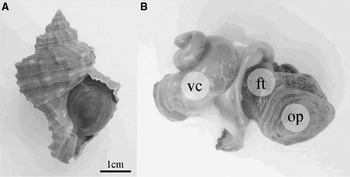
In the laboratory, shells were drained to remove excessive water retained inside the mantle cavity (sealed by the operculum) and blotted dry onto absorbent paper. Subsequently, live H. trunculus (Figure 1A) were measured for shell length (SL; mm) with a digital calliper (precision of 0.01 mm) and weighed for total weight (TW; g) on a top-loading digital balance (precision of 0.01 g).
The banded murex, Hexaplex trunculus. (A) Live specimen (ventral view); (B) edible portion of the organism (foot and viscera, excluding the operculum) after shell breakage. Abbreviations: ft, foot; op, operculum; vc, visceral coil (digestive gland and gonad complex).

After de-shelling each specimen in a bench vice, the soft-body was removed and individuals were sexed. Due to the occurrence of imposex in H. trunculus from this region (Vasconcelos et al., Reference Vasconcelos, Gaspar and Castro2006a), males were identified by the presence of penis and lack of capsule gland, and females by the presence of vagina and capsule gland. Afterwards, the operculum was removed, the soft-body was drained and blotted dry onto absorbent paper to eliminate extra-visceral water, and the whole meat was weighed (MW; g) on the top-loading digital balance (precision of 0.01 g). This constitutes the edible portion of H. trunculus as it is consumed locally (all soft tissues, namely the foot and viscera) (Figure 1B).
The raw meat yield (MY) was calculated as the proportion of meat weight relative to total weight (MY(%) = (MW/TW)) and results are expressed as mean±SD percentage of wet weight (i.e. g/100 g ww). In order to assess the influence of specimen size and sex on meat yield, individuals of both sexes were grouped in four SL size-classes (<50, 50–60, 60–70 and >70 mm).
Proximate composition and energy value
Due to the difficulty in sampling enough individuals (and collecting sufficient edible content for analysis) from the smallest size-class (<50 mm SL), only specimens above the minimum landing size legally stipulated for H. trunculus (MLS = 50 mm SL) were subjected to proximate composition analysis, grouped in three SL size-classes (50–60, 60–70 and >70 mm). From each size-class, five to ten individuals were randomly selected (both sexes combined), and their raw meat yield was pooled and homogenized in an automated grinder (5000 rotations/minute for 15–20 seconds).
Moisture, protein, fat and ash contents were determined according to procedures established by the Association of Official Analytical Chemistry (AOAC, 1998). Moisture was determined by constant-weight drying in an oven at 100°C, protein was analysed through a modified Kjeldahl method (total nitrogen was converted into crude protein by multiplying by a factor of 6.25), fat was estimated by the Soxhlet extraction method with ethyl ether, and ash was determined in a muffle furnace at 550°C until constant weight. Carbohydrate was estimated by difference to 100% (by subtracting the sum of percentages of moisture, protein, fat and ash from 100%). Because of the time required and/or cost of the analyses, samples were analysed in duplicate and results are expressed as mean±SD percentage on wet weight basis (i.e. g/100 g ww).
The total energy content of an organism can be reconstructed from its proximate composition because while moisture and ash only contribute to mass, protein, fat and carbohydrate contribute to its energy value. The energetic value of the edible portion of H. trunculus was estimated according to the method proposed by FAO (1989), calculated by multiplying the mean values of protein, fat and carbohydrate by the following factors: protein = 4.27 kcal/g ww; fat = 9.02 kcal/g ww; carbohydrate = 4.11 kcal/g ww (1 kcal = 4.185 kJ). The energy content is expressed as kcal and kJ/100 g ww.
Statistical analysis
The relationship between specimen size (SL and TW) and meat weight (MW) was investigated through regression analysis (least squares method), by fitting the power function (Y = aXb) to raw data, and the degree of association between variables was assessed by the correlation coefficient (r). The type of relationship was assessed through the allometry coefficient (b). In relationships between the same type of variables (both ponderal, such as TW versus MW) isometry occurs for b = 1, whereas between different types of variables (linear and ponderal, such as SL versus MW) isometry occurs for b = 3. Therefore, a t-test (Sokal & Rohlf, Reference Sokal and Rohlf1987) was applied to confirm if the slopes obtained in these relationships were included in the isometric range (b = 1 or b = 3) or allometric ranges (negative allometry: b < 1 or b < 3; positive allometry: b > 1 or b > 3).
Average meat yield of the overall specimens was compared between sexes using a Z-test (Zar, Reference Zar1996). For comparison between multiple groups (meat yield and proximate composition as a function of month, size-class and sex), data were analysed through analysis of variance (ANOVA). Whenever ANOVA assumptions (normality and homogeneity of variances) were not accomplished, the Kruskal–Wallis test (ANOVA on ranks) was performed. Each time the ANOVA or Kruskal–Wallis test detected statistically significant differences among groups, pairwise multiple comparisons through the Tukey test and the Dunn test, respectively, were applied to determine whose samples were responsible for the differences (Zar, Reference Zar1996). Statistical analyses were performed using the software package SigmaStat© (version 2.0) and statistical significance was considered for P < 0.05.
RESULTS
Meat yield
A total of 1418 H. trunculus (733 males and 685 females) were sampled, presenting broad size (40.17–82.84 mm SL) and weight ranges (5.28–58.20 g TW).
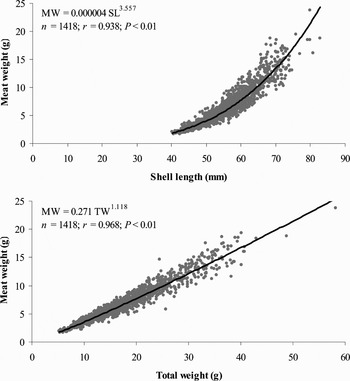
The relationships established between specimen size (SL and TW) and meat weight (MW) were highly significant (P < 0.01) and presented high correlation coefficients (Figure 2). The relationship TW versus MW (r = 0.968) displayed a better fitting than the relationship SL versus MW (r = 0.938), indicating that H. trunculus total weight is a better indicator of its meat weight (and therefore of raw meat yield). Both relationships exhibited positive allometry (SL versus MW: b = 3.557, t-test = 16.01, P < 0.01; TW versus MW: b = 1.118, t-test = 15.31, P < 0.01).
Relationships established between specimen size (shell length (SL) and total weight (TW)) and meat weight (MW).

Overall, H. trunculus presented an average meat yield of 37.9±4.6% (range = 22.5–59.7%) and female meat yield was significantly higher (39.1±4.7%) than male meat yield (36.8±4.2%) (Z-test: Z = 9.77, P < 0.01). An increasing trend was observed between average meat yield and specimen size (grouped in four SL size-classes) (Figure 3), with statistically significant differences between size-classes (ANOVA: F = 52.11, P < 0.01), except between the greater size-classes (60–70 and >70 mm SL). In general, females presented higher meat yield than males, with statistically significant differences between sexes (ANOVA: F = 29.38, P < 0.01), except in the smallest size-class (<50 mm SL). Thus, most differences in meat yield between size-classes were due to the increasing female meat yield.
Average meat yield according to specimen size and sex (individuals grouped in 10 mm SL classes). Symbols denote statistically significant differences (Tukey test, P < 0.05) in each sex between adjacent size-classes (≠) or between sexes in each size-class (*).

The seasonal variation in average meat yield of both sexes during the sampling period (Figure 4) presented statistically significant monthly differences (ANOVA: F = 16.54, P < 0.01) and an analogous variation between sexes (except between December and February). Significant monthly differences in average meat yield were also observed between sexes (ANOVA: F = 130.16, P < 0.01), with females presenting invariably higher yields than males (between March and May, August and September, and January and February). Monthly variation in meat yield was more frequent in females (between March and April, May and June, and July and October) compared to males (between August and September).
Monthly variation of the average meat yield in both sexes. Symbols denote statistically significant differences (Tukey test, P < 0.05) in each sex between consecutive months (≠) or between sexes in each month (*).

Proximate composition and energy value
Overall, the proximate composition of the raw edible portion of H. trunculus contained 70.7±1.4% moisture, 20.1±1.2% protein, 1.6±0.3% fat and 3.0±0.3% ash, with the remaining corresponding to 4.6±1.2% carbohydrate. This biochemical composition corresponded to an energetic value of 119.2±7.5 kcal/100 g ww, the equivalent to 498.9±31.4 kJ/100 g ww.
Specimen size (grouped in three SL size-classes) had no statistically significant effect on the percentages of moisture (ANOVA: F = 2.34, P = 0.10), protein (ANOVA: F = 2.71, P = 0.07), fat (ANOVA: F = 2.77, P = 0.07), ash (Kruskal–Wallis: H = 5.35, P = 0.07) and carbohydrate (Kruskal–Wallis: H = 2.36, P = 0.31) (Figure 5). As a consequence, the energetic value of the raw edible content of H. trunculus also did not show any statistically significant differences among size-classes (Kruskal–Wallis: H = 3.49, P = 0.17).
Average proximate composition (moisture, protein, fat, ash and carbohydrate contents) according to specimen size (individuals grouped in 10 mm SL classes).

The proximate composition of the raw edible portion of H. trunculus displayed a slight monthly variability during the one-year study period, and in some constituents statistically significant differences were detected between consecutive months (Figure 6). Moisture ranged from 68.7±0.7% (December) to 72.2±1.0% (April), with temporal variation during the study period (ANOVA: F = 10.46, P < 0.01) and a significant decrease between April and May. Fat content was between 1.3±0.1% (August) and 2.0±0.4% (January), showing inter-monthly variability (ANOVA: F = 3.33, P < 0.01) and a significant increase between April and May. The protein values were in the range 18.5±0.3% (August) and 22.1±1.5% (May), with seasonal variability throughout the year (ANOVA: F = 6.12, P < 0.01) and a marked oscillation between April and June. The minimum and maximum values of ash were respectively 2.4±0.3% (November) and 3.5±0.1% (June), with seasonal variability during the study period (Kruskal–Wallis: H = 44.69, P < 0.01), but without significant differences between consecutive months. Carbohydrate varied between 2.8±0.8% (March) and 6.0±0.5% (November), with monthly differences throughout the year (Kruskal–Wallis: H = 49.03, P < 0.01), but also without significant variation between consecutive months. Consequently, the energetic value was in the range 111.0±5.8 kcal/100 g (April) and 128.8±4.4 kcal/100 g (December), with seasonal fluctuation (ANOVA: F = 10.86, P < 0.01) that was particularly discernible between April and June, i.e. following the trends displayed by the protein and fat contents.
Monthly variation of the average proximate composition (moisture, protein, fat, ash and carbohydrate contents) and energy value. Symbols denote statistically significant differences (Tukey test or Dunn test, P < 0.05) between consecutive months (≠).

DISCUSSION
Meat yield
The positive allometries obtained in the relationships established between specimen size and meat weight revealed that during growth the meat weight (and consequently the raw meat yield) increased at a higher rate than H. trunculus size (both in terms of SL and TW). In practice, this means that during ontogeny the banded murex allocates more energetic resources towards somatic growth than towards shell secretion.
By predicting the amount of meat contained within a H. trunculus individual using either SL or TW (and therefore the meat yield that can be obtained from a batch of specimens with a certain size or weight range), this kind of information is most valuable both for consumers and for the seafood processing industry. For example, through the weight–length relationship established for H. trunculus (TW = 0.00008 SL3.022, r = 0.975, P < 0.01) (Vasconcelos et al., Reference Vasconcelos, Gaspar, Pereira and Castro2006b) it is possible to estimate that one specimen with the MLS (50 mm SL) weighs 10.90 g TW, and therefore that 1 kg of H. trunculus with the MLS contains around 92 individuals. Subsequently, by employing the relationship established between shell length and meat weight (MW = 0.000004 SL3.557, r = 0.938, P < 0.01) it is possible to predict that one specimen with 50 mm SL yields 4.42 g of edible portion, and consequently that from 1 kg of H. trunculus (92 specimens) approximately 407 g of meat can be obtained.
In gastropods, the relationships established between specimen size and meat weight are highly influenced by specificities of shell secretion during growth (e.g. with some species gradually developing stronger, thicker and more ornamented shells than others), contributing to strong inter-specific variability and therefore making it difficult to compare types of growth. For instance, lower allometric coefficients were obtained in Chicoreus ramosus (SL versus MW: b = 2.805) (Thapnu & Tantichodok, Reference Thapnu and Tantichodok1991), Buccinum undatum (SL versus MW: b = 2.525 to 3.559, according to collecting site) (Kenchington & Glass, Reference Kenchington and Glass1998) and in juvenile Strombus gigas (TW versus MW: b = 1.043) (Berg, Reference Berg1976). In practice, and compared to H. trunculus, this reveals lower rates of accumulation of somatic tissue as a function of specimen size (SL or TW) during the ontogeny of these species.
This tendency for increasing meat yield during ontogeny was further emphasized when specimens were grouped in shell length size-classes. The increasing trend between specimen size and average meat yield (except between the greater size-classes: 60–70 and >70 mm SL) is an additional reason for accomplishing the MLS stipulated for H. trunculus (50 mm SL). Indeed, besides the general concerns related to the fishery exploitation and management, the fact that commercially under-sized specimens yielded the lowest meat content should also discourage their commercialization or processing.
On the whole, females provided higher meat yield than males, and except in the smallest size-class (<50 mm SL) significant differences in meat yield (females > males) were also detected between size-classes. This reflects differential growth between sexes, but could also relate to distinct features of the reproductive cycle between H. trunculus females and males. Firstly, during sexual maturation females normally develop bigger gonads than males (Vasconcelos et al., Reference Vasconcelos, Lopes, Castro and Gaspar2008b) whose greater volume (and weight) might contribute to differences in meat yield between sexes. Moreover, the spawn of H. trunculus comprises several egg capsules that enclose the eggs and developing embryos (for further details see Vasconcelos et al., Reference Vasconcelos, Gaspar, Joaquim, Matias and Castro2004). Being the female-specific organ responsible for providing substances for the encapsulation, the capsule gland reaches considerable size (and weight) during the reproductive season, particularly before the spawning period (Vasconcelos et al., Reference Vasconcelos, Lopes, Castro and Gaspar2008b) and certainly also contributes to a higher meat yield in females compared to males. Corroborating this assumption, only in the smallest size-class (<50 mm SL), which comprises sexually immature individuals, females did not show higher meat yields than males. By contrast, Buccinum undatum males yielded more meat (30.0±0.4%) than females (25.2±0.3%) (Kenchington & Glass, Reference Kenchington and Glass1998).
Both sexes presented an analogous seasonal variation in meat yield during the study period, generally with females yielding a higher edible portion than males. Some monthly fluctuations in meat yield (both between consecutive months and sexes) were intimately related with the reproductive cycle of H. trunculus in the Ria Formosa, whose spawning season occurs mainly between May and June (Vasconcelos et al., Reference Vasconcelos, Lopes, Castro and Gaspar2008c). Accordingly, some periods of increasing meat yield were observed in phases of higher reproductive activity (namely in terms of sexual maturation, with enlarged gonads and filled capsule gland), whereas a period of decreasing meat yield was observed after spawning (with reduced gonads and depleted capsule gland) (Vasconcelos et al., Reference Vasconcelos, Lopes, Castro and Gaspar2008b). Moreover, the month when the lowest meat yield was registered in both sexes (July) also coincided with the resting phase of H. trunculus reproductive cycle, which occurs simultaneously in both sexes between June and August (Vasconcelos et al., Reference Vasconcelos, Lopes, Castro and Gaspar2008c).
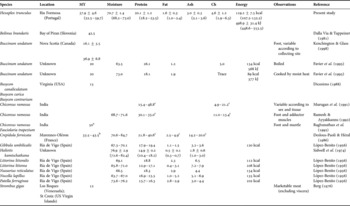
The meat yield of the banded murex from the Ria Formosa (37.9±4.6%) compared favourably with similar data reported for H. trunculus from other geographical areas, such as 33.3% in Cyprus (Alyakrinskaya, Reference Alyakrinskaya2004, Reference Alyakrinskaya2005), 33.6% in Slovenia (Dalla Via & Tappeiner, Reference Dalla Via and Tappeiner1981) and 34.2% in Greece (Alyakrinskaya, Reference Alyakrinskaya2004, Reference Alyakrinskaya2005) (all data converted from percentage of shell weight/total weight). The comparison of meat yield between species is rather complicated due to the different types of meat extraction (mechanized versus manual), treatments (raw versus cooked, wet weight versus dry weight) and organs/tissues included in the edible content (foot, mantle, digestive gland, gonads, etc.). Despite these constraints, the comparison of the meat yield of H. trunculus with similar information available for other marine gastropods is compiled in Table 1. Because in H. trunculus the edible portion comprises all soft-body tissues, its meat yield compared favourably to other gastropod species (e.g. Buccinum undatum, Busycon canaliculatum, B. carica, B. contrarium and Strombus gigas) and in particular to those species whose viscera are removed from the remaining soft-body tissues (e.g. Chicoreus ramosus and Fasciolaria trapezium). Only Bolinus brandaris, another muricid species whose edible content also includes all soft-body tissues, presented higher meat yield (42.5%), which is explained by the fact that B. brandaris has a weaker, thinner and 10% lighter shell than H. trunculus (Dalla Via & Tappeiner, Reference Dalla Via and Tappeiner1981).
Comparison of meat yield, proximate composition and energy value between Hexaplex trunculus and other gastropod species. Data presented as mean±SD (minimum–maximum), raw meat yield expressed in percentage of total weight, proximate composition in percentage of wet weight and energy value in kcal or kJ/100 g wet weight (unless when stated otherwise, see observations and table footnote). MY, meat yield; Ch, carbohydrate.

a Expressed in percentage of soft-body total weight; b converted from percentage of shell weight/total weight; c expressed in percentage of dry weight.
Proximate composition and energy value
Generally, factors such as age and size play significant roles in introducing variability in the proximate composition (Sidwell et al., Reference Sidwell, Foncannon, Moore and Bonnet1974). However, in the present study, specimen size (grouped in three SL size-classes) had no influence on the proximate composition, and therefore also on the energetic value of the raw edible meat of H. trunculus. This is probably due to the fact that all individuals analysed were above the MLS stipulated for the banded murex (50 mm SL), which in turn is established in function of the species size at first sexual maturation. Consequently, the variability that could be expected between immature and mature individuals presumably did not occur, and thus the influence of the reproductive cycle on the proximate composition was similar between size-classes.
In molluscs, the proximate composition may be influenced by environmental factors affecting metabolism (mainly temperature), as well as by biotic factors such as feeding activity, food availability and nutritional value of the food supply, sexual maturation and spawning (Bayne & Newell, Reference Bayne, Newell, Saleuddin and Wilbur1983; Gabbott, Reference Gabbott and Hochachka1983). Reproduction is one of the most energy demanding periods of the life cycle and has large associated energy costs due to intensive biochemical synthesis, namely through the mobilization of nutrients to meet energy needs for gonad maturation. Normally, gametogenic development implies an increase of lipid and protein contents in the gonads, while spawning imposes a decrease in these components and a rise in water content (Giese, Reference Giese1969). The lipid storage in the gonads is mobilized for the biosynthetic processes of gametogenesis (particularly at more advanced stages of maturation) and subsequently lost during spawning (Gabbott, Reference Gabbott and Hochachka1983; Voogt, Reference Voogt and Hochachka1983).
The proximate composition and energetic value of H. trunculus only displayed slight seasonality, but some constituents had monthly fluctuations related to the reproductive cycle, which coincided with the periods of maturation and spawning of this species in the Ria Formosa (Vasconcelos et al., Reference Vasconcelos, Lopes, Castro and Gaspar2008c). In particular, the fat and protein contents increased between April and May, accompanied by a decrease in the moisture content, corresponding to the period of gonad maturation. Subsequently, the protein content decreased between May and June, synchronized with the main spawning season. The energetic value followed the trends displayed by the fat and protein contents, with major oscillation between April and June, i.e. increasing during gonad maturation and decreasing during spawning. In addition, the lowest fat and protein contents (and therefore the lowest energetic values) were obtained mainly during the resting phase of the reproductive cycle (from June to August). Similar correlation between the phase of the reproductive cycle and the lipid content has been demonstrated in several gastropod species (Voogt, Reference Voogt and Hochachka1983), such as an increase in lipid content during the reproductive period of Crepidula fornicata (Deslous-Paoli & Héral, Reference Deslous-Paoli and Héral1986), an accumulation of lipid in the gonad during maturation of Patella vulgata (Blackmore, Reference Blackmore1969) and P. depressa (Morais et al., Reference Morais, Boaventura, Narciso, Ré and Hawkins2003), or a decrease in lipid content of the gonad after spawning of Haliotis rubra (Litaay & De Silva, Reference Litaay and De Silva2003).
As already mentioned above, H. trunculus spawns several egg capsules (Vasconcelos et al., Reference Vasconcelos, Gaspar, Joaquim, Matias and Castro2004). The energy expenditure associated with encapsulation appears to be high, because the egg capsules of gastropods are chemically complex and energetically costly (Miloslavich, Reference Miloslavich1996). The biological matrix of the capsule wall is primarily composed of proteins and carbohydrates (polysaccharides) (Benkendorff et al., Reference Benkendorff, Davis and Bremner2001; Przeslawski & Benkendorff, Reference Przeslawski and Benkendorff2005), plus minor lipid components (Ojeda & Chaparro, Reference Ojeda and Chaparro2004). Moreover, egg capsules also provide a nutrient-rich environment that might include nurse eggs and intracapsular liquid with nutritive value for the developing embryos (Moran, Reference Moran1999; Martínez et al., Reference Martínez, López, Mettifogo and Cancino2008). Generally, carbohydrates (glycogen) are the most important energetic reserves in the egg capsules, followed by proteins and lipids (Bayne, Reference Bayne1968; Miloslavich, Reference Miloslavich1996). In this context, the deposition of egg capsules and the transfer of intracapsular nutrients might have also contributed to the decrease in the protein content during the spawning period of H. trunculus (between May and June) (Vasconcelos et al., Reference Vasconcelos, Lopes, Castro and Gaspar2008c), possibly further aggravated because this species interrupts the feeding activity during spawning (Dulzetto, Reference Dulzetto1946, Reference Dulzetto1950; Vasconcelos et al., Reference Vasconcelos, Gaspar, Joaquim, Matias and Castro2004).
The inter-specific comparison of proximate composition is difficult because in works aiming to study physiological processes the organs are frequently analysed separately (instead of the entire soft-body or whole edible content), sometimes using distinct analytical methods. Moreover, factors such as seasonality, type of species, age and size also play an important role in introducing variability in the proximate composition (Sidwell et al., Reference Sidwell, Foncannon, Moore and Bonnet1974). Nevertheless, despite these limitations the comparison of H. trunculus proximate composition with analogous data available for other marine gastropods is summarized in Table 1. In general, the values of the constituents analysed in the present study were within the range of those measured in other gastropods, most of them commercially valuable species from distinct geographical areas.
Overall, the proximate composition analyses revealed the adequate nutritional quality of the banded murex, which is crucial taking into account that shellfish constitutes a traditional component of the Portuguese diet and there is an emergent trend for the diversification of shellfish products in the local seafood market. In particular, H. trunculus is a valuable dietary source of protein with low fat content, and therefore its use on a regular basis can help balancing human nutrition, being particularly recommended whenever shellfish is an alternative to foods of animal origin. Nevertheless, it is worth emphasizing that additional studies should be conducted in the near future to achieve the comprehensive biochemical characterization of this species, including analyses of the total amino acid and fatty acid profiles, as well as the quantification of the cholesterol content.
ACKNOWLEDGEMENTS
The authors would like to thank Susana Gonçalves, Cláudia Afonso and Helena Lourenço (IPIMAR/U-VPPA) for their valuable help in the proximate composition analyses. Thanks are also due to the anonymous referees, whose suggestions improved the revised version of the manuscript. This study was partially funded by a PhD grant from the Fundação para a Ciência e Tecnologia (FCT: SFRH/BD/5139/2001).