According to Erikson (Reference Erikson1994) the central task of adolescence is identity formation. Erikson described the process as requiring experimentation and divergence from parental and societal expectations, as if “trying on” different ideas, values, attitudes, and behaviors until the “best fit” can be achieved. Thus adolescence was seen as a stage of instability in which personality often changes substantially. A recent longitudinal study of personality change over early adolescence (Göllner et al., Reference Göllner, Roberts, Damian, Ludtke, Jonkmann and Trautwein2016) followed children from Grade 5 to Grade 8 (i.e., 10–11 years of age to 14 –15 years of age) in German schools; the children self-reported on a brief form of the Five-Factor model, and the parents reported on each child as well. Rank-order and mean stability was well preserved for the five traits in self-report as well as in parental reports. The changes that did occur were mainly a decrease over time in openness, agreeableness, and extraversion. However, girls were consistently more mature (i.e., agreeable, conscientious, and open) than boys. The parental reports reflected greater change than the child's self-report. These results are consistent with those of the Flemish Study of Parenting (Van den Akker, Dekovic, Asscher, & Prinzie, Reference Van den Akker, Dekovic, Asscher and Prinzie2014), which followed children from the age of 9 through adolescence and into early adulthood. They found that from late childhood to early adolescence there was a decline in conscientiousness and benevolence, as well as extraversion. By 13 years of age conscientiousness began to increase again, while extraversion continued its linear decline. Girls were more conscientious than boys, as well as more benevolent, and their maturational recovery after the decline of early adolescence started earlier. It appears then, from longitudinal studies utilizing the Five-Factor model, that substantial changes in personality occur in adolescence, and that there is an inflexion point around middle adolescence. Moreover, when viewed by parents, the changes of early adolescence might justify the “storm and stress” (Arnett, Reference Arnett1999) and “turbulence” (Erikson, Reference Erikson1994) views of adolescence, as the child's personality becomes less mature before recovery over the second phase of adolescence. The parent might be distressed over what might be experienced as a regressive trend: the child who was an obedient and benevolent 9-year-old is replaced by a more self-centered, less easily managed, more impulsive tween and teen, and for a time, the process of personality maturation is halted or reversed. This process might be tougher for parents of adolescent boys then those of girls as the personality of girls matures earlier.
These average trends in groups have been complemented by examining individual growth linking ego development to identity achievement from 14 years of age to young adulthood at age 24 (Syed & Seiffge-Krenke, Reference Syed and Seiffge-Krenke2013). In this 10-year longitudinal study, ego development and identity formation increased for most individuals, albeit at different paces. Overall from age 14 and on, maturation was evident. Others suggest that the causal and thematic cohesion that is necessary for crafting the narrative self, the self-story (i.e., a crucial component of one's identity), is available in the second phase of adolescence (McAdams, Reference McAdams2001). As a result, the narrative self is to be expected to begin to emerge in the second phase of adolescence and is further developed over adulthood and into old age. Thus the psychodynamic view of personality, as well as the self-story view, describes personality maturation as typical in the second phase of adolescence that usually occurs sometime after age 14.
The Temperament and Character Inventory (TCI) Model of Personality
The current study measures personality according to the biopsychosocial model of temperament and character (Cloninger, Svrakic, & Svrakic, Reference Cloninger, Svrakic and Svrakic1997). This model is two-tiered, with temperament preceding character over development and maturation. Individual differences in temperament traits are measurable early in development, and reflect individual differences in brain structures and function (Cloninger, Reference Cloninger2004). They are preconscious or unconscious and thus not easily accessible and are thus less subject to change. There are four temperament traits. Harm avoidance (HA) is primarily an inhibitory inclination; individuals high in HA are pessimistic, fearful, shy away from novel stimuli, and are fatigable. Novelty seeking (NS) is an excitatory trait; individuals high in NS are curious, impulsive, spendthrift, and are liable to make their own rules. HA and NS correlate negatively but weakly, so that they are not opposite poles of a single temperament dimension, and are both high in many individuals with attention-deficit/hyperactivity disorder (Gomez & Corr, Reference Gomez and Corr2014). Individuals high in reward dependence (RD) are sentimental, make close attachments, are highly sensitive to social cues, and are very dependent on social acceptance. Individuals high in persistence (PS) are hardworking, will not easily be frustrated as they work toward a goal, are ambitious, and are perfectionistic. Individuals who are low in HA, and high in RD and PS, tend to be reliable, to have better social and occupational adaptation, and to have better physical (Cloninger & Zohar, Reference Cloninger and Zohar2011) and mental (Cloninger, Zohar, Hirschman, & Dahan, Reference Cloninger, Zohar, Hirschmann and Dahan2012) health outcomes.
There are three character traits. Individuals high in self-directedness (SD) are responsible, goal oriented, resourceful, self-accepting, and have good habits that support their chosen directions. Individuals high in cooperativeness (CO) accept others, are empathic and sympathetic, help others, and are guided by explicit prosocial values. Individuals high in both SD and CO exhibit character maturity, whereas all personality disorders are characterized by low maturity (i.e., low scores on these two character traits; Cloninger & Svrakic, Reference McCrae, Costa, Terracciano, Parker, Mills, De Fruyt and Mervielde2017). Individuals high in self-transcendence (ST) experience self-forgetfulness and flow, identify with groups or values beyond their individual existence, and are more spiritual and less materialistic. Individuals high in all three character traits have mental and physical health advantages, in particular they tend to have heightened positive affect (Cloninger & Zohar, Reference Cloninger and Zohar2011), and healthier heart rate variability (Zohar, Cloninger, & McCraty, Reference Zohar, Cloninger and McCraty2013).
The Relationship of the TCI to the Five-Factor Model (FFM) and to the Tellegen Multidimensional Personality Questionnaire
Psychologists often prefer the particular model of personality with which they are most familiar from training and clinical experience. Such preferences are tolerable because there is extensive descriptive overlap among most multidimensional models of personality, and no available model is consistently superior to the others for all purposes (Grucza & Goldberg, Reference Grucza and Goldberg2007). In addition, the number and content of personality factors is indeterminate when based on factor analysis; explicit solutions are based on untested assumptions, so it is reasonable and prudent to tolerate the many alternative descriptive models of personality at least for their heuristic value (Mulaik, Reference Mulaik2009). For example, TCI temperament traits are based on differences in associative conditioning and related brain networks, whereas the TCI character traits are based on differences in intentional goals and values (Cloninger, Svrakic, & Przybeck, Reference Cloninger, Svrakic and Przybeck1993). There is extensive evidence that these domains are regulated by different genes and brain networks (Cloninger, Reference Cloninger2004), as well as having distinct developmental trajectories in adulthood, as described more fully in the next section. Accordingly, it may be useful for psychologists to understand how to relate descriptive models that are familiar to them to an alternative descriptive model like the TCI, which provides at least as much descriptive information as other models (Grucza & Goldberg, Reference Grucza and Goldberg2007) while providing additional information about the biological aspects of personality that can be understood in terms of distinct processes of learning and memory.
The five factors of personality as described by Costa and McCrae (Reference Costa and McCrae1992) include openness, conscientiousness, extraversion, agreeableness, and neuroticism. There are multiple associations between the FFM and the seven traits of the TCI. HA is positively correlated with neuroticism, and negatively with extraversion; NS correlates positively with extraversion and openness; RD with extraversion, and PS with extraversion and conscientiousness (Cloninger, Reference Cloninger2010). In studies of temperament and health, low HA and high PS are related to better outcomes (Cloninger & Zohar, Reference Cloninger and Zohar2011), as found for high conscientiousness in studies utilizing FFM (Friedman, Kern, Hampson, & Duckworth, Reference Friedman, Kern, Hampson and Duckworth2014). SD correlates negatively with neuroticism and positively with conscientiousness (Cloninger, Reference Cloninger2010), and together with low HA and high PS predicts the best physical (Cloninger & Zohar Reference Cloninger and Zohar2011) and mental (Cloninger et al., Reference Cloninger, Zohar, Hirschmann and Dahan2012) health outcomes.
The eleven primary factors of the Multidimensional Personality Questionnaire (Tellegen, & Waller, Reference Tellegen, Waller, Boyle, Matthews and Saklofske2008) are well-being, social potency, achievement, social closeness, stress reaction, alienation, aggression, control versus impulsivity, harm avoidance versus danger seeking, traditionalism, and absorption. HA correlates positively with stress reaction and with harm avoidance versus danger seeking. NS correlates negatively with the latter and control but positively with aggression. RD correlates positively with social closeness; PS correlates positively with achievement. For the character traits, SD correlates with well-being and with social potency. CO correlates with social closeness. ST correlates negatively with alienation and traditionalism and positively with absorption (Gomez & Corr, Reference Gomez and Corr2014).
Change and Stability in Temperament and Character Over the Life Span
There are complex interactions among multiple aspects of personality and changing life situations as a person ages, so the self-organization of personality is characterized by multifinality (i.e., people with the same set of features can have different outcomes at a later age) and equifinality (i.e., people with different features can have the same outcome at a later age; Cicchetti & Rogosch, Reference Cicchetti and Rogosch1996; Cloninger et al., Reference Cloninger, Svrakic and Svrakic1997). In addition, not all components of personality are equally plastic. Specifically, temperament traits (i.e., personality features that describe basic emotional drives) can be behaviorally conditioned to increase or decrease but do not have a consistent direction of change in response to age, parenting, or other social pressures (Josefsson, Jokela, Cloninger, et al., Reference Josefsson, Jokela, Cloninger, Hintsanen, Salo, Hintsa and Keltikangas-Jarvinen2013; Josefsson, Jokela, Hintsanen, et al., Reference Josefsson, Jokela, Hintsanen, Cloninger, Pulkki-Raback, Merjonen and Keltikangas-Jarvinen2013). In contrast, character traits (i.e., personality features that involve a person's intentional goals and values as expressions of identity) change in young adults in directions favored by social pressures to work responsibly and be cooperative (Josefsson, Jokela, Cloninger, et al., Reference Josefsson, Jokela, Cloninger, Hintsanen, Salo, Hintsa and Keltikangas-Jarvinen2013; Josefsson, Jokela, Hintsanen, et al., Reference Josefsson, Jokela, Hintsanen, Cloninger, Pulkki-Raback, Merjonen and Keltikangas-Jarvinen2013). Unfortunately, broad linear factors of personality as measured by trait models of personality in adolescents are heterogeneous composites of multiple temperament and character traits that differ in genetic antecedents (Gillespie, Cloninger, Heath, & Martin, Reference Gillespie, Cloninger, Heath and Martin2003), associated brain structures (Gardini, Cloninger, & Venneri, Reference Gardini, Cloninger and Venneri2009; Van Schuerbeek, Baeken, De Raedt, De Mey, & Luypaert, Reference Van Schuerbeek, Baeken, De Raedt, De Mey and Luypaert2011), the effects of parental care giving (Josefsson, Jokela, Hintsanen, et al., Reference Josefsson, Jokela, Hintsanen, Cloninger, Pulkki-Raback, Merjonen and Keltikangas-Jarvinen2013), and their stability and adaptive fitness during adolescence and early adulthood (Moreira et al., Reference Moreira, Oliveira, Cloninger, Azevedo, Sousa, Castro and Cloninger2013). As a result, it may be particularly informative for developmental studies of personality to use assessments that distinguish between temperament and character, as can be done with the TCI with age-appropriate forms (Luby, Svrakic, McCallum, Przybeck, & Cloninger, Reference Luby, Svrakic, McCallum, Przybeck and Cloninger1999).
In a large longitudinal epidemiological cohort study in Finland, emerging adults were followed from the age of 20 and into middle age using measures of temperament and character. Josefsson, Jokela, Cloninger, et al. (Reference Josefsson, Jokela, Cloninger, Hintsanen, Salo, Hintsa and Keltikangas-Jarvinen2013) found that while rank order was mainly preserved for all seven traits, mean levels of traits changed over young adulthood, more so for character traits than for temperament. As this report started with young adults, we do not know in terms of character and temperament if these processes began in adolescence or whether they characterize adult development.
In a cross-sectional study spanning adolescence in Portugal, Moreira et al. (Reference Moreira, Oliveira, Cloninger, Azevedo, Sousa, Castro and Cloninger2013, Reference Moreira, Cloninger, Dinis, Sa, Oliveira, Dias and Oliveira2014) found that comparisons between middle school and high school children followed the maturational principle: the older adolescents were less novelty seeking, more reward dependent, more persistent, more self-directed, and more cooperative than the younger adolescents. These cross-sectional results are consistent with those found using the FFM. The study design precluded measuring the middle adolescence inflexion point found in longitudinal studies of adolescent personality development. High scores in PS on the Junior Temperament and Character Inventory (JTCI) were as strongly associated with academic achievement as IQ in children from age 12 to 18 years (Moreira et al., Reference Moreira, Oliveira, Cloninger, Azevedo, Sousa, Castro and Cloninger2013). Other cross-sectional research showed that children around age 11 with temperament profiles of low NS and high PS on the JTCI had higher adaptive functioning and less psychopathology as measured by the Child Behavior Checklist than children with the opposite configuration (Rettew, Althoff, Dumenci, Ayer, & Hudziak, Reference Rettew, Althoff, Dumenci, Ayer and Hudziak2008). The temperament configuration of low NS low HA, and high RD is described as “reliable” (Cloninger & Cloninger, Reference Cloninger and Cloninger2011) because of its association with high adaptive functioning and low risk of any behavioral problems, personality disorders, or psychopathology in both children and adults (Andriola et al., Reference Andriola, Donfrancesco, Zaninotto, Di Trani, Cruciani, Innocenzi and Cloninger2012; Maggini, Ampollini, Marchesi, Gariboldi, & Cloninger, Reference Maggini, Ampollini, Marchesi, Gariboldi and Cloninger2000).
It is not surprising that the reliable temperament is associated with health because extensive research shows that the opposite of each of its components is related to a subtype of personality disorder and associated psychopathology: low RD is characteristic of odd behavior (Cluster A with disorders involving social detachment), high NS is characteristic of impulsive behavior (Cluster B with externalizing disorders), and high HA is characteristic of anxious behavior (Cluster C with anxiety disorders) in both adults (Battaglia, Przybeck, Bellodi, & Cloninger, Reference Battaglia, Przybeck, Bellodi and Cloninger1996; Bayon, Hill, Svrakic, Przybeck, & Cloninger, Reference Bayon, Hill, Svrakic, Przybeck and Cloninger1996; Cloninger, Reference Cloninger2000; Svrakic, Whitehead, Przybeck, & Cloninger, Reference Svrakic, Whitehead, Przybeck and Cloninger1993) and children and adolescents (Copeland, Landry, Stanger, & Hudziak, Reference Copeland, Landry, Stanger and Hudziak2004; Csorba et al., Reference Csorba, Dinya, Ferencz, Steiner, Bertalan and Zsadon2010; George, Connor, Gullo, & Young, Reference George, Connor, Gullo and Young2010; Gothelf, Aharonovsky, Horesh, Carty, & Apter, Reference Gothelf, Aharonovsky, Horesh, Carty and Apter2004; Hiramura et al., Reference Hiramura, Uji, Shikai, Chen, Matsuoka and Kitamura2011; Rettew, Copeland, Stanger, & Hudziak, Reference Rettew, Copeland, Stanger and Hudziak2004; Rettew, Doyle, Kwan, Stanger, & Hudziak, Reference Rettew, Doyle, Kwan, Stanger and Hudziak2006; Rettew, Stanger, McKee, Doyle, & Hudziak, Reference Rettew, Stanger, McKee, Doyle and Hudziak2006). In addition, low HA and the character trait of high SD modulate high PS as components of a complex adaptive system that promotes well-being and resilience (Cloninger et al., Reference Cloninger, Zohar, Hirschmann and Dahan2012). As a result, high PS is positively associated with the reliable temperament configuration in healthy people (Tillman et al., Reference Tillman, Geller, Craney, Bolhofner, Williams, Zimerman and Beringer2003) because of its protective effect against depressive disorders (Cloninger et al., Reference Cloninger, Zohar, Hirschmann and Dahan2012). The combination of high PS with reliable temperament is similar to conscientiousness in the FFM, which is likewise correlated with health (Kern, Della Porta, & Friedman, Reference Kern, Della Porta and Friedman2014) and with low NS, low HA, and high PS, but not with RD (Cloninger, Reference Cloninger2010).
Adolescence is characterized by intense central nervous system development, which affects the reward systems, avoidance, and withdrawal behavior, as well as self-regulatory processes (Eldreth, Hardin, Pavletic, & Ernst, Reference Eldreth, Hardin, Pavletic and Ernst2013). Therefore, it is to be expected that temperament traits as well as the self-regulatory character traits will change over adolescence. However, empirical prospective data about the relationship of temperament and character to adaptive functioning and healthy self-organization are limited to a few studies (Cloninger, Reference Cloninger, Staudinger and Lindenberger2003; Cloninger et al., Reference Cloninger, Svrakic and Svrakic1997; Josefsson, Jokela, Cloninger, et al., Reference Josefsson, Jokela, Cloninger, Hintsanen, Salo, Hintsa and Keltikangas-Jarvinen2013). Prospective studies confirm the expectation from cross-sectional studies of people of varying ages that character configurations self-organize toward an adaptive optimum characterized by higher SD and higher CO from age 18 to age 45. Extensive research has shown that low SD and low CO are characteristic of all personality disorders in general (Cloninger, Reference Cloninger2000; Cloninger, Zohar, & Cloninger, Reference Cloninger, Zohar and Cloninger2010; Svrakic et al., Reference Svrakic, Whitehead, Przybeck and Cloninger1993). Consequently, the sum of SD and CO has been called “maturity” because it is associated with low risk of any personality disorder (Cloninger, Reference Cloninger2000; Joyce, Mulder, McKenzie, Luty, & Cloninger, Reference Joyce, Mulder, McKenzie, Luty and Cloninger2004; Martinotti et al., Reference Martinotti, Mandelli, Di Nicola, Serretti, Fossati, Borroni and Janiri2008; Mulder, Joyce, Sullivan, Bulik, & Carter, Reference Mulder, Joyce, Sullivan, Bulik and Carter1999), with use of mature psychological defenses (Mulder, Joyce, Sellman, Sullivan, & Cloninger, Reference Mulder, Joyce, Sellman, Sullivan and Cloninger1996; Mulder et al., Reference Mulder, Joyce, Sullivan, Bulik and Carter1999), with generativity (i.e., fertile and/or stable marriage; psychologically well-integrated sperm donors; Brandstrom, Przybeck, & Sigvardsson, Reference Brandstrom, Przybeck and Sigvardsson2011; Fassino et al., Reference Fassino, Garzaro, Peris, Amianto, Piero and Abbate Daga2002; Rizzo, Reference Rizzo2013; Sydsjo et al., Reference Sydsjo, Lampic, Brandstrom, Gudmundsson, Karlstrom, Solensten and Skoog Svanberg2012), and with resilience despite trauma and adversity (Eley et al., Reference Eley, Cloninger, Walter, Laurence, Synnott and Wilkinson2013; North, Abbacchi, & Cloninger, Reference North, Abbacchi and Cloninger2012).
The overall goal of the present study was to characterize developmental stability and changes in temperament and character dimensions during adolescence using a longitudinal population-based sample of American children for temperament and character at ages 12, 14, and 16 years. This data set allows us to test the existence of change and discontinuity around the inflexion point described in the FFM studies. It is designed to test the hypothesis that girls' personality matures earlier than boys. It also allows for examining the interplay of temperament and character, both as individual traits and as complex adaptive systems in this important period of change.
In our analyses, we addressed a set of specific questions pertaining to adolescent personality development. To what extent does personality change over adolescence? Do temperament and character, two major domains of personality, show similar or distinct developmental trajectories? Is the change the same for boys and for girls? Is change over adolescence more dramatic than change in childhood or in adulthood? Is there a characteristic quality to the change in personality over adolescence? How do temperament and character influence each other at this developmental stage? To what extent can personality profiles in late adolescence be predicted by personality profiles in early adolescence?
Method
Participants
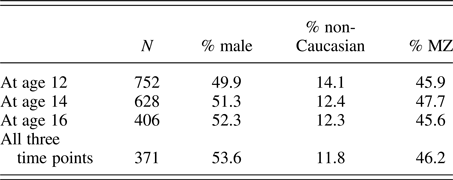
Subjects were adolescent twins participating in the longitudinal study of Genetics, Neurocognition, and Adolescent Substance Abuse at Washington University in St. Louis funded by the National Institute of Drug Abuse (NIDA Grant DA018899). All participants were recruited from the local population using a statewide birth record database, so the sample is largely representative of the general population. Exclusion criteria were minimal and included a history of serious head trauma and health conditions precluding a laboratory visit or the ability to perform the experimental tasks (e.g., severe visual impairment or mental retardation). The demographic and background variables about the subjects are summarized in Table 1. Initially, at age 12, 752 individuals participated, and at age 14 there were 628 participants, or 83.5% adherence. At age 16 there were 406 participants, with much of the attrition due to interruption of data collection due to a funding hiatus. After accounting for this factor, adherence from age 14 to 16 was 83.4%. The sample with assessments at all three ages (n = 371) had more males, fewer non-Caucasians, and more monozygotic twins than the base sample, but none of these differences were significant (χ2 < 1, p > .5). Thus attrition was as expected in longitudinal studies, and did not affect the representativeness of the sample. The assumption of random missing data allowed for including incomplete records in the analyses.
Demographic and background variables of study participants

Note: MZ, monozygotic twins.
Measures and procedure
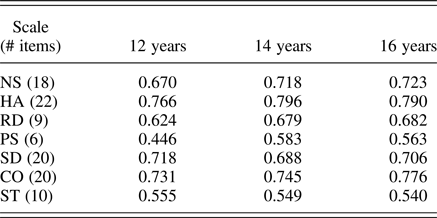
Personality was measured using the JTCI (Luby et al., Reference Luby, Svrakic, McCallum, Przybeck and Cloninger1999), at all three time points. The JTCI has been shown independently to be a psychometrically reliable and clinically valid instrument for adolescents in the United States (Copeland et al., Reference Copeland, Landry, Stanger and Hudziak2004; Rettew, Copeland, Stanger, & Hudziak, Reference Rettew, Copeland, Stanger and Hudziak2004; Rettew, Stanger, et al., Reference Rettew, Doyle, Kwan, Stanger and Hudziak2006; Tillman et al., Reference Tillman, Geller, Craney, Bolhofner, Williams, Zimerman and Beringer2003) as well as in authorized translations of the inventory in other countries (e.g., Andriola et al., Reference Andriola, Donfrancesco, Zaninotto, Di Trani, Cruciani, Innocenzi and Cloninger2012). The JTCI was administered to participants in a paper-and-pencil form as part of an assessment battery during their laboratory visits at ages 12, 14, and 16. They were instructed to “Try to describe the way you usually or generally act and feel, not just how you are feeling right now.” Mean ages at testing were 12.6, 14.6, and 16.6 (SD = 0.3 at each age). The JTCI is a 108-item inventory that uses a true–false format for response. The JTCI measures the seven major dimensions of the psychobiological model of temperament and character, using age-appropriate items corresponding to the adult TCI scales. It has four temperament scales: novelty neeking (NS); harm avoidance (HA); reward dependence (RD), and persistence (PS). It has three character scales: self-directedness (SD), cooperativeness (CO), and self-transcendence (ST). Scale reliability assessed by Cronbach α for each of the seven scales for each age group are summarized in Table 2 for this sample. Except for two short scales (PS and ST), all scales at each age group had acceptable reliability estimates ranging from 0.6 to 0.8.
Junior Temperament and Character Inventory scale reliability (Cronbach α)
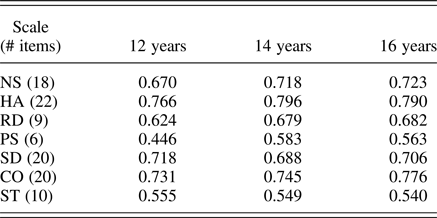
Note: NS, novelty seeking; HA, harm avoidance; RD, reward dependence; PS, persistence; SD, self-directness; CO, cooperativeness; ST, self-transcendence.
Race was coded was a binary variable (White vs. minority). A measure of socioeconomic status was derived from parental occupation data. Parental occupations were classified into nine categories according to Hollingshead (Reference Hollinghead1975), and the score categories were averaged for both parents. If only one parent provided occupational data, the family was assigned a score based on the available data from one parent.
Temperament and character profiles
Based on prior research showing that the temperamental disposition to healthy personality involved high PS combined with reliability (low NS, low HA, and high RD), we examined the sum of these as a measure of dependability or healthy temperament. The temperament profile associated with maturity and effective coping, dependability, was defined as [NS (reversed) + HA (reversed) + RD + PS].
We also examined two healthy character profiles: maturity, defined as [SD + CO], and creativity, defined as [SD × CO × ST]. These definitions have been validated in prior work: the sum of SD and CO reliably distinguishes individuals without personality disorder from others (Cloninger, Reference Cloninger2000), whereas the product of the three character traits distinguishes those with superior physical, mental, and social functioning from others (Cloninger & Zohar, Reference Cloninger and Zohar2011; Zohar et al., Reference Zohar, Cloninger and McCraty2013).
Data analysis
Rank-order stability analysis
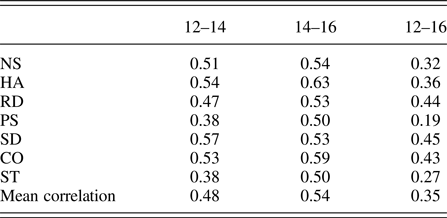
In order to be able to compare our results to earlier studies, we assessed rank-order stability over each 2-year period (12 to 14 and 14 to 16) and the 4-year rank-order stability (12 to 16); Pearson correlations were calculated for the trait scores using SPSS 21.1. Analysis of rank-order stability provided a basis for comparison to other studies. For each of the correlations of the seven traits for an age group, a mean correlation was calculated. The mean correlations for the three time periods were compared using the Fisher r-to-z transformation.
Hierarchical linear modeling (HLM)
For the total sample of 752 subjects, we carried out HLM using SAS. For the HLM, the total variance in each personality trait was partitioned using an analysis of variance into the between-group variance due to gender (male vs. female) and the within-subjects variance due to age (12, 14, and 16 years of age). This allowed the calculation of the intraclass correlation coefficient (ICC), which is the ratio of the between-group variance to the total variance. HLM has two levels of analysis. The first level is the fixed part, which is like any linear model producing a global trend. The second level is the random part, which generates one estimate for each individual. The random information is saved into a covariance matrix. Here, we focused primarily on the fixed effect because the random variables are the covariates race and socioeconomic status (SES) that we adjusted for in all our models. There were three steps to our HLM.
First, we verified the ICC for each variable to evaluate the applicability of HLM to our data set. We considered HLM to be applicable if ICC was higher than 0.05, indicating that there was substantial variance due to the between-group effect (gender in this study). All of the ICCs for each of our personality variables were higher than 0.30 (NS = 0.43, HA = 0.50, RD = 0.44, PS = 0.35, SD = 0.50, CO = 0.50, ST = 0.37, reliable temperament = 0.49, mature character = 0.56, and creativity = 0.38), suggesting that HLM was appropriate for modeling our data set.
Second, we followed a stepwise procedure to estimate the variability attributable to age, gender, race, and SES for each personality trait for boys and for girls. To do so, we added complexity (variables, interactions between variables, and quadratic models) in steps to a model by optimizing the Akaike information criterion. Specifically, we started with an empty model, that is, without any variables, and just a random intercept. Then, we added the age variable, which in this case has a fixed effect and still has a random intercept. Afterward, we added age as a random variable; however, if the results were worse than the previous model, we retained the better fitting model. Finally, we added all other variables. Because age and sex were almost all significant, we also considered Age × Sex interactions and age2. Although we did not find significant Age × Sex interactions, age2 was significant in some models, and we maintained this variable in those models. The effect of twin zygosity (monozygotic vs. dizygotic) was negligible, but race and SES were retained in all models as covariates. Thus, we evaluated the first or fixed effect of the model by considering the following measurements: intercept, slope for age, slope for age2, slope for sex, slope for SES, and slope for race. The amount of variance explained by these effects was estimated as the HLM pseudo-R 2 in SAS (Recchia, Reference Recchia2010). The resulting equation is summarized as
 $$\eqalign{ \hat Y & = intercept + {\rm \beta} _{\rm 1} + age + {\rm \beta} _2 {\rm \times} age^2 \cr & \quad + {\rm \beta} _3 {\rm \times} sex + {\rm \beta} _4 {\rm \times} SES + {\rm \beta} _{\rm 5} {\rm \times} race.} $$
Third, we considered the second level of analysis that corresponds to the random effect estimated for each individual. The random information was encoded as a matrix of the covariates race and SES, and we adjusted the model accordingly for each of the personality variables. In our analysis, we focused primarily on the fixed effects because the effects of the covariates were mostly small; however, they were significant for some variables and so we retained the covariates consistently in the full models for all variables.
Fourth, to visualize the model in an appropriate fashion, we only group variables by sex. Then, the intercept is not longer meaningful and we can exhibit differential shapes with the following equations:
 $$\eqalign{& \hat Y = intercept + {\rm \beta} _1 {\rm \times} age + {\rm \beta} _2 {\rm \times} age^2 + {\rm \beta} _3 {\rm \times} male \cr & \hat Y = intercept + {\rm \beta} _1 {\rm \times} age + {\rm \beta} _2 {\rm \times} age^2 + {\rm \beta} _3 {\rm \times} female.} $$
The difference observed in the plots (y-axis) is based on the sex_effect, which corresponds to the absolute difference in the dependent variable between male and female groups. The absolute values added the values of the intercepts:
 $$\hat Y = intercept + sec\_effect. $$
The intercepts in the plots exhibit relative values (slightly different from the real values) because they do not include the effect of the covariates (e.g., race or SES), which have an effect in the full model. We did not include this effect in the plots because of the endless possible combinations (e.g., White male with SES 1, Black female with SES 2, etc.). In sum, the current plots are sufficient to exhibit the differences (shape and sex effect) between and among age and sex, despite the relative values of the intercepts.
Analysis of temperament–character relationships
The relations between dependability in temperament or maturity in character at age 16 to temperament and character at earlier ages was analyzed in the sample of 371 adolescents with assessments at all three ages (12, 14, and 16 years). Blocks of temperament traits and/or blocks of character traits at ages 12 and 14 were used in regression analyses to predict dependability of temperament at age 16 or maturity of character at age 16 years. Boys and girls were analyzed separately in view of the consistent gender differences observed in HLM of the total sample and in this subsample. In this subsample, when boys and girls are considered separately, and successive ages are considered as pairwise comparisons, the hierarchical regression model is reduced to y = Xβ, which corresponds to the generalized linear model. These analyses were carried out in SPSS 21.1.
Results
Rank-order stability for TCI traits
The rank stabilities from ages 12 to 14 and 14 to 16 were not significantly different from one another; however, both were significantly higher than the mean correlation from age 12 to 16. Table 3 displays the correlations.
Pearson correlations for trait scores at ages 12, 14 and 16
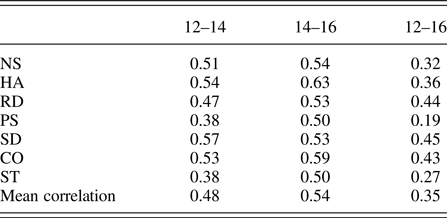
Note: All correlations were significantly different from 0 at p < .001. The mean correlation from age 12 to 16 is significantly smaller than the mean correlations from age 12 to 14 and from age 14 to 16 applying the method for dependent sample correlations (Meng, Rosenthal, & Rubin, Reference Meng, Rosenthal and Rubin1992): rdiff = –0.19, 95% confidence interval [–0.31, 0.15]; z = 5.35, p < .0001. NS, novelty seeking; HA, harm avoidance; RD, reward dependence; PS, persistence; SD, self-directness; CO, cooperativeness; ST, self-transcendence.
HLM analysis
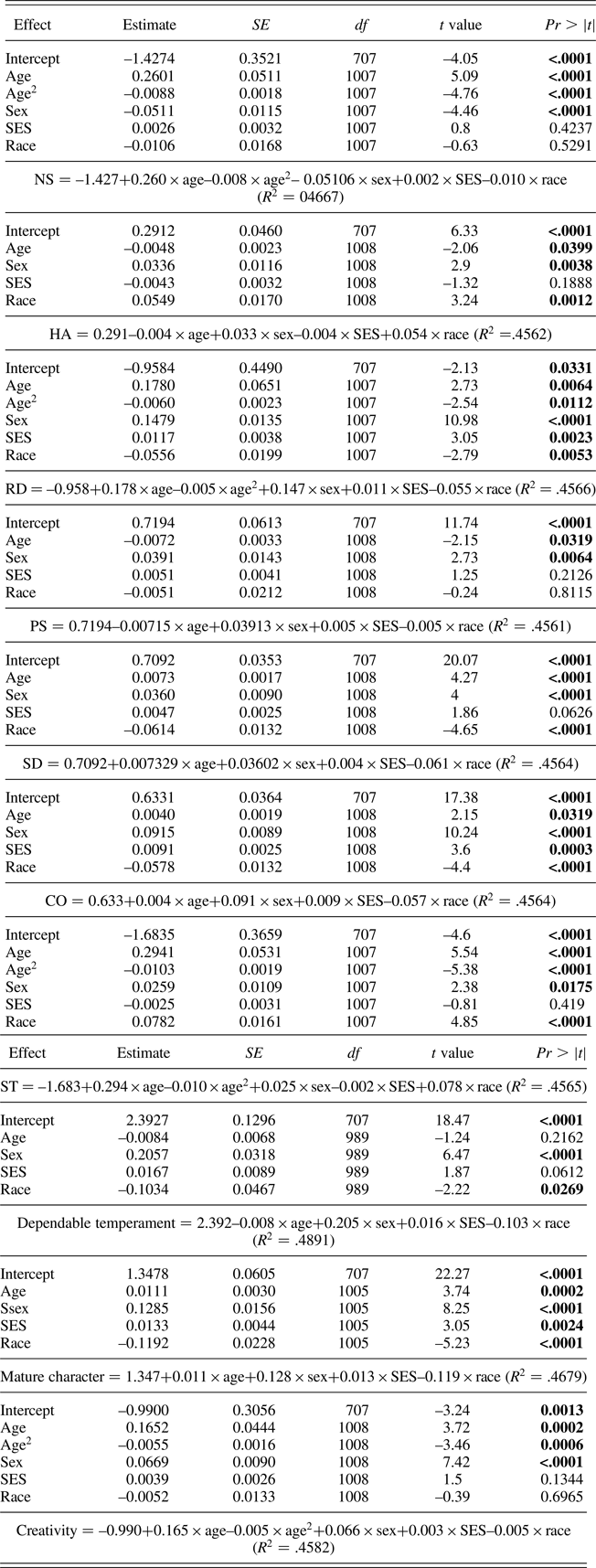
The effects of sex, age, age2, SES, and race on JTCI mean trait levels in the total sample were tested using HLM, as summarized in Table 4. Sex had a significant effect on all individual JTCI personality variables and the composite measures of temperament and character. The interaction of age and sex was not significant for any personality measure, so was omitted from Table 4.
Hierarchical linear modeling of Junior Temperament and Character Inventory personality trait development at ages 12, 14, 16. The “Estimate” column gives the values of the coefficients of the hierarchical linear regression equation for each personality variable. Significant values are in bold.
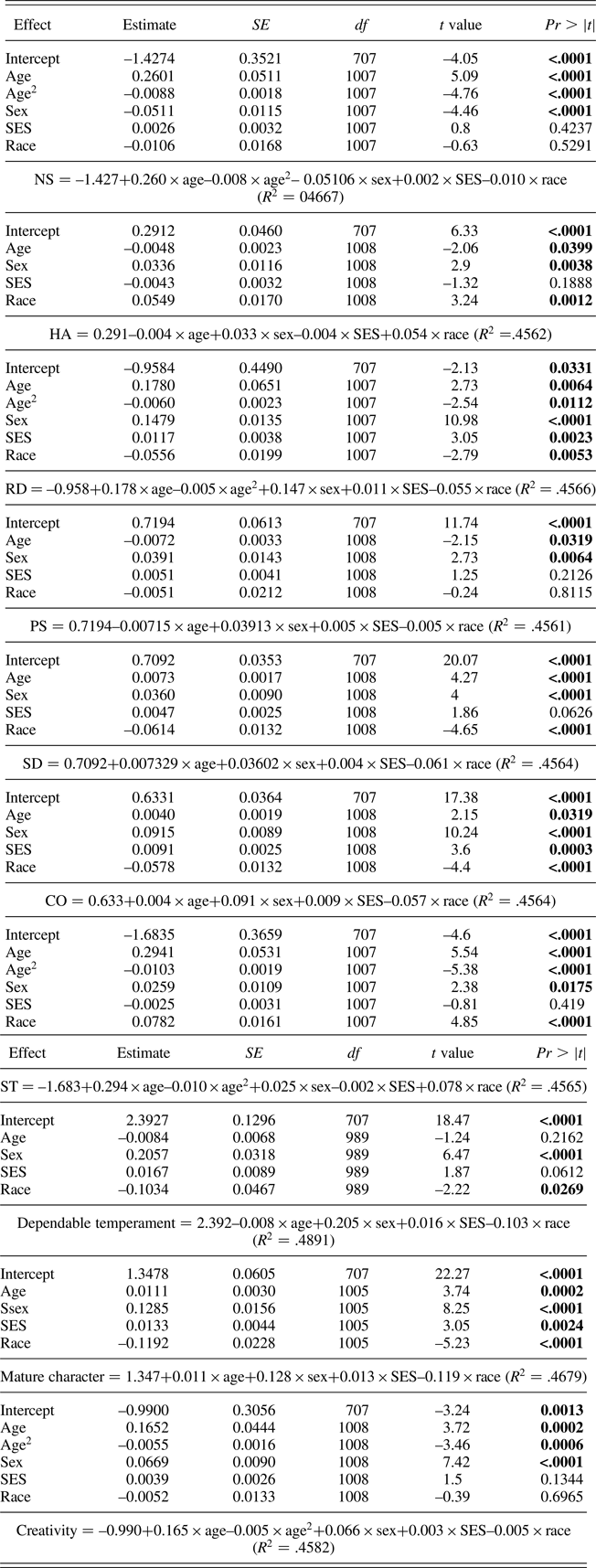
Note: SE, standard error; SES, socioeconomic status; NS, novelty seeking; HA, harm avoidance; RD, reward dependence; PS, persistence; SD, self-directness; CO, cooperativeness; ST, self-transcendence.
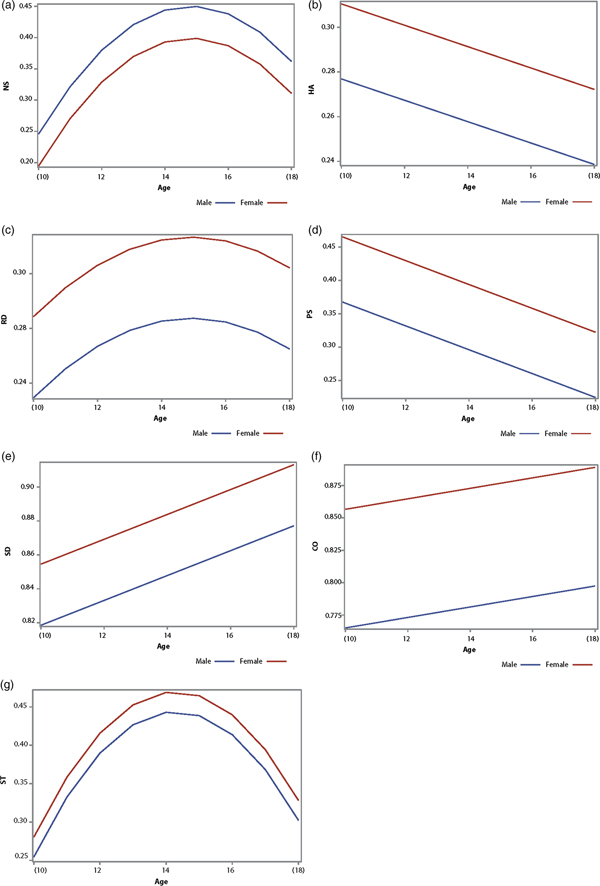
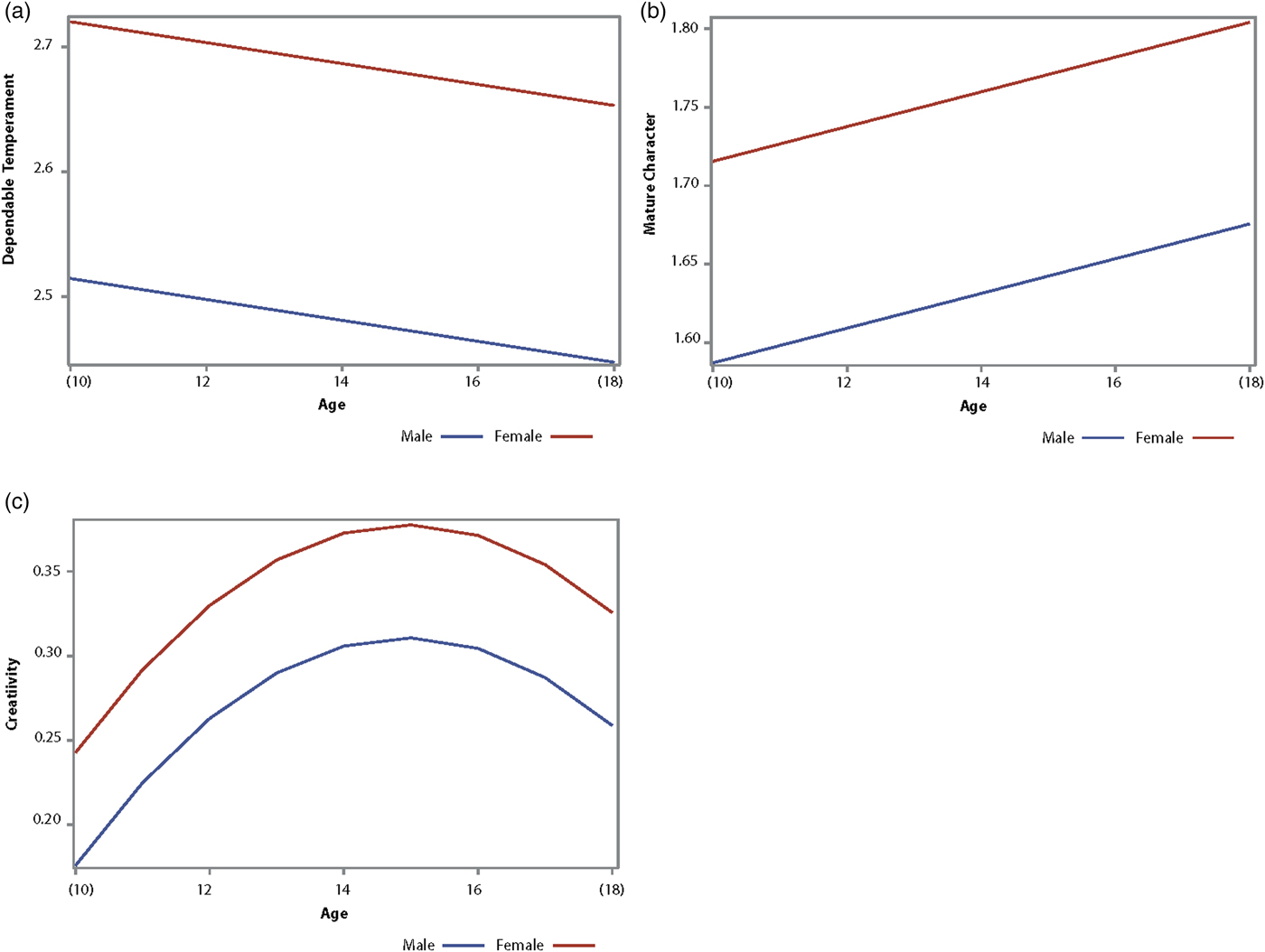
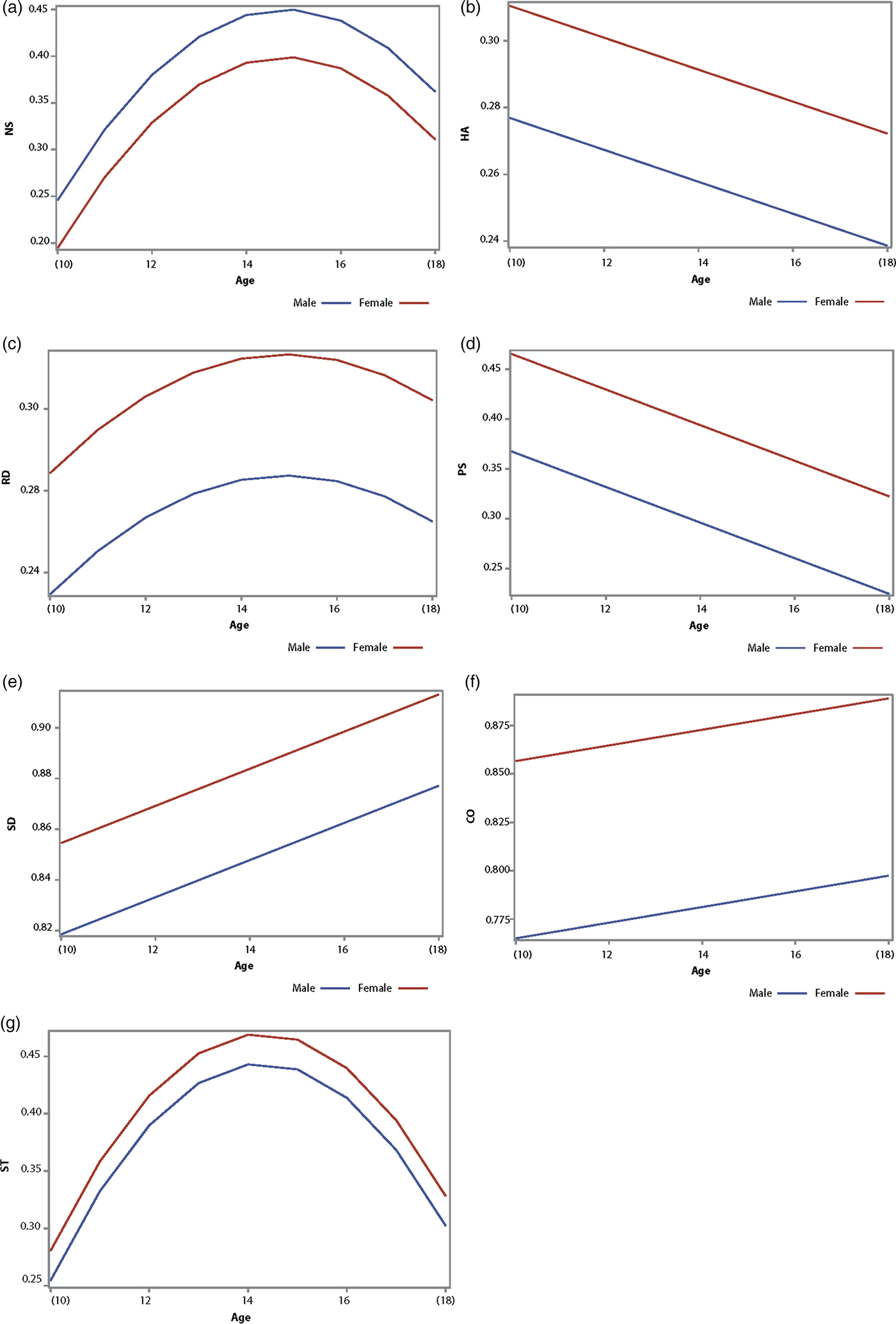
Girls had higher scores than boys at all ages for all the individual personality traits except for NS (Figure 1). Girls were also higher in the composite measures of dependable temperament, mature character, and creativity at all ages (Figure 2).
Age-related changes in individual dimensions of temperament and character during adolescence estimated using hierarchical linear modeling of longitudinal data around ages 12, 14, and 16. Average Temperament and Character Inventory scale scores per item on 5-point Likert scale on the vertical axis. Scores observed around 12, 14, and 16 are shown on the horizontal axis with unobserved extrapolation of the fitted continuous polynomial just to illustrate the form of the observed pattern.
Age-related changes in composite measures of healthy temperament and character during adolescence estimated using hierarchical linear modeling of longitudinal data around ages 12, 14, and 16. Average Temperament and Character Inventory scale scores per item on 5-point Likert scale on vertical axis. Scores observed around 12, 14, and 16 are shown on the horizontal axis with unobserved extrapolation of the fitted continuous polynomial just to illustrate the form of the observed pattern.
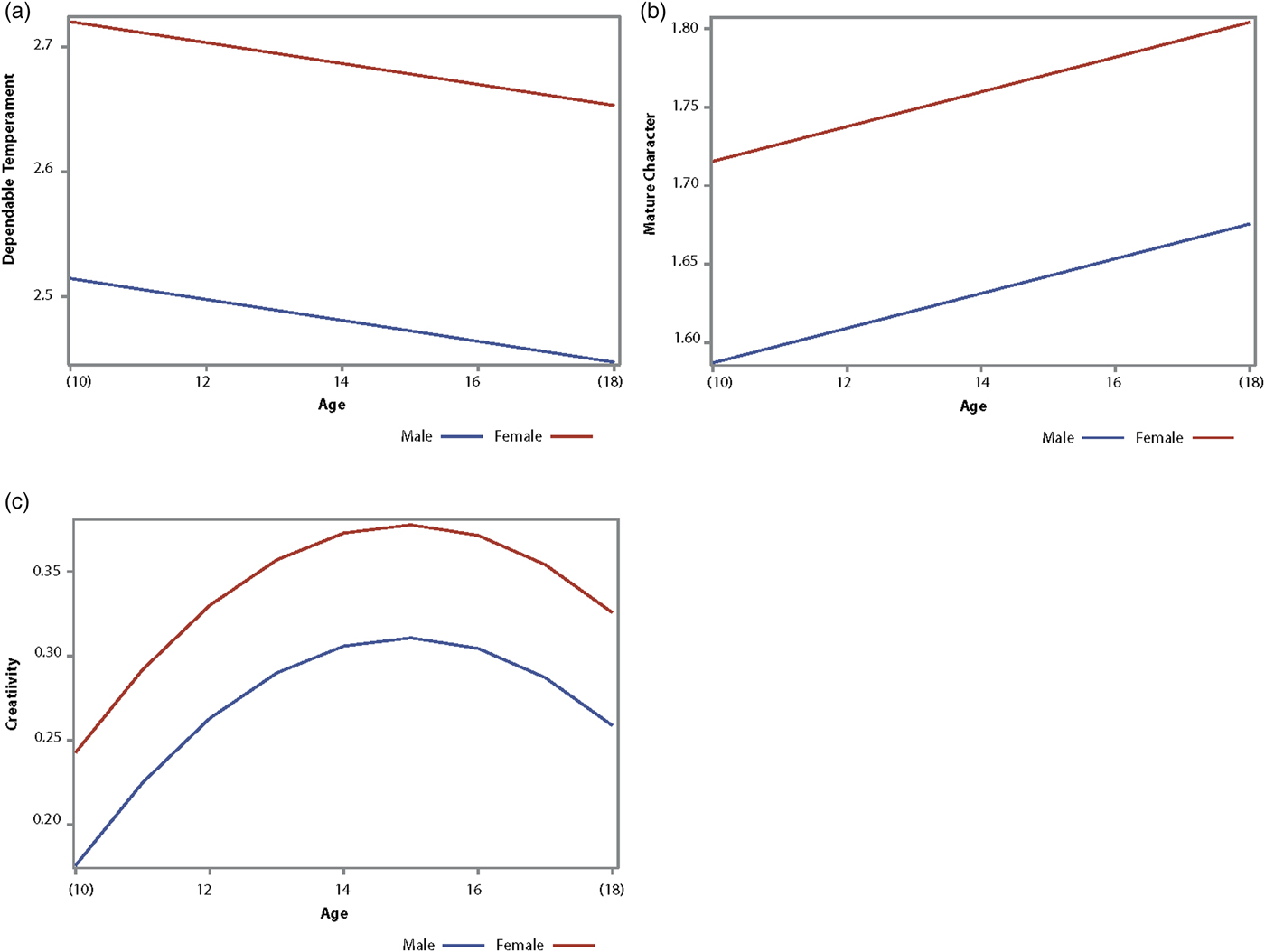
Age was associated with significant increases in levels of the individual temperament traits of NS (i.e., less rigid and obedient to convention and authority) and RD (i.e., more receptive to peer expectations and pressure), and with modest decreases in HA (i.e., less afraid of punishment) and PS (i.e., quicker to abandon previously rewarded behaviors), so the composite measure of dependable temperament did not change significantly (Table 4). In contrast, age was associated with a substantial increase in SD and the composite measures of maturity and creativity of character, as well as with a modest increase in the other character traits (CO and ST).
The quadratic function of age was significantly negative for NS, RD, and ST, and for creativity of character. Consequently, these personality traits had a curvilinear course peaking in middle adolescence around age 14 and then decreasing again (see Figures 1 and 2). In other words, teenagers first increase to age 14 in NS (i.e., become less obedient of authorities), RD (i.e., become more responsive to approval of social peers), and ST (i.e., become less traditional), and then as they approach age 16, they become more orderly, independent, and conventional. This pattern was observed for both genders, so no Age × Sex interactions were significant for any of these personality measures.
Teenagers from homes with higher SES were significantly less approval seeking (RD, –0.06), less helpful to others (CO, –0.01), and more mature in character (0.01), but these effects are very small compared to those of gender and age (Table 4). Likewise, compared to European American teens, minority-status teenagers were significantly more pessimistic (HA, 0.05), less sociable (RD, –0.06), less self-directed (SD, –0.06), less cooperative (CO, –0.06), as well as more unconventional (ST, 0.08), less dependable (–0.10), less mature (mature character, –0.12), and less creative (–0.005), but these effects are small compared to those of gender and age except for HA and SD (Table 4). Minority status was associated with becoming higher in HA (i.e., more anxious and pessimistic) and lower in SD (i.e., less purposeful and resourceful), and the effects were greater than those for age (HA: 0.0549 vs. –0.0048; SD: –0.0614 vs. 0.0073) or for sex (HA: 0.0549 vs. 0.0336; SD: 0.0549 vs. 0.0360; Table 4).
The relationship between temperament and character over adolescence
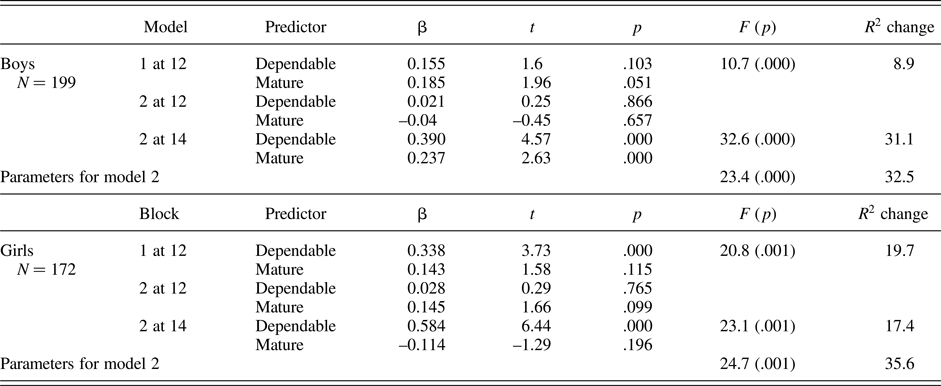
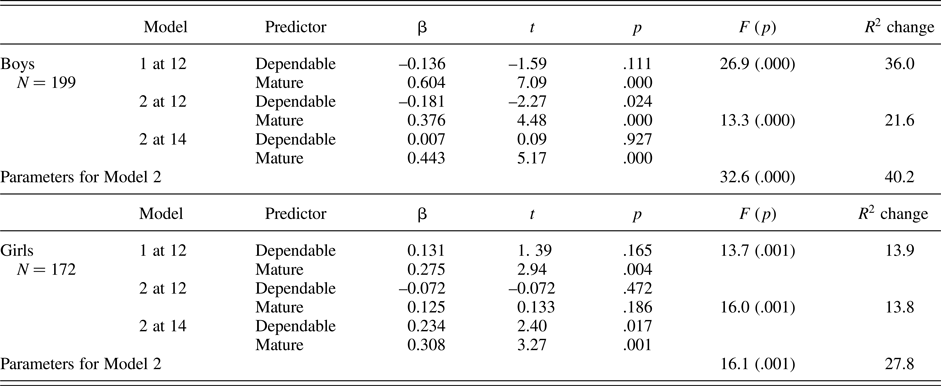
The correlation between dependability of temperament and maturity of character at each timepoint was high: at age 12 (r = .70, p < .0001), at age 14 (r = .69, p < .001), and at age 16 (r = .63, p < .0001). Therefore, we further examined the relationship between dependable temperament and mature character by conducting hierarchical linear regression, entering temperament and character at age 12 (Block 1) and then at age 14 (Block 2), to predict dependable temperament at age 16 or mature character at age 16. Because of the sex differences found for the traits and profiles, the analyses were conducted separately for boys and for girls. The results are shown in Table 5 for dependable temperament, and Table 6 for mature character.
Predicting dependable temperament at age 16 for boys and girls by hierarchical linear regression (Block 1 predictors at age 12, and Block 2 predictors at age 14)
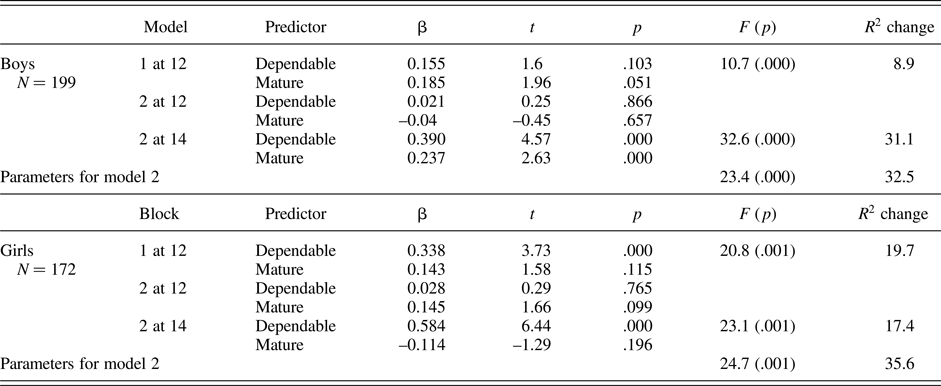
Note: Dependable temperament = [NS (reversed) + HA (reversed) + RD + PS]. Mature character = [SD + CO].
Predicting mature character at age 16 for boys and girls by hierarchical linear regression (Block 1 predictors at age 12, and Block 2 predictors at age 14)

Note: Dependable temperament = [NS (reversed) + HA (reversed) + RD + PS]. Mature character = [SD + CO].
For boys, dependable temperament at age 16 is predicted by earlier values of dependable temperament, and there is a trend for it being predicted by mature character at age 12 (p = .051). For girls, dependable temperament at age 16 is predicted by the earlier values of dependable temperament, and there is a trend for it being predicted by mature character at age 14 (p = .099).
For boys, mature character at age 16 is predicted by earlier values of mature character with no contribution from dependable temperament. For girls, mature character at age 16 is predicted both by earlier values of mature character and by earlier values of dependable temperament.
Discussion
Adolescence as a time of identity transformation
We found that temperament and character traits were only moderately stable from ages 12 to 16 (r = .35), which is consistent with findings for the FFM for personality development from ages 12 to 18 (McCrae et al., Reference McCrae, Costa, Terracciano, Parker, Mills, De Fruyt and Mervielde2002). In contrast, both temperament and character are much more stable in adults. Josefsson, Jokela, Cloninger, et al. (Reference Josefsson, Jokela, Cloninger, Hintsanen, Salo, Hintsa and Keltikangas-Jarvinen2013) followed a large multicohort sample of Finns from the age of 20 until they were 45, and found that the rank-order stability for the seven traits was much higher in adulthood with a mean correlation of 0.74. Zohar, Sandbank, and Gelfin (Reference Zohar, Sandbank, Gelfin and Stoyanov2015) followed older adults in the community over 6 years from mean age 58 to mean age 64 and found a mean rank-order stability of 0.78. The stability from age 12 to age 16 is approximately half that found in the studies of adults over the life span. Thus, it is clear that there is greater change in personality traits during adolescence than in adulthood.
The pattern of changes observed in early adolescence has sometimes been described as a period in which the maturation of personality is arrested or reversed (Göllner et al., Reference Göllner, Roberts, Damian, Ludtke, Jonkmann and Trautwein2016; Van den Akker et al., Reference Van den Akker, Dekovic, Asscher and Prinzie2014). We also found that NS increased from age 12 to 14 before declining again. This means that from the perspective of parents and other adult authority figures, the period from age 12 to 14 can certainly be viewed as impulsive and rebellious as young teens experiments with new ways of behaving as they develop autonomy from parental direction. The capacity to self-regulate emotional impulses by character strengths is not fully developed in early adolescence, especially for boys. Nevertheless, the full picture suggests that the observed changes are precisely what was needed for healthy identity formation in ways that allow society to adapt to changes in circumstances and aspirations of successive generations. Specifically, we found that the character traits of SD and CO increase consistently from age 12 to 16. In other words, teenagers are increasing in their sense of personal agency and autonomy (i.e., increasing in SD) in ways that they experience as being cooperative in the sense of being tolerant, empathic, helpful, forgiving, and principled (i.e., increasing in CO). However, in order to develop their own identity and values, they must be prepared to be more free from control by their parents and other authorities, so throughout adolescence they are decreasing in HA (i.e., less afraid of punishment) and PS (i.e., quicker to abandon previously rewarded behaviors). The increase in SD is substantial in early adolescence, and the associated modest decreases in HA and PS may provide further support for their developing capacity to be self-directed rather than controlled by others in authority. In addition, from age 12 to 14 teens become more eager to explore new ways of doing things, so they are less rigidly obedient to parents and other authorities (i.e., they increase in NS). Therefore, early teens are ready to experiment with new lifestyles in contrast to the more conservative adults represented by their parents and themselves increasingly from age 14 and older. At the same time that early teens are ready to try new ways of doing things that are not sanctioned by parental authority, they are also becoming more receptive to the norms favored by their peers (i.e., they increase in RD). This configuration of changes means that each generation has its own characteristic pattern of tastes, preferences, and values that distinguish it, so that sociologists find it useful to distinguish different birth cohorts in order to understand their behavior as society adapts to changing external conditions and internal aspirations (e.g., Baby-boomers, Generation X, Millennials, etc.). Once a person has begun to internalize his or her created identity around age 14, then the person gradually become less and less high in NS (i.e., more rigid) and RD (i.e., more independent of peer pressure). The decreases in NS and RD after age 14 are linked as well with decreases in ST, so people become more traditional and conservative from age 14 into much of adulthood. Overall, the whole pattern of change in two phases during adolescence allows teenagers to develop their own identity in ways that are distinct from their parents and other authority figures and that are also responsive to the changes in circumstances that influence successive generations. More formally, the process of emancipation from adult authority is facilitated by decreases in HA (i.e., less afraid of punishment) and PS (i.e., quicker to extinction of previously rewarded behaviors), along with increases in NS (i.e., less rigid and obedient) and SD (i.e., more autonomous). The process of identification with peers and their emergent social norms is facilitated by increases in RD (i.e., more desirous of peer approval), CO (i.e., more tolerant and empathic), and ST (i.e., less conventional and more self-forgetful and able to identify with others).
Our findings that NS, RD, and ST declined in the latter half of adolescence is supported by the inflexion point observed in other adolescent longitudinal studies of personality using other personality measures (Van Akker et al., Reference Van den Akker, Dekovic, Asscher and Prinzie2014). The rise in NS in the first part of adolescence is consistent with the rise found for openness to experience in a meta-analysis spanning adolescence (McCrae et al., Reference McCrae, Costa, Terracciano, Parker, Mills, De Fruyt and Mervielde2002). The decline of NS and RD in later adolescence is a trend that continues throughout adulthood, at a more gentle pace, as found in the Young Finns Study (Josefsson, Jokela, Cloninger, et al., Reference Josefsson, Jokela, Cloninger, Hintsanen, Salo, Hintsa and Keltikangas-Jarvinen2013). The decline in RD and NS starting in late adolescence is also consistent with the decline in extraversion throughout adulthood (Wortman, Lucas, & Donnellan, Reference Wortman, Lucas and Donnellan2012). It seems there is a peak of adventurousness and sociability in middle adolescence that is later tempered once the emergent identity begins to be internalized and reinforced socially and culturally by the newly created social norms.
Our finding that HA declined consistently with age throughout adolescence is consistent with the general tendency to optimism and vigor during adolescence. In adults 20–45 years of age, HA is more or less unchanged (Josefsson, Jokela, Cloninger, et al., Reference Josefsson, Jokela, Cloninger, Hintsanen, Salo, Hintsa and Keltikangas-Jarvinen2013), while neuroticism seems to decline throughout adulthood to old age (Wortman et al., Reference Wortman, Lucas and Donnellan2012). Likewise, the consistent decline in PS we observed during adolescence is consistent with adolescence being a period of transformation rather than stability. In adults, PS rises gently until middle adulthood (Josefsson, Jokela, Cloninger, et al., Reference Josefsson, Jokela, Cloninger, Hintsanen, Salo, Hintsa and Keltikangas-Jarvinen2013), and this trend is consistent with the rise in conscientiousness found throughout adult development (Wortman et al., Reference Wortman, Lucas and Donnellan2012).
Gender differences during adolescence
Throughout adolescence there were significant and consistent gender differences for all seven traits. Girls were lower in NS, higher in HA, RD, and PS, as well as higher in SD, CO, and ST (Table 4 and Figure 1). As can be seen in the parallel trajectories for girls and boys depicted in the figures, the process of personality development was very similar for both genders across adolescence.
However, girls exhibit more mature personalities throughout adolescence. As adults, they remain substantially higher in RD and CO, but the differences in other traits are weak (Josefsson, Jokela, Cloninger, et al., Reference Josefsson, Jokela, Cloninger, Hintsanen, Salo, Hintsa and Keltikangas-Jarvinen2013). Already during adolescence, the largest differences between the genders in personality were for RD and CO, indicating the greater social warmth and cooperation observed in women on average.
Predicting temperament and character profiles at age 16
Over the life span we expect maturation in the sense of adapting to changing environmental demands, personal aspirations, and a need for coherent integration of the various facets of a person's personality. To what extent are temperament and character profiles at age 16 a function of temperament and character profiles at age 12 and at age14? Hierarchical regression showed that dependable temperament at age 16 was mainly predicted by dependable temperament at age 12 and at age 14 for both boys and girls. However, for boys mature character at age 12 and 14 also played a formative role in dependable temperament at age 16. This suggests that the distinction between temperament and character is valid over adolescence, and that for boys, the self-regulation of temperament is increasingly aided by the growth of mature character traits. For girls, character has substantially matured by the start of the present study at 12 years of age, and its influence over temperament has already been exerted in childhood (i.e., before age 12).
Mature character at age 16 was predicted strongly by mature character at age 12 and at age 14 for both boys and girls. In addition, mature character at age 16 was predicted, albeit less strongly, by dependable temperament at age 12 in boys and at age 14 in girls. Thus character is influenced to some degree by earlier temperament, but it is mainly influenced by earlier character development, again showing the validity and utility of the distinction between temperament and character.
Cognitive aspects of identity formation in adolescence
Erikson described adolescence as the period of identity formation in which an individual's goals and values develop. In other words, character traits mature during adolescence, particularly SD as measured by the JTCI (Cloninger, Reference Cloninger2004; Vaillant, Reference Vaillant1993). Identity formation can also be understood in relation to the creative development of the narrative self as a person becomes self-aware of his or her own past, present, and future as a continuity in autonoetic consciousness (Tulving, Reference Tulving2001). Our identity involves a sense of continuity across time despite change, and this sense of continuity is a result of our autobiographical memory, which begins to mature by age 4 as regions of the brain that support self-awareness begin to myelinate (Levine, Reference Levine2004). As autobiographical memory matures, a person is able to mentally travel in time so that he or she can vividly recall past events and imagine future events in a coherent and detailed manner (Quoidbach, Hansenne, & Mottet, Reference Quoidbach, Hansenne and Mottet2008; Willoughby, Desrocher, Levine, & Rovet, Reference Willoughby, Desrocher, Levine and Rovet2012). Studies in children and adolescents, aged 8 to 16, show that girls and older subjects are better at recollection of vivid details of past experiences and imagination of vivid details of future events than boys and younger subjects (Willoughby et al., Reference Willoughby, Desrocher, Levine and Rovet2012). Being higher in NS predicts greater imagination of positive future events in autonoetic consciousness, that is, the feeling of mentally traveling through time and experiencing events as if they were happening (Quoidbach et al., Reference Quoidbach, Hansenne and Mottet2008). In addition, TCI CO strongly predicts the amount of detail in autonoetic consciousness for both past and future events (Quoidbach et al., Reference Quoidbach, Hansenne and Mottet2008). PS predicts the coherence of both recollected and imagined events in the same study; that is, higher PS is associated with people recollecting events in their lives in the context of a continuous life history rather than as isolated events.
In our study, we found that girls were much higher in CO and RD than boys, which is a consistent finding about gender differences in personality regardless of age (Cloninger et al., Reference Cloninger, Svrakic and Przybeck1993). We also found that girls develop a dependable temperament and mature character earlier than boys, suggesting that self-awareness (i.e., autonoetic consciousness) develops earlier in girls than in boys. The increase in levels of NS for both boys and girls between ages 12 and 14 suggest that identity and autonoetic consciousness are developing further during this period by means of the complex processes of emancipation and identification described earlier, rather than greater NS representing only an antimaturational trend as is usually inferred from behavioral observations that suggest greater impulsivity and rule breaking. In other words, identify formation requires both imagination and experimentation with personally valued goals, so emancipation (i.e., freedom from past conditioning and parental control) is not really antimaturational, even though it may be disconcerting to parents who want to continue controlling their teenage children. These findings together indicate that it will be useful to study the development of temperament, character, and autonoetic consciousness in terms of both cognitive and behavioral changes longitudinally from age 4 through 18. Such studies need to be longitudinal and person centered in order to characterize the dynamics of cognitive, temperamental, and character changes associated with emancipation, identification, and internalization of identity as a complex adaptive system (Cloninger et al., Reference Cloninger, Svrakic and Svrakic1997).
Adolescent personality change and psychopathology
The advent of adolescence, with the increase in independence and agency, as well as the increased influence of peers rather than parents, opens more choices than did childhood. Personality can be a buffer against the risks conferred by poverty and dangerous neighborhoods (Nieuwenhuis, Hooimeijer, & Meeus, Reference Nieuwenhuis, Hooimeijer and Meeus2015). Being high in the three character traits is associated with greater well-being throughout adolescence (Moreira et al., Reference Moreira, Cloninger, Dinis, Sa, Oliveira, Dias and Oliveira2014), and having a resilient personality can also be protective against feelings of loneliness and symptoms of depression (Vanhalst et al., Reference Vanhalst, Klimstra, Luyckx, Scholte, Engels and Goossens2012). Believing that personality change is possible (which may indicate greater flexibility and growth in autonoetic consciousness) has been shown to be protective against the stress of moving from elementary school to middle school (Yeager et al., Reference Yeager, Johnson, Spitzer, Trzesniewski, Powers and Dweck2014).
In contrast, exposure to alcohol (Blonigen et al., Reference Blonigen, Durbin, Hicks, Johnson, McGue and Iacono2015), to cannabis (Chabrol, Melioli, & Goutaudier, Reference Chabrol, Melioli and Goutaudier2015), or to both (Castellanos-Ryan, Parent, Vitaro, Tremblay, & Seguin, Reference Castellanos-Ryan, Parent, Vitaro, Tremblay and Seguin2013) is more likely to happen to children higher in NS and less mature in character (George et al., Reference George, Connor, Gullo and Young2010; Laucht, Becker, Blomeyer, & Schmidt, Reference Laucht, Becker, Blomeyer and Schmidt2007), and can in turn influence subsequent personality development (Blonigen et al., Reference Blonigen, Durbin, Hicks, Johnson, McGue and Iacono2015). Social inequity is also known to have a deleterious effect on health and well-being (Pickett & Wilkinson, Reference Pickett and Wilkinson2009; Wilkinson & Marmot, Reference Wilkinson and Marmot2003). For example, we found that minority status was associated with increased HA and decreased SD (i.e., greater neuroticism). Overall, a variety of stressful life experiences that interfere with development of the character traits needed to self-regulate emotional drives may impair health and well-being (Cloninger, Reference Cloninger2004). Having immature character is a diathesis for personality disorders (Chabrol et al., Reference Chabrol, Melioli and Goutaudier2015). Putting all of this together, it seems that early adolescence is a particularly vulnerable time for behavioral dysregulation because it is associated with less dependence on external inhibitions at the same time that the capacity for mature self-regulation remains only weakly developed. This vulnerability to dysregulation appears to be a personal price of the process of emancipation from past conditioning and control by authorities, but this personal price for some individuals serves to allow transformation of societal norms between successive generations as society must adapt to changing conditions and aspirations. The need to balance cost and benefits may imply a societal duty to minimize social inequity and the hazards of youthful experimentation while encouraging means for respectful dialogue between generations that are needed for healthy cultural evolution. Parents and children have complementary personality strengths, so they can learn from one another.
The present finding of somewhat delayed development of character traits relative to temperament traits, particularly in boys, is consistent with evidence from studies of brain development suggesting a developmental imbalance between relative maturity of primarily subcortical brain regions related to motivation and emotion and relative immaturity of brain regions supporting cognitive control during adolescence. This “developmental asynchrony” results from a delayed and more protracted maturation of primarily prefrontal cortical regions that continues into young adulthood. This neurodevelopmental imbalance can place adolescents at increased risk for poorly controlled, impulsive behaviors including substance abuse (Casey, Getz, & Galvan, Reference Casey, Getz and Galvan2008; Chambers, Garavan, & Bellgrove, Reference Chambers, Garavan and Bellgrove2009; Luna, Padmanabhan, & O'Hearn, Reference Luna, Padmanabhan and O'Hearn2010; Rubia, Reference Rubia2013; Spear, Reference Spear2013). Cognitive control (and a related concept of executive function) encompasses processes supporting deliberative self-regulation of planned, goal-directed behavior and top-down inhibitory control over motivational impulses and thus can be regarded as a neurocognitive foundation of the character domain of personality. This asynchronous development is particularly noticeable in boys, who show a significant increase in NS over adolescence and relatively delayed maturation of character. In particular, the pattern of developmental changes in adolescent boys (an increase in NS combined with a decrease in HA and low SD) may result in a greater propensity to reckless and impulsive behaviors and increased risk for externalizing-spectrum psychopathology such as conduct problems and substance abuse.
Overall, the pattern of developmental changes in temperament and character revealed in the present study is highly consistent with evidence for gender differences in the prevalence of internalizing and externalizing psychopathology in adolescence (higher in girls and boys, respectively).
In summary, it is reasonable to suggest that neurodevelopmental influences on adolescent behavior and psychopathology are largely mediated by differential developmental trajectories of temperament and character traits. Longitudinal studies involving extensive neurocognitive assessments and neuroimaging must shed light on these relationships.
Strengths and limitations of the study
This study represents the first prospective study of temperament and character change during adolescence. The strengths of the study are its prospective design and the representativeness of the sample. However, there are some limitations. First, even though the cohort with complete data at all three time points was representative of the initial sample, there was attrition over time. Using HLM to calculate the trajectories made up to a certain extent for the attrition. Second, the two short scales measuring PS and ST had only moderate internal consistency (0.5–0.6). Third, the personality traits of twins are correlated, so the subjects are not fully independent. Consequently, the standard errors of variables may be underestimated, so we have been conservative in interpretation of significance levels that we regard as modest (.01 < p < .05). Fortunately, most of our findings about the effects of age and gender on personality were highly significant (p < .01 and often p < .0001) rather than marginal (.01 < p < .05), and most findings are supported by comparable work in nontwins.
General implications and conclusions
Adolescence is a time of substantial change in personality as suggested by Erikson despite our findings that rank order of personality traits is somewhat stable. Personal goals and values, as measured by a person's profile of character traits, are intentional expressions of a person's identity or narrative self (Cloninger, Reference Cloninger2004; Cloninger et al., Reference Cloninger, Svrakic and Przybeck1993). Maturity of character at age 16 is influenced by both temperament and character at earlier ages, whereas healthy temperament is influenced primarily by earlier temperament. Thus during adolescence, both temperament and character are changing, but a person's identity, as expressed in intentional character traits, is formed through the maturation and integration of antecedent temperament and character traits. PS (i.e., emotional resistance to becoming discouraged) is associated with greater sense of coherence and continuity of events across the life span, so it contributes to the integration of temperament and character development in a coherent identity (Cloninger et al., Reference Cloninger, Zohar, Hirschmann and Dahan2012; Quoidbach et al., Reference Quoidbach, Hansenne and Mottet2008).
In other words, identity formation is the intentional self-actualization of personal goals and values, which is the construction of the narrative self in self-aware consciousness (Cloninger, Reference Cloninger2004). More briefly, character is “what we make of ourselves intentionally” (Kant, Reference Kant, Dowdell and Van De Pitte1797). In contrast, behavioral conditioning of prior temperament levels is what primarily shapes later temperament.
The differences we observed between temperament and character development during adolescence add further support to other findings that temperament and character are distinct domains of personality. Prior evidence supporting this conclusion has come from genetic (Gillespie et al., Reference Gillespie, Cloninger, Heath and Martin2003), brain imaging (Van Schuerbeek et al., Reference Van Schuerbeek, Baeken, De Raedt, De Mey and Luypaert2011), phylogenetic analyses (Cloninger & Kedia, Reference Cloninger, Kedia, Sussman and Cloninger2011), and studies of the effects of parental child rearing and early home environment (Josefsson, Jokela, Hintsanen, et al., Reference Josefsson, Jokela, Hintsanen, Cloninger, Pulkki-Raback, Merjonen and Keltikangas-Jarvinen2013), and studies of the effects of mindfulness training (Campanella, Crescentini, Urgesi, & Fabbro, Reference Campanella, Crescentini, Urgesi and Fabbro2014). All available data indicate that temperament and character are instantiated in dissociable but interacting brain networks regulating distinct systems of learning for behavioral conditioning of temperament and for intentional self-actualization of character, which are integrated into a more or less coherent identity in self-aware consciousness. Further longitudinal research is warranted to examine changes in temperament and character prospectively across the life span to complement the studies already available from age 12 to 16 and from age 18 to 45.