




No CrossRef data available.
Article contents
Cost-effectiveness of nutritional counseling for obese patients and patients at risk of ischemic heart disease
Published online by Cambridge University Press: 26 April 2005
Abstract
Objectives: Obesity and dyslipidemia are risk factors for ischemic heart disease, and prevention and treatment in primary care can reduce these risks. The objective of this cost-effectiveness analysis was to compare the costs and effects (in terms of life years gained) of providing nutritional counseling by a general practitioner (GP) or a dietician.
Methods: A total of 60 GPs, who accepted to participate, were randomized either to give nutritional counseling or to refer patients to a dietician for counseling. The life years gained was estimated using a Cox regression model. Costs were estimated on the basis of registered use of time (dieticians) or agreed salaries (GPs).
Results: The effect of nutritional counseling comparing GPs and dieticians is greatest when counseling is performed by a GP—0.0919 years versus 0.0274 years. These effects appear to be moderate, but they are significant. It is also proven that the GP group was the most cost-effective—the cost of gaining 1 extra life year was estimated to be 8,213 DKK compared with the dietician group, for which the incremental cost-effectiveness ratio was estimated to be 59,987 DKK.
Conclusions: The effects were moderate, but other studies of other patient groups and interventions report effects within the same magnitude. The GP group was the most cost-effective, but it must be concluded that both counseling strategies were relatively cost-effective. Even though the cost of gaining an extra life year was estimated to be 59,987 DKK in the dietician group, this might be an acceptable price.
Information
- Type
- GENERAL ESSAYS
- Information
- International Journal of Technology Assessment in Health Care , Volume 21 , Issue 2 , April 2005 , pp. 194 - 202
- Copyright
- © 2005 Cambridge University Press
Obesity and dyslipidemia are risk factors for ischemic heart disease (IHD), and prevention and treatment in primary care can reduce these risks (5). According to international guidelines, nutritional counseling should be initiated prior to eventual medical treatment (20).
Between April 2000 and December 2001, a Health Technology Assessment (HTA) study was conducted in Copenhagen County. The overall objective of the HTA study was to compare nutritional counseling by a general practitioner (GP) with that by a dietician to patients with obesity and high risk of IHD. The study of the counseling strategies included comparison of clinical as well as economic outcomes, organizational aspects, and patient perspectives (19).
This study describes the health economic part, and the objective was to compare the costs and effects (in terms of life years gained) of providing nutritional counseling by a GP or a dietician. The analysis was organized as a cost-effectiveness analysis (CEA).
MATERIALS AND METHODS
A total of 60 GPs, who accepted to participate, were randomized either to give nutritional counseling or to refer patients to a dietician for counseling (the study used two dieticians). Patients with high body mass index (≥30 kg/m2), large waist circumference (men>102 cm; women>88 cm), dyslipidemia, or type 2 diabetes were included. All patients were included by their GP. After inclusion, the intervention consisted of five counseling sessions over a 12-month period.
The GP intervention consisted of usual treatment, that is—according to focus groups with GPs—counseling in terms of general advice and delivery of commercially available written information on healthy diet. The initial counseling session was approximately 30 minutes, and the following session was approximately 12 minutes.
Intervention by dietician consisted of individual counseling based on the indication for referral, dietary history, and diet routines. Focus was on principles of good nutrition, advice on food shopping, cooking methods, meal planning, and exercise. Recommendations included restriction of total dietary energy, reduction of the fat component, and/or a cholesterol lowering diet. The initial counseling session was approximately 1 hour, and the following session was approximately 30 minutes (19).
Effects
The effects of the nutritional counseling were measured in terms of life years gained and life years gained without IHD, and a Cox regression model with age as the time scale was used to predict the effect of the intervention (2;18).
The included risk factors in the model were sex, cholesterol (including high density lipoprotein), systolic blood pressure, smoking, body mass index (BMI), diabetes, familial predisposition, and previous heart disease. These data were measured at the baseline examination.
Two Danish population studies (n = 11,765) with 10-year follow-ups were used to establish the risk scores in the model, and nine randomized clinical trials were used to estimate the effect of intervention (18). The Cox regressions described the time to a certain event by several covariates (risk factors) and an underlying survival function. The survival function was given by

where Σjβj·Zij is the prognostic index. βj is the β-coefficient for covariate j, and Zij is the value of covariate j for individual i. The absolute risk of an event (death or IHD) before the eightieth year was given by

where Ti was time of the event for individual i, and a was the current age.
For each included patient, the prognostic index, the absolute risk of dying before the eightieth year, and the absolute risk of IHD before the eightieth year were calculated before and after the intervention (the absolute risk of IHD was estimated as in equation II—the event was then IHD instead of death). That is, the intervention was compared with “no counseling” as it was assumed that the prognostic index remained unchanged without the intervention. The effects—life years gained and life years gained without IHD—was caused by the improvement in lifestyle that was influenced by the counseling sessions, and it was assumed that this improvement—which in terms of the model was reflected in the prognostic index—was maintained.
The life years gained (Δyears) was estimated as follows:

where Ri(a) was the absolute risk of dying before the eightieth year before and after the intervention, respectively. Remaining life expectancy is 80 years minus current age. That is, all included patients were expected to be 80 years, which is a simplification of reality. However, 80 years is close to the actual average life expectancy in Denmark. Eighty years was also chosen because the Cox regression model is able only to generate predictions for persons younger than 81 years.
Formula III is an estimate of the area between the survival curve before the intervention and the survival curve after the intervention. This area is equal to the life years gained.
It was assumed that the life years gained are gained at the end of life, that is, the life years gained were discounted for a period equal to the remaining life expectancy. The applied discount rate was 5 percent.
Costs
The following relevant costs were identified:
- Direct intervention costs—that is, time spent by the GPs and dieticians
- The patients' use of time
- Potential changed consumption of medicine due to the intervention
In addition, possible changed costs due to changed shopping routines caused by improved dietary habits (that is, more purchase of healthier food and less purchase of unhealthy food products) should be included. However, based on the available data and study design, it was not possible to estimate these potential changes in costs.
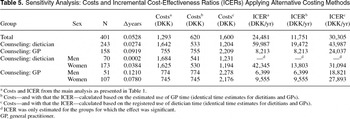
For the dieticians, the direct intervention costs were estimated on the basis of the dieticians' registered use of time (registered by the dieticians). The use of time was valued by the average hourly wage for dieticians in Denmark (12). The GPs involved did not in the same way register their use of time. Therefore, the intervention costs for the GPs were measured and valued on the basis of agreed salary, that is, the agreed salary or charge for visits at the GP were used (16). This costing method suggests certain methodically problems, because time estimates (for the dieticians) are compared with standard agreed salaries (for the GPs). Therefore, two alternative methods of estimation of the direct intervention costs are presented in the sensitivity analyses:
- Costs calculated based on the estimated use of GP time (identical time estimates for dieticians and GPs)
- Costs calculated based on the registered use of dietician time (identical time estimates for dieticians and GPs)
where the “estimated use of GP time” was calculated as the paid salary divided by the GPs average hourly wage. The average hourly wage for dieticians was based on data from Oekonomaforeningen (12), and the average hourly wage for GPs was calculated on the basis of the Overenskomst for almen praksis (16).
Costs accrued due to changed use of prescribed medicine were estimated on the basis of individual but encrypted data on prescribed medicine from a central prescription register.
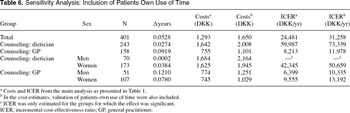
Inclusion of patients' use of time is not presented in the main results but is included in the sensitivity analyses. It is then assumed that the use of time at the first counseling session was 1 hour and 0.5 hours for the following five sessions. If the counseling session took place during working hours, it can be argued that there was a societal loss of production. And even if the patient was unemployed, the sessions were involved with costs, because the time spent on counseling could have been used alternatively.
The loss of production was calculated on the basis of sex- and age-specific hourly wages (gross) for the private sector (4), and the calculations were adjusted for work force participation (3). The human capital approach was applied.
The results for effects and costs will be presented separately as well as incremental cost-effectiveness ratios (ICER). The ICER is defined as follows:

where ΔC is the average incremental costs, that is, the extra costs of counseling compared with no counseling. Δyears is the average incremental effect, that is, life years gained compared with no counseling.
Sensitivity Analyses and Statistical Analyses
Inclusion of patients' use of time will be presented in terms of a simple one-way sensitivity analysis. Application of the alternative intervention cost estimates will also be presented in terms of simple one-way sensitivity analyses.
Confidence intervals (CI) for the effect and cost estimates will be presented but to estimate confidence intervals for the cost-effectiveness ratios, the nonparametric bootstrapping method was applied. The bias-corrected method was applied (1;7;17). A total of 10,000 iterations were performed in the SAS® System.
RESULTS
Of the 30 GPs who were randomized to refer patients to a dietician, 29 participated, and of the 30 GPs who were randomized to counsel themselves, 22 participated. In all, 503 patients were included in the study, where 312 received counseling from a dietician and 191 from a GP. Of the patients who were counseled by a dietician, 67.0 percent completed all six counseling sessions, and 68.1 percent of the patients who were counseled by a GP completed all the sessions.
Effects
It was not possible to predict the effect for all of the patients included, because missing data on the risk factors made estimation of the prognostic index impossible. For 401 patients, the effects in terms of life years gained were predicted, and for 377 patients, the effects in terms of life years gained without IHD was predicted.
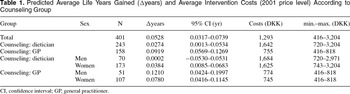
In Table 1, the average life years gained is shown. In total—when no comparison between GPs and dieticians are made—the effect of nutritional counseling, compared with no counseling (that is, an unchanged prognostic index) was an average gain of 0.0528 year. This effect, which is equivalent to 19.3 days, appears to be in the lower end, but the effect is significant (95 percent CI, 0.0317–0.0739). When GPs and dieticians are compared, it shows that the greatest effect appears when counseling is performed by a GP. For the dietician group, the effect was most distinct among women, whereas the effect was most distinct among men when counseling was performed by a GP. Finally, it should be noted that the average effect for men counseled by a dietician was insignificant.

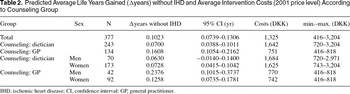
Table 2 shows the corresponding results for average life years gained without IHD. It shows that the effect of counseling was greater in terms of life years gained without IHD. Again, the effect was greatest for the patients counseled by a GP, and it should be noted that the average effect for men counseled by a dietician was insignificant.

Costs
Costs due to changed consumption of medicine were not included in the intervention costs, because analysis of the register data on prescribed medicine showed that the relatively small changes in the consumption of medicine for the two groups of patients before and after the intervention did not have significant impact on the cost level. The consumption of medicine was measured in defined daily doses (DDD) as well as DKK.
Intervention costs were then equivalent to the direct intervention costs, that is, time spent by the GPs and dieticians (patients' use of time is included in the sensitivity analysis). The average intervention costs are presented in Table 1. It shows that the intervention costs were higher for the dietician group compared with the GP group. Two factors influenced the costs: the number of counsels that the individual patient attended (degree of completion) and the duration of the sessions. The degree of completion was almost the same for the two groups (67.0 percent and 68.1 percent, respectively), but the duration of the individual sessions were longer in the dietician group; therefore, the costs were higher for this group.
Cost-Effectiveness
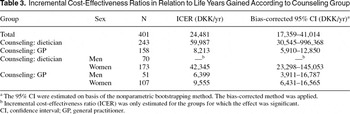
Table 3 presents the ICERs in relation to life years gained, that is, the ICER expresses the cost of gaining 1 extra life year. It shows that the GP group was the most cost-effective—the cost of gaining 1 extra life year was estimated to be 8,213 DKK compared with the dietician group, for which the ICER was estimated to be 59,987 DKK. When a distinction between sexes also is included, it shows that the intervention was most cost-effective in the group of men counseled by a GP.

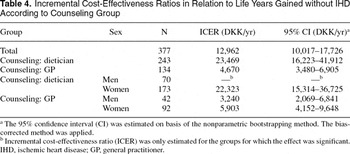
In the same way, Table 4 presents the ICERs in relation to life years gained without IHD, that is, the ICER expresses the cost of gaining 1 extra life year without IHD. In general, the ICERs were lower compared with Table 3, that is, the cost of gaining 1 extra life year without IHD was lower than the cost of gaining 1 extra life year. Again, it shows that the GP group was the most cost-effective—the cost of gaining 1 extra life year without IHD was estimated to be 4,670 DKK compared with the dietician group for which the ICER was estimated to be 23,469 DKK.

Sensitivity Analyses
In Table 5, the results from application of alternative costing methods are shown. It is proved that application of the method, where costs were calculated based on either the registered use of dietician time or the estimated use of GP time, that is, identical time estimates for dieticians and GPs, resulted in lower intervention costs for the dietician group compared with the GP group. However, counseling by a GP was still the most cost-effective.

Table 6 presents results where valuation of patients' use of time related to the counseling sessions was included in the cost estimates. This valuation caused an increase in the costs, which suggested a decrease in the cost-effectiveness, that is, higher ICERs, but the overall conclusion is still that the GP group was the most cost-effective. Sensitivity analyses (Tables 5 and 6) are only presented in relation to life years gained, but the conclusions also applied for costs and effects in relation to life years gained without IHD.

Statistical Analyses
To determine the precision of the ICERs, confidence intervals were estimated applying the bootstrapping method with 10,000 replications. In practice, decision making based on one ICER (point estimate) would not be considered adequate, for which reason estimation of confidence intervals is relevant (6). In Tables 3 and 4, the 95 percent CIs for the ICERs are shown. In general, the confidence intervals were wider in relation to life years gained compared with life years gained without IHD, and it was also proven that statistical uncertainty was greater for the dietician group than the GP group.
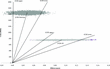
In Figure 1, bootstrapping plots for the dietician group and the GP group are shown (only plots for life years gained are shown), respectively. It appears that, for the GP group, all ICERs were in the first quadrant, whereassome plots for the dietician group were in the second quadrant, which in this case, suggests that the upper confidence limit (ICER upper) was approaching infinity. From the figure, it also appears that the statistical uncertainty was greater for the dietician group than the GP group.

Bootstrap plot, dietician group (n = 243), and general practitioner (GP) group (n = 158). The incremental cost-effectiveness ratio (ICER) Dietician/GP line corresponds to the ICER presented in Table 3 (row 3 and 4, respectively). The ICER lower line corresponds to the lower limit in the bias corrected 95% confidence interval presented in Table 3 (row 3 and 4, respectively). The ICER upper line corresponds to the upper limit in the bias corrected 95% CI presented in Table 3 (row 3 and 4, respectively).
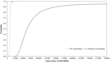
In Figure 2, acceptability curves constructed on the basis of the bootstrap iterations are presented. Given the axis of abscissas represents the decision-makers' maximum willingness to pay for a life year gained, it shows that probability of acceptance of GP counseling would have been much greater than acceptance of dietician counseling: If the maximum willingness to pay for a life year gained was 25,000 DKK, counseling by a GP would have been accepted with certainty, whereas counseling by a dietician would not have been accepted at all.

Acceptability curve.
DISCUSSION
Nutritional counseling of obese patients and patients at risk of ischemic heart disease by a GP or dietician has been compared. Effects were estimated on the basis of a Cox regression model, costs were estimated on the basis of the dietician's registered use of time and on the basis of GPs' salaries. The effects in terms of life years gained and life years gained without IHD were greatest and most distinct in the GP group, and the costs were greatest in the dietician group given the applied costing method. As a consequence, the GP group was the most cost-effective nutritional counseling strategy.
The use of models is always a limitation in itself, because models are a simplification of the behavior of individuals based on more or less strict assumptions. For example, it was assumed that the improvement of lifestyle was maintained, but this assumption may be realistic only if the counseling sessions are repeated or if there is some kind of follow-up beyond the year of intervention (11;15). On the other hand, it should be noted that data from patient questionnaires show that a majority of patients in both groups report that they have improved their dietary habits (unpublished data, Willaing et al., 2004).
Even though the effects were significant, and in that sense robust, it appears that the gains were moderate (e.g., numbers of life years gained in the interval of 0.0384– 0.1210 year, see Table 1 column 4, corresponding to 14–44 days). However, other studies of other patient groups and interventions report effects within the same magnitude: Maetzel et al. (2003) report an increased event-free life expectancy by 0.13 year over an 11-year period in a study where the value of pharmacological treatment of type 2 diabetes mellitus in overweight and obese patients is estimated (10). Sanders et al. (2003) analyze the effect of a potential vaccine for human papillomavirus (HPV) and report a life-expectancy gain of 2.8 days due to a decrease in HPV and subsequent cervical cancer (14). However, in relation to vaccine and screening programs, attention should be paid to the fact that, even though the effect on average appears low (e.g., 2.8 days in Sanders et al.; 14), the effect (e.g., avoided death because of avoided cervical cancer) on the individual level is high for the persons for whom death is postponed for years. In the present study, the counseling sessions and the subsequent change in lifestyle caused an effect for each included patient, and this effect was in terms of life years gained on average 0.0528 year.
Even though it could be argued that the effect of the counseling is limited, it should be noted that, for these obese patients, often there is no alternative to counseling and improvement of lifestyle and dietary habits. In Denmark, surgical treatment of adipositas involving reduction of the volume of the stomach (e.g., gastric bypass) is only performed on patients with BMI>40 (9).
The greater effect in the GP group may also have been caused by other circumstances, because even though it was the intention of the study that the intervention should consist of nutritional counseling, especially the GPs probably have combined the nutritional counseling with advice regarding other lifestyle changes, for example, smoking cessation. This broader approach in the GP group may have influenced the risk reduction positively.
The overall average intervention costs in relation to life year gained were 1,293 DKK. In Table 1, the minimum costs and maximum costs are presented but the 95 percent CI is 1,238 DKK; 1,347 DKK, which indicates little variation in the estimates.
The applied costing method—where the cost estimates were based on the dieticians' registered use of time and the GPs' salaries (reimbursement)—in principle suggests certain methodological problems, because time estimates are compared with standard agreed salaries. However, in this study, this method was the most relevant, because these cost estimates reflected the actual costs, that is, the actual time spent. But two alternative costing methods were applied, which resulted in lower costs in the dietician group compared with the GP group. Nevertheless the GP group was still the most cost-effective. If the dietician group should have been as cost-effective as the GP group, given the differences in effect, the average costs in the dietician group should have been 225 DKK, given the corresponding costs on 755 DKK in the GP group.
Based on the ICERs and the 95 percent CI alone, nutritional counseling by a GP should be preferred. However, the number of GPs in Denmark is expected to decrease (13), and the prevalence of this type of patients is expected to increase (5). This change indicates that cost-effectiveness considerations are highly relevant, but it also indicates that other health professionals besides GPs should be considered in relation to nutritional counseling.
Furthermore, attention should be paid to representativity of the GPs. Initially, all GPs in the region received information about the project. The included GPs responded positively to this information. This finding indicates that GPs with a special interest in preventive medicine possible are overrepresented.
The GP group was the most cost-effective, but it must be concluded that both counseling strategies were relatively cost-effective. Even though cost of gaining an extra life year was estimated to be 59,987 DKK in the dietician group, it might be an acceptable price. A Danish study (8) has estimated the willingness to pay per quality-adjusted life year (QALY) to be 88,000 DKK, and even though there is a difference in the measurement of effect—QALY versus life year gained—costs per life year gained that amounts to 59,987 DKK is apparently within an realistic magnitude.
Policy Implications
Among other studies, the present study was supposed to form the basis for future decisions on the organization for nutritional counseling in primary care. Even though GPs are estimated to be the most cost-effective, the study suggests that other health professionals could be involved in relation to nutritional counseling. Furthermore, results indicate that nutritional counseling should be combined with advice regarding other lifestyle changes.
This study actually formed the basis for the organization of primary prevention in general practice in the region. It is now possible for GPs to cooperate with other health professionals, for example, dieticians, concerning preventive services.
CONTACT INFORMATION
Jens Olsen, MSc (Econ) (jeo@cast.sdu.dk), Program Manager, Centre for Applied Health Services Research and Technology Assessment, University of Southern Denmark, Winsløwparken 19, DK-5000 Odense C, Denmark
Ingrid Willaing, MPH, RN (ingwil01@glostruphosp.kbhamt.dk), Research Manager
Steen Ladelund (stelad01@glostruphosp.kbhamt.dk), Statistician, Research Centre for Prevention and Health, Glostrup University Hospital, Ndr. Ringvej 57, Building 84/85, DK-2600 Glostrup, Denmark
Torben Jørgensen, DMSci (torjoe01@glostruphosp.kbhamt.dk), Director, Research Centre for Prevention and Health, Glostrup University Hospital, Ndr. Ringvej 57, Building 84/85, DK-2600 Glostrup, Denmark
Jens Gundgaard, MSc (Econ) (jgu@cast.sdu.dk), Consultant, Jan Sørensen, MSc (Econ), MSc (Health Econ), Director, Centre for Applied Health Services Research and Technology Assessment, University of Southern Denmark, Winsløwparken 19, DK-5000 Odense C, Denmark
References
Briggs A,
Fenn P.
1998
Confidence Intervals or Surfaces? Uncertainty on the cost-effectiveness plane.
Health Econ.
7:
723–
740.Google Scholar
Danmarks Statistik.
2001.
Statistical information, labour market. [Statistiske Efterretninger, Arbejdsmarked 2001].
Copenhagen:
Danmarks Statistik
Danmarks Statistik.
2003.
Wage statistics for the private sector. [Lønstatistik for den private sektor].
Copenhagen:
Danmarks Statistik
Dansk Selskab for Almen Medicin.
2002
Clinical guideline. Prevention of ischaemic heart disease in general practice [Klinisk vejledning. Forebyggelse af iskæmisk hjertekarsygdom i almen praksis]. 2. reviderede udgave.
Copenhagen:
Dansk Selskab for Almen Medicin.
Drummond M,
O'Brien B.
1993
Clinical importance, statistical significance and the assessment of economic and quality-of-life outcomes.
Health Econ.
2:
205–
212.Google Scholar
Glick HA,
Briggs AH,
Polsky D.
2001
Quantifying stochastic uncertainty and presenting results of cost-effectiveness analyses.
Expert Rev Pharmacoeconomics Outcomes Res.
1:
25–
36.Google Scholar
Larsen JF,
Jensen PMF.
2004
Obesity surgery [Adipositaskirurgi].
Ugeskr Laeger.
166:
790–
792.Google Scholar
Maetzel A,
Ruof J,
Covington M,
Wolf A.
2003
Economic evaluation of orlistat in overweight and obese patients with type 2 diabetes mellitus.
Pharmacoeconomics.
21:
501–
512.Google Scholar
Muir J,
Mant D,
Jones L,
Yudkin P.
1994
Effectiveness of health checks conducted by nurses in primary care: Results of the OXCHECK study after one year.
BMJ.
308:
308–
312.Google Scholar
Praktiserende Lægers Organisation.
1999
Forecast 1999—general practice. Supply and demand for GPs 1999–2020 [Lægeprognosen 1999—almen praksis. Udbud og efterspørgsel af alment praktiserende læger 1999–2020].
Praktiserende Lægers Organisation
Sanders GD,
Taira AV.
2003
Cost-effectiveness of a potential vaccine for human papillomavirus.
Emerg Infect Dis.
9:
37–
48.Google Scholar
SBU—Statens beredning för medicinsk utvärdering.
2002
Obesity–problems and interventions. A systematic literature review [Fetma—problem och åtgärder. En systematisk litteraturöversikt].
SBU
Sygesikringens Forhandlingsudvalg og Praktiserende Lægers Organisation.
1999
Agreement for general practice [Overenskomst for almen praksis].
Tambour M,
Zethraeus N.
1998
Bootstrap confidence intervals for cost-effectiveness ratios: Some simulation results.
Health Econ.
7:
143–
147.Google Scholar
Thomsen TF,
Davidsen M,
Ibsen H, et al.
2001
A new method for CHD prediction and prevention based on regional risk scores and randomized trials; PRECARD and the Copenhagen Risk Score.
J Cardiovasc Risk.
8:
291–
297.Google Scholar
Willaing I,
Jørgensen T,
Ladelund S, et al.
2003
Nutritional counselling in general practice by GP or dietician. A randomized trial in a HTA-perspective [Kostvejledning i almen praksis ved praktiserende læger eller diætist. En randomiseret undersøgelse analyseret i et MTV-perspektiv].
Forskningscenter for Forebyggelse og Sundhed,
Københavns Amt
Wood D,
Backer GD,
Faergeman O, et al.
1998
Prevention of coronary heart disease in clinical practice: Recommendations of the Second Joint Task Force of European and other Societies on Coronary Prevention.
Eur Heart J.
19:
1431–
1503.Google Scholar
Predicted Average Life Years Gained (Δyears) and Average Intervention Costs (2001 price level) According to Counseling Group
Predicted Average Life Years Gained (Δyears) without IHD and Average Intervention Costs (2001 price level) According to Counseling Group
Incremental Cost-Effectiveness Ratios in Relation to Life Years Gained According to Counseling Group
Incremental Cost-Effectiveness Ratios in Relation to Life Years Gained without IHD According to Counseling Group
Sensitivity Analysis: Costs and Incremental Cost-Effectiveness Ratios (ICERs) Applying Alternative Costing Methods
Sensitivity Analysis: Inclusion of Patients Own Use of Time
Bootstrap plot, dietician group (n = 243), and general practitioner (GP) group (n = 158). The incremental cost-effectiveness ratio (ICER) Dietician/GP line corresponds to the ICER presented in Table 3 (row 3 and 4, respectively). The ICER lower line corresponds to the lower limit in the bias corrected 95% confidence interval presented in Table 3 (row 3 and 4, respectively). The ICER upper line corresponds to the upper limit in the bias corrected 95% CI presented in Table 3 (row 3 and 4, respectively).
Acceptability curve.
 You have
Access
- 23
- Cited by