The Eastlake Library
Sir Charles Eastlake (1793–1865) was the first Director of the National Gallery, from 1855 until his death in 1865. He had been an avid book collector since his youth, and he lived for a number of years in Rome as a practising artist, where he fraternized with German as well as Italian artists and art historians. He served as Librarian of the Royal Academy from 1842 to 1844. During his 10 years as Director of the National Gallery, he made annual trips to continental Europe, especially to Italy, chiefly to acquire paintings for the Gallery, but also along the way collecting books to add to his library. Being fluent in several European languages, he acquired books in English, French, German, Italian, Spanish and Dutch. The library would eventually amount to over 2000 volumes, covering a wide range of publications and formats, monographs, periodicals, pamphlets, offprints, as well as a few manuscript volumes, mainly transcripts of unpublished source materials:
The Library includes:
-
• histories of schools and periods of art and monographs on individual artists
-
• theory and philosophy of art and aesthetics, including early treatises
-
• works on iconography
-
• dictionaries of art
-
• public and private collection catalogues
-
• auction catalogues
-
• travel guides
-
• practical manuals and technical literature
-
• and publications on antiquities, architecture, prints, literature, restoration and conservation, etc.
Eastlake's library was a working library for research, rather than a rare books collection, but it does include two incunabula, one of which is the Hypnerotomachia Poliphili printed in Venice in 1499. The second is Johannes De Ketham's Fasciculus Medicinae, the first illustrated medical work to appear in print, in 1500.
In 1865 Charles Eastlake died, still in post as Director, in the middle of one his annual trips to Italy. His widow Lady Eastlake wished to ensure that his pioneering work at the National Gallery would continue and be respected. After some negotiating, she sold the library to the Gallery, on condition that it be known as ‘The Eastlake Library’. The Eastlake Library has been the heart of the National Gallery Library collections ever since its acquisition in 1870.
Cataloguing challenges
Fast forward to the present: we faced two challenges in presenting the Eastlake Library to 21st century researchers.
The first challenge was that cataloguing of the collection needed to be brought up to rare books cataloguing standards. The collection was, in fact, catalogued within a couple of years of being acquired by the Gallery in 1870 as part of the accession process, and a single-volume printed catalogue, compiled by bookseller George Green, was published in 1872. However, this promising start was not systematically followed up for a very long time, with the result that, in the case of some of the books, nearly a century and a half later, the entry in the George Green catalogue remained the only catalogue record in existence.
The second challenge was the lack of online access to catalogue records. In fact, the National Gallery Library still has no public access online catalogue. As regards the Eastlake books, this situation was mitigated to some extent in 2012 when the 1872 George Green catalogue was digitised as a PDF file and made available via a link on the Gallery's web site; however, the unlikelihood of researchers finding their way to the PDF file, and the brevity of Green's catalogue entries, severely limit the usefulness of this resource.
So what are we doing about the situation?
Firstly, we have launched a rare books cataloguing project. With private funding, we are employing a rare books cataloguer, who is either creating new catalogue records, or enhancing existing ones, for the entire Eastlake collection. The records follow rare book cataloguing standards, including provenance information, notes about inscriptions, stamps, bookplates and inserted ephemera. During 2015 and 2016, 508 and 704 books were catalogued respectively, and the work continues. Overall, we have passed the half-way mark in terms of getting records into electronic format for the Eastlake Library. A recent focus has been the Eastlake books held in the Gallery's Technical Library, a satellite collection which supports conservation science and conservation-related research. Charles Eastlake's most influential publication was Materials for a History of Oil Painting, volume 1 published 1847, which was still in print, in an Italian translation, at the end of the 20th century. The cataloguing of these rare books on technical art history is supporting an in-depth article which is due to appear in the National Gallery Technical Bulletin in late 2017 on the relationship between the contents of the library and Materials for a History of Oil Painting.
Secondly, in order to address the lack of online access to catalogue records, we have launched a wider retrospective conversion and online access project. As mentioned earlier, there is still no general online public access to the National Gallery Library catalogue, and we only have electronic records for books catalogued since 2005, less than a fifth of our collection of around 100,000 volumes. The rest are still catalogued only on traditional 5 × 3 cards. Starting in October 2016, however, we sent seven boxes of sheaf catalogue paper slips for about 20,000 books, to Dublin, Ohio, to be converted by OCLC into electronic format. This first phase was completed by the end of March 2017, and the second phase is now underway. As part of the arrangement with OCLC, our records will be loaded into the WorldCat Art Discovery Group catalogue, and are now showing up in WorldCat. Moreover, in the second half of 2017, we anticipate loading our records into Copac, the union catalogue of research and specialist libraries in the United Kingdom and Ireland.
Eastlake's book collecting may well have been inspired by the example of the Cicognara Library. The National Gallery Library is participating in the international Digital Cicognara project, and a substantial portion of our holdings of pre-1821 titles have already been checked against the Cicognara catalogue. Depending upon the findings and requirements of the Digital Cicognara project, we hope to be in a position to digitize some unique or rare titles from the Eastlake collection in the near future.
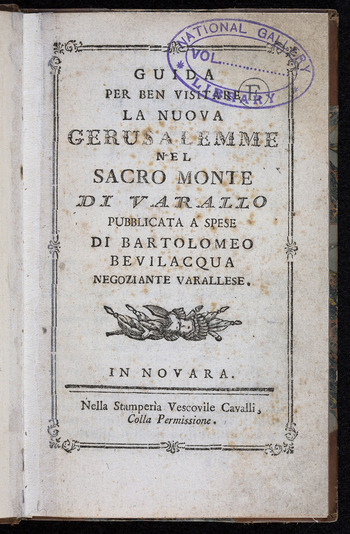
Guida per ben visitare la nuova Gerusalemme nel Sacro Monte di Varallo, Varallo 1787 (NG Library 109415).

Some collection highlights
Finally, here are a few examples of highlights from the Eastlake Library, chosen to illustrate something of the range and depth of the collection.
Guida per ben visitare la nuova Gerusalemme nel Sacro Monte di Varallo (Novara, 1787) is believed to be a unique example of the 1787 guidebook to the sacred precinct at Varallo Sesia in Piedmont, northern Italy, and is typical of the many guidebooks to Italian sites collected by Sir Charles Eastlake.
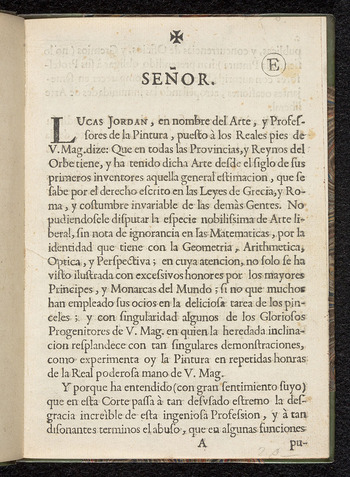
Luca Giordano's Memorial to Charles II of Spain, in praise of the Art of Painting (Madrid, 1690s?) is a printed memorial or petition by the Italian artist Luca Giordano (1634–1705), who was Court Painter to Charles II of Spain at the end of the 17th century. The text, which is written in praise of the art of painting, is undated but presumably relates to Giordano's time in Madrid. Again, copies are hard to locate in other libraries.
Luca Giordano, [A Memorial or Petition from Luca Giordano to Charles II of Spain, in Praise of the Art of Painting], 1690s? (NG Library 109417).

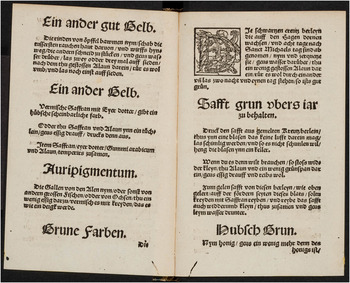
Drey Schoner Künstreicher Büchlein, Leipzig 1532 (NG Library 108051).

Drey Schoner Künstreicher Büchlein (Leipzig, 1532) is an extremely rare publication of which only a handful of copies exist outside libraries in Germany. Eastlake's copy is in very clean condition. The work contains recipes for textile cleaning, metalworking and dyeing.
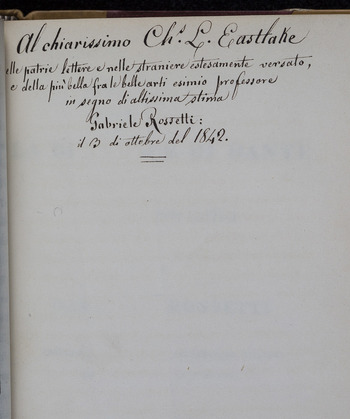
Gabriele Rossetti's La Beatrice di Dante (London, 1842) is an inscribed presentation copy to Charles Eastlake from the author, Gabriele Rossetti (1783–1854), who was the father of the Pre-Raphaelite painter and poet Dante Gabriele Rossetti. The work is a commentary with symbolic interpretation on the works of Dante.
Gabriele Pasquale Giuseppe Rossetti, La Beatrice di Dante, ragionamenti critici, London 1842 (NG Library 109416).

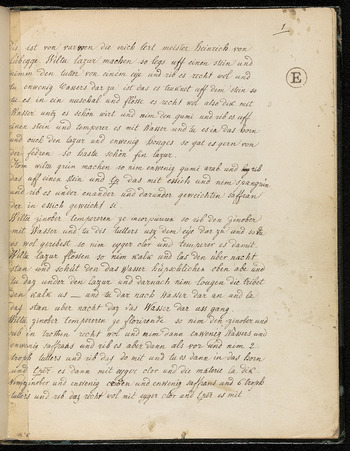
The Strasbourg Manuscript, nineteenth-century transcript (NG Library 108241).

The Strasbourg Manuscript was an early 15th century technical manual including recipes for the preparation of drying oil media and their application in panel painting, and an important source for the study of Northern European painting techniques. When the original manuscript was destroyed in a fire at Strasbourg Public Library in 1870, this handwritten copy in the Eastlake Library became the sole carrier of the text.