




No CrossRef data available.
Enigmas of Intolerance: Fifty Years after Stouffer's Communism, Conformity, and Civil Liberties
Published online by Cambridge University Press: 24 February 2006
Abstract
Scholars seeking to understand the causes and consequences of political intolerance are now celebrating the fifty-year anniversary of Stouffer's pathbreaking research on intolerance and repression. Yet despite substantial advances in our understanding of intolerance, several major unanswered questions remain. The purpose of this article is to identify and discuss these tolerance enigmas, while proffering some ideas about how future research on intolerance might proceed. The article begins by documenting the significance of understanding intolerance and concludes with speculation about how resolving these enigmas might contribute to a more peaceful and democratic world.James L. Gibson is Sidney W. Souers Professor of Government in the Department of Political Science, Washington University in St. Louis and a Fellow at the Centre for Comparative and International Politics, Stellenbosch University, South Africa (jgibson@wustl.edu). This is a revised version of the Alexander George Award Lecture, delivered at the International Society for Political Psychology Annual Conference, Eden Hall, Lund University, Lund, Sweden, July 15–18, 2004. The author is indebted to many for their comments and suggestions on earlier versions of this paper, including Dennis Chong, Jamie Druckman, Leonie Huddy, Jim Kuklinski, Marc Peffley, Brian Silver, and John Transue, and especially Stanley Feldman and Donald Green. He also appreciates the research assistance of Marc Hendershot. Support for the research on which this paper is based has been provided by the Weidenbaum Center on the Economy, Government, and Public Policy at Washington University in St. Louis, and Steven S. Smith in particular. This paper makes use of data collected from Russia with the support of the National Science Foundation (SBR-9423614 and SBR-9710137). The South African data were collected with support from NSF's Law and Social Sciences Program (SES 9906576). Any opinions, findings, and conclusions or recommendations expressed in this material are those of the authors and do not necessarily reflect the views of the National Science Foundation.
Information
- Type
- Research Article
- Information
- Copyright
- © 2006 American Political Science Association
Over the 50 years since Samuel Stouffer published Communism, Conformity, and Civil Liberties a great deal of attention has been devoted by social scientists to the problem of political intolerance. In the United States alone, comprehensive national surveys were conducted and reported by Nunn, Crockett, and Williams,1
Sullivan, Piereson, and Marcus,2 Gibson,3 and Davis and Silver,4 in addition to a variety of highly focused projects5See, for instance, Hurwitz and Mondak 2002.
See, for instance, Marcus et al. 1995. Because the study of political intolerance is a multi-disciplinary preoccupation, it is difficult to keep track of all relevant literature. A useful review can be found in Sullivan and Transue 1999.
For a recent study based on these data see Mondak and Sanders 2003a.
For examples, Bahry, Boaz, and Gordon 1997; Gibson and Duch 1993; Sullivan et al. 1985; Caspi and Seligson 1983; Sniderman et al. 2000; Peffley and Rohrschneider 2003.
The study of political intolerance is not of course entirely the domain of political scientists. See for example Kunovich and Hodson 1999.
That social scientists would allocate so many resources to investigating intolerance is understandable since political intolerance is one of the most pressing problems facing the world today. As cultures have come into closer interaction with each other over the last century (through globalization and emigration), clashes have often resulted. Tolerance is one of the few viable solutions to the tensions and conflict brought about by multiculturalism and political heterogeneity; tolerance is an essential endorphin of a democratic body politic. Is tolerance an issue of great practical import? Certainly Muslims in the United States, Arabs in France, Chechens in Russia, and Communists, Jews, and atheists throughout the world—to name just a few—would undoubtedly answer a resounding “yes!”
With so much research effort devoted toward understanding intolerance one might suppose that few important questions remain unanswered. In fact, that is decidedly not so. As studies have accumulated, at least five notable conundrums have emerged. These are all crucially important theoretical and empirical questions, and, until progress is made on solving these puzzles, it is unlikely that a better understanding of (and hence means of controlling) intolerance will emerge. In short, the pressing enigmas of intolerance are:
- Threat as an Unexplained Variable: The single most important predictor of intolerance—perceptions of the threat posed by one's political enemies—is an unexplained variable in nearly all studies of intolerance. Thus, the key determinant of intolerance is itself poorly understood. Despite several concentrated research efforts, we simply know very little about why some people are more threatened by their foes while others are less threatened. Without understanding the causes of this cardinal determinant of intolerance, it is unclear how more tolerance can be created.
- The Multidimensionality of Threat Perceptions: Perhaps one reason why variation in threat perceptions cannot be explained is that threat turns out to be a multidimensional concept. At a minimum, a crucial distinction exists between sociotropic threat—threats to the collective and its identity and ideology—and egocentric threat–direct personal threat. And perhaps counter-intuitively, personalized threat perceptions are not the most efficacious determinants of intolerance. Instead, those who see threats to their “way of life” —not their personal safety—often tend to be the most intolerant. Thus, support for political repression does not require that individuals perceive themselves as directly endangered.
- The Independence of Social and Political Intolerance: A less well-known but equally significant puzzle lies in the finding that social intolerance (prejudice in particular) and political intolerance are not necessarily closely connected. The conventional expectation that both are grounded in strong personality attributes (such as authoritarianism) has been challenged in at least two diverse research settings. No theory to date has propounded a differentiated explanation of the origins of social and political intolerance, and thus no unified theory of the etiology of intolerance exists.
- Measuring Intolerance: One might add to this list growing
concern over the measurement of intolerance. Since Sullivan, Piereson, and
Marcus first developed the so-called least-liked measurement
technology,10various scholars have expressed reservations about both the validity and reliability of the data produced by the questions. More recently, a provocative thesis has been asserted by Mondak and Sanders,11 who contend that tolerance is essentially dichotomous, not continuous. These measurement issues threaten to unravel further the progress that has been made to date in understanding intolerance.
The least-liked approach to measuring intolerance allows the respondent to identify her or his own target group. The intolerance questions are then asked about the group the individual names as “most disliked” (which means that the phrase “least-liked” is something of a misnomer). With the notable exception of the GSS, the least-liked approach has become the dominant measurement strategy among those who study intolerance. On measurement, see also Finkel, Sigelman, and Humphries 1999.
- The Asymmetry of Tolerance and Intolerance: Finally, although it seems natural to treat intolerance and tolerance as opposite endpoints on a single, unidimensional continuum, in fact evidence is accumulating to suggest that these two attitudes differ in ways that have numerous important consequences for psychometrics and real politics. Unfortunately, it appears from extant research that intolerance is a potent attitude, while tolerance is a weakling. Intolerant attitudes therefore have more substantial political consequences than tolerant attitudes. More research is necessary to understand how tolerance and intolerance are connected to various other attitudes toward democracy and majority and minority rights.
The fifty-year anniversary of Stouffer's pathbreaking study presents a propitious opportunity for a review of progress in the study of political intolerance.12
The first systematic, empirical study conducted of elite and mass intolerance was produced by the sociologist, Samuel Stouffer. Based on a survey in 1954 that was itself a landmark in the technology of survey research, Stouffer discovered widespread mass intolerance of Communists and a variety of “fellow travelers,” and considerably less widespread intolerance among a sample of local community leaders (“elites”). This study was executed in the context of the pervasive political repression of the McCarthy era, but also more generally gave rise to the elitist theory of democracy and many subsequent studies of mass and elite intolerance. Moreover, the conceptual framework Stouffer used to study intolerance—asking questions about whether hated political foes should be allowed basic civil liberties—has dominated and defined the subfield for the ensuing fifty years.
Preliminaries: A Minimalist Approach to Tolerance and Democratic Theory
Previous scholars have devoted a great deal of thought to conceptualizing political intolerance,13
See especially Sullivan, Piereson, and Marcus 1982, who clearly distinguish between “tolerance” and “toleration,” defining the latter as having to do with religion. Tolerance, on the contrary, has more to do with “struggles among political doctrines” (1982, 3). Indeed, the doctrine of religious toleration seeks “to remove religious opinions and religious conflicts from the political realm” (1982, 3). The understanding of tolerance I develop in this paper is a “minimalist” view since there are many useful and important ways in which the concept can be expanded beyond its core function in democratic theory.
A widely accepted definition of political tolerance asserts that tolerance requires putting up with that with which one disagrees.15
Crucial to this definition is the so-called objection precondition—one cannot tolerate (i.e., the word does not apply) ideas of which one approves. Political tolerance is forbearance; it is the restraint of the urge to repress one's political enemies. Democrats cannot tolerate Democrats, but they may or may not tolerate Communists. Political tolerance, then, refers to allowing political activity (considered below) by one's political enemies.But what exactly must the tolerant allow? Obviously, every society places some legitimate limits on the kinds of political activities in which groups can engage. Few would claim that tolerance requires putting up with terrorism or other acts of political violence. Nonetheless, there is a wide range of other actions, short of those that are generally illegal, about which people disagree. The challenging assignment is to specify a principled position from which the domain of tolerated behaviors can be derived.
Perhaps democratic theory can provide some guidance here. When empirical theorists speak of tolerance, they mean in most instances “political” tolerance. More specifically, they mean “democratic political tolerance,” or to be even more precise, “liberal democratic political tolerance.” That is, most understandings of tolerance are derived primarily from theories of liberal democracy. The key defining characteristic of a liberal democracy is that all political movements have institutionalized opportunities to compete for political power, that is, to try to become a political majority. Democracy is therefore a system that must grant unimpaired opportunities for all full citizens to
- formulate their preferences.
- signify their preferences to their fellow citizens and the government by individual and collective action.
- have their preferences weighed equally in the conduct of the
government, that is, weighted with no discrimination because of the
content or source of the preference.16
Dahl 1971, 1, 2.
Unless all political interests have an opportunity to persuade the majority, the marketplace of ideas is constrained, and competition among ideas cannot flourish. Without such competition, citizens may be denied the opportunity to support the political movements of their choice, political freedom may be lost, and democratic accountability may be undermined. Thus, the activities that must be tolerated in a liberal democracy are, at a minimum, those involving political competition—organizing, taking one's message to the people, competing in elections, etc. Why must these activities be tolerated? Because they make democracy work.
Finally, there is the matter of context. Few democratic theorists would deny to the state some rights to regulate the circumstances within which political views are expressed. Considerations of public safety and convenience are relevant—it seems quite legitimate not to close freeways so that groups can demonstrate. Yet invariably states attempt to quash freedom under the guise of regulation, and the threat of a disorderly reaction from onlookers at demonstrations is often used to justify the prohibition of marches.17
As in the so-called “heckler's veto”; see Gibson and Bingham 1985.
One other theoretical issue requires consideration. Although this understanding of tolerance is heavily molded by democratic theory, it does not equate democracy and tolerance. A reasonable hypothesis is that as political tolerance increases, the likelihood of successful democracy increases. But the relationship may not be entirely linear.18
At very high levels of tolerance, for instance, an increment in tolerance may not produce an increment in democracy, and indeed some even believe that at extreme levels (allowing all activities, by every conceivable idea), tolerance can undermine democracy.19See Rohrschneider 1996.
Note that Peffley and Rohrschneider (2003) refer to levels of tolerance in the 17 countries they study as “a scarce commodity” (248) and “abysmally low” (254), and generally conclude that “intolerance is the norm, tolerance the exception” (248).
Thus, tolerance means putting up with that with which one disagrees. It means allowing one's political enemies to compete openly for political power. A tolerant citizen is one who would not support unreasonable or discriminatory governmental restrictions on the rights of groups to participate in politics.
The consequences of political intolerance
Does political intolerance actually matter? Undoubtedly, there are chapters of American political history in which mass political intolerance was focused and therefore became pernicious. For instance, one understanding of the outbreak of repression associated with Senator Joe McCarthy goes as follows.21
See Gibson 1988 and Peffley and Sigelman 1989.
Many believe that intolerance in the United States grew after the attack of September 11, 2001.22
Huddy, Khatib, and Capelos (2002, 426) assert: “Compared with attitudes reported prior to September 11, the attacks … increased the willingness to forgo civil liberties.” However, the available data are fragmentary, and probably indicate what Americans view as necessary, rather than what they prefer.
Political intolerance can also provide the underpinning for a culture of conformity. I, for instance, have argued that perhaps the most pernicious effects of political intolerance are felt in the ways citizens repress each other, rather than in the way citizen-backed public policy limits political expression and political freedom.24
If intolerance creates a culture of conformity25See, for example, Noelle-Neumann 1984.
I do not mean to imply that this is the only causal structure that has emerged from the literature. Peffley and Rohrschneider (2003) demonstrate persuasively that political participation contributes to tolerance, rather than simply being a result of adopting a tolerant viewpoint. See also Sullivan et al. 1993.
Summary
In fifty years of research, much has been learned about the causes and consequences of intolerance. We know that intolerance is an ever-present threat to democratic politics, and that creating more tolerant citizens and societies is therefore a project of utmost importance to democrats. But although extant research on political intolerance has made some headway in understanding the causes and consequences of intolerance, several pressing conundrums remain. I turn next to these conundrums.
Five Tolerance Enigmas
Threat as an unexplained variable
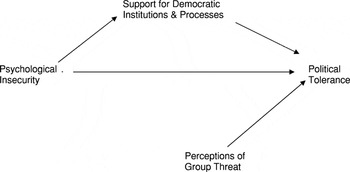
In what is indisputably the most important post-Stouffer study of intolerance in the United States, Sullivan, Piereson, and Marcus28
developed the model depicted in Figure 1 to account for variability in political intolerance.29There have been other important attempts to account for the variance in tolerance (e.g., Bobo and Licari 1989), but little other research identifies additional predictors with a strong theoretical grounding and consistent predictive capacity.
See also Marcus et al. 1995.
See McClosky and Brill 1983. However, this relationship may be fairly weak in transitional regimes, and in fact earlier research on the connections between tolerance and other democratic values in Russia indicates that only a modest correlation exists between these two constructs (Gibson 1998).

The Conventional, Cross-Sectional Model of the Origins of Political Tolerance
An obvious hypothesis is that those who are more psychologically insecure—and in particular those more willing to strictly divide the world into friends and foes (the definition of dogmatism33
Sullivan, Piereson, and Marcus (1982, 218) refer to psychological insecurity as the general concept. However, their empirical analysis makes plain that the overwhelmingly dominant influence on the measure of insecurity is dogmatism (or closed-mindedness). The failure of the other dimensions of insecurity to predict intolerance is an important but often overlooked finding from their research.
Indeed, when the threat measures are regressed on both the dogmatism and democratic values indicators, the resulting explained variances (R2) in 2000, 1998, and 1996 are: .00, .00, and .00. No relationship whatsoever can be found.
See, for example, Marcus et al. 1995 and Feldman and Stenner 1997.
See, for example, Gibson 2002.
Thus, the first major objective of future research on political intolerance should be to launch a new attack on explaining the variance in perceived threat. Several avenues seem potentially fruitful, ranging from developing better and additional measures of personality attributes39
An obvious possibility to consider is Sidanius' Social Dominance Orientations; see Sidanius and Pratto 1999.
Sniderman, Hagendoorn, and Prior 2004. The connection between threat perceptions and intolerance typically varies according to the specific groups named by the respondents in the least-liked question. However, since the least-liked approach is said to be “content controlled,” investigators have paid little attention to this finding. I suspect that the predominant type of threat perceived from groups varies according to the type of group. It seems unlikely that the threat perceived from homosexuals is similar in nature to the threat perceived from atheists, for instance.
Recent research (e.g., de Figueiredo and Elkins 2003) has shown that nationalism and patriotism are quite distinct phenomena, and therefore that they most likely have varying consequences for different types of threat perceptions.
The multidimensionality of threat perceptions
Convincing evidence that threat perceptions are not unidimensional has recently emerged, and several scholars now distinguish between sociotropic and egocentric perceptions of group threat.42
See, for example, Gibson and Gouws 2003 and Davis and Silver 2004. This distinction originates in research on citizen perceptions of the economy, with researchers typically distinguishing between the individual's own economy and the country's economy. Sociotropic economic perceptions generally are more useful for predicting political phenomena than egocentric perceptions. See for example Alvarez and Nagler 1998. Davis and Silver (2004, 34) define sociotropic threat perceptions as “a generalized anxiety and sense of threat to society, the country as a whole, or the region where one lives,” and egocentric perceptions as “a sense of threat to oneself or one's family.”
Gibson 2004a. For a similar finding on group power, see also Marcus et al. 1995.
Moreover, sociotropic threat perceptions have more powerful consequences for intolerance than egocentric threat,44
See, for example, Sniderman, Hagendoorn, and Prior 2004.
It is perhaps interesting to note that Stouffer (1955) found that one of the distinguishing attributes of Communists for the American people was their “godlessness,” not their control of nuclear weapons. The magnitude of the ideological difference seems to be the driving force in creating perceptions of threat from groups.
An associated paradox is that perceptions of group power (or potential for power) have virtually no consequences for political intolerance.46
See, for example, Marcus et al. 1995 and Gibson and Gouws 2003.
The original threat items were constructed without making an explicit distinction between types of threat; differentiating between sociotropic and egocentric threats has largely emerged as a result of induction rather than deduction. Obviously, a group characterization such as “dangerous to society” is measuring sociotropic threat, as is “not willing to follow the rules of democracy.” Alternatively, a query asking the respondent to assess whether the group is “likely to affect how well my family and I live” is tapping egocentric concerns. However, some adjectives are ambiguous (e.g., “unpredictable”), and in general little thoughtful consideration has been given to developing separate egocentric and sociotropic indicators of group threat.
More generally, little systematic effort to establish the validity, reliability, and dimensionality of extant measures of threat perceptions has been conducted. Davis and Silver, for instance, report that the two types of threat are correlated in the United States at .4447
, which is actually a fairly strong relationship for survey data. I report a similar correlation for black South Africans.48 Are the two types of threat truly distinct, and how might valid and reliable multiple indicators of each type of threat be created? Moreover, do different types of threat have different neurological representations, as some have suggested?49See, for example, Marcus, Wood, and Theiss-Morse 1998.
Other frailties afflict the conventional indicators of perceived group threat. For instance, most studies measure threat perceptions using seven-point semantic differential scales (e.g., respondents might be asked to rate the group's power on a seven-point scale ranging from “powerful” to “powerless”). Since the threat questions are asked of an extremely disliked political group (by definition, given the least-liked technology), it should not be surprising that a majority of respondents—for some items, an extraordinary majority—selects the most extreme point on the scale. This produces skewness and degenerate variance, which no doubt have undesirable statistical consequences. Therefore, the response sets for the threat scales are also in need of reconstruction and recalibration.
Thus, one major focus of future research on intolerance should be to develop and test new indicators of sociotropic and egocentric threat perceptions, as well as to explore more thoroughly perceptions of the power (and power potential) of hated political enemies.50
One important deficiency of the GSS tolerance measures is that no measure of perceived group threat is available for the five groups about which the questions are asked. Some scholars have attempted ingenious ways of developing surrogates for such measures (e.g., Wilson 1994), but these are at best surrogates, not direct measures.
The independence of social and political intolerance
In the original work of Sullivan, Piereson, and Marcus51
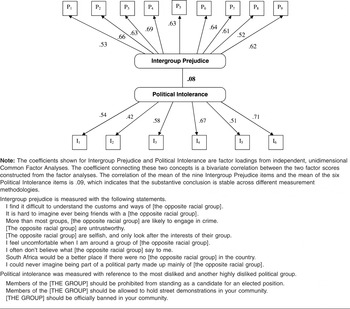
, an important but a little-noticed finding was presented to the effect that prejudice toward a group and intolerance of political activity by the group are distinct. This finding is certainly compatible with the marked segregation of scholars studying intergroup prejudice and political tolerance. To a truly remarkable degree, those who study intergroup prejudice and those who work on political intolerance rarely intersect.Many scholars presume that prejudice and intolerance fit hand in glove. For instance, Stenner makes this assumption explicitly. She asserts: “This work began with the conviction that racial, political and moral intolerance, normally studied in isolation, are really kindred spirits: primarily driven by the same fundamental predispositions, fueled by the same motives, exacerbated by the same fears.”52
Stenner 2005, 325.
In Overcoming Apartheid: Can Truth Reconcile a Divided Nation? independent measures of intergroup prejudice and political intolerance were developed. As Figure 2 depicts, both of these are multiple indicator constructs.53
Additional details about these measures can be found in Gibson 2004a.

Political Intolerance and Intergroup Prejudice in South Africa, Black South African, 2001
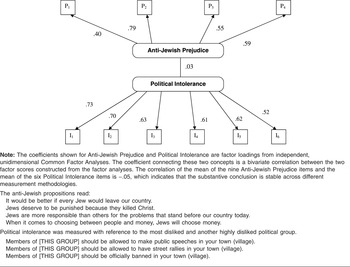
Are the South African findings idiosyncratic to South Africa? Available data suggest not. Howard and I investigated anti-Jewish prejudice in Russia based on data from a survey in 2000.54
Both political intolerance and anti-Jewish prejudice (stereotypes, scapegoating, etc.) were measured. As Figure 3 depicts, the correlation between prejudice and political intolerance is .03!55Both indices are reliable, with a Cronbach's alpha of .80 for Political Intolerance and .67 for Anti-Jewish Prejudice.

Political Intolerance and Intergroup Prejudice in Russia, 2000
Why are social and political intolerance so weakly connected in these two analyses? One answer may have to do with measurement: The political tolerance items assure that all respondents are reacting to a highly disliked political enemy (through the least-liked technology). Prejudice researchers, on the other hand, typically preselect a group (as in the items asking about Jews) and therefore questions are asked of at least some respondents who hold no animus whatsoever toward the group.56
However, this may not be an adequate explanation for the findings. Based on a separate measure of general affect (like versus dislike) of Jews, this correlation was re-calculated among that portion of the Russian sample expressing any degree of negative affect toward Jews. This group is therefore asked the anti-Semitism questions about a group about which they feel negatively, and the intolerance questions by definition addressed highly disliked groups. The correlation of prejudice and intolerance among this portion of the Russian sample is an amazing −.01. Prejudice and intolerance are absolutely unrelated.
Investigating further the relationship between prejudice and intolerance should be one of the most important tasks of future research if it is to be established that these Russian and South African results are not anomalies. To begin, measures of social intolerance (prejudice, social distance) for the groups identified in the least-liked questions should be developed. This will allow the assessment of whether the types of intolerance are related, based upon social and political questions asked about exactly the same group.
Future research should also extend the least-liked logic to ethnic groups, asking the respondents to identify the ethnic group they dislike the most. Both social and political intolerance questions can then be asked about this group. This strategy would also allow the assessment of the relationship between the two types of intolerance.
Of course, with better (and more direct) measures of the personality attributes of the respondents, researchers may well discover a common origin to both types of intolerance.
Experimental vignettes57
See, for example, Gibson 2004a.
See, for example, Sniderman, Hagendoorn, and Prior 2004.
My own view is that expressing prejudice toward one's political enemies is simply not a precondition for political intolerance. What groups stand for is a sociotropic factor, which is quite different from the perceived characteristics of the individual members of the group. For many, it is not necessary to ascribe a series of negative stereotypes to those with whom political disagreements are severe.59
Conversely, Sullivan, Piereson, and Marcus (1982, 4) argue that “Tolerance … is not merely the absence of prejudice … The prejudiced person may in fact be tolerant, if he understands his prejudices and proceeds to permit the expression of those things toward which he is prejudiced.” They conclude: “Thus, the prejudiced person may be either tolerant or intolerant, depending on what action he or she is prepared to take politically” (1982, 5).
Measuring intolerance
The least-liked measurement technology introduced by Sullivan, Piereson, and Marcus has been a major contribution to the study of intolerance. Nonetheless, many have expressed unease with this approach to measuring intolerance60
See, for examples, McClosky and Brill 1983, Gibson 1986, Sniderman et al. 1989, Chong 1993, and Hurwitz and Mondak 2002.
The least-liked measurement approach ensures that all respondents are reacting toward their most disliked political enemy, and therefore measures intolerance at the extreme in the sense that the group asked about is as distant from the respondent as possible. The least-liked group is obviously a strong stimulus, but is useful for many political and analytical purposes.
But it is also important to know something about the “breadth” of intolerance, by which I mean the range of differences in ideas that is not tolerated. Perhaps many people can name a particular group/idea that they find uniquely offensive (in the twentieth century context, Nazis, for instance), and owing to the extraordinary nature of the group or idea, they would not tolerate it. At the same time, however, the category of not-tolerated-ideas or groups is limited to this most extreme instance.
Other citizens express intolerance for their most disliked group, but are also willing not to tolerate many other groups that are disliked less than the most disliked. This gives these citizens a broad range of groups, perhaps covering a considerable expanse of ideological territory, that they will not put up with. Most Americans in the 1950s would not tolerate political activity by Communists; but most also would not tolerate political activity by socialists, atheists, and even “integrationists.”61
Stouffer 1955. For an engaging and insightful analysis of how race and anti-Communism got conflated in Texas in the 1950s (and in Houston in particular) see Carleton 1985.
To address this issue, one must ask questions about not just the most disliked group, but many different groups. So, for instance, the World Values Survey asked about only a single group, thus providing no information on breadth (Peffley and Rohrschneider 2003). Gibson and Gouws (2003), on the other hand, asked about several groups, giving the authors at least some purchase on the breadth question. Providing a spatial analysis of the breadth of ideological difference deemed legitimate in a society (the breadth of the “loyal opposition”) seems to be an important but difficult research question for the field.
A widely used alternative approach to measuring intolerance in the United States is to ask questions about groups or ideas pre-specified by the researcher.63
For a comparison of the data generated by the two approaches to measuring intolerance see Gibson 1992b.
Because the GSS continues to churn out data on intolerance based on the Stouffer measurement approach, scholars continue to do the best they can in using these data to understand intolerance in the United States. A recent example is the work by Mondak and Sanders.64
This important paper raises some very serious issues of measurement.Mondak and Sanders believe that “the question of tolerance versus intolerance is inherently dichotomous, not continuous.”65
Mondak and Sanders 2003a, 496, emphasis in the original.
Unfortunately, Mondak and Sanders conflate the theoretical and empirical issues involved in measuring intolerance. Undoubtedly, highly realistic and relevant questions could be devised that would stimulate the 18 percent they identified as “inherently tolerant” to give an intolerant response (in the American context, a question about burning a flag in protest66
—a legal and constitutionally protected civil liberty—would likely convert a sizable proportion of these respondents to intolerance). Respondents must also differ in the intensity of their tolerance, despite the fact that the Stouffer items are measured on a simple dichotomous response set. Treating both tolerance and intolerance as continuous is undoubtedly the most fruitful measurement strategy, in part because citizens vary in the degree to which they are willing to allow full (versus some or none) rights of political contestation to ideas they detest (or dislike to a certain degree).67For example, Nie, Junn, and Stehlik-Barry (1996, 29–30) contend that nearly half of the Americans in the 1990 Citizen Participation Survey express complete tolerance. However, their measure is based on only four tolerance items. I doubt Mondak and Sanders would accept this 47 percent figure, arguing instead that were these respondents asked additional, more demanding questions, their intolerance would be exposed.
An obvious implication of this discussion is that an effort must be made to unpack the “clumpiness” in the tolerance/intolerance continuum, at both ends of the continuum (e.g., among the tolerant in the United States, among the intolerant in Russia and South Africa). Thus, surveys might include questions designed to measure “how far the respondent will go.” Those giving perfectly intolerant responses should be queried about whether there any limits to the repression of members of the disliked group; those expressing perfect tolerance should be questioned about whether there any limits to the activities to be permitted for the hated political groups.68
In South Africa, intolerance is fairly widespread so a substantial proportion of people score at the highest measured level of intolerance. In a survey conducted in 2004, we asked the respondents who gave three intolerant responses with regard to their least-liked group (34.3 percent) whether they would support permanently expelling members of the group from the country. This question differentiates further those scoring as most intolerant on the traditional index (and it consumes very little interview time). A little more than one-half of those giving three intolerant responses to the primary question also wanted to expel the group from South Africa.
A related issue has to do with the role of contexts and situations in making tolerance judgments. Mondak and Sanders (2003b) argue that particular contexts are highly influential on Americans, while Gibson and Gouws (2003) found that context had virtually no influence at all on the tolerance judgments of South Africans. These contradictory findings could be addressed by developing a contextualized vignette (since even Mondak and Sanders would not contend that the Stouffer items present the best means of addressing the hypothesis that circumstances matter). With both the Stouffer data and the vignette, the role of context could be thoroughly addressed.
Thus, measurement issues continue to bedevil the field. Perhaps the research question that is least interesting (but not entirely uninteresting) is whether people will tolerate political activity by the group they hate more than any other they can imagine. Instead, the breadth of their intolerance is a more politically relevant question, since knowing the breadth will tell us something about the range of differences of opinions that are considered legitimate in a society. Specifying the border between disliked ideas that are tolerated and disliked ideas that are not remains a pressing task for our measures of political intolerance.
The asymmetry of tolerance and intolerance
The final, and in some respects the most disconcerting, enigma has to do with the differing psychometric properties of tolerance and intolerance. Some important evidence suggests that tolerance and intolerance may have a number of different political and psychological characteristics. Though it is common to treat tolerance and intolerance as simply the opposite poles of a continuum, research has shown that these two attitudes may be constructed differently and have quite disparate consequences for political action.
For instance, I and others70
Gibson 1998. See, for examples, Peffley, Knigge, and Hurwitz 2001, Sniderman et al. 1996, Marcus et al. 1995, and Kuklinski et al. 1991.
For instance, based on the Sober Second Thought Experiment, Gibson reports (1998, 828) that, while 74.1 percent of intolerant Russians did not budge from their intolerance when presented with three reasons to tolerate, only 44.8 percent of the tolerant remained tolerant when exposed to three pro-intolerance counter-arguments. Other research reports similar asymmetries.
An obvious example of free speech concerns being trumped is legislation and policy against so-called hate speech.
A second, and undoubtedly related, component of this asymmetry has to do with consequences for political action. Again unfortunately for those favoring a more tolerant world, intolerance has stronger behavioral consequences than does tolerance. That is, those who are intolerant are more likely than the tolerant to act on the basis of their attitudes.75
Gibson and Bingham 1985, and Marcus et al. 1995, 191.
The picture that emerges from extant research is thus, that intolerance is an attitude more strongly held, with fewer sources of internal discord, and with greater behavioral potential. In contrast, tolerance is typically only weakly embraced, is readily malleable, and political action is less likely to flow from tolerance. Although tolerance and intolerance must obviously be cut from the same attitudinal cloth, these different attributes result in considerably greater pernicious potential for intolerance.
The empirical findings described here are much in need of additional thought and research. Because the conventional view is that intolerance and tolerance are merely polar opposites on an unidimensional continuum, researchers have not paid enough attention to the hypothesis of asymmetry. Given the practical importance of these findings—we know how to create intolerance out of tolerance, but not vice versa—further research into the psychodynamics of intolerance should receive high priority.
Concluding Comments
Whether heterogeneous societies can live peacefully and democratically together is a question of immense practical importance throughout the world today. By what mechanisms can Catholics and Protestants be induced to live together in peace in Northern Ireland; will Israelis and Palestinians ever peacefully coexist; will the uneasy truce in the former Yugoslavia ever be converted to true tolerance; and can those who were masters and slaves under apartheid tolerate each other and create a multiracial democratic political system? Intolerance not only threatens established democratic systems, but it also makes democratic transitions arduous by undermining the consolidation of democracy (as in so-called illiberal democracies), especially in multicultural polities. If even partial answers to these questions can be discovered through additional research, the United States and the rest of the world could well become more peaceful and democratic.
In the 50 years since Stouffer's groundbreaking survey on political intolerance a number of urgent intellectual puzzles have emerged. Consider the pivotal issue of the unpredictability of threat perceptions: Are threat perceptions unpredictable owing to unanticipated attributes of the least-liked measurement technology (and especially the vast heterogeneity of the groups identified by the measure)? Are threat perceptions capricious because they are multidimensional, rendering any simple, single-minded theory impotent? Why are not threat perceptions grounded in personality attributes; how can it be that those who are psychologically insecure are not more threatened by their political enemies? Perhaps most important, how can threat perceptions be managed or changed? If we do not know what causes threat perceptions, then obviously few tools are available for ameliorating perceptions of group threat, which is crucial since threat is the single best predictor of political intolerance.76
This question of how groups get connected to threat is one that is poorly understood. For instance, Gibson and Howard (forthcoming) argue that, although various elites made anti-Semitic appeals to the Russian people during the 1990s, these appeals did not resonate, in part because it was simply implausible to blame Jews for the many problems of Russia. The conditions under which charges becomes plausible, however, are very poorly understood by political scientists.
The focus of this article has been on the major enigmas of intolerance research. With this emphasis, I do not mean to suggest that only these research questions are worthy of the concerted attention of the field. Many important issues and problems remained under-investigated. For instance, the role of context needs to be better understood, especially the way in which citizens form their subjective perceptions of objective characteristics of civil liberties disputes. This is important because perceptions of threat may not actually be grounded in reality, in the actions of dissident groups.77
See, for example, Gibson and Gouws 2003.
As in the outstanding initial efforts of Peffley and Rohrschneider 2003.
Stouffer 1955 was optimistic that the U.S. would become a more tolerant country, based in part on the role of education in creating tolerance and in the connection between youth and political tolerance. This question of change, however, has itself become controversial, as in the Sullivan, Piereson, and Marcus (1982) critique of the Stouffer projections. See also Mondak and Sanders 2003a.
Nonetheless, it is important that research on political intolerance move forward to address the pressing enigmas identified in this article. Answering the scientific questions is essential if a viable and comprehensive theory of the causes and consequences of intolerance is to be produced. Answering the policy questions ranks among the most pressing for a world of growing, and more pernicious, political intolerance.
References
Alvarez, R. Michael, and
Jonathan Nagler.
1998.
Economics, entitlements, and social issues: Voter choice in the 1996
presidential election.
American Journal of Political Science
42 (4):
1349–63.Google Scholar
Bahry, Donna,
Cynthia Boaz, and
Stacy Burnett Gordon.
1997.
Tolerance, transition, and support for civil liberties in
Russia.
Comparative Political Studies
30 (4):
484–510.Google Scholar
Bobo, Larry, and
Frederick C. Licari.
1989.
Education and political tolerance.
Public Opinion Quarterly
53 (3):
285–308.Google Scholar
Carleton, Don E.
1985.
Red scare! Right-wing hysteria, fifties fanaticism, and their legacy
in Texas.
Austin, TX:
Texas Monthly Press.
Caspi, Dan, and
Mitchell A. Seligson.
1983.
Toward an empirical theory of tolerance: Radical groups in Israel
and Costa Rica.
Comparative Political Studies
15 (4):
385–404.Google Scholar
Chong, Dennis.
1993.
How people think, reason and feel about rights and liberties.
American Journal of Political Science
37 (3):
867–99.Google Scholar
Dahl, Robert A.
1971.
Polyarchy.
New Haven:
Yale University Press.
Davis, Darren W., and
Brian D. Silver.
2004.
Civil liberties vs. security: Public opinion in the context of the
terrorist attacks on America.
American Journal of Political Science
48 (1):
28–46.Google Scholar
De Figueiredo, Rui J. P. Jr.,
and
Zachary Elkins.
2003.
Are patriots bigots? An inquiry into the vices of in-group
pride.
American Journal of Political Science
47 (1):
171–88.Google Scholar
Feldman, Stanley, and
Karen Stenner.
1997.
Perceived threat and authoritarianism.
Political Psychology
18 (4):
741–70.Google Scholar
Finkel, Steven F.
2002.
Civic education and the mobilization of political participation in
developing democracies.
The Journal of Politics
64 (4):
994–1020.Google Scholar
Finkel, Steven F.,
Lee Sigelman, and
Stan Humphries.
1999.
Democratic values and political tolerance. In
Measures of political attitudes.
Edited by John Robinson et al. New York:
Academic Press.
Gibson, James L.
2006.
Is intolerance incorrigible? An analysis of change among
Russians. In
Toleration on Trial, eds.
Ingrid Creppell,
Russell Hardin, and
Stephen Macedo.
Lanham, MD:
Lexington Books.
Gibson, James L.
2004a.
Overcoming apartheid: Can truth reconcile a divided nation?
New York:
Russell Sage Foundation.
Gibson, James L.
2004b.
Linking identities and intolerance: Conditional
relationships.
Paper delivered at the 2004 Annual Meeting of the American
Political Science Association, September 2–5, 2004.
Gibson, James L.
2002.
Becoming tolerant? Short-term changes in Russian political
culture.
British Journal of Political Science
32 (April):
309–34.Google Scholar
Gibson, James L.
1998.
A sober second thought: An experiment in persuading Russians to
tolerate.
American Journal of Political Science
42 (July):
819–50.Google Scholar
Gibson, James L.
1996.
The paradoxes of political tolerance in processes of
democratisation.
Politikon: South African Journal of Political Studies
23 (2):
5–21.Google Scholar
Gibson, James L.
1992a.
The political consequences of intolerance: Cultural conformity and
political freedom.
American Political Science Review
86 (2):
338–56.Google Scholar
Gibson, James L.
1992b.
Alternative measures of political tolerance: Must tolerance be
“least-liked”?
American Journal of Political Science
36 (May):
560–77.Google Scholar
Gibson, James L.
1988.
Political intolerance and political repression during the McCarthy
Red Scare.
American Political Science Review
82 (2):
511–29.Google Scholar
Gibson, James L.
1986.
Pluralistic intolerance in America: A reconsideration.
American Politics Quarterly
14 (October):
267–93.Google Scholar
Gibson, James L., and
Richard D. Bingham.
1985.
Civil liberties and Nazis: The Skokie free speech
controversy.
New York:
Praeger.
Gibson, James L., and
Raymond M. Duch.
1993.
Political intolerance in the USSR: The distribution and etiology of
mass opinion.
Comparative Political Studies
26:
286–329.Google Scholar
Gibson, James L., and
Amanda Gouws.
2003.
Overcoming intolerance in South Africa: Experiments in democratic
persuasion.
New York:
Cambridge University Press.
Gibson, James L., and
Marc Morjé Howard.
Forthcoming.
Russian anti-Semitism and the scapegoating of Jews: The dog that
didn't bark?
British Journal of Political Science.
Huddy, Leonie,
Nadia Khatib, and
Theresa Capelos.
2002.
The polls—trends: Reactions to the terrorist attacks of
September 11, 2001.
Public Opinion Quarterly
66 (3):
418–50.Google Scholar
Hurwitz, Jon, and
Jeffrey J. Mondak.
2002.
Democratic principles, discrimination and political
intolerance.
British Journal of Political Science
32 (1):
93–118.Google Scholar
Kraus, Stephen J.
1995.
Attitudes and the prediction of behavior: A meta-analysis of the
empirical literature.
Personality and Social Psychology Bulletin
21:58–75.Google Scholar
Kuklinski, James H.,
Ellen Riggle,
Victor Ottati,
Norbert Schwarz, and
Robert S. Wyer Jr.
1991.
The cognitive and affective bases of political tolerance
judgments.
American Journal of Political Science
35 (1):
1–27.Google Scholar
Kunovich, Robert M., and
Randy Hodson.
1999.
Conflict, religious identity, and ethnic intolerance in
Croatia.
Social Forces
78 (2):
643–74.Google Scholar
Marcus, Georges E.,
John L. Sullivan,
Elizabeth Theiss-Morse, and
Sandra L. Wood.
1995.
With malice toward some: How people make civil liberties
judgments.
New York:
Cambridge University Press.
Marcus, George E.,
Sandra L. Wood, and
Elizabeth Theiss-Morse.
1998.
Linking neuroscience to political intolerance and political
judgment.
Politics and the Life Sciences
17 (2):
165–78.Google Scholar
McClosky, Herbert, and
Alida Brill.
1983.
Dimensions of tolerance: What Americans think about civil
liberties.
New York:
Russell Sage Foundation.
Mondak, Jeffrey J., and
Mitchell S. Sanders.
2003a.
Tolerance and intolerance, 1976–1998.
American Journal of Political Science
47 (3):
492–502.Google Scholar
Mondak, Jeffrey J., and
Mitchell S. Sanders.
2003b.
Absolute and situational intolerance.
Paper presented at the 2003 annual meeting of the Midwest
Political Science Association, Chicago, Illinois, April
3–6.
Mutz, Diana.
2002.
Cross-cutting social networks: Testing democratic theory in
practice.
American Political Science Review
96 (1):
111–26.Google Scholar
Nie, Norman H.,
Jane Junn, and
Kenneth Stehlik-Barry.
1996.
Education and democratic citizenship in America.
Chicago:
University of Chicago Press.
Noelle-Neumann, Elisabeth.
1984.
The spiral of silence: Public opinion, our social skin.
Chicago:
University of Chicago Press.
Nunn, Clyde Z.,
Harry J. Crockett Jr., and
J. Allen Williams Jr.
1978.
Tolerance for nonconformity.
San Francisco:
Jossey-Bass Publishers.
Peffley, Mark,
Pia Knigge, and
Jon Hurwitz.
2001.
A multiple values model of political tolerance.
Political Research Quarterly
54 (2):
379–406.Google Scholar
Peffley, Mark, and
Robert Rohrschneider.
2003.
Democratization and political tolerance in seventeen countries: A
multi-level model of democratic learning.
Political Research Quarterly
56 (3):
243–57.Google Scholar
Peffley, Mark, and
Lee Sigelman.
1989.
Intolerance of Communists during the McCarthy Era: A general
model.
Western Political Quarterly
43:93–111.Google Scholar
Rohrschneider, Robert.
1996.
Institutional learning versus value diffusion: The evolution of
democratic values among parliamentarians in Eastern and Western
Germany.
Journal of Politics
68 (May):
442–66.Google Scholar
Sidanius, Jim, and
Felicia Pratto.
1999.
Social dominance: An intergroup theory of social hierarchy and
oppression.
New York:
Cambridge University Press.
Sniderman, Paul M.
1975.
Personality and democratic politics.
Berkeley:
University of California Press.
Sniderman, Paul M.,
Joseph F. Fletcher,
Peter H. Russell, and
Philip E. Tetlock.
1996.
The clash of rights: Liberty, equality, and legitimacy in pluralist
democracy.
New Haven:
Yale University Press.
Sniderman, Paul M.,
Louk Hagendoorn, and
Markus Prior.
2004.
Predisposing factors and situational triggers: Exclusionary
reactions to immigrant minorities.
American Political Science Review
98 (1):
35–49.Google Scholar
Sniderman, Paul M.,
Pierangelo Peri,
Rui de Figuerido, and
Thomas Piazza.
2000.
The outsider: Prejudice and politics in Italy.
Princeton:
Princeton University Press.
Sniderman, Paul M.,
Philip E. Tetlock,
James M. Glaser,
Donald Philip Green, and
Michael Hout.
1989.
Principled tolerance and the American mass public.
British Journal of Political Science
19 (1):
25–45.Google Scholar
Stenner, Karen.
2005.
The authoritarian dynamic.
New York:
Cambridge University Press.
Stouffer, Samuel C.
1955.
Communism, conformity and civil liberties.
New York:
Doubleday.
Sullivan, John L.,
James E. Piereson, and
George E. Marcus.
1982.
Political tolerance and American democracy.
Chicago:
University of Chicago Press.
Sullivan, John L.,
Michal Shamir,
Patrick Walsh, and
Nigel S. Roberts.
1985.
Political tolerance in context: Support for unpopular minorities in
Israel, New Zealand, and the United States.
Boulder, CO:
Westview Press, Inc.
Sullivan, John L., and
John E. Transue.
1999.
The psychological underpinnings of democracy: A selective review of
research on political tolerance, interpersonal trust, and social
capital.
Annual Review of Psychology
50:
625–50.Google Scholar
Sullivan, John L.,
Pat Walsh,
Michal Shamir,
David G. Barnum, and
James L. Gibson.
1993.
Why politicians are more tolerant: Selective recruitment and
socialization among political elites in Britain, Israel, New Zealand and
the United States.
British Journal of Political Science
23 (January):
51–76.Google Scholar
Wilson, Thomas C.
1994.
Trends in tolerance toward rightist and leftist groups,
1976–1988: Effects of attitude change and cohort succession.
Public Opinion Quarterly
58 (4):
539–56.Google Scholar
The Conventional, Cross-Sectional Model of the Origins of Political Tolerance
Political Intolerance and Intergroup Prejudice in South Africa, Black South African, 2001
Political Intolerance and Intergroup Prejudice in Russia, 2000
 You have
Access
- 152
- Cited by