INTRODUCTION
Intricate ecological associations between anthozoans and crustaceans (including Amphipoda, Caridea, Majidae, Porcellianidae, Latreillidae and Galatheideae) are well known in shallow, warm-water ecosystems (Goh et al., Reference Goh, Ng and Chou1999; Wirtz & d'Udekem-d'Acoz, Reference Wirtz and d'Udekem-d'Acoz2001; Castro et al., Reference Castro, Williams and Cooper2003; Jonsson et al., Reference Jonsson, Nilsson, Floruta and Lundalv2004). Although such associations are less well known in cold-water habitats, recent research is beginning to reveal that similar interactions may also be common in the deep-sea. In the North Atlantic, for example, Caridea and Galatheidae are common cryptic inhabitants of reefs formed by the scleractinians Lophelia pertusa and Madrepora oculata (Jensen & Frederiksen, Reference Jensen and Frederiksen1992; Mortensen et al., Reference Mortensen, Hovland, Torvleiv and Robert1995). A newly described amphipod (Pleusymtes comitari) is also associated with gorgonian forests at 1 km depth off Ireland (Myers & Hall-Spencer, Reference Myers and Hall-Spencer2003) and various Crustacea are parasitic on deep-water gorgonians at 330–500 m depth off Nova Scotia (Buhl-Mortensen & Mortensen, Reference Buhl-Mortensen and Mortensen2004).
Our present study describes observations of the chirostylid Gastroptychus formosus using a remote operated vehicle (ROV) at numerous sites in the North Atlantic. In shallow waters of the temperate North Pacific chirostylids are known to occur predominantly on gorgonian corals (Osawa & Nishikiori, Reference Osawa and Nishikiori1998; Baba, Reference Baba2005). In the North Atlantic, chirostylids have only been found in deep waters and, due to their inaccessibility, relatively little is known about their ecology. Previous records of G. formosus are scarce, although it has been reported across the Atlantic from Nova Scotia to Ireland and south to the Azores along the Mid-Atlantic Ridge at depths of 800–1700 m (Pohle & Macpherson, Reference Pohle and Macpherson1995).
A recent international surge of interest in deep-water coral habitats (Roberts et al., Reference Roberts, Wheeler and Freiwald2006) has led to a series of surveys of north-eastern Atlantic coral habitats providing an archive of high quality in situ film (Olu-Le Roy et al., Reference Olu-Le Roy, Caprais, Crassous, Dejonghe, Eardley, Freiwald, Galeron, Grehan, Henriet, Huvenne, Lorance, Noel, Opderbecke, Pitout, Sibuet, Unnithan, Vacelet, van Weering, Wheeler and Zibrowius2002; Huvenne et al., Reference Huvenne, Beyer, De Hass, Dekindt, Henriet, Kozachenko, Olu-Le Roy, Wheeler, Freiwald and Roberts2005; Lindberg et al., Reference Lindberg, Berndt and Mienert2007; Roberts et al., Reference Roberts, Henry, Long and Hartley2008; Wienberg et al., Reference Wienberg, Beuck, Heidkamp, Hebbeln, Freiwald, Pfannkuche and Monteys2008). These surveys are beginning to reveal the ecological complexities of newly discovered coral reef habitats and underpin our advancing knowledge of how to manage deep-sea habitats (Davies et al., Reference Davies, Roberts and Hall-Spencer2007). In this study we adopt the approach taken by Costello et al. (Reference Costello, McCrea, Freiwald, Lundälv, Jonsson, Bett, Van Weering, de Haas, Roberts, Allen, Freiwald and Roberts2005) who used film from a variety of sources to investigate how fish interact with temperate coral reefs. Based on an analysis of film from multiple deep-sea surveys this study aims to establish whether the chirostylid–anthozoan association found in Indo-Pacific waters also occurs in deep-sea areas of the north-eastern Atlantic and if habitat use of G. formosus differs among deep coral reefs at regional scale.
MATERIALS AND METHODS
Data on the distribution of Gastroptychus formosus (and the synonyms Ptychogaster formosus and Chyrostylus formosus) were compiled from a recent catalogue of squat lobsters (Baba et al., Reference Baba, Macpherson, Poore, Ahyong, Bermudez, Cabesas, Lin, Nizinski, Rodriguez and Schnabel2008) and original papers from the ‘Travailleur’ expedition of 1883 (Milne-Edwards & Bouvier, Reference Milne-Edwards and Bouvier1900), the ‘Caudan’ expedition of 1885 (Caullery, Reference Caullery and Koehler1896), the ‘Prince of Monaco Cruise’ of 1901 (Bouvier, Reference Bouvier1922), the ‘Huxley’ in 1906 (Kemp, Reference Kemp1910) were reviewed together with papers by Selbie (Reference Selbie1914), Zariquiey Álvarez (Reference Zariquiey Álvarez1968) and Pohle & Macpherson (Reference Pohle and Macpherson1995). In addition, videos from the deep-water North Atlantic cruises ‘Caracole’, ‘Divanaut2’, ‘Atos’ and ‘Diapisub’ held in the Ifremer photographic library and the ‘Ark XIX/3 2003’ cruise were examined to note occurrences of Gastroptychus sp., as well as photographs from the ‘Arqdaço-27-P07’ campaign in the Azores Islands (38.660°N 28.265°W) at 1062–1100 m depth. By-catch specimens and locations were also obtained from fishermen in Le Guilvinec (Brittany, France). Dissections were carried out to sample the stomach contents from two specimens provided by fishermen (carapace lengths including the rostrum were 2.47 and 1.96 cm). Organisms could not be distinguished in the contents using a binocular microscope. Therefore, we examined sub-samples using a scanning electron microscope (SEM).
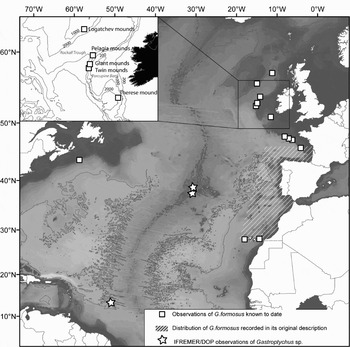
We studied habitat use and the interactions between G. formosus and anthozoans at five sites between 600 and 1200 m depth off Ireland. The sites were Logatchev Mounds (55°32′N 15°14′W) on the edge of Rockall Trough, Pelagia mounds (53°47′N 13°57′W), Giant Mounds (53°06′N 14°55′W) and Twin Mounds (53°06′N 14°54′W) on Porcupine Bank and Thérèse Mound (51°25′N 11°46′W) in the Porcupine Seabight (Figure 1). Visual surveys using ROV ‘Victor 6000’ were carried out in August 2001 on Logatchev Mounds, Pelagia Mounds and Thérèse Mound during the ‘Caracole’ cruise, and in June 2003 on Twin Mounds and Giant Mounds on the ‘Ark XIX/3’ cruise. One passage of the ROV was completed over each site and resulted in 13 hours of useable video from Thérèse Mound, 23 hours from Giant Mounds, 18 hours from Twin Mounds, 12 hours from Logatchev Mounds and 27 hours from Pelagia Mounds. The ROV position was obtained via an USBL (ultra-short baseline) positioning system with an estimated error of 1% of depth-range. On each cruise the ROV was used to record the biota that occurred on bathymetric highs that had been detected during previous multibeam echosounder surveys (Olu-Le Roy et al., Reference Olu-Le Roy, Caprais, Crassous, Dejonghe, Eardley, Freiwald, Galeron, Grehan, Henriet, Huvenne, Lorance, Noel, Opderbecke, Pitout, Sibuet, Unnithan, Vacelet, van Weering, Wheeler and Zibrowius2002; Klages et al., Reference Klages, Thiede and Fouchet2004). Video was recorded on SVHS from two cameras mounted on the ROV; a forward-facing camera was used to aid anthozoan and crustacean identifications and a downward-facing camera for quantitative records of G. formosus and host identification. We analysed the distribution of megafauna using only film taken when the ROV was 2–4 m above the sea bed and moving at mean speed of 0.3 m.s−1. Identification of G. formosus was not possible when the ROV was >4 m off the seabed or moving >0.5 m.s−1. We were able to identify G. formosus based on body shape and the ratio of cheliped to carapace + rostrum length which is more than 4:1 and characteristic of this species of chirostylid in the north-eastern Atlantic (Hayward & Ryland, Reference Hayward and Ryland1990). Occurrences of G. formosus were recorded only when the limbs were clearly distinguishable to avoid confusion with similar-shaped crustaceans which were observed in association with anthozoans (e.g. Rochinia sp.). Distributions of Leiopathes sp. and Bathypathes sp. (antipatharians), and Paramuricea sp. (gorgonians) were noted along ROV dive tracks based on their shape, size and colouring with reference to voucher material collected with the manipulator arm of the ROV during filming. For each dive we thus obtained records of the abundance of Leiopathes sp., Bathypathes sp. and Paramuricea sp. colonies together with indication of the presence of G. formosus on each coral colony observed.
North Atlantic distribution of Gastroptychus sp. and G. formosus observations and the distribution of this species according to first description (Milne-Edwards & Bouvier, Reference Milne-Edwards and Bouvier1900).

Statistical analysis was carried out with R software using generalized linear models (www.r-project.org). To assess the binomial response variable (Ngfo 1 presence of G. formosus on coral/ Ngfo 0 absence of G. formosus on coral) on different hosts and at different sites, the data were analysed using the logistic regression model. This method is widely used in biostatistics to describe the relationship between a response variable, expressed as proportions, and one or more explanatory discrete variables (Hosmer & Lemeshow, Reference Hosmer and Lemeshow2000; Wasserman, Reference Wasserman2004). The Wald-statistic was calculated on all 3 hosts and 5 sites to examine whether these variables were significant predictors in the model. Logistic regression fits the relationship between each variable to an S-shaped curve (logit function) within a range of 0 to 1 (presence/absence of G. formosus). The slope estimate shows the positive or negative effect as determined by the parameters.
RESULTS
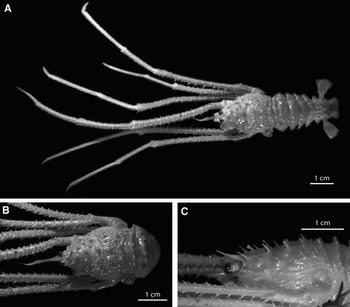
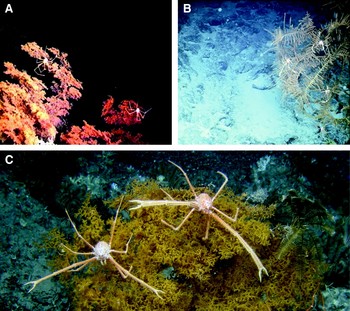
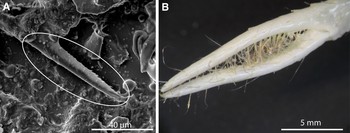
Compilation of published and unpublished accounts and an analysis of archive video reveals that G. formosus occurs on both the north-eastern and north-western Atlantic coasts and ranges from Darwin Mounds off Scotland in the north to the Azores in the south (Figure 1). Two specimens were provided by local fishermen targeting deep-sea species on the continental margin off Brittany (Figure 2), one of them having a short piece of Leiopathes sp. attached to its legs. Still images and image captures of archive video of this association are presented in Figure 3 for various North Atlantic localities. Stomach contents analysis revealed that most of the particles observed using SEM could not be identified except a few pieces of crustacean shorter than 0.1 mm (Figure 4A). It was striking to note that on archive material from Barbados and the Mid-Atlantic Ridge chirostylids were always found holding onto antipatharians and gorgonians and were never seen on surrounding habitat types or on reef-building scleractinians.
Anatomical details of G. formosus caught in bottom trawls by fishermen on the continental shelf break off Biscay in March 2006 showing (A) characteristically long chela and (B, C) details of the carapace.

In situ images of Gastroptychus cf. formosus. (A) Bushy Leiopathes sp. at 834 m depth at the Menez Gwen vent site on the Mid-Atlantic Ridge in 1994; (B) likely Gastroptychus sp. living on an unidentified antipatharian at 1300 m depth off Barbados in 1992 (11°14′N 59°22′W); (C) meral display of G. formosus on Leiopathes sp. on the Twin Mounds at 1092 m depth off Ireland in 2003. Images copyright Ifremer.

(A) Stomach contents of Gastroptychus formosus in SEM (×3000) showing crustacean exoskeleton parts (circled); (B) right chela of a specimen caught on the shelf slope off Biscay showing bushy setae on dactylus and propodus.

At the five sites where we analysed ROV film quantitatively, G. formosus were only found on corals but were never seen on the 1000s of Lophelia pertusa and Madrepora oculata colonies that form reefs on the tops and flanks of carbonate mounds in this region (Klages et al., Reference Klages, Thiede and Fouchet2004). The G. formosus were always seen either holding onto the gorgonian Paramuricea sp. (which formed dense stands on rock outcrops and among living Lophelia pertusa) or were attached to the antipatharians Bathypathes sp. and Leiopathes sp. The antipatharians were more isolated in occurrence than the gorgonians and were usually attached to boulders and cobbles at the reef periphery or at the base of the mounds. Abundant stands of Paramuricea sp. were recorded at Giant Mounds and Thérèse Mound but these hosted only sparse G. formosus (Table 1). At four out of five sites the most common chirostylid host coral was Leiopathes sp. and G. formosus was found most frequently at Thérèse Mound. At this site 261 corals (240 Leiopathes sp and 21 Paramuricea sp.) were seen with at least one squat lobster holding onto them (Table 1).
Data on the presence/absence of Gastroptychus formosus in relation to host coral types at five sites visited during the ‘Caracole’ cruise in 2001 (Thérèse Mound, Pelagia Mounds, Logatchev Mounds) and the ‘Ark XIX/3’ cruise in 2003 (Twin Mounds and Giant Mounds). Ngfo 1: presence of at least one G. formosus on coral, Ngfo 0: absence of G. formosus on coral.

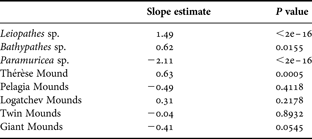
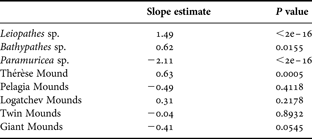
Statistical analyses are summarized in Table 2 where slope estimate and corresponding Wald-test P values are given. The results show a significant positive relationship between G. formosus presence and the host Leiopathes sp. (P < 0.005, slope estimate = 1.49) and, with a lesser degree of significance, for the host Bathypathes sp. (P = 0.015, slope estimate = 0.62). On the contrary, a significant negative relationship between the presence of the squat lobster and Paramuricea sp. was found (P < 0.005, slope estimate = –2.11). This means that while G. formosus is preferentially associated with Leiopathes sp., they are not exclusively limited to this host. The G. formosus occurred significantly more frequently at Thérèse Mound than the other four sites (P < 0.005, slope estimate = 0.63).
Slope estimate and Wald-statistic for the logistic regression fitted with presence/absence of Gastroptychus formosus. Slope estimate gives the positive or negative effect of the variables (corals and collection sites) on the model, and Wald statistic gives the P values associated with each variable.
Groups of up to nine G. formosus were observed on large (1 m tall) Leiopathes sp. colonies and these groups included both large and small individuals living together. No aggressive behaviour was noted within the groups during the time of observation, although the approach of the ROV sometimes elicited meral display behaviour, whereby the animals fully extended their chelipeds (Figure 3C). More usually the G. formosus exhibited no response to the ROV and were either stationary or seen repeatedly moving their chelae from the coral surfaces to their mouths and back while they collected prey or detritus in their first maxillipeds, possibly indicating that they feed off the coral surfaces.
DISCUSSION
It is likely that species in the genera Uroptychus, Eumunida and Gastroptychus have close ecological ties with deep-sea corals since they have all been recorded in trawl samples containing corals from >200 m depth (Caullery, Reference Caullery and Koehler1896; Milne-Edwards & Bouvier, Reference Milne-Edwards and Bouvier1900; Selbie, Reference Selbie1914; de Saint Laurent & Macpherson, Reference de Saint Laurent and Macpherson1990). For instance, association of Eumunida picta with various deep water corals have been reported from the north-western Atlantic (Buhl-Mortensen & Mortensen, Reference Buhl-Mortensen and Mortensen2004) and quantitative analysis from video observation of shipwrecks in the Gulf of Mexico showed that E. picta occurs primarily in association with L. pertusa (Jensen & Frederiksen, Reference Jensen and Frederiksen1992; Mortensen et al., Reference Mortensen, Hovland, Torvleiv and Robert1995; Kilgour & Shirley, Reference Kilgour and Shirley2008). Our analyses of in situ observations at a range of north-eastern Atlantic sites show that G. formosus forms a close association with antipatharians that is similar to the chirostylid–anthozoan associations reported in Indo-Pacific waters. Gastroptychus formosus has been observed living singly or in groups mainly attached to Leiopathes sp. at depths of 600–1200 m. A series of cruises carried out with submersible and ROVs have also recently documented Gastroptychus sp. associated with antipatharians on the New England seamounts off the east coast of the USA (France et al., Reference France, Watling, Auster, Badd, Moore, Mullineaux, Adkins, Shank and Waller2006).
Although invertebrate identifications using ROV video film can be difficult, it was relatively easy to identify G. formosus by comparing images with by-catch specimens provided by the fishing fleet and specimens held at the Natural History Museum in London. This species is the only north-eastern Atlantic chirostylid that has distinctively long chelipeds. However G. salvadori, recently described from the subtropical north-western Atlantic (Rice & Miller, Reference Rice and Miller1991) would be difficult to differentiate from G. formosus by video. Nevertheless, the former is reported to live in association with the brisingid starfish Novodinia antillensis rather than antipatharians. We were unable to determine the species of Gastroptychus observed off Barbados (Figure 2B), as G. affinis, G. salvadori, G. spinifer and the recently described Gastroptychus meridionalis (Melo-Fiho & Melo, Reference Melo-Fiho and Melo2004) all occur in the eastern Atlantic. It is worth noting that G. salvadori (Rice & Miller, Reference Rice and Miller1991) closely resembles G. formosus (Pohle & Macpherson, Reference Pohle and Macpherson1995) and is described based on a single specimen of an ovigerous female. Similarly, the description of G. meridionalis is based on five ovigerous females and males have never been found.
We have extended the known distribution of G. formosus to northern parts of Rockall Trough and our chirostylid records from the Mid-Atlantic Ridge close to the Menez Gwen vent system (Figure 2A) are probably G. formosus as they had characteristically long, slender chelipeds and small chelae and were living on Leiopathes sp. growing on basalt rock at similar depths (800 m) to the populations off the British Isles. Although G. formosus has a wide distribution, it still remains to be determined whether its populations differ genetically due to isolation. An analysis of Galatheidae and Chirostylidae in the Pacific indicated that their populations were not genetically isolated, despite being located on geographically isolated seamounts (Samadi et al., Reference Samadi, Bottan, Macpherson, De Forges and Boisselier2006). Other deep-sea chirostylids are known to have a wide geographical range in the North Atlantic like Uroptychus nitidus (Zariquiey Álvarez, Reference Zariquiey Álvarez1968). More information on the distribution range of all chirostylids can be found in the recent catalogue of squat lobsters of the world (Baba et al., Reference Baba, Macpherson, Poore, Ahyong, Bermudez, Cabesas, Lin, Nizinski, Rodriguez and Schnabel2008).
Although G. formosus has repeatedly been collected with coral since the first records, their association with coral hosts was not based on in situ observations and quantitative data. We have shown that G. formosus lives on octocorals and is mainly found on Leiopathes sp. which tended to be the bushiest large coral. Note that these colonial corals are not dominant in the studied reefs where scleractinian reef builders cover the main part of the surface (Huvenne et al., Reference Huvenne, Beyer, De Hass, Dekindt, Henriet, Kozachenko, Olu-Le Roy, Wheeler, Freiwald and Roberts2005). The reasons for this preference are unknown, although G. formosus may feed on particulate organic matter and zooplankton trapped in mucus produced by the corals since their stomachs contained minuscule crustacean particles. The chelae of all by-catch and museum individuals examined were characterized by dense comb-like setae on dactylus and propodus (Figure 4B) and it is therefore possible that these chelae are used to brush through coral mucus and collect food particles from nearby coral branches. The feeding could be similar to that of the ophiurid Astrobrachion constrictum that lives on the antipatharian Antipathes fiordensis in New Zealand fjords where the ophiuroid feeds primarily on mucus produced by the antipatharian polyps as well as on planktonic prey captured by the coral host nematocysts (Grange, Reference Grange1991). A mutualistic relationship was suggested: the ophiuroid gains protection and food, whilst enhancing the survival of the antipatharian host by cleaning the particulate matter off the polyps and preventing epizoic larval settlement. In shallow water corals, it is already well described how coral mucus provides trapped particles to the heterotrophic reef community (Wild et al., Reference Wild, Huettel, Klueter, Kremb, Rasheed and Jorgensen2004).
During all transects analysed, any G. formosus was observed on the reef-builder coral species (i.e. scleractinian corals) and neither they were during close up view of these species. However, as already reported in various deep-sea coral reefs of the north-eastern Atlantic (Mortensen et al., Reference Mortensen, Hovland, Torvleiv and Robert1995; Kelmanson & Matz, Reference Kelmanson and Matz2003; Jonsson et al., Reference Jonsson, Nilsson, Floruta and Lundalv2004; Roberts et al., Reference Roberts, Henry, Long and Hartley2008), numerous Galatheidae from the genus Munida were observed living in the Lophelia reef interstices during ROV sampling operations. We suggest that a comparison of the diet of G. formosus and Munida spp. (Munida sarsi, Munida rugosa and Munida intermedia) including stable isotopic analysis of C13 and N15 from corals and squat lobster tissues respectively could be relevant in the study of the ecology of the squat lobsters living in deep-sea coral reef communities.
CONCLUSION
Chirostylids are typically deep water animals from the continental slope to abyssal depth and often are associated with corals such as antipatharians and gorgonaceans (Baba et al., Reference Baba, Macpherson, Poore, Ahyong, Bermudez, Cabesas, Lin, Nizinski, Rodriguez and Schnabel2008). In this paper we have updated the known distribution for G. formosus, confirming that it is an amphiatlantic species that occurs along the Mid-Atlantic Ridge at least as far south as the Azores and at least as far north as Scotland at depths of 600–1700 m. On deep water corals, the adults have very specific habitat preferences, being only found on antipatharians and gorgonians (soft corals) with a strong preference for the antipatharian Leiopathes sp. as a host. This highly restricted habitat preference is likely to render chirostylids vulnerable to the impacts of demersal fishing both directly as by-catch and indirectly through habitat loss. The past 20 years have seen an increased intensity of deep-water fishing in the north-eastern Atlantic which has led to damage to carbonate mound habitats although demersal trawlermen try to avoid gear contact with scleractinian coral reefs due to the extensive damage this causes to their gear and their catch (Hall-Spencer et al., Reference Hall-Spencer, Allain and Fossa2002). However, antipatharian corals such as Leiopathes sp. are frequently found attached to cobbles and boulders on sedimentary grounds that are more accessible by trawlers (Hall-Spencer et al., Reference Hall-Spencer, Allain and Fossa2002). These boulders are difficult to detect even with modern echosounder technology, and although not targeted by fishermen, their attached fauna is at high risk of destruction through accidental trawling (Davies et al., Reference Davies, Roberts and Hall-Spencer2007). We are only beginning to understand the basic ecology of deep coral habitats but there is clearly a need for improved management of these systems to protect long-lived corals and their associated species.
ACKNOWLEDGEMENTS
We thank Cedric Dudeckem d'Acoz and Enrique MacPherson for verifying our chirostylid identifications from photographs, Valentina de Matos for access to Azores records, Pierre Tandeo for statistical analysis assistance and Gilles Collin from FV ‘Baraloden’ for providing specimens. For access to video archives, we are deeply indebted to Pierre Marie Sarradin (chief scientist ‘Atos’ cruise), Mikael Klages (chief scientist ‘Ark XIX/3’ cruise), Jean Claude Faugères (chief scientist ‘Diapisub’) and Daniel Desbruyères (chief scientist ‘Divanaut2’) and K. Olu-Le Roy (chief scientist ‘Caracole’). We also specially thank Stephane Lesbats for fishermen specimens' image documentation. J.M. H-S. was funded by the Esmée Fairbairn Foundation and the EU KNOWSEAS project. The PhD of E. LG. was funded by the Region Bretagne and Ifremer.