Introduction
Heightened susceptibility to depression has been attributed to familial risk (both genetic and environmental) (Weissman et al. Reference Weissman, Gammon, John, Merikangas, Warner, Prusoff and Sholomskas1987; Kendler, Reference Kendler1995; Warner et al. Reference Warner, Weissman, Mufson and Wickramaratne1999) and stressful life circumstances (Monroe & Simons, Reference Monroe and Simons1991; Kessler, Reference Kessler1997; Kendler et al. Reference Kendler, Gardner and Prescott1999a; Tenant, Reference Tennant2002). Nevertheless, not all individuals exposed to these risks develop depression, indicating that other factors acting to deter pathological features may be operating. Identification of protective factors, especially those that may offset predisposing risk for psychiatric illness, is as important as establishing which factors elevate vulnerability. In this study we investigated whether attendance at religious or spiritual services and personal beliefs regarding the importance of religion or spirituality predict resilience in individuals at increased risk for major depressive disorder (MDD) and other forms of psychopathology.
Resilience has been conceptualized as the capacity to withstand adversity or resist a liability or predisposition that substantially elevates risk for maladjustment, depression or other such negative consequences (Garmezy et al. Reference Garmezy, Masten and Tellegen1984; Masten et al. Reference Masten, Best and Garmezy1990; Luthar & Cicchetti, Reference Luthar and Cicchetti2000). Assessed qualities or outcomes that connote resilience involve the development of specific competencies under stressful conditions, or the absence of pathological features with severe threat or increased vulnerability (Masten et al. Reference Masten, Best and Garmezy1990; Rutter, Reference Rutter1999; Luthar et al. Reference Luthar, Cicchetti and Becker2000; Luthar, Reference Luthar, Cicchetti and Cohen2006); in other words, relatively positive adaptation when the likelihood of dysfunction or disorder is high. Factors that protect against dysfunction or disorder in most persons, including personal resources (e.g. self-esteem or coping ability), positive family/friend relationships and extended support systems at school, work and other community settings, may also reinforce an individual's capacity to manage adversity, thereby fostering resilience (Werner & Smith, Reference Werner and Smith1992; Aldwin, Reference Aldwin1994; Grotberg, Reference Grotberg1999; Rutter, Reference Rutter, Shonkoff and Meisels2000).
There is increasing recognition of religious involvement as a protective influence that may prevent or assuage the development of depression (McCullough & Larson, Reference McCullough, Larson and Koenig1998, Reference McCullough and Larson1999;Koenig et al. Reference Koenig, McCullough and Larson2001). A meta-analysis of 147 independent studies confirmed a modest but significant inverse association between attendance at religious services and depressive symptoms across general population, convenience and clinical samples (Smith et al. Reference Smith, McCullough and Poll2003). Our group found a lowered probability for lifetime MDD with greater personal beliefs of religious importance among mothers of current study offspring (Miller et al. Reference Miller, Warner, Wickramaratne and Weissman1997), and Kendler and colleagues reported similar associations between dimensions of religiosity and lifetime internalizing and externalizing disorders (Kendler et al. Reference Kendler, Gardner and Prescott1997, Reference Kendler, Gardner and Prescott1999a, Reference Kendler, Karkowski and Prescottb, Reference Kendler, Liu, Gardner, McCullough, Larson and Prescott2003; Kendler & Myers, Reference Kendler and Myers2009; Vance et al. Reference Vance, Maes and Kendler2010). Associations between religious/spiritual beliefs and remission of MDD have been reported in clinical samples (Koenig et al. Reference Koenig, George and Peterson1998), and some studies support a prospective link between religiosity and depressive symptoms (Krause, Reference Krause2009) and disorder (Ellison & Flannelly, Reference Ellison and Flannelly2009).
Other studies, albeit fewer in number, have tested a buffering effect hypothesis, comparing associations between religiosity and depression in high- and low-risk groups; for example, in parents who experienced the recent death of a child versus parents whose child died more than 2 years previously (Maton, Reference Maton1989), in spouse-caretakers of dementia patients versus spouses of healthy adults (Robinson & Kaye, Reference Robinson and Kaye1994), and in persons currently undergoing stress versus persons without such exposure (Kendler et al. Reference Kendler, Karkowski and Prescott1999b). Although these studies tend to support moderation of the stress–depression association by religious beliefs or behaviors, other studies have reported mixed or statistically non-significant findings (Thearle et al. Reference Thearle, Vance, Najman, Embelton and Foster1995; Strawbridge et al. Reference Strawbridge, Shema, Cohen, Roberts and Kaplan1998; Tsuang et al. Reference Tsuang, Williams, Simpson and Lyons2002;Maselko et al. Reference Maselko, Gilman and Buka2009).
The current study
In this study, religious service attendance and the importance of religion/spirituality are treated as potential protective factors that predict resilience in high-risk youths. In that context, high risk is defined as having a parent who received treatment for moderate or severe depression, and resilience is defined as significantly lower odds for subsequent MDD in relation to increased service attendance and importance of religion/spirituality in higher-risk compared to lower-risk offspring. Our group (Weissman et al. Reference Weissman, Gammon, John, Merikangas, Warner, Prusoff and Sholomskas1987, Reference Weissman, Warner, Wickramaratne, Moreau and Olfson1997; Warner et al. Reference Warner, Weissman, Mufson and Wickramaratne1999) and others (Beardslee et al. Reference Beardslee, Keller and Klerman1985; Orvaschel et al. Reference Orvaschel, Walsh-Allis and Ye1988; Hammen et al. Reference Hammen, Burge, Burney and Adrian1990, Reference Hammen, Burge and Adrian1991) have shown parent depression to be a powerful predictor of offspring depression, especially early-onset depression (Wickramaratne & Weissman, Reference Wickramaratne and Weissman1998), a known risk for recurrent depressive episodes (e.g. Kessler et al. Reference Kessler, Avenevoli and Merikangas2001; Hammen et al. Reference Hammen, Brennan, Keenan-Miller and Herr2008). Offspring of depressed parents are also exposed to elevated levels of negative life events (NLEs; Downey & Coyne, Reference Downey and Coyne1990), another well-established precipitating risk for depression. Such research suggests that early-onset depression and high NLE exposure may be among the key mechanisms that underlie heightened vulnerability in offspring of depressed parents, and would explain in part why these youths often follow an increasingly depression-prone pathway into adulthood (e.g. Kandel & Davies, Reference Kandel and Davies1986; Weissman et al. Reference Weissman, Warner, Wickramaratne, Moreau and Olfson1997). Accordingly, in analyses confined to these already high-risk offspring, we examined whether relationships between religiosity/spirituality and disorder were stronger for those with additional risk, defined as having a history of prior MDD or high exposure to NLE, than for those without additional risk.
Parent depression and other risks examined here may also precede other forms of psychiatric illness (Kandel & Davies, Reference Kandel and Davies1986; Harrington et al. Reference Harrington, Fudge, Rutter, Pickles and Hill1990; Weissman et al. Reference Weissman, Warner, Wickramaratne, Moreau and Olfson1997; Kasen et al. Reference Kasen, Cohen, Skodol, Johnson, Smailes and Brook2001). Moreover, religiosity has been examined as a protective factor in relation to externalizing disorders and to other internalizing disorders (e.g. Tsuang et al. Reference Tsuang, Williams, Simpson and Lyons2002;Kendler et al. Reference Kendler, Liu, Gardner, McCullough, Larson and Prescott2003; Maselko et al. Reference Maselko, Gilman and Buka2009), albeit to a lesser extent than depression. Furthermore, resilience may be better defined as the absence of any psychiatric disorder under adverse circumstances rather than as the absence of a specific disorder. Therefore, resilience was examined at three hierarchical levels: (a) MDD, (b) mood disorder (which includes MDD) and (c) any psychiatric disorder (any mood, anxiety, disruptive or substance disorder).
This study has the potential to strengthen or extend previous findings related to religiosity and depression. First, because the study sample was drawn from offspring of depressed and non-depressed parents, a risk–resilience model in which religious variables might interact with predisposing risks to influence disorder can be tested (Ingram & Luxton, Reference Ingram, Luxton, Hankin and Abela2005). Using that model, we examined (1) whether service attendance or importance of religion/spirituality was related to disorder in offspring of depressed and non-depressed parents and, among offspring of depressed parents only, in those with additional risk and those without additional risk, and (2) whether relationships between attendance or importance and disorder differed significantly across offspring of depressed and non-depressed parents, or across offspring of depressed parents with and without additional risk. Second, use of a longitudinal design allowed us to estimate the predictive utility of service attendance and religious/spiritual importance. Third, because offspring of depressed parents often follow a problematic trajectory, we investigated in these already high-risk offspring whether greater attendance or importance mitigated associations between additional risks (prior MDD or high NLE exposure) and disorders. Fourth, depression and other forms of psychopathology were assessed at the diagnostic level.
We hypothesized that (1) increased service attendance and the importance of religion or spirituality would protect against subsequent disorder in offspring of depressed and non-depressed parents, and that (2) associations would be stronger in offspring of depressed parents. Because early-onset MDD and high NLE exposure characterize the trajectory followed by offspring of depressed parents, we also hypothesized that (3) odds for subsequent disorders would be lower in relation to greater religiosity among offspring of depressed parents with prior MDD or high NLE exposure than offspring of depressed parents without these additional risks. If our hypotheses were supported, the study findings would meet definition criteria for interpreting religiosity as a protective factor that may build resilience in high-risk individuals.
Method
Descriptions of sampling criteria and procedures summarized below are published in detail elsewhere (Weissman et al.Reference Weissman, Gammon, John, Merikangas, Warner, Prusoff and Sholomskas1987, Reference Weissman, Warner, Wickramaratne, Moreau and Olfson1997, Reference Weissman, Wickramaratne, Nomura, Warner, Pilowski and Verdeli2006).
Sample composition
Subjects were biological offspring of depressed and non-depressed parents followed longitudinally. High-risk offspring were selected in 1982 for the presence of moderate or severe MDD in one or both parents at study entry based on Research Diagnostic Criteria (RDC); parents received treatment at an out-patient clinic at Yale University, New Haven, Connecticut. Non-depressed parents were drawn from a 1975 survey from the same community and had no history of psychiatric illness based on four lifetime diagnostic interviews.
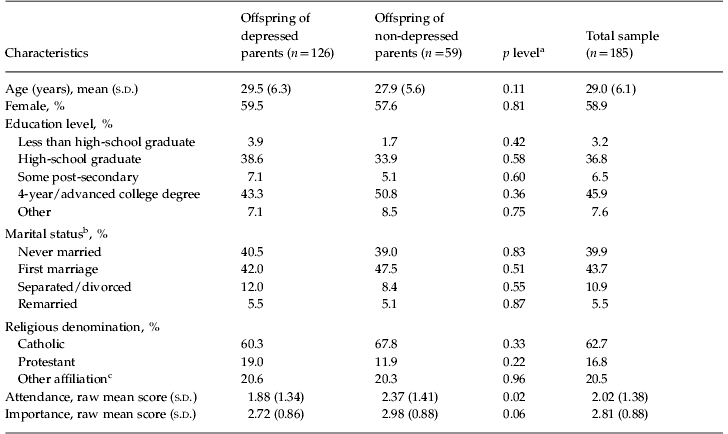
The original sample interviewed at baseline was composed of 220 offspring from 91 families. Forty-three new offspring from the same families were interviewed 2 years later when they became age eligible (⩾6 years old), making a total of 263 offspring eligible for reinterview at the 10-year follow-up. Newly age-eligible offspring first interviewed at the 10-year follow-up were not included in the current study and are not described. Of the 263 offspring, 222 (84.4%) were reinterviewed at the 10-year follow-up; among the 41 not interviewed, 20 refused consent, 18 could not be located, two were deceased, and one had Down syndrome. At the 20-year follow-up, 83.3% (185/222) were reinterviewed and comprised the analytic sample for this study. Among the 37 not interviewed, 26 refused consent, seven could not be located or scheduled, and four were deceased. In the current study sample, 68.1% (126/185) were at high risk based on parent depression and, at the 10-year follow-up, 58.9% (109/185) were female and the mean age was 29.0 (range 17–38) years (see Table 2 for background characteristics by parent depression status and in combined samples all 185 offspring). The 37 offspring reinterviewed at the 10-year but not the 20-year follow-up did not differ significantly from the study sample with regard to parent depression status or age, education, religious/spiritual importance or service attendance at the 10-year follow-up. However, the current study sample had a higher proportion of females (59% v. 35%, χ2=7.19, df=1, p=0.007).
Assessments
Psychiatric diagnoses
Semi-structured diagnostic interviews were conducted across all waves with the Schedule for Affective Disorders and Schizophrenia – Lifetime Version (SADS-L; Mannuzza et al. Reference Mannuzza, Fyer, Klein and Endicott1986) or, for those between ages 6 and 17, with the Kiddie-SADS (epidemiological version K-SADS-E; Orvaschel et al. Reference Orvaschel, Puig-Antich, Chambers, Tabrizi and Johnson1982; Kaufman et al. Reference Kaufman, Birmaher, Brent, Rao, Flynn, Moreci, Williamson and Ryan1997). Diagnostic interviews yielded DSM-III diagnoses at baseline and DSM-III-R diagnoses at the 10-year follow-up. At the 20-year follow-up, the SADS-L interview was modified to meet DSM-IV criteria. Interviews were conducted independently by trained mental health professionals blind to parent clinical status and previous offspring assessments. Final diagnoses are based on the best estimate procedure (Leckman et al. Reference Leckman, Sholomskas, Thompson, Belanger and Weissman1982), described in detail elsewhere (Weissman et al. Reference Weissman, Warner, Wickramaratne, Moreau and Olfson1997).
Disorders assessed at the 20-year follow-up cover the 10-year interval since the 10-year follow-up and constitute this study's primary dependent variables. MDD was considered separately and as a mood disorder along with dysthymia and bipolar I or II disorder. Any psychiatric disorder [a mood disorder, an anxiety disorder (generalized anxiety, obsessive–compulsive, panic, phobic, post-traumatic stress), a disruptive disorder (attention deficit hyperactivity, conduct, oppositional defiant) or a substance disorder (alcohol/illicit drug abuse or dependence)] was also examined. The risk factor ‘prior MDD’ was based on lifetime MDD assessed at baseline and again at the 10-year follow-up, when offspring were average age 29 years. In the current study sample, 24.3% (45/185), 33.0% (61/185) and 51.9% (96/185) of offspring were diagnosed with MDD, a mood disorder and any psychiatric disorder respectively in the 10-year interval between the 10- and 20-year follow-ups, and 45.4% (84/185) were diagnosed with prior MDD by, on average, age 29.
Religiosity
At the 10-year follow-up, offspring responded to religious items from the demographic section of the SADS-L. Denomination was assessed with the questions: ‘How would you describe your current religious beliefs? Is there a particular denomination or organization that you are part of?’ Nearly two-thirds of the current sample (116/185) were Catholic, with other groups much fewer in number (31 Protestant, 10 personal beliefs, 10 unknown, nine Jewish, eight agnostic, and one Buddhist). Service attendance was assessed with the question: ‘How often, if at all, do you attend church, synagogue, or other religious or spiritual services?’ (response options: 0=never, 1=less than once a year, 2=once or twice a year, 3=about once a month, 4=once a week). The mean score (2.02, s.d.=1.38) indicated that, at the 10-year follow-up, average service attendance in the total sample was once or twice a year. Personal beliefs regarding religious/spiritual importance were assessed with the question: ‘How important to you is religion or spirituality?’ (response options: 1=not important at all, 2=slightly important, 3=moderately important, 4=highly important). The mean score (2.81, s.d.=0.88) indicated that, at the 10-year follow-up, a nearly moderate level of importance was normative for the total sample. Religion variables are referred to in this study as denomination, attendance and importance.
NLEs
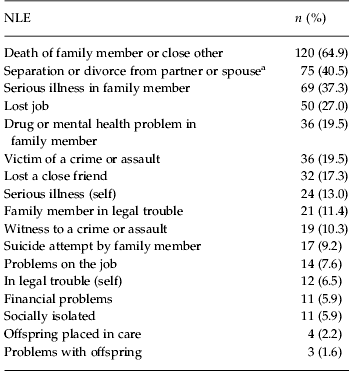
NLEs reported at the 10-year follow-up for the preceding 10 years were examined as a predisposing risk for disorders diagnosed over the next 10-year interval (i.e. between the 10- and the 20-year follow-up); event rates are shown in Table 1. The mean NLE score was 3.1 (s.d.=2.0, range 0–10) out of a possible 17 events. The cut-off score ⩾5 (equivalent to 1 s.d. above the mean) specified offspring with high (n=38; 20.5%) or average/low (n=147; 79.5%) NLE exposure.
Rates of negative life events (NLEs) reported by 185 offspring at the 10-year follow-up for the preceding 10 years

a Includes separated or divorced from partner/spouse; partner/spouse not living at home; and end of love relationship.
Analyses
To test the study hypotheses while adjusting for non-independence among offspring from the same family, we used the SAS GENMOD procedure (SAS/STAT software, version 9.0; SAS Institute Inc., USA) using a generalized estimating equation (GEE) approach (Liang & Zeger, Reference Liang and Zeger1986). All analyses were controlled (a priori) for age, gender and denomination. As there were sufficient numbers of offspring of only Catholic and Protestant denominations to permit meaningful comparisons, dummy coding was used to compare Protestant offspring (n=31) and Catholic offspring (n=116, reference group). Models based on both offspring of depressed parents and offspring of non-depressed parents (n=185) (i.e. testing hypotheses 1 and 2) examined effects of attendance or importance (each separately) with parent depression status, prior MDD, NLE exposure, and all two-way interaction terms formed by their multiplicative combinations. Models based only on offspring of depressed parents (n=126) (i.e. testing hypothesis 3) examined effects of attendance or importance (each separately) with prior MDD, NLE exposure, and all two-way interaction terms formed by their multiplicative combinations.
Results
Background characteristics
Offspring of depressed parents did not differ significantly from offspring of non-depressed parents with regard to gender, age, denomination, education level, and marital status at the 10-year follow-up (see Table 2). However, group differences in attendance and importance (raw score means: 1.88 v. 2.37, p=0.018 and 2.72 v. 2.98, p=0.059 respectively) indicated greater religiosity/spirituality among offspring of non-depressed parents.
Background characteristics at the 10-year follow-up in 185 offspring by parent depression status

s.d., Standard deviation.
a Probability levels for between-group (offspring of depressed parents versus offspring of non-depressed parents) differences.
b Marital status is based on 124 offspring of depressed parents and 183 total offspring.
c In the total sample, other affiliations include personal beliefs (n=10), unknown (n=10), Jewish (n=9), agnostic (n=8), and Buddhist (n=1).
Parent depression status and offspring risk
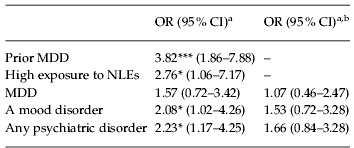
Offspring of depressed parents were at significantly increased odds for prior MDD by the 10-year follow-up [odds ratio (OR) 3.82, p=0.0003], high NLE exposure in the 10 years preceding the 10-year follow-up (OR 2.76, p=0.037), and mood (OR 2.08, p=0.045) and any psychiatric disorder (OR 2.23, p=0.015) between the 10- and 20-year follow-ups (Table 3), confirming the continuing negative trajectory of these high-risk youths. Prior MDD significantly increased the odds for subsequent MDD [OR 3.09, 95% confidence interval (CI) 1.48–6.49, p=0.003), mood disorder (OR 3.31, 95% CI 1.66–6.58, p=0.001) and any psychiatric disorder (OR 2.76, 95% CI 1.46–5.22, p=0.002) between the 10- and 20-year follow-ups, whereas high NLE exposure significantly increased the odds for subsequent MDD (OR 2.03, 95% CI 1.01–4.44, p=0.049) and any psychiatric disorder (OR 2.82, 95% CI 1.28–6.24, p=0.010) but not mood disorder (OR 1.46, 95% CI 0.68–3.13, p=0.329) during that period (not tabulated). After adjusting for prior MDD and NLE exposure, parent depression status was no longer associated significantly with either mood or any psychiatric disorder between the 10- and 20-year follow-ups. No significant interaction effects were observed between parent depression status and age, gender or denomination.
Parent depression status and odds for prior major depressive disorder (MDD) by 10-year follow-up, high exposure to negative life events (NLEs) in the 10 years preceding the 10-year follow-up, and MDD, mood disorder and any psychiatric disorder between the 10-year and 20-year follow-ups, in 185 offspring

OR, Odds ratio; CI, confidence interval.
Parent depression status coded 0=non-depressed parents, 1=depressed parent(s).
a ORs adjusted for age, sex and denomination.
b ORs adjusted for effects of prior MDD and high exposure to NLEs.
* p<0.05, ** p<0.01, *** p<0.001.
Religiosity and risk for disorder
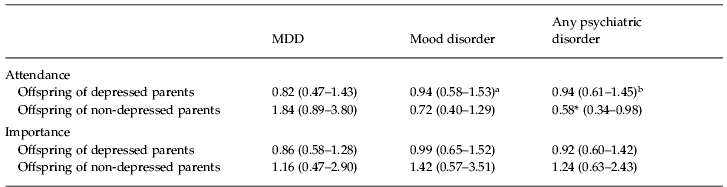
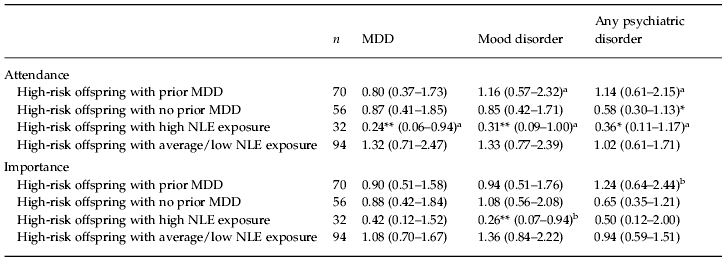
We report odds for disorder between the 10- and 20-year follow-ups in relation to attendance and importance at the 10-year follow-up separately for offspring of depressed parents (n=126) and offspring of non-depressed parents (n=59) (Table 4), and for offspring of depressed parents with (n=70) and without (n=56) prior MDD and with high (n=32) versus average/low (n=94) NLE exposure (Table 5). Although not tabulated, significant main effects of attendance or importance in the combined samples (i.e. offspring of depressed parents and offspring of non-depressed parents) are noted; significant interactive effects between attendance or importance and parent depression status in the combined samples, and between attendance or importance and additional risk in offspring of depressed parents, are also noted. Attendance and importance were treated as continuous predictors and standardized; thus, noted change in odds for disorder corresponds to a 1 s.d. change in religiosity/spirituality. For example, a 1 s.d. increase in attendance from the standardized mean (0) would be roughly equivalent to an increase in attendance from once or twice a year to at least once a month; a corresponding increase in importance would be roughly equivalent to increasing from nearly moderate importance to nearly highly important.
Attendance and importance at the 10-year follow-up and odds for major depressive disorder (MDD), mood disorder and any psychiatric disorder over the next 10 years in 126 offspring of depressed parents and 59 offspring of non-depressed parents

Values given as odds ratio (95% confidence interval). All odds ratios (ORs) are adjusted for age, sex, denomination, prior MDD and high exposure to negative life events (NLEs) in the preceding 10 years.
a Significant (p<0.05) interaction effect between attendance and parent depression status.
b Trend (p<0.10) interaction effect between attendance and parent depression status.
* p<0.05.
Attendance and importance and odds for major depressive disorder (MDD), mood disorder and any psychiatric disorder over the next 10 years in 126 (high-risk) offspring of depressed parents with and without additional risks: prior MDD and exposure to negative life events (NLEs)

Values given as odds ratio (95% confidence interval). All odds ratios (ORs) are adjusted for age, sex, denomination, and additional risk (prior MDD or high exposure to NLEs).
a Significant (p<0.05) interaction effect between attendance and additional risk.
b Significant (p<0.05) interaction effect between importance and additional risk.
* p<0.10, ** p<0.05.
Offspring of depressed and non-depressed parents
Increased attendance was associated with reduced odds for mood (OR 0.51, 95% CI 0.30–0.87, p=0.013) and any psychiatric (OR 0.47, 95% CI 0.29–0.79, p=0.004) disorder in the combined samples, but not with MDD (OR 1.05, 95% CI 0.59–1.87, p=0.871). Attendance also moderated relationships between parent depression status and mood (interaction OR 2.13, 95% CI 1.14–3.97, p=0.017) and any psychiatric (interaction OR 1.81, 95% CI 0.96–3.41, p=0.069, trend) disorder: in both interactions, offspring of non-depressed parents were at significantly lower odds for disorder in relation to attendance than offspring of depressed parents. When examined separately by parent depression status, attendance was related to significantly reduced odds for any psychiatric disorder (by 42%, p=0.042) only in offspring of non-depressed parents; however, note that odds for all disorders in relation to attendance were below 1 among offspring of depressed parents (Table 4). Importance was not related significantly to disorder whether offspring of depressed and non-depressed parents were combined or treated separately, nor did it interact with parent depression status in relation to disorder.
Offspring of depressed parents with and without additional risk
Neither attendance nor importance was associated significantly with disorder in offspring of depressed parents (Table 4); however, each interacted with additional risk to influence disorder.
Attendance moderated associations between prior MDD and mood (interaction OR 2.82, 95% CI 1.13–7.05, p=0.027) and any psychiatric (interaction OR 3.03, 95% CI 1.45–6.36, p=0.023) disorder, and importance moderated associations between prior MDD and any psychiatric disorder (interaction OR 2.62, 95% CI 1.17–5.84, p=0.019). In all interactions, those without prior MDD had significantly lower odds for disorders in relation to attendance or importance than those with prior MDD. When examined separately by prior MDD status, no significant religiosity–disorder associations were observed in offspring of depressed parents either with or without prior MDD (Table 5).
Attendance also moderated associations between NLE exposure and MDD (interaction OR 0.27, 95% CI 0.09–0.84, p=0.024), mood (interaction OR 0.22, 95% CI 0.08–0.60, p=0.003) and any psychiatric (interaction OR 0.26, 95% CI 0.11–0.63, p=0.003) disorder, and importance moderated associations between NLE exposure and mood disorder (interaction OR 0.18, 95% CI 0.05–0.61, p=0.006). In all interactions, those with high NLE exposure were at significantly lower odds for disorder in relation to attendance or importance compared to those with average/low NLE exposure. Although not significant, interaction effects between importance and NLE exposure were in the same direction for MDD (interaction OR 0.41, 95% CI 0.13–1.37, p=0.150) and any psychiatric disorder (interaction OR 0.54, 95% CI 0.13–2.30, p=0.402). When examined separately by level of NLE exposure, attendance was associated with significantly reduced odds for MDD (by 76%, p=0.041), mood (by 69%, p=0.05) and any psychiatric (by 64%, p=0.091, trend) disorder, and importance was associated with significantly reduced odds for mood disorder (by 74%, p=0.040), only among offspring of depressed parents with high NLE exposure (Table 5).
Discussion
Consistent with the findings of other studies noted earlier, attendance was a protective factor against mood and any psychiatric disorder in the combined samples (i.e. offspring of depressed and non-depressed parents). Nevertheless, effects were stronger in offspring of non-depressed parents and, when examined separately by parent depression status, significant in offspring of non-depressed parents only. Those findings may be explained in part by common familial factors (genetic and environmental), which may underlie both religiosity and vulnerability to depression (D'Onofrio et al. Reference D'Onofrio, Eaves, Murrelle, Maes and Spilka1999) and were not accounted for in this study. Additional findings that religiosity and history of prior MDD differed significantly by parent depression status, with increased odds for religiosity (Table 2) and decreased odds for prior MDD (Table 3) in offspring of non-depressed parents, bolster that conclusion.
Among offspring of depressed parents, attendance and, albeit to a lesser extent, importance were related to significantly lower odds for MDD, mood and psychiatric disorder in those with high NLE exposure, suggesting that increased religiosity may interrupt the disorder-prone trajectory characteristic of offspring of depressed parents. Moreover, odds for all disorders were significantly lower in relation to increased religiosity in offspring of depressed parents with high NLE exposure than in offspring of depressed parents with average/low NLE exposure, which is consistent with criteria for defining attendance and importance as resilience factors. That finding also confirms other reports that religiosity protects against depression under adverse conditions (Kendler et al. Reference Kendler, Karkowski and Prescott1999b), and extends them by testing the differential effects of religiosity on psychopathology at the diagnostic level in high- and low-risk persons over a 10-year interval.
Findings regarding service attendance and the importance of religion/spirituality as potential resilience factors were limited to high NLE exposure. Those aspects of religiosity may provide a pragmatic means by which to deal with adversity that does not apply to either past parent depression or prior MDD. Religiously involved people often use religion-related cognitions to minimize threatening experiences (Pargament, Reference Pargament1997). A benign rather than a grim appraisal of NLEs (e.g. believing such events happen for a valid reason and provide opportunities for religious or personal growth) may protect against harmful mental health sequelae (George et al. Reference George, Larson, Koenig and McCullough2000). In a high-risk sample of unaccompanied minors living outside their country of origin under stressful conditions, religious involvement was reported to be an essential component of all coping strategies applied (Ní Raghallaigh & Gilligan, Reference Ní Raghallaigh and Gilligan2010). Social support, a key factor implicated in resilience (Daud et al. Reference Daud, af Klinteberg and Rydelius2008), is another mechanism that may be operating, as religiously involved people, especially those who attend services on a regular basis, have increased access to church-related resources and activities (George et al. Reference George, Larson, Koenig and McCullough2000; Koenig et al. Reference Koenig, McCullough and Larson2001).
Despite evidence to the contrary (e.g. McCullough & Larson, Reference McCullough and Larson1999, Reference Koenig, McCullough and Larson2001;Koenig et al. Reference Koenig, McCullough and Larson2001; Smith et al. Reference Smith, McCullough and Poll2003), service attendance and religious/spiritual importance did not have a protective effect against MDD. Most previous research is typically based on depressive symptoms, which may be more susceptible to change from external forces than MDD, especially in offspring of depressed parents, where the potential for genetic transmission of MDD is high. In our sample, about 45% of all offspring and 56% of offspring of depressed parents had a prior episode of MDD; thus, roughly half the sample was assessed with a recurrent episode. Effects of religiosity may differ between first-onset MDD and recurrent MDD, which cannot be examined in this sample because of the insufficient sample size. Additionally, previous research has been based primarily on older adults, for whom depression decreases as personal religious beliefs become more firmly ingrained (Koenig, Reference Koenig and Schumaker1992); thus, it also is plausible that religiosity was not yet fully developed in many of our offspring by ages 17–38, when they were assessed for religiosity.
Our findings also suggest that attendance has a greater protective influence than importance. We note that others have found inverse relationships between religiosity and depressive symptoms to be stronger when more public aspects of religious involvement, such as service attendance, are examined in contrast to more private aspects, such as strength of beliefs (McCullough & Larson, Reference McCullough and Larson1999). Others have reported similar findings for MDD (Maselko et al. Reference Maselko, Gilman and Buka2009). Increased opportunities for social support in religious settings, especially during late adolescence/young adulthood, the period when religiosity was assessed in the current study, may protect against future negative consequences in high-risk persons. An alternative explanation may be that reinforcement of religiosity is more likely to occur in a setting of like-minded persons, increasing the magnitude of attendance effects. In a subset of the current study sample limited to Catholic and Protestant offspring stable for denomination between the 10-year and 20-year follow-ups, increased importance of religion/spirituality protected against MDD in offspring of depressed parents (Miller et al., in press), suggesting that multiple aspects of religiosity may work in tandem to influence risk for disorder.
The significant effect of parent depression status on mood and any psychiatric disorder was not independent of prior MDD or NLEs, corroborating others' findings that more proximal circumstances may mediate earlier adversity (Hazel et al. Reference Hazel, Hammen, Brennan and Najman2008). Additionally, although parent depression increased the odds by nearly fourfold for prior MDD by the 10-year follow-up (see Table 3), offspring of depressed parents were not at any significantly greater odds for MDD over the next 10 years (between the 10-year and 20-year follow-ups). In our sample, MDD assessed between the 10- and 20-year follow-ups was predominantly a recurrent episode, which may no longer be contingent upon predisposing risks that underlie earlier onset MDD, as, for example, has been demonstrated by a diminishing relationship between negative events and recurring depressive episodes (Kendler et al. Reference Kendler, Thornton and Gardner2000).
Our findings should be interpreted keeping study limitations in mind. The design of high-risk offspring and low-risk controls was ideal for examining religiosity as a resilience factor. However, the offspring were all Caucasian and predominantly Catholic; thus, caution should be exercised if generalizing findings to samples with differing racial compositions or affiliations. Although denomination was included as an a priori control, only Catholic and Protestant denominations had sufficient numbers for meaningful comparisons. We considered known factors that influence psychopathology or religiosity or both, but did not address other confounders such as disadvantaged socio-economic background or early trauma (e.g. sexual/physical abuse). Insufficient statistical power due to small cell sizes precluded testing three-way interactions to determine whether moderating effects of religion/spirituality on relationships between NLEs and disorders differed by parent depression status; for the same reason, potential gender differences were not tested. We assessed attendance and importance with one-item scales, whereas others have shown that psychopathology is related to more extensive and varied dimensions of religiosity (e.g. Vance et al. Reference Vance, Maes and Kendler2010); moreover, items referred to both religiosity and spirituality, which may have differential effects on disorder (Tsuang et al. Reference Tsuang, Williams, Simpson and Lyons2002;Maselko et al. Reference Maselko, Gilman and Buka2009). Religiosity was assessed at the 10-year follow-up and may have changed over the next 10 years when diagnostic outcomes were assessed, thus relationships should be considered associative, not causal. Diagnoses in successive assessments were based on updated versions of the DSM, which may have introduced method bias (Regier et al. Reference Regier, Kaelber, Rae, Farmer, Knauper, Kessler and Norquist1998), although such bias is more salient to prevalence estimates that provide the basis for determining mental health service needs. Additionally, prior MDD was the strongest predictor of MDD between 10-year and 20-year follow-ups, and the method of ascertainment (diagnostic interviews by trained professionals and best-estimate procedures for final diagnoses) remained stable across assessments. NLE and disorder outcomes were assessed over two consecutive 10-year intervals (between baseline and the 10-year follow-up and between the 10- and 20-year follow-ups respectively), a period of sufficient duration for negative fallout from NLEs to diminish. NLE exposure may have long-term psychological consequences (Tennant et al. Reference Tennant2002), however, sometimes over several decades (Kasen et al. Reference Kasen, Chen, Sneed and Cohen2010). Our measure of NLEs also did not take into account event severity or duration, which may have lasting effects on those exposed (Brown, Reference Brown, Brown and Harris1989). Nonetheless, the mitigating effects of increased attendance on relationships between NLEs and disorder applied to all disorders, providing additional support for this aspect of religiosity as a protective factor that may foster resilience in certain high-risk individuals.
Acknowledgments
These analyses were funded by the John Templeton Foundation. Data collection was funded by the National Institute of Mental Health (2 R01 MH36197) including a supplement from the National Institute of Drug Abuse.
Declaration of Interest
In the past two years Dr S. Kasen received funding from the American Foundation for Suicide Prevention, and Dr M. M. Weissman received funding from the National Institute of Mental Health (NIMH), the National Institute on Drug Abuse (NIDA), the National Alliance for Research on Schizophrenia and Depression (NARSAD), the Sackler Foundation, the Templeton Foundation, and the Interstitial Cystitis Association; he also receives royalties from Oxford University Press, Perseus Press, American Psychiatric Association Press, and MultiHealth Systems.