

Recent years have been characterized by women’s increased participation in economic activity. The International Labor Organization (ILO 2016) estimated that the global rate of female participation in the labor force is 49.6%. In Latin America and the Caribbean, the female labor force increased from 48.5% in 2006 to 49.6% in 2015, while male participation decreased in the same period (75.5% in 2006 to 75.1% in 2015). Female business activities and contributions have also increased in recent years (Reference MinnitiMinniti 2010). It is estimated that, globally, women own and manage more than one-third of companies, including independent workers (or the self-employed) and micro, small, medium, and large-sized enterprises (ILO 2015).
Women’s barriers to participating in business activities are related to the lack of access to financing sources, stereotypes, negative perceptions about women as entrepreneurs, and challenges of balancing work and family life, among others problems (SELA 2010). Several studies stated that the start-up, development, and growth of women-owned businesses are influenced by social, cultural, and institutional environments (networks, information, legal, and political framework barriers); therefore, these businesses can’t achieve the same performance as men-owned businesses (Reference AidisAidis 2006; Reference Baughn, Chua and NeupertBaughn, Chu, and Neupert 2006; Reference Aidis, Weeks and AnackerAidis, Weeks, and Anacker 2015; Reference Jennings and BrushJennings and Brush 2013; Reference Griffiths, Gundry and KickulGriffiths, Gundry, and Kickul 2013; Reference Terjesen and AmorósTerjesen and Amorós 2010; Reference Bernat, Lambardi and PalaciosBernat, Lambardi, and Palacios 2017; Reference Dixit and MoidDixit and Moid 2017; Reference SegnestamSegnestam 2017; Reference DavisDavis 2018; Reference BoitanoBoitano 2017; Reference CowanCowan 2017) because the context limits opportunities, individual actions, and business initiatives (Reference WelterWelter 2011).
The purpose of this study is to develop an overview of the Latin American women-owned businesses environment in order to analyze the challenges that women entrepreneurs face. Since there is no database providing complete data for this study, the data was collected from several sources that included information of women-owned businesses in Latin American countries from 2010 to 2016. This work is based on documentary research, scientific papers, and secondary sources.
This study is important for several reasons. Women entrepreneurs contribute to higher levels of autonomy, empowerment, and reduction of income inequality (Reference HellerHeller 2010). In addition, women’s entrepreneurship favors economic development, employment creation, family support, and the reduction of poverty (ILO 2014a, Reference KantorKantor 1999). Nevertheless, legal, institutional, and cultural barriers constitute a set of disadvantages to women-owned businesses (ILO 2014a). Therefore, it is necessary to study the environment surrounding women-owned businesses in the region in order to empower their companies and benefit them, their families, and the countries. The few available studies on the influence of business environment in women-owned businesses are country-specific. This study focuses on analyzing various business environment factors in Latin America.
Women Entrepreneurship in Latin America
Women-owned businesses are one of the entrepreneurial populations with the highest growth in the world. These companies significantly contribute to innovation, employment, and economic growth (Reference Brush and CooperBrush and Cooper 2012; Reference LawtonLawton 2010), but men-owned businesses are still more prominent. Latin America and the Caribbean have the highest total entrepreneurial activity (TEA) in all regions of the world (19.9%), followed by Africa (Reference Kelley, Singer and HerringtonKelley, Singer, and Herrington 2016) (Table 1). It is important to note that in Latin America and the Caribbean, except for Peru, the male TEA is higher than the female TEA (Table 2).Footnote 1
Ranking of entrepreneurial activity by region (adapted from Reference Kelley, Singer and HerringtonKelley, Singer, and Herrington 2016).

Gender distribution of TEA in Latin America (adapted from Reference Kelley, Singer and HerringtonKelley, Singer, and Herrington 2016).

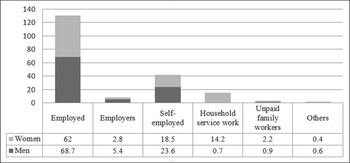
Concerning female work activity in Latin America, the percentage of women who own a business is 2.8%, which represents less than half the percentage of male business owners (ILO 2014b). Self-employed women represent 18.5% of the population. The segmentation of the labor market shows that the majority of women are employed (62%), although this percentage is lower than for their male peers. Similarly, few women are employers (2.8%), while men almost double this percentage, and 18.5% are self-employed. Conversely, household service work (14.2%) and contributing family workers (2.2%) are represented by women (ILO 2014b). These data show the low female participation in the business world in Latin America (Figure 1).
Work category by gender in Latin America (ILO 2014b).

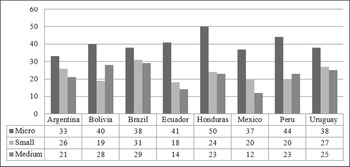
Women entrepreneurs in Latin America are usually married or cohabitants and generally own micro, small, or medium-sized businesses (ILO 2014b; World Bank 2010) related to the service and trade sector in rural areas (Reference HellerHeller 2010) (Figure 2). In many cases, the region’s entrepreneurial and self-employment alternatives become a part of a survival strategy for women who find no other way to earn income (Reference HellerHeller 2010).
Percentage of women-owned businesses by company size (World Bank 2010).

The International Bank for Reconstruction and Development and the World Bank (IBRD and World Bank 2010) point out the barriers that women entrepreneurs face in Latin America: a feeling of being less prepared to perform complex activities in relation to the standards and procedures of the companies rules, access to networks and markets, fewer possibilities to get training and business development services, greater risk aversion or fear to get a loan, assets of less value and size, and gender roles force them to have more responsibilities at home. The Economic Commission for Latin America and the Caribbean (ECLAC) state that one of the main problems women face is the imbalance between productive work and family responsibilities (Reference DaerenDaeren 2000). Heller (Reference Heller2010) states that the main problems Latin American women entrepreneurs have are the lack of business and trade experience; insufficient business education; barriers to accessing credit, financing, and trade networks; and the excessive procedures and paperwork to start a business.
Some authors have studied the causes of entrepreneurship based on personal aspects. Bengtsson, Sanandaji, and Johannesson (Reference Bengtsson, Sanandaji and Johannesson2012); Caliendo, Fossen, and Kritikos (Reference Caliendo, Fossen and Kritikos2014); and Boënte and Piegeler (Reference Boënte and Piegeler2013) point out that personality traits influence the decision to become an entrepreneur. Boënte and Piegeler (Reference Boënte and Piegeler2013) find that competitiveness is related to personality. Risk aversion is another element taken into account. Kihlstrom and Laffont (Reference Kihlstrom and Laffont1979) state that risk-averse people become employees, while people who are more tolerant of risk become entrepreneurs. Several studies indicate that some risk measures relate to personality and entrepreneurship traits (Reference Boënte and PiegelerBoënte and Piegeler 2013; Reference Bengtsson, Sanandaji and JohannessonBengtsson, Sanandaji, and Johannesson 2012; Reference Verheul, Thurik, Grilo and van der ZwanVerheul et al. 2012). Other research indicates that women are more risk-averse (Reference LlussaLlussa 2010; Reference Caliendo, Fossen and KritikosCaliendo, Fossen, and Kritikos 2014; Reference Bengtsson, Sanandaji and JohannessonBengtsson, Sanandaji, and Johannesson 2012). However, Bernat, Lambardi, and Palacios (Reference Bernat, Lambardi and Palacios2017) state that personality traits do not have a significant impact on entrepreneurial activity except for the need for achievement and, to a lesser extent, autonomy. Similarly, Kuzilwa (Reference Kuzilwa2005) points out that, in spite of personal business characteristics—such as education, attitudes, motivation, and experience—the environment may impede business development.
Other studies specify that it is insufficient to review only individual aspects to explain entrepreneurship, and we need to understand the problems influenced by the environment rather than by individual aspects. Aldrich, Rosen, and Woodward (Reference Aldrich, Rosen, Woodward, Churchill, Hornaday, Kirchhoff, Krasner and Vesper1987) state that social structures affect the entrance of women into the business sector. Business environment factors can be economic, financial, legal, political, and sociocultural, and these are beyond the company’s control (Reference KuzilwaKuzilwa 2005). Different studies point out that the cultural, social, and institutional environment influences the entrance, growth, and development of women-owned businesses (Reference AidisAidis 2006; Reference Baughn, Chua and NeupertBaughn, Chu, and Neupert 2006; Reference Aidis, Weeks and AnackerAidis, Weeks, and Anacker 2015; Reference Jennings and BrushJennings y Brush 2013; Reference Griffiths, Gundry and KickulGriffiths, Gundry, and Kickul 2013). The extent to which these structural dimensions affect women entrepreneurs depends on cultural norms in a given society (Reference Kyalo and KigananeKyalo and Kiganane 2016).
Conceptual Framework
The analysis of the environment in Latin American women-owned businesses has used some components of the Integrated Framework Assessment for an Enabling Environment for Women-Owned Businesses developed by the ILO (2014a). It is a tool that supports the identification of the most effective mechanisms to create a more equitable and favorable environment for women-owned businesses’ development and growth (ILO 2007).
This study will use the following components of the framework: access to credit and financial services, institutionalism, associations and women entrepreneurs’ networks, legal and regulatory framework, citizen security and gender-based violence, and promotion of women entrepreneurship. The factors were selected based on the available information. This study includes the use of time, since this is considered an important element in the environment of women (Figure 3).
The conceptual framework (ILO 2014a).

Access to Credit and Financial Services
A fundamental aspect for business development is access to financing, which can influence the success of new and growing women-owned businesses (Reference Okoth, Nambuswa and NamusongeOkoth, Nambuswa, and Namusonge 2016). In the financial system, the role of institutions is to capture resources from family savings and then, through credit, allocate them to investment projects and business and family initiatives. In this sense, the financial system is related to the economic progress of developing countries because it stimulates savings, capital accumulation, and a better allocation of resources or productive efficiency (CAF 2011).
There is a lot of evidence about the positive impact of credit in business performance (in Nigeria, Nicaragua, Canada, and Croatia) (Reference OjoOjo 2009). However, this success is not the same for men and women. Scherr, Sugrue, and Ward (Reference Scherr, Sugrue and Ward1993) point out that lenders could discriminate due to negative social beliefs about women. In Latin America, Heller (Reference Heller2010) notes that this is one of the main difficulties women entrepreneurs have. For this reason, women mainly use their personal savings for entrepreneurship and women progressively participate more in informal investments (Reference Romani, Atienza and AmorósRomani, Atienza, and Amorós 2012).
Hisrich and O’Brien (Reference Hisrich, O’Brien and Vesper1981) suggest that lenders could discriminate due to negative social beliefs about women or to uncertainty with regard to the payment of debts. Nevertheless, Ormazabal (Reference Ormazabal2014) states that women have a lower credit default in comparison with men. D’Espallier, Guérin, and Mersland (Reference D’Espallier, Guérin and Mersland2011) developed a literature review and found arguments that explained the origin of the gender differences in credit default rates and reimbursement. One of them is related to women’s conservative and prudent investment strategies, which leads them to maintain the best credit reimbursement rates to conserve their access to funding. The follow-up and collection of the debt is active for women because they communicate more with the financing institution.
In Latin America, more than half of women (52%) don’t have a bank account (the global average is 43%), even though the proportion of women with bank accounts increased from 35% in 2011 to 48.5% in 2014. This represented the highest regional growth in that period. The progress mainly occurred in Brazil, Costa Rica, Jamaica, Mexico, and the Dominican Republic (Reference Olloqui, Andrade and HerreraOlloqui, Andrade, and Herrera 2015). In addition, according to the Global Financial Inclusion (Global Findex) Database, women in developing economies are 20% less likely than their male peers to have an account at a formal financial institution (bank, credit union, cooperative, post office, or microfinance institution) and are 17% less likely to have taken out a formal loan (Reference Demirguc-Kunt, Klapper and SingerDemirguc-Kunt, Klapper, and Singer 2013). In the region, according to the Global Findex Database, the main reason for men and women not having an account is the lack of enough money. The second most important reason for women is that another family member already has an account.
With regard to formal savings, one of the most important tools to improve the productivity and empowerment of women is to give more control and privacy to manage their resources. Only 11.4% of women save in a financial institution, which is less than half of the world average of 25% (Reference Olloqui, Andrade and HerreraOlloqui, Andrade, and Herrera, 2015). Only 10% of women have received formal credit from a financial institution, compared to 9.6% of the world average (Reference Olloqui, Andrade and HerreraOlloqui, Andrade, and Herrera, 2015). In addition, Latin American women have specific characteristics in regard to the access to credit: women use credit less often; women apply for smaller loans (loans to men entrepreneurs are approximately 2.2 to 2.5 times higher than women entrepreneurs); women rely on informal financing sources, personal savings, or family loans; women’s assets are consistently of lower value than those owned by men; and men and women invest in different assets (World Bank 2010).
Likewise, the main barriers that make it hard for women microentrepreneurs to access financial credit are high financial cost; low level of operational and financial self-sufficiency increasing the financial cost; requirement of securities that women do not have; strict deadlines for paying a loan; complex bureaucratic procedures that women do not understand and have no time to process, since they are responsible for the household and children; and legal problems, since the property titles and land rights that may be considered as guarantees traditionally are in men’s name (Reference ZuñigaZuñiga 2004).
In summary, in Latin America, the low financial inclusion level of women entrepreneurs impedes growth. According to the available information, women-owned businesses have problems with credit guarantees and mainly finance their businesses with personal or family savings, which limits their growth. In addition, credit evaluation and financial products do not reflect the specific characteristics of women entrepreneurs. On the other hand, crowdfunding could be an alternative for women entrepreneurs, since it represents a single category of fund-raising based microfinance and crowdsourcing (Reference MollickMollick 2013). Greenberg and Mollick (Reference Greenberg and Mollick2017) pointed out that, at least in part, crowdfunding reduces the importance of traditional geographic constraints even as it potentially imposes new ones. Crowdfunding represents a novel way for founders to raise capital for a wide variety of projects.
Institutionalism
The institutional context, along with political-economic aspects, influences entrepreneurship because it includes the formal, regulatory, and policy frameworks within companies and the entrepreneurship intention (Reference DiMaggio and PowellDiMaggio and Powell 1983; Reference Lecuna, Cohen and ChavezLecuna, Cohen, and Chavez 2017; Reference Van de VenVan de Ven 1993; Reference Birley, Westhead, Birley and MacMillanBirley and Westhead 1993; Reference KouriloffKouriloff 2000). Governments have tried to stimulate entrepreneurship in their economies because they have acknowledged its importance (Reference Biglaiser and McGauvranBiglaiser and McGauvran 2018; Reference DruckerDrucker 1985; Reference Reynolds, Storey and WestheadReynolds Storey and Westhead 1994). It is progressively recognized that gender is an issue in entrepreneurship and that entrepreneurial development is different between the sexes (Reference Aidis and WeeksAidis and Weeks 2016).
Several studies stated that institutions play an important role in the facilitation of female entrepreneurship (Reference Allen, Elam, Langowitz and DeanAllen et al. 2008; Reference Elam and TerjesenElam and Terjesen 2010; Reference Terjesen, Elam, Brush, Hindle and KlyverTerjesen, Elam, and Brush 2011). Aidis, Weeks, and Anacker (2013) indicate that this may be reflected in equal legal rights, access to education, networking, technology, and capital. Institutional support is related to financing, governmental regulation, market opportunities, skilled labor, and connections to resource holders (Reference DavidssonDavidsson 1991). Institutionality is a critical element to improve the business environment, which includes the mainstreaming of gender perspective in the government, the institutionality of the executive power to support women-owned businesses, and the participation of women entrepreneurs in business development policies (ILO 2014a).
The political context and the visibility of women in politics also influence the business field. Women in political positions can be an example of leadership; some research revealed that there is a relationship between women’s political power and the rates of female entrepreneurship (Reference Goltz, Buche and PathakGoltz, Buche, and Pathak 2015). Conversely, women’s political empowerment and entrepreneurship support may be disconnected or be less evident for women. This would have a lesser impact on female business behaviors (Reference Brush, Ali, Kelley and GreeneBrush et al. 2017).
At the Fourth World Conference on Women in Beijing (1995), the platform for action with respect to women’s equality and empowerment was defined. It changed the legal frameworks and created institutions oriented to develop and promote gender equality in several countries. (SELA 2010).
While all the countries in the region have introduced gender-related topics in their agendas, these are insufficient in certain areas. There is a deficit of policies and programs that foster the development of small and mid-sized enterprises (SMEs) and promote gender equity. There are cases where governments have generated specific programs and projects for small women-owned businesses, but they are not articulated to productive policies because they are not included in the economic agenda (SELA 2010).
Latin America is still in the conformation and consolidation process of the institutions and tools that support the work and economic development of women. Some countries have ministries or departments responsible for promoting gender equality and female employment. In March 2014, Chile created the Ministry of Women and Gender Equity; Paraguay has the Ministry of Women; Peru, the Ministry of Women and Vulnerable Populations; Venezuela, the Ministry of Popular Power for Women and Gender Equality, ex-Ministry of the Family, etc. Ecuador, Colombia, Uruguay and Argentina do not have these initiatives, but they deal with the problems of this population in a different way. Ecuador has the National Council for Gender Equality; Colombia has the Presidential Office for Women’s Equality; Uruguay, the National Institute for Women, and so forth (Table 3).
Gender equality policies and plans in Latin America.

In summary, although there are initiatives to consider the mainstreaming of gender perspective in the government and the institutionality of the executive power to support the development of women-owned businesses, the impact of these initiatives on women entrepreneurship is unclear and the gender perspective is not mainstreamed in all areas.
Women Entrepreneurs’ Associations and Networks
The associations and networks of women entrepreneurs, as voluntary cooperation mechanisms to obtain individual benefits through joint actions, play a fundamental role to develop entrepreneurship. World Bank (2010) states that networks are important resources for enterprise growth because market information and suppliers and investors contacts are shared. Women’s networks provide various services (meetings, forums, seminars, events, discussions, etc.), training, workshops, and personalized advice. They connect their partners with other professionals and influence the policies and laws to reduce the gender gap within the business and economic system. Networks also maintain a sense of partnering and interconnection and democratically manage the commitments and networks (Corporación Santiago Innova, n.d.). Therefore, business networks are an important source of knowledge, growth and development for women-owned businesses (ILO 2014a).
Women have smaller networks than men, which limits their scope and choice of sector (Reference Aldrich, Rosen, Woodward, Churchill, Hornaday, Kirchhoff, Krasner and VesperAldrich, Rosen, and Woodward 1987; Reference Brush, Carter, Gatewood, Greene and HartBrush et al. 2004). This is related to the small capital stock they have (Reference Romani, Atienza and AmorósRomani, Atienza, and Amorós 2012). Some studies suggested that personal networks are more important for women than commercial networks, mentoring, and coaching (Reference Bogren, Friedrichs, Rennemo and WiddingBogren et al. 2013).
Latin American women entrepreneurs have problems accessing networks and markets for their products and they are less likely to get training and business development services. The available networks focus on the traditional roles and exclude women from the productive and higher growth sectors. However, although for many years the networks were occupied by men, today women are involved and have important leadership roles in this environment; these associations are flourishing throughout the region (World Bank 2010).
There are different networks and associations in the region that empower women and support the development of women entrepreneurs. For instance, the Associação de Mulheres Empreendedoras (Women Entrepreneurs Association) in Brazil values the participation of women entrepreneurs in order to promote business opportunities and give professional training to that specific population. In Chile, Mujeres Emprendedoras (Women Entrepreneurs) is an institution that guides women to accomplish business goals through consultancies and networking and to develop business ideas, in addition to promoting agreements with companies and among members.
In summary, Latin American women-owned businesses have heterogeneous structures in size, needs, and/or services. The promotion of women entrepreneurs’ networks and associations is one of the most widely used public and private tools to support the development of women-owned businesses. Nevertheless, these are isolated projects that are not clearly articulated; hence, their effectiveness is relatively low (ILO 2014a).
Legal and Regulatory Framework
Several studies affirm that there is an intimate relationship between elements of the political context and entrepreneurship (Reference MurdockMurdock 2012; Reference Kim and LiKim and Li 2014; Reference Weeks and SeilerWeeks and Seiler 2001) which can strongly influence genders (Reference Ardagna and LusardiArdagna and Lusardi 2010). According to the International Finance Corporation (IFC) and the Global Reporting Initiative (2009) reports, even a gender-impartial legal and regulatory environment can have gender-differentiated results; this is evident in regard to the access to credit, assets, training, and information.
The legal and regulatory framework influences the start, formalization, and growth of women-owned businesses (ILO 2014a). There is clear progress in all Latin American countries; however, some countries emphasize more the maternity or gender-specific legal frameworks than the others do (Reference Avolio, Di Laura and MarquinaAvolio and Di Laura 2016). There is noticeable progress in the creation and adaptation of national and international regulations and governmental agreements with respect to nondiscrimination and promotion of gender equality in the region. Some of the international standards are implemented in the agreements made among the countries, and these guide the policies to achieve gender equality within the work environment. These are the Equal Remuneration Convention (1950), the Discrimination (Employment and Occupation) Convention, the Workers with Family Responsibilities Convention (1981), and the Maternity Protection Convention (1952 and 2000). Several of these conventions have been ratified by the majority of countries, while the latter is ratified only by Belize and Cuba (ILO 2013).
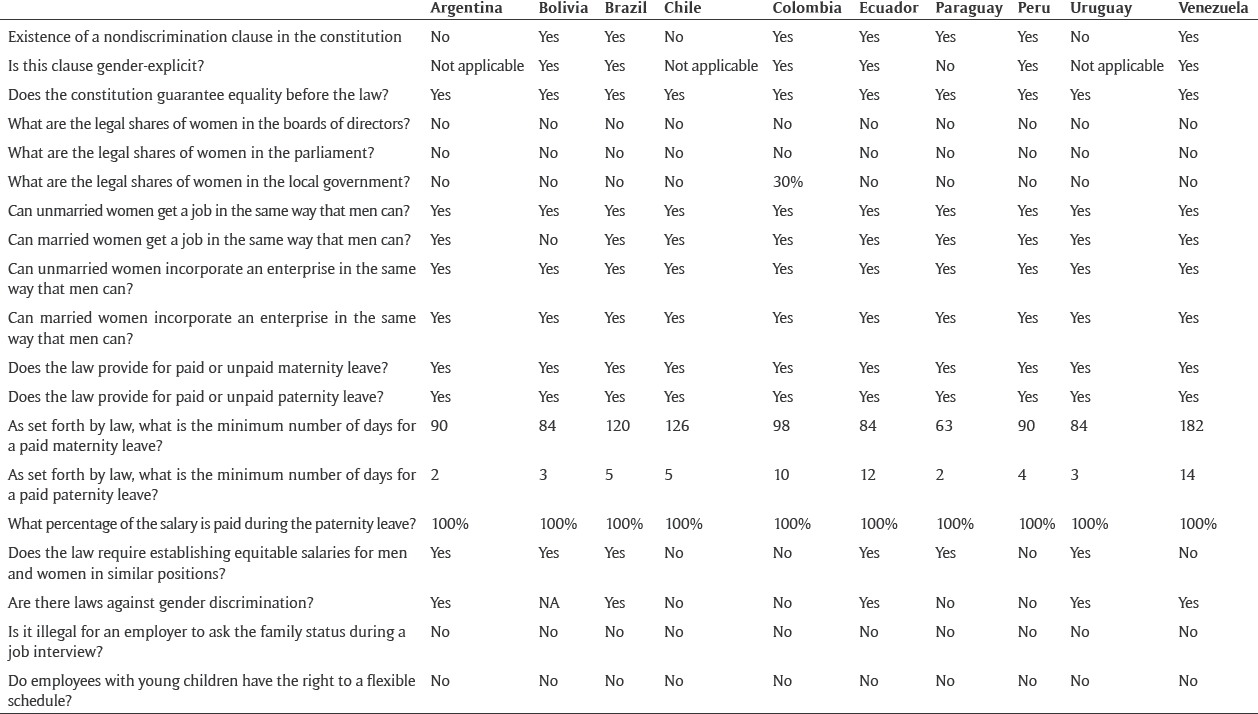
A study conducted in Latin American countries recognized that in Bolivia, Brazil, Colombia, Ecuador, Paraguay, Peru, and Venezuela there is a clause for nondiscrimination in the constitution, while in Argentina, Chile, and Uruguay there is no such clause. In spite of this, in all the countries the constitution guarantees equality before the law. In regard to labor protections, in Chile, Colombia, Peru, and Venezuela the law does not require establishing fair wages for men and women in similar job positions. In Argentina, Brazil, Ecuador, Uruguay, and Venezuela there are laws that prohibit gender-based discrimination (Reference Avolio, Di Laura and MarquinaAvolio and Di Laura 2016). (See Table 4).
Legal framework supporting the access of women to productive activities.
In summary, there has been significant progress in the Latin American regulatory framework with regard to gender equality, work conditions, and nondiscrimination in compliance with international standards. The countries in the region have repealed almost all the discriminatory regulations against women in aspects related to work conditions (access to employment, performance, termination, and type of available jobs).
Distribution of the Use of Time
Terjesen, Elam, and Brush (Reference Terjesen, Elam, Brush, Hindle and Klyver2011) state that the role of Latin American women entrepreneurs is increasingly important; however, their participation in the economy is limited due to family responsibilities. Entrepreneurship can offer a flexible option to earn profits for women who have household duties and a solution to increase the household income (Reference Brush, Ali, Kelley and GreeneBrush et al. 2017). Work has been traditionally considered a source of income or economic support; however, in many cases, unpaid productive work (household chores, parenting, and community, or volunteer work), which is mainly performed by women, has been disregarded (ECLAC 2013). The double burden shows the structural problems that the societies of Latin America have. “Despite the fact that women have been incorporated massively to the economically active population and also participate in paid work, there is no family shared responsibility because the household chores are not redistributed. These chores remain assigned to women due to the cultural mandate” (INEI 2011, 18).
In Latin America, on average, the sum of paid and unpaid work hours is higher for women than for men and unpaid work is mainly performed by women. Mexico has the highest rate, where the sum of paid work hours (847.4) plus unpaid work hours (847.5) totals 94.9 hours per week. Other countries with a high level of unpaid work are Uruguay (44.2, plus the time of paid work totals 82.7 hours per week), and Peru, where unpaid work consists of 39.4 hours per week. The countries where women perform less unpaid work are Brazil (25.2) and Costa Rica (31.6) (ECLAC 2014).
The unequal distribution of the use of time has an adverse effect on the workforce of this population. The equitable distribution of household and childcare chores between men and women influences the integration of women in the labor market in decent and equal conditions (Reference Aspiazu and SeltzerAspiazu and Seltzer 2011). When women are overrepresented in unpaid work, this becomes an obstacle that negatively impacts their employment opportunities, financial compensation, and psychosocial development (Reference Aguirre and FerrariAguirre and Ferrari 2014).
The imbalance of the total work load categorically disadvantages Latin American women in different aspects. The lack of assistance and support to Latin American women in regard to the care of children and dependent persons within and outside their family space becomes a problem because, although these activities are productive and necessary for the harmony and development of societies, they do not generate financial compensation and, on the contrary, cause the physical and emotional fatigue of women.
Citizen Security and Gender-Based Violence
Violence against women extends globally (World Health Organization 2013), and it has been recognized internationally that it threatens public health, violates human rights, and creates a barrier to economic development (Reference Bott, Guedes, Goodwin and AdamsBott et al. 2014). Violence can be manifested physically through the use of force; it can be sexual if there is any kind of forced sexual contact; psychological if the self-esteem and personality are attacked; and economic if there is human trafficking and financial resources are withdrawn (Reference Brendel and SchwitallaBrendel and Schwitalla 2011). Globally, about 30% of women who have been in a relationship reported that they have experienced some form of physical and/or sexual violence. A comparison report developed in twelve countries of Latin America and the Caribbean showed that the number of women that have been physically or sexually abused by their partners in their lifetime is 53.3% in Bolivia, 39.7% in Colombia, and 17% in the Dominican Republic (Reference Bott, Guedes, Goodwin and AdamsBott et al. 2014).
Violence against women has different facets and levels of impact, such as socioeconomic, family, social, and individual. The economic and social costs of violence against women are significant for society, businesses, families, and individuals (Reference Brendel and SchwitallaBrendel and Schwitalla 2011). In regard to employed women in a company, it is found that although violence may not originate in the company, it affects business productivity. This problem causes corporate financial losses due to the decrease of labor productivity and to the staff turnover (Reference Valera and BrendelValera and Brendel 2015). In the region, violence against women causes severe economic problems. In Peru, the business cost of partner violence ranges from 3.7% to 3.9% of the 2012 GDP, due to absenteeism and presenteeism, which represents an annual loss of approximately US$6,744 million—an equivalent of 70 million working days (Reference VaraVara 2013a). In Bolivia, the estimated economic loss of violence against women is US$2,000 million per year, equivalent to 6.5% of the GDP (Reference VaraVara 2015). In Ecuador, a study on microentrepreneurs conducted in 2013 found that they have annual losses of US$8.7 million—an equivalent of 6.7 million working days—due to violence (Reference VaraVara 2013b). Finally, in medium- and large-sized enterprises in Paraguay, the loss of labor productivity is US$734.8 million per year—equivalent to 2.39% of the GDP and 21 million working days (Reference GonzálezGonzález 2015). One of the factors contributing to this problem is low economic empowerment, since an economically empowered woman has less risk of being a victim of domestic violence (Reference AndersonAnderson 1997). Violence against women has far-reaching consequences, since it “impoverishes women, their families, communities and nations. It lowers the economic production, drains resources from public services and employers, and reduces human capital formation” (United Nations 2006, 4). Therefore, violence against women is not only a personal problem because it goes beyond the socioeconomic level, which means that the companies have to cover the costs (Reference Brendel and SchwitallaBrendel and Schwitalla 2011).
There are few studies on how factors external to companies, such as citizen insecurity, affect their economic dynamics. Victimization in the public and commercial sectors is generally more difficult to count than crimes committed against individuals or households (Reference Brand and PriceBrand and Price 2000). Moreover, there are no studies on how insecurity can specifically affect women-owned businesses. However, Figueroa and colleagues (Reference Figueroa, Montes, Rivera, Artavia and Marshall1997) pointed out that insecurity has a high social and economic cost not only for governments and citizens but also for companies because it affects business operations. Figueroa and colleagues (Reference Figueroa, Montes, Rivera, Artavia and Marshall1997, 68) stated in their study in Central America (Costa Rica, El Salvador, Guatemala, Honduras, and Nicaragua) that “insecurity increases the costs of companies, decreases the production and productivity, affects sales revenues and has a high opportunity cost of the resources used to combat it, as well as the investments that are not made due to the increased risk perceived by this problem.”
In conclusion, there is a need for greater and better institutional relations between public institutions and private companies to deal with gender-based violence and insecurity in relation with women-owned businesses. It should be noted, however, that there are different initiatives to fight violence against women, and these are included in policies, standards, action plans, and campaigns (Reference Alméras and Calderón MagañaAlméras and Calderón 2012).
Promotion of Women Entrepreneurship
The public instruments to support entrepreneurship in Latin America are heterogeneous and characterized by distinct paths and progresses. Due to the absence of a solid governmental role, private initiatives are more prominent. Nevertheless, the majority of the countries of the region have begun to take firm steps to provide support instruments and are working on an articulated entrepreneurship policy (Reference Hidalgo, Kamiya and ReyesHidalgo, Kamiya, and Reyes 2014). Latin America needs public intervention to promote entrepreneurship in order to improve the quality of life and, in the long term, to make viable the possibilities of growth and economic and social development (CAF 2013).
Lopez-Acevedo and Tan (Reference Lopez-Acevedo and Tan2010) show that some entrepreneurship programs in Latin America, in countries such as Peru, Colombia, Mexico, and Chile, had good, positive results in business productivity and growth. The study found that participants in public programs had increases in sales, production per worker, wages, and employment in their companies.
In relation to women entrepreneurship programs in several Latin American countries, there are public initiatives based on the policies in the region. The most used instruments are lines of financing, management and administration training, networks, access to credit, technical assistance to improve production, trade shows, seminars, meetings, and conferences, among others (SELA 2010). Some of the programs to promote gender equity in women-owned businesses are shown in Table 5 (SELA 2010).
Programs in Latin America to support women and their companies.

Similarly, entrepreneurship initiatives in Latin America are relevant. For example, municipalities and the national government agencies are implementing more projects to disseminate entrepreneurial culture (Reference Angelelli and PratsAngelelli and Prats 2005). Another example is the Development Committee for Women Entrepreneurs of the Lima Chamber of Commerce in Peru, which promotes the “International Forum of Women Entrepreneurs: New Challenges in the World” in order to raise awareness and train women entrepreneurs in leadership, ethics, entrepreneurship, and marketing, among other skills.
The promotion of entrepreneurship in Latin America is increasingly relevant. The municipalities and the national government agencies implement more projects to disseminate the entrepreneurial culture (Reference Angelelli and PratsAngelelli and Prats 2005).
Discussion
In recent years, the empowerment of women in Latin America has been increasing. Specifically, the gender gap in the labor market has been reduced, which is reflected in the progressive and steady increase in the female labor force (ILO 2012). Likewise, women’s total entrepreneurial activity is the highest in the region (Reference Kelley, Singer and HerringtonKelley, Singer, and Herrington 2016). However, in comparison with their male peers, there are still several challenges. Despite the fact that women-owned businesses favor economic development, job creation, family support, and poverty reduction, they still face environmental, legal, institutional, and cultural barriers (ILO 2014a).
In relation to access to credit, in many Latin American countries, the lack of access to financial services is an obstacle to the growth of women-owned businesses (ILO 2014a). The study states that Latin American women entrepreneurs have specific characteristics with respect to access to credit and savings. In spite of the increase of women in the credit system, there are still few women with a bank account. The reasons for this are linked to the lack of money or the fact that another member of the family has an account. However, there are also external factors, such as the institutional, financial, and social factors that affect the relation between women entrepreneurs and the banking system. Credit and financial services have characteristics based on men’s needs. The specific characteristics of women-owned businesses are not taken into account; thus, women entrepreneurs have less access to these services. The particular characteristics of women-owned businesses in the region should be considered, especially in relation to bank loan guarantees. It is also essential to develop an economic and financial literacy strategy so that the resources can be correctly allocated and used. One way to improve women-owned businesses is to increase the access to credit through rates, terms, and guarantees.
In relation to institutionalism, there are international agreements to promote equity in different economic aspects; in spite of this, women entrepreneurs are not included in the agendas of Latin American countries. In this region, the process is still in progress; nevertheless, there are important achievements, such as the constitution of ministries of women, although at present not all countries in the region have ministries for women. In addition, there are various initiatives of plans or policies that address women entrepreneurship. However, it should be noted that these are scarce, and productive policies for women entrepreneurs are not adequately interconnected with the productive policies of their countries (SELA 2010). One recommendation is to coordinate work concerning women-owned businesses at a governmental level, because this might be fundamental to developing women’s families and the economy in general. It is also necessary to continue fostering a gender perspective in public institutions so as to support women entrepreneurs. These public policies must consider the cultural characteristics of each country and the statistical data, still scarce, about the situation of women entrepreneurs. Likewise, the country policies should recognize and simplify the entry of women into the business sector and consider them key actors of economic development. It is necessary to define specific guidelines in public policies that respond to the needs of this population, recognizing the particular reality they face.
In regard to associations, women entrepreneurs are at a disadvantage compared to their male counterparts, since they have less access to associations, information sources, and business formalization. While women do not have lesser entrepreneurial skills than men, they do have less chance of getting the necessary training to develop their companies. In addition, it should be noted that networks structure are different for men and women; women have small networks and these are mainly homogeneous social and family relationships (Reference HellerHeller 2010). However, associations and networks, which for many years were managed by men, are currently focused on the performance of female leadership roles and participation of the female population.
In regard to the legal and regulatory framework, Latin America has made significant progress in the promotion of gender equity, and there has been steady progress in institutional reforms toward equity. Nevertheless, in relation to the rights related to women’s economic opportunities, the results are varied (World Bank 2010). In the region, there are laws that support nondiscrimination, workplace protections, and pregnant women’s rights, among others; however, these are not yet adequate. Despite the fact that there are various laws that protect women in these areas, there are still cultural practices that undermine these rights. It is recommended to conduct research and report the legal work to give greater security and development to women.
In regard to the use of time, traditional gender roles disproportionately assign household and family responsibilities to women, which impedes their development in paid or business activities. In regard to the use of time between paid and unpaid work, women in the region are disadvantaged, since the sum of their paid and unpaid work is higher than men’s (ECLAC 2014). Recommendations include increasing social awareness about shared responsibility and improving the distribution of the time within the family structure, so that women have better conditions in which to lead their companies. In addition, reconciling the family and the company based on policies and programs provides flexibility in work and family life.
In relation to violence, no data have been found about the relationship between violence and women entrepreneurs. However, there are alarming figures in some countries of the region and it might be assumed that violence also affects women entrepreneurs and their leadership. Another factor of business environment is citizen insecurity. Further studies on gender-based violence are recommended to measure the impact that this could have on women entrepreneurs.
In regard to the promotion of entrepreneurship, even though programs and projects are not necessarily articulated with the policies, it is found that some of the programs are getting good results. The recommendation is to define appropriate programs to enhance women entrepreneurs’ skills and include them in policies and plans for greater impact.
Contributions and Recommendations for Future Research
This research has contributed to the knowledge of women entrepreneurship. It examined the environmental factors that influence women-owned businesses, because this subject is not studied enough at present. Furthermore, it contributes to regional studies since studies on the environment of women entrepreneurs in Latin America are scarce. The conclusions include recommendations that should be adjusted for each country and its level of development. The study has some limitations that can be considered as a basis for improving subsequent studies on the environment of women entrepreneurs. Data should be collected in greater detail and future studies planned with greater scope. The results only reflect the reality of Latin America and not another region. Also, the study only focuses on women entrepreneurs and does not make a comparison with male entrepreneurs. The recommendation is to conduct future research with firsthand data and include the eleven factors of the Enabling Environment for Women-Owned Businesses developed by the ILO. Quantitative research based on analysis of these factors should be conducted to generalize the results by country and to make comparisons between women’s and men’s business environments.




 Open access

