Introduction
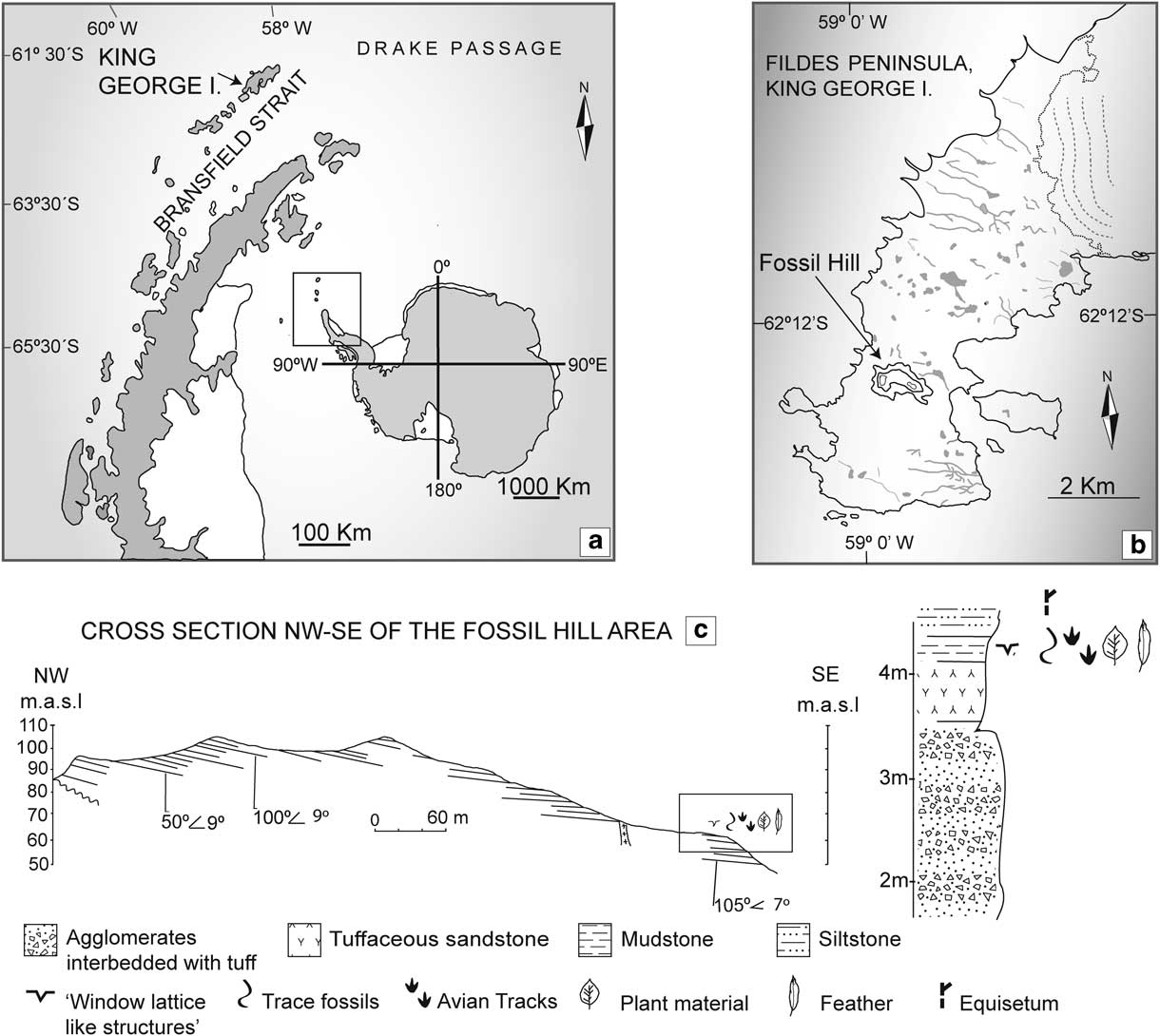
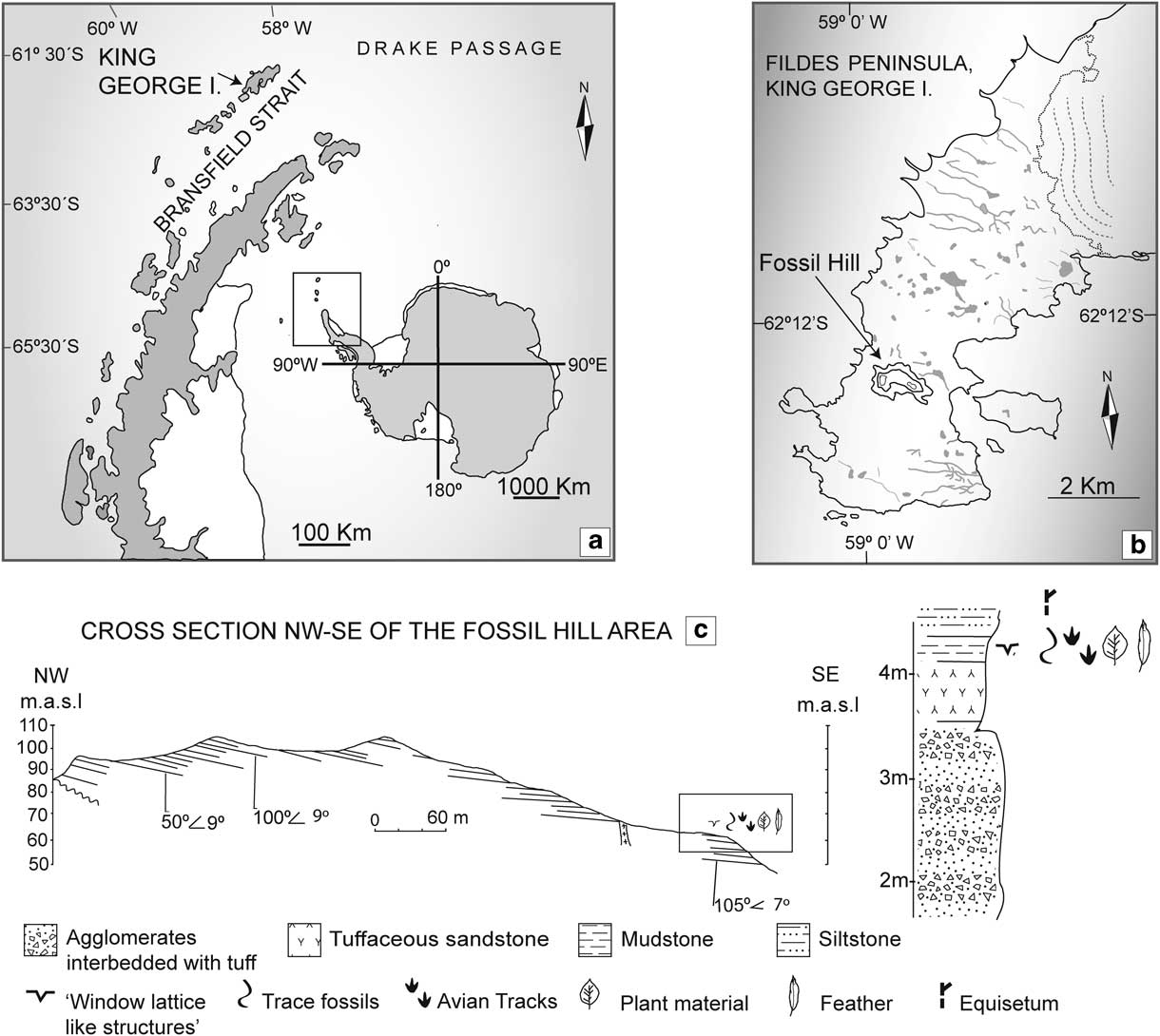
The Fossil Hill Formation outcrops on the Fildes Peninsula, King George Island, Antarctica (Fig. 1). Due to the richness of palaeontological records and their excellent preservation (ATCM 2009), sediments at the type locality form part of Antarctic Specially Protected Area 125a (ASPA). The fossil assemblage includes abundant ichnofossils referred to a variety of invertebrates (Covacevich & Lamperein Reference Covacevich and Lamperein1972, Yang & Shen Reference Yang and Shen1999), bird footprints (Covacevich & Lamperein Reference Covacevich and Lamperein1970, Reference Covacevich and Lamperein1972, Covacevich & Rich Reference Covacevich and Rich1982, Li & Zhen Reference Li and Zhen1994, Mansilla et al. Reference Mansilla, De Valais, Stinnesbeck, Varela and Leppe2012), and diverse floral remains, including palynomorphs, leaves, roots and trunks (e.g. Orlando Reference Orlando1964, Lyra Reference Lyra1986, Troncoso Reference Troncoso1986, Torres & Meón Reference Torres and Meón1990, Li Reference Li1994, Poole et al. Reference Poole, Hunt and Cantrill2001, Li & Zhou Reference Li and Zhou2007, Fontes & Dutra Reference Fontes and Dutra2010). Here we add the first fossil avian feather to the Fossil Hill assemblage, as well as to the fossil record in Antarctica.
Location of the Fossil Hill Formation and the feather-bearing section. a. Antarctic Peninsula and South Shetland Islands. Arrow shows King George Island. b. Fildes Peninsula, King George Island. Arrow points to Fossil Hill - Antarctic Specially Protected Area 125a. c. Cross section of the Fossil Hill area, modified from Shen (Reference Shen1994) with part of the stratigraphic column (modified from Mansilla et al. Reference Mansilla, De Valais, Stinnesbeck, Varela and Leppe2012) showing the feather-bearing section.
Locality and geological setting
Fossil Hill covers an area of 1.8 km2 and is located 2 km south-west of the permanent Chilean base Escudero, on the Fildes Peninsula of King George Island, South Shetland Islands, Antarctica (between 62°10′50′′S–62°11′28′′S and 58°55′27′′W–58°56′38′′W). This is where the feather described here was discovered (Fig. 1).
The feather-bearing section at Fossil Hill consists of grey-yellow tuffaceous sandstone and red-brown mudstone with average silt size of between 0.004–0.062 mm. The strata form units of a few millimetres to one metre thickness. The section corresponds to the unit No. 1 described by Covacevich & Lamperein (Reference Covacevich and Lamperein1972) and is located in the lower part of the Fossil Hill Formation (Shen Reference Shen1994), a sedimentary unit of the Fildes Peninsula Group (Hawkes Reference Hawkes1961). Radiometric ages and the floral and palynological assemblage record suggest that the Fossil Hill Formation is early to middle Eocene in age (Pankhurst & Smellie Reference Pankhurst and Smellie1983, Cao Reference Cao1992, Li Reference Li1994, Shen Reference Shen1994).
Materials and methods
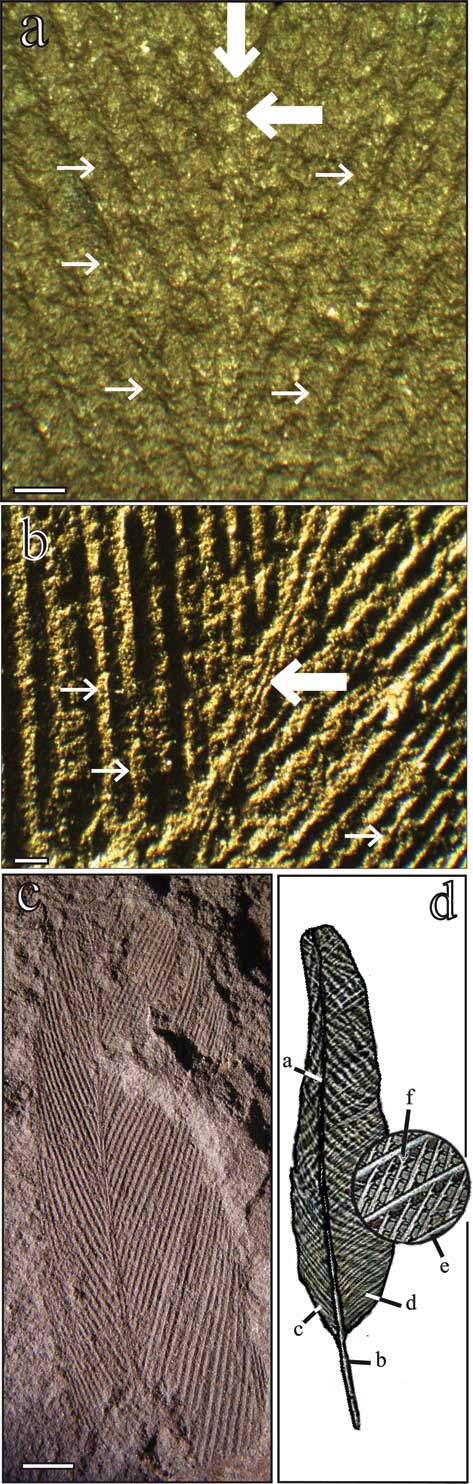
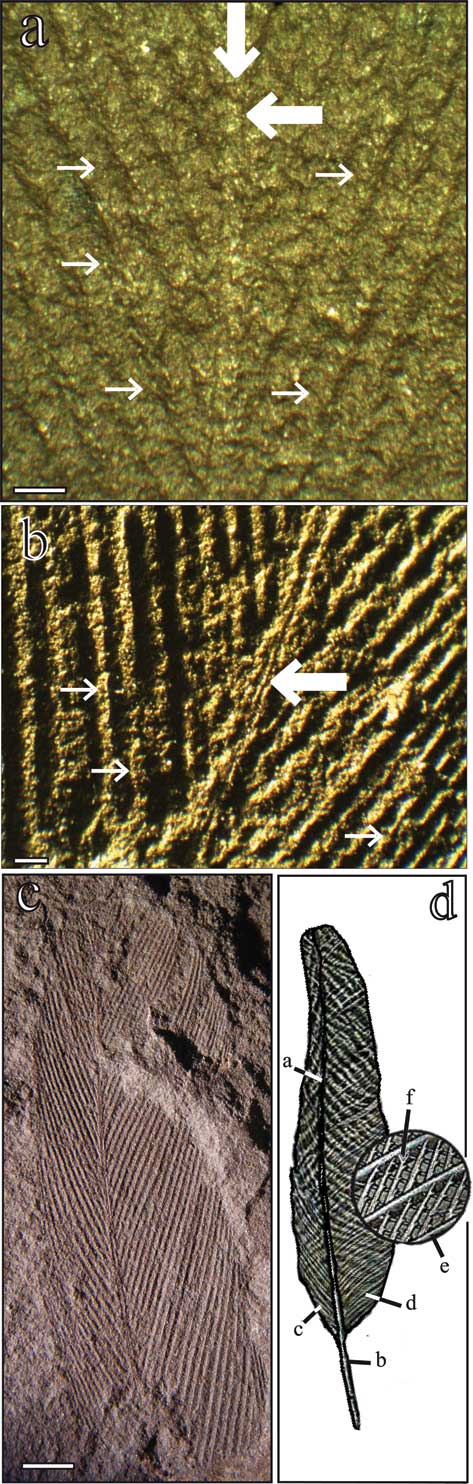
The specimen (Fig. 2) was found during the 2011 Chilean Antarctic expedition. It is now housed in the Laboratorio de Paleobiología of the Instituto Antártico Chileno (INACH), Punta Arenas, Chile, where it forms part of the Colección Paleontológica Antártica y Patagónica (CPAP). Its registration numbers are 0006 and 0007.
Fossil feather discovered at Fossil Hill (CPAP 0007). a. Rachis and barbs preserving barbules, the large arrows indicate the rachis and the small arrows show the barbules in barbs (scale bar 0.2 mm). b. The bridge that preserved the rachis in the slab is indicated by the large arrow, the small arrows show the barbs (scale bar 0.2 mm). c. Fossil impressions of a fight feather as an external mould, note the asymmetry between vanes and the closed-pennaceous texture (scale bar 0.5 mm). d. Schematic of a typical flight feather.
The feather is preserved as an external mould preserved in two slabs (slab and counterslab) showing three-dimensional characteristics. The slab (CPAP 0007) is around 10 mm thick and the counterslab (CPAP 0006) is 13 mm thick. Both are preserved in red-brown tuffaceous mudstone. In the slab CPAP 0007 the calamus, part of the right vane and the basal part of the vanes and rachis are covered by a thin sheet of sediment; in the counterslab CPAP 0006 these parts are not preserved. The sediment layer of CPAP 0007 was not removed to avoid damage to the fossil. A leaf impression of Nothofagus is preserved in the same slab.
Scanning microscope (SEM) analysis was conducted through a portion of the upper part of CPAP 0006 with a Jeol Scanning Microscope 5410 in the Departamento de Metalúrgia of the Universidad de Santiago de Chile (USACH). The sample surface was coated with gold and palladium to improve the conductivity of the sample for better resolution, with the objective to catch microstructures that could help in the identification of the specimen.
Description of the feather follows terminology in Lucas & Stettenheim (Reference Lucas and Stettenheim1972) and Hudon (Reference Hudon2005).
Description
The specimen preserves part of the rachis, ventral groove, barbs and barbules (Fig. 2). The feather is 7.4 mm at maximum width and 20.88 mm long. Vanes present a closed-pennaceous texture and are asymmetrical, with a maximum diameter of 5 mm for the inner vane and 3 mm for the outer vane. The rachis is 0.1 mm thin. It tapers distally and is slightly curved preserving the ventral groove in the widest part. Seventy-four barbs are preserved in the complete specimen from both vanes and are oriented distally on the feather. The distance separating barbs from each other is 0.2 mm on average, constant in both vanes. The proximal barbs are longest with a maximum length of 12 mm. The distal barbs are shorter with a maximum length of 4 mm. The proximal barbs present a mean angle of 25° with the rachis. This angle decreases in the distal barbs, where they become gradually parallel with the distal end of the rachis. All barbs preserve barbules; these are oriented upward with respect to the barbs and some appear to be interlocking, but microstructures like hooklets are not identified unequivocally during SEM analysis.
Discussion and conclusions
Fossil feathers are extremely rare in the fossil record, but have been more commonly found in the Northern Hemisphere, particularly in Mesozoic strata from China. Reports from the Southern Hemisphere are extremely scarce, with reports from Brazil being the most common (Sayao et al. Reference Sayao, Saraiva and Uejima2011) and the Victoria specimen from Australia the southernmost record (Talent et al. Reference Talent, Duncan and Handby1966). The specimen described here represents the first record of a feather from the Antarctic continent.
Preservation as carbonized traces and amber are most common (Davis & Briggs Reference Davis and Briggs1995), whereas preservation as an external mould is relatively rare (Wetmore Reference Wetmore1943). Most avian fossil feathers described to date are body contour feathers whereas wing and tail feathers are rare (Davis & Briggs Reference Davis and Briggs1995). The present specimen is one of these exceptions, the asymmetry of vanes with a closed-pennaceous texture, the apparent stiffness of the rachis with a deep ventral groove, the obtuse end and its short and wide outline suggest that it represents a remige or rectrice feather (López-Albors et al. Reference López-Albors, Gil, Vázquez, Latorre, Ramíre-Zarzosa, Orenes and Moreno1999, Hudon Reference Hudon2005), indicating that the Antarctic feather was used for flight.
Some groups of extant birds can be identified by the presence of microscopic characteristics in the barbules (Dove & Koch Reference Dove and Koch2010). Barbules were well preserved in the present specimen, but microscopic characters such as villi, nodes and hooks have not been recognized. However, the possible owner may be assigned by relating the feather to avian tracks described from the Fossil Hill Formation. These were identified as Gruipeda Panin & Avram, Avipeda Vialov and Uhangrichnus Yang et al. ichnotaxa (Mansilla et al. Reference Mansilla, De Valais, Stinnesbeck, Varela and Leppe2012). Fossil bones have not been reported from the unit.
The combined presence of feathers and bird footprints, hitherto unknown in the literature, constitute unequivocal evidence for the presence of birds in this region. The presence of feathers, avian footprints, rain drops, ripple marks and equisetid tails suggest a coastal ichnofacies for the locality (Lockley et al. Reference Lockley, Hunt and Meyer1994, Doyle et al. Reference Doyle, Wood and George2000, Mansilla et al. Reference Mansilla, De Valais, Stinnesbeck, Varela and Leppe2012) and a shorebird ecotype for the holder of the feather. The latter certainly belonged to a Neornithes which are known from Eocene sediments of the James Ross Basin with various representatives (Tambussi & Acosta Hospitaleche Reference Tambussi and Acosta Hospitaleche2007), thus actual plover, duck or stork could resemble the type of bird that owned the feather.
The preservation of a bridge in the internal mould (CPAP 0006) indicates that the ventral part of the feather was in contact with the sediment and its dorsal side was facing upward. Rapid burial in a fine-grained sediment (siltstone) prompted the preservation of barbs and barbules as well as of the ventral groove in the external mould (CPAP 0007). Water energy was low or currents even absent during decay, minimizing disturbance in the sediment. Botanical remains (e.g. equisetids) and sedimentological evidence (e.g. rain drop impressions, ripple bedding) suggest a position near the coast line.
The preservation of this feather was related to the environment of sedimentation and burial conditions. Low energy environments in a lacustrine or lagoonal setting were proposed for Fossil Hill by Xue et al. (Reference Xue, Shen and Zhuo1996) and Poole et al. (Reference Poole, Hunt and Cantrill2001), and new data by Jacques et al. (Reference Jacques, Shi, Li and Wang2012) indicate high levels of rain revealing a summer monsoon, probably causing high sedimentation rates and leading to rapid burial of organic debris. The prevailing mudstone sediment is characterized by a very fine grain (0.004–0.062 mm), supporting low energy conditions for the site and also facilitating the preservation of fragile structures like barbules.
The continental position, feather type and the preservation as an external mould with detailed structures make this specimen exceedingly rare. The early to middle Eocene Fossil Hill Formation has revealed an important continental fossil assemblage, with an exceptional preservation of some fossils, including the feather described here. These characteristics of the Fossil Hill deposit allow for a reconstruction of the faunal assemblage and their interactions, as well as regional climatic conditions, at the time of deposition. These data reinforce the importance of the Fossil Hill locality for understanding the climatic and biological history in Antarctica during the Eocene.
Acknowledgements
We are grateful to Eberhard “Dino” Frey, Carla Dove and Alan Vaugh for their detailed and constructive reviews that clearly helped to improve this manuscript. David Rubilar kindly commented on an earlier version of this manuscript. Harufumi Nishida discovered the specimen at Fossil Hill and Gladys Olivares is acknowledged for assistance in the SEM analysis and Jaime Carcamo for allowing access to the ornithological collection of the Universidad de Magallanes. Financial support for this project was obtained from FONDECYT Project 11080223 (2009–11) and from BMBF research grant CHL 10A/09.