Antibiotic resistance among gram-negative bacteria continues to emerge. In particular, resistance to extended-spectrum cephalosporins (ESC) among Enterobacteriaceae (EB) is increasingly prevalent.Reference Pitout, Hanson, Church and Laupland 1 – Reference Ben-Ami, Schwaber and Navon-Venezia 4 Urinary tract infections (UTIs) are the most common bacterial infection among adults in the community,Reference Simonsen, Conn, Pinner and Teutsch 5 and data have demonstrated marked increases in bacterial resistance to first-line antibiotics used to treat UTIs in ambulatory settings.Reference Talan, Krishnadasan, Abrahamian, Stamm, Moran and EMERGEncy 6 In particular, reports of ESC-resistant (ESC-R) EB UTIs in the outpatient setting have been increasing.Reference Pitout, Nordmann, Laupland and Poirel 7 – Reference Apisarnthanarak, Kiratisin and Mundy 11
Relatively little is known about the outcomes associated with such community-onset ESC-R EB UTIs. Prior studies have shown that ESC-R EB infections among hospitalized patients are associated with increased morbidity, mortality, and healthcare costs.Reference Lautenbach, Patel, Bilker, Edelstein and Fishman 12 , Reference Schwaber, Navon-Venezia, Kaye, Ben-Ami, Schwartz and Carmeli 13 Community-onset bacteremic UTIs due to ESC-R EB have been associated with delay in appropriate antibiotics and increased mortality.Reference Yang, Ku and Lin 14 – Reference MacVane, Tuttle and Nicolau 17 In a retrospective study of 120 patients that included both community- and hospital-onset UTIs, the only independent predictor of clinical failure was ESBL production.Reference Esteve-Palau, Solande and Sanchez 18 However, few prior studies have evaluated the outcomes associated with the more common nonbacteremic community-onset ESC-R EB UTI. Therefore, in this study, we sought to determine the association between community-onset ESC-R EB UTI and clinical failure. Furthermore, we evaluated whether community-onset ESC-R EB UTI was associated with a delay in the initiation of appropriate antibiotics and whether this impacted the clinical outcome.
Materials and Methods
Study design and setting
A retrospective cohort study was performed at two emergency departments (EDs) and a network of outpatient practices within the University of Pennsylvania Health System (UPHS) as follows: (1) the ED at the Hospital of the University of Pennsylvania (HUP), a 776-bed quaternary-care medical center; (2) the ED at Penn Presbyterian Medical Center (PPMC), a 331-bed academic medical center, and (3) a network of 246 primary care physicians at community- and hospital-based practices.
Study population
The initial source population was composed of all patients presenting to an ED or outpatient practice who had a urine culture positive for EB between December 21, 2010, and April 22, 2013. Potentially eligible patients were identified through the HUP Clinical Microbiology Laboratory, which processes all cultures from HUP and PPMC, as well as >90% of urine cultures from UPHS outpatient practices. A patient was designated as having a community-onset urine culture if it was obtained in the ED, in outpatient practices, or within 72 hours of hospital admission. Subsequently, our exclusion criteria were as follows: patients <18 years old, those who expired during the follow-up period, long-term care-facility residents, and patients whose physician failed to consent. The remaining subjects were approached for consent. Subsequently, only patients with a true UTI were included because we sought to identify outcomes associated with ESC-R EB UTI rather than urinary colonization. The presence of a UTI was determined via medical record review, which was performed by an infectious diseases-trained physician (J.H.H.), who used the Centers for Disease Control and Prevention (CDC)/National Healthcare Safety Network (NHSN) criteria. 19
Exposed patients were defined as those with an EB UTI demonstrating resistance to an ESC (ie, ceftriaxone or cefotaxime minimum inhibitory concentration [MIC] >1 mg/L) according to the criteria of the Clinical and Laboratory Standards Institute (CLSI). 20 Unexposed patients were those who had a UTI with ESC-susceptible EB during the study period (ie, ceftriaxone and cefotaxime MICs ≤ 1 mg/L). Unexposed patients were randomly selected from among all patients with ESC-susceptible EB UTIs using a computerized random number generator and were matched with exposed patients in a 1:1 ratio based on study year.
Each patient was included as a subject only once. If an EB was isolated on multiple occasions in the same patient, only the first episode of infection was considered in these analyses. The Institutional Review Board of the University of Pennsylvania approved this study.
Outcomes
The primary outcome was clinical failure. Among outpatients, clinical failure was defined by a repeat clinical visit or phone call for ongoing UTI symptoms; a repeat positive urine culture with the same EB organism after 48 hours on initial therapy; or the use of a second antibiotic to treat the UTI due to ongoing UTI symptoms or in vitro resistance of the EB organism to the initial antibiotic. Among inpatients, clinical failure was defined by persistent fever, leukocytosis, or UTI symptoms without a documented alternative etiology; a repeat positive urine culture with the same organism after 48 hours on initial therapy; or the use of a second antibiotic due to ongoing UTI symptoms or in vitro resistance of the EB organism to the initial antibiotic. In both outpatients and inpatients, clinical failure was assessed through 7 days following the initial evaluation for UTI (ie, the day of urine culture collection). Notably, clinical failure was not considered present if antibiotics were changed due to adverse reactions or appropriate narrowing (ie, changing from one antibiotic to which the EB was susceptible to a second antibiotic to which the EB was susceptible that had a narrower spectrum of activity). Secondarily, a modified definition of the outcome was employed (“modified clinical failure”), in which clinical failure was defined by ongoing signs or symptoms of UTI or repeat positive cultures with the same EB organism after 48 hours on initial therapy. With this modified clinical failure definition, the addition or change of antibiotics did not constitute clinical failure.
The second outcome was inappropriate initial antibiotic therapy (IIAT). IIAT was defined as failure of the patient to receive an antibiotic to which the organism was susceptible within 48 hours of urine culture collection.
Data collection
Data on exposed and unexposed patients were abstracted from the UPHS electronic medical record system. Information was collected on demographics, comorbidities, urologic disorders, recent skilled nursing facility (SNF) or hospital stay, culture location (ED, inpatient, or outpatient practice), and all inpatient and outpatient antibiotic therapy in the 6 months preceding the UTI and in the 7 days following the UTI diagnosis.
Ascertainment of the exposure and the outcomes were determined by review of the electronic medical record by physicians trained in infectious diseases (J.H.H. and J.A.A.).
Susceptibility testing of Enterobacteriaceae isolates
Susceptibility testing of EB isolates was performed by the HUP Clinical Microbiology Laboratory. All isolates identified from study subjects were tested as part of routine care for susceptibility to antibiotics using the semi-automated Vitek 2 identification and susceptibility system (bioMerieux, Durham, NC). Updated minimum inhibitory concentration (MIC) breakpoints for ceftriaxone and cefotaxime were used without confirmatory ESBL testing according to CLSI guidelines. 20
Statistical analysis
Exposed and unexposed patients were characterized by potential confounders, such as demographics, comorbidities, and prior antibiotic use. For this paired data, continuous variables were compared using the Wilcoxon signed rank test, and categorical variables were compared using the McNemar test. Bivariable logistic regression was used to examine the relationship between ESC-R EB UTI and each of the outcomes: clinical failure, modified clinical failure, and IIAT. A mixed-effects multivariable logistic regression model was fit to adjust for potential confounders with clustering by matched pair. Variables from bivariable analyses with P values<.20 or confounders of the primary association were considered for inclusion in the final multivariable model. The order in which variables were added was based on biologic plausibility. Variables were retained in the final model if they were confounders (ie, altered the effect estimate of the primary association by more than 15%), or if they had a P<.05 in the multivariable model. An odds ratio (OR) and 95% confidence interval (CI) were calculated to evaluate the strength of any association. All analyses were performed using STATA version 14.0 software (StataCorp, College Station, TX).
Results
Study population
In total, 2,009 unique subjects grew an EB species on a urine culture from an outpatient visit, ED visit, or within 72 hours of hospital admission during the study period. After applying exclusion criteria, 887 subjects were eligible. Of these 887 potential subjects, 574 (65%) consented to participate in the study. Of these, 151 had an ESC-R EB on urine culture that was consistent with true UTI (rather than colonization) and were thus the final “exposed” group. Finally, 151 patients with community-onset UTI due to an ESC-susceptible EB were then matched to the exposed patients and comprised the final “unexposed” group.
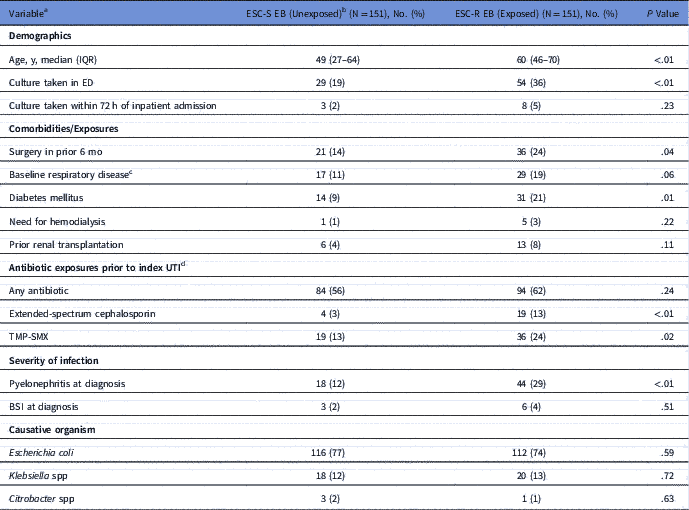
Among the entire study cohort of 302 patients, the median age was 56 years (interquartile range [IQR], 37–68), and 62 (21%) were men. The most common pathogens isolated were Escherichia coli (76%), Klebsiella spp (13%), and Enterobacter spp (9%). Baseline characteristics of the cohort that were candidates for the multivariable models are shown in Table 1; additional baseline characteristics are described in Supplemental Table 1.
Baseline Characteristics of the Study Cohort Stratified by Exposure Status

Note. EB, Enterobacteriaceae; BSI, bloodstream infection; CI, confidence interval; ESC-R, extended-spectrum cephalosporin-resistant; ESC-S, extended-spectrum cephalosporin-susceptible; ED, emergency department; IQR, interquartile range; OR, odds ratio; TMP-SMX, trimethoprim-sulfamethoxazole; UTI, urinary tract infection; COPD, chronic obstructive pulmonary disease.
a Only those variables that were candidates for the final multivariable models of clinical failure and IIAT are shown here. See Supplemental Table 1 for the complete list of variables considered.
b Data are presented as numbers (percentages) except where noted.
c COPD or chronic bronchitis.
d Receipt in the 6 months prior to EB UTI presentation (not mutually exclusive).
Association of ESC-R EB UTI with clinical failure
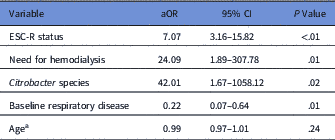
Within the entire cohort, 86 patients (29%) experienced clinical failure. In the unadjusted analysis, ESC-R EB UTI was associated with an increased odds of clinical failure (odds ratio [OR], 4.82; 95% confidence interval [CI], 2.52–9.22; P<.01). In the final multivariable model (Table 2), ESC-R EB UTI remained a significant independent risk factor for clinical failure (adjusted OR [aOR], 7.07; 95% CI, 3.16–15.82; P<.01). Other independent risk factors for clinical failure included infection with a Citrobacter spp and need for hemodialysis. Odds of clinical failure was decreased with baseline respiratory disease.
Mixed-Effects Multivariable Logistic Regression Model of Clinical Failure

Note. aOR, adjusted odds ratio; ESC-R, extended-spectrum cephalosporin resistant; CI, confidence interval.
a Confounder of ESC-R status and clinical failure. The aOR for age is given per 1-year increase in age.
With the modified clinical failure outcome, we again found a borderline significant association between ESC-R EB UTI and clinical failure on multivariable analysis (aOR, 2.65; 95% CI, 1.00–7.01; P=.05). The other independent risk factor for modified clinical failure was need for hemodialysis.
Association of ESC-R EB UTI with IIAT
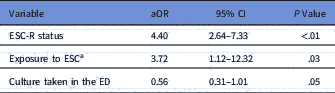
Within the entire cohort, 158 patients (53%) experienced IIAT. The initial antibiotics administered to the cohort are described in Supplemental Table 2. In the multivariable analysis (Table 3), ESC-R EB UTI was a significant independent risk factor for IIAT (aOR, 4.40; 95% CI, 2.64–7.33; P<.01). Exposure to an extended-spectrum cephalosporin in the 6 months before the index UTI was also a significant risk factor for IIAT, and having a urine culture obtained in the ED was associated with decreased odds of IIAT.
Mixed-Effects Multivariable Logistic Regression Model of Inappropriate Initial Antibiotic Therapy (IIAT)

Note. aOR, adjusted odds ratio; CI, confidence interval; ED, emergency department; ESC, extended-spectrum cephalosporin; ESC-R, extended-spectrum cephalosporin-resistance.
a Exposure within the 6 months prior to EB UTI presentation.
When IIAT was incorporated into the clinical failure model, ESC-R status was still significantly associated with clinical failure, but the aOR was attenuated (aOR, 5.88; 95% CI, 2.58–13.38; P<.01 compared to an aOR of 7.07, as shown in Table 2). Also, IIAT was a confounder of this relationship. However, there was no effect modification by IIAT; the impact of IIAT on the association between ESC-R status and clinical failure did not differ considerably between the ESC-R and ESC-susceptible (ESC-S) EB UTI groups.
Discussion
In this study, patients who presented with a community-onset ESC-R EB UTI experienced worse outcomes than those with an ESC-S EB UTI, with an increased odds of clinical failure through 7 days. Importantly, this study primarily included patients who did not have an associated bacteremia or pyelonephritis. Patients presenting with an ESC-R EB UTI were less likely to receive appropriate antibiotics within 48 hours of UTI evaluation. Delayed appropriate antibiotics confounded the relationship between ESC-R status and clinical failure, suggesting that prompt appropriate antibiotics impacts the relationship between ESC-R EB UTI and clinical outcomes. However, after adjusting for IIAT, a significant association remained between ESC-R EB UTI and clinical failure, suggesting that IIAT does not fully explain the impact of ESC-R EB on poor clinical outcomes in community-onset UTIs.
The association between ESC-R EB UTI and clinical failure is consistent with prior literature that has shown bacteremic ESC-R EB UTIs, and hospital-acquired ESC-R EB UTIs are associated with increased length of stay and increased mortality.Reference Lautenbach, Patel, Bilker, Edelstein and Fishman 12 – Reference Kang, Song and Chung 16 This association may be related to several factors. Our study shows that delay in appropriate antibiotics contributed to the patients’ worse outcomes, but this did not fully explain the association. Other potential explanations include increased virulence of the resistant organisms, resulting in more severe infections; unmeasured host factors that predisposed the patients to worse clinical outcomes; and more severe baseline infection not captured by pyelonephritis and bloodstream infections. This finding suggests that community-onset UTI with an ESC-R EB organism requires increased clinical monitoring after diagnosis to ensure clinical resolution, even in the absence of bacteremia, pyelonephritis, or hospital admission.
The association between ESC-R EB UTI and IIAT is also consistent with prior studies showing that ESC-R EB bloodstream infections are associated with increased odds of IIAT.Reference Hyle, Lipworth, Zaoutis, Nachamkin, Bilker and Lautenbach 21 – Reference Tumbarello, Spanu and Di Bidino 23 Our study shows that the higher risk for IIAT observed with ESC-R EB infection extends to community-onset nonbacteremic UTIs. Thus, patients presenting with UTI in the outpatient setting who are at risk for ESC-R EB as the etiology should have urine cultures collected and vigilant follow-up to ensure appropriate therapy is administered.
In addition to ESC-R status, we detected increased odds of clinical failure associated with (1) UTI due to Citrobacter spp and (2) need for hemodialysis. The increased odds of clinical failure associated with Citrobacter UTIs may be related to the inducible ampC production observed among this species,Reference Lindberg, Westman and Normark 24 which may result in the inadvertent use of a less effective antibiotic. However, the number of Citrobacter infections in this cohort was relatively small, so further study is needed to confirm this finding. The association between hemodialysis and clinical failure is consistent with prior studies that have shown renal dysfunction to be associated with increased susceptibility to bacterial infections and worse clinical outcomes due to uremia-induced immune dysfunction.Reference Minnaganti and Cunha 25 Baseline respiratory disease was associated with decreased odds of clinical failure. This finding may be due to recurrent respiratory infections among this group that results in broader empiric antibiotic regimens when presenting with infectious symptoms.
Our study has several limitations. Misclassification is a concern in retrospective studies. However, both the exposure and outcomes were validated through medical record review by physicians trained in infectious diseases rather than relying on diagnostic or billing codes. The assessment of the outcomes was limited to review of the UPHS medical record. Patients who experienced clinical failure and sought care from outside providers would not have been captured. However, this missing information should be nondifferential between the exposed and unexposed groups. Furthermore, because the outcome was assessed at 7 days post-UTI evaluation, relocation of care is less likely in this short time frame. Finally, because the present study was conducted in a single healthcare system, the results may not be generalizable to other dissimilar institutions.
In conclusion, the results of our study demonstrate that community-onset ESC-R EB UTIs are associated with increased odds of clinical failure and IIAT. Also, IIAT is in part, but not entirely, responsible for the worse outcomes associated with ESC-R EB UTIs. Further studies are needed to determine those patients who are at high risk for drug-resistant UTIs so that urine cultures are collected and appropriate antibiotics are prescribed promptly.
Acknowledgments
None.
Financial support
This work was supported by the Agency for Healthcare Research and Quality (grant no. R18-HS020002 to E.L.), by the National Institutes of Health (grant nos. K24-AI080942 to E.L. and K01-AI103028 to J.H.H.), by the Centers for Disease Control Cooperative Agreement Epicenters for the Prevention of Healthcare Associated Infections (grant no. FOA#CK16-004 to E.L.), and by the Antibacterial Resistance Leadership Group (grant no. 5 UM 1AI104681-05 with a subaward fellowship grant to J.A.A.).
Conflict of interest
All authors report no conflicts of interest relevant to this article.
Supplementary material
To view supplementary material for this article, please visit https://doi.org/10.1017/ice.2018.254