Implications
Skatole and indole are two key compounds of boar taint and can be influenced by modifying dietary composition to enhance the flow of fermentable nutrients to the large intestine. As fattening entire male boars will be playing a more important role in the European and global market in the future, means to control boar taint are of key importance to maintain pork quality.
Introduction
Entire male pigs can develop boar taint, an unfavourable odour and flavour in the meat. Boar taint is mainly due to the presence of the three substances: androstenone (Patterson, Reference Patterson1968), skatole and indole (Vold, Reference Vold1970; Walstra and Maarse, Reference Walstra and Maarse1970). Skatole (3-methyl-indole) and indole have a faecal-like odour and are produced during the anaerobic degradation of l-tryptophan by specific bacteria in the colon (Yokoyama and Carlson, Reference Yokoyama and Carlson1979; Bernal-Barragan, Reference Bernal-Barragan1992). These substances are easily absorbed in the hind gut and the amounts which are not metabolized in the liver (Babol et al., Reference Babol, Squires and Lundström1998) are accumulated in the adipose tissue because of their lipophilic properties. Their concentrations in the adipose tissue depend on the diet, rearing conditions and handling of the pigs as well as on sex, slaughter age and genetics (Claus et al., Reference Claus, Weiler and Herzog1994; Hansen et al., Reference Hansen, Larsen, Jensen, Hansen-Møller and Barton-Gade1994; Babol et al., Reference Babol, Zamaratskaia, Juneja and Lundström2004).
The most important source of tryptophan for microbial skatole formation in the digestive system is gut mucosa cell debris from the distal part of the gastrointestinal tract (Claus et al., Reference Claus, Weiler and Herzog1994). The mitotic rate in the mucosa of the small intestine is elevated by feeding high-energy diets, particularly when the energy is mainly presented as carbohydrates with a high pre-caecal digestibility (Raab et al., Reference Raab, Leiser, Kemmer and Claus1998). Carbohydrates, such as oligosaccharides, resistant starches and non-starch polysaccharides (NSP), which have a low pre-caecal digestibility, have been shown to decrease skatole synthesis (Jensen and Jensen, Reference Jensen and Jensen1998). Dietary components that favour butyrate production seem to be particularly effective in reducing skatole formation. They reduce apoptosis, thus limiting the concentrations of available tryptophan and offer sufficient fermentable energy to move tryptophan metabolism away from fermentation towards microbial protein synthesis (Claus et al., Reference Claus, Lösel, Lacorn, Mentschel and Schenkel2003; Mentschel and Claus, Reference Mentschel and Claus2003).
In barley and oats, high levels of β-d-glucan and pentosan (essentially arabinoxylan) are present. The β-glucans in barley and oats are similar in structure, but they differ in the ratio of β-(1-3) and β-(1-4) linkages. Oat β-glucans have a higher proportion of β-(1-4) linkages than β-(1-3) linkages and therefore are more insoluble than barley β-glucans due to the higher proportion of β-(1-4) linkages (Duss and Nyberg, Reference Duss and Nyberg2004). However, barley has a higher proportion of soluble than insoluble β-glucans (Hogberg and Lindberg, Reference Hogberg and Lindberg2004). Therefore, barley because of its higher content of total-and soluble-β-glucans of lower molecular weight, may provide a more readily fermentable substrate for the microbial population in the gastrointestinal tract. It is well documented that enzymes like β-glucanase can effectively hydrolyze viscous (NSP) in the diet leading to a reduction in diet and digesta viscosities and thus enhanced nutrient availability (Dierick and Decuypere, Reference Dierick and Decuypere1996; O’Connell et al., Reference O’Connell, Sweeney, Callan and O’Doherty2005). It is our hypothesis that the type of cereal will affect skatole and indole concentrations in the digesta and adipose tissue, through changes in the microbiological population, volatile fatty acid (VFA) production and pH in the large intestine. By polysaccharide hydrolysis, exogenous NSP enzymes may remove specific microbial substrates for microbial fermentation particularly in the lower part of the large intestine with a consequential increase in the production of indolic compounds. The objectives of the experiment are to evaluate the effects of two cereals (barley and oats) and NSP enzyme inclusion on digesta pH, VFA, skatole and indole concentrations and on the composition of the large intestinal microflora, as well as skatole and indole concentrations in adipose tissue of finisher entire male pigs.
Material and methods
All procedures described in this experiment were conducted under experimental licence from the Irish Department of Health in accordance with the Cruelty to Animals Act of 1876 and the European Communities (Amendments of the Cruelty to Animals Act of 1976) Regulations, 1994.
Experimental design
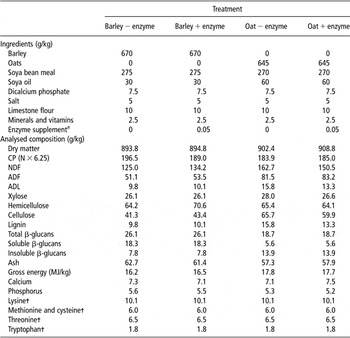
The experiment was designed as a 2 × 2 factorial comprising four dietary treatments. The experimental treatments were as follows: (i) barley-based diet; (ii) barley-based diet containing an enzyme supplement; (iii) oat-based diet; and (iv) oat-based diet containing an enzyme supplement. The enzyme supplement (0.05 g/kg feed) was derived from Penicillium funiculosum (IMI SD 101) and contained endo-1, 3 (4)-β-glucanase (EC 3.2.1.6) and endo-1, 4-β-xylanase (EC 3.2.1.8) only. The diets were formulated to contain identical concentrations of ileal digestible lysine (8.5 g/kg) and net energy (9.8 MJ/kg; Sauvant et al., Reference Sauvant, Perez and Tran2004). All amino acid requirements were met relative to lysine (Close, Reference Close1994). The dietary composition and analysis of the diets are presented in Table 1. All the diets were fed in meal form.
Composition and analysis of experimental diets (as fed basis)

1Vitamin and mineral inclusion (per kg diet): 3 mg retinol, 0.05 mg cholecalciferol, 40 mg α-tocopherol, 25 mg copper as copper II sulphate, 100 mg iron as iron II sulphate, 100 mg zinc as zinc oxide, 0.3 mg selenium as sodium selenite, 25 mg manganese as manganese oxide and 0.2 mg iodine as calcium iodate on a calcium sulphate/calcium carbonate carrier.
2Calculated from proximate analysis (Sauvant et al., Reference Sauvant, Perez and Tran2004).
aEnzyme supplement contained 100 U β-glucanase (1950 AGL/g) and 70 U β-xylanase (1350 AXC/g) per kg (Penicillium funiculosum; IMI SD 101; Ronozyme AX, DSM, Belfast, Northern Ireland).
Animals and management
Thirty-two entire male finisher pigs (progeny of meat-line boars × (Large White × Landrace sows)) were blocked on the basis of live weight (69.0 kg; s.d. 3.1 kg) and within each block were randomly allocated to one of the four dietary treatments (eight entire males per treatment). Animals were given a 10-days dietary adaptation period. Each treatment was offered in a partially slatted (30 : 70, slat : solid floor ratio) pen housing eight pigs; the solid part was cleaned out each day. The pigs were stocked at 0.95 m2/pig. Individual feeders with water nipples were present in all pens providing an ad libitum supply of both feed and water as described by O’Doherty and Keady (Reference O’Doherty and Keady2000). Animals were individually weighed at the beginning of the experiment (day 0) and subsequently on day 45 (113.6 kg; s.d. 11.3 kg). All animals were slaughtered on day 46. Animals were slaughtered heavier than current slaughter weights in Ireland (Lawlor, Reference Lawlor2003) to favour the development of boar taint. Feed was not withdrawn before slaughter.
Microbiology
Immediately after slaughter digesta samples (approximately 10 ± 1 g) were aseptically removed under aerobic conditions from the caecum as well as the proximal and distal colon of each animal, stored in sterile containers (Sarstedt, Wexford, Ireland) on ice and transported to the laboratory within 7 h. Bifidobacteria spp., Lactobacillus spp. and Enterobacteriaceae spp. were isolated and counted according to the method described by Pierce et al. (Reference Pierce, Sweeney, Callan, Byrne, McCarthy and O’Doherty2006).
pH measurements
Samples of digesta from the distal and proximal colon were taken and placed in universal containers. Samples were stored immediately after collection at −20°C; the pH of the digesta was determined after thawing. All pH measurements were made on a Mettler Toeldo MP 220 pH meter that was standardised with certified pH 4 and 7 buffer solutions. Distilled water was added to some very viscous samples to enable their pH to be measured.
Skatole and indole in the digesta content
Digesta samples from the distal and proximal colon were taken and placed in universal containers and immediately stored after collection at −20°C. After thawing and mixing, subsamples were taken for extraction. Skatole and indole concentrations in the digesta were determined by reverse-phase HPLC as described by Dehnhard et al. (Reference Dehnhard, Bernal-Barragan and Claus1991) and Lösel (Reference Lösel2006). Briefly, the samples were extracted with methanol and purified on absorber resin Amberlite (Merck, Darmstadt, Germany). Skatole and indole concentrations were referenced to the dry matter (DM) of the extracted matrix. The chromatographic conditions were as follows: column, Gemini 5 μm C18 RP 110A 125 mm (Phenomenex, Macclesfield, Cheshire, UK); eluent, 0.02 M acetic acid, acetonitrile and 2-propanol (55 : 30 : 15, v : v : v); flow rate, 1.0 ml/min. For quantification, multi-level calibration using the internal standard 2-methylindole was performed. The wavelength for UV detection was 280 nm. The lower limit of detection was 0.5 μg/g.
Skatole, indole and androstenone in the adipose tissue
Samples of adipose tissue from the pig’s back were taken at slaughter, vacuum packed and stored at −20°C. Skatole, indole and androstenone concentrations in the adipose tissue were analysed according to the method described by Hansen-Møller (Reference Hansen-Møller1994). Briefly, adipose tissue samples were liquefied in a microwave oven for 2 × 2 min at 250 W. The liquefied lipids were centrifuged for 2 min at 11 000 × g at 20°C and kept at around 47°C. The water was then removed and 0.50 ± 0.01 g water-free liquid fat was placed in 2.5 ml eppendorf tubes in duplicates and internal standard was added (1 ml methanol containing 0.050 mg/l 2-methylindole and 0.496 mg/l androstenone). After vortexing for 30 s, the tubes were incubated for 5 min at 30°C in an ultrasonic bath (RK 255H, Bandelin Sonorex, Zürich, Switzerland), kept at 0°C on ice for 20 min and then centrifuged for 20 min at 11 000 × g at 4°C. Finally, 50 μl of the supernatant was transferred into an HPLC vial for skatole, indole and androstenone analysis with an HPLC system from Hewlett–Packard series 1200. Concentrations were expressed per gram of lipid fraction from the adipose tissue. The detection limits were 0.03 μg for skatole and indole and 0.2 μg for androstenone.
Volatile fatty acids sampling and analysis
Digesta samples from the proximal and the terminal colon of each pig were taken for VFA analysis. VFA concentrations in the digesta were determined using the method of O’Connell et al. (Reference O’Connell, Callan and O’Doherty2006).
Laboratory analysis
Feed and faeces samples were analysed for DM, ash, gross energy (GE), neutral-detergent fibre (NDF), acid-detergent fibre (ADF) and nitrogen (N). Feed samples were also analysed for xylose, cellulose, hemicellulose and acid detergent lignin (ADL) concentrations. The feed and faeces samples were milled through a 1-mm screen (Christy and Norris hammer mill, Ipswich, UK). Proximate analysis of diets for DM and ash was carried out according to the Association of Official Analytical Chemists (1995). The DM was determined after drying for 24 h at 103°C. Ash was determined after ignition in a muffle furnace at 500°C for 4 h (Nabertherm, Bremen, Germany). The GE was measured using a Parr 1201 oxygen bomb calorimeter (Parr Instruments, Illinois, USA). The NDF, ADF and ADL contents were determined using a Fibertec Extraction Unit (Tecator, Hoganans, Sweden) according to the method described by Van Soest et al. (Reference Van Soest, Robertson and Lewis1991). The N content of feed was determined using the LECO FP 528 instrument (Leco Instruments Ltd, Stockport, UK). The N content of fresh faeces was analysed by the macro-Kjeldahl technique using a Buchi 323 distillation unit and distillation apparatus (Buchi, Flawil/Schweiz, Switzerland). The soluble and insoluble β-glucan content was determined according to McCleary and Glennie-Holmes (Reference McCleary and Glennie-Holmes1985). The xylose content was determined using a Megazyme assay kit (Megazyme International Ireland Ltd, Bray, Co. Wicklow, Ireland). The cellulose content was estimated as ADF − ADL. The hemicellulose content was estimated as NDF − (ADF + ADL). The lignin content was estimated as ADL. Enzyme activity of the experimental diets was analysed as described by Somogyi (Reference Somogyi1960).
Statistical analysis
The experimental data were analysed as a 2 × 2 factorial arrangement of treatments using the GLM procedure with the NCSS software package (v. 2007; NCSS. Kaysville, Utah, USA). The model

in which Yijk = dependent variable, μ = mean, Ai = type of cereal (i = barley or oat), Bj = enzyme inclusion (j = yes or no), ABij = interaction effect between cereal type and enzyme inclusion. In case of an interaction, means were separated using test for two-factor interactions (Tukey–Kramer multiple-comparison test; probability level P < 0.05). For skatole, indole and androstenone in the adipose tissue, carcass weight was added as a covariate in the model. The individual pig served as the experimental unit. The probability level, which denotes significance is P < 0.05. To obtain normality, indole and skatole concentrations in the digesta were transformed with log10(x); and skatole, indole and androstenone concentrations in the adipose tissue were transformed with 1/√x. When analysing microbial ecology, in case of no normality, the robust factorial ANOVA was used with the rank transform method; the data were converted to ranks and the usual GLM procedure was applied to the ranks. For the Enterobacteriaceae concentration in the caecum, the logistic regression procedure was used to determine the significance of the factors. The data are presented in the tables as least square means (LSM) ± s.e. of the mean. The skatole and indole concentrations in digesta and adipose tissue were compared using Spearman’s Rank correlation analysis.
Results
Carcass characteristics
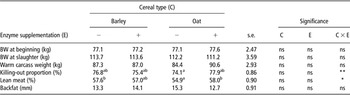
All pigs were monitored for average daily gain (ADG) for the entire experimental period. The ADG (kg) was 0.813 for the barley-based diet, 0.820 for the barley-based diet and enzyme supplement, 0.781 for the oat-based diet and 0.746 for the oat-based diet and enzyme supplement (s.e.m. = 0.051 kg). There was a significant interaction between cereal type and enzyme supplementation on killing-out percentage (P < 0.01) and lean meat content of the carcass (P < 0.05; Table 2). Enzyme supplementation increased killing-out percentage and lean meat content in animals fed the oat-based diets. However, enzyme supplementation had no effect (P > 0.05) on killing-out percentage and lean meat content with the barley-based diets.
Effect of cereal type and enzyme inclusion on carcass characteristics (least-square mean ± s.e.)

ns = non-significant (P > 0.05).
*P < 0.05, **P < 0.01.
Volatile fatty acids study
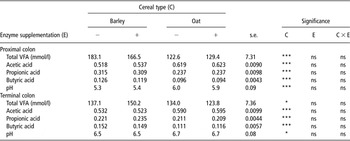
Feeding barley-based compared to oat-based diets led to significant changes in the VFA ratios in different parts of the colon (Table 3). Barley-based diets had a higher concentration of total VFA in the proximal (P < 0.001) and terminal (P < 0.05) colon and lower proportions of acetic acid in the proximal (0.527 v. 0.621; s.e. 0.0062; P < 0.001) and terminal (0.528 v. 0.593; s.e. 0.0068; P < 0.001) colon than oat-based diets. Barley-based diets had higher proportions of propionic acid in the proximal (0.312 v. 0.237; s.e. 0.0067; P < 0.001) and terminal (0.228 v. 0.210; s.e. 0.0030; P < 0.001) colon and higher proportions of butyric in the proximal (0.122 v. 0.095; s.e. 0.0030; P < 0.001) and terminal colon (0.150 v. 0.113; s.e. 0.0040; P < 0.001) than oat-based diets. Enzyme inclusion had no effect on the proportion of VFA in the colon.
Effect of cereal type and enzyme inclusion on total VFA concentrations in digesta, molar proportions of VFA, pH in digesta of proximal and terminal colon (least-square mean ± s.e.)

VFA = volatile fatty acids; ns = non-significant (P > 0.05).
*P < 0.05, ***P < 0.001.
Pigs offered barley-based diets had a lower proximal colonic pH (5.4 v. 5.9; s.e. 0.06; P < 0.001) and terminal colonic pH (6.5 v. 6.7; s.e. 0.05; P < 0.05) than pigs fed oat-based diets.
Study on boar taint compounds
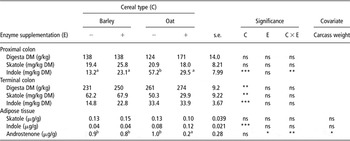
Skatole concentrations in the digesta of the proximal colon and in the adipose tissue did not differ (P > 0.05) between experimental diets. However, pigs offered barley-based diets had a higher skatole concentration in the digesta of the terminal colon (65.0 v. 40.1 mg/kg DM; s.e. 6.30; P < 0.01) than oat-based diets (Table 4).
Effect of cereal type and enzyme inclusion on skatole and indole concentrations in the digesta and skatole, indole and androstenone levels in the adipose tissue (least-square mean ± s.e.)

DM = dry matter; ns = non-significant (P > 0.05).
*P < 0.05, **P < 0.01, ***P < 0.001.
There was a significant interaction (P < 0.01) between cereal type and enzyme inclusion on the indole concentration in the digesta of the proximal colon. Pigs offered barley-based diets had a lower (P < 0.05) indole concentration than unsupplemented oat-based diets. However, there was no difference in indole concentration between barley and oats when enzymes were added.
Indole concentrations in the digesta from the terminal colon (18.8 v. 33.6 mg/kg DM; s.e. 2.5; P < 0.001) and in the adipose tissue (0.04 v. 0.10 μg/g; s.e. 0.01; P < 0.001) were lower in pigs fed barley-based compared to oat-based diets. Carcass weight had a significant effect (P < 0.05) on androstenone concentration in the adipose tissue. Heavy carcasses had higher androstenone concentrations in adipose tissue than light carcasses. There was also a significant interaction between cereal type and enzyme inclusion in androstenone concentrations (P < 0.05). Pigs offered unsupplemented oat-based diets had higher (P < 0.05) androstenone concentrations in the adipose tissue than animals fed enzyme-supplemented oat-based diets. However, enzyme inclusion had no effect in androstenone concentration with barley-based diets.
Skatole in adipose tissue was positively correlated (r = 0.50; P < 0.01) with indole in adipose tissue. The correlation coefficient between skatole in adipose tissue and in digesta of the terminal part of the colon was not significant (P > 0.05). However, indole concentrations in adipose tissue were correlated (r = 0.61; P < 0.001) with their concentrations in the digesta of the terminal part of the colon. Furthermore, skatole and indole concentrations in the digesta of the proximal part of the colon were positively correlated with their respective concentrations of the terminal part (skatole, r = 0.61; P < 0.001; indole, r = 0.42; P < 0.05).
Microbiology study
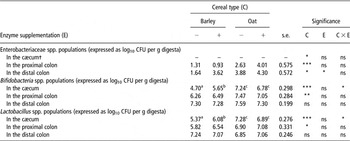
Pigs offered barley-based diets had a lower (P < 0.05) population of Enterobacteriaceae in the caecum, as well as in the proximal part and distal parts of the colon than animals fed oat-based diets (Table 5). Furthermore, enzyme supplemented diets had a higher population of E. coli in the distal part of the colon than unsupplemented diets.
Effects of cereal type and enzyme inclusion on large intestinal microbial ecology (least-square mean ± s.e.)

CFU = colony forming unit; ns = non-significant (P > 0.05).
*P < 0.05, **P < 0.01, ***P < 0.001.
†Analysed with logistic regression procedure.
There was a significant interaction (P < 0.05) between cereal type and enzyme supplementation in the caecal part of the digestive tract for Bifidobacteria spp. and Lactobacilli spp. Pigs offered the unsupplemented barley-based diets had a lower population of Bifidobacteria (P < 0.05) and Lactobacilli (P < 0.01) compared with pigs fed the enzyme-supplemented barley-based diets. However, there was no effect of enzyme supplements in the oat-based diets.
Pigs offered the barley-based diets had significantly lower Bifidobacteria spp. (6.38 v. 7.26; s.e. 0.201; P < 0.01) and Lactobacilli (6.16 v. 6.99; s.e. 0.234; P < 0.05) concentrations in the proximal part of the colon than pigs offered oat-based diets. However, this effect of cereal type was not observed in the distal part of the colon.
Discussion
As indole and skatole share tryptophan as a common precursor, their syntheses are related to one another. Their production is favoured by the absence of adequate energy, which would otherwise allow the production of microbial protein. Indole synthesis is mediated by many types of bacteria, whereas skatole production requires the presence of specific bacterial strains (Deslandes et al., Reference Deslandes, Gariepy and Houde2001). Type and amount of carbohydrates are probably the major regulators of the microbial activity and hence of indole synthesis (Bach Knudsen et al., Reference Bach Knudsen, Borg Jensen, Andersen and Hansen1991; Jensen et al., Reference Jensen, Cox and Jensen1995a). Feed stuffs with low ileal energy digestibility (fibre-rich diet) lead to butyrate formation in the colon, which is a potential inhibitor of apoptosis of epithelial cells and reduce skatole formation (Claus et al., Reference Claus, Lösel, Lacorn, Mentschel and Schenkel2003). Skatole synthesis has been shown to be related to the pH of the intestinal content, being promoted in comparison to indole as the pH is lowered (Jensen and Jensen, Reference Jensen and Jensen1998). The hypothesis of this study is that skatole and indole contents in the adipose tissue will depend on the energy availability in the large intestine. The results from this study clearly show cereal effects on intestinal fermentation and with it an effect on skatole and indole concentrations.
Feeding barley-based diets in comparison to oat-based diets led to a higher total concentration of VFA in the colon, indicating the availability of more fermentable substrate. Feeding barley-based diets led to higher butyric acid concentrations than oat-based diets. The data show a clear relationship between VFA concentrations and pH and, overall, barley-based diets led to a lower pH. The difference in pH between the barley- and oat-based diets was more pronounced in the proximal colon. The data from this study suggests that the fermentable fraction, probably the soluble β-glucans in barley-based diets was easily accessible and thus more efficiently fermented in the upper part of the colon in comparison to oat-based diets. Similarily, Lynch et al. (Reference Lynch, Sweeney, Callan and O’Doherty2007) reported that the soluble β-glucans are broken down in the small intestine, while the insoluble β-glucans pass into the large intestine, where they are fermented by bacteria.
In animals fed the barley-based diets, indole concentrations were relatively low throughout the colon. Skatole concentrations were also low in the upper part; however, they were high in the terminal part. The increase in skatole content in the digestive tract is in agreement with the measured VFA concentrations and pH, which do suggest higher fermentation activity in the upper part of the colon, confirming previous findings that fermentable substrates decrease skatole synthesis (Jensen and Jensen, Reference Jensen and Jensen1998). The absolute butyric acid concentrations were similar between the proximal and terminal colon and do not offer an additional explanation for the higher skatole concentration. The differences in fermentation pattern between the proximal and terminal colon would suggest that animals fed barley-based diets did not have enough fermentable substrate at the end of the digestive tract to limit skatole synthesis. Feeding components such as sugar beet pulp (Knarreborg et al., Reference Knarreborg, Beck, Jensen, Laue, Agergaard and Jensen2002) or raw potato starch (Pauly et al., Reference Pauly, Spring, O’Doherty, Ampuero and Bee2008) in the last days before slaughter seems more efficient at limiting skatole synthesis.
In contrary to the barley-based diets, feeding an unsupplemented oat-based diet resulted in high indole concentrations, particularly in the proximal part of the colon. This difference in the main site of fermentation product synthesis agrees with previous findings (Claus et al., Reference Claus, Dehnhard, Herzog, Bernal-Barragan and Giménez1993; Knarreborg et al., Reference Knarreborg, Beck, Jensen, Laue, Agergaard and Jensen2002). The overall high pH in the oat-based diets indicates less fermentation activity. Furthermore, observations in pig faecal slurries (Jensen et al., Reference Jensen, Cox and Jensen1995b) show that high pH values favour the production of indole, whereas low pH values favour the production of skatole.
Supplementation with β-glucanase and β-xylanase preparations can substantially improve the nutrient value of β-glucan- and β-xylan-rich diets. Several studies in chicken fed barley-based diets show an increase in the digesta DM content in the small intestine and colon, and an improved apparent ileal digestibility of starch, N and β-glucans (Åman and Graham, Reference Åman and Graham1987). The effect of the enzyme is generally less pronounced in pigs than chickens (de Lange, Reference De Lange2000). This data would suggest that barley provided sufficient fermentable energy to efficiently control indole concentrations in the proximal colon. Enzyme supplementation did not provide additional control. The VFA and pH data indicate that feeding oat-based diets compared to barley-based diets provided less fermentable substrate. By liberating fermentable substrate, NSP enzyme supplementation resulted in a reduced indole concentration in the digesta from the proximal colon of pigs fed the oat-based diets. The skatole concentration in the digesta from the terminal colon tended also to be lower with enzyme supplementation. This indicates the supply of more fermentable substrate in the lower part of the large intestine. Despite these differences in amino acid fermentation products, there was no clear difference in VFA concentrations with enzyme supplementation to the oat-based diet. This may suggest that the enzyme mix used was not capable of hydrolysing the cell wall polysaccharides in oats. It would have been useful to analyse the presence of various NSP in the different segments of the digestive tract, to better understand the effect of enzyme supplementation on the rate and extent of substrate degradation and fermentation.
In this study, all bacterial counts were relatively low in comparison with other studies (O’Connell et al., Reference O’Connell, Sweeney, Callan and O’Doherty2005; Lynch et al., Reference Lynch, Sweeney, Callan and O’Doherty2007). The oat-based diets brought about a beneficial effect on the gut microflora as these diets supported higher populations of the beneficial Bifidobacteria and Lactobacilli in the caecum and proximal colon than the barley-based diets. The observed increase in the Bifidobacteria and Lactobacilli populations may be due to the higher levels of insoluble β-glucans in the oat-based diets compared to the barley-based diets. Therefore, it can be assumed that the higher level of insoluble β-glucans provided by the oat-based diets in this experiment passed undigested into the large intestine where it acted as a prebiotic stimulating the growth of the beneficial Bifidobacteria and Lactobacilli populations. This finding was not observed in the proximal part of the colon. These results offer an extra indication that substrate availability differed between cereal and with enzyme supplementation and thus, influenced the growth of specific bacterial populations. While many types of bacteria are able to produce indole from tryptophan, skatole production is reported only for strains of few genera, Lactobacillus and Clostridium bacteria (Jensen et al., Reference Jensen, Cox and Jensen1995b; Jensen and Jensen, Reference Jensen and Jensen1998; Deslandes et al., Reference Deslandes, Gariepy and Houde2001). Skatole-producing bacteria comprise <0.01% of total intestinal flora (Jensen and Jensen, Reference Jensen and Jensen1993). The present data clearly indicate shifts in bacterial populations. In case of further studies, it would be important to focus specifically on skatole-producing strains such as Lactobacillus sp. strain 11201 (Yokoyama et al., Reference Yokoyama, Carlson and Holdeman1977; Jensen et al., Reference Jensen, Cox and Jensen1995b).
In this study, indole concentrations in the digesta from the terminal part of the colon and adipose tissue were positively and significantly correlated. However, the skatole concentrations in the digesta from the terminal part and adipose tissue were not correlated. Several studies demonstrate a significant correlation between skatole concentrations in digesta and adipose tissue (Hawe et al., Reference Hawe, Walker and Moss1992; Jensen et al., Reference Jensen, Cox and Jensen1995a; Knarreborg et al., Reference Knarreborg, Beck, Jensen, Laue, Agergaard and Jensen2002). Pigs offered barley-based diet had lower DM content in the digesta from the terminal part than those animals consuming the oat-based diet. Fibre provides bulk to the digesta and increases the water-holding capacity, diluting the skatole produced and thus decreasing the rate of transfer over the intestinal wall (Hawe et al., Reference Hawe, Walker and Moss1992). This hypothesis could be an explanation for the higher skatole content in the terminal part of pigs fed the barley-based diet in comparison to those fed the oat-based diets, which was not observed in the adipose tissue. Furthermore, a rapid passage means that digesta remain in the intestine for a shorter time. Therefore, endogenous bacteria would have less contact with digesta, and hence the amount of skatole produced before defecation may be reduced (Hawe et al., Reference Hawe, Walker and Moss1992). The discrepancy between studies could be explained through the implication of the liver enzymes due to genetic differences in the hepatic clearance rate (Lin et al., Reference Lin, Lou and Squires2006). Another hypothesis could be that androstenone reduced the rate of skatole and indole metabolism in the liver by decreasing the CYP2E1 level in the liver microsomes. Therefore, excessive skatole accumulation in some pigs may be secondary to the overproduction of androstenone (Doran et al., Reference Doran, Whittington, Wood and McGivan2002).
The measured androstenone concentrations in adipose tissue reached on average the threshold value for consumer acceptability in the European Union (1 μg/g; Desmoulin et al., Reference Desmoulin, Bonneau, Frouin and Bidard1982; Bonneau, Reference Bonneau1998). Six of the 31 animals had higher concentrations in adipose tissue than the threshold value. Androstenone concentration in adipose tissue increased with carcass weight, which was integrated as covariable in this study. In this study, feeding supplemented oat-based diet with an enzyme induced lower androstenone concentrations in the adipose tissue. Chen et al. (Reference Chen, Zamaratskaia, Andersson and Lundström2007) measured a slightly decreased androstenone concentration in adipose tissue after feeding raw potato starch, although this decrease did not reach statistical significance. The reason for the lower concentration in this study is not clear. Without information on testis, bulbourethral gland weights or sperm maturity, it is difficult to judge, if the treatment affected the onset of puberty, which would be the most logical explanation for such differences. It should also be taken into consideration that the number of animals was low to evaluate the effect on a parameter like androstenone, which does show large variations in the weight range at which the animals were slaughtered.
In conclusion, a clear cereal effect was observed on the concentrations of VFA and indolic compounds in the colon and of indole in the adipose tissue of finisher entire male pigs. Enzyme supplementation did not affect those fermentation parameters in the barley-based diet; however, they led to a reduction in indole concentrations in the proximal colon of pigs fed oat-based diets. Overall, barley was the more efficient cereal to reduce indole independent of whether enzymes were added or not; however, the concentrations of indolic compounds were still relatively high.
Acknowledgments
The authors thank Beat Huber–Eicher for his statistical assistance and James Callan, Kenton Hart and Cormac O’Sheafor for their technical assistance.