INTRODUCTION
Long-term field experiments have provided important information for guiding agricultural development and are valuable for determining yield change over time, for assessing soil nutrient status and system sustainability as well as for predicting soil-carrying capacity (Leigh & Johnston Reference Leigh and Johnston1994). In China, rice (Oryza sativa L.), wheat (Triticum aestivum L.) and maize (Zea mays L.) are the main crops grown on an area of 31·7, 28·9 and 25·9 million hectares, respectively (National Soil Survey 1998). Long-term cropping with maize, wheat–maize rotation and rice-based crops has been widely practised in China.
Of all farming practices, rational fertilization is among the most important measures for the sustainable crop production required to meet the food demand of the growing population of the country. There have been concerns that soil degradation threatens the sustainability of cropping systems (Duxbury et al. Reference Duxbury, Abrol, Gupta, Bronson, Abrol, Bronson, Duxbury and Gupta2000; Yadav et al. Reference Yadav, Dwivedi and Pandey2000a; Timsina & Connor Reference Timsina and Connor2001; Bhandari et al. Reference Bhandari, Ladha, Pathak, Padre, Dawe and Gupta2002; Ladha et al. Reference Ladha, Dawe, Pathak, Padre, Yadav, Singh, Singh, Singh, Singh, Kundu, Sakal, Ram, Regmi, Gami, Bhandari, Amin, Yadav, Bhattarai, Das, Aggarwal, Gupta and Hobbs2003; De Costa & Sangakkara Reference De Costa and Sangakkara2006; Ghosh et al. Reference Ghosh, Manna, Dayal and Wanjari2006; Taylor et al. Reference Taylor, Younie, Matheson, Coutts, Mayer, Watson and Walker2006). Use of manures is generally seen as a key practice for maintaining soil fertility and agricultural sustainability in the wheat–maize rotation and rice-based cropping systems (Yadav et al. Reference Yadav, Dwivedi and Pandey2000a, Reference Yadav, Dwivedi, Prasad, Tomar, Shurpali and Pandeyb; Bhandari et al. Reference Bhandari, Ladha, Pathak, Padre, Dawe and Gupta2002; Regmi et al. Reference Regmi, Ladha, Pathak, Pasuquin, Bueno, Dawe, Hobbs, Joshy, Maskey and Pandey2002; Ladha et al. Reference Ladha, Dawe, Pathak, Padre, Yadav, Singh, Singh, Singh, Singh, Kundu, Sakal, Ram, Regmi, Gami, Bhandari, Amin, Yadav, Bhattarai, Das, Aggarwal, Gupta and Hobbs2003; Sarkar et al. Reference Sarkar, Singh and Singh2003; Saleque et al. Reference Saleque, Abedin, Bhuiyan, Zaman and Panaullah2004; Yadvinder et al. Reference Yadvinder, Bijay, Ladha, Khind, Gupta, Meelu and Pasuquin2004; Jiang et al. Reference Jiang, Hengsdijk, Dai, De Boer, Qi and Cao2006). The application of manure not only provides extra organic carbon and major nutrients such as nitrogen (N), phosphorus (P) and potassium (K), but also improves soil physical and chemical properties (Yadav et al. Reference Yadav, Dwivedi, Prasad, Tomar, Shurpali and Pandey2000b; Bhandari et al. Reference Bhandari, Ladha, Pathak, Padre, Dawe and Gupta2002). Thus, one would expect that application of inorganic NPK fertilizers with manure would have a greater effect on soil organic matter and related soil properties than the application of NPK fertilizers without manure. However, combined application of inorganic NPK fertilizers with manure may not result in an increase of soil organic carbon (SOC) because organic matter accumulation depends on the net incorporation of organic matter in the soil, which in turn depends on the cropping and management system employed (Dick Reference Dick1992; Paustian et al. Reference Paustian, Collins, Paul, Paul, Paustian, Elliot and Cole1997; Edmeades Reference Edmeades2003).
While the effects of manure application on soil properties are well known, the effects of manure application on SOC content and micronutrient availability may be complicated under long-term cropping practice. Although manures generally slow down the decrease of SOC content, there is less compelling evidence that long-term manure application has accumulated effects on yield increase (Dawe et al. Reference Dawe, Dobermann, Ladha, Yadav, Lin, Gupta, Lal, Panaullah, Sariam, Singh, Swarup and Zhen2003). Some long-term fertilization experiments show that organic amendments have positive effects on yield trends, i.e. continue to increase yield (Yadav et al. Reference Yadav, Dwivedi, Prasad, Tomar, Shurpali and Pandey2000b), whereas other long-term experiments suggest no significant effects on yield trends (Ladha et al. Reference Ladha, Dawe, Ventura, Singh, Ventura and Watanabe2000; Duxbury Reference Duxbury2001; Dawe et al. Reference Dawe, Dobermann, Ladha, Yadav, Lin, Gupta, Lal, Panaullah, Sariam, Singh, Swarup and Zhen2003). These discrepancies may be caused by inconsistencies in experimental design and/or the difference in soil properties and cropping practice among the existing long-term fertilization experiments. Clearly, more comprehensive studies are needed to understand the effects of regular manure application on grain yield under a wide range of environmental conditions. The objective of the current paper was to examine the effects of manure application on grain yields for nine long-term experiments from diverse agroecological regions in China.
MATERIALS AND METHODS
Site description
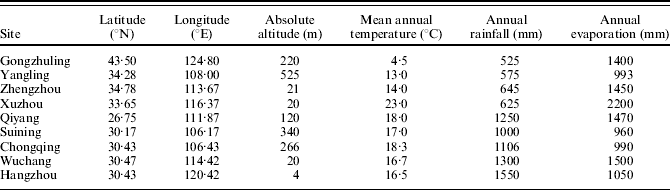
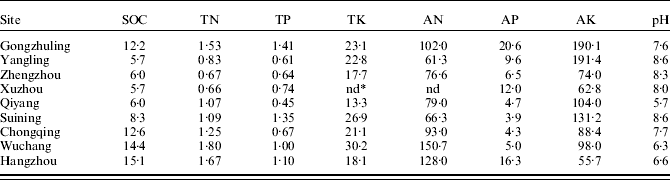
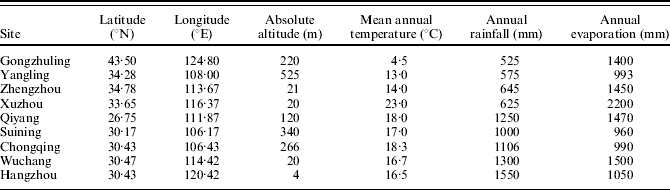
There were nine long-term experiments, representing a wide variety of soil properties, climatic conditions and crop management practices (Tables 1 and 2). The Gongzhuling long-term experiment was performed in the Songliao Plain region in Northeastern China, with a humid/semi-humid climate. This site has black soil (Luvic Phaeozems soil; FAO/UNESCO 1988) with a clay loam texture (32% clay (by volume), 41% silt and 27% sand; Table 2). The Yangling long-term experiment was performed at the Loess Plateau region in Northwestern China with a semi-arid warm temperature climate. It has loess soil (Anthrosol soil) that has a clay loam texture (30% clay, 42% silt and 28% sand). The Zhengzhou and Xuzhou long-term experiments were performed at the Northern China Plain region with a semi-arid warm temperature climate with hot summer and cool winter. The soils are fluvo-aquic soils (Calcaric Cambisol soils) with a silt loam texture (13% clay, 35% silt and 52% sand; 8% clay, 43% silt and 49% sand). The Qiyang long-term experiment, performed in the hilly area in Southern China, has a humid or sub-humid sub-tropical climate with severe hot humid summers and fairly cool winters. The soil is an upland red soil (Ferralic Cambisol) with a heavy clayey texture (44% clay, 32% silt and 24% sand). The Suining, Chongqing, Wuchang and Hangzhou long-term experiments are also performed in Southern China, with a climate similar to the Qiyang long-term experiment and having paddy soils with a loam texture (22–25% clay, 38–49% silt and 28–42% sand).
Locations and climate conditions (1980–2005) at nine long-term experimental sites in China
Contents of SOC (g/kg), total N, P and K (TN, TP, TK: g/kg) and available N, P and K (AN, AP, AK: mg/kg), and soil pH at the beginning of the long-term experiments in China
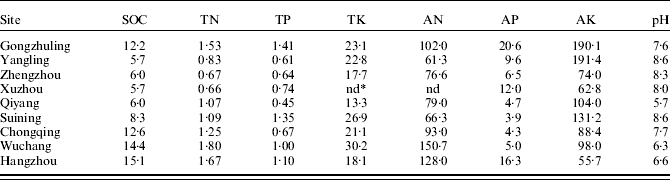
* nd: not determined.
Soil samples were drawn to determine organic C (Walkley & Black Reference Walkley and Black1934), total N (Black Reference Black1965), total P (Murphy & Riley Reference Murphy and Riley1962) and total K (Knudsen et al. Reference Knudsen, Peterson, Pratt, Page, Miller and Keeney1982) as well as available N (NH4+NO3; Black Reference Black1965), available P (Olsen et al. Reference Olsen, Cole, Watanabe and Dean1954) and available K (Black Reference Black1965). Soil pH was measured in 1:2·5 soil:water suspension (Lu Reference Lu2000).
Soil fertility varies largely across these long-term experiments in terms of SOC (6–15 g/kg), total nitrogen (TN; 0·66–1·80 g/kg), total phosphorus (TP; 0·61–1·41 g/kg), total potassium (TK; 13·3–30·2 g/kg), available N (AN; 61–151 mg/kg), available P (AP; 4–21 mg/kg), available K (AK; 56–191 mg/kg) and pH (5·7–8·6; Table 2).
Cropping and fertilization
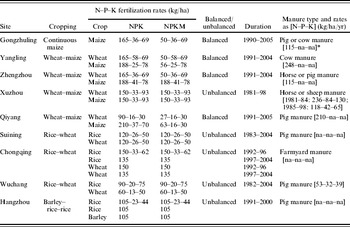
There were three types of cropping system: continuous maize, wheat–maize and rice-based (Table 3). The Yangling, Zhengzhou, Xuzhou, and Qiyang long-term experiments had two crops per year, wheat (October–June) and maize (July–October). For the Suining, Chongqing, and Wuchang long-term experiments, rice was grown during summer months (June–October) and wheat during the cooler winter months (November–June). The Hangzhou long-term experiment had three crops per year: early rice (April–July) and late rice (July–November) followed by barley (November–March). The Gongzhuling long-term experiment had only one crop (maize), grown during April–August each year. Crops at maturity were harvested manually close to the ground using sickles and all harvested biomass removed from the plots.
Cropping and fertilization practices for the nine long-term experiments

* na: not available.
There were seven treatments in each experiment, a non-fertilized (control) and six different fertilization regimes: nitrogen (N), combined nitrogen–phosphorus (NP), combined nitrogen–potassium (NK), combined phosphorus–potassium (PK), combined nitrogen–phosphorus–potassium (NPK) and combined NPK–manure (NPKM). Inorganic nitrogen, phosphorus and potassium fertilizers are urea, single superphosphate or (NH4)2HPO4 and KCI or K2SO4, respectively. The NPK and NPKM treatments are compared in the present paper.
There were two types of manure application in the set of long-term experiments (Table 3). At four sites (Gongzhuling, Yangling, Zhengzhou and Qiyang) there was a ‘balanced N’ approach, i.e. the total amount of N applied was the same for both the NPK and NPKM treatments. At the other five sites the fertilization regime was ‘unbalanced N’, where the application rates of inorganic fertilizers are the same in treatments with and without manure, i.e. manure supplied additional N to the inorganic fertilizers. Thus, at these ‘unbalanced N’ sites, the total amounts of nutrient input in NPKM treatments exceeded those in the NPK treatments.
Statistical analysis
To test the hypothesis that use of manure has positive effects on the long-term trends of crop yield, the null hypothesis that yield trends in the NPK treatments are not significantly different from those in the NPKM treatments was tested. The yield trends, i.e. the annual change rates (kg/ha/yr), were determined using a least-squares linear regression (SPSS Inc. 2001).


where Y is the grain yield (kg/ha), a 1 and a 2 the intercept (i.e. the initial grain yield), b 1 and b 2 the slope (i.e. the yield trend) for the NPK and NPKM treatments, respectively, and X the year. A t-statistic test (Gai Reference Gai2001) is applied for each crop.
RESULTS
Maize and wheat–maize cropping systems
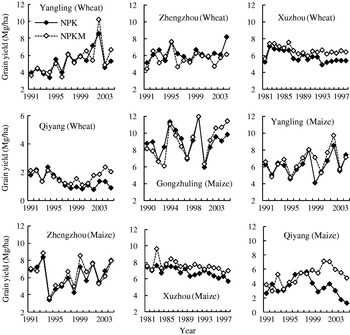
Figure 1 presents grain yields from four experiments for wheat and five for maize from one continuous maize and four wheat–maize cropping systems. While there were considerable interannual variations in grain yields in both treatments, the NPKM treatments produced higher grain yields than the NPK treatments for most experiments. The differences were pronounced at the Xuzhou and Qiyang sites, which showed declines in grain yield under the NPK treatment. These two sites had the lowest SOC content and relatively low contents for other nutrients (Table 2). In addition, the Qiyang site had the lowest fertilization rates for the wheat-growing season (Table 3), which may be largely responsible for the extremely low yields during long-term cropping. Replacing inorganic nitrogen with organic manure at this site resulted in an increase of grain yield, particularly during the last few years.
Grain yields of wheat and corn during the long-term experiments in the maize and wheat–maize cropping systems in China.

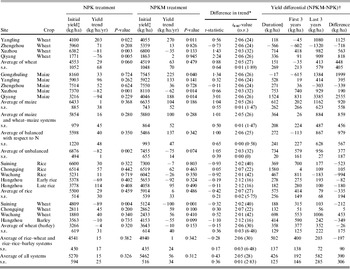
For the four wheat experiments, the ranges of the initial yield and yield trend were large for both the NPK and NPKM treatments (Table 4). For instance, the yield trend ranged from −81 to 203 kg/ha/yr for the NPK and from −35 to 270 kg/ha/yr for the NPKM treatment, respectively. The averaged yield trend increased from 29 to 63 kg/ha/yr due to the addition of manure. While the applications of manure (NPKM) had positive effects on the yield trend in three out of the four experiments, statistical analyses indicate that the difference in the yield trend between the NPK and NPKM treatments was significant only at the Qiyang site.
Grain yield trends in long-term maize, wheat–maize and rice-based experiments in China

* These two columns report the t-statistic (and its associated absolute value of t-value, i.e. |t value|) for testing the null hypothesis that the slope of the yield change is identical for NPK and NPKM treatments.
† The first three of these four columns report the difference in average yields between the NPKM and the NPK treatment for (1) the duration of long-term experiment; (2) the first 3 years of the long-term experiment; and (3) the final 3 years of the long-term experiment. The fourth column is the difference between the third and second columns.
‡ Initial yield is reported as an average of the yield in the first 3 years of the long-term experiment to avoid undue influence of unusual years.
§ Duration column refers to yield differential over the entire duration of the experiment, and for the number of years of the duration see Table 1.
For the five maize experiments, the initial yield and yield trend had smaller ranges relative to those for the wheat experiments. The yield trend showed a range from −62 to 225 kg/ha/yr with an average of 104 kg/ha/yr for the NPKM treatment and a range from −94 to 96 kg/ha/yr with an average of 1 kg/ha/yr for the NPK treatment. The addition of manure resulted in a marked increase of yield trend at the Gongzhuling, Yangling and Qiyang sites. The largest and only significant increase of yield trend was found at the Qiyang site where the yield trend was positive in the NPKM treatment, but negative in the NPK treatment. In contrast, the application of manure did not prevent the decline of yield trend at the Xuzhou experiment site, suggesting that either the rates of manure application or the quality of the manure type (Table 3) were not efficient to maintain soil fertility during long-term cropping.
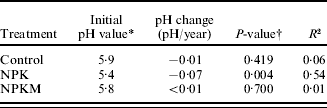
At the Qiyang station, the upland red soil with heavy clay texture had an initial soil organic C content of 6·0 g/kg, available P of 4·7 mg/kg and pH of 5·7. Long-term application of chemical fertilizers alone (NPK treatment) resulted in the decrease of exchangeable Ca and Mg as well as a lower pH in soil (Wang et al. Reference Wang, Xu and Wen2005; Zhang et al. Reference Zhang, Wang and Xu2008), which may have contributed to the decline of grain yield. The application of chemical fertilizers in combination with manure (NPKM treatment) caused an increase of available Cu and Zn contents and decrease of exchangeable H+ and Al3+ to some extent (Table 5), leading to increased grain yield (Wang et al. Reference Wang, Xu and Wen2005; Zhang et al. Reference Zhang, Wang and Xu2008).
Initial soil pH, pH change and significance of soil pH change for various treatments in a 15-yr (1990–2005) fertilization experiment at Qiyang, Hunan, China
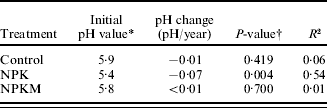
* An average of the soil pH in the first 3 years of the long-term experiment.
† Level of significance of change in soil pH.
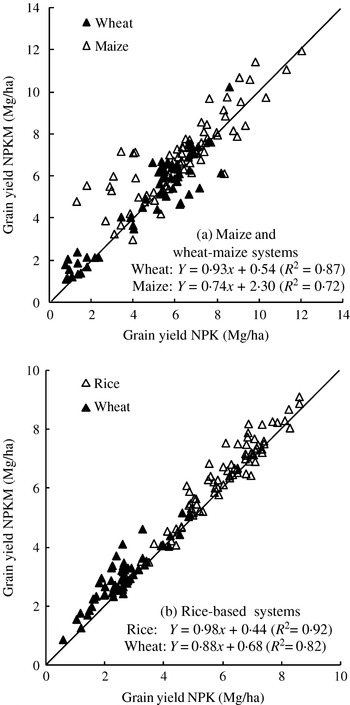
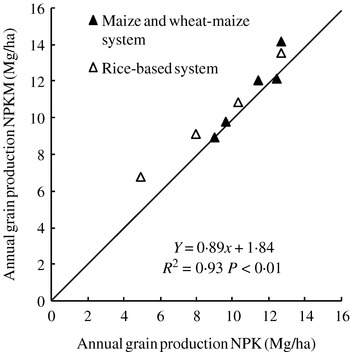
Considering all five long-term maize and wheat–maize experiments, there seems to be no consistent yield increase in association with application of manure (Fig. 1). While the NPKM treatment tended to have positive effects on the low yield range, particularly for the maize cropping systems, application of manure showed small effects on increase of wheat grain yield (Fig. 2a). Overall, the present analyses show that the NPKM treatment resulted in a small increase in the total annual grain production averaged over the entire duration of the long-term experiment (Fig. 3).
Grain yield from the NPKM treatments v. those from the NPK treatments in the maize and wheat–maize systems and in the rice-based systems.

Averaged annual grain production for the NPKM treatments v. that for the MPK treatments. Values shown are annual means for each site.

To investigate further the effects of manure application on the yield trend, the yield difference (i.e. the yield of the NPKM treatment subtracted from the yield of the NPK) was compared between the first and the last 3 years (Table 4). For the wheat crops, the yield difference was greater during the final 3 years than that during the initial 3 years of the experiment, except at the Zhengzhou site. For the maize crops, the averaged increase of the yield difference was 920 kg/ha per crop from the initial 3 years to the final 3 years. It appears that the increase of the yield difference caused by application of manure was less for wheat (448 kg/ha per crop) than for maize.
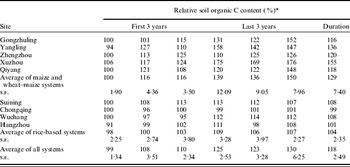
Table 6 shows the averaged relative SOC (i.e. the ratio of SOC in the NPKM to SOC in the NPK) in the NPKM for the first and last 3 years and entire period. Overall, the relative SOC was close to 100% with little interannual variation during the first 3 years, indicating a small effect of manure application on the SOC content at the early stage of the experiment. On average, the relative SOC in the NPKM treatment was 111% and 141% in the maize and wheat–maize cropping systems for the first and last 3 years, respectively. The long-term application of manure resulted in considerable increase (30%) in the relative SOC. The balanced N treatment produced lower values of the averaged relative SOC (134% and 123%) for the last 3 years and entire experiment duration, respectively) than the unbalanced N treatment (173% and 155%).
Averaged relative SOC (i.e. the ratio of SOC in the NPKM to SOC in the NPK) in the NPKM for the first and last 3 years and entire period for the long-term maize, wheat–maize and rice-based experiments in China
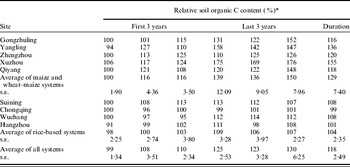
* The value of relative SOC content in the NPK is 100%.
Rice-based cropping systems
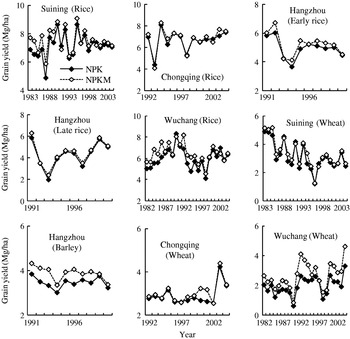
Figure 4 shows the grain yields from rice-based experiments. There were remarkable fluctuations, particularly in the rice cropping systems, showing no clear trend. It appears that application of manure had positive effects on the grain yield during the early years of experiment in the rice cropping systems, in contrast to the wheat and maize cropping systems (e.g. Fig. 1).
Grain yields of rice and wheat (barley at Hangzhou) during the long-term experiments in the rice-based cropping systems in China.

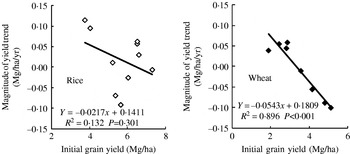
Statistical analyses indicated that there was no trend in grain yield except for the wheat cropping at the Suining site (Table 4). While there was no significant difference in grain yield between the NPK and NPKM treatments during the entire experiment, the average yields were statistically higher during the first 3 years in the NPKM treatments than in the NPK treatments (Table 4). The high yield at the early stage of the experiment may have implications for soil fertility and crop production during the long-term experiment. For instance, negative yield trends will be more pronounced when the initial yields (measured as the average yield in the first 3 years) are high. To test this hypothesis, the magnitude of the yield trend was plotted against the initial yield for the four rice-based experiments (Fig. 5). There was a negative correlation between the yield trend and the initial yield level in both the rice and wheat cropping systems, which is consistent with the many other observations available in the literature (Dawe et al. Reference Dawe, Dobermann, Moya, Abdulrachman, Singh, Lal, Li, Lin, Panaullah, Sariam, Singh, Swarup, Tan and Zhen2000, Reference Dawe, Dobermann, Ladha, Yadav, Lin, Gupta, Lal, Panaullah, Sariam, Singh, Swarup and Zhen2003; Ladha et al. Reference Ladha, Dawe, Pathak, Padre, Yadav, Singh, Singh, Singh, Singh, Kundu, Sakal, Ram, Regmi, Gami, Bhandari, Amin, Yadav, Bhattarai, Das, Aggarwal, Gupta and Hobbs2003).
Relationship between the yield trend (annual rate of yield change) and the average grain yield during the first 3 years from both the NPKM and NPK treatments in the long-term rice-based experiments.

For all four long-term rice-based experiments, there were overall yield increases for both the rice and wheat crops because of the application of manure (Fig. 2b), resulting in significant (P<0·01) increases in the total grain production over the entire duration of the long-term experiment (Fig. 3).
It seems that there was a yield increase in association with application of manure in the total annual grain production averaged over the entire duration of the long-term experiment across all nine sites (Fig. 3). However, the averaged yield difference between the NPKM and NPK treatments did not differ statistically during the final 3 years from that during the initial 3 years of the experiment (Table 4).
For rice-based cropping systems, the SOC content in the NPKM treatment was not significantly different from that in the NPK treatment with long-term application of manure. The relative SOC in the NPKM treatment was 100%, 108% and 104% during the first 3 years, last 3 years and entire experiment duration, respectively (Table 6). The relative SOC associated with manure application was considerably lower in the rice-based cropping systems than those in the maize cropping systems, which may partly explain the lower influence of manure on rice yield than on maize yield.
DISCUSSION
The data presented here suggest that, in statistical terms, the overall yield trends are similar in the NPKM (15 kg/ha/yr) and NPK (56 kg/ha/yr) treatments for all the long-term experiments (Table 4). For the maize and wheat–maize cropping systems, the averaged yield trend was much higher in the NPKM treatments (100 kg/ha/yr) than in the NPK treatments (16 kg/ha/yr). However, the averaged yield trend was 1 kg/ha/yr in the NPKM treatments for the rice-based experiments, but reached 15 kg/ha/yr in the NPK treatments, despite the NPKM treatments receiving more nutrients because of the unbalanced manure application relative to the NPK treatments. The low averaged yield trend in the NPKM treatments was caused by some negative trends at several sites in the rice-based systems. The negative yield trends were pronounced in the NPKM treatments when the initial yields were higher than those in the NPK treatments.
As pointed out by Dawe et al. (Reference Dawe, Dobermann, Ladha, Yadav, Lin, Gupta, Lal, Panaullah, Sariam, Singh, Swarup and Zhen2003), if the yields start off at a low level, the trend over a long period is less likely to be negative. The mean yield during the initial years of experiment was higher for the NPKM treatment than for the NPK treatment, 8·8% for rice-based systems, and only 0·4% for maize and wheat–maize systems, respectively. This might be one reason for the difference in yield trend between the two cropping systems. Another reason is likely to be the different ‘organic C effect’ (i.e. improvements in SOC and soil physical properties) between the maize and wheat–maize systems and the rice-based systems (Dawe et al. Reference Dawe, Dobermann, Ladha, Yadav, Lin, Gupta, Lal, Panaullah, Sariam, Singh, Swarup and Zhen2003).
The present study seems to indicate that the initial increase in grain yield associated with manure application in maize and wheat–maize systems was likely to be caused by increased supply of N, P, K or other nutrients. However, the increase of maize grain yield during the final years may be related to the ‘organic C effect’ and/or delayed nutrient release because of the low decomposition rate of manure.
For the rice-based systems, a large amount of nutrients may be taken away from the soil with the high initial yields, which may result in the gradual depletion of some nutrients. For example, the contents of available Zn and non-exchangeable K during the final years are significantly lower than that during initial years at the Suining site, whereas the contents of B, Mn and S are significantly lower at the Wuchang site (Xu et al. Reference Xu, Liang and Zhang2006).
Studies have shown that SOC dynamics is affected by cropping practice and other environmental conditions (Olk et al. Reference Olk, van Kessel, Bronson, Kirk and Olk2000; Powlson & Olk Reference Powlson, Olk, Kirk and Olk2000). The relative SOC in the rice-based systems was close to 100% (Table 6), indicating little increase in the SOC with long-term application of organic manure. The average annual temperature and annual rainfall and initial SOC content were higher (17·1°C, 1239 mm and 12·6 g C/kg soil, respectively) in the rice-based systems than in the maize and wheat–maize systems (14·5°C, 724 mm and 7·1 g C/kg soil; Table 1). Therefore, the accumulation of SOC was more difficult in the rice-based systems than in the maize and wheat–maize systems. Long-term rice-based cropping practice without manure application typically causes a decline of SOC content at sites with moderate to high initial soil C content, but an increase at sites with low initial SOC levels (Ram Reference Ram, Swarup, Reddy and Prasad1998; Yadav et al. Reference Yadav, Yadav, Singh and Kumar1998; Duxbury et al. Reference Duxbury, Abrol, Gupta, Bronson, Abrol, Bronson, Duxbury and Gupta2000). However, long-term wheat–maize cropping typically results in SOC accumulation, even without manure application or when all aboveground biomass is removed from the field (Gami et al. Reference Gami, Ladha, Pathak, Shah, Pasuquin, Pandey, Hobbs, Joshy and Mishra2001; Regmi et al. Reference Regmi, Ladha, Pathak, Pasuquin, Bueno, Dawe, Hobbs, Joshy, Maskey and Pandey2002; Yang et al. Reference Yang, Li, Malhi, Wang, Suo and Wang2004; Fan et al. Reference Fan, Stewart, Yong, Junjie and Guangye2005; Hao et al. Reference Hao, Fan, Wei, Pen and Lai2005; Mando et al. Reference Mando, Ouattara, Sedogo, Stroosnijder, Ouattara, Brussaard and Vanlauwe2005).
The accumulation of SOC with application of manure was low during the long-term experiments with the rice-based systems, suggesting that a higher rate of manure application may be needed to increase soil fertility and crop productivity. However, manure application showed little improvement in rice yield during the final years, which indicates that there may be other limiting factors in the rice-based cropping systems. Clearly, more studies are needed to understand how long-term cropping affects soil properties under different fertilization practices.
The main conclusions from the present work are that across all nine sites, the application of manure had positive effects on the SOC and the crop grain yield and complex effects on the yield trend. Overall, regular use of manure resulted in larger increase in SOC in the maize and wheat–maize systems than in the rice-based systems. Application of manure tended to increase the grain yield in the maize and wheat–maize systems during the final years, but increased the grain yield in the rice-based systems during the initial years of the long-term experiments. There was only one site (Qiyang) that showed significant improvement in the yield trend in association with the application of manure. The complex effect of manure on yield trend is likely related to the initial yield, the ‘organic C effect’ and nutrient conditions.
This research was supported by the 11th Five Year Key Planning Program of China for Science and Technology (2006BAD05B09) and the Fund of Chinese Academy of Agricultural Sciences for the Outstanding Researchers in Current Soil Science. Thanks to Drs Wang Xiujun and Yang Shengmao for their constructive comments on the manuscript. We would also like to acknowledge the valuable contributions made by many researchers conducting the long-term experiments in China, including Drs Shi Xiaojun, Yang Xueyun, Zhang Shuxiang, Wang Boren, Zhu Ping, Huang Shaomin, Chen Yi, Li Shuanglai, Sun Xifa and Zhang Aijun.