Introduction
Cryopreservation of boar semen can increase the speed of genetic selection, control the spread of infectious diseases, and enhance the utilization value of stock boar. Because the freezing tolerance of boar sperm is feeble compared with other domestic animals, the breeding rate after using frozen–thawed boar sperm is much lower than that of natural mating (Zhou et al., Reference Zhou, Yue, Sun, Liang, Chang and Tan2002). However, the freezing resistance of boar sperm can be increased by adding cryoprotectant into the extender and the suitable cryoprotectant can improve sperm motility, acrosome and plasma membrane integrity after being frozen–thawed (Kaeoket et al., Reference Kaeoket, Tantiparinyakul, Kladkaew, Chanapiawat and Techakumphu2008). The most popular cryoprotectants for boar frozen semen were glycerol and egg yolk (Hu et al., Reference Hu, Jiang, Lv, Li, Zhang, Zan, Li and Li2011). In recent years, the egg yolk has become a common component of extenders for cryopreservation of semen from different domestic animal species (Hu et al., Reference Hu, Li, Jiang and Li2008; Amirat-Briand et al., Reference Amirat-Briand, Bencharif, Vera-Munoz, Bel Hadj Ali, Destrumelle, Desherces, Schmidt, Anton and Tainturier2009; Varela Junior et al., Reference Varela Junior, Corcini, Ulguim, Alvarenga, Bianchi, Corrêa, Lucia and Deschamps2009; Hu et al., Reference Hu, Li, Zan, Jiang, An, Wang and Jia2010).
Low-density lipoprotein (LDL), composed of lipids and proteins, is responsible for the gelation process in freezing–thawing because it can form a protective film at the surface of sperm membranes. Moussa et al. (Reference Moussa, Marinet, Trimeche, Tainturier and Anton2002) proved that LDL extracted from yolk played an important role in protecting the sperm, and bull sperm motility and movement characteristics were improved after thawing (Moussa et al., Reference Moussa, Marinet, Trimeche, Tainturier and Anton2002). Lamia et al. (2004) found that the high-density lipoproteins (HDL) of avian yolk caused damage to sperm in the freezing–thawing process, and LDL could reduce the damage to sperm (Lamia et al., 2004). Jiang et al. (Reference Jiang, Li, Li, Hu, Zhao and Zhang2007) demonstrated that LDL significantly protected boar sperm DNA integrity from the damage caused by cryopreservation and the optimal concentration of LDL in diluents was 9% (Jiang et al., Reference Jiang, Li, Li, Hu, Zhao and Zhang2007). Su et al. (Reference Su, Li, Quan, Yang, Li, He and Tang2008) compared the effectiveness of egg yolk from five avian species on the cryopreservation of bull sperm and found that 20% pigeon egg yolk provided the best effect (Su et al., Reference Su, Li, Quan, Yang, Li, He and Tang2008). Hu et al. (Reference Hu, Li, Zan, Jiang, An, Wang and Jia2010) found that the physiological indexes of bull sperm were significantly improved by the supplementation of 8% LDL in the freezing extender (Hu et al., Reference Hu, Li, Zan, Jiang, An, Wang and Jia2010).
Although many studies have reported the effects of LDL on boar sperm quality, little information is known about the effects of LDL extracted from different avian egg yolk on post-thaw boar semen quality. The purpose of this study was to add LDL extracted from yolk of chicken egg, duck egg, quail egg, pigeon egg and ostrich egg into diluents, and compare and analyze the effects of LDL with various concentrations and different species on boar sperm quality after freezing– thawing.
Materials and methods
The boar care and procedures used to collect semen were approved by the Animal Care and Use Committee of Northwest A&F University, China.
Extraction of LDL
According to the method described by Moussa et al. (Reference Moussa, Marinet, Trimeche, Tainturier and Anton2002), LDL was extracted from yolk of hen egg, duck egg, quail egg, pigeon egg and ostrich egg. Fresh eggs were manually broken and the egg yolk diluted twice with isotonic saline solution (0.17 MNaCl) was centrifuged at 10,000 g for 45 min after stirring 1 h. The supernatant was mixed with 40% ammonium sulfate and stirred at 4°C for 1 h and then centrifuged at 10,000 g for 45 min to separate the supernatant from sediment. Subsequently, the supernatant was dialyzed 12 h against distilled water. After this process, the solution was again centrifuged at 10,000 g for 45 min at 4°C and the floating residue was collected.
In order to investigate the optimum LDL concentration of five avian egg yolk, the different concentrations of LDL (0.06, 0.07, 0.08, 0.09 and 0.1 g/ml) extracted from chicken egg yolk, duck egg yolk, quail egg yolk, pigeon egg yolk and ostrich egg yolk were added to boar semen freezing extender, respectively. The sperm motility was evaluated and each treatment was repeated three times. The sperm acrosome integrity and plasma membrane integrity after being frozen–thawed were evaluated under the optimal concentrations of each egg yolk LDL extracted from egg yolks. Each treatment was also repeated three times.
Semen collection
Sexually mature boars (1.5–2 years) from Wugong Shanchuan Co. Ltd. (Shaanxi province, China) were used in this study. Semen was collected by the gloved hand technique, filtered through four layers of sterile cotton gauze to remove the gel particles and then transferred into an insulated vacuum bottle. The sperm-rich fractions were assessed for volume, sperm concentration and per cent motile spermatozoa. Ejaculates containing greater than 85% motile and 90% morphologically normal spermatozoa were pooled and used in this study.
Semen freezing processes
Equal volume and pre-warmed BTS (beltsville thawing solution) was added to semen sample. All tubes were wrapped by sterile gauze (four layers). The sperm suspension was slowly cooled to 15°C in 3 h, afterwards centrifuged at 800 g for 10 min. Then the supernatant was discarded and the concentrated semen was diluted to 1 ml with the cooling extender at 15°C. The diluted semen was gently mixed and slowly cooled to 5°C in 1.5–2.5 h. The semen (5°C) was further diluted (1:2) with freezing extenders, respectively. The final sperm concentration was 1.0 × 10⁹ sperm/ml, and the final glycerol concentration was 3%. The sperm suspension was loaded into 0.25 ml straws (IMV L′Aigle, France) immediately, and the straws were sealed manually using polyvinyl alcohol. Then the straws were maintained at 5°C for 1 h. The freezing program was as follow: from +5°C to –5°C with 1°C/min by programmable freezing device (Biotronics Ltd., Leominster, UK). All straws were then placed about 4 cm above liquid nitrogen for 15 min and then immersed into liquid nitrogen for storage.
Sperm thawing
Semen straws were thawed in a water bath at 37°C for 45 s. Thawed sperm from each straw were suspended in a solution containing 9.5 ml of BTS and 0.5 ml of the relevant cooling extender and incubated in a water bath at 37°C.
Assessment of sperm motility
Sperm motility was assessed by determining the percentage of sperm showing any movement of the flagellum. The percentage of linear motile sperm was examined visually. Six microlitres of sperm samples were paced on microscope, covered with a glass cover-slip and estimated at 37°C by light microscope at ×400 magnification.
Assessment of acrosome integrity
Acrosome integrity was evaluated by the fluorescein isothiocyanate-conjugated peanut agglutinin (FITC–PNA) method (Johnson et al., 2000). Briefly, semen was transferred into a plastic tube containing 2 ml 3% polyvinylpyrrolidone (PVP) after thawing, centrifuged at 800 g for 3 min at room temperature and the supernatant solution was poured off. The sediment was diluted with phosphate-buffered saline (PBS) solution (37°C) to obtain 1–2 × 10⁶ sperm/ml. Aliquots (30 μl) of semen were used to prepare smears on microscope slides. Sperm smears were fixed with absolute methanol for 10 min at room temperature after air drying. The 30 μl FITC–PNA solution (100 μg/ml) in PBS was spread over each slide. The slides were then incubated in a dark and moist chamber for 30 min at 37°C. After incubation, the slides were then rinsed with PBS, air dried, and then mounted with 10 μl of antifade solution to preserve fluorescence. A cover-slip was then applied and the edges were sealed with colourless nail polish.
The acrosome status of sperm was examined and photographed using a fluorescence microscope (Nikon TE 2000, Nikon Optical Co. Ltd., Tokyo, Japan). The whole acrosome visualized with strong green fluorescence under a microscope was scored as intact-acrosome sperm. The percentage of intact-acrosome sperm was counted in at least 300 sperm per slide.
Assessment of plasma membrane integrity
The plasma membrane integrity of sperm was evaluated by the hypoosmotic swelling test (HOST) (Pérez-Llano et al., 2003). In brief, the straws were thawed in a water bath at 37°C for 45 s. The assay was performed by mixing 50 μl of semen with 1 ml of hypoosmotic solution (7.35 g sodium citrate.2H2O and 13.51 g fructose in 1 l distilled water). After incubation for 30 min at 37°C, sperm swelling was assessed by placing 15 μl of well mixed sample on a slide that was covered with a cover glass before being observed under light microscopy at ×400 magnification. Sperm with intact plasma membrane had coiled tails after HOST. At least 300 sperm per slide were observed. The sperm are classified as positive or negative based on the presence or absence of a coiled tail, respectively.
Statistical analyses
The data of sperm motility, acrosome integrity and plasma membrane integrity were performed using Statistical Product (SPSS 11.5 for Windows; SPSS, Chicago, USA). All results were expressed as mean values ± standard error the mean (SEM). The Duncan's multiple range tests by a one-way analysis of variance (ANOVA) procedure was used to compare mean values of individual treatments when the F-value was significant (P < 0.05).
Results
The effects of LDL extracted from different avian yolk on frozen–thawed boar spermatozoa motility
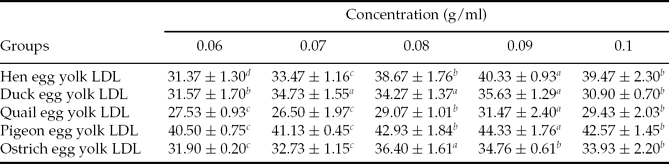
The effects of LDL on frozen–thawed boar sperm were evaluated and the results were shown in Table 1. The extenders supplemented with 0.09 g/ml LDL exhibited higher sperm motility in comparison with the other groups from the same avian yolk LDL (P < 0.05). However, for ostrich egg yolk LDL, the extender supplemented with 0.08 g/ml LDL exhibited higher sperm motility than that of other groups. In five different groups with different avian egg yolk LDL, pigeon egg yolk LDL showed the best effect (P < 0.05).
Effects of LDL extracted from different avian species egg yolk on boar sperm motility after freezing–thawing

Note: a–dValues in the same row marked with different letters mean significant difference (P < 0.05).
The effects of different avian egg yolk LDL on frozen–thawed boar spermatozoa acrosome integrity and membrane integrity
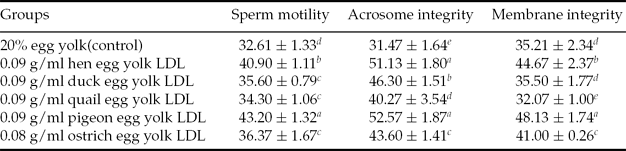
Based on the previous experiment, the feasible kinds and concentrations of LDL were selected. Then the effects of LDL extracted from five kinds of avian egg in extender on boar sperm acrosome integrity and membrane integrity after freezing–thawing were evaluated and the results were shown in Table 2. The extender supplemented with 0.09 g/ml pigeon egg LDL exhibited the highest sperm motility, acrosome integrity and membrane integrity in comparison with other groups (P < 0.05).
Effects of LDL extracted from five kinds of avian egg yolk on boar sperm acrosome integrity and membrane integrity after freezing–thawing
Note: a–eValues in the same column marked with different letters mean significant difference (P < 0.05).
LDL, low-density lipoprotein; PNA, peanut agglutinin.
The correlation analysis of spermatozoa motility, acrosome integrity and plasma membrane integrity
The correlation coefficients among different tests (sperm motility, FITC–PNA staining and HOST tests) were analyzed and the results were shown in Table 3. The correlation coefficients among the three tests were high, especially the correlation between sperm motility and plasma membrane integrity (P < 0.01). The correlation coefficients were 0.749 between sperm motility and FITC–PNA staining, 0.913 between sperm motility and HOST test, 0.624 between FITC–PNA staining and HOST tests.
Correlation coefficients among different methods for testing boar sperm quality after freezing–thawing

Note: aSignificant correlation P < 0.01. PNA, peanut agglutinin.
Discussion
Our results demonstrated that LDL extracted from pigeon egg yolk had the best cryoprotective effects on frozen–thawed boar sperm among the five avian egg yolks LDL of hen, duck, quail, pigeon and ostrich. Furthermore, the extender supplemented with 0.09 g/ml pigeon egg yolk LDL showed beneficial effects. This result was similar to the report by Su et al. (Reference Su, Li, Quan, Yang, Li, He and Tang2008). Our study suggested that LDL extracted from pigeon egg yolk could be a good substitute for yolk in extender.
In cryopreservation of sperm, adding egg yolk can reduce the damage to sperm in the process of cooling (Recai et al., 2010). The total solids of egg yolk are made up of about two-thirds of LDL and other components. The previous research affirmed that the LDL fraction was responsible for the cryoprotective effects of egg yolk during the freezing–thawing of mammalian spermatozoa (Evans & Ozaki, Reference Evans and Ozaki1973; Pace & Graham, Reference Pace and Graham1974; Demianowicz & Strezek, 1996; Trimeche et al., Reference Trimeche, Anton, Renard, Gandemer and Tainturier1996; Bergeron et al., 2004; Hu et al., Reference Hu, Li, Zan, Jiang, An, Wang and Jia2010, Reference Hu, Jiang, Lv, Li, Zhang, Zan, Li and Li2011). The precise mechanism by which LDL aids in the protection of spermatozoa during the freezing–thawing process is not clearly established. Manjunath et al. and Bergeron et al. proposed that LDL could isolate bull seminal plasma (BSP) proteins (BSP-A1/A2, BSP-A3 and BSP-30-kDa) in seminal plasma and then protect spermatozoa (Manjunath et al., 2002; Bergeron et al., 2004). Bergeron et al. (2004) confirmed that the prevention of BSP binding to sperm and lipid efflux from sperm membrane resulted in the increase in sperm motility, and the lipid from the low-density lipoprotein fraction (LDF) could associate with sperm membrane and preserve the integrity of plasma membrane during sperm preservation (Bergeron et al., 2004). Manjunath et al. (2002) considered that egg yolk-LDF was the only component of egg yolk that bind specifically the BSP proteins and the sequestration of BSP proteins by LDF might represent the major mechanism of sperm protection by egg yolk (Manjunath et al. 2002). Moreover, Manjunath et al. (2002) suggested that the beneficial role of LDF was not limited to the direct binding of LDL to sperm plasma membrane but may involve interplay among BSP proteins, LDF and sperm membrane (Manjunath et al. 2002). Thus an assumption was that LDL might offer protection to sperm by reducing the deleterious effect of seminal plasma proteins on sperm membranes.
Different avian yolks LDL had different effects on boar sperm during the freezing–thawing in this study. Bathgate et al. indicated that different avian yolks contained different components (Bathgate et al., Reference Bathgate, Maxwell and Evans2006). The yolk of duck egg contains more single unsaturated fatty acid than that of hen egg, and hen egg contains more single unsaturated fatty acid than that of quail egg yolk. Trimeche et al. (Reference Trimeche, Anton, Renard, Gandemer and Tainturier1996) found that lecithin in hen egg was significantly higher than that in quail egg, and the contents of polyunsaturated fatty acids and saturated fatty acids content were near between the two kinds of egg (Trimeche et al., Reference Trimeche, Anton, Renard, Gandemer and Tainturier1996). Royle et al. (Reference Royle, Surai, Mccartney and Speake1999) considered that the proportion of fatty acid in hen and duck egg lipid was different, which could explain the different effects on sperm motility and acrosome integrity following freezing–thawing when different avian yolks LDL was added to the extender (Royle et al., Reference Royle, Surai, Mccartney and Speake1999). Our results showed that the effects of pigeon egg yolk LDL on protecting sperm in the cryopreservation process was the best and it was significantly superior to others avian egg yolks LDL. Maybe the pigeon egg yolk has more lecithin than that of other four kinds of yolk. The lecithin can replace some of phospholipid in sperm plasma membrane and form a protective film in the cooling process, thus decrease the damage to sperm plasma membrane and improve sperm motility after freezing–thawing.
In addition, our study found that different concentrations of LDL had different effects on boar sperm quality during the process of freezing–thawing. In this study, for hen egg, duck egg, quail egg and pigeon egg, boar sperm motility was significantly improved by supplementing with 0.09 g/ml LDL, whereas there was a significant decline when LDL concentration in extender was increased to 0.1 g/ml. For ostrich egg, boar sperm motility was significantly improved by supplementing with 0.08 g/ml LDL, but there was a significant decline when LDL concentration in extender was increased to 0.09 g/ml. Demianowicz & Strezek separated yolk into two lipoproteins: LDL and HDL. They observed that if LDL provided better protection for boar sperm than yolk, HDL decreased significantly sperm motility compared with yolk, and maybe the reason was that the HDL contained granules (Demianowicz & Strzezek, Reference Demianowicz and Strzezek1995). It can be hypothesized that HDL has a detrimental effect on its cryoprotective properties. Moreover, Moussa et al. (Reference Moussa, Marinet, Trimeche, Tainturier and Anton2002), Hu et al. (2006) and Jiang et al. (Reference Jiang, Li, Li, Hu, Zhao and Zhang2007) observed that the increase of LDL concentration in the extender above 10% led a decrease in sperm performance after freezing–thawing. This observation could be related to the granules. A hypothesis could be advanced that this effect was due to the increase of LDL concentration which led to the aggregation of granules. Another possibility could be that the increase of LDL concentration also led to HDL aggregation (Moussa et al., Reference Moussa, Marinet, Trimeche, Tainturier and Anton2002; Hu et al., 2006; Jiang et al., Reference Jiang, Li, Li, Hu, Zhao and Zhang2007). The granules and HDL had negative effects on sperm viability (Pace & Graham, Reference Pace and Graham1974; Thérien & Manjunath, Reference Thérien and Manjunath1999), thus the sperm function was reduced after freezing–thawing when LDL concentration was exceed 10% in the extender. In our study, boar sperm motility was different when the extender was supplemented with different kinds of LDL (at the same concentration). This may be because different avian egg yolks had different contents of HDL and granules. The HDL and granules in pigeon egg yolk were less than that in other egg yolks, so the extender supplemented with pigeon egg yolk LDL had the least HDL and granules. The contents of HDL and granules in different egg yolks were needed further study.
The results of this study showed a significant correlation among sperm motility, acrosome integrity and plasma membrane integrity. Sperm motility was highly correlated with plasma membrane integrity (r = 0.913), suggesting that plasma membrane integrity was related to sperm motility. The correlation coefficients between sperm motility and acrosome integrity, plasma membrane integrity and acrosome integrity were 0.749 and 0.624, respectively. All three tests were used to assess sperm viability and the close correlation among the tests might suggest that any one of them would be an equal effective diagnostic indicator of boar sperm quality after freezing–thawing.
Conclusion
Our results showed that LDL extracted from pigeon egg yolk had the best cryoprotective effects on frozen–thawed boar sperm among the five avian egg yolks LDL of hen, duck, quail, pigeon and ostrich. Furthermore, the optimum concentration of pigeon egg yolk LDL in boar semen freezing extender was 0.09 g/ml. These results suggested that LDL from pigeon egg yolk could be a good substitute for yolk in extender. But further studies are needed to clarify the different components in different avian egg yolks and the mechanism of how LDL protects sperm during the freezing–thawing process.
Acknowledgements
This research was supported by the 12th Five-year Plan Rural Areas State Science and Technology Support Projects (2011BAD19B04–3), Science and Technology Innovation Support Projects of Xi'an City [NC1118 (1)], National Swine Industry Technology System (CARS-36), the Foundation for the Author of Excellent Doctoral Dissertation of Shaanxi Province (A213020901) and Youth Extra Found of Northwest A&F University (Z111020905).