Dilated cardiomyopathy is the most common form of cardiomyopathy in paediatric population, with an annual incidence of 1.13/100,000 infants and children.Reference Lipshultz, Sleeper and Towbin 1 It is a myocardial disorder characterised by a dilated left ventricular chamber and systolic dysfunction. Right ventricular dysfunction can also be noticed, increasing disease severity.Reference Maron, Towbin and Thiene 2
Although rare, dilated cardiomyopathy is a common cause of heart failure in children and it is also the most common cause of heart transplantation in children older than 1 year of age.Reference Boucek, Waltz and Edwards 3
Unlike adults, whose main cause is coronary heart disease, the aetiology in the paediatric population is mainly idiopathic or due to myocarditis, inherited metabolic diseases, neuromuscular diseases and malformative syndromes.Reference Maron, Towbin and Thiene 2 , Reference Towbin, Lowe and Colan 4
The demographics and underlying causes of paediatric dilated cardiomyopathy are not well characterised, particularly in our country. A better understanding of the epidemiology, aetiology and outcome of the disease would facilitate planning and provision of medical services.
The aim of the study was to provide a detailed description of clinical profile and outcome of dilated cardiomyopathy in children.
Methodology
We performed a retrospective review of children diagnosed with dilated cardiomyopathy from January, 2005 to June, 2012 in a tertiary centre of Paediatric Cardiology. All patients were examined by a paediatric cardiologist and data reported were based on comprehensive chart review of each patient visit. Demographic data, clinical presentation, aetiology, treatment and outcome were assessed.
The diagnostic criteria for dilated cardiomyopathy were (i) reduced left ventricular systolic function on any form of cardiac imaging in patients with symptoms or a family history of dilated cardiomyopathy, (ii) a measured left ventricular ejection fraction <45% or a fractional shortening ⩽20% in children without symptoms or a positive family history.Reference Daubeney, Nugent and Chondros 5 Although most patients had left ventricular dilatation, this was not required for study inclusion, because some patients with rapidly progressive symptoms had normal left ventricular size at presentation.Reference Daubeney, Nugent and Chondros 5
Patients with dilated cardiomyopathy resulting from congenital heart disease were excluded. Viral myocarditis was considered when viral isolation by polymerase chain reaction was obtained.
Outcome measures were death, cardiac transplantation and the composite end-point of death and/or transplantation.
Descriptive statistics are presented as percentages or means and standard deviations, with skewed continuous data summarised as medians and interquartile ranges. The distributions of categorical variables were compared using χ2 statistics.
Results
Demographic data
We identified 61 patients with dilated cardiomyopathy – 37 were female and 24 were male. The median age at diagnosis was 15 months (IQR 56.0 months). The majority of the patients were younger than 2 years of age at diagnosis [n=41 (67.2%)].
Clinical presentation
The majority of the patients had clinical evidence of heart failure at diagnosis [n=51 (83.6%)]. Of all, 44.3% (n=27) needed to be admitted to an intensive care unit. The need for intensive care admission was significantly higher in younger patients (21.0 months versus 63.7 months, p=0.009).
Family history of dilated cardiomyopathy and sudden death were observed in two patients, each.
A measured left ventricular ejection fraction at clinical presentation was available for 85.2% of patients; in the remaining patients, there was qualitative information of reduced left ventricular systolic function. The mean left ventricular ejection fraction was 32.0% (standard deviation ±13.0%). Left ventricular ejection fraction ⩽30% was observed in 23 patients (37.7%), between 30% and 50% in 24 patients (39.3%) and >50% in five patients (8.2%). Patients admitted to an intensive care unit had a significantly lower mean left ventricular ejection fraction at presentation (mean −8%, p=0.026).
Aetiology
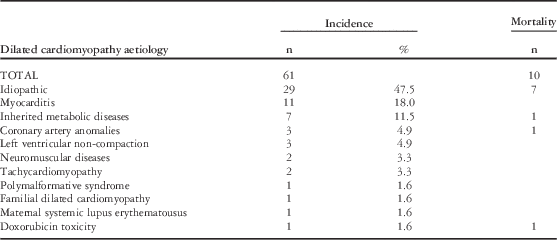
An idiopathic form of dilated cardiomyopathy was responsible for 47.5% (n=29) of all the cases. In the majority of the patients, the aetiology of dilated cardiomyopathy was identified, with the most common known causes being viral myocarditis [n=11 (18.0%)] and inherited metabolic diseases [n=7 (11.5%)]. The less common causes can be consulted in Table 1.
Dilated cardiomyopathy aetiology and respective mortality.

Of the 11 patients with identification of a potentially cardiotoxic virus, eight patients had Parvovirus B19, two patients had cytomegalovirus and one patient had influenza-1. Endomyocardial biopsy was not performed on any patient, as it is not done on a routine basis in our centre owing to its limited role in evaluation of patients with cardiomyopathy.Reference Baughman 6
Of all patients, 50.7% (n=31) were evaluated at inherited metabolic diseases consultation. Inherited metabolic diseases identified were: three cases of mitochondrial citopathies – including one Barth Syndrome – two cases of fatty acid oxidation disease (long-chain acyl CoA dehydrogenase deficiency) and two cases of lysosomal storage diseases (Mucopolysaccharidosis type I and type VI). In the majority (n=5/7), dilated cardiomyopathy presentation preceded the inherited metabolic disease diagnosis.
Duchenne and Becker muscular dystrophy were the two neuromuscular diseases identified.
The polymalformative syndrome associated with dilated cardiomyopathy was Jacobsen Syndrome.
Therapy
At the time of dilated cardiomyopathy diagnosis, 82.0% (n=50) of the patients were started on anticongestive medication, 80.3% (n=49) received an angiotensin-converting enzyme inhibitor and 72.1% (n=44) antiaggregant therapy. Antiarrhythmic agents and inotropes were used on 29.5% (n=18) of cases, each. There was a lower use of β-blockers [n=11 (18.0%)] and calcium channel blockers [n=1 (1.6%)]. Pacemaker and ventricular assist device were rarely used [n=2 (3.3%) and n=1 (1.6%), respectively]. Ventricular assist device was used only in one patient, as a bridge to transplantation.
Outcome
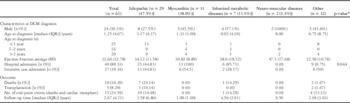
The overall mortality rate was 16.1% (n=10) (Table 2). The median age at death was 6.5 years and median time interval from the diagnosis to death was about 7.5 months (IQR 60.8 months). The mortality was significantly higher in patients under 1 year of age (32.0% versus 5.6%, p=0.006).
Characteristics at diagnosis and outcome of 61 patients with Dilated cardiomyopathy (DCM), by aetiology.

* The distributions of categorical variables by cause were compared using χ2 statistic
Analysing the outcome by the composite end-point of death and/or transplantation according to the aetiologies subgroups, the subgroup with a significantly better outcome was the myocarditis group, with no deaths or transplants registered (0% versus 30% in the remaining subgroups, p=0.036). The aetiological subgroup with higher mortality and/or transplantation, although not statistically significant, was the idiopathic subgroup (16.4% versus 8.2% in the remaining subgroups, p=0.079). Within inherited metabolic disease causes, only one patient died (Barth Syndrome patient) (Table 2).
In all, five patients underwent heart transplantation: two of them in other centres and three of them in our centre – an idiopathic form, a familial form and a left ventricular non-compaction disease; the median age at transplantation was 11.7 years. After 2 years of follow-up, no mortality was observed in transplanted patients.
Among not transplanted survivors, the median follow-up time from diagnosis of dilated cardiomyopathy was 35.5 months (IQR 51.3 months). Of those, 24.6% (n=15) maintained cardiac dysfunction despite pharmacological therapy and 36.1% (n=22) had normalisation of cardiac function.
Discussion
Dilated cardiomyopathy is an important cause of heart failure in children and, although a variety of aetiological factors have been investigated, a significant proportion of our patients with documented dilated cardiomyopathy did not have a demonstrable cause. In fact, almost half of our patients had an idiopathic form of dilated cardiomyopathy. In the literature, an idiopathic form of dilated cardiomyopathy is usually reported in about two-thirds to a half of the children.Reference Lipshultz, Sleeper and Towbin 1 , Reference Towbin, Lowe and Colan 4 , Reference Nugent, Daubney and Chondros 7
Viral myocarditis is an important, and often unrecognised, cause of dilated cardiomyopathy. The exact incidence of myocarditis is difficult to ascertain as the viral evaluation by polymerase chain reaction, although performed in most clinically suggestive cases, was not performed in all patients. Despite that, a high prevalence of Parvovirus B19 was observed in our population. In fact, the epidemiology of viral myocarditis has been changing in the past few decades. After 1995, as the prevalence of enterovirus decreased, the prevalence of adenovirus increased.Reference Bowles, Ni and Kearney 8 , Reference Schultz, Hilliard, Cooper and Rihal 9 More recently, Parvovirus B19 is reported as the most commonly detected viral genome. Whereas the pathogenic role of enterovirus and adenovirus in myocarditis and dilated cardiomyopathy is well established, the role of Parvovirus B19 is uncertain. Whether it is an incidental or a pathogenic agent in acute myocarditis is still unclear.Reference Kühl, Pauschinger and Seeberg 10 – Reference Kindermann, Kindermann and Kandolf 12
In our series, a significant proportion of cases caused by inherited metabolic diseases was identified, 11.5% of the cases when compared with the 4–6% described in the literature.Reference Towbin, Lowe and Colan 4 , Reference Cox 13 , Reference Wilkinson, Landy and Colan 14 This evidence is probably due to the high rate of metabolic diseases investigation. These data reinforce the importance of considering inherited metabolic diseases in the differential diagnosis of children presenting with dilated cardiomyopathy, as it is crucial to define prognosis. The ideal time to diagnose inherited metabolic diseases is obviously the neonatal period, before clinical manifestations, using newborn screening followed by confirmatory studies. However, as three of our patients had mitochondrial citopathies, not included in the neonatal screening, and long-chain acyl CoA dehydrogenase deficiency patients were born before the inclusion of the disease in the neonatal screening, the majority of our patients had identification of the metabolic disease in the aetiological study for dilated cardiomyopathy.
Recent population data from several groups have improved our understanding about the natural history of dilated cardiomyopathy. The Paediatric Cardiomyopathy Registry in North America showed a 5-year survival rate of 54% for dilated cardiomyopathy.Reference Wilkinson, Landy and Colan 14 The National Australian Childhood Cardiomyopathy Study showed 5-year freedom from death or transplantation of 63% for children with dilated cardiomyopathy.Reference Nugent, Daubney and Chondros 7 The predictors of survival for dilated cardiomyopathy vary considerably between series. The most consistent risk factors at diagnosis for subsequent death or transplantation are age, congestive heart failure, lower fractional shortening and ejection fraction and aetiology of dilated cardiomyopathy.Reference Towbin, Lowe and Colan 4 , Reference Feingold and Webber 18 , Reference Alvarez, Wilkinson and Lipshultz 19
In our study, age at diagnosis and aetiology were the most important prognosis factors. We observed that younger patients had worse prognosis: the younger the patient the greater the need for intensive care (p=0.009) and, additionally, patients under 1 year of age presented higher mortality (p=0.006). Aetiology also presented as an important prognostic factor. In fact, it is essential to establish the aetiology of dilated cardiomyopathy to determine the subsequent optimal management and more accurate prognosis. The idiopathic forms of dilated cardiomyopathy have a significant impact on morbidity and mortality in paediatric population. The overall prognosis of idiopathic forms tends to be poor, with a reported 5-year mortality rate in the literature of about 14–50%, from either sudden cardiac death or pump failure.Reference Lipshultz, Sleeper and Towbin 1 , Reference Nugent, Daubney and Chondros 7 , Reference Friedman, Moak and Garson 15 , Reference Arola, Tuominen and Ruuskanen 16 In our population, the mortality rate of this specific subgroup was of 24%, thus superior to overall mortality of 16.1%. The worse prognosis associated with idiopathic forms, in comparison to other causes of dilated cardiomyopathy, raises questions about its optimal management: should these patients go through a more exhaustive aetiological study or should they undergo heart transplantation sooner?
On the other hand, the outcome of viral myocarditis in children is superior. Studies have shown survival rates of between 75% and 100% for acute myocarditis in childhood.Reference English, Janosky and Ettedgui 17 In our patients, viral myocarditis resulted in no mortality or transplantation. This emphasises the benefit of knowing the diagnosis of myocarditis, as acute transplantation should be avoided, even if mechanical support is required. This will provide the opportunity for cardiac recovery, as well as minimise the risks of transplantation during recent or active viral infection.Reference Feingold and Webber 18
With regard to treatment, anticongestive agents, angiotensin-converting enzyme inhibitors and antiaggregant therapy were the most commonly used drugs. Pacemaker and ventricular assist device were rarely used. When acute heart failure is unresponsive to aggressive medical management, institution of mechanical circulatory support must be considered, sometimes as a bridge to transplantation.
Heart transplantation remains the main therapy for end-stage heart failure refractory to surgical and medical therapy in children. In the literature, current 1-year survival after heart transplantation in children is 85%; the overall survival rate 20 years after transplantation is 40%.Reference Hsu and Pearson 20 With a modest experience in paediatric heart transplantation, we report no mortality in patients who underwent transplantation, after 2 years of follow-up.
The present report reflects the reality of the referral network of our tertiary centre, representing an overview of paediatric dilated cardiomyopathy. The observational and retrospective nature of the study constitutes a limitation. The centralisation of paediatric tertiary services provides a great opportunity to examine the presentation and natural history of this rare condition. A comprehensive analysis of data obtained from different observational studies can expand our understanding about the natural history of dilated cardiomyopathy in the paediatric population.
Acknowledgements
None.
Financial Support
This research received no specific grant from any funding agency, commercial or not-for-profit sectors.
Conflicts of Interest
None.