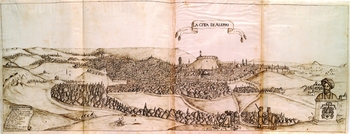
The Venetian nobleman Ambrosio Bembo (1652–1705) included this panorama of Aleppo by the French artist G.J. Grélot (see Figure 1), as one of the fifty-one carefully observed line drawings of cities, buildings, and people integral to his travelogue, proudly entitled Travels and Journal through Part of Asia during about Four Years Undertaken by Me, Ambrosio Bembo, Venetian Noble.Footnote 1 During his visits to Aleppo between 1672 and 1675, Bembo may have crossed paths with the great Ottoman traveler Evliya Çelebi (1611–82?), who included his own description of that commercial capital of the eastern Mediterranean in his monumental Seyahatname (Book of Travels).Footnote 2 Evliya's book does not include a single illustration. This divergence is emblematic of the distinct ways in which early modern societies (in this case, Middle Eastern and European) visualized cities and architecture, and highlights a major challenge to writing the architectural and urban history of the Middle East before the 19th century: the almost complete absence of images that represent architecture.
G. J. Grélot, Panorama of the city of Aleppo, from Viaggio e giornale per parte dell'Asia di quattro anni incirca fatto da ma Ambrosio Bembo Nobile Veneto (Travels and Journal through Part of Asia during about Four Years Undertaken by Me, Ambrosio Bembo, Venetian Noble). Venice, ca. 1676. James Ford Bell Library, University of Minnesota, Minneapolis, Ms. 1676 fBe, fol. 10–11.

In Renaissance European culture, the visual depiction of architecture, maps, and urban views constituted a significant art form. An urban panorama like Grélot's offers the illusion that a city is totally accessible and knowable visually. By contrast, sources on the city produced by Ottoman subjects such as Evliya from the imperial capital or from regional intellectual centers are almost entirely non-visual. Indeed, the history of vision in the medieval and early modern Middle East has a very different trajectory from that of its history in Europe. Locally produced early modern views of cities or buildings are exceedingly rare, despite the centrality of urban life in Islamicate culture. One exceptional example is Matrakçı Nasuh's topographical representation of Aleppo (1537–38), contained in a unique manuscript that recounts an Ottoman military campaign.Footnote 3 Texts on topics explicitly defined in spatial terms (such as historical topographies or biographical dictionaries of notables from a given city) frustrate the architectural and urban historian's quest in other ways as well. They take urban space and its social meaning as their subject, but they rarely discuss visual qualities in any detail or dwell on the aesthetic appreciation of buildings. Even legal documents that explicitly describe, record, and evaluate architecture, such as endowment deeds, widely used in architectural history, can be inaccurate or incomplete on occasion, or lack detailed visual information. The jurists who wrote them did not possess the vocabulary or knowledge of builders. Craftsmen belonged to another social class, and their modes of communication, both visual and linguistic, did not cross over to the literati, with few exceptions.
While architectural historians take architecture and urban space as their primary sources, they also rely on visual representations and textual discussions of buildings, cities, and landscapes. When architecture has not survived or has been altered, we reconstruct it from texts and images. We also turn to textual evidence to answer deeper questions about the relationship of people to their cities, the social experience of space, and early modern societies’ appreciation of cities and sights. The nature of the sources in the Middle East turns this task into a kind of detective story. How do we reconstruct the physicality of urban space in the absence of visual data?
The urban historian of the medieval and early modern Middle East must rely on an expanded field of evidence. We shift our sources as well as our questions. The same questions that are asked of European Renaissance cities cannot be easily asked of Middle Eastern Ottoman cities. In the absence of visual materials or architectural remains, art historical inquiry moves beyond the study of architectural form to include an analysis of the use and reception of the built environment; it shows how constructed spaces intersect with discursive spaces. Such inquiry draws inspiration from the social history of space, which maintains that space is not simply an environment in which social life takes place but a rather a medium through which social life is produced and reproduced. Less conventionally used sources, such as hagiographies, poems, and the productions of nondominant or marginal groups, make it possible to get at the social perception and use of space. Conversely, insights gained about social practice complicate the perception and interpretation of architectural remains—and even lead to hidden histories that the architecture may literally have covered over.
Grélot's panorama features on the left, to the city's northeast, a hill topped by cypress trees and a series of domes (marked with a Q): the dervish lodge of Shaykh Abu Bakr. By the 1670s, when the panorama was drawn, the lodge was one of Aleppo's most important Sufi institutions. As Evliya observed, it also served as the occasional residence, administrative center, and burial ground of Ottoman provincial governors. Closely associated with imperial power, the lodge was a popular attraction centered on the elaborate tomb of Abu Bakr (1503–83), where “[any] supplication . . . will be answered,” according to the mufti ʿUmar al-ʿUrdi (d. 1615).Footnote 4 Ostensibly, the saint's charisma and ability to bestow baraka long after his death prompted the development of the lodge and a suburban neighborhood. Yet during his lifetime, the saint had rejected society and its norms. He squatted in the wilderness on the city's fringe, adopting spectacular forms of antinomian behavior and consorting with wild animals and a ragtag band of followers who flaunted Islamic law, including its prohibition of alcohol and hallucinogens. How and why did a marginal mystical community evolve into a suburban center of power and pilgrimage, and what does this reveal about social space in the early modern Middle East?
The voluminous biographical literature that ʿulamaʾ devoted to Abu Bakr underscores his importance but does not provide a single visual representation of him. Before the advent of photography, the lodge's architecture is only documented through European views like Grélot's and some archival documents. As an art historian intent on reconstructing urban change, and faced with a lack of visual information, I turned to a broad variety of texts.Footnote 5 My most important sources turned out to be the mystical biographies of the saint and his followers, but not because they described places or buildings. Rather, reading the successive biographies of the same mystic produced by ʿulamaʾ between the late 16th and 19th centuries enabled me to track fluctuations in the saint's representation. I combed the texts’ repetitive anecdotes to locate the saint's miraculous acts and mapped them onto the city. Through a qualitative analysis of the biographies and the manner in which they deployed mystical episodes, I derived a sense of the social meaning ascribed to places: the built-up city as opposed to the wilderness at its edge, indeed an entire geography of alternative mystical sites and an upside-down world of antinomian dervishes. I was able to at least partially reconstruct the spatial practice of mystical groups and the specific development of the lodge. The dervishes devoted to the unruly saint eventually allowed themselves to be co-opted into the urban social network and in turn transformed their wilderness retreat into a settlement. Paradoxically, then, individuals who had rejected society and architecture pioneered urban development and made their way back into normative social life. This deep history of social and spatial practice became possible precisely because I did not have visual data. A methodological challenge became an opportunity to do something new. For even the intense visual access of the Venetian panorama stops short of revealing the troubled history of spatial use and reuse that became the focus of my own narrative of Aleppo.