Introduction
Respiratory distress is a condition in which the body’s oxygen requirement cannot be met due to insufficient ventilation or perfusion, and acute respiratory distress accounts for approximately 10% of paediatric emergency department admissions and 20% of hospitalisations. Reference Krauss, Harakal and Fleisher1 The most common cause of cardiopulmonary arrest in children is respiratory failure. Reference Vega, Kaur and Edemekong2 Although most respiratory diseases are moderate and self-limiting, children require rapid diagnosis and treatment in the emergency department. The most common pulmonary causes of acute respiratory distress are infection, asthma, bronchiolitis, anaphylaxis, foreign body aspiration, trauma or chest wall anomalies, interstitial disease, cystic fibrosis, and bronchopulmonary dysplasia, while the most common cardiac causes are congenital heart anomalies, acute decompensated heart failure, myocarditis, pericarditis, arrhythmia, shock, and cardiac tamponade. Reference Rotta and Wiryawan3
The physiologically inactive BNP fragment N-terminal (1–76) pro-brain natriuretic peptide has a low molecular weight of 8.5 kDa, is very stable in blood, and can easily be measured with commercial immunoassays. Reference Clerico, Passino, Franzini and Emdin4 The mechanisms of its release into and removal from the circulation are manifold. From a diagnostic point of view, its secretion from cardiomyocytes upon dilatation of the cardiac chambers, for example due to congenital or acquired heart diseases, and its elimination via kidneys are the most significant pathways Reference Clerico, Recchia, Passino and Emdin5 N-terminal (1–76) pro-brain natriuretic peptide is used in research as a marker of heart failure and has been used in the monitoring and treatment of heart failure in many studies. Reference Lin, Zeng and Jiang6–Reference Iacob, Butnariu, Leucuţa, Samaşca, Deleanu and Lupan9
Serum N-terminal (1–76) pro-brain natriuretic peptide concentrations may be used to assist in the differentiation between dyspnoea resulting from respiratory diseases and heart failure Reference Maisel, Krishnaswamy and Nowak10 and have been demonstrated to correlate with the severity of left ventricular) dysfunction and functional status. Reference Richards, Nicholls and Espiner11 Despite several studies demonstrating the significance of N-terminal (1–76) pro-brain natriuretic peptide as a biomarker for heart failure, its measurement is not commonly involved in the routine testing performed in children with cardiac disease. N-terminal (1–76) pro-brain natriuretic peptide is a reliable test to diagnose significant structural or functional cardiovascular diseases in children. Optimal cut-off values are different from adult values. Reference Law, Hoyer, Reller and Silberbach12
Our aim in this study was to use N-terminal (1–76) pro-brain natriuretic peptide to differentiate respiratory distress of cardiac and pulmonary origin in emergency room patients who have severe respiratory distress as assessed with the Pediatric Respiratory Severity Score and to investigate the role of N-terminal (1–76) pro-brain natriuretic peptide in the detection of patients with new-onset heart failure in the absence of an underlying congenital heart anomaly. We also aimed to determine N-terminal (1–76) pro-brain natriuretic peptide cut-off values in patients with respiratory distress to facilitate faster differential diagnosis and more effective treatment management.
Materials and methods
Study design
This prospective cohort study was conducted in the paediatric emergency department of Ege University between September 2017 and September 2019. Our paediatric emergency department is a tertiary centre and one of the largest paediatric emergency departments in the country. Ethics committee approval was obtained from the scientific research ethics committee of the Ege University Faculty of Medicine. The parents or caregivers of all participants were informed in writing and provided informed consent before inclusion in the study.
Patient selection
All children aged 0–18 years who presented to the paediatric emergency department due to severe respiratory distress were included in the study prospectively. A total of 47 patients with severe respiratory distress and 45 healthy children of similar age and gender distribution were included in the study. We excluded patients with respiratory distress due to nervous system damage (e.g., cranial trauma, central nervous system infection, hypotension), gastrointestinal causes (abdominal pain or distension-related hypoventilation), metabolic causes (diabetic ketoacidosis, intoxication, hyperthyroidism, hypothyroidism, hypocalcaemia, hyperammonemia), and haematological causes (decreased oxygen-carrying capacity for reasons such as deep anaemia, acute chest syndrome). Respiratory distress was assessed using Pediatric Respiratory Severity Score, and patients with Pediatric Respiratory Severity Score indicating severe respiratory distress (4–5 points) were included in the study. Reference Miyaji, Sugai and Asako13
Patient evaluation, data, and blood samples collection
Patient evaluation and data collections
The patients’ demographic characteristics, presenting complaints, clinical findings, and N-terminal (1–76) pro-brain natriuretic peptide levels were investigated. All patients underwent posterior-anterior chest X-ray for evaluation of lung involvement and were evaluated by an experienced paediatric emergency specialist. Left ventricular ejection fraction measurements were performed by a paediatric cardiologist using two-dimensional transthoracic echocardiography (Vivid E9, GE-Vingmed Ultrasound AS, Horten, Norway). The diagnosis of heart failure was made by an experienced paediatric cardiologist based on clinical, echocardiographic, and other biochemical parameters.
Blood sample collection
A venous blood sample (2 mL) was collected into an EDTA tube at admission to the paediatric emergency department and used to measure serum N-terminal (1–76) pro-brain natriuretic peptide concentration using a chemiluminescent immunoassay kit (Roche Diagnostics; Mannheim, Germany) and ElecSys 2010 analyser. Unlike BNP, N-terminal (1–76) pro-brain natriuretic peptide is stable in EDTA plasma for 3 days at room temperature or longer at 4 jC. The N-terminal (1–76) probrain natriuretic peptide (N-terminal (1–76) pro-brain natriuretic peptide) method is precise (CV V 6.1%), has a wide dynamic measuring range, is free from common interferences, and does not cross-react with BNP. Reference Yeo, Wu and Apple14
Analysers
Elecsys analyser is a fully automated analyser that uses a patented electrochemiluminescence technology for immunoassay analysis. It is designed for both quantitative and qualitative in vitro assay determinations for a broad range of applications. The Roche N-terminal (1–76) pro-brain natriuretic peptide is fully automated and will accommodate the testing of large numbers of clinical samples for assessing cardiac dysfunction. Daily internal quality control and monthly external quality control are carried out in our laboratory.
Definitions
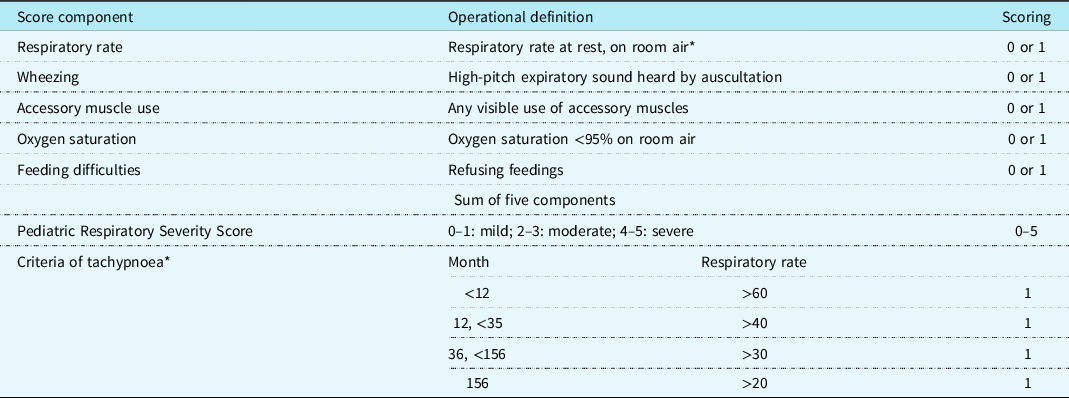
Respiratory distress was evaluated using Pediatric Respiratory Severity Score upon patients’ admission to the emergency department (Table 1). Pediatric Respiratory Severity Score of 0–1 was interpreted as mild, 2–3 as moderate, and 4–5 as severe respiratory distress. In patients with severe Pediatric Respiratory Severity Score, congestive heart failure score was calculated using the modified Ross Score. Ross scores of 0–4 were evaluated as mild, 5–8 as moderate, and 9–12 as severe heart failure. Reference Ross15
Pediatric Respiratory Severity Score scoring system

* Respiratory rate evaluated according to American Heart Association guideline.
Left ventricular ejection fraction was calculated by performing transthoracic echocardiography on the day of admission to the paediatric emergency department, by the same paediatric cardiologist, without knowing the patients’ N-terminal (1–76) pro-brain natriuretic peptide values. The same paediatric cardiologist evaluated the patients for concomitant congenital heart anomalies. Left ventricular ejection fraction was calculated using the Simpson method. The control group was detected by a paediatric cardiologist with transthoracic echocardiography and physical examination. No cardiac pathology was detected.
Statistical analysis
The data were analysed using SPSS version 21.0 (IBM Corp, Armonk, NY, USA). The Kolmogorov–--Smirnov test was used to test whether the data were homogeneously distributed. Comparisons of data from two independent groups were performed using Student’s t-test for homogeneous data and Mann–Whitney U-test for non-homogeneous data. The chi-square test was used to compare group ratios. Comparisons with p values <0.05 were considered statistically significant.
Receiver operating characteristic curve analysis was used to determine optimal NT-pro BNP cut-off values. The area under the receiver operating characteristic curve, sensitivity, specificity, positive and negative predictive values, and 95% confidence intervals were calculated for the cut-off values. A probability of ≤0.05 was considered significant.
Results
Demographics
This study included 47 children between the ages of 1 month and 14 years who were admitted to the Ege University Medical Faculty Pediatric Emergency Department with severe respiratory distress. In addition, 45 healthy children with similar age and sex characteristics who presented to the emergency department and had their N-terminal (1–76) pro-brain natriuretic peptide level assessed were included as the control group. The patient group comprised 21 girls (44.7%) and 26 boys (55.3%) with a mean age of 33.8 months (1 month–14 years). The control group comprised 22 girls (48.8%) and 23 boys (51.2%) with a mean age of 30.6 months (3 months–15 years).
Clinical findings
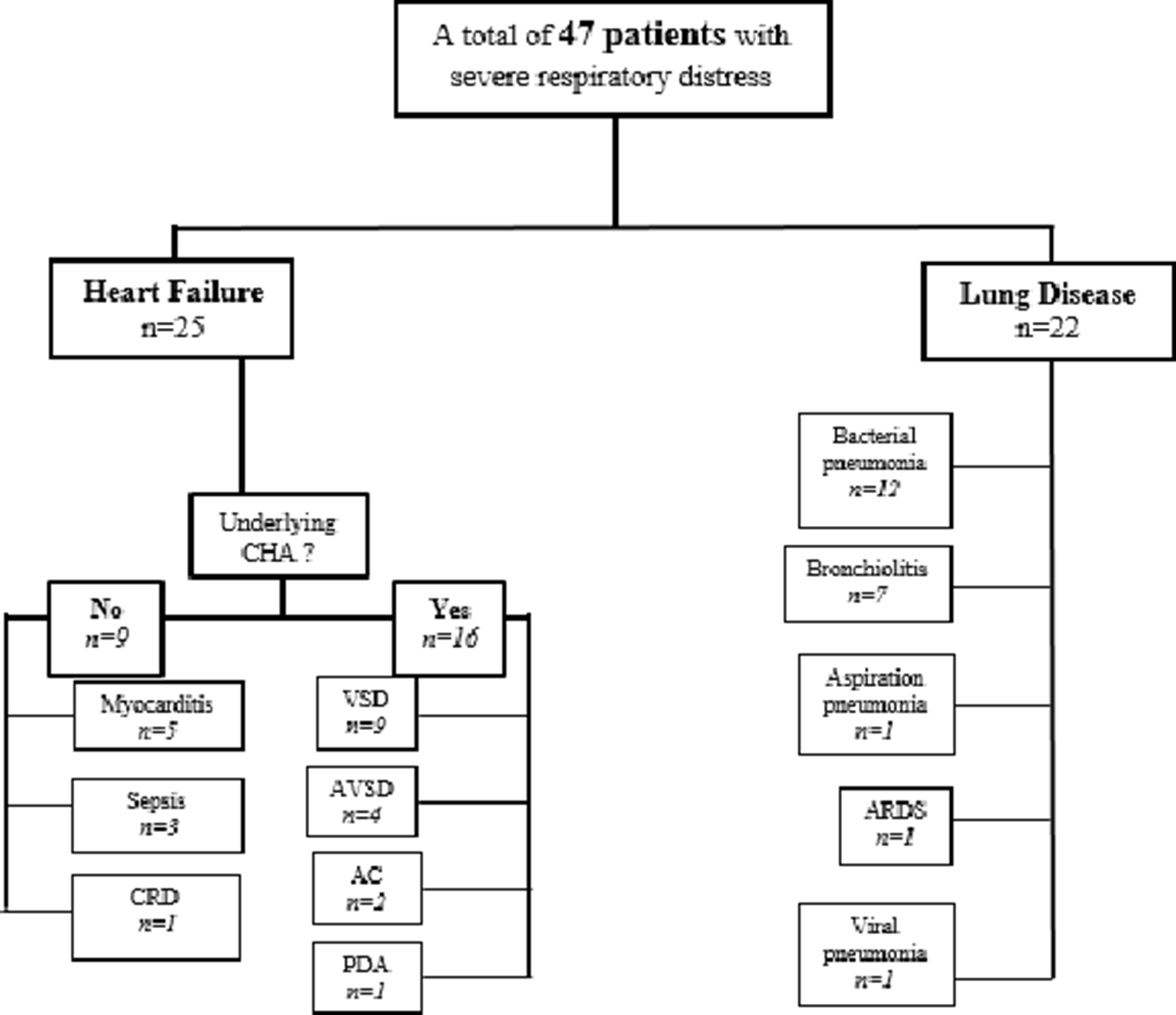
Of the 47 patients with respiratory distress, the aetiology was heart failure in 25 patients and lung disease in 22 patients (Fig 1). These lung diseases included bacterial pneumonia in 12 patients, bronchiolitis in 7 patients, aspiration pneumonia in 1 patient, acute respiratory distress syndrome in 1 patient, and viral bronchopneumonia in 1 patient. Sixteen patients in the group with heart failure had an underlying congenital heart anomaly (ventricular septal defect in 9 patients, complete atrioventricular septal defect in 4 patients, aortic coarctation in 2 patients, and large patent ductus arteriosus in 1 patient). Nine patients had new-onset heart failure due to myocarditis, chronic kidney disease, or sepsis, with no underlying congenital heart anomaly (Fig 1).
Distribution of patients enrolled in the study period. AC: aortic coarctation; ARDS: acute respiratory distress syndrome; AVSD: atrioventricular septal defect; CHA: congenital heart anomaly; CRD: chronic kidney disease; PDA: patent ductus arteriosus; VSD: ventricular septal defect.

N-terminal (1–76) pro-brain natriuretic peptide levels
The median N-terminal (1–76) pro-brain natriuretic peptide concentration was 5717 (IQR:16158) pg/mL in the 25 patients with severe respiratory distress due to heart failure, 8281 (IQR:8372) pg/mL in the 16 patients with underlying congenital heart anomalies, and 1983 (IQR:2150) pg/mL in the 9 patients without a congenital heart anomaly. In the 22 patients with severe respiratory distress due to lung pathology, the median N-terminal (1–76) pro-brain natriuretic peptide concentration was 437 (IQR:874) pg/mL. The 45 patients in the control group had a median N-terminal (1–76) pro-brain natriuretic peptide concentration of 47.2 (IQR:56.2) pg/mL. N-terminal (1–76) pro-brain natriuretic peptide level differed significantly between the heart failure group and the control group (p < 0.001) and respiratory distress patients in the heart failure and lung disease groups (p < 0.001).
Echocardiogram
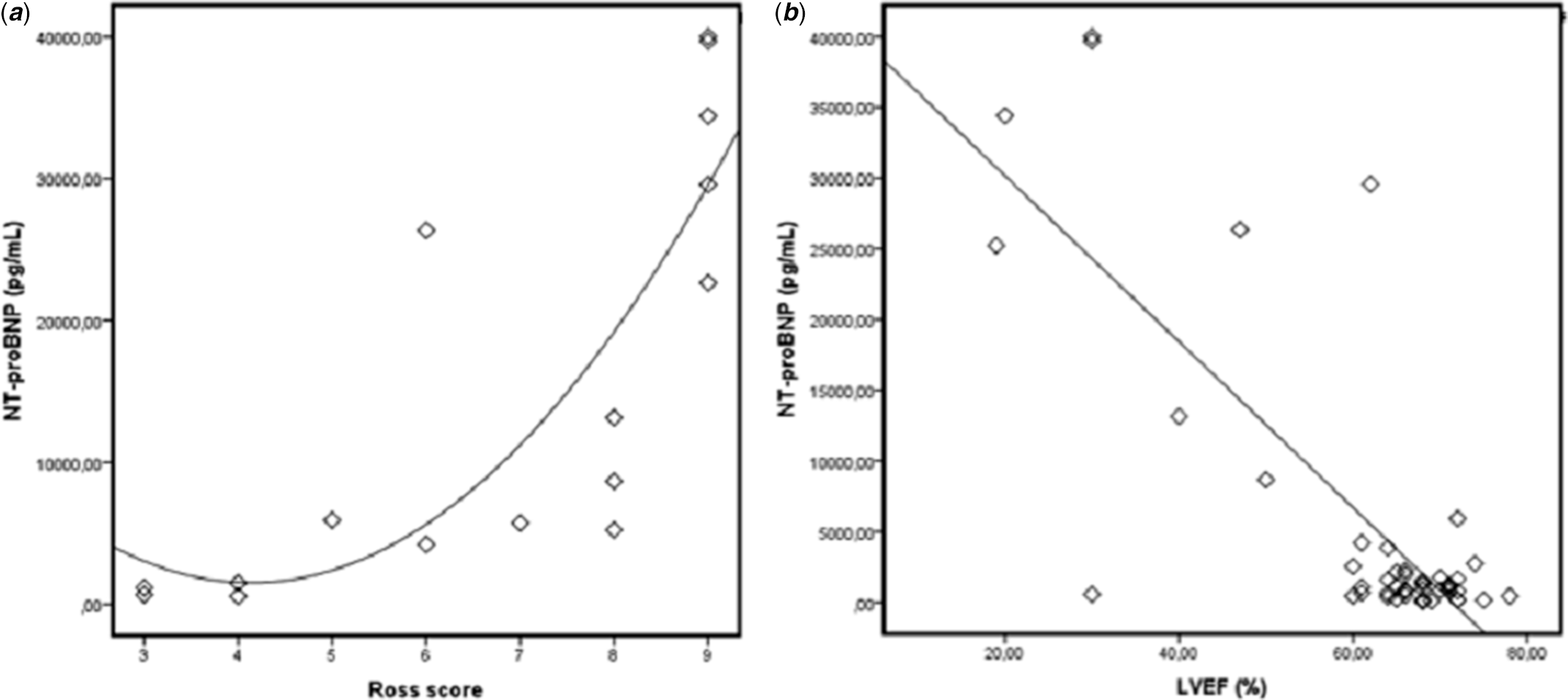
Left ventricular ejection fraction was evaluated from the patients’ echocardiograms using the Simpson method. The patients had minimum, maximum, and mean left ventricular ejection fraction values of 19, 78, and 61%, respectively. A negative correlation was detected between the patients’ left ventricular ejection fraction and N-terminal (1–76) pro-brain natriuretic peptide concentration (Fig 2b).
( a ) Modified Ross score was positively correlated with NT-proBNP level in patients with heart failure. ( b ) A negative correlation was detected between the patients’ LVEF and NT-proBNP concentration. LVEF: Left ventricular ejection fraction; NT-proBNP: N-terminal pro brain natriuretic peptide.

The sensitivity and specificity of N-terminal (1–76) pro-brain natriuretic peptide and modified Ross score
The N-terminal (1–76) pro-brain natriuretic peptide cut-off value to determine whether respiratory distress was of cardiac origin in the patient group was >1100 pg/mL. Using this cut-off, the sensitivity was 96% and specificity was 95.5%.
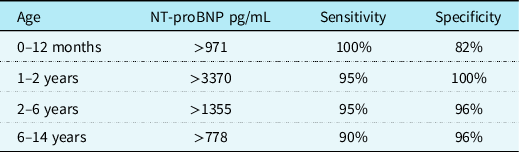
When N-terminal (1–76) pro-brain natriuretic peptide cut-off values to identify respiratory distress of cardiac origin (without differentiating by underlying congenital heart anomalies) were calculated according to age, the resulting values are shown in Table 2.
NT-proBNP cut-off values to identify respiratory distress of cardiac origin

NT-proBNP: N-terminal pro brain natriuretic peptide.
Modified Ross score was positively correlated with N-terminal (1–76) pro-brain natriuretic peptide level in patients with heart failure (p < 0.001, correlation coefficient: 0.809)(Fig 2a).
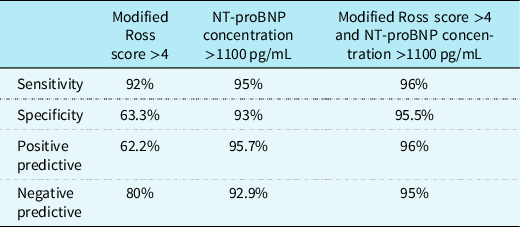
When only modified Ross score >4 was used as a marker of heart failure in the patient group, sensitivity was 92%, specificity was 63.6%, positive predictive value was 62.2%, and negative predictive value was 80%. When modified Ross score >4 and N-terminal (1–76) pro-brain natriuretic peptide concentration >1100 pg/mL were used as heart failure markers, sensitivity was 95%, specificity was 93%, positive predictive value was 95.7%, and negative predictive value was 92.9%(Table 3).
Sensitivity, specificity, positive predictive values, and negative predictive values of modified Ross score >4 and NT-proBNP concentration >1100 pg/mL, in the patient group

NT-proBNP: N-terminal pro-brain natriuretic peptide.
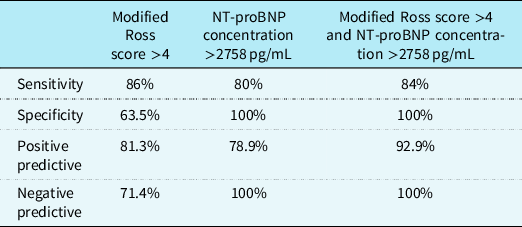
In patients with cardiac respiratory distress and congenital heart anomaly as the aetiology, an N-terminal (1–76) pro-brain natriuretic peptide cut-off value of >2758 pg/mL resulted in sensitivity of 80% and specificity of 100%. When modified Ross score of >4 and N-terminal (1–76) pro-brain natriuretic peptide concentration >2758 pg/mL were used in this subgroup, the sensitivity was 84%, specificity was 100%, positive predictive value was 92.9%, and negative predictive value was 100% (Table 4).
Sensitivity, specificity, positive predictive values, and negative predictive values of modified Ross score >4 and NT-proBNP concentration >2758 pg/mL, in the cardiac origin group

NT-proBNP: N-terminal pro-brain natriuretic peptide.
Outcomes
Of the patients with severe respiratory distress, 19 (40.4%) presented during the day shift and 28 (59.6%) during the night shift. Sixteen patients (34%) had high fever at admission. Thirty-three (70%) of the patients were given oxygen support via non-rebreathing mask. Eight patients (17%) were intubated and received invasive mechanical ventilation. Intravenous positive inotropic support was initiated in the emergency department for 7 (14.9%) of the patients with heart failure. The patients were monitored in the emergency department for a mean of 17 hours (1–96 hours). The mean length of hospital stay was 11.5 days (1.5–41 days).
Seven of the 47 patients with severe respiratory distress died, 4 due to congestive heart failure, 1 due to fulminant myocarditis, and 2 due to acute respiratory distress syndrome. N-terminal (1–76) pro-brain natriuretic peptide concentrations were significantly higher in patients with congestive heart failure compared to surviving patients (mean: 24,052 ± 24,160 pg/mL, p < 0.05).
Discussion
Respiratory distress is one of the most common causes of emergency department admissions. Reference Krauss, Harakal and Fleisher1 Although there are many causes of respiratory distress, it is most commonly of pulmonary or cardiac origin. Reference Khemani, Smith and Lopez-Fernandez16 The diagnostic criteria for heart failure are largely clinical, and several standardised diagnostic classification systems have been proposed. Reference Kirk, Dipchand and Rosenthal17 One of the scoring systems used to grade heart failure is the modified Ross score.
BNP and N-terminal (1–76) pro-brain natriuretic peptide are most frequently used for the diagnosis and risk assessment of heart failure in adults. Reference Clerico, Passino, Franzini and Emdin4,Reference McCullough and Kluger18 An age- and gender-independent upper limit of 300 pg/mL (ng/L) has been reported to rule out acute heart failure. Reference McCullough and Kluger18 In contrast to its well-established diagnostic power in adults, reference values for neonates, infants, and children are widely varying. Thus, so far, the clinical relevance of N-terminal (1–76) pro-brain natriuretic peptide for children is limited. Reference Cantinotti, Walters, Crocetti, Marotta, Murzi and Clerico19,Reference Smith, Goetze, Andersen and Vejlstrup20 Nevertheless, various indications of promising applications in children with congenital and acquired heart diseases were found. Reference Cantinotti, Walters, Crocetti, Marotta, Murzi and Clerico19 In order to identify pathological values, the knowledge and easy identification of reference intervals, however, are of crucial relevance.
Highest N-terminal (1–76) pro-brain natriuretic peptide concentrations were found within the postnatal period. Reference Mir, Laux and Hellwege21 During the first year of life, there is a rapid decline, followed by a slight but steady decrease in N-terminal (1–76) pro-brain natriuretic peptide concentration during childhood. Reference Albers, Mir, Haddad and Läer22 During adolescence, concentration converges to adult reference values at an age of approximately 18 years. Reference Nir, Lindinger and Rauh7
N-terminal (1–76) pro-brain natriuretic peptide dynamics, especially in the first year of life, may probably be attributed essentially to two main influencing factors: On the one hand, postnatal adaptation of fetal circulation with beginning perfusion of the lungs and resulting changes of intracardiac pressures causes a strong increase in secretion. Reference Cantinotti, Walters, Crocetti, Marotta, Murzi and Clerico19 Additionally, in children with congenital or acquired heart diseases, secretion of N-terminal (1–76) pro-brain natriuretic peptide by cardiomyocytes might even be greatly increased depending on the corresponding haemodynamics. Reference Holmgren, Westerlind, Lundberg and Wåhlander23 On the other hand, renal elimination plays an essential role. Reference Cantinotti, Walters, Crocetti, Marotta, Murzi and Clerico19 Immediately after birth, renal function is restricted and evolves with time, especially in the first months of life. Reference Lin, Tang, Wen, Chen, Zeng and Chen24
The 2012 revision of the Ross score included age-specific N-terminal (1–76) pro-brain natriuretic peptide values, with cut-off values determined for 0, 1, and 2 points. For patients aged 0–3 years, these were 0 points for <450 pg/mL, 1 point for 450–1700 pg/mL, and 2 points for >1700 pg/ml; for patients aged 3–18 years, these values were 0 points for <300 pg/mL, 1 point for 300–1500 pg/mL, and 2 points for >1500 pg/mL. Reference Ross15 In our study, we calculated age-specific N-terminal (1–76) pro-brain natriuretic peptide cut-off values.
In our study, N-terminal (1–76) pro-brain natriuretic peptide concentrations in the healthy control group were found to be normal according to the laboratory reference range (<133 pg/mL), whereas even if non-cardiogenic, patients with respiratory distress had N-terminal (1–76) pro-brain natriuretic peptide concentrations slightly higher than the laboratory reference range. When evaluated alone, detecting N-terminal (1–76) pro-brain natriuretic peptide concentrations higher than the cut-off value rather than slightly higher is clinically significant and can help avoid inappropriate treatments performed due to moderate elevations. In our study, patients with respiratory distress of cardiac origin had significantly higher N-terminal (1–76) pro-brain natriuretic peptide values than those with pulmonary aetiology (p < 0.05).
Treatment algorithms differ in cases of respiratory distress caused by lung pathologies and those caused by heart failure. For example, intravenous hydration is recommended for a patient presenting with bronchiolitis, while diuretic and fluid restriction is recommended for a patient with low EF secondary to myocarditis. A rapid differential diagnosis is critical in the emergency department. It is important to determine the cut-off values of the method used in developed treatment algorithms in order to minimise errors in treatment.
Lin et al. determined the N-terminal (1–76) pro-brain natriuretic peptide cut-off value for heart failure to be ≥598 ng/L in patients with a modified Ross score above 4. They found that children with non-cardiogenic respiratory distress and healthy children had normal N-terminal (1–76) pro-brain natriuretic peptide concentrations according to the laboratory’s reference ranges. Reference Lin, Zeng and Jiang6 Lin et al may have obtained a lower cut-off value in their study because they evaluated patients only according to the modified Ross score. In our study, patients were evaluated using Pediatric Respiratory Severity Score, and severe cases were included in the study. In another study by Lin et al, the N-terminal (1–76) pro-brain natriuretic peptide cut-off value was found to be ≥1268 ng/L in patients with sepsis and heart failure. Reference Lin, Tang, Wen, Chen, Zeng and Chen24 As the patient’s clinical condition worsens, N-terminal (1–76) pro-brain natriuretic peptide cut-off values increase.
In patients with cardiac respiratory distress and congenital heart disease in the aetiology, a N-terminal (1–76) pro-brain natriuretic peptide cut-off value of >2758 pg/mL had 80% sensitivity and 100% specificity. Studies have shown that patients with congenital heart disease have high N-terminal (1–76) pro-brain natriuretic peptide concentrations. Reference Butnariu, Iancu, Samaşca, Chira and Lupan25,Reference Zhou, Zhou and Tian26 In patients with congenital heart defects, basal N-terminal (1–76) pro-brain natriuretic peptide values were found to be high and were shown to be a post-operative prognostic indicator in patients requiring surgery. Reference Qu, Liang and Zhou27–Reference Lin, Zheng and Cui29 In our study, the high N-terminal (1–76) pro-brain natriuretic peptide cut-off values in the patient group with congenital heart disease supported the presence of ventricular strain associated with the heart defect and higher basal N-terminal (1–76) pro-brain natriuretic peptide concentrations compared to patients without cardiac defects. In this group, heart failure monitoring can be done by intermittent N-terminal (1–76) pro-brain natriuretic peptide measurement, with an increase from basal N-terminal (1–76) pro-brain natriuretic peptide concentration suggesting progression to heart failure. In patients with underlying congenital heart anomalies and new-onset lung pathology, an increase in basal N-terminal (1–76) pro-brain natriuretic peptide concentration can be expected.
In some cases, history-taking from the family of a critical patient presenting to the emergency department due to respiratory distress may not be possible. N-terminal (1–76) pro-brain natriuretic peptide concentrations can be used in cases where decisions must be made according to the patient’s clinical symptoms. As access to a paediatric cardiologist is difficult in most centres, it may help to decide which patients will be referred to advanced centres. Most of our patients presented during the night shift; if a specialist physician consultation is necessary for such a patient, elective rather than emergency cardiac evaluation can be planned if their N-terminal (1–76) pro-brain natriuretic peptide concentration is below the cut-off value. N-terminal (1–76) pro-brain natriuretic peptide level, which can now be assessed in nearly every centre, will help clinicians determine aetiology and will guide treatment.
Conclusion
Using scoring systems in combination with N-terminal (1–76) pro-brain natriuretic peptide cut-off values can help direct and manage treatment. In addition, elevated N-terminal (1–76) pro-brain natriuretic peptide concentration correlate with the patients’ clinical status. When making treatment decisions, N-terminal (1–76) pro-brain natriuretic peptide can be used to support the modified Ross score. Using N-terminal (1–76) pro-brain natriuretic peptide cut-off values in the approach to patients with respiratory distress in the emergency department will facilitate rapid and accurate treatment. Many studies today are seeking ways to avoid mistakes due to subjective decision-making. Identifying different cut-off values for patients with congenital heart disease can prevent more invasive and incorrect treatment.
Acknowledgements
The authors would like to express their sincere gratitude to all members who worked together to provide technical and writing assistance and to the departmental heads for their general support.
Financial support
This research received no specific grant from any funding agency, commercial, or not-for-profit sectors.
Conflict of interest
None.
Ethical standards
The authors assert that all procedures contributing to this work comply with the ethical standards of the relevant national guidelines on human experimentation and with the Helsinki Declaration of 1975, as revised in 2008, and has been approved by the institutional committees (Ege University 18/5-38).