Introduction
Major depression (MD) occurs about twice as often in women as in men, and this difference in prevalence emerges in puberty (Kessler, Reference Kessler2003; Oldehinkel & Bouma, Reference Oldehinkel and Bouma2011; Kuehner, Reference Kuehner2017). However, whether sex differences subsist after disease onset is unclear as findings concerning course of illness are inconsistent. While some studies found similar recurrence rates for both sexes (Kessler et al. Reference Kessler, McGonagle, Swartz, Blazer and Nelson1993; Gopinath et al. Reference Gopinath, Katon, Russo and Ludman2007; Mattisson et al. Reference Mattisson, Bogren, Horstmann, Munk-Jorgensen and Nettelbladt2007; Holma et al. Reference Holma, Holma, Melartin, Rytsälä and Isometsä2008; Hardeveld et al. Reference Hardeveld, Spijker, De Graaf, Hendriks, Licht, Nolen, Penninx and Beekman2013a, Reference Hardeveld, Spijker, De Graaf, Nolen and Beekmanb), other studies reported higher risk for females of recurrence (Mueller et al. Reference Mueller, Leon, Keller, Solomon, Endicott, Coryell, Warshaw and Maser1999; Eaton et al. Reference Eaton, Shao, Nestadt, Lee, Bienvenu and Zandi2008), chronicity (Bracke, Reference Bracke1998), readmissions for recurrent depressive episodes (Kessing, Reference Kessing1998) or contact at a psychiatric hospital for depression (Musliner et al. Reference Musliner, Munk-Olsen, Laursen, Eaton, Zandi and Mortensen2016).
In addition, systematic studies concerning sex differences in risk factors specifically for recurrence of MD are lacking. This is unfortunate as knowledge about sex differences in recurrence rates and the risk factors that are involved could contribute to the clarification of the etiology of MD (Rutteret al. Reference Rutter, Caspi and Moffitt2003; Oldehinkel & Bouma, Reference Oldehinkel and Bouma2011): differential effects of (genetic and environmental) risk factors such as comorbidity, family history or stressful life events in men and women might point to sex-specific mechanisms in the course of depression.
Second, establishing sex differences in risk factors for recurrence of MD could improve identifying individuals at high risk for progression to more severe courses of illness: if risk factors differ substantially between the sexes, general prediction algorithms might not be accurate for one or both of the sexes (van Loo et al. Reference van Loo, van den Heuvel, Schoevers, Anselmino, Carney, Denollet, Doyle, Freedland, Grace, Hosseini, Parakh, Pilote, Rafanelli, Roest, Sato, Steeds, Kessler and de Jonge2014). For these reasons, the aim of this study is to systematically investigate potential sex differences in rates and risk factors of recurrence of MD in a sample from the general population followed prospectively over time after reporting an episode of MD in the last year.
Methods
Samples
Data were used from a two-wave study of male–male and male–female twin pairs from the Virginia Adult Twin Study of Psychiatric and Substance Use Disorders (VATSPSUD), a population-based longitudinal study of male–male and male–female Caucasian twin pairs (Kendler & Prescott, Reference Kendler and Prescott2006). Previous studies showed that the VATSPSUD sample is broadly characteristic of the white population in the USA in demographic features and rates of psychopathology. Clinical features and heritability of MD in this sample is quite similar to that of other epidemiological data sets (Kendler & Prescott, Reference Kendler and Prescott2006). The study consisted of two interview waves. Initially, 6814 twins were interviewed, primarily by phone. At least 1 year later, these participants were recontacted and 5629 individuals (82.6%) participated in a follow-up interview, mostly face-to-face (for additional details about Methods, see online Supplementary File 1).
This analysis is based on 653 male and female twins who reported a DSM-III-R MD episode in the year prior to baseline interview and whose depression status in the year prior to follow-up interview was known. Due to the design of the study – based on birth registry identification of male–male and male–female twin pairs – this sample included more male participants (n = 427) than female participants (n = 226). To minimize recall bias with respect to reports on individual symptoms and time-varying life circumstances, we used reports of a depressive episode in the last year rather than lifetime. Of 6814 twins interviewed at baseline, 798 reported a MD-episode in the year prior to baseline interview, of whom 669 participated at follow-up. From these 669 twins, 16 were excluded who reported an interval ⩽60 days between the offset of their last MD episode at baseline and their first depressive episode during the follow-up, so as to focus on prediction of MD recurrence instead of chronicity.
To get accurate estimates of prediction accuracy, we randomly divided the males (n = 427) into a training sample (n = 277, 65%) and test sample (n = 150, 35%). The training sample was used to find an optimal prediction model, and the test sample was then used to evaluate its performance. If a prediction model is overfitting the training data (i.e. the modeling process capitalizes on ‘noise’ in the training data), the training data will give an overly optimistic estimate of prediction accuracy. Thus, independent test data are needed to obtain an estimate of the prediction accuracy and generalizability of the model (Hastie et al. Reference Hastie, Tibshirani and Friedman2009; James et al. Reference James, Witten, Hastie and Tibshirani2013). The female sample was not split into a training and test sample due to its smaller size (n = 226).
Assessment of MD and predictor variables
A diagnosis of MD in the year prior to baseline interview was based on the DSM-III-R criteria as assessed by the Structured Clinical Interview for DSM-III-R (29). Recurrence of a depressive episode was defined as the first reported episode meeting DSM-III-R criteria in the year prior to follow-up interview. Note that this definition of recurrence may both include relapses (full MD-syndrome after remission) and recurrences (full-MD syndrome after recovery) as defined by Frank et al. (Reference Frank, Prien, Jarrett, Keller, Kupfer, Lavori, Rush and Weissman1991). Time at risk for recurrence (follow-up) was defined as the interval between the offset of MD in the year prior to baseline interview and the onset of MD in the year prior to follow-up interview. Data were right-censored for subjects who did not report a recurrence of MD in the year prior to follow-up interview.
A total of 70 putative predictor variables classified into eight major risk domains were considered and included in the initial modeling. These predictor variables assessed different aspects of (1) characteristics of the depressive episode in the year prior to baseline, (2) current state, (3) psychiatric history, (4) family history, (5) personality, (6) early adverse life events, (7) recent adverse life events, (8) current social and economic environment. Online Supplementary File 1 includes a detailed description.
Missing data were relatively minor across the predictors and time to follow-up: on average 1.3% of values were missing (Online Supplementary Table S1). There were no missing values for our primary outcome measure recurrence of MD as participants with missing MD status at wave 2 interview were excluded. Missing values were imputed in one data set using Multivariate Imputation by Chained Equations (van Buuren & Groothuis-Oudshoorn, Reference van Buuren and Groothuis-Oudshoorn2011).
Statistical analyses
Model discovery
Since the primary interest in this study was to investigate potential sex differences among males and females in predictors of recurrence of depression, we performed the following analyses in the entire sample (n = 653), and in males (n = 277, training sample) and females separately (n = 226). Elastic net penalized regression analysis was used to identify an accurate multivariate prediction model from the rich set of investigated predictors (Friedman et al. Reference Friedman, Hastie and Tibshirani2010; Simon et al. Reference Simon, Friedman, Hastie and Tibshirani2011). Penalized linear regression methods utilize a penalty parameter controlling the selection and effect sizes of predictors. These methods aim to increase prediction accuracy and model interpretation by reducing overfitting, which make them appropriate for studies that examine large numbers of predictors such as the current study (Hastie et al. Reference Hastie, Tibshirani and Friedman2009; James et al. Reference James, Witten, Hastie and Tibshirani2013), or in genome wide association studies (Wu et al. Reference Wu, Chen, Hastie, Sobel and Lange2009).
Model assessment
We evaluated the prediction performance of the elastic net models to answer two questions: First, what is the expected prediction accuracy in new data? Second, do sex-specific prediction models outperform a general model in predicting recurrence of MD? To answer these questions, we compared prediction accuracy of the three prediction models (males, females, general) in the training samples with prediction accuracy of these models in different test samples of the same sex (for males) and of the opposite sex (for males and females). As described above, we could not create a same sex test sample for females due to the limited sample size.
Prediction accuracy of the models was assessed by estimating model discrimination and calibration (Steyerberg et al. Reference Steyerberg, Vickers, Cook, Gerds, Gonen, Obuchowski, Pencina and Kattan2010; Royston & Altman, Reference Royston and Altman2013). Discrimination was first assessed by averaging areas under the receiving operating characteristic-curve (AUC) for different time points in the training and test data (Heagerty & Saha-Chaudhuri, Reference Heagerty and Saha-Chaudhuri2013). Second, Kaplan Meier survival curves were used to compare cumulative recurrence estimates for different tertile risk groups based on linear predictor scores derived from the selected prediction models to get a general impression of both model calibration and discrimination (Royston & Altman, Reference Royston and Altman2013; Schloerke et al. Reference Schloerke, Crowley, Cook, Hofmann, Wickham, Briatte, Marbach and Thoen2014; Thernau, Reference Thernau2014).
Statistical interactions
Additionally, we examined interactions in the combined data of males and females (n = 653) as another way to identify possible sex-dependent differences in risk factors for recurrence of MD. We included all 70 predictors and their two-way interactions with sex in Lasso regression analyses (α = 1) and assessed which predictors were retained in the model with least prediction error (Friedman et al. Reference Friedman, Hastie and Tibshirani2010; Simon et al. Reference Simon, Friedman, Hastie and Tibshirani2011). We repeated this procedure 100 times in 80% bootstrapped samples. The sex-dependent two-way interactions that were retained ⩾50% of the times were analyzed using unpenalized cox regression analysis to assess their effect size and statistical significance (Thernau, Reference Thernau2014). All statistical analyses were performed in R (R Core Team, 2014).
Results
Baseline characteristics and rates of MD recurrence
The selected sample, 653 twins who reported a last year episode of MD, had a mean age of 35 years (s.d. 8.8). Sixty-one percent reported a history of MD prior to the index episode with a median of three prior episodes (mean 11.6). Many of the baseline characteristics were similar among men and women, such as most depressive and anxiety symptoms, impairment levels, and recent adverse life events (Online Supplementary Table S1). A few baseline characteristics were more often reported by men, such as feeling irritable and angry during the episode of MD in the past 12 months, problems with friends, being never married, a history of alcohol dependence and a higher number of lifetime traumas; the latter three remained significantly different after Bonferroni correction. Conversely, women more often reported appetite gain and fatigue during the episode of MD in the past 12 months, maternal MD, number of confidants, support from and problems with relatives and early-onset anxiety, childhood sexual abuse; the latter two remained significantly different after Bonferroni correction.
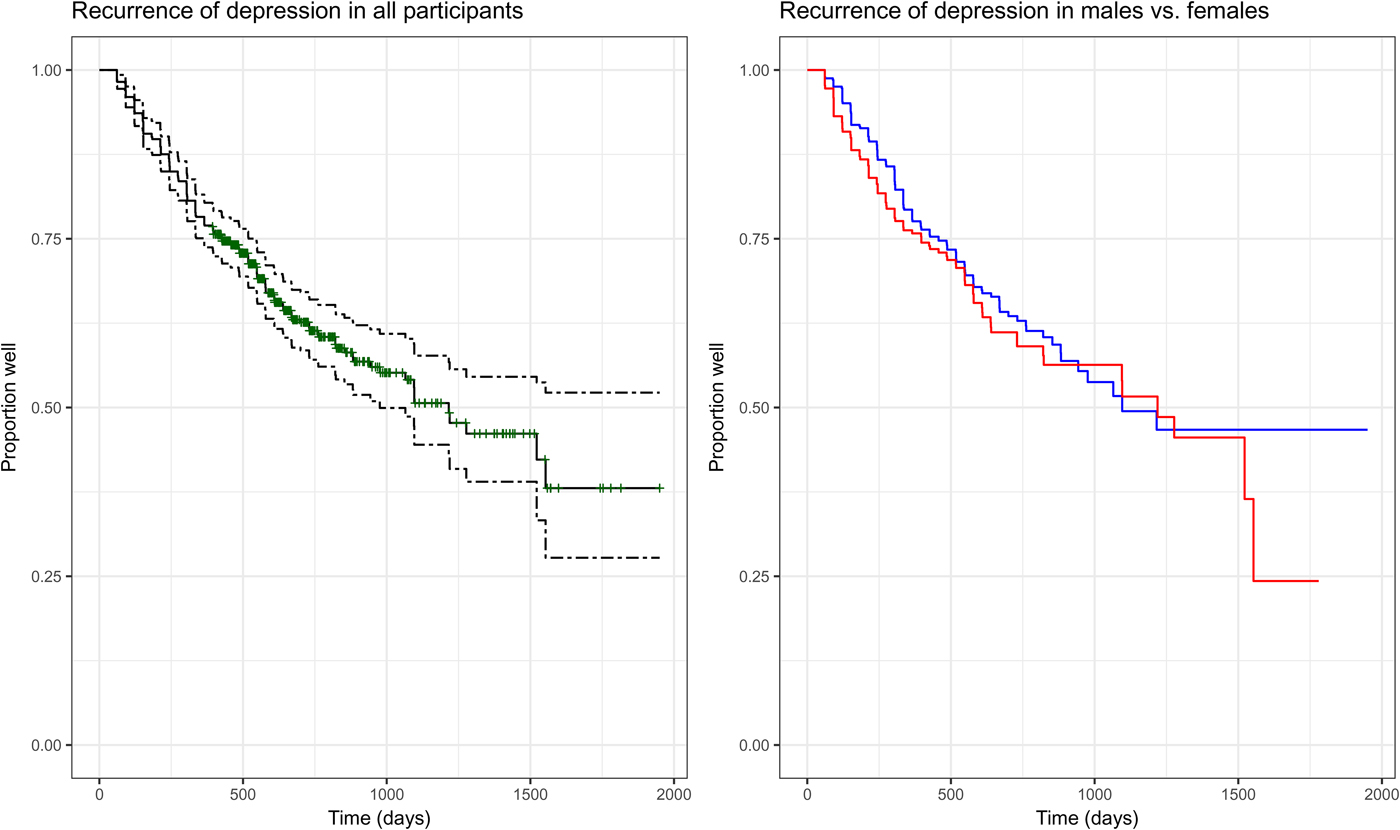
During follow up, recurrence rates were similar for men and women, without significant differences between the two survival curves (χ2 0.6, p value 0.43, Fig. 1). For the entire sample, Kaplan Meier cumulative recurrence risk estimates were 23% after 1 year (95% confidence interval (CI) 20–26), 38% after 2 years (CI 33–42), and 47% after 3 years (CI 41–53). This course approximates an exponential curve with higher percentages of recurrence in the first years (23 and 15% in years 1 and 2) after MD offset and lower percentages of recurrence rates in later years (9-7-8%, respectively in years 3-4-5).
Recurrence of MD during follow up. Left figure: Kaplan Meier estimated proportion of subjects without recurrence (n = 653, solid line) with confidence interval (dash-dotted line). Green marks indicate censored observations. Right figure: Kaplan Meier estimated proportion of subjects without recurrence in males (n = 427, blue line) versus females (n = 226, red line).

Predictors of recurrence in males and females
Consistent risk factors in the full sample
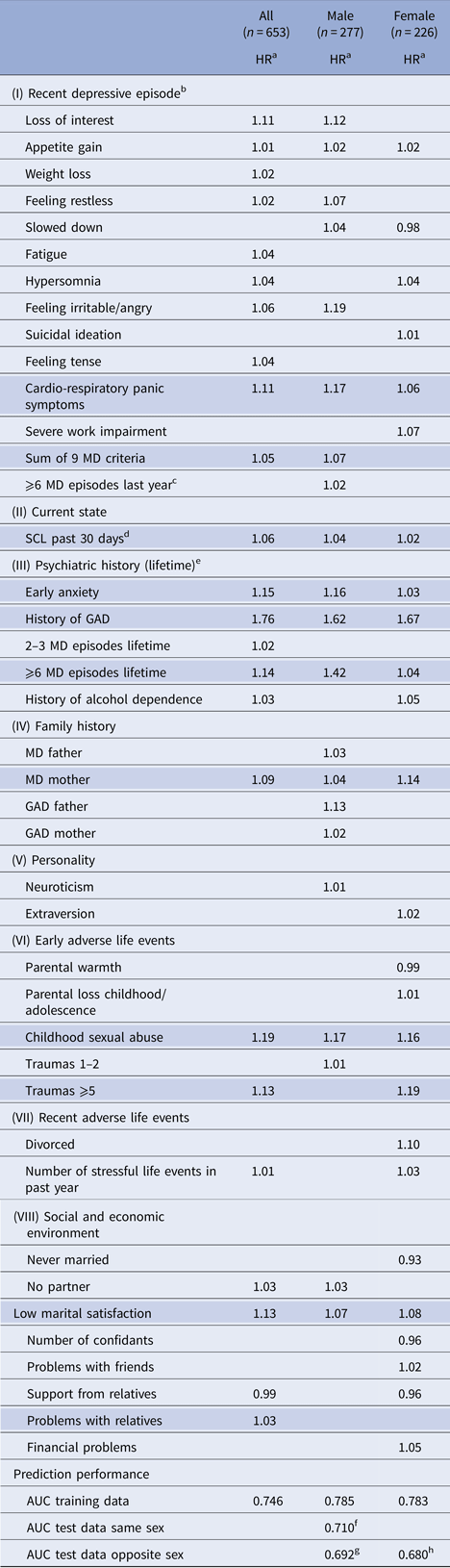
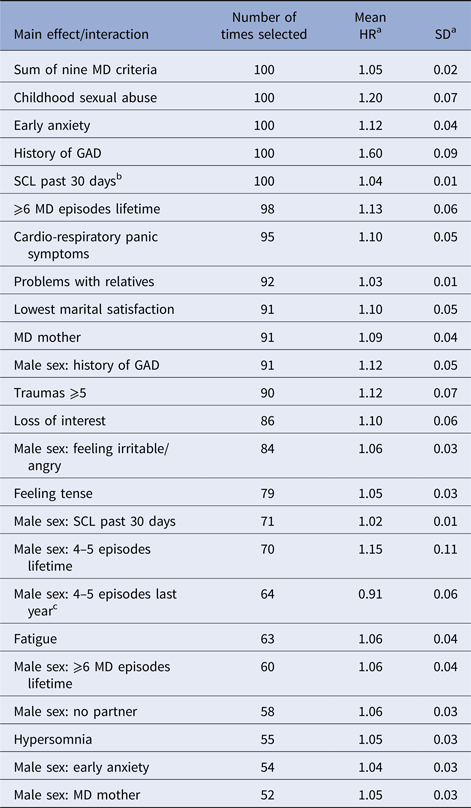
Eleven risk factors were consistently retained as predictors of recurrence in the elastic net models across different values of alpha (the regularization parameter) and as main effects in ⩾90 of the 100 Lasso models testing for sex-dependent interactions (Tables 1 and 2, Online Supplementary Table S3). They included predictors from six different domains: cardio-respiratory panic symptoms; the sum of nine MD criteria during the last depressive episode; the current level of internalizing symptoms (SCL past 30 days); a psychiatric history with ⩾6 MD episodes, early-onset anxiety and a lifetime diagnosis of GAD; a history of childhood sexual abuse and ⩾5 lifetime traumas; maternal MD; problems with relatives and low marital satisfaction. A history of GAD had the largest (penalized) effect size across all models. Sex was not included as a main effect in any of these models.
Predictors of recurrence in penalized multivariate Cox models

AUC, Area under the Receiver Operating Characteristic curve; GAD, generalized anxiety disorder; HR, hazard ratio; MD, major depression; SCL, symptom checklist.
Shaded rows indicate predictors that were selected ⩾90 out of 100 times in 100 Lasso Cox regressions using 100 different bootstrapped samples of the combined male and female data (n = 522, 80% of 653). Predictors were all 70 main effects and sex-dependent two-way interactions (see also Table 2).
a Penalized hazard ratios of all predictors for recurrence of MD with effect sizes ⩽0.99 or ⩾1.01 based on elastic net regression for alpha = 0.1 including all 70 (dummy) variables. Sex was included as a predictor in the model for all participants (n = 653) but not selected in the prediction model. Depressed mood was excluded as a predictor for the females due to too little variation (99% of the females reported depressed mood).
b Characteristics of episode in the year prior to baseline interview (MF1).
c Number of MD episodes lasting ⩾5 days in the last year (note that only for this predictor variable we used a shorter duration criterion than the 14 days indicated by the DSM-III-R).
d First principal component of depression and anxiety scales of the Symptom Checklist past 30 days.
e Lifetime: prior to last year (⩾1 year ago).
f AUC of the male-model in independent, same sex, test data (n = 150 male twins).
g AUC of the male-model in independent, opposite sex, test data (n = 226 female twins).
h AUC of the female-model in independent, opposite sex, test data (n = 427 male twins).
Main effects and sex-dependent interactions predicting recurrence of MD

GAD, generalized anxiety disorder; HR, hazard ratio; MD, major depression; SCL, symptom checklist; SD, standard deviation.
All predictors for recurrence of MD with effect sizes ⩽0.99 or ⩾1.01 in ⩾50 out of 100 Lasso Cox regressions using 100 different bootstrapped samples of the combined male and female data (n = 522, 80% of 653). Predictors were all 70 main effects and sex-dependent two-way interactions; the outcome was recurrence of MD during follow-up (survival data).
a Average penalized hazard ratios and standard deviations.
b First principal component of depression and anxiety scales of the Symptom Checklist past 30 days.
c Number of MD episodes lasting ⩾5 days in the last year (note that only for this predictor variable we used a shorter duration criterion than the 14 days indicated by the DSM-III-R).
Sex similarities
The elastic net prediction models for recurrence of MD in men and women showed substantial overlap (Table 1). In both sexes, elastic net regression models were highly multifactorial including at least one predictor from each risk domain. In total, 42 (61%) of the predictors were either excluded or retained with similar direction of effect in both models for men and women, whereas 27 (39%) predictors were selected for only one of the sexes or showed a different direction of effect in men or women.
The 11 most consistently retained risk factors in the entire sample (described above) were also included in the prediction models for both men and women, except for the sum of the nine MD criteria (only included in the model for men), ⩾5 lifetime traumas (only in women) and problems with relatives (not included in the models for men and women separately). Additional common predictors among men and women included appetite gain and psychomotor retardation, with the latter having an opposite effect in men (HR 1.04) and women (HR 0.98), although neither were retained as risk factors when analyzed in the entire sample.
Sex differences
The elastic net prediction models also indicated potential sex differences (Table 1). The model for males retained more risk factors concerning characteristics of the recent depressive episode and a family history of MD or GAD (12 v. 7 in males v. females), whereas the model for females favored more risk factors concerning early and recent adverse life events and socioeconomic indices (12 v. 4 in females v. males). A similar pattern emerged in elastic net models across increasing degrees of penalization (i.e. higher values of alpha, online Supplementary Table S3).
When analyzing potential sex differences using interactions of all 70 risk factors with sex in 100 Lasso regression analysis based on 80% bootstrapped samples, nine two-way interactions were retained in the prediction models ⩾50 times indicating potential sex differences for specific risk factors (Table 2). Only two of those interactions were statistically significant in unpenalized Cox regression models including main effects for sex, the predictor, and the interaction between these two: (1) the interaction between male sex and feeling irritable/angry (HR 2.2; CI 1.2–3.8, p value < 0.05) and (2) the interaction between male sex and 4-5 lifetime episodes of MD (HR 2.7; CI 1.01–7.25, p value < 0.05). These interactions indicated that feeling irritable/angry and 4–5 lifetime episodes of MD were stronger at predicting recurrence in men compared with women. The remaining seven sex-dependent interactions were not significant in unpenalized Cox regression models.
Prediction accuracy
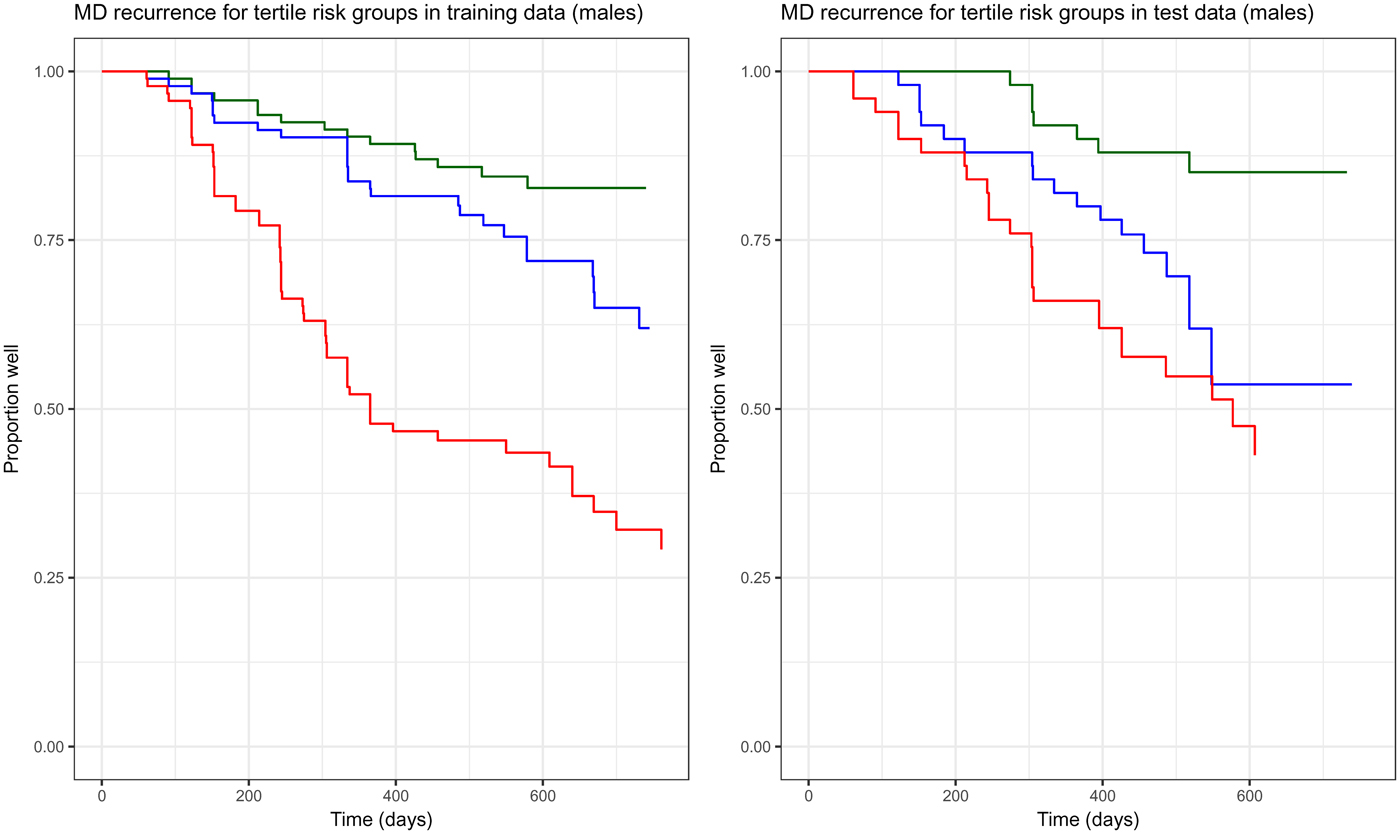
We examined the prediction accuracy of the final elastic net models for males and females by calculating AUC's and plotting KM-survival curves (Table 1, Fig. 2). First, we tested the overall prediction performance of the selected elastic net models by comparing prediction accuracy in the male training and test samples. As expected, the prediction model for males predicted MD-recurrence more accurately in the male training sample (AUC 0.785), than in the male test sample (AUC 0.710), but the differences were modest suggesting that the model did not substantially overfit to the training data. KM-survival curves showed that higher derived risk scores were associated with more recurrences in both training and test data (discrimination). Compared with males with lower risk scores, time to recurrence was significantly shorter in males with higher risk scores, in both training and test data (training data: χ2 61.3, p value 5·10−14; test data: χ2 14.1, p value 9·10−4). One year after the offset of the depressive episode, the cumulative recurrence estimates for the three risk groups based on tertiles of increasing predicted risk were 10.8% (CI 4.2–16.8), 17.4% (CI 9.3–24.8), and 52.2% (CI 40.8–61.4) in the training data. Comparably, in the test data, the cumulative recurrence estimates were 10.0% (CI 1.3–17.9) and 20.0% (CI 8.1–30.4) for the lower and intermediate risk score group, which indicated good calibration. The recurrence estimates were, however, substantially lower for the highest risk score group in the test data, viz. 32.0% (CI 19.5–45.9). In general, the KM-curves for the low risk group in both training and test data were very similar, indicating good discrimination and calibration for subjects with lower risk for depression. The KM-curves for the intermediate and high risk groups were more similar in the test data than in the training data, which indicated that the model was less well-calibrated for higher risk patients.
Recurrence of MD for different risk groups. Kaplan Meier estimated proportion of male participants without recurrence in different tertile risk groups in training sample (n = 277, left figure) and test sample (n = 150, right figure). Top line: males predicted in the lowest one third risk; middle line: males predicted in the intermediate one third risk group, lowest line: males predicted in the highest one third risk group.

Accuracy of the male and female models was also examined using opposite sex twin members to test for overlap in prediction between the sexes (Online Supplementary Fig. S1) and as an additional way of testing for overfitting (given that opposite sex subjects were independent test samples as they were not used during model discovery). Predicted relative risks of each subject based on the male and female models were highly correlated (Pearson's r = 0.8; Spearman rank-order r = 0.7). Prediction accuracy was slightly attenuated when the prediction models were applied to the opposite sex participants (male model in females: AUC 0.692; female model in males: AUC 0.680). Nevertheless, the three risk groups showed different KM-curves with significant more recurrences in the higher risk groups (female model in males: χ2 33.5, p value 5·10−8; male model in females: χ2 26.2, p value 2·10−6). This limited attenuation of prediction accuracy pointed to subtle sex differences, and the absence of highly overfitting prediction models.
Discussion
This study aimed to assess potential sex differences among a large set of risk factors for recurrence of MD. For both sexes, the prediction models for recurrence were highly multifactorial including risk factors from diverse domains, such as psychiatric history, early traumas and social and economic problems. Certain risk factors were consistently retained in all models: cardio-respiratory experiences of panic, the current level of internalizing symptoms, ⩾6 lifetime MD episodes, early-onset anxiety, history of GAD, maternal MD, childhood sexual abuse, and low marital satisfaction. We also found evidence for subtle sex differences: for men, many risk factors concerned characteristics of the recent depressive episode and family history of MD and GAD, whereas for women, many risk factors concerned early and recent adverse life events and socioeconomic environment. Specifically, feeling irritable/angry during the index depressive episode and a high number of lifetime MD-episodes were associated with higher risk for recurrence of MD in men than in women. However, sex differences were subtle as (1) most baseline characteristics and rates of recurrence were similar, (2) there was substantial overlap among risk factors for both sexes, (3) prediction accuracy in both sexes based on the opposite-sex prediction models was not substantially attenuated.
Relation to previous studies
Similar to most previous studies, we found identical rates of MD-recurrence for both sexes (Kessler et al. Reference Kessler, McGonagle, Swartz, Blazer and Nelson1993; Gopinath et al. Reference Gopinath, Katon, Russo and Ludman2007; Mattisson et al. Reference Mattisson, Bogren, Horstmann, Munk-Jorgensen and Nettelbladt2007; Holma et al. Reference Holma, Holma, Melartin, Rytsälä and Isometsä2008; Hardeveld et al. Reference Hardeveld, Spijker, De Graaf, Hendriks, Licht, Nolen, Penninx and Beekman2013a, Reference Hardeveld, Spijker, De Graaf, Nolen and Beekmanb). Two prospective studies reported (borderline) significantly higher rates of recurrence in women, but study samples were relatively small (n = 380 and n = 92 subjects, respectively) (Mueller et al. Reference Mueller, Leon, Keller, Solomon, Endicott, Coryell, Warshaw and Maser1999; Eaton et al. Reference Eaton, Shao, Nestadt, Lee, Bienvenu and Zandi2008); other studies assessed higher recurrence in women through readmissions or contact at a mental health care institutions (Bracke, Reference Bracke1998; Musliner et al. Reference Musliner, Munk-Olsen, Laursen, Eaton, Zandi and Mortensen2016), which could lead to over-representing females due to a higher help-seeking tendency (Rutter et al. Reference Rutter, Caspi and Moffitt2003).
This is the first study that systematically investigated gender differences across a large set of risk factors specifically for recurrence of MD, which complicates comparing our results with previous studies. The most comparable studies with date are two studies that were performed on different subsamples from the VATSPSUD data.
The first study used developmental structural equation models to find sex-differences in risk factors for MD occurrence in the last year in 1057 male–female twin pairs (Kendler & Gardner, Reference Kendler and Gardner2014). In this study 60% of the paths in the model differed between the sexes, in contrast to 61% overlap in the current study. Similar to the previous study, we found indications for the greater importance of interpersonal relationships for women (parental warmth, divorce, social support) and prior history of MD for men (4–5 lifetime episodes). However, we did not find that childhood sexual abuse and other stressful life events were stronger risk factors in males than in females – in our study these had equal impact for both sexes. These variations between the two studies could indicate that sex differences are subtle indeed, although these could also result from different study designs: the previous study used a different outcome measure (occurrence instead of recurrence), a different set of predictors (e.g. conduct disorder and drug abuse were missing in the current study whereas specific depressive and anxiety symptoms were missing in the previous study), and used different statistical models (structural equation modeling).
In the second study, similarly designed as the current study, we aimed to identify a prediction model for recurrence of MD in 194 female–female twin pairs. In this study in female twins only, we also found a multifactorial model with many risk factors from different domains contributing to risk of recurrence of MD (van Loo et al. Reference van Loo, Aggen, Chardner and Kendler2015). In total, 7 out of 11 most consistent predictors in this study were also retained as predictors in the former study (online Supplementary Table S2). Overall, the overlap between prediction models for females in the current and previous study was 59%. Of note, the overlap between predictors regarding characteristics of the recent depressive episode including all symptoms was low (32%), whereas the overlap among remaining predictors was higher (70%), which could indicate that episode characteristics such as depressive symptoms are not the most stable predictors for course of illness. Other explanations for the modest percentage of overlap across both female models could be that some predictors were differently assessed or missing in the current study (online Supplementary Table S2).
Strengths and limitations
The results of this study should be considered within the context of several limitations, of which the first four are described in more detail in our previous study (van Loo et al. Reference van Loo, Aggen, Chardner and Kendler2015).
First, the follow-up interview instructed participants to report on recurrences in the year prior to interview as opposed to recurrences over the entire period between baseline and follow-up interview. This might have resulted in an underestimation of the time to recurrence, despite our overall recurrence rates exceed previous estimates in the general population (Mattisson et al. Reference Mattisson, Bogren, Horstmann, Munk-Jorgensen and Nettelbladt2007; Eaton et al. Reference Eaton, Shao, Nestadt, Lee, Bienvenu and Zandi2008; Patten et al. Reference Patten, Wang, Williams, Lavorato, Khaled and Bulloch2010; Hardeveld et al. Reference Hardeveld, Spijker, De Graaf, Nolen and Beekman2013b).
Second, we studied a relatively small heterogeneous group of participants with regard to their longitudinal history of depression: some participants reported a first episode, but most reported a more extensive history of depression. Stratification of subjects based on number of lifetime episodes might lead to more accurate prediction models if risk factors have differential impact on course of illness in patients with a first episode than in patients with an extensive depression history (Kessing et al. Reference Kessing, Andersen and Mortensen1998; Kendler et al. Reference Kendler, Thornton and Gardner2000; Boschloo et al. Reference Boschloo, Schoevers, Beekman, Smit, van Hemert and Penninx2014). This stratification would be especially relevant when the impact of previous number of episodes would differ across men and women. Studies with larger sample sizes are needed to investigate, with sufficient power, potential sex differences in the relation between risk factors for MD recurrence, number of previous MD episodes and recurrence of MD.
Third, despite our rich set of predictors, certain potentially relevant predictors were not available, such as biological variables, chronic somatic diseases (Gerrits et al. Reference Gerrits, van Oppen, van Marwijk, van der Horst and Penninx2013), information on current treatment and prior treatment response (Gopinath et al. Reference Gopinath, Katon, Russo and Ludman2007), and workload and stress (Wang et al. Reference Wang, Patten, Currie, Sareen and Schmitz2012). We also did not study other outcomes of depression such as chronicity or suicide, which could be different for men and women (Bracke, Reference Bracke1998; Mattisson et al. Reference Mattisson, Bogren, Horstmann, Munk-Jorgensen and Nettelbladt2007).
Fourth, the identified model was relatively complex containing many predictors with different scales and often small effect sizes, which can complicate attempts to translate these findings into clinical practice.
Fifth, sparse prediction algorithms can be unstable, that is, different data sets might lead to selection of different predictor sets (Xu et al. Reference Xu, Caramanis and Mannor2012), which complicates model interpretation and comparison. We limited this instability by using different types of statistical analysis including elastic net regression (Zou & Hastie, Reference Zou and Hastie2005) for the discovery of sex differences, but new studies in larger samples are warranted to check for the robustness of the identified sex similarities and differences. In addition, in order to find the most accurate prediction models, other statistical learning methods should be explored, such as random forests, support vector machines or regression splines, and compared with the methods used here.
Sixth, the limited number of female twins in this study precluded testing the prediction accuracy of the female prediction model in an independent female test sample. New studies in independent test data from female samples are needed to reliably assess the prediction accuracy of the female prediction model.
Beside these limitations, this is the first study systematically investigating gender differences in risk factors for recurrence of MD by combining a very rich and diverse set of predictors in multivariate analyses aimed at maximizing prediction accuracy in a prospective general population sample. We used statistical methods specifically developed to deal with large sets of predictors and we tested our prediction models in independent test data.
Findings in perspective
Our study found that, for both sexes, recurrence rates were comparable, many risk factors had similar impact on recurrence of MD, and prediction models were highly multifactorial including multiple risk factors from diverse risk domains. What do these findings suggest about possible mechanisms influencing the course of depression and what is the importance for clinical practice?
First, the substantial overlap in the prediction models for men and women points in the direction that gender differences with respect to course of illness – aside from some subtle differences – are more likely to lie in differential risk factor exposure than in differential sensitivity to risk factors. For instance, women tend to be more exposed to sexual abuse than men (Kuehner, Reference Kuehner2017), but the impact of sexual abuse on course of MD might be equal for both sexes. For clinical practice, this is a relevant finding as it implies that most risk factors are as potent for men and women in the course of MD.
Second, some previous studies described gender differences in both risk factor exposure and impact for the onset of MD – e.g. with young women being more sensitive to stressful life events than young men (Piccinelli & Wilkinson, Reference Piccinelli and Wilkinson2000; Oldehinkel & Bouma, Reference Oldehinkel and Bouma2011). If there are indeed gender differences in the impact of risk factors before the onset of MD that disappear during the course of MD, then biological, psychological and cognitive changes might take place after MD onset, so-called ‘scarring’ (Wichers et al. Reference Wichers, Geschwind, van Os and Peeters2010), similarly operating in both sexes and moderating the course of MD (Kuehner, Reference Kuehner2017). However, sex differences with respect to the impact of risk factors for first-onset are not unequivocal (Stroud et al. Reference Stroud, Davila and Moyer2008; de Graaf et al. Reference de Graaf, ten Have, Tuithof and van Dorsselaer2013). Future studies are warranted to determine whether this is an accurate representation, to replicate the current findings in clinical samples, to study other potential risk factors and course of illness measures, and to investigate potential gender differences both in first-onset and course of illness to further clarify viable disease mechanisms.
Third, the broad and diverse set of risk factors included in the prediction models for recurrence of MD in both sexes supports the idea that the onset and course of MD depends on a complex interplay between biological, psychological, and environmental factors (Kendler, Reference Kendler2014; van Loo et al. Reference van Loo, Aggen, Chardner and Kendler2015). Given the multifactorial nature of the course of MD, it is likely that clinical risk assessments based on an extensive set of risk factors will outperform more narrowly targeted clinical risk assessments in differentiating patients with a higher v. lower risk for a severe course of illness. Furthermore, most insight in the course of MD can be expected to come from studies that focus on a broad set of risk factors across multiple levels rather than studies focusing on one or a few risk factors from a narrow set of domains.
Supplementary material
The supplementary material for this article can be found at https://doi.org/10.1017/S0033291717003178
Acknowledgements
This work was supported in part by grant MH49492 from the US National Institutes of Health. The Virginia Twin Registry is supported by grant UL1RR031990.
Declaration of Interest
None.