Implications
In a choice system, meat-type chickens exhibited a preference to be present and to consume feed under a light intensity of 20 lux compared to pens with light intensities with 5 and 10 lux. However, broiler chickens also congregated in an area with low light intensity (1 to 2 lux) and neither feed nor water. It is suggested that regulations requiring uniform light intensities for broiler chicken production might be reconsidered based on bird’s behaviour allowing opportunity to retreat between bouts of eating and drinking to areas with low light intensity.
Introduction
Light intensity influences other aspects of the physiology and behaviour of birds. For instance, young chickens exhibited more resting with longer periods and greater frequency, during the photophase with a light intensity of 5 lux compared to either 50 or 200 lux (Alvino et al., Reference Alvino, Blatchford, Archer and Mench2009). Turkeys reared under 1 lux showed lower aggression as indicated by injurious pecking than those at 10 lux (Lewis et al., Reference Lewis, Perry and Sherwin1998). Locomotory activity is also affected by light intensity with the level of activity of young meat-type chickens being lower when exposed to a light intensity of 5 lux compared to those at either 50 or 200 lux (Blatchford et al., Reference Alvino, Blatchford, Archer and Mench2009). Similarly, the activity of growing chicks was lower when exposed to dim red light compared to moderate red light (Prayitno et al., Reference Prayitno, Phillips and Stokes1997).
Environmental conditions employed for raising broiler chickens attempt to maximise production. There is evidence that performance of meat-type chickens is not optimal at light intensities below 1 lux and, hence, these are not employed by commercial poultry producers. For instance, broiler chickens at 0.1 lux exhibited greater mortality together with lower BW and feed intakes at day 14 compared to those raised 1, 5 or 10 lux (Deep et al., Reference Deep, Raginski, Schwean-Lardner, Fancher and Classen2013). Moreover, feed intake between days 14 and 35 was lower in birds on 0.5 lux compared to 1, 5 or 10 lux (Deep et al., Reference Deep, Raginski, Schwean-Lardner, Fancher and Classen2013). Similarly, greater growth rates in meat-type chickens have been reported in birds reared under 5 lux than 0.2 lux (Deep et al., Reference Deep, Schwean-Lardner, Crowe, Fancher and Classen2010; Reference Deep, Raginski, Schwean-Lardner, Fancher and Classen2013). In contrast, increased wing weights were reported for chickens reared under 0.5 or 1 lux compared to 10 lux (Deep et al., Reference Deep, Schwean-Lardner, Crowe, Fancher and Classen2010; Reference Deep, Raginski, Schwean-Lardner, Fancher and Classen2013). There are also reports that growth rates in meat-type chickens are lower in birds raised under light intensities of 25 lux than 5 lux (Olanrewaju et al., Reference Olanrewaju, Purswell, Collier and Branton2011). However, in other studies, there were no differences in either growth rate or immune functioning of meat-type chickens raised in chambers at 5, 50 or 200 lux (Blatchford et al., Reference Alvino, Blatchford, Archer and Mench2009) or between 0.1 and 100 lux (Newberry et al., Reference Newberry, Hunt and Gardiner1986). Moreover, there was no difference in the growth rate or of an indicator of stress, the heterophil:lymphocyte ratio, in chickens raised at either 1 or 10 lux (Lien et al., Reference Lien, Hess, McKee, Bilgili and Townsend2007).
There have been few studies where chickens have the choice of light intensities. Two-week-old chickens spent more time in a 200-lux environment while 6-week-old birds exhibited a preference for 6 lux when given a choice of environments with different light intensities (6, 20, 60 and 200 lux) (Davis et al., Reference Davis, Prescott, Savory and Wathes1999). However, the study employed the physiologically anomalous system of continuous lighting. Another report considered preferred light intensity for feeding in laying hens. When the birds had the choice of eating under <1 or 6 or 20 or 200 lux, they disproportionately favoured the high light intensity and consumed the least under the lowest light intensity (Prescott and Wathes, Reference Prescott and Wathes2002).
Lighting intensity can be a welfare issue in poultry. Continuous high-intensity light has been associated with eye problems including eye damage (Oishi and Murakami, Reference Oishi and Murakami1985) and increased intra-ocular pressure and blindness in chickens (Chui et al., Reference Chui, Lauber and Kinnear1975). Conversely, eye weights are increased at low light intensities being greater at 5 lux compared to 50 and 100 lux (Blatchford et al., Reference Alvino, Blatchford, Archer and Mench2009) and at 1 lux compared to 10, 20 and 40 lux (Deep et al., Reference Deep, Schwean-Lardner, Crowe, Fancher and Classen2010). However, it is not clear whether eye weights indicate a welfare issue or a physiological accommodation to low light intensity. Welfare issues have influenced regulations. The light intensity requirements for broiler (meat) production in the European Union are the following ‘All buildings shall have lighting with an intensity of at least 20 lux during the lighting periods, measured at bird eye level and illuminating at least 80% of the useable area’ (European Union, 2007). This directive uses the information available in a report of the European Commission (European Commission, 2000) in 2000. In the United Kingdom, there is an identical regulation (UK Government, 2007; DEFRA, 2018).
Despite the importance of light intensity to the well-being of broiler (meat-type) chickens and to regulatory and other controls, there is limited information of preferences of birds for different light intensities (Buyse et al., Reference Buyse, Simons, Boshouwers and Decuypere1996). For instance, it is not known whether young growing broiler chickens exhibit any preferences for light intensities used in the poultry industry. The present study employed a novel choice-type system to examine whether broiler chickens prefer environments with a light intensity of 5 or 10 or 20 lux.
Materials and methods
Study design
The study employed a choice-type design to examine whether broiler chickens prefer an environment/pen with a light intensity of 5 or 10 or 20 lux provided by incandescent lighting [25 w incandescent bulbs (Osram Sylvania, St. Mary, PA 15857)]. The 5 and 10 lux light intensities were achieved, in an iterative manner, by spraying the bulbs with black paint and measuring the resultant light intensities. The transit pens were illuminated by ambient lighting in the house but with the light intensity at bird level being 1 to 2 lux due reduction of light access by light-proofing materials around the pens.
Pen complex for choice study
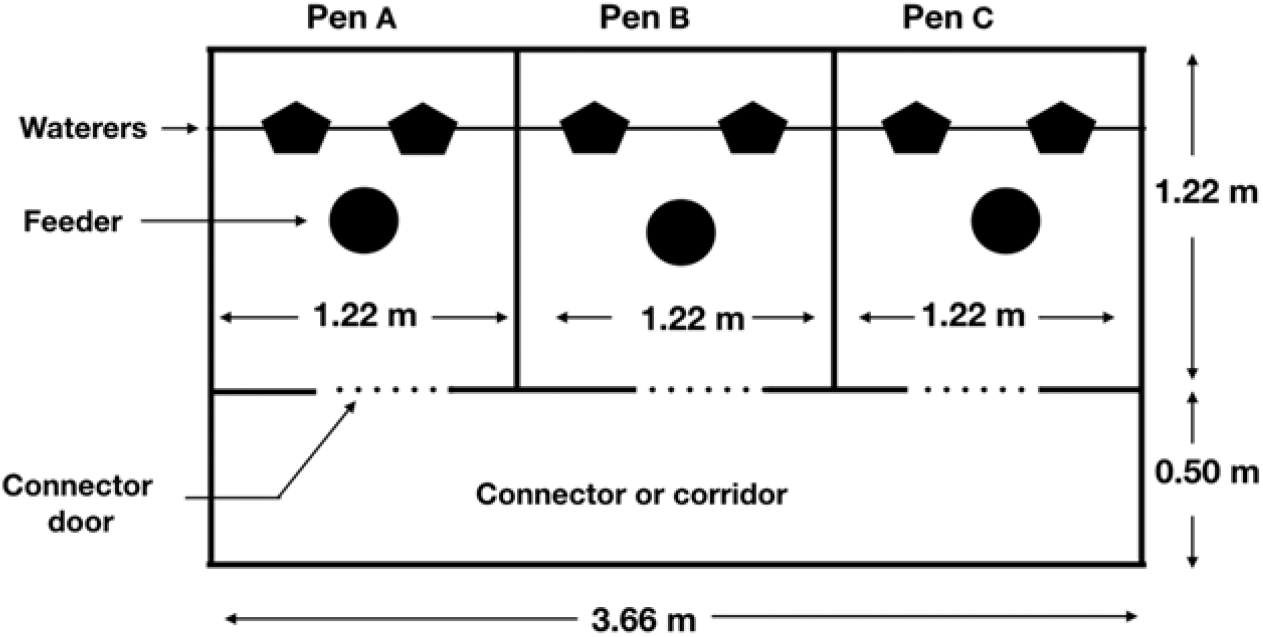
Each pen was 1.22 m x 1.22 m (area – 1.48 m2) and contained a hanging feeder (area 0.05 m2) and automated waterer. Three light-proofed pens were located side by side (see Figure 1) with heavy duty black plastic sheets (BARRACADE 6 – mil Plastic Sheeting,) attached to the sides but the tops open. The connecting corridor was 0.61-m wide and 3.66-m long (area – 2.23 m2) (see Figure 1). It was also surrounded by black plastic sheeting on the sides leaving the top open. The connecting corridor had doors (of hanging plastic sheeting) such that birds were free to move into the pens and, thus, between the pens. It did not contain either feeders or waterers. No light leakage was observed visually from the pens into the transit compartment. Overall the experimental (pen and connecting corridor) complex was 1.83 m by 3.66 m with an area of complex (6.70 m2). The floors of the pens and connecting corridor were deep litter composed of pine shavings.
System for choice studies with four light-proof pens. Pens A, B and C included both a feeder and a waterer. There were flaps that could be opened by the chickens between the connecting compartment and each of pen A, pen B and pen C.There were no doors between pen A and B or between pens B and C. There was no feeder or waterer in the connecting compartment.

The complexes were placed in the middle of a commercial poultry house. The temperature at litter level in the absence of birds was the same in each compartment of the pen complex. It is unlikely that there were difference in the ventilation in the pens or connecting area as both were surrounded by the same plastic sheeting.
Chickens
Cobb 500 broiler chicks were raised on fresh deep litter with a photoperiod of 18 h of light per day (18L:6 D) from placement (day 1) and access to a commercial feed and water available ad libitum prior to and throughout experimentation.
Experimentation
The two replicate choice studies examined the preference of broiler chickens to different light intensities and the data from these were combined in a single analysis. Figure 1 summarises the system employed in the choice study. The three pens (A, B, C) had light intensities of, respectively, 5, 10 and 20 lux while the light intensity of transit pen was 1 to 2 lux. Chicks (30 – 15 female, 15 male) were randomly placed in six choice systems at 2 days old and raised to 39 days old with a final average weight of 2.73 kg. To eliminate potential bias, the following arrangements were used: 5 (pen A – see Figure 1), 10 (pen B), 20 lux (pen C) for two choice systems, 10 (pen A), 20 (pen B), 5 lux (pen C) for two choice systems and 20 (pen A), 5 (pen B), 10 lux (pen C) for two choice systems. The experimental design and execution were approved by the University of Arkansas Animal Care and Use Committee.
Measures
Images of the pens showing the number of chicks present in pens A, B and C were taken using a GoProHERO 6 video camera (San Mateo, CA, USA) in time lapse mode with one frame per second at 38 days of age. The camera was manually placed and secured above the pens at the beginning of the photophase. The cameras were positioned such that birds in each pen and the transit compartment could be readily recorded. The number of birds in each pen was determined using 12 images at intervals of 5 min in each of the first and last hours of the photophase (respectively, periods 1 and 3) and 18 times randomly between hours 2 and 17 of the photophase (period 2). Numbers of birds were determined from the images by manual counting. Feed consumption was determined.
Statistical analysis
Numerical data from the six choice complexes were the units for analysis employing the mean numbers of chicks per pen over the specified time or bird density (number of birds per pen over the specified time per square metre. Data on feed consumption per day were analysed by two-way ANOVA [light intensity × trial] with means separated by the Tukey’s test. χ2 analysis was employed to verify that data were independent. However, data on chicken numbers were not independent between the pens with three light intensities and the transit compartment, there being a fixed number of birds. To address this, data were analysed in separate ANOVA comparing 1. bird number at the three light intensities and 2. bird number in the 20 lux pen and the transit compartment. In both cases, data were analysed by three ways ((pens/compartments) × trial with time of day as repeated measures). χ2 analysis was employed to verify that data in the three light treatments and between the 20 lux pen and the transit area were independent. Differences between time of day within a light intensity treatment were analysed by repeated measures ANOVA. Means were separated by the Tukey’s test. Regression analyses were performed with number of chickens per pen regressed against either light intensity and feed consumption per pen v. either light intensity.
Results
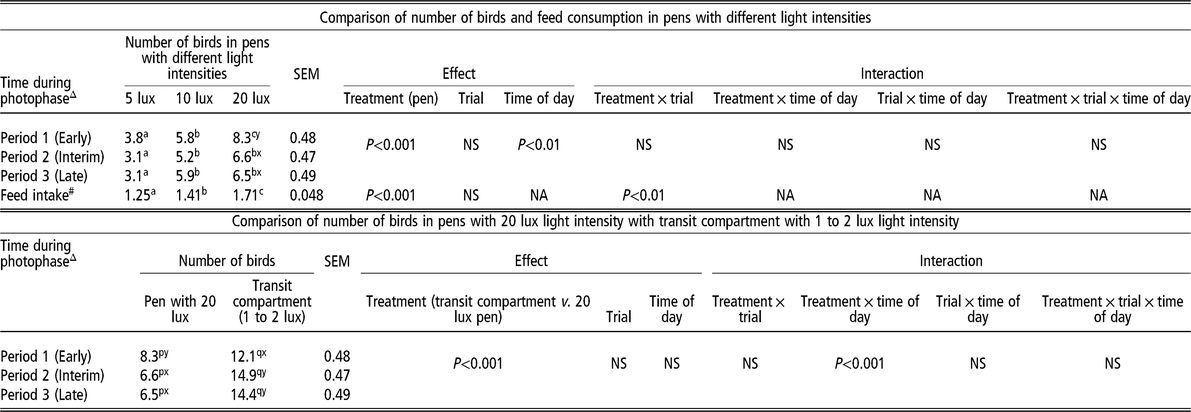
If broiler chickens had no preferences for light intensity, it would be predicted that they would distribute randomly between pens. However, this was not the case. There were more (P < 0.05) chickens in 20 lux pens compared to 10 lux and more (P < 0.05) in the 10 lux pens than the 5 lux pens (Table 1). The differences were evident at all time periods (Table 1). There was a positive relationship between bird number per and light intensity (adjusted R 2 = 0.693, P = 0.0033). There were more (P < 0.05) chickens in the 20 lux pens during period 1 than either period 2 or 3 and, as a corollary, fewer (P < 0.05) birds in the transit area. The “transit” area was well populated in all periods (Table 1).
Distribution of young chickens in pens with different light intensities in a choice study

NS = non-significant; NA = not applicable.
Data show mean number of birds in each pen (two trials each with n=6 units consisting of three pens and a connecting corridor/transit area).
a,b,c Values within a row (pens with different light intensities) with different superscripts differ P<0.05.
p,q Values within a row (comparing bird numbers in the 20 lux pen and the transit compartment) with different superscripts differ P<0.05.
x,y Values within a column(at different times of day) with different superscripts differ P<0.05.
# kg/pen per day.
Δ Period 1 was the first hour of the photophase, period 2 was at random times in hours 2 to 17 of the day and period 3 was the last hour of the photophase.
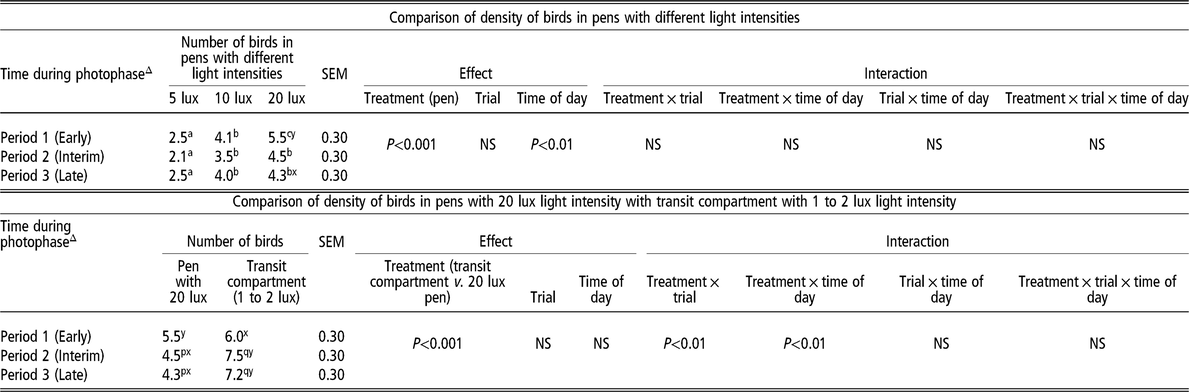
It might be expected that few birds would be present in the “transit” area due to the absence of either feeder or waterer. Instead, it was well populated with more birds than in the 20 lux pens during the three time periods examined (Table 1). However, the transit compartment was larger than the individual pens. When the number of birds was expressed per square metre, bird density in the transit area remained greater (P < 0.05) than in the 20 lux pens during periods 2 and 3 (Table 2). It might be argued that the area taken up by the feeders impeded chickens remaining in the pens. However, the area of the feeders is only 3.5% of the pen and, thus, their effect is minimal.
Density of young chickens (mean number per square) in pens with different light intensities in a choice- study

NS = non-significant.
Data shows mean number of birds in each pen (two trials each with n=6 units consisting of three pens with different light intensities and a connecting corridor/transit area).
a,b,c Values within a row (pens with different light intensities) with different superscripts differ P<0.05.
p,q Values within a row (comparing bird numbers in the 20 lux pen and the transit compartment) with different superscripts differ P<0.05.
x,y Values within a column (at different times of day) with different superscripts differ P<0.05.
Δ Period 1 was the first hour of the photophase, period 2 was at random times in hours 2 to 17 of the day and period 3 was the last hour of the photophase.
There were differences in feed consumption in the choice pen systems with different light intensities (Table 1). Feed consumption was greatest (P < 0.001) in the 20 lux compartment and lowest in the 5 lux pen in both studies 1 and 2 (Table 1). There was a positive relationship between feed consumption per day and light intensity (adjusted R 2 = 0.655, P = 0.0318).
Discussion
If there were no preference for light intensities, young chickens would be expected to distribute themselves randomly between the environments with feed and water available but different light intensities. In the present study, there was clearly a preference by the chickens for eating in the pens with the higher light intensity (20 lux) than at either 5 or 10 lux light intensities. This preference is not only supported by greater number and greater density of birds in the 20 lux pen (Tables 1 and 2) but also the elevated feed consumption in the 20 lux pens (Table 1). This is the first report that there is preference by broiler chickens for a higher light intensity, at least for expression of feeding behaviour. The present study was conducted at a single age. Further research is needed to determine whether this applies to other ages and whether broiler chickens prefer to drink at 20 lux. Similarly, laying hens favour eating at the high light intensities (Prescott and Wathes, Reference Prescott and Wathes2002).
Buyse and colleagues (Reference Buyse, Simons, Boshouwers and Decuypere1996) concluded the literature on light intensity and chickens was ‘inconsistent’. These present data suggest that light intensity is a stronger ‘driving force’ for chicken distribution than stocking density. There have been few consistent preference effects reported in choice studies in chickens (e.g. Senaratna et al., Reference Senaratna, Samarakone, Madusanka and Gunawardane2012; Reference Senaratna, Samarakone and Gunawardane2014). Two-week-old birds spent more time in the chamber with high illumination but only during the subjective night (e.g. Senaratna et al., Reference Senaratna, Samarakone and Gunawardane2014). In contrast, 4-week-old chicks spent more time under low intensity during the photophase (Senaratna et al., Reference Senaratna, Samarakone and Gunawardane2014).
It was initially thought that chickens would spend little time in the transit compartment due to the absence of either feed or water. Instead, it was considered probable that the chickens would be observed close to the feeders and waterers. However, this was not seen. What was unexpected was that young chickens seemed to congregate in the dimly lit transit compartment (1 to 2 lux) (see Tables 1 and 2). It might be suggested that chickens may move away from the areas where they feed/drink migrating to an area of low light intensity to rest. The present data of higher densities of birds in the transit area are consistent reports of behaviours of adult chickens; birds being farthest apart when walking and closest together when standing and preening (Keeling and Duncan, Reference Keeling and Duncan1991; Keeling, Reference Keeling1994). Similarly, laying hens favoured eating at the high light intensities (Prescott and Wathes, Reference Prescott and Wathes2002). The assumption that broiler chickens would locate close to feeders may be anthropomorphism or reflect an exaggerated view of how much time these birds spend eating. Broiler chickens were reported to spend only 4.7% of their time engaged in eating (Weeks et al., Reference Weeks, Danbury, Davies, Hunt and Kestin2000).
The higher densities of birds in the 20 lux pen and the transit compartment may reflect flocking and synchronisation behaviours. Adult bantam chickens spontaneously form cohesive flocks after mixing (Keeling and Duncan, Reference Keeling and Duncan1991). Moreover, synchronisation of feeding was reported in laying hens housed in pairs (Webster and Hurnik, Reference Webster and Hurnik1994). Similarly, in broiler chickens, there is evidence for synchronisation of feeding activities (Hughes, Reference Hughes1971; Collins and Sumpter, Reference Collins and Sumpter2007) and of dust bathing (Lundberg and Keeling, Reference Lundberg and Keeling2003). This has been interpreted as social facilitation (Collins and Sumpter, Reference Collins and Sumpter2007).
The density of birds in the 5 lux pen was markedly (84%) lower than in 1 to 2 lux transit compartment (Table 2). This again is unexpected were bird density to be a major ‘driving force’ for the distribution of young chickens. What appears to be occurring is that there is preference for eating at 20 lux (compared to 5 and 10 lux). This is consistent with a study where chicks were raised in an environment with graded light intensity and temperatures; they congregated in an area reported to be between 1 and 21 lux (Alsam and Wathes, Reference Alsam and Wathes1991). Moreover, based on the results of another choice study, it was concluded that in the study of 6-week-old chickens, chickens ‘prefer to spend much of their time in a light environment of < 10 lux intensity’ (Appleby et al., Reference Appleby, McRae and Pietz1983/1984). The preference for a higher light intensity (20 lux) compared to lower light intensities for feeding (Tables 1 and 2) parallels the results of earlier work.
There was a marked increase in the number of chickens in the 20 lux pens at the beginning of the photophase (Table 1). This early photophase increase in feed intake is consistent with a previous report determining changes in feed intake during the day (Buyse et al., Reference Buyse, Adelsohn, Decuypere and Scanes1993). There was very low feed intake during the scotophase followed by a large rebound increase in feed intake during the early photophase (Buyse et al., Reference Buyse, Adelsohn, Decuypere and Scanes1993).
Conclusions
The study provided evidence that the preference of meat-type chickens is for 20 lux (compared to 5 and 10 lux) light intensity for feeding and that feeding at 5 lux light intensity is the least preferred. In contrast, the meat-type chickens congregated at high densities away from feed and at low light intensities. It is argued that the requirements for resting and feeding are more complex than a simple minimum light intensity and density as set forth in regulations. This is analogous with the demonstration that the multiple aspects of broiler management are important to the welfare of the birds than does stocking density or overcrowding (Dawkins et al., Reference Dawkins, Donnelly and Jones2004). It is interesting to note that no discernible effects of stocking density were observed on the incidence of behaviours in young broiler chickens (Febrer et al., Reference Febrer, Jones, Donnelly and Dawkins2006).
The present results support a recommendation of at least 20 lux for the areas around the feeders and waterers and, further, suggest that light intensity may be reduced in other areas for resting and other activities.
Acknowledgements
The authors appreciate the assistance by the staff of the Applied Broiler Research Center at the University of Arkansas and financial support from the Division of Agriculture.
C. G. Scanes, 0000-0003-4543-143X
Declaration of interest
The authors had no conflicts of interests.
Ethics statement
Conceived and designed the experiments: MR, YVT, KC, DJA, CGS. Performed the experiments: MR, YVT, DJA, KC; analysed the data: MR, YVT, KC, DJA, CGS; wrote the paper: CGS, YVT, MR, DJA, KC. The experimental design and execution were approved by the University of Arkansas Animal Care and Use Committee.
Software and data repository resources
None of the data were deposited in an official repository.