Introduction
Pulmonary arterial hypertension (PAH) is a severe complication of CHD Reference Gatzoulis, Beghetti, Landzberg and Galiè1 with an estimated incidence of 5 to 10%. Reference van Riel, Schuuring and van Hessen2 Pulmonary arterial hypertension associated with CHD (PAH-CHD) is often caused by left-to-right shunting defects or obstructive left heart disease. Reference Diller, Kempny and Inuzuka3 Unfortunately, the management of PAH-CHD is challenging because of limited prospective registry studies in PAH-CHD, heterogeneity of the underlying CHD, and variability in pulmonary haemodynamics. The most recent update from the 6th World Symposium on Pulmonary Hypertension proposed updates in paediatric PAH epidemiology, including classification of PAH-CHD. Reference Rosenzweig, Abman and Adatia4,Reference Simonneau, Montani and Celermajer5 CHD with left-to-right shunts has been classified in group 1.4.4 “Congenital heart disease”, including patients with operable and inoperable CHD, Eisenmenger syndrome and post-operative cardiac defects. Pulmonary hypertension with complex CHD is categorised in group 5.4 “Complex CHD”, including patients with segmental pulmonary hypertension and unoperated or operated single ventricle. Reference Dimopoulos, Diller and Opotowsky6,Reference Yasuhara and Yamagishi7 Patients with single ventricle physiology remains a difficult group to define as these patients have variable pulmonary blood flow at different stages of palliation and have a wide range of pulmonary vascular disease after the Fontan procedure. Reference Ridderbos, Wolff and Timmer8 PAH has a direct impact on morbidity and mortality in these various types of CHD patients. Thus, an appropriate pulmonary hypertension therapy is crucial to improve the quality of life and prognosis in patients with PAH-CHD.
There are four groups of pulmonary vasodilators as targeted therapies for PAH, including endothelin receptor antagonists, phosphodiesterase type 5 inhibitors, prostacyclin analogues, and soluble guanylate cyclase stimulators. Reference Galiè, Humbert and Vachiery9,Reference Galiè, Humbert and Vachiery10 The use of targeted pulmonary therapies is based on the data extrapolated from studies in PAH patients and data on the comparison of pulmonary vasodilators in the different setting of PAH-CHD are lacking. Most studies on the use of pulmonary vasodilators in PAH-CHD have been published for adult Eisenmenger syndrome. Reference Galiè, Beghetti and Gatzoulis11–Reference Gatzoulis, Landzberg and Beghetti14 In patients with Eisenmenger syndrome, bosentan, and macitentan, the dual endothelin receptor antagonist, as well as sildenafil and tadalafil, phosphodiesterase type 5 inhibitors, have been demonstrated to improve exercise capacity and haemodynamics. Despite the small number of patients, several studies have been reported on the efficacy of pulmonary vasodilators such as bosentan, sildenafil, tadalafil selexipag, and riociguat in corrected or uncorrected CHD patients with PAH. Reference Rosenkranz, Ghofrani and Beghetti15–Reference Beghetti, Channick and Chin19 In addition, beneficial haemodynamic effects as well as improvements in markers of exercise capacity have been reported in patients with Fontan circulation on bosentan, ambrisentan, and sildenafil. Reference Giardini, Balducci, Specchia, Gargiulo, Bonvicini and Picchio20–Reference Hill, Maharaj, Li, Thompson, Barker and Hornik24 However, studies comparing the efficacy of different pulmonary vasodilators in each type of PAH-CHD are scarce. Furthermore, the selection of the appropriate pulmonary vasodilators for this population with different haemodynamic characteristics remains controversial. Herein, we aimed to improve the quality of life and reduce risk for adverse outcomes in PAH-CHD patients and thus conducted a network meta-analysis to compare the safety and efficacy of various pulmonary vasodilators in PAH-CHD.
Materials and methods
Search strategy
The current network meta-analysis is reported in compliance with the Preferred Reporting Items for Systematic Reviews and Meta-Analyses (PRISMA) guidelines. Reference Liberati, Altman and Tetzlaff25 All studies that investigated the impact of pulmonary vasodilators on efficacy and safety outcomes in patients with PAH-CHD were identified using a two-level search strategy. First, PubMed and EMBASE were searched comprehensively from inception to May 16, 2022 using web-based search engines. Second, relevant studies were identified through a manual search of secondary sources including references of initially identified articles, reviews, and commentaries. All references were downloaded for consolidation, elimination of duplicates, and further analyses.
The search terms included pulmonary hypertension OR pulmonary arterial hypertension OR PH OR PAH, congenital heart disease OR congenital heart defects OR CHD, endothelin receptor antagonist OR ERA OR bosentan OR ambrisentan OR macitentan OR phosphodiesterase-5 inhibitor OR PDE-5 inhibitor OR sildenafil OR tadalafil OR prostacyclin analogue OR selexipag OR soluble guanylate cyclase stimulator OR riociguat. Two independent and blinded authors (J.Y. and T.K.) reviewed the search results separately to select the studies based on the inclusion and exclusion criteria. Any discrepancies were resolved by discussion and consensus.
Inclusion and/or exclusion criteria
Studies which met the following criteria were included: (1) the study was published in peer-reviewed journals, (2) the design was a comparative study of patients with PAH-CHD who received different pulmonary vasodilators or placebo/no pulmonary vasodilators; and (3) the study reported either 6-minute walk distance (6MWD), NYHA functional class, N-terminal pro-brain natriuretic peptide (NT-proBNP), mean pulmonary arterial pressure, pulmonary vascular resistance, or oxygen saturation measured by pulse oximetry (SpO2) as efficacy outcomes at baseline and follow-up time point. No restriction to publication language was applied.
Outcomes
The primary efficacy outcomes were mean difference of changes in 6MWD, NYHA functional class, and NT-proBNP from baseline to follow-up, which were included as main parameters in comprehensive risk assessment in the most recent 2022 ESC/ERS Guidelines. Reference Humbert, Kovacs and Hoeper26 The secondary efficacy outcomes included mean difference of changes in haemodynamic parameters such as pulmonary vascular resistance (dynes·sec·cm−5 = Wood units × 80) and mean pulmonary arterial pressure as well as SpO2 to evaluate the efficacy of different pulmonary vasodilators. Changes in these parameters were measured from baseline to follow-up. Mean difference was calculated as the difference in mean values between the specified follow-up and baseline. In addition, adverse events and side effects were extracted to assess the safety outcomes of pulmonary vasodilators, including death, clinical worsening, and any symptoms. We investigated bosentan versus ambrisentan versus macitentan versus sildenafil versus tadalafil versus selexipag versus riociguat versus combination of bosentan and sildenafil versus placebo or no pulmonary vasodilators since these medication and combination were previously studied. Other parameters extracted were author, number of patients, age, sex, follow-up period, type of CHD, and comorbidities. Disagreements regarding the extracted data were resolved through discussion and consensus of a third author (H.T.).
Risk of bias assessment
To assess the risk of bias, we used the Cochrane Collaboration risk of bias tool for randomised controlled trials Reference Higgins, Altman and Gøtzsche27 and the Newscastle–Ottawa Assessment Scale for observational studies. Reference Stang28 A publication bias was assessed by Egger’s test and Funnel plots. Reference Egger, Davey Smith, Schneider and Minder29 Two investigators (J.Y. and T.K.) reviewed the studies and judged selection, comparability, and outcomes.
Statistical analysis
For each study, the adjusted hazard ratio and associated 95% confidence interval were extracted. The mean difference of change in mean mean pulmonary arterial pressure, pulmonary vascular resistance, SpO2, 6MWD, NYHA functional class, and NT-proBNP levels between treatment arms were synthesised for comparison. Considering the potential heterogeneity among the included studies, the effect estimate was pooled using the random-effect model for the analysis. We performed a network meta-analysis using R “netmeta” 3.6.2 package (R Foundation for Statistical Computing, Vienna, Austria). Reference Neupane, Richer, Bonner, Kibret and Beyene30 Within the framework, I 2 and Q statistics, which represent the proportion of total variation in study estimates that is due to heterogeneity, were used to quantify heterogeneity. Reference Rücker31 The I 2 statistic represents the proportion of variability that is not attributable to chance. I 2 values were interpreted as follows: <25% indicating low, 25–50% moderate, and >50% high heterogeneity. Reference Higgins, Thompson, Deeks and Altman32 The Q statistic is the sum of a statistic for heterogeneity, and a statistic for inconsistency, which represents the variability of treatment effect between direct and indirect comparisons at the meta-analytic level. Potential publication bias was assessed by the Funnel plots and Egger’s linear regression test. Subgroup analyses were performed in Eisenmenger syndrome patients, other patients with biventricular circulation (CHD-PH), and Fontan patients as well as by excluding studies in Fontan patients with pulmonary hypertension.
Results
Among the 1112 articles retrieved following database and manual searches, 14 studies fulfilled eligibility criteria, enrolling a total of 807 patients with PAH-CHD (Fig 1). Reference Galiè, Beghetti and Gatzoulis11–Reference Hill, Maharaj, Li, Thompson, Barker and Hornik24 Eleven randomised controlled trials and three observational studies were identified. The study and patient characteristics are summarised in Table 1. The follow-up period ranged from 1 day to 24 months. The risk of bias assessment is shown in Supplementary Fig S1 and Supplementary Table.
Preferred Reporting Items for Systematic Reviews and Meta-Analyses (PRISMA) flow diagram for the study selection.

Characteristics of the included studies

Abbreviations: 6MWD 6-minute walk distance, CHD-PH CHD-associated pulmonary hypertension, CI confidence interval, ES Eisenmenger syndrome, MD mean difference, mPAP mean pulmonary arterial pressure, NA not available, No. number, NTproBNP N-terminal pro brain natriuretic peptide, PH pulmonary hypertension, PVR pulmonary vascular resistance, RCT randomised controlled trial, SpO 2 oxygen saturation.
Structure of the network meta-analysis
The characteristics of the network of pulmonary vasodilators used in analysis are shown in Fig 2. We compared the following treatment strategies of pulmonary vasodilators: bosentan, ambrisentan, macitentan, sildenafil, tadalafil, selexipag, riociguat, combination therapy of bosentan and sildenafil, and placebo.
Network of pulmonary vasodilator comparisons. The width of the lines between pulmonary vasodilator strategies reflects the number of studies available for each comparison. ( a ) PVR, ( b ) mPAP, ( c ) 6MWD, ( d ) SpO2, ( e ) NYHA, ( f ) NT-proBNP. 6MWD, 6-minute walk distance; mPAP, mean pulmonary arterial pressure; NT-proBNP, N-terminal pro brain natriuretic peptide; NYHA, New York Heart Association; PVR, pulmonary vascular resistance; SpO2, resting oxygen saturation.

Primary efficacy outcome
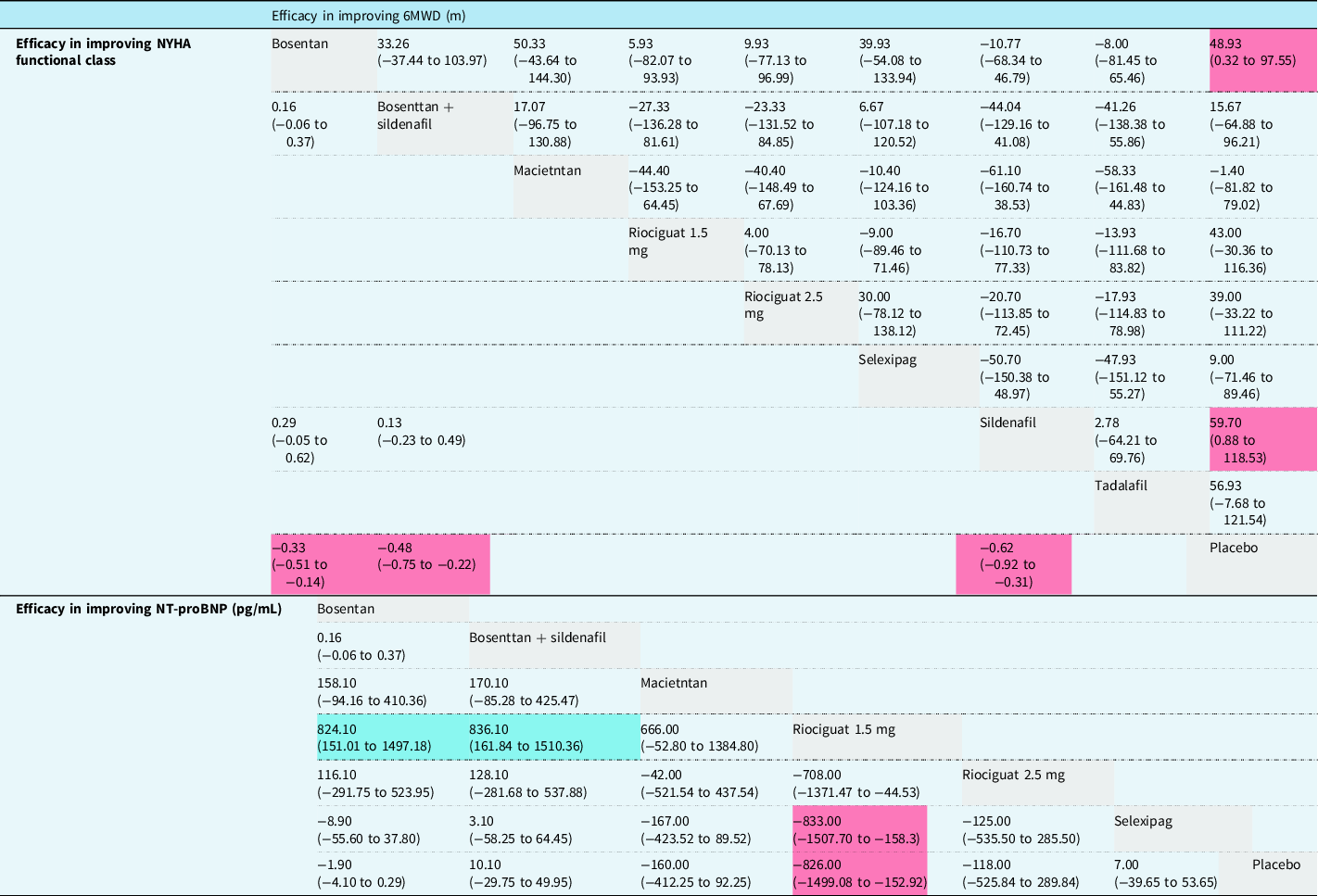
Bosentan and sildenafil were associated with a significant increase in 6MWD from baseline compared with placebo (MD 48.92 m, 95% CI 0.32 to 97.55 and MD 59.70 m, 95% CI 0.88 to 118.53, respectively) (Table 2 and Fig 3). There was no significant difference in change of 6MWD from baseline between bosentan, macitentan, sildenafil, tadalafil, selexipag, reiociguat, and combination of bosentan and sildenafil. This analysis had high heterogeneity (I 2: 62.9%; p = 0.06) and significant inconsistency (p = 0.01).
Effect of pulmonary vasodilators on the primary efficacy outcome (6MWD). Forest plots for the comparisons among pulmonary vasodilators (random effects model): ( a ) versus bosentan; ( b ) versus macitentan; ( c ) versus sildenafil; ( d ) versus tadalafil; ( e ) versus selexipag; ( f ) versus riociguat 1.5 mg; ( g ) versus riociguat 2.5 mg; ( h ) versus bosentan+sildenafil; ( i ) versus placebo. 6MWD, 6-minute walk distance; CI, confidence interval; MD, mean difference.

Network meta-analysis comparing the primary efficacy outcomes of pulmonary vasodilators for PAH-CHD.

Mean difference of changes from baseline to follow-up and 95% confidence interval are shown.
Abbreviations: 6MWD 6-minute walk distance, NTproBNP N-terminal pro brain natriuretic peptide
Bosentan, sildenafil, and combination of bosentan and sildenafil were associated with significant improvement in NYHA functional class compared with placebo (MD −0.33, 95% CI −0.51 to −0.14, MD −0.58, 95% CI −0.75 to −0.22 and MD −0.62, 95% CI −0.92 to −0.31, respectively) (Table 2 and Fig 4). There was no significant heterogeneity (I 2: 0.0%; p = 0.38) and no significant inconsistency (p = 0.56) in this analysis.
Effect of pulmonary vasodilators on the secondary efficacy outcome (NYHA functional class). Forest plots for the comparisons among pulmonary vasodilators (random effects model): ( a ) versus bosentan; ( b ) versus sildenafil; ( c ) versus bosentan + sildenafil; ( d ) versus placebo. CI, confidence interval; MD, mean difference.

Riociguat 1.5 mg was associated with a significant decrease in NT-proBNP levels compared with placebo (MD −826.00 pg/mL, 95% CI −1499.08 to −152.92) (Table 2 and Fig 5). Furthermore, riociguat 1.5 mg was associated with a significant improvement in change of NT-proBNP levels compared with bosentan, selexipag, riociguat 2.5 mg, and combination of bosentan and sildenafil. There was no significant heterogeneity (I 2: 0.0%; p = 0.94) in this analysis.
Effect of pulmonary vasodilators on the secondary efficacy outcome (NT-proBNP). Forest plots for the comparisons among pulmonary vasodilators (random effects model): ( a ) versus bosentan; ( b ) versus bosentan+sildenafil; ( c ) versus placebo. CI, confidence interval; MD, mean difference; NT-proBNP, N-terminal pro brain natriuretic peptide.

Secondary efficacy outcomes
Pulmonary vascular resistance was significantly decreased in bosentan (MD −472.0 dynes·sec·cm−5, 95% CI −906.8 to −37.1 [MD −5.9 Wood units, 95% CI −11.3 to −0.5]), macitentan (MD −489.0 dynes·sec·cm−5, 95% CI −899.8 to −78.2 [MD −6.1 Wood units, 95% CI −11.2 to −1.0]) and tadalafil (MD −584.0 dynes·sec·cm−5, 95% CI −866.2 to −301.8 [MD −7.3 Wood units, 95% CI −10.8 to −3.8]) compared with placebo (Supplementary Fig S2). Bosentan, macitentan, and tadalafil were associated with a significant decrease in pulmonary vascular resistance compared with ambrisentan (MD −448.0 dynes·sec·cm−5, 95% CI −887.2 to −8.8 [MD −5.6 Wood units, 95% CI −11.1 to −0.1], MD −465.0 dynes·sec·cm-Reference Simonneau, Montani and Celermajer5 , 95% CI −880.3 to −49.7 [MD −5.8 Wood units, 95% CI −11.0 to −0.6], and MD −560.0 dynes·sec·cm−5, 95% CI −848.7 to −271.3 [MD −7.0 Wood units, 95% CI −10.6 to −3.4], respectively). In addition, tadalafil were associated with a significant reduction in pulmonary vascular resistance than riociguat 1.5 mg (MD −524.0 dynes·sec·cm−5, 95% CI −978.7 to −69.4 [MD −6.6 Wood units, 95% CI −12.2 to −0.9]). There was no significant heterogeneity (I 2: 0.0%; p = 0.00) and no significant inconsistency (p = 1.0) in this analysis.
Sildenafil was associated with a significant decrease in mean pulmonary arterial pressure from baseline compared with placebo (MD −6.2 mmHg, 95% CI −12.2 to −0.2) (Fig S3). There was no significant difference in change of mean pulmonary arterial pressure from baseline between bosentan, ambrisentan, macitentan, sildenafil, tadalafil, and riociguat. There was no significant heterogeneity (I 2: 0.0%; p = 0.17) and no significant inconsistency (p = 0.89) in this analysis.
Bosentan, tadalafil, and combination of bosentan and sildenafil were associated with a significant increase in peripheral blood oxygen saturation as assessed by SpO2 compared to placebo (MD 6.7, 95% CI 2.6 to 10.9, MD 1.9, 95% CI 0.8 to 3.1, and MD 11.6, 95% CI 6.7 to 16.4, respectively) (Fig S4). Bosentan was associated with a significant increase in SpO2 compared to macitentan, sildenafil, or tadalafil (MD 5.8, 95% CI 1.5 to 10.1, MD 5.8, 95% CI 1.6 to 10.1 and MD 4.8, 95% CI 0.5 to 9.0, respectively). Furthermore, combination therapy of bosentan and sildenafil was significantly more effective in improving SpO2 compared with bosentan, macitentan, sildenafil, and tadalafil monotherapies (MD 4.9, 95% CI 2.1 to 7.6, MD 10.7, 95% CI 5.7 to 15.7, MD 10.7, 95% CI 5.8 to 15.7, MD 9.6%, and 95% CI 4.7 to 14.6, respectively). There was no significant difference in change of SpO2 between macitentan, tadalafil, and sildenafil. There was no significant heterogeneity (I 2: 0.0%; p = 0.74) and no significant inconsistency (p = 0.39) in this analysis.
Safety outcomes
Nine of the studies reported adverse events in bosentan (29.5%), macitentan (66.7%), sildenafil (5.6%), tadalafil (28.9%), selexipag (95.0%), riociguat (87.0%), combination of bosentan and sildenafil (20.0%), and placebo (54.3%), including headache, palpitation, back pain, nausea, itching, peripheral oedema, fatigue, flushing, dizziness, and liver dysfunction. Serious adverse events, such as right heart failure, acute kidney injury, liver function abnormalities, respiratory failure, hypotension, discontinuation of pulmonary vasodilators, were seen in bosentan (4.8%), macitentan (6.1%), and riociguat (8.7%), similar to placebo (8.5%).
Subgroup analyses
The subgroup analyses in Eisenmenger syndrome patients, other patients with biventricular circulation (CHD-PH), and Fontan patients as well as excluding patients with Fontan circulation showed similar results (Supplementary Fig S5-20). Bosentan and combination of bosentan and sildenafil were associated with significant improvement in 6MWD compared with placebo in Eisenmenger syndrome patients. In CHD-PH patients, bosentan, sildenafil, and combination of bosentan and sildenafil were associated with significant improvement in NYHA functional class compared with placebo, while tadalafil and riociguat were associated with significant improvement in 6MWD or NT-proBNP, which is not consistent with the main result. Bosentan was associated with significant improvement in 6MWD compared with placebo in Fontan patients. Bosentan, sildenafil, and combination of bosentan and sildenafil were associated with significant improvement in NYHA functional class compared with placebo when excluding Fontan patients. However, 6MWD was significantly improved in tadalafil compared with placebo, which is also inconsistent with the main result.
Publication bias
A significant publication bias in each outcome was not detected by using funnel plots and Egger’s test (Supplementary Fig S21).
Discussion
This systematic review and network meta-analysis comprehensively reviewed published articles and described the efficacy and safety of pulmonary vasodilators in patients with PAH-CHD. We demonstrated that bosentan and sildenafil were ranked best in terms of the efficacy on primary outcomes such as 6MWD and NYHA functional class. While various adverse effects were identified, serious adverse event rates were relatively low, and overall pulmonary vasodilators were well tolerated.
The most recent 2022 ESC/ERS Guidelines for the diagnosis and treatment of pulmonary hypertension proposed comprehensive prognostic evaluation and risk assessment based on a multiparametric approach using a three-strata model to classify patients at low, intermediate, or high risk of death. Reference Humbert, Kovacs and Hoeper26 Although main parameters are assessed in this risk stratification, including sings of right heart failure, progression of clinical manifestations, syncope, World Health Organization functional class (WHO-FC), 6MWD, cardiopulmonary exercise testing, biomarkers such as BNP or NT-proBNP, RV function and hemodynamics, the use of WHO-FC, 6MWD, and BNP/ NT-proBNP is recommended. Several studies identified WHO-FC, 6MWD, and BNP/NT-proBNP as the strongest prognostic predictors. Reference Hoeper, Kramer and Pan33–Reference Benza, Kanwar and Raina35 Functional capacity has been shown to be associated with outcomes in patients with PAH-CHD. Reference Dimopoulos, Inuzuka and Goletto36 6MWD is the most commonly used measure of functional capacity in patients with PAH because of its simplicity and validation. Despite the disadvantage of a potentially subjective assessment, functional class is also a good predictor of survival and aids in clinician decision to initiate pulmonary vasodilator therapy for PAH-CHD. Reference Baumgartner, De Backer and Babu-Narayan37 In this study, we demonstrated that bosentan and sildenafil improved 6MWD compared with placebo. Moreover, NYHA class was significantly improved in bosentan, sildenafil, and combination therapy of bosentan and sildenafil compared with placebo. Furthermore, we exhibited that riociguat 1.5 mg was associated with a significant improvement in change of NT-proBNP levels compared with placebo. Collectively, our network meta-analysis demonstrated that bosentan and sildenafil were ranked best in terms of the efficacy on risk factors determining prognosis, including 6MWD and NYHA functional class. Previous studies reported that bosentan and sildenafil might have the effects of improving exercise tolerance and hemodynamic parameter in patients with different types of PAH-CHD, supporting our findings. Reference Schulze-Neick, Gilbert and Ewert38–Reference Zeng, Lu and Xiong40 However, evidence on the use of pulmonary vasodilators in patients with PAH-CHD remains limited. Bosentan improved 6MWD in Eisenmenger syndrome patients with WHO-FC III. Reference Galiè, Beghetti and Gatzoulis11 Other ERAs and phosphodiesterase type 5 inhibitors have shown favourable effects on functional and haemodynamic parameters in Eisenmenger syndrome. Reference Gatzoulis, Landzberg and Beghetti14,Reference Zuckerman, Leaderer, Rowan, Mituniewicz and Rosenzweig41 The efficacy of PAH therapies in patients with prevalent systemic-to-pulmonary shunts, segmental pulmonary hypertension, and Fontan circulation is not well established. Reference Dimopoulos, Diller and Opotowsky6,Reference Manes, Palazzini, Leci, Bacchi Reggiani, Branzi and Galiè42–Reference Goldberg, Zak and Goldstein44 Given the heterogeneous patient population in PAH-CHD, further studies are warranted to compare outcomes of pulmonary vasodilators in homogeneous patient cohort of PAH-CHD.
In addition to the effect on 6MWD and NYHA functional class, we also demonstrated potential benefits of bosentan and sildenafil in improving haemodynamics such as pulmonary vascular resistance, mean pulmonary arterial pressure, and SpO2 in patients with PAH-CHD compared to placebo. Although lower pulmonary vascular resistance and mean pulmonary arterial pressure are generally accepted to be beneficial in PAH-CHD including Fontan, the efficacy of pulmonary vasodilators on pulmonary vascular resistance and mean pulmonary arterial pressure in PAH-CHD remains controversial since there are many factors associated with pulmonary vascular resistance and mean pulmonary arterial pressure, including various anatomic lesions, non-pulsatile pulmonary blood in Fontan circulation, an abnormal vascular tone, and a variety of pulmonary vascular disease. We found that bosentan, sildenafil, macitentan, and tadalafil might be more effective in improving pulmonary vascular resistance. However, the study analysing ambrisentan in our meta-analysis was conducted in Fontan patients, and thus the small effective size of ambrisentan may reflect differences in patient population rather than the effectiveness of pulmonary vasodilators. Baseline resting SpO2 was reported to be a reliable prognosticator in patients with Eisenmenger syndrome. Reference Kempny, Dimopoulos and Alonso-Gonzalez45 A deterioration in SpO2 as well as functional capacity were reported to be associated with adverse outcome in Eisenmenger syndrome patients. Reference Van De Bruaene, De Meester and Voigt46 In our network meta-analysis, bosentan might be more effective in improving SpO2 than other monotherapies. Although the heterogeneity of the included studies and patients needs to be considered, these findings may support the efficacy of bosentan and sildenafil in PAH-CHD.
Our network meta-analysis demonstrated that bosentan and sildenafil combination therapy might be more effective in several of the secondary outcomes than other monotherapies. Combination therapy has been becoming to play a central role in patients with PAH. Reference Galiè, Barberà and Frost47,Reference Galiè, Channick and Frantz48 Benefits of initial combination therapy of endothelin receptor antagonist and phosphodiesterase type 5 inhibitor have been demonstrated in PAH. Reference Galiè, Barberà and Frost47,Reference Jansa and Pulido49 In recent years, a treatment strategy called "treat and repair," in which upfront combination therapy of multiple pulmonary vasodilators are administered preoperatively and post-operatively to close the defect even in patients with a high pulmonary vascular resistance has been tried, and some reports are showing its effectiveness. Reference Kijima, Akagi and Takaya50,Reference Arvind, Relan and Kothari51 However, no consensus has been reached regarding which drugs are recommended for treating and repairing left-to-right shunting defects such as atrial septal defect and ventricular septal defect. In addition, combination therapy remains controversial in PAH-CHD because there are only few data available to support combination therapy for PAH-CHD and heterogeneity of the underlying CHD. There have been studies reporting monotherapy of current available pulmonary vasodilators such as endothelin receptor antagonist, phosphodiesterase type 5 inhibitor, sGC stimulators, and prostacyclin analogues in PAH-CHD. Bosentan has the strongest evidence for the use in PAH-CHD, demonstrating favourable long-term outcomes as well as improvements in functional capacity and hemodynamics. Reference Galiè, Beghetti and Gatzoulis11,Reference Vis, Duffels and Mulder52 Macitentan achieves a higher affinity for the lipophilic milieu and a longer duration of action compared with bosentan and ambrisentan. Reference Clozel53 Phosphodiesterase type 5 inhibitor monotherapy such as sildenafil and tadalafil in patients with PAH-CHD was reported to improve functional capacity and pulmonary hemodynamics. Reference Mukhopadhyay, Nathani, Yusuf, Shrimal and Tyagi13,Reference Galiè, Ghofrani and Torbicki54,Reference Mukhopadhyay, Sharma and Ramakrishnan55 Riociguat was reported to improve pulmonary vascular resistance and exercise capacity in PAH-CHD patients and has been utilised widely for PAH-CHD lately. Reference Rosenkranz, Ghofrani and Beghetti15 By contrast to monotherapy, data investigating benefits of combination therapy for PAH-CHD are scarce. Combination of bosentan and sildenafil was shown to improve functional capacity and hemodynamic parameters in PAH-CHD patients in some studies, while other studies failed to demonstrate benefits. Reference Iversen, Jensen, Jensen, Vejlstrup and Søndergaard12,Reference D'Alto, Romeo and Argiento56–Reference Durongpisitkul, Chungsomprasong, Vijarnsorn, Chanthong, Kanjanauthai and Soongswang58 Although overall pulmonary vasodilators were well tolerated in our study, combination therapy may deteriorate the patient’s clinical condition in PAH-CHD, developing complications including pulmonary oedema, interstitial lung disease, and alveolar haemorrhage. Reference Chida-Nagai, Sagawa and Tsujioka59 Thus, the strategy of combination therapy for patients with PAH-CHD should be considered prudently and our findings of combination therapy warrant further investigation.
Limitations
Our study has some limitations. First, there is heterogeneity of the studies included in our network meta-analysis with regards to study population, including patients with PAH due to repaired CHD, unrepaired CHD with Eisenmenger syndrome, and Fontan patients. Each group has a different haemodynamic profile and different expected response to pulmonary vasodilator therapies. Particularly in Fontan patients, mean pulmonary arterial pressure is markedly different and pulmonary vascular resistance is difficult to assess. Therefore, we performed the subgroup analyses in Eisenmenger syndrome patients, other patients with biventricular circulation, and Fontan patients as well as excluding Fontan patients, which showed similar results to our primary analysis with regards to positive impacts of bosentan and sildenafil on primary outcomes (6MWD and NYHA class). However, we could not assess the efficacy of pulmonary vasodilators separately due to a small number of included studies in each group. Second, each study contained a small number of patients, potentially leading to heterogeneity. In particular, riociguat and ambrisentan were reported in only one study, respectively. Small sample size produces larger effect sizes which are more variable than large samples size studies, limiting the statistical power of the meta-analyses. Therefore, our analyses need to be interpreted with great caution. Third, we included both children and adults with PAH-CHD in our meta-analysis, which also lead to substantial heterogeneity. The purpose of retrieving studies without age restriction was to systemically review all cases and to compare the efficacy and safety of pulmonary vasodilators in PAH-CHD patients. In the subgroup analysis, we excluded the study reporting children, Reference Shang, Lu and Zhang23 showing overall consistent results with the main result. Fourth, the study duration ranged from 1 day to 24 months, which also lead to substantial heterogeneity. The different lengths of follow-up may limit the validity of our network meta-analysis in the comparisons of efficacy and safety among pulmonary vasodilators. Fifth, each efficacy and safety outcome were not obtainable across the included studies. For example, pulmonary vascular resistance was reported in 6 of the 14 studies and all-cause death could not be evaluated due to limited available data. Sixth, most analyses had wide confidence intervals of pooled estimates, indicating less precise estimates and leading to concerns about the reliability of our findings. However, the robustness of our results was verified in subgroup analyses. Seventh, there is a dose–effect of each drug compared to placebo, which can be analysed by dose–effect meta-regression analysis, whereas it is difficult to compare the dose-effect of one drug with the dose–effect of another drug and to investigate which dose of one drug is compared with the dose–effect of another drug is of concern since dose and outcome are related. Therefore, dose–effects can be evaluated only for one drug each, which is not the main objective of our network meta-analysis aiming to compare multiple drug effects. Eighth, although relative change proportional to the baseline would be more appropriate to identify positive treatment effects compared to mean difference of changes since relative change proportional to the baseline is adjusted for the differences in pre-treatment values when divided by the pre-treatment values, there are many data where pre-treatment values are not available, making it difficult to examine the relative change in baseline proportionality. Lastly, our study is a network meta-analysis of trial-level data and not individual patient data, therefore lack of detailed analysis including data on underlying CHD might have contributed to our results. Further studies are needed to compare the outcomes of pulmonary vasodilators in homogeneous patient population, which will help establish optimal treatment strategies for each type of PAH-CHD.
Conclusions
This network meta-analysis showed that pulmonary vasodilator therapy in PAH-CHD appears to demonstrate largely favourable efficacy and safety with relatively low serious adverse event rates, including monotherapies and combination therapies. Bosentan and sildenafil and their combination were ranked best in terms of risk stratification factors in PAH such as 6MWD and NYHA functional class. Further comparative studies to examine outcomes of pulmonary vasodilators in each type of PAH-CHD are warranted.
Supplementary material
For supplementary material accompanying this paper visit https://doi.org/10.1017/S1047951123000124
Acknowledgements
We thank Mr. John Martin for his linguistic assistance with the manuscript.
Financial support
This research received no specific grant from any funding agency, commercial, or not-for-profit sectors.
Conflict of interest
None.