Instances of morphological and anatomical deformities or abnormalities have been reported worldwide in a variety of fishes. The abnormalities were extreme in certain cases that it is difficult even to identify them correctly which led to erroneous interpretation in its taxonomy; and these abnormalities were often described as new species (Devadoss, Reference Devadoss1983). Day (Reference Day1878) noticed an abnormal specimen of Gymnura poecilura and described it as a separate species, viz., Ceratoptera chrenbergii (Bigelow & Schroeder, Reference Bigelow and Schoroeder1953). Several morphological abnormalities in elasmobranchs have been reported in the past decades as deformities, especially in skates and rays (Templeman, Reference Templeman1965). Most of the malformations were reported as the failure of anterior lobes of the pectorals to join with the head during embryonic development (Gill, Reference Gill1896; Johnstone, Reference Johnstone1906; Ford, Reference Ford1930; Gudger, Reference Gudger1933; Castro-Aguire & Torres-Villegas, Reference Castro-Aguirre and Torres-Villegas1979; Rosa et al., 1996; Hoisington & Lowe, Reference Hoisington and Lowe2005; Castillo et al., Reference Castillo, Mariano-Meléndez and Villavicencio-Garayzar2006; Bornatowski & Abilhoa, Reference Bornatowski and Abilhoa2008; Sanchez et al., Reference Sánchez, Galván-Magaña, Downton-Hoffmann, Carrera-Fernández and Alatorre-Ramírez2008).
Reports on abnormal features of elasmobranchs from the Indian seas have been made by Luther (Reference Luther1961), Bennet (Reference Bennet1964), Chhapgar (Reference Chhapgar1964), Easwaran (Reference Easwaran1967), Nair & Chellam (Reference Nair and Chellam1971), Devadoss (Reference Devadoss1983) and Ramaiyan & Sivakumar (Reference Ramaiyan and Sivakumar1988).
The present paper discusses the incidence of an abnormal ray Gymnura poecilura caught in Indian waters. According to the International Union for Conservation of Nature Red List of Endangered Species, Gymnura poecilura is categorized under ‘Near Threatened’, due to its high level of irrational exploitation through much of its range and its restricted habitat. Fecundity appears to be very low, it is ovo-viviparous in reproduction, and is reported to bear up to seven pups per litter (Bizzarro & White, Reference Bizzarro and White2006). Also, females of G. poecilura tend to abort their embryos commonly upon capture. Any sort of deformation has to be checked seriously as this species is under Near Threatened status. Currently, there is a lack of continuous monitoring and investigation of this species.
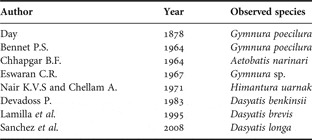
Our specimen of G. poecilura was caught by gill net (10 cm mesh size) in March 2011 by artisanal fishermen at Nagapattinam (10°.79′N 79°.84′E) Tamilnadu, south-east coast of India. It was deposited in the Museum of the Centre of Advanced Study in Marine Biology, Faculty of Marine Sciences, Annamalai University, Tamilnadu, India (Catalogue No. CASMB FM 09–2011). The specimen was identified as female G. poecilura (Shaw, 1804) of the family Gymnuridae and the morphometric measurement details are summarized in Table 1. The review of the teratogenic cases of elasmobranchs is detailed in Table 2.
Morphometric measurements of Gymnura poecilura.

Review of teratogenic cases of elasmobranchs (fins separated of the head).

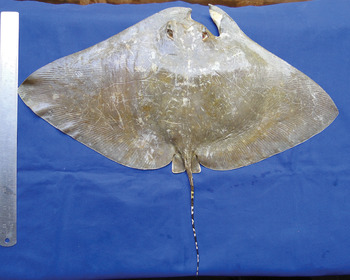
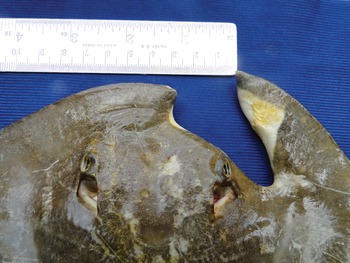
In our reported specimen of G. poecilura, the lateral and posterior region as well as the left pectoral fin was normal, whereas those of the right region separated to form horn like expansion (Figure 1). The interesting fact is that the anterior margin of the right pectoral fin was not fused to the head and it expanded and separated forward, forming a horn like structure (Figure 2). The slit originates near to the base of right spiracle and it extends from posterior to anterior with width ranges from 1.0 to 3.0 cm, as in the radiographic image shown in Figure 3.
Abnormal specimen of Gymnura poecilura.

Anteriorly extended pectoral fin of Gymnura poecilura.

Radiographic image of extended pectoral fin of Gymnura poecilura.

According to Rosa et al. (Reference Rosa, Gomes and Gadig1996), the principal morphological abnormalities reported in rays are in such a fashion that the pectoral fins were not fused to its head. It is reported that during the embryonic development, a failure might trigger the pectoral lobes not to fuse with the head (Bigelow & Schroeder, 1953; Templeman, Reference Templeman1965). Lamilla et al. (Reference Lamilla, Pequeno and Kong1995) reported a teratogenic condition in which both the pectoral lobes failed to join with the head in Dasyatis brevis in Chile and Sanchez et al. (2008) pointed out the same in Dasyatis longa in the Gulf of California, Mexico. Several authors observed the phenomenon of partial fusion in some Indian species (Bennet, Reference Bennet1964; Chhapgar, Reference Chhapgar1964; Easwaran, Reference Easwaran1967; Nair & Chellam, Reference Nair and Chellam1971; Devadoss, Reference Devadoss1983).
The radiographic image of the presently reported specimen of G. poecilura proved that, the cross bracings and skeleton structures of the right pectoral are not fused anteriorly and it draws attention to how this modification supports the oscillatory swimmers (Gymnuridae) in its locomotion. Oscillatory swimming performed by Gymnuridae requires specialized adaptation in its wing, because the bending of the wing of oscillatory swimmers is concentrated proximally (Heine, Reference Heine1992; Rosenberger, Reference Rosenberger2001).
Appropriate reasons for the occurrence of anomalies in the reported specimen of G. poecilura are found wanting and these anomalies are reported rarely from Indian waters. Based on the occurrence of a single specimen there is insufficient data to suggest causes for these anomalies. If anomalies constantly persist and exist in more individuals, this should be treated with great caution. These anomalies might be due to either any sort of genetic aberrations or embryonic malformations, triggered either by pollution or ecosystem alterations or some other unknown factors. Furthermore, there may be wider negative repercussions in the food web to which the population of the fish species is linked, that deserve greater attention.
ACKNOWLEDGEMENTS
We thank fishers of the Nagapattinam landing centre, who donated the specimen. The authors are grateful to Professor Dr T. Balasubramanian, Dean, Faculty of Marine Sciences, for his constant encouragement and support, and authorities of Annamalai University for facilities and Department of Biotechnology, Government of India for the financial support.