Introduction
The effects of bilingualism on cognitive functions have stirred research interest for many decades. In earlier research, bilingualism was mostly regarded as exerting a negative influence (see review in e.g. Hakuta & Diaz, Reference Hakuta, Diaz and Nelson1985) while research from the last three decades has suggested that bilingualism can in fact enhance cognition, especially executive functions (for review see e.g. Bialystok, Reference Bialystok2009). The reported bilingual advantage in certain executive functions could be related to the fact that managing two languages requires executive processing, i.e., inhibition of the language not in use at the moment (Green, Reference Green1998). Since bilinguals typically perform frequent and rapid switching from one language to another, they thus receive more practice than monolinguals in a process that engages executive functions.
A bilingual advantage has been found in several studies comparing bilinguals and monolinguals on tasks measuring executive functions, primarily on inhibition of interfering irrelevant information. Bialystok (Reference Bialystok1999) studied cognitive control in two age groups of monolingual and bilingual children and found that the bilinguals were better at inhibiting distracting information. In line with the Bialystok (Reference Bialystok1999) study, Carlson and Melzoff (Reference Carlson and Meltzoff2008), who used nine tasks to study various aspects of executive functioning in monolingual and bilingual children, found that bilinguals were better on tasks requiring inhibition of attention to a distracting response, but not on tasks with relatively low demands on working memory or on tasks involving the ability to suppress a motor response or to delay gratification. Moreover, Bialystok and Viswanathan (Reference Bialystok and Viswanathan2009) found that bilingual children were better than monolingual children in inhibition and switching between tasks, but there was no difference between language groups in response suppression. Other studies, with adults, have found a bilingual advantage on executive functions. Bialystok, Craik, Klein and Viswanathan (Reference Bialystok, Craik, Klein and Viswanathan2004) studied inhibition in monolingual and bilingual adults by using the Simon task. They found that bilinguals were better at inhibiting irrelevant spatial information in the task and were also faster overall. Bialystok et al. (Reference Bialystok, Craik, Klein and Viswanathan2004) employed a somewhat different Simon task version, which included control trials to measure response speed when no inhibition was required, and working memory trials to investigate whether the bilingual advantage was associated with better working memory skills. While no difference was found between the language groups concerning response speed on the control trials, bilinguals showed better performance on both executive inhibition and working memory trials (see also Bialystok, Craik & Ryan, Reference Bialystok, Craik and Ryan2006). Costa, Hernández, and Sebastián-Gallés (Reference Costa, Hernández and Sebastián-Gallés2008) studied inhibitory control in monolingual and bilingual university students by using the attentional network task (ANT). The results were similar to those of Bialystok et al. (Reference Bialystok, Craik, Klein and Viswanathan2004): bilinguals were faster overall, and showed better inhibition skills. Costa et al. (Reference Costa, Hernández and Sebastián-Gallés2008) also found that bilinguals showed an advantage in switching between the different types of trials in the task. Recently, Prior and MacWhinney (Reference Prior and MacWhinney2010) studied cued task switching in monolingual and bilingual college students and found that bilinguals had a smaller switch cost, even though both groups performed identically on non-switch trials. Finally, in their 2004 study mentioned above, Bialystok et al. (Reference Bialystok, Craik, Klein and Viswanathan2004) studied two age groups (mean age about 40 and 70 years, respectively) of monolingual and bilingual adults and suggested that bilingualism may reduce the age-related decline in the executive functions, since monolinguals showed a larger age-related increase in the time it takes to inhibit the irrelevant information and give a response in the Simon task. The difference in reaction times between language groups was also larger in the older age group.
One should note that not all studies have been able to find the bilingual advantage in executive functioning. In a study with 6–7-year-old monolingual and bilingual children, Morton and Harper (Reference Morton and Harper2007) failed to find differences between the language groups on the Simon task. Instead, the results indicated that better performance was related to a higher socio-economic status. However, Bialystok and Viswanathan (Reference Bialystok and Viswanathan2009) argued that their Canadian and Indian bilinguals’ similar superior performance makes the socio-economic account unlikely, as the cultural differences were far greater than the expected socio-economic differences between monolinguals and bilinguals in a study that would be performed within a single country. Additionally, in the antisaccade task with eye movement responses (Study 1 in Bialystok et al., Reference Bialystok, Craik and Ryan2006), the results showed no significant bilingual advantage in response suppression, inhibitory control or task switching (see also Bialystok, Martin & Viswanathan, Reference Bialystok, Martin and Viswanathan2005).
If the bilingual advantage on visual tasks measuring executive functions is a valid finding, it should also generalize to auditory tasks tapping these functions. Hugdahl, Westerhausen, Alho, Medvedev, Laine and Hämäläinen (Reference Hugdahl, Westerhausen, Alho, Medvedev, Laine and Hämäläinen2009) recently suggested that the bilingual advantage could also appear in a dichotic listening task based on the forced-attention paradigm (Hugdahl & Andersson, Reference Hugdahl and Andersson1986), since the task creates different degrees of cognitive conflict that call for executive functions. In the forced-attention dichotic listening task, two different stimuli are presented simultaneously to each ear and the task is to modulate attention according to instructions. Usually three attention conditions are used: forced-right (FR), forced-left (FL) and non-forced (NF). In the FR and FL conditions, the task is to focus attention to the right vs. the left ear and inhibit the stimuli presented to the other ear. In the NF condition that corresponds to standard dichotic listening, no attention instruction is given, and the task is to report the stimuli (syllables) heard best/first, irrespective of which ear the stimuli are presented to. Overall, it is easier to report the stimuli presented to the right than to the left ear, indicating a right-ear advantage (REA). The REA is interpreted to reflect a left temporal lobe specialization for processing of simple speech sounds, since the right-ear input enters the left auditory cortex more directly (Hugdahl, Reference Hugdahl2000). Thus a particularly interesting situation is created by the FL condition that exhibits a conflict between bottom–up (stimulus-driven) and top–down (instruction-driven) processes. In other words, in the FL condition the bottom–up processes strive to a right-ear response while the top–down processes strive to a left-ear response. In contrast, in the FR condition both processes work together towards a right-ear response (Hugdahl et al., Reference Hugdahl, Westerhausen, Alho, Medvedev, Laine and Hämäläinen2009). Several studies with the forced-attention paradigm have shown that the REA is modifiable by executive processing (e.g., Andersson, Reinvang, Wehling, Hugdahl & Lundervold, Reference Andersson, Reinvang, Wehling, Hugdahl and Lundervold2008; Takio et al., Reference Takio, Koivisto, Jokiranta, Rashid, Kallio, Tuominen, Laukka and Hämäläinen2009; Tallus, Hugdahl, Alho, Medvedev & Hämäläinen, Reference Tallus, Hugdahl, Alho, Medvedev and Hämäläinen2007; Thomsen, Rimol, Ersland & Hugdahl, Reference Thomsen, Specht, Hammar, Nyttingnes, Ersland and Hugdahl2004). Focusing attention to the right in the FR condition increases the REA, while focusing attention to the left in the FL condition decreases the REA to the extent that the ear advantage usually switches over to a left-ear advantage (LEA) in healthy right-handed adults.
The idea that especially the FL condition calls for executive processing has found support in fMRI studies with normal adult subjects. While dichotic listening in general engages frontotemporal areas (Jäncke & Shah, Reference Jäncke and Shah2002; Thomsen, Rimol et al., Reference Thomsen, Rimol, Ersland and Hugdahl2004; Thomsen, Specht, Hammar, Nyttingnes, Ersland & Hugdahl, Reference Thomsen, Specht, Hammar, Nyttingnes, Ersland and Hugdahl2004), there is evidence that the FL condition activates more the left middle frontal gyrus and the anterior cingulate than the FR condition does (Hugdahl et al., Reference Hugdahl, Westerhausen, Alho, Medvedev, Laine and Hämäläinen2009; Thomsen, Rimol et al., Reference Thomsen, Rimol, Ersland and Hugdahl2004). These activation increases in the FL condition were related to attentional focusing and ignoring irrelevant information as well as resolving a response conflict, respectively.
The possible bilingual advantage in executive functions has, to our knowledge, not been studied within the forced-attention dichotic listening paradigm. The aim of the present study was to test the hypothesis put forth by Hugdahl et al. (Reference Hugdahl, Westerhausen, Alho, Medvedev, Laine and Hämäläinen2009) that bilinguals would show an advantage in forced-attention dichotic listening due to better inhibition skills. Of particular relevance is the FL condition where top–down executive function should override the stimulus-driven REA. It may also be that the bilingual advantage, if present, is more pronounced in older subjects. For these purposes, we tested two groups of Finnish–Swedish early bilinguals (30–50-year-olds and 60–74-year-olds), contrasted with carefully matched groups of monolingual speakers.
Materials and Methods
Dichotic listening task
The task used in this study was a Finnish version of the forced-attention dichotic listening task (Hugdahl & Andersson, Reference Hugdahl and Andersson1986). In this task, the subjects listen and report dichotically presented consonant–vowel (CV) syllables that are phonologically relevant, but semantically meaningless. While listening to the syllables, participants modulate their attention either to the right- or the left-ear syllable, according to task instructions. As previously mentioned, the task consisted of three attention manipulation conditions: forced-right (FR), forced-left (FL) and non-forced (NF).
The dichotic listening task consisted of six syllables, created by combining a consonant to the vowel /a/: /ba/, /da/, /ga/, /pa/, /ta/, /ka/. For each attention condition, the syllables were paired using all possible combinations, thus forming 36 syllable pairs per condition. The syllables in each pair were presented through headphones at the same time, one syllable to the left and one to the right ear. The 36 syllable pairs in each condition also included six different homonyms, i.e., the same syllable presented to both ears. The homonyms functioned as a confirmation that all participants were able to perceive the six different syllables, and these trials were not included in the statistical analyses. All in all, the task included 108 syllable pairs. The syllables were read by a male voice, with constant intonation and intensity. Each syllable pair was presented for 300–400 ms with an intertrial interval of 4 sec. The task always began with the NF condition, but the FR and FL conditions were presented in a counterbalanced order so that every other participant completed FR before FL and vice versa. In the NF condition, the subjects were asked to listen to the syllables presented and then report which syllable they could hear more clearly. In the FR condition, the participants were instructed to report the syllable presented in the right ear and in the FL condition, the syllable presented in the left ear. In all conditions, the participants gave their answers by repeating the syllable out loud and simultaneously pointing at the syllable on a written list with all six syllables. Before the task, the participants completed a short practice sequence.
Background tests and questionnaires
All participants were asked to give their written informed consent and to fill out the Edinburgh Handedness Inventory (Oldfield, Reference Oldfield1971). They also completed a background information sheet probing their age, education, occupation, vision, hearing, possible reading difficulties, possible neurological and psychiatric illnesses, medication, subjective level of alertness and possible alcohol intake during the 24-hour period preceding the testing. The participants were also requested to fill out a questionnaire concerning their language background and language skills. Two tests from the Wechsler Adult Intelligence Scale – Third Edition (WAIS–III) were used as estimates of overall cognitive ability: Digit span (forward and backward) and Similarities.
Participants
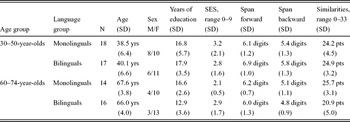
The present study employed Finnish monolinguals and Finnish–Swedish bilinguals from two age groups: 30–50-year-olds and 60–74-year-olds. Eight participants were discarded because of reported hearing problems and four because of technical problems with the task. Consequently, the group of 30–50-year-olds consisted of 18 monolinguals and 17 bilinguals and the group of 60–74-year-olds of 14 monolinguals and 16 bilinguals. All participants were neurologically healthy and right-handed. In the younger monolingual group, the age varied from 30 to 49 years, in the younger bilingual group from 30 to 50 years. In the older monolingual group the age range was from 62 to 74 years and in the older bilingual group from 60 to 73 years. There was no significant difference in age between monolinguals and bilinguals in the younger group (t(33) = –0.71, p = .482), or the older group (t(28) = 1.14, p = .262). There was also no significant difference in sex ratio between the age groups (χ2(1, N = 65) = 2.05, p = .152), or between monolinguals and bilinguals in the younger group (χ2(1, N = 35) = 0.31, p = .581), or the older group (χ2(1, N = 30) = 0.40, p = .526).
Concerning background tests, the age groups did not differ significantly on Digit span forward (t(63) = 1.28, p = .206) or Similarities (t(63) = 1.21, p = .232). However, as expected, the younger group was significantly better in Digit span backwards (t(63) = 2.35, p = .022). In the younger group, there was a significant difference between monolinguals and bilinguals on Digit span forward (t(33) = −2.20, p = .035) in favor of the bilinguals, but no significant difference on Digit span backwards (t(33) = −0.86, p = .397) or Similarities (t(33) = −0.50, p = .618, variances not assumed to be equal). In the older group, there was no significant difference between monolinguals and bilinguals on Digit span forward (t(28) = 0.57, p = .577, equal variances not assumed) or backwards (t(28) = 0.91, p = .369), but here the monolinguals were significantly better than the bilinguals on Similarities (t(28) = 3.21, p = .003).
As regards reported years of education, the younger age group had studied significantly longer than the older group (t(63) = 2.50, p = .014), but there was no significant difference between monolinguals and bilinguals in the younger age group (t(33) = −0.74, p = .467). The monolinguals were, however, more educated than the bilinguals in the older age group (t(28) = 3.16, p = .004). An estimation of the participants’ socio-economic status (SES) was done based on their occupations that were grouped into ten SES categories, according to the Classification of Occupations 2001 (Statistics Finland, 2001), in which category 1 is the highest SES value and 9 the lowest (0 represents military personnel). There was no significant difference in the SES between the age groups (t(63) = 1.32, p = .193), or between monolinguals and bilinguals in the younger age group (t(33) = 0.64, p = .526) or the older age group (t(17.607) = −1.80, p = .088). Demographics and performance on background tests are summarized in Table 1.
Summary of demographics and performance on the background tests.

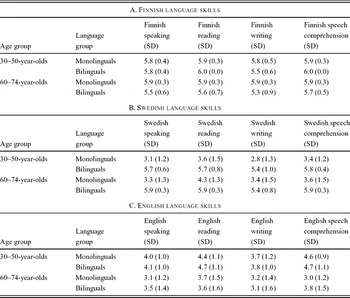
All bilinguals participating in this study were early simultaneous bilinguals, i.e., they had learned both languages before the age of seven and since then actively used them throughout their lives. To evaluate the participants’ language skills, both the monolinguals and bilinguals were asked to grade their language skills in Finnish, Swedish and English on a scale from 0 to 6, where 0 corresponded to no skills in that particular language and 6 to native-level skills.Footnote 1 For the younger bilingual group, there was no significant difference between their estimates of Finnish and Swedish speaking (t(16) = −1.14, p = .269) or reading skills (t(16) = −1.85, p = .083). On average, the younger bilinguals graded their speaking skills in Finnish (mean 5.8 (SD 0.4)) and Swedish (mean 5.7 (SD 0.6)) as fluent. There was, however, a significant difference within the older bilingual group, so that they estimated their speaking skills in Swedish as better than in Finnish (t(15) = 3.00, p = .009). However, there was no significant difference concerning their reading skills (t(15) = 2.09, p = .054) and on average they graded their speaking skills in Finnish (mean 5.5 (SD 0.6)) and Swedish (mean 5.88 (SD 0.3)) as fluent. As expected, both monolingual groups estimated their language skills in Finnish to be at a native level. On average, English was the second best language (speaking mean 4.0 (SD 1.0); reading 4.4 (1.1)) in the younger monolingual group, but the difference in speaking skills between Finnish and English was highly significant (t(15) = 6.93, p < .001). For the older monolingual group, Swedish was the second best language (speaking mean 3.3 (SD 1.3); reading 4.3 (1.3)), but the difference in speaking skills between Finnish and Swedish (t(13) = −8.13, p < .001) was highly significant. The participants’ estimations of their language skills are summarized in Table 2.
Summary of the participants’ estimations of their language skills on a scale from 0 (no skills) to 6 (native-level skills).

Dichotic listening results
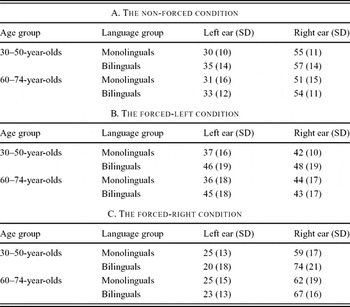
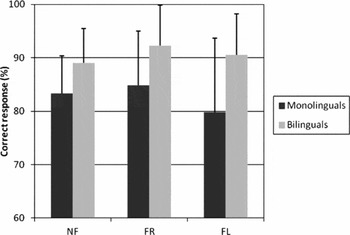
A mixed-model 3 × 2 × 2 × 2 (attention condition, ear, language group, age group) ANOVA was computed on correctly reported syllables (see Table 3). This analysis showed a significant main effect of attention condition (F(2,122) = 3.98, p = .021), with the participants having the highest number of correct responses in the FR condition, and the lowest in the FL condition (NF mean 26.0 (SD 2.1); FR 26.5 (2.9); FL 25.8 (3.6)). The results also showed a significant main effect of ear (F(1,61) = 60.26, p < .001), indicating the expected right-ear dominance across attention conditions (left-ear mean 28.5 (SD 10); right ear 49.3 (11.2)). The performance was not significantly affected by age (F(1,61) = 2.31, p = .134), but there was a significant main effect of language (F(1,61) = 20.52, p < .001), indicating that bilinguals in general had a higher number of correct responses (mean 81.5 (SD 4.8)) than monolinguals (74.4 (7.7)) (see Figure 1).
Average percentage of correct responses in the Dichotic Listening task.

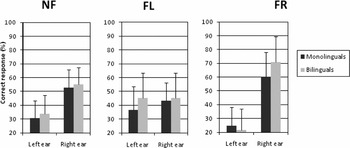
Sum of correct responses (SD) in percentage for left and right ear, for monolinguals and bilinguals in the non-forced (NF), forced-right (FR) and forced-left (FL) conditions (collapsed over the age groups). See the Results section for further details.

The results also showed a significant interaction between attention condition and ear (F(2,122) = 47.80, p < .001, sphericity not assumed), which stems from the fact that the participants, as expected, modulated their attention according to task instructions (NF left-ear mean 9.7 (SD 3.9); NF right ear 16.2 (3.8); FR left ear 6.9 (4.4); FR right ear 19.7 (5.7); FL left ear 12.3 (5.3); FL right ear 13.3 (4.7)). There was no significant interaction between attention condition and age (F(2,122) = 1.14, p = .324), or attention condition and language (F(2,122) = 1.97, p = .143), and also the other two-way interactions were non-significant (Fs < 1). There was, however, a significant three-way interaction between attention condition, ear, and language (F(2,122) = 3.31, p = .040), but all other three- and four-way interactions were non-significant (Fs <1).
The significant three-way interaction was analyzed further with univariate ANOVAs for both ears separately within each attention condition, using pooled age groups. The analyses for the NF condition showed that there was no difference between language groups in the number of reports from the left (F(1,63) = 1.08, p = .303) or the right ear (F < 1). There was also no significant difference between language groups concerning left-ear responses in the FR condition (F < 1), but bilinguals excelled the monolinguals in focusing on right-ear stimuli (F(1,63) = 5.51, p = .022) (FR bilinguals right-ear mean 21.2 (SD 5.6); FR monolinguals right ear 18.1 (5.3)). Regarding the FL condition, the bilinguals were able to report significantly more syllables from the left ear (F(1,63) = 3.98, p = .050) (FL bilinguals left-ear mean 13.6 (SD 5.4); FL monolinguals left ear 11.0 (5.0)), while there was no difference concerning right-ear reports (F < 1) (see Figure 2).
Average percentage of correctly reported syllables (SD) per ear in bilinguals and monolinguals (collapsed over the age groups) in the three attention conditions. See the Results section for further details.

Discussion
The aim of the present study was to investigate the hypothesis that bilingual language background would facilitate directing attention and inhibition of irrelevant stimuli in an executive phonological task, namely the dichotic listening task based on the forced-attention paradigm (Hugdahl et al., Reference Hugdahl, Westerhausen, Alho, Medvedev, Laine and Hämäläinen2009). Monolinguals and bilinguals from two age groups (30–50-year-olds and 60–74-year-olds) participated in the study. As regards standard, non-forced dichotic listening, all of our groups demonstrated a significant REA.
In line with the bilingual advantage hypothesis, the present results show that the bilinguals reported significantly more targets from the right ear in the FR condition and from the left ear in the FL condition than the monolinguals. Previous research has suggested that managing the FL and FR attention conditions requires inhibition of the stimuli presented in the opposite ear and directing attention on the attended ear (Hugdahl et al., Reference Hugdahl, Westerhausen, Alho, Medvedev, Laine and Hämäläinen2009). The results from the present study thus suggest that the bilinguals, as hypothesized, are more effective in focusing attention and ignoring task-irrelevant stimuli. This finding supports previous research using visual tasks (Bialystok, Reference Bialystok1999; Bialystok et al., Reference Bialystok, Craik, Klein and Viswanathan2004; Bialystok et al., Reference Bialystok, Craik and Ryan2006; Carlson & Meltzoff, Reference Carlson and Meltzoff2008; Costa et al., 2006) and indicates that lifelong bilingualism can enhance executive functioning and primarily inhibition of irrelevant information, presumably because managing two languages requires inhibition of the language not in use at the moment (Green, Reference Green1998).
The results from the present study also show that the bilinguals had more correct responses overall. A possible explanation for this may lie in differences in perceiving voiced (/b d g/) and unvoiced (/p t k/) consonants by Finnish monolinguals vs. Finnish–Swedish bilinguals. In Finnish, the voiced consonants /b/ and /g/ exist only in loanwords, and are often pronounced as /p/ and /k/ (Karlsson, Reference Karlsson1983). In contrast, the same consonants are frequently used in the Swedish language. Consequently, it is possible that the Finnish–Swedish bilinguals are better in distinguishing between the voiced and unvoiced consonants in a dichotic listening situation. However, since this ability depends on a fine-grained analysis of sound duration that can be attributed to left hemisphere function (Brancucci, D'Anselmo, Martello & Tommasi, Reference Branucci, D'Anselmo, Martello and Tommasi2008), a small difference in discriminability of the stimuli between monolinguals and bilinguals may play a role in the FR condition, but not in the FL condition. The results from the present study support this idea, since the group difference was larger in the FR condition. Nevertheless, the results also showed a significant difference in target-ear reports in favor of the bilingual group in the particularly demanding FL condition, suggesting an executive advantage in bilinguals.
In contrast to past findings (Andersson et al., Reference Andersson, Reinvang, Wehling, Hugdahl and Lundervold2008; Hugdahl et al., Reference Hugdahl, Carlsson and Eichele2001; Takio et al., Reference Takio, Koivisto, Jokiranta, Rashid, Kallio, Tuominen, Laukka and Hämäläinen2009; Thomsen, Specht et al., Reference Thomsen, Rimol, Ersland and Hugdahl2004), we failed to find an age effect on the ability to modify REA. While neither the younger nor the older subjects were able to convert REA to LEA in the FL condition, both groups exerted top–down attentional control to the extent that the difference between ears became minimal. Thus even our older group could modulate their attention to a significant degree, which was not the case in the studies of Takio et al. (Reference Takio, Koivisto, Jokiranta, Rashid, Kallio, Tuominen, Laukka and Hämäläinen2009) and Thomsen, Specht et al. (Reference Thomsen, Rimol, Ersland and Hugdahl2004). However, in the studies by Andersson et al. (Reference Andersson, Reinvang, Wehling, Hugdahl and Lundervold2008) and Hugdahl, Carlsson and Eichele (Reference Hugdahl, Carlsson and Eichele2001), the older age group was able to modulate their attention in the FL condition. One possible explanation for the good performance in older adults in both the Andersson et al. (Reference Andersson, Reinvang, Wehling, Hugdahl and Lundervold2008) study and the present study may be the fairly high level of education in both of these studies (on the average 14.0 and 14.6 years, respectively), which tends to correlate with overall intellectual capacity as measured by cognitive tests. For example, it has been shown that executive functions in working memory and general intelligence correlate (Engle, Reference Engle2002). Education or SES was not reported by Hugdahl et al. (Reference Hugdahl, Carlsson and Eichele2001), Takio et al. (Reference Takio, Koivisto, Jokiranta, Rashid, Kallio, Tuominen, Laukka and Hämäläinen2009) or Thomsen, Specht et al. (Reference Thomsen, Rimol, Ersland and Hugdahl2004).
In summary, the present results indicate that early simultaneous bilinguals have an advantage compared to monolinguals at directing attention and inhibiting task-irrelevant stimuli in the forced-attention dichotic listening task. This provides support for the idea that long-term experience in the use of two languages can enhance some executive functions.