Implications
Supplementing beef cattle with an inorganic or organic complexed source of Co, Cu, Mn and Zn during a 45-day preconditioning program increased liver concentrations of Co, Zn and Cu through preconditioning and reduced plasma cortisol concentrations during the period comprising transport and feedlot entry, but did not impact cattle performance and humoral immunity response during preconditioning and a 58-day feedlot receiving period.
Introduction
Preconditioning programs prepare weaned beef calves to face stress and immune challenges associated with feedlot entry, mainly through a complete vaccination program and introduction of cattle to dry feeds (Duff and Galyean, Reference Duff and Galyean2007). Accordingly, preconditioning programs allow for specific nutritional approaches targeted to optimize cattle health and productive traits post-weaning and during feedlot receiving (Roeber et al., Reference Roeber, Speer, Gentry, Tatum, Smith, Whittier, Jones, Belk and Smith2001; Arthington et al., 2008). An example of such approach is Zn, Cu, Mn and Co supplementation due to their role on stress, health and growth responses in cattle (Spears, Reference Spears2000). Moreover, supplementing organic complexed Zn, Cu, Mn and Co during preconditioning may be of further benefit based on their enhanced absorption, retention and biological activity compared with inorganic sulfate sources (Spears, Reference Spears1996; George et al., Reference George, Nockels, Stanton and Johnson1997; Marques et al., Reference Marques, Cooke, Rodrigues, Cappellozza, Larson, Moriel and Bohnert2016).
Traditional preconditioning recommendations include a 30-day period between weaning and feedlot entry (Pritchard and Mendez, Reference Pritchard and Mendez1990). Research results indicated that supplementing organic complexed Zn, Cu, Mn and Co to beef cattle during a 30-day preconditioning increased feedlot receiving growth, but not health, compared with cattle non-supplemented or receiving inorganic Zn, Cu, Mn and Co (Dorton et al., Reference Dorton, Engle and Enns2006). Currently, a 45-day preconditioning program is recommended to allow proper vaccine administration and enhance cattle health during feedlot receiving (Faber et al., Reference Faber, Hartwig, Busby and Bredahl1999). However, the impacts of Zn, Cu, Mn and Co supplementation during a 45-day preconditioning are still unknown and should be investigated, given that extending the supplementation period may further increase the benefits of these trace minerals. Therefore, this experiment evaluated the effects of Cu, Mn, Zn and Co supplementation, either as inorganic or organic complexed sources, during a 45-day preconditioning program on productive, immunity and physiologic parameters of cattle through preconditioning followed by a 58-day feedlot receiving period.
Material and methods
This experiment was conducted at the Oregon State University – Eastern Oregon Agricultural Research Center (Union Station). Animals utilized were cared for in accordance with acceptable practices and experimental protocols reviewed and approved by the Oregon State University, Institutional Animal Care and Use Committee (no. 4739). The experiment was divided into a preconditioning (day 0 to 45) and feedlot receiving phase (day 46 to 103).
Animals and treatments
In total, 90 Angus×Hereford calves (72 steers and 18 heifers) were weaned at 7 months (day −1), sorted by sex, weaning BW and age (initial BW=261±2 kg; initial age=224±2 days), and allocated to 1 of 18 drylot pens (5 calves/pen, 1 heifer and 4 steers/pen) on day 0, in a manner that pens had equivalent initial BW and age. Pens (14×35 m, dirt surfaced with covered feed bunks) were balanced for initial calf BW and age, and randomly assigned to receive a preconditioning concentrate containing one of three treatments: (1) Cu, Co, Mn and Zn sulfate sources (INR; custom blend manufactured by Performix Nutrition Systems, Nampa, ID, USA), (2) Cu, Mn, Co and Zn complexed organic source (AAC; Availa®4; Zinpro Corporation, Eden Prairie, MN, USA) or (3) no Cu, Co, Mn and Zn supplementation (CON). The AAC trace mineral source was based on a metal : amino acid complex ratio of 1 : 1 for Zn, Cu and Mn, in addition to Co glucoheptonate (Zinpro Corporation). Steers and heifers were used due to availability of cattle at the research station. Nevertheless, all pens had the same proportion of steers and heifers to ensure that calf sex would not bias the experimental objectives.
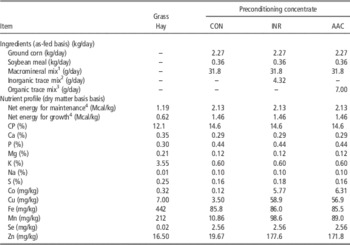
During the preconditioning phase (day 0 to 45), cattle received concentrate treatments (Table 1) while having free-choice access to orchardgrass (Dactylis glomerata L.), long-stem hay and water. The INR and AAC sources were formulated to provide the same daily amount of Cu, Co, Mn and Zn based on 7 g/calf daily of the AAC source as recommended by the manufacturer and previous research with this ingredient (Marques et al., Reference Marques, Cooke, Rodrigues, Cappellozza, Larson, Moriel and Bohnert2016). Concentrate and hay were offered twice daily (0700 and 1500 h) in different sections of the same feed bunk. On days 15, cattle were vaccinated against Clostridium (One Shot Ultra 7; Zoetis, Florham Park, NJ, USA), parainfluenza virus, infectious bovine rhinotracheitis virus, bovine respiratory syncytial virus, bovine viral diarrhea virus (BVDV) types 1 and 2, and Mannheimia haemolytica (MH; Bovi-Shield Gold One Shot; Zoetis). On day 29, cattle were re-vaccinated against all the aforementioned pathogens but for MH (Bovi-Shield Gold 5; Zoetis).
Ingredient composition and nutrient profile of orchardgrass (Dactylis glomerata L.), long-stem hay and concentrates containing no (CON; n=6), inorganic (INR; n=6) or organic complexed (AAC; n=6) sources of supplemental Cu, Co, Mn and Zn, and offered to cattle during a 45-day preconditioning

1 Containing (dry matter basis) 571.1 g/kg CaHPO4, 190 g/kg NaCl, 164.1 CaCO3, 31.3 g/kg MgO, 16.8 g/kg Na2O3Se 1%, 15 g/kg KCl, 10 g/kg MgCl2, 0.8 g/kg vitamin A 1000, 0.6 g/kg vitamin E 50%, 0.2 g/kg vitamin D 500 and 0.1 g/kg C2H10I2N2 79.5%.
2 Containing (dry matter basis) 500 g/kg of ground corn, 231 g/kg ZnSO4, 147 g/kg MnSO4, 114 g/kg CuSO4 and 8 g/kg of CoSO4.
3 Availa®4 (Zinpro Corporation, Eden Prairie, MN, USA), which contained (dry matter basis) 5.15% Zn from 1 : 1 Zn and amino acid complex, 2.86% Mn from 1 : 1 Mn and amino acid complex, 1.80% Cu from 1 : 1 Cu and amino acid complex and 0.18% Co from Co glucoheptonate.
4 Calculations for net energy for maintenance and growth were calculated with the equations proposed by the NRC (2000).
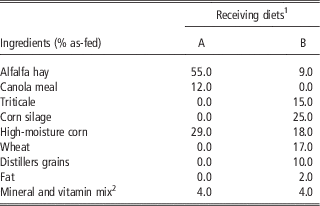
On day 46, cattle were loaded into a single double-deck commercial livestock trailer (Legend 50′ cattle liner; Barrett LLC, Purcell, OK, USA) and transported for 192 km to a commercial feedlot (Lighting Feeders, Nyssa, OR, USA) for a 58-day receiving phase (day 46 to 103). Upon arrival on day 46, cattle were vaccinated against Clostridium (Ultrabac 8; Zoetis), parainfluenza virus, infectious bovine rhinotracheitis virus and MH (Pyramid 5+Presponse; Boehringer Ingelheim Pharmaceuticals, Inc., Ridgefield, CT, USA), and received anti-helminthic (Vetrimec Plus; VetOne, Boise, ID, USA) and hormonal implant (Component TE 200; Elanco Animal Health, Greensfield, IN, USA). During the feedlot receiving phase, cattle were maintained in a single pen and offered the same free-choice diets (Table 2).
Ingredient composition (as-fed basis) of receiving diets offered (free-choice) to cattle

1 Diet A was offered for 24 days upon arrival; diet B was offered for 33 days after diet A.
2 Customized blend of minerals, vitamins and feed additives (Performix Nutrition Systems, Nampa, ID, USA), which contained 1/3 of Zn, Mn and Cu as metal : amino acid complexes (Zinpro Corporation, Eden Prairie, MN, USA) and 2/3 as sulfate sources.
Sampling
Feedstuffs
Samples of hay and concentrate ingredients offered during preconditioning were collected weekly, pooled across all weeks, and analyzed for nutrient content by a commercial laboratory (Dairy One Forage Laboratory, Ithaca, NY, USA). Each sample was analyzed in triplicate by wet chemistry procedures for concentrations of CP (method 984.13; Association of Official Analytical Chemists (AOAC), Reference Arthington, Cooke, Maddock, Araujo, Moriel, DiLorenzo and Lamb2006), ADF (method 973.18 modified for use in an Ankom 200 fiber analyzer, Ankom Technology Corp., Fairport, NY, USA; AOAC, Reference Arthington, Cooke, Maddock, Araujo, Moriel, DiLorenzo and Lamb2006), NDF (Van Soest et al., Reference Van Soest, Robertson and Lewis1991; modified for Ankom 200 fiber analyzer, Ankom Technology Corp.), macro and trace minerals using inductively coupled plasma emission spectroscopy (Sirois et al., Reference Sirois, Reuter, Laughlin and Lockwood1991), as well as Se according to method 996.16 of the AOAC (Reference Arthington, Cooke, Maddock, Araujo, Moriel, DiLorenzo and Lamb2006). Calculations for net energy for maintenance and growth were calculated with the equations proposed by the National Research Council (NRC) (2000).
Performance traits
Calf full BW were recorded on days −1 and 0, days 45 and 46 before truck loading, and on days 102 and 103. Calf BW recorded on consecutive days were used for average daily gain (ADG) calculation. Calf ADG during preconditioning was calculated based on initial preconditioning BW (average BW on days −1 and 0) and final preconditioning BW (average BW on days 45 and 46). Calf feedlot receiving ADG was calculated based on final preconditioning BW and final receiving BW (average BW on days 102 and 103).
During the preconditioning phase, concentrate, hay and total dry matter (DM) intake were evaluated from each pen by collecting and weighing refusals daily. Samples of the offered and non-consumed feed were collected daily from each pen and dried for 96 h at 50°C in forced-air ovens for DM calculation. Hay, concentrate and total daily DM intake of each pen were divided by the number of cattle within each pen, and expressed as kg per calf/day. Daily intake of Co, Cu, Mn and Zn were estimated by hay and concentrate intake of each pen, in addition to trace mineral content of hay and concentrate (Table 1). Total BW gain and DM intake of each pen from day 0 to 46 were used for preconditioning feed efficiency calculation.
Health and physiologic variables
During preconditioning, cattle were observed daily for sickness, including the bovine respiratory disease (BRD) symptoms according to the subjective criteria described by Berry et al. (Reference Berry, Confer, Krehbiel, Gill, Smith and Montelongo2004), and received 0.1 ml/kg of BW of Hexasol LA Solution (Norbrook® Inc. USA, Overland Park, KS, USA) when symptoms were observed. During the receiving period, cattle were observed daily for sickness and BRD symptoms (DART system; Zoetis), and received medication according to Wilson et al. (Reference Wilson, Step, Maxwell, Wagner, Richards and Krehbiel2015).
Liver samples were collected from all animals via needle biopsy on day 0, 22 and 45 of the preconditioning phase via needle biopsy (Tru-Cut biopsy needle; Becton Dickinson, Franklin Lakes, NJ, USA) according to the procedures described by Marques et al. (2016). Liver samples were analyzed via inductively coupled plasma mass spectrometry for concentrations of Co, Cu, Mn and Zn by the Michigan State University – Diagnostic Center for Population and Animal Health (Lansing, MI, USA). Blood samples were collected via jugular venipuncture into commercial heparinized blood collection tubes (Vacutainer, 10 ml; Becton Dickinson) on days 15, 29, 45, 47, 49, 53 and 60 of the experiment. Blood samples were placed immediately on ice, centrifuged (2500×g for 30 min; 4°C) for plasma harvest, and stored at −80°C on the same day of collection. Plasma samples collected on days 15, 29, 45 and 60 were analyzed for concentrations of MH leukotoxin antibodies (Confer et al., Reference Confer, Nutt, Dabo, Panciera and Murphy1996) and BVDV type I and II strains (BVDV Ab ELISA no. 99-44000; IDEXX Switzerland AG, Westbrook, ME, USA; Gonda et al., Reference Gonda, Fang, Perry and Maltecca2012). Plasma samples collected on days 45 to 60 were analyzed for plasma concentrations of haptoglobin (Cooke and Arthington, Reference Cooke and Arthington2013) and cortisol (Immulite 1000; Siemens Medical Solutions Diagnostics, Los Angeles, CA, USA). The intra- and inter-assay CV for haptoglobin were 2.2% and 6.1%, respectively. Plasma cortisol was analyzed within a single assay, and the intra-assay CV was 6.5%.
Statistical analysis
Data were analyzed using pen as the experimental unit, with Satterthwaite approximation to determine the denominator degrees of freedom for tests of fixed effects. Quantitative data were analyzed using the MIXED procedure of SAS (SAS Institute Inc., Cary, NC, USA) and binary data were analyzed using the GLIMMIX procedure of SAS (SAS Institute Inc.). Model statements for BW, ADG, feed efficiency, and morbidity and mortality rates within each phase contained the effects of treatment and calf sex as an independent covariate. Model statement for DM intake and plasma variables contained the effects of treatment, day, the resultant interaction and calf sex as an independent covariate. Model statement for liver Co, Cu, Zn and Mn concentrations contained the effects of treatment, day, the resultant interaction, in addition to calf sex and values from day 0 as independent covariates. All data were analyzed using pen(treatment) and calf(pen) as random variables, but for DM intake and feed efficiency that used pen(treatment) as random variable and did not include sex in the fixed model because DM intake was recorded from each pen. The specified term for the repeated statements was day, with pen(treatment) or calf(pen) as subject for DM intake or plasma and liver variables, respectively. The covariance structure used was first-order autoregressive, which provided the smallest Akaike information criterion and hence the best fit for all variables. Results are reported as least square means and were separated using least square differences. Significance was set at P⩽0.05 and tendencies were determined if P>0.05 and ⩽0.10. Results are reported according to main effects if no interactions were significant, or according to the highest-order interaction detected.
Results
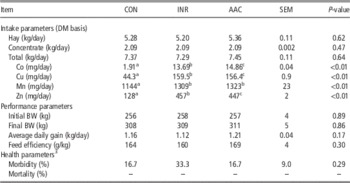
During the 45-day preconditioning phase, no treatment differences were detected (P⩾0.47) for hay, concentrate and total DM intake (Table 3). As designed, estimated daily intake of Co, Cu, Mn and Zn were greater (P⩽0.01) in AAC and INR compared with CON cattle (Table 3), whereas INR cattle consumed more (P<0.01) Cu and Zn, but less (P<0.01) Co compared with AAC cohorts (Table 3). However, no treatment differences were detected (P⩾0.17) during preconditioning for BW, ADG, feed efficiency, as well as morbidity and mortality rates (Table 3).
Intake, performance and health responses during a 45-day preconditioning from beef cattle receiving a preconditioning concentrate containing no (CON; n=6), inorganic (INR; n=6) or organic complexed (AAC; n=6) sources of supplemental Cu, Co, Mn and ZnFootnote 1 , Footnote 2

1 INR and AAC cows received the same amount of Cu, Co, Mn and Zn from sulfate sources or Availa®4 (Zinpro Corporation, Eden Prairie, MN, USA).
2 Concentrate, hay and total dry matter intake were evaluated daily from each pen by collecting and weighing refusals daily, divided by the number of animals within each pen, and expressed as kg per calf/day. Daily intake of Co, Cu, Mn and Zn were estimated by hay and concentrate intake of each pen, in addition to trace mineral content of hay and concentrate. Calf average daily gain was calculated based on initial preconditioning BW (average from days −1 and 0) and final preconditioning BW (average from days 45 and 46). Feed efficiency was calculated based on total BW gain (g) divided by total dry matter intake (kg) from day 0 to 45.
3 Calves were observed daily for morbidity according to the subjective criteria described by Berry et al. (Reference Berry, Confer, Krehbiel, Gill, Smith and Montelongo2004), and received 0.1 ml/kg of BW of Hexasol LA Solution (Norbrook® Inc. USA, Overland Park, KS, USA) when symptoms were observed.
a,b,cWithin rows, Means with different superscript letters differ (P⩽0.05).
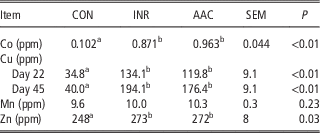
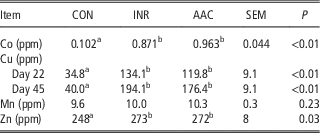
Treatment effects were detected for liver Co and Zn (P⩽0.03), whereas a treatment×day interaction was detected (P<0.01) for liver Cu concentrations (Table 4). No treatment effects were detected (P=0.23) for liver Mn concentrations (Table 4). It is important to note that liver Co, Cu, Mn and Zn concentrations were similar (P⩾0.15) among CON, INR and AAC cattle on day 0 of the experiment (0.177, 0.181 and 0.184 ppm of Co, respectively, SEM=0.006; 44.0, 30.0 and 41.1 ppm of Cu, respectively, SEM=5.7; 10.8, 10.8 and 10.7 ppm of Mn, respectively, SEM=0.4; and 271, 286 and 304 ppm of Zn, respectively, SEM=13), whereas liver Cu, Mn and Zn values were significant (P⩽0.04) covariates. During the preconditioning period, mean liver Co and Zn concentrations were greater (P⩽0.02) in AAC and INR compared with CON, and similar (P⩾0.14) between AAC and INR cattle (Table 4). On days 22 and 45, liver Cu concentrations were also greater (P<0.01) in AAC and INR compared with CON, and similar (P⩾0.16) between AAC and INR cattle (Table 4). However, liver Cu concentrations increased (day effect, P<0.01) from day 22 to 45 in AAC and INR, but not in CON cattle (day effect, P<0.62).
Liver concentrations of Co, Cu, Mn and Zn in beef cattle receiving concentrate containing no (CON; n=6), inorganic (INR; n=6) or organic complexed (AAC; n=6) sources of supplemental Cu, Co, Mn and Zn during a 45-day preconditioning programFootnote 1 , Footnote 2
1 INR and AAC cows received the same amount of Cu, Co, Mn and Zn from sulfate sources or Availa®4 (Zinpro Corporation, Eden Prairie, MN, USA).
2 Liver samples were collected at the beginning (day 0), and on days 22 and 45 of the preconditioning period via needle biopsy (Marques et al., 2016). Values on day 0 served as independent covariate. Concentrations of Co, Cu, Mn and Zn were determined by the Michigan State University’s Diagnostic Center for Population & Animal Health (Lansing, MI, USA).
a,bWithin rows, means with different superscript letters differ (P⩽0.05). A treatment×day interaction was detected for liver Cu concentrations (P<0.01), but not for liver Co, Mn and Zn concentrations (P⩾0.72).
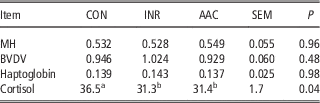
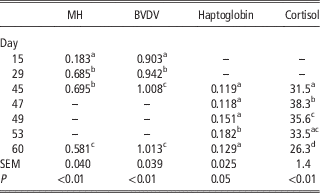
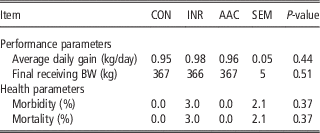
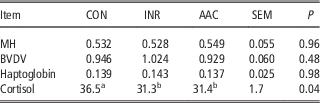
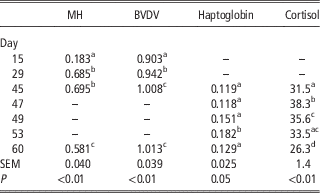
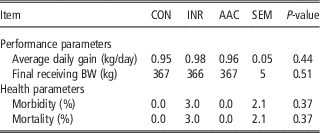
No treatment effects were detected (P⩾0.48) for plasma concentrations of antibodies against MH and BVDV (Table 5), although day effects were detected (P<0.01) for both variables as they increased from day 15 to 60 of the experiment (Table 6). No treatment effect was detected (P=0.98) for plasma haptoglobin concentrations (Table 5), which peaked (day effect, P=0.05) on day 53 of the experiment (Table 6). A treatment effect was detected for plasma cortisol concentrations, which were greater (P⩽0.04) for CON compared with INR and AAC during the experiment, and similar (P=0.97) between INR and AAC cattle (Table 5). A day effect was also detected (P<0.01) for plasma cortisol concentrations, which peaked on day 47 followed by a steady decrease until day 60 of the experiment (Table 6). During the receiving period, no treatment effects were detected (P⩾0.37) for cattle ADG, final receiving BW, as well as health parameters (Table 7).
Plasma concentrations of antibodies against Mannheimia haemolytica (MH; ng/antibody bound), bovine viral diarrhea viruses (BVDV; sample : positive control ratio as in Gonda et al., Reference Gonda, Fang, Perry and Maltecca2012), as well as cortisol (ng/ml) and haptoglobin (µg/ml) in beef cattle receiving concentrate containing no (CON; n=6), inorganic (INR; n=6) or organic complexed (AAC; n=6) sources of supplemental Cu, Co, Mn and Zn during a 45-day preconditioning programFootnote 1 , Footnote 2 , Footnote 3
1 INR and AAC cows received the same amount of Cu, Co, Mn and Zn from sulfate sources or Availa®4 (Zinpro Corporation, Eden Prairie, MN, USA).
2 Calves were preconditioned from day 0 to 45 of the experiment, and transported for 192 km to a commercial feedlot on day 46, where they remained for 58 days (day 46 to 103 of the experiment). Cattle were vaccinated against Clostridium (One Shot Ultra 7; Zoetis, Florham Park, NJ, USA), parainfluenza virus, infectious bovine rhinotracheitis virus, BVDV types 1 and 2, and MH (Bovi-Shield Gold One Shot; Zoetis) on days 15 and 29. On day 46, cattle were vaccinated against Clostridium (Ultrabac 8; Zoetis), parainfluenza virus, infectious bovine rhinotracheitis virus and MH (Pyramid 5+Presponse; Boehringer Ingelheim Pharmaceuticals, Inc., Ridgefield, CT, USA).
3 Blood samples were collected for MH and BVDV analyses on days 15, 29, 45 and 60, and for cortisol and haptoglobin analyses on days 45, 47, 49, 53 and 60 of the experiment.
a,bWithin rows, means with different superscript letters differ (P⩽0.05).
Plasma concentrations of antibodies against Mannheimia haemolytica (MH; ng/antibody bound), bovine viral diarrhea virus (BVDV; sample : positive control ratio as in Gonda et al., Reference Gonda, Fang, Perry and Maltecca2012), as well as cortisol (ng/ml) and haptoglobin (µg/ml) in beef cattle during a 45-day preconditioning and 58-day feedlot receiving periodFootnote 1 , Footnote 2 , Footnote 3
1 Calves were preconditioned from day 0 to 45 of the experiment, and transported for 192 km to a commercial feedlot on day 46, where they remained for 58 days (days 46 to 103 of the experiment).
2 Cattle were vaccinated against Clostridium (One Shot Ultra 7; Zoetis, Florham Park, NJ, USA), parainfluenza virus, infectious bovine rhinotracheitis virus, BVDV types 1 and 2, and MH (Bovi-Shield Gold One Shot; Zoetis) on days 15 and 29. On day 46, cattle were vaccinated against Clostridium (Ultrabac 8; Zoetis), parainfluenza virus, infectious bovine rhinotracheitis virus and MH (Pyramid 5+Presponse; Boehringer Ingelheim Pharmaceuticals, Inc., Ridgefield, CT, USA).
3 Blood samples were collected for MH and BVDV analyses on days 15, 29, 45 and 60, and for cortisol and haptoglobin analyses on days 45, 47, 49, 53 and 60 of the experiment.
a,b,c,dWithin columns, means with different superscript letters differ (P⩽0.05).
Performance and health responses during a 58-day feedlot receiving from beef cattle offered a concentrate containing no (CON; n=6), inorganic (INR; n=6) or organic complexed (AAC; n=6) sources of supplemental Cu, Co, Mn and Zn only during a 45-day preconditioningFootnote 1 , Footnote 2 , Footnote 3
1 INR and AAC cows received the same amount of Cu, Co, Mn and Zn from sulfate sources or Availa®4 (Zinpro Corporation, Eden Prairie, MN, USA).
2 Calves were preconditioned from day 0 to 45 of the experiment, and transported for 192 km to a commercial feedlot (Lighting Feeders, Nyssa, OR, USA) on day 46, where they remained for 58 days (days 46 to 103 of the experiment). Calves were observed daily for morbidity according to the DART system (Zoetis, Florham Park, NJ, USA) and received medication according to the management criteria of the commercial feedlot.
3 Calf average daily gain was calculated based on final preconditioning BW (average from days 45 and 46) and final receiving BW (average from days 102 and 103).
Discussion
As previously mentioned, steers and heifers were used herein due to cattle availability at the research station, while all pens had the same proportion of steers and heifers. Moreover, all calf performance and immune responses were analyzed using calf sex as an independent covariate, and the treatment×sex interaction was not tested because experimental units were not replicated by calf sex (Marques et al., Reference Marques, Cooke, Rodrigues, Cappellozza, Larson, Moriel and Bohnert2016). Hence, calf sex was properly balanced among experimental units and used to adjust calf-related responses to ensure that calf sex did not bias the experimental outcomes.
As expected based on the experimental design, both INR and AAC treatments increased estimated daily Co, Cu, Mn and Zn intake during the preconditioning period compared with the CON treatment (Table 3). Although daily Co, Cu and Zn intake also differed between AAC and INR cattle, such differences seem biologically irrelevant given that intake (Table 3) of these trace minerals was beyond NRC (2000) requirements for growing cattle (0.74 mg/day of Co, 74 mg/day of Cu, 148 mg/day of Mn and 222 mg/day of Zn). Moreover, daily Cu and Zn intake in CON cattle were below NRC (2000) requirements during the preconditioning phase (Table 3).
The similar liver Co, Cu, Mn and Zn concentrations on day 0 indicates that cattle in all treatments had similar, as well as adequate (Kincaid, Reference Kincaid2000; McDowell, Reference McDowell2003) Co, Cu, Mn and Zn liver status before the beginning of the experiment. During the preconditioning period, treatment effects detected for liver Co, Cu and Zn corroborate with increased daily intake of these trace minerals in AAC and INR compared with CON cattle (Table 4) and are supported by previous research (Stanton et al., Reference Stanton, Whittier, Geary, Kimberling and Johnson2000; Akins et al., Reference Akins, Bertics, Socha and Shaver2013; Marques et al., Reference Marques, Cooke, Rodrigues, Cappellozza, Larson, Moriel and Bohnert2016). Although organic mineral forms are expected to have enhanced absorption, retention and biological activity compared with sulfate minerals (Spears, Reference Spears1996; George et al., Reference George, Nockels, Stanton and Johnson1997), similar liver concentrations of Cu, Co and Zn between AAC and INR cattle validates that differences in estimated daily Co, Cu and Zn intake between AAC and INR were biologically irrelevant. Accordingly, the effects of supplementing organic or inorganic Zn, Cu and Co on liver mineral status of beef cattle have been variable, with research reporting similar effects or advantage in cattle supplemented with organic forms (Stanton et al., Reference Stanton, Whittier, Geary, Kimberling and Johnson2000; Arthington and Swenson, Reference Arthington, Qiu, Cooke, Vendramini, Araujo, Chase and Coleman2004; Marques et al., Reference Marques, Cooke, Rodrigues, Cappellozza, Larson, Moriel and Bohnert2016). The lack of treatment differences in liver Mn concentrations during preconditioning (Table 4) has also been reported by others (Ahola et al., Reference Ahola, Baker, Burns, Mortimer, Enns, Whittier, Geary and Engle2004; Marques et al., Reference Marques, Cooke, Rodrigues, Cappellozza, Larson, Moriel and Bohnert2016), suggesting that hepatic Mn concentrations in ruminants are not influenced by increased dietary Mn intake (Underwood and Suttle, Reference Underwood and Suttle1999).
It is important to note, however, that liver Co, Cu, Mn and Zn status during preconditioning (Table 4) were either marginal or adequate across all treatments (Kincaid, Reference Kincaid2000; McDowell, Reference McDowell2003), indicating that inadequate Cu and Zn intake by CON cattle (NRC, 2000) was not sufficient to result in hepatic deficiency for these trace elements. It is well known that Cu, Zn, Mn and Co (as component of vitamin B12; NRC, 2000) play essential roles on growth and immune responses in cattle (Spears, Reference Spears2000). Therefore, marginal and adequate liver status of these trace minerals among all treatments likely contributed to the similar preconditioning DM intake, ADG, feed efficiency and morbidity (Table 3). The same rationale can be applied to the lack of treatment differences for plasma concentrations of antibody against MH and BVDV (Table 5). These variables similarly increased among treatments following initial vaccination (Table 6), suggesting similar vaccine efficacy and subsequent immune protection against these pathogens in AAC, INR and CON cattle during preconditioning and feedlot receiving (Callan, Reference Callan2001). Contrary to our findings, George et al. (Reference George, Nockels, Stanton and Johnson1997) reported that heifers supplemented with organic complexed Co, Cu, Mn and Zn had improved antibody titer response to infectious bovine rhinotracheitis virus vaccination compared with heifers supplemented with inorganic sources of these trace elements. However, George et al. (Reference George, Nockels, Stanton and Johnson1997) did not evaluate liver status of these trace minerals, and perhaps the organic complexed treatments evaluated by these authors impacted liver Co, Cu, Zn and Mn status differently than herein, such as by replenishing hepatic deficiencies.
Plasma cortisol and haptoglobin concentrations peaked on days 47 and 53 of the experiment, respectively, as expected based on the neuroendocrine stress response and acute-phase protein reaction elicited by transport and feedlot entry (Cooke et al., Reference Cooke, Bohnert, Moriel, Hess and Mills2011; Cooke et al., Reference Cooke, Guarnieri Filho, Cappellozza and Bohnert2013). However, elevated cortisol has been positively associated with plasma haptoglobin concentrations (Cooke et al., Reference Cooke, Carroll, Dailey, Cappellozza and Bohnert2012; Cooke et al., Reference Cooke, Guarnieri Filho, Cappellozza and Bohnert2013), while the greater mean plasma cortisol concentration in CON cattle from days 45 to 60 did not yield a similar haptoglobin response. These outcomes suggest that Co, Cu, Zn and Mn supplementation to feeder cattle during preconditioning, either as sulfate or organic complexed sources, alleviated the neuroendocrine stress response elicited by transport and feedlot entry without impacting the resultant acute-phase protein reaction (Carroll and Forsberg, Reference Carroll and Forsberg2007).
As previously mentioned, Dorton et al. (Reference Dorton, Engle and Enns2006) reported increased feedlot receiving ADG when beef cattle were supplemented with organic complexed Zn, Cu, Mn and Co during a 30-day preconditioning. Based on these outcomes, we hypothesized that supplementing cattle with an organic complexed Zn, Cu, Mn and Co during a 45-day preconditioning program would yield similar or greater benefits as reported by Dorton et al. (Reference Dorton, Engle and Enns2006), mainly due to increased supplementation length. However, receiving performance and health parameters were similar among CON, INR and AAC cattle (Table 7), which should also be attributed to proper liver status of Co, Cu, Zn and Mn in all treatment groups during the preconditioning period. Nonetheless, Dorton et al. (Reference Dorton, Engle and Enns2006) did not evaluate liver status of these trace minerals, and it is unknown if outcomes reported by these authors are related to treatment effects on replenishing hepatic deficiencies of these trace minerals. Dorton et al. (Reference Dorton, Engle and Enns2006) also maintained different Co, Cu, Zn and Mn supplementation strategies during the 28-day receiving period, while in the present experiment all cattle were offered the same feedlot receiving diet (Table 2). Thus, receiving performance may also be impacted when Co, Cu, Zn and Mn supplementation is altered during preconditioning and receiving period, as in Dorton et al. (Reference Dorton, Engle and Enns2006).
Morbidity during the receiving period in this experiment (Table 7) was not as prevalent compared with values from research conducted at commercial receiving yards (Snowder et al., Reference Snowder, Van Vleck, Cundiff and Bennett2006; Marques et al., Reference Marques, Cooke, Rodrigues, Cappellozza, Larson, Moriel and Bohnert2016). In fact, calves utilized herein were subjected to the stress of weaning, transportation, as well as exposure to cattle from other sources in a novel environment during feedlot receiving (Arthington et al., 2008; Step et al., Reference Step, Krehbiel, DePra, Cranston, Fulton, Kirkpatrick, Gill, Payton, Montelongo and Confer2008; Cooke et al., Reference Cooke, Guarnieri Filho, Cappellozza and Bohnert2013). Hence, reduced morbidity during feedlot receiving was unexpected but can be attributed to an effective 45-day preconditioning program (Faber et al., Reference Faber, Hartwig, Busby and Bredahl1999; Duff and Galyean, Reference Duff and Galyean2007) independent of Co, Cu, Zn and Mn supplementation, which may have also contributed to the lack of treatments effects on receiving performance and health variables.
Conclusions
Collectively, results from this experiment indicate that supplementing beef cattle with an inorganic or organic complexed source of Co, Cu, Mn and Zn during a 45-day preconditioning program increased liver concentrations of Co, Zn and Cu through preconditioning and reduced plasma cortisol concentrations during the period comprising transport and feedlot entry, but did not impact cattle performance and health responses during preconditioning and a 58-day receiving period. It is important to note, however, that cattle evaluated herein had adequate liver status of Co, Cu, Mn and Zn at the beginning of the experiment. Hence, additional research is warranted to further assess the impacts of inorganic or organic complexed sources of Co, Cu, Mn and Zn on performance and health responses of cattle preconditioned for 45 days, particularly cattle deficient in these trace minerals and experiencing elevated morbidity rates during feedlot receiving.
Acknowledgments
Financial support for this research was provided by Zinpro Corporation (Eden Prairie, MN, 55344, USA). Appreciation is also extended to Zoetis (Florham Park, NJ 07932, USA) and IDEXX Laboratories, Inc. (Westbrook, ME 04092, USA) for product donation. Dr Reinaldo Cooke is also affiliated as permanent professor to the Programa de Pós-Graduação em Zootecnia/Faculdade de Medicina Veterinária e Zootecnia, Univ Estadual Paulista (UNESP), Botucatu, SP, 18618-970, Brazil.