The seventeen-year-old Princess Victoria was ‘much amused’. On attending the tenth performance of Michael Balfe’s Maid of Artois at the Drury Lane Theatre, on 17 June 1836, she thought it ‘rather too long, and rather too melancholy’; and that the tenor lead, John Templeton, ‘sang and acted as badly, and was as disagreeable, as usual’. Nevertheless, there was ‘a good deal of pretty music’, most of which was sung by the prima donna around whom the opera had been shaped: Maria Malibran.Footnote 1
Malibran’s final Drury season has not tended to occupy much space in the biographies that began to appear within days of her much-lamented death later that summer, at the Manchester Music Festival, and that have continued ever since. French and Italian writers, in particular, have seen little of interest in a repeat engagement to sing operas in English at a venue not renowned for its musical connoisseurs. The Comtesse de Merlin, for example, confuses Covent Garden with Drury Lane in her account of 1838, and leaves Balfe’s opera unmentioned.Footnote 2 Such a level of inattention is matched by later retellings, which to this day often go no further than recycling the claim made by the reviewer in the Revue et Gazette musicale de Paris that the work consists of a tissue of musical borrowings, capped by a final aria for Malibran, ‘With Rapture Dwelling’ (later changed to ‘The Rapture Swelling’) lifted directly from Johann Strauss the Elder.Footnote 3
The charge of plagiarism was predictable for an unabashedly Italianate work jostling for notice in the crowded post-Rossinian marketplace. But there are reasons to pay more attention to this concluding waltz, aside from its purported Viennese origins. After all, even the reviewer in the Gazette acknowledged the number as a highlight, thanks to the ‘unbelievable vigour’ of Malibran’s performance. Others, whether writing at the time or in mournful retrospect, were still more fulsome, declaring it variously ‘one of the most delicious, thrilling pieces that has perhaps ever been heard on the stage’, and ‘beyond comparison the most perfect and effective musical performance I had ever listened to’.Footnote 4 In the Bijou Almanack, released at the end of 1836, this was the melody reproduced in tiny script, alongside a portrait of Malibran as the Maid, as a fingernail-sized epitome of her musical gifts.Footnote 5 Later, it would gain sufficient continental fame as the ‘air de Balfe’ for the composer supposedly to be introduced to the Russian Empress in Saint Petersburg as ‘Monsieur Balfe of the air’.Footnote 6 By the end of the century, it would even see publication as ‘the favourite aria of Malibran’.Footnote 7
In an age of excerpts, it was unusually excerptible, and in both the libretto and the vocal score already appeared gloriously unmoored from the rest of the single scene that constitutes the entire third act.Footnote 8 The opera’s plot is derived from the Abbé Prévost’s Manon Lescaut, and this final act takes place in a parched sandy desert that Jules de Montagnon and his beloved Maid of Artois, Isoline, somehow manage to stumble upon in tropical French Guiana, having fled the Guianese fort where Jules has been exiled during Act II by the Marquis de Château-Vieux, who wants Isoline for himself. Isoline’s delight at their escape quickly gives way to concern for the wounded and unresponsive Jules. Eventually he comes round, only for them both to face the prospect of dying of thirst. The desperate last words of the libretto prior to the finale come from Jules, to the expiring Isoline: ‘I could not share thy life – I will thy death!’; and it is at that point that the waltz appears to begin.
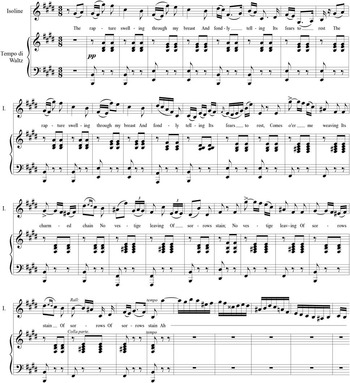
On stage, this dramatic lurch was smoothed over by the insertion of an orchestral march to accompany the arrival of Marquis and his forces, followed by enough refreshment and resolutory dialogue to propel Isoline into the yodelling leaps of a ninth, a tenth – or, at one point, a fourteenth – that bring the opera to a happy close (see Ex. 1); and then, in the inevitable encore, do so all over again.
The opening of Isoline’s final aria.

When the opera was revived in 1846, with Anna Bishop in the title role, one author suggested that the problem with the finale was that it ‘converts a vocalist into an instrument – a sort of human piano-forte’. Malibran avoided this through her expressive genius, the writer recalled, with her wail over the body of Jules, and ‘the scream of delight as she exclaimed “he breathes, my love lives”’.Footnote 9 Her performance of the actual finale was thereby sidestepped, and in truth – for all the praise it attracted in the opera’s original reception – the spectre of the singer as machine had been present from the start.
An account in the Examiner, for instance, described Balfe’s music for Malibran as a collection of ‘every roulade and cadence the lady ever sang in an opera’. For the later historian this offers a tantalising prospect: a written trace of ‘the peculiarities of her voice’. The implication, though, was that the result was diligent but heartless; an attempt at a simulacrum of Malibran’s musical mannerisms that becomes most pronounced in the final number, with its play on the two registers around her vocal break, before climaxing on a high trill characterised principally by its predictability: ‘we have a shake on C in alt, as usual, from Malibran, and the curtain descends’.Footnote 10 In the Musical Library, the audience’s pleasure at the final number was even turned into an ironic complicity, since Isoline ‘so well caricatures the modern vicious style of singing, makes it so palpably ridiculous, that the burlesque is immediately understood, is relished, and never fails to be clamorously called for a second time’.Footnote 11
More seems at stake here than simply whether one fell for Malibran’s charms or not. Céline Frigau Manning has written of Malibran’s calculated performance of excess, and while this was not the only opera to encourage such polarised opinions, here it was as if Balfe’s faux-Italian (or faux-Viennese) music risked unmasking Malibran as herself inauthentic, and her voice no more than a collection of musical tricks plagiarised from her own earlier performances.Footnote 12 Tricks, moreover, designed to please a particular audience, as explained in her Examiner obituary: ‘on the English stage … Malibran indulged in extravagances which she curtailed elsewhere – screaming shakes on C above the line, are compliments which we may consider as exclusively addressed to our peculiar taste’.Footnote 13 For those beyond the Channel, little more would be necessary to furnish a true explanation of her subsequent death, as Jules Janin described in the Revue et Gazette musicale: ‘It is England that has killed her for us, it is the English fog that has weighed down on this annihilated genius. She killed herself, this woman, in trying to bring to life this statue of iron and coal called England.’Footnote 14
It is striking, in this overheated context, that the narratives that collected around this aria in later years played precisely on its connections to naturalness, as if to extinguish any aura of the mechanical. There is the account of Balfe introducing the aria at a late stage, for instance, having dreamt up the waltz melody one night in a blaze of inspiration, before rushing to Malibran’s house and waking her to play it.Footnote 15 Or the story of Malibran singing it on a horse ride in the countryside outside London, to the amazement of a pair of sheep drovers.Footnote 16 Or even, most famously, the tale told by Alfred Bunn, manager of Drury Lane, of a trapdoor being cut in the stage to allow Malibran – all too human – to receive a pint of porter while languishing in the Guianese sands, which then sustained her through the concluding number.Footnote 17
The resonances of this last anecdote could echo in a variety of directions. For one thing, it chimed with moralising rumours raised both before and after Malibran’s death of her partiality for a tipple.Footnote 18 For another, it seemed to offer a key to the singer’s outlandish gifts of sufficient promise that the author of an 1885 medical treatise on the effects of alcohol on the voice would still record that ‘I cannot but think that the large amount of faith vested in the value of porter as a vocal stimulant rests largely on its reputation as the favourite beverage of the great Malibran.’Footnote 19
But it could also be read in another way. Porter, after all, was one of the greatest products of industrial London: the first mass-produced beer, constituting a large majority of the nigh-on three million barrels produced in the capital during the year of the premiere of The Maid of Artois; a total, as W. Weir calculated in 1843, that amounted to seventy-six gallons a year for every inhabitant of the city – man, woman and child. ‘Beer is to the London citizen’, Weir adds, ‘what the water in the reservoirs of the plain of Lombardy, or the kahvreez of Persia, is to the village peasantry of those countries.’Footnote 20 But its appeal was not just local; across the world people ‘know that London is the place where porter was invented’, including ‘in the tropical climates of the west’ – such as French Guiana, for example – where ‘bottled porter reigns supreme’.Footnote 21
Janin’s statue of iron and coal, in other words, had porter running through its veins, and empire on its mind. And in these terms even the comical image of Malibran’s deep draught – hidden by a sandbank in the tropical desert of Drury – before hurtling body and breath into her final aria, might yet yield new meanings. Meanings that underscore the singer’s lasting skill at confounding the binary certainties of her age; but meanings, too, that might help to reframe the centrality of London for Malibran, and, by extension, for the history of nineteenth-century opera.