Introduction
Psychotic experiences (PEs), including hallucinations and delusions, are common among the general population with a lifetime prevalence of 5.8–12.5% (Nuevo et al. Reference Nuevo, Chatterji, Verdes, Naidoo, Arango and Ayuso-Mateos2010; Linscott & van Os, Reference Linscott and van Os2013; McGrath et al. Reference McGrath, Saha, Al-Hamzawi, Alonso, Bromet, Bruffaerts, Caldas-de-Almeida, Chiu, de Jonge, Fayyad, Florescu, Gureje, Haro, Hu, Kovess-Masfety, Lepine, Lim, Mora, Navarro-Mateu, Ochoa, Sampson, Scott, Viana and Kessler2015). Recent evidence indicates that exposure to childhood adversities (CAs) is associated with elevated risk of later PEs (Varese et al. Reference Varese, Smeets, Drukker, Lieverse, Lataster, Viechtbauer, Read, van Os and Bentall2012; Trotta et al. Reference Trotta, Murray and Fisher2015; Morgan & Gayer-Anderson, Reference Morgan and Gayer-Anderson2016), with a meta-analysis reporting that CAs are associated with a 76% increased risk of PEs (Trotta et al. Reference Trotta, Murray and Fisher2015).
Existing research on CAs and PEs is limited by a focus on specific types of CAs rather than a comprehensive set of CAs. For example, studies have reported mainly on the following types of CAs and risk of PEs: (a) sexual abuse (Read et al. Reference Read, Agar, Argyle and Aderhold2003; Shevlin et al. Reference Shevlin, Dorahy and Adamson2007; Kilcommons et al. Reference Kilcommons, Morrison, Knight and Lobban2008; Bentall et al. Reference Bentall, Wickham, Shevlin and Varese2012; Murphy et al. Reference Murphy, Shevlin, Houston and Adamson2014; van Dam et al. Reference van Dam, van Nierop, Viechtbauer, Velthorst, van Winkel, Bruggeman, Cahn, de Haan, Kahn, Meijer, Myin-Germeys, van Os and Wiersma2015), (b) child abuse and neglect (Janssen et al. Reference Janssen, Krabbendam, Bak, Hanssen, Vollebergh, de Graaf and van Os2004; Arseneault et al. Reference Arseneault, Cannon, Fisher, Polanczyk, Moffitt and Caspi2011; Kelleher et al. Reference Kelleher, Keeley, Corcoran, Ramsay, Wasserman, Carli, Sarchiapone, Hoven, Wasserman and Cannon2013; van Dam et al. Reference van Dam, van Nierop, Viechtbauer, Velthorst, van Winkel, Bruggeman, Cahn, de Haan, Kahn, Meijer, Myin-Germeys, van Os and Wiersma2015), and (c) bullying and peer victimisation (van Dam et al. Reference van Dam, van Nierop, Viechtbauer, Velthorst, van Winkel, Bruggeman, Cahn, de Haan, Kahn, Meijer, Myin-Germeys, van Os and Wiersma2012; Kelleher et al. Reference Kelleher, Keeley, Corcoran, Ramsay, Wasserman, Carli, Sarchiapone, Hoven, Wasserman and Cannon2013; Wolke et al. Reference Wolke, Lereya, Fisher, Lewis and Zammit2014; Cristobal-Narvaez et al. Reference Cristobal-Narvaez, Sheinbaum, Ballespi, Mitjavila, Myin-Germeys, Kwapil and Barrantes-Vidal2016).
CAs rarely occur in isolation (Green et al. Reference Green, McLaughlin, Berglund, Gruber, Sampson, Zaslavsky and Kessler2010; Kessler et al. Reference Kessler, McLaughlin, Green, Gruber, Sampson, Zaslavsky, Aguilar-Gaxiola, Alhamzawi, Alonso, Angermeyer, Benjet, Bromet, Chatterji, de Girolamo, Demyttenaere, Fayyad, Florescu, Gal, Gureje, Haro, Hu, Karam, Kawakami, Lee, Lepine, Ormel, Posada-Villa, Sagar, Tsang, Ustun, Vassilev, Viana and Williams2010; McLaughlin et al. Reference McLaughlin, Green, Gruber, Sampson, Zaslavsky and Kessler2010b ). The pathways linking CAs and subsequent mental health are also complex and inter-correlated. For example, an association between parental mental illness and psychopathology in the offspring may be influenced by parenting ability (an ‘environmental’ exposure) as well as a range of confounding factors including shared genetic effects. CAs, like many traditional measures of environmental adversity, are modestly to moderately heritable (Kendler & Baker, Reference Kendler and Baker2007). Thus, more complex models that account for both the type and number of CAs are needed to determine whether the associations of CAs with PEs are specific to certain types of experiences but not others, and how increasing levels of exposure influence the risk for PEs. Indeed, several prior studies have documented a dose-response relationship between number of CAs and lifetime prevalence of PEs (Janssen et al. Reference Janssen, Krabbendam, Bak, Hanssen, Vollebergh, de Graaf and van Os2004; Shevlin et al. Reference Shevlin, Dorahy and Adamson2007; Wigman et al. Reference Wigman, van Winkel, Jacobs, Wichers, Derom, Thiery, Vollebergh and van Os2011a , Reference Wigman, van Winkel, Raaijmakers, Ormel, Verhulst, Reijneveld, van Os and Vollebergh b ; Bentall et al. Reference Bentall, Wickham, Shevlin and Varese2012; Murphy et al. Reference Murphy, Houston, Shevlin and Adamson2013; Muenzenmaier et al. Reference Muenzenmaier, Seixas, Schneeberger, Castille, Battaglia and Link2015).
Moreover, while the evidence linking CAs and lifetime PEs is robust (Morgan & Gayer-Anderson, Reference Morgan and Gayer-Anderson2016), little is known about the patterning of these associations at different stages of development. In particular, we are unaware of studies that have examined whether PEs tend to occur in close proximity to CA exposure, or whether CAs are associated with the onset of PEs at later periods in the life-course. PEs that emerge soon after CAs would suggest more direct and proximal mechanisms, consistent with stress-related mechanisms (CAs lead to a sensitization process that renders exposed individuals more reactive to subsequent stressors) (Cristobal-Narvaez et al. Reference Cristobal-Narvaez, Sheinbaum, Ballespi, Mitjavila, Myin-Germeys, Kwapil and Barrantes-Vidal2016). On the other hand, PEs that emerge many decades later might suggest indirect pathways, perhaps mediated by the occurrence of mental disorders. With regard to the latter possibility, extensive evidence suggests that CAs are associated with elevated risk of first onset of a wide range of mental disorders (Green et al. Reference Green, McLaughlin, Berglund, Gruber, Sampson, Zaslavsky and Kessler2010; Kessler et al. Reference Kessler, McLaughlin, Green, Gruber, Sampson, Zaslavsky, Aguilar-Gaxiola, Alhamzawi, Alonso, Angermeyer, Benjet, Bromet, Chatterji, de Girolamo, Demyttenaere, Fayyad, Florescu, Gal, Gureje, Haro, Hu, Karam, Kawakami, Lee, Lepine, Ormel, Posada-Villa, Sagar, Tsang, Ustun, Vassilev, Viana and Williams2010; McLaughlin et al. Reference McLaughlin, Green, Gruber, Sampson, Zaslavsky and Kessler2010b ; Reference McLaughlin, Greif Green, Gruber, Sampson, Zaslavsky and Kessler2012). We recently demonstrated that most mental disorders are also associated with increased odds of subsequent PE onset (McGrath et al. Reference McGrath, Saha, Al-Hamzawi, Alonso, Andrade, Borges, Bromet, Oakley Browne, Bruffaerts, Caldas de Almeida, Fayyad, Florescu, de Girolamo, Gureje, Hu, de Jonge, Kovess-Masfety, Lepine, Lim, Navarro-Mateu, Piazza, Sampson, Posada-Villa, Kendler and Kessler2016b ). Thus, it seems reasonable to assume that the association between CAs and PEs may be mediated, at least in part, by the onset of mental disorders following exposure to CAs. A recent analysis of the National Comorbidity Survey found that the associations of CAs with PEs were mediated partly by depression and/or anxiety (Sitko et al. Reference Sitko, Bentall, Shevlin, O'Sullivan and Sellwood2014), although the temporal sequence of the association was not ascertained. Other research suggests that symptoms related to affective or emotional instability partially mediate the association between CAs and PEs (Bak et al. Reference Bak, Krabbendam, Janssen, de Graaf, Vollebergh and van Os2005; Kramer et al. Reference Kramer, Simons, Myin-Germeys, Jacobs, Derom, Thiery, van Os and Wichers2012; Marwaha et al. Reference Marwaha, Broome, Bebbington, Kuipers and Freeman2014). Based on this initial work, there is a need for studies that explore the influence of mental disorders on the relationship between CAs and PEs. Ideally, these studies should explore a range of mental disorders, and ensure that the variables of interest are temporally ordered (i.e. that CAs occur prior to onset of mental disorders, which occur prior to the onset of PEs), a necessary but not sufficient condition to infer causality.
Finally, prior work has estimated the population attributable risk proportions (PARPs) of mental disorders that are associated with CAs, and found sizable PARPs both in the United States and cross-nationally (e.g. 38–45% of childhood-onset mental disorders; and 28–29% of early-adult onset mental disorders) (Green et al. Reference Green, McLaughlin, Berglund, Gruber, Sampson, Zaslavsky and Kessler2010; Kessler et al. Reference Kessler, McLaughlin, Green, Gruber, Sampson, Zaslavsky, Aguilar-Gaxiola, Alhamzawi, Alonso, Angermeyer, Benjet, Bromet, Chatterji, de Girolamo, Demyttenaere, Fayyad, Florescu, Gal, Gureje, Haro, Hu, Karam, Kawakami, Lee, Lepine, Ormel, Posada-Villa, Sagar, Tsang, Ustun, Vassilev, Viana and Williams2010). Estimates of PARPs related to psychotic experiences have also been derived from meta-analysis (33%) (Varese et al. Reference Varese, Smeets, Drukker, Lieverse, Lataster, Viechtbauer, Read, van Os and Bentall2012), but the relative importance of different types of CAs in contributing to the onset of PEs in the population remains unknown.
The aims of the present study were to examine the associations between CAs and first-onset of PEs, determine whether those associations vary at different stages of the life-course, and investigate the degree to which temporally-prior mental disorders explain the association between CAs and subsequent PE onset. We also estimated the population attributable risk proportion of PEs related to CA exposure. We used a large sample of adults drawn from a cross-national population-based study – the WHO World Mental Health (WMH) surveys.
Method
Samples
The WMH surveys are a coordinated set of community surveys administered in probability samples of the general population in countries throughout the world (www.hcp.med.harvard.edu/WMH; Kessler & Ustun, Reference Kessler and Ustun2004). We examined 17 WMH surveys that included both the CIDI Psychosis Module and items related to CAs. These 17 countries are distributed across North and South America (Colombia, Mexico, Peru, Sao Paulo in Brazil, USA); Africa (Nigeria); the Middle East (Iraq, Lebanon); Asia (Shenzhen in the People's Republic of China); and Europe (Belgium, France, Germany, Italy, The Netherlands, Portugal, Romania, Spain). All 17 surveys were based on multi-stage, clustered area probability sampling designs (Supplementary Table S1). The weighted average response rate across all 17 countries was 71.9%.
In keeping with previous studies of PEs (Saha et al. Reference Saha, Scott, Johnston, Slade, Varghese, Carter and McGrath2011a , Reference Saha, Scott, Varghese, Degenhardt, Slade and McGrath b ; McGrath et al. Reference McGrath, Saha, Al-Hamzawi, Alonso, Bromet, Bruffaerts, Caldas-de-Almeida, Chiu, de Jonge, Fayyad, Florescu, Gureje, Haro, Hu, Kovess-Masfety, Lepine, Lim, Mora, Navarro-Mateu, Ochoa, Sampson, Scott, Viana and Kessler2015, Reference McGrath, Saha, Al-Hamzawi, Andrade, Benjet, Bromet, Browne, Caldas de Almeida, Chiu, Demyttenaere, Fayyad, Florescu, de Girolamo, Gureje, Haro, Ten Have, Hu, Kovess-Masfety, Lim, Navarro-Mateu, Sampson, Posada-Villa, Kendler and Kessler2016a , b), we made the a priori decision to exclude individuals with PEs who screened positive for possible schizophrenia/psychosis, and manic-depression/mania. Thus, we excluded respondents who (a) reported (1) schizophrenia/psychosis or (2) manic-depression/mania in response to the question ‘What did the doctor say was causing (this/these) experiences?’; or (b) reported lifetime use of an antipsychotic medication for these symptoms. This resulted in the exclusion of 91 respondents (0.4% of all respondents), leaving 23998 respondents for this study (see Supplementary Table S1).
Procedures
All surveys were conducted in the homes of respondents by trained lay interviewers. Informed consent was obtained before beginning interviews in all countries. Procedures for obtaining informed consent and protecting individuals (ethical approvals) were approved and monitored for compliance by the institutional review boards of the collaborating organizations in each country (Kessler & Ustun, Reference Kessler and Ustun2008a ). Standardized interviewer training and quality control procedures were used consistently in the surveys. Full details of these procedures are described elsewhere (Kessler et al. Reference Kessler, Haro, Heeringa, Pennell and Ustun2006; Kessler & Üstün, Reference Kessler, Üstün, Kessler and Üstün2008b ).
Interviews were administered in two parts to reduce respondent burden. Part 1 was administered to all participants and included the core diagnostic assessment of DSM-IV mental disorders. Part 2 of the interview included additional questions about PEs, correlates and other disorders was administered to respondents who met lifetime criteria for any Part 1 disorder and a random proportion of other respondents without any mental disorders. Part 2 individuals were weighted by the inverse of their probability of selection to adjust for differential sampling, and therefore provide representative data on the target adult general population. Additional weights were used to adjust for differential probabilities of selection within households, non-response, and to match the samples to population socio-demographic distributions.
Data collection and data items
The instrument used in the WMH surveys was the WHO Composite International Diagnostic Interview (CIDI) (Kessler & Üstün, Reference Kessler, Üstün, Kessler and Üstün2008b ), a validated fully-structured diagnostic interview (http://www.hcp.med.harvard.edu/wmhcidi/instruments_download.php) designed to assess the prevalence and correlates of a wide range of mental disorders according to the definitions and criteria of both the DSM-IV and ICD-10 diagnostic systems. WHO translation, back-translation, and harmonisation protocols were used to adapt the CIDI for use in each participating country.
Psychotic experiences
The CIDI Psychosis Module included questions about six PE types – two related to hallucinatory experiences (visual hallucinations, auditory hallucinations) and four related to delusional experiences (thought insertion/withdrawal, mind control/passivity, ideas of reference, plot to harm/follow) (Supplementary Tables S2a, S2b). The respondents were asked if they ever experienced each PE (e.g. ‘Have you ever seen something that wasn't there that other people could not see?’; ‘Have you ever heard any voices that other people said did not exist?’ etc.). Only PEs occurring when the person was ‘not dreaming, not half-asleep, or not under the influence of alcohol or drugs’ were included. Respondents who reported PEs were then asked a probe question about the age of onset of PEs (i.e. ‘How old were you the very first time (this/either of these things/any of these things) happened to you?’).
Childhood adversity
The WMH surveys assessed a range of family-related CAs (see Kessler et al. Reference Kessler, McLaughlin, Green, Gruber, Sampson, Zaslavsky, Aguilar-Gaxiola, Alhamzawi, Alonso, Angermeyer, Benjet, Bromet, Chatterji, de Girolamo, Demyttenaere, Fayyad, Florescu, Gal, Gureje, Haro, Hu, Karam, Kawakami, Lee, Lepine, Ormel, Posada-Villa, Sagar, Tsang, Ustun, Vassilev, Viana and Williams2010). Eleven dichotomously scored CAs occurring before age 18 were assessed (full details are provided in Supplementary material S3). Age-of-exposure data were collected for other parental loss, parental divorce, parental death in the CIDI childhood section (e.g. ‘How old were you when your father/ mother died’), while the data on sexual abuse were collected using questions in the post-traumatic stress disorder section. As with previous analyses of CAs in the WMH surveys (Green et al. Reference Green, McLaughlin, Berglund, Gruber, Sampson, Zaslavsky and Kessler2010; Kessler et al. Reference Kessler, McLaughlin, Green, Gruber, Sampson, Zaslavsky, Aguilar-Gaxiola, Alhamzawi, Alonso, Angermeyer, Benjet, Bromet, Chatterji, de Girolamo, Demyttenaere, Fayyad, Florescu, Gal, Gureje, Haro, Hu, Karam, Kawakami, Lee, Lepine, Ormel, Posada-Villa, Sagar, Tsang, Ustun, Vassilev, Viana and Williams2010), we undertook an exploratory factor analysis via promax rotation (Supplementary Table S4), and confirmed that two meaningful groups of CAs were identified: (a) ‘Maladaptive Family Functioning’ (MFF) CAs, and (b) ‘Other CAs’. Seven CAs loaded onto the MFF factor (parental mental illness, substance disorder and criminal behaviour, family violence, physical abuse, sexual abuse and neglect) and four CAs (parental death, parental divorce, other parental loss and economic adversity) loaded onto the Other CA factor. All subsequent analyses examined CAs grouped by MFF and Other CAs.
Mental disorders
The WMHS CIDI assessed lifetime history of 21 mental disorders including mood disorders (major depressive disorder, bipolar disorders); anxiety disorders [panic disorder, generalized anxiety disorder (GAD), specific phobia, social phobia, agoraphobia without panic, post-traumatic stress disorder (PTSD), separation anxiety disorder (SAD) further divided into childhood SAD and adult separation anxiety disorder]; behaviour disorders (intermittent explosive disorder, attention deficit disorder, oppositional defiant disorder, conduct disorder); eating disorder (anorexia nervosa, bulimia nervosa, and binge eating disorder); and substance use disorders (alcohol abuse, alcohol dependence, drug abuse, and drug dependence). The disorders that require childhood onset (e.g. attention deficit disorder, oppositional defiant disorder, conduct disorder, separation anxiety disorder) were included in Part 2 and are limited to respondents in the age range 18–39 or 18–44 years (depending on site) because of concerns about recall bias among older respondents (Kessler et al. Reference Kessler, Angermeyer, Anthony, Demyttenaere, Gasquet, Gluzman, Gureje, Haro, Kawakami, Karam, Levinson, Medina Mora, Oakley Browne, Posada-Villa, Stein, Adley Tsang, Aguilar-Gaxiola, Alonso, Lee, Heeringa, Pennell, Berglund, Gruber, Petukhova, Chatterji and Ustun2007). All other disorders were assessed for the full sample age range. Clinical reappraisal studies indicate that lifetime diagnoses based on the CIDI have good concordance with diagnoses based on blinded clinical interviews (Haro et al. Reference Haro, Arbabzadeh-Bouchez, Brugha, de Girolamo, Guyer, Jin, Lepine, Mazzi, Reneses, Vilagut, Sampson and Kessler2006). In keeping with our previous research, standardized diagnostic hierarchy rules among the disorders assessed were applied where appropriate (Kessler et al. Reference Kessler, Chiu, Demler, Merikangas and Walters2005; McGrath et al. Reference McGrath, Saha, Al-Hamzawi, Andrade, Benjet, Bromet, Browne, Caldas de Almeida, Chiu, Demyttenaere, Fayyad, Florescu, de Girolamo, Gureje, Haro, Ten Have, Hu, Kovess-Masfety, Lim, Navarro-Mateu, Sampson, Posada-Villa, Kendler and Kessler2016a ).
Statistical analysis
Discrete-time survival analyses with person-year as the unit of analysis was used to investigate the associations between CAs and PEs. A person-year dataset was created such that each year in the life of each respondent (up to and including the age of onset of PE or in those without PE, their age at interview) was treated as a separate observational record. Age-of-exposure dates were available for sexual abuse, other parental loss, parental divorce and parental death, otherwise age 4 years was set as a default age-of-exposure, in keeping with previous analyses for CAs used in the WMH studies (Bruffaerts et al. Reference Bruffaerts, Demyttenaere, Borges, Haro, Chiu, Hwang, Karam, Kessler, Sampson, Alonso, Andrade, Angermeyer, Benjet, Bromet, de Girolamo, de Graaf, Florescu, Gureje, Horiguchi, Hu, Kovess, Levinson, Posada-Villa, Sagar, Scott, Tsang, Vassilev, Williams and Nock2010; Green et al. Reference Green, McLaughlin, Berglund, Gruber, Sampson, Zaslavsky and Kessler2010). In all analyses, the temporal order required the onset of CAs to precede that of PEs. We first estimated bivariate associations of CAs with PEs followed by a series of multivariate models: (a) M1 included all CAs simultaneously into the models without considering number of CAs (type model), (b) M2 used only number of CAs based on MFF and/or Other CAs (number model), and (c) M3 based on both type and number of CAs (multivariate interactive model). We also examined if there were gender differences in the associations between CAs and PEs. In order to choose a model for subsequent analyses, we examined both (a) model fitting measures [Bayesian Information Criterion (BIC), Akaike's Information Criterion (AIC); Akaike, Reference Akaike1974; Schwarz, Reference Schwarz1978], and (b) χ² tests in order to compare the odds ratios between CA types and/or number indicators as predictors of PEs.
Next, we re-estimated associations based on the most informative model for PE onsets occurring in four life-course stages: childhood (4–12 years); adolescence (13–19 years); young adulthood (20–29 years); and later adulthood (⩾30 years). This allowed us to examine whether the associations of CAs with PE onset varied across the life-course. Then, we examined the strength and pattern of association between CAs and PEs when adjusted for 21 temporally ordered mental disorders (i.e. the mental disorder occurred after the CA age-of-exposure but prior to the onset of PEs).
Finally, the PARPs were calculated based on the proportion of PE associated with the CA in the bivariate models. PARPs can be interpreted as the expected proportion of reduction in the outcome prevalence if CAs were eradicated (Cole & MacMahon, Reference Cole and MacMahon1971; Rothman & Greenland, Reference Rothman and Greenland2005). In order to assess the differential impact of three country level strata on PE risk, we conducted post-hoc analyses by including interaction terms between CAs and country income strata. Details of the country strata classification have been published elsewhere (McGrath et al. Reference McGrath, Saha, Al-Hamzawi, Alonso, Bromet, Bruffaerts, Caldas-de-Almeida, Chiu, de Jonge, Fayyad, Florescu, Gureje, Haro, Hu, Kovess-Masfety, Lepine, Lim, Mora, Navarro-Mateu, Ochoa, Sampson, Scott, Viana and Kessler2015).
As the WMH data are both clustered and weighted, the design-based Taylor series linearization implemented in SUDAAN software was used to estimate standard errors and evaluate the statistical significance of coefficients. Survival coefficients were exponentiated and are reported as odds ratios (ORs). Significance tests were evaluated using 0.05-level two-sided tests.
Results
Prevalence of CAs in those with and without PEs
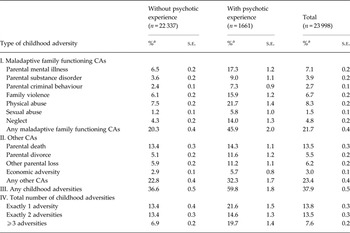
More than one-third of respondents (n = 10,015, 37.9%) reported exposure to at least one CA before age 18 years (Table 1). The prevalence of CA exposure among respondents with PEs was 59.8% compared to 36.6% in those with no PEs. Among respondents with PEs, there was wide variation in the frequency of exposure to specific types of CAs, with the highest prevalence reported for physical abuse (21.7%) followed by parental mental illness (17.3%). Among those with PEs, 19.7% had been exposed to three or more CAs, whereas the comparable proportion in those without PEs was 6.9%.
Prevalence of childhood adversities (CA) among those with and without psychotic experiences

aEstimates were based on weighted data.
The influence of type and number of CAs
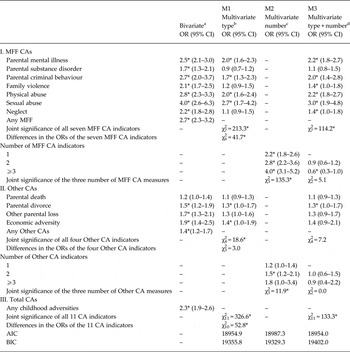
Table 2 summarizes the associations between CAs and subsequent first onset of PEs using type and/or number of CAs in both bivariate and multivariate models. In the bivariate model, all CAs with the exception of parental death were significantly associated with increased odds of subsequent PEs. Respondents with exposure to any CA had twice the odds of subsequent onset PEs compared to respondents with no CAs (OR 2.3, 95% CI 1.9–2.6). The ORs ranged from 1.7–4.0 for MFF CAs and 1.4–1.9 for Other CAs, with the highest ORs associated with sexual abuse (OR 4.0, 95% CI 2.6–6.3) physical abuse (OR 2.8, 95% CI 2.3–3.3), and parental criminal behaviour (OR 2.7, 95% CI 2.0–3.7).
Bivariate and multivariate associations between childhood adversities (CA) and the subsequent first onset of psychotic experiences

OR, Odds ratio; CI, confidence interval; MFF, maladaptive family functioning; AIC, Akaike's Information Criterion; BIC, Bayesian Information Criterion.
*Significant at the 0.05 level, two-tailed test.
a Each model was estimated with one childhood adversity entered at a time as predictor of psychotic experiences onset controlling for country, person-year dummies, age cohort and sex.
b M1: Model was estimated with dummy variables for all childhood adversities entered simultaneously as predictors of psychotic experiences onset including the controls specified in note a.
c M2: Model was estimated with dummy variables for number of MFF CAs (exactly 1 MFF, exactly 2 MFF and ⩾3 MFF) and number of Other CAs (exactly 1 Other CA, exactly 2 Other CAs and ⩾3 Other CAs) entered simultaneously as predictors of psychotic experiences onset including the controls specified in note a.
d M3: Model was estimated with dummy variables for type and number of childhood adversities (starting at exactly 2 MFF and ⩾3 MFF, exactly 2 Other CA and ⩾3 Other CAs) entered simultaneously as predictors of psychotic experiences onset including the controls specified in note a.
Total number of person-years used across all models = 9 75 199.
In general, the ORs in the multivariate model that controlled for all CA types were smaller than in the bivariate model, due to the high co-occurrence of CAs (see M1 multivariate model, Table 2). In the multivariate model, the ORs for PEs associated with specific types of CAs varied significantly (χ2 10 = 52.8, p < 0.001). The CAs that remained significantly associated with PEs in this model were parental mental illness, parent criminal behaviour, physical and sexual abuse, parent divorce, and economic adversity. For these CAs, the adjusted ORs ranged from 1.7–2.7 for MFF CAs and 1.3–1.4 for Other CAs. The highest adjusted ORs (⩾2) were found for sexual abuse (OR 2.7, 95% CI 1.7–4.2), physical abuse (OR 2.0, 95% CI 1.6–2.4), and parental mental illness (OR 2.0, 95% CI 1.6–2.3). We further examined whether there were gender differences in the associations of the latter three CAs with subsequent PE onset (data not shown). The sex-specific associations were similar for parental mental illness (females: OR 1.9, 95% CI 1.5–2.4; males: OR 2.0, 95% CI 1.4–2.9). For physical abuse, the OR (95% CI) was somewhat higher for males (2.3, 1.7–3.0) compared to females (1.7, 1.3–2.3), whereas for sexual abuse, the OR was higher and significant for females (2.7, 1.7–4.4) and lower and non-significant for males (1.7, 0.8–3.6).
In the model examining number of CAs only (i.e. exactly 1, exactly 2, ⩾3 CAs), there was a monotonic increase in the odds of PEs in respondents exposed to a greater number MFF CAs, indicating a dose-response relationship between number of CAs and PEs. A similar pattern of increasing odds of PEs was observed as the number of Other CAs increased (see M2 multivariate model, Table 2).
When we examined more complex models using type and number simultaneously in the multivariate models (M3), the OR associated with number of MFF and Other CAs were for the most part lower than 1.0, indicating a pattern of sub-additive interactions, whereby the incremental association of each additional CAs lessens in magnitude as the number of CAs increases. Taking into account the BIC and AIC as well as the pattern of findings across the models, we chose indicators only for type of MFF and Other CAs as the most informative model for subsequent analyses (Table 2, model M1).
In summary, we observed that exposure to CAs is associated with an increased odds of subsequent onset of PEs, that different CA types vary in their association with subsequent PEs, and that there was a dose-response relationship between higher numbers of CA types and increased risk of subsequent PEs.
Associations between CAs and subsequent onset of PEs across four life-course stages
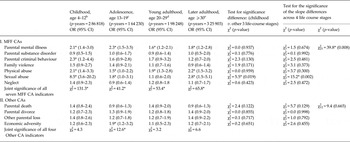
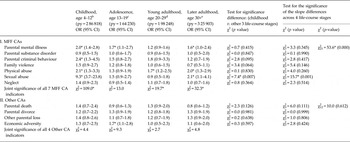
Table 3 shows the associations between CAs and subsequent onset of PEs in four life-course stages (see M1). MFF CAs, as a set (i.e. when all MFF types were considered together), were associated with onset of PEs in all four life-course stages (childhood, adolescence, early adulthood, later adulthood), whereas Other CAs, as a set, were associated with PE onset only during adolescence. A test for variation in the ORs across life-course stages was significant for MFF CAs (χ2 21 = 39.8, p = 0.008), but not in Other CAs, (χ2 12 = 9.4, p = 0.66). When examining the associations of particular CA types with PE onset across the life-course, only two MFF CAs (parental mental illness, physical abuse) were significantly associated with increased odds of subsequent PE onset across each of the four life-course stages. Across particular CA types, only sexual abuse showed significant variation across life-course stages with respect to subsequent PE onset (χ2 3 = 15.2, p = 0.002). The highest OR for sexual abuse and PE onset was during childhood (4–12 years) (OR 8.5, 95% CI 3.6–20.2), and further analyses confirmed that respondents exposed to sexual abuse were more likely to have their PE onset during childhood (4–12 years) compared to older years (⩾13; χ2 1 = 5.5, p = 0.019).
Multivariate associations between childhood adversities (CA) and the subsequent first onset of psychotic experiences in each of four life-course stages a

OR, Odds ratio; CI, confidence interval; MFF, maladaptive family functioning.
*Significant at the 0.05 level, two-tailed test.
a Model was estimated with dummy variables for all childhood adversities entered simultaneously as predictors of psychotic experiences onset controlling for country, person-years, age cohort and sex.
b Model is restricted to person-years between 4 and 12.
c Model is restricted to person-years between 13 and 19.
d Model is restricted to person-years between 20 and 29.
e Model is restricted to person-years > 29.
In summary, MFF CAs are associated with PEs in all life-course stages, whereas Other CAs are associated with PEs only in adolescence. Moreover, while MFF CAs are associated with PEs across all life-course stages, sexual abuse was more strongly associated with PEs that emerge during childhood (4–12 years).
Associations between CAs and PEs adjusting for mental disorders
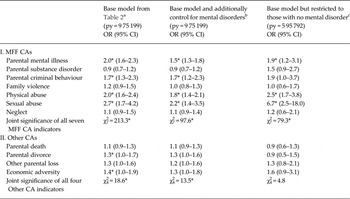
Next, we examined the associations of CAs with PEs adjusting for mental disorders that were temporally prior to the onset of PEs (Table 4). There were slight reductions in the ORs associated with particular CA types after adjusting for mental disorders (M4) compared to the unadjusted model (M1). However, the associations of both MFF CAs and Other CAs with PEs remained significant as a set after adjusting for mental disorders. We also examined the association of CAs with PEs within the subgroup of respondents without any mental disorders that were temporally prior to the onset of PEs (M5). As a set, associations for MFF CAs remained significant with PEs, but the relationship became non-significant for Other CAs. Of interest, the OR (95% CI) for the relationship between sexual abuse and PEs was 6.7 (2.5–18.0).
Multivariate associations between childhood adversities (CA) and the subsequent first onset of psychotic experiences

py, Person-years; OR, odds ratio; CI, confidence interval; MFF, maladaptive family functioning.
*Significant at the 0.05 level, two-tailed test.
a See note b in Table 2 for a description of model 1.
b Model specification is as above and additionally control for 21 DSM-IV mental disorders and exactly 2 and ⩾3 DSM-IV mental disorders.
c Base model but restricted to those without prior history of mental disorder temporally prior to the onset of PEs.
Finally, we examined the role of temporally-prior mental disorders in the associations of CAs and PEs across life-course stages (Table 5). The pattern of findings was similar to the unadjusted life-course models, with one exception. As a set, MFF and Other CAs were no longer associated with PE onsets during adolescence after adjustment for temporally prior mental disorders. The association between sexual abuse and PEs during childhood persisted.
Multivariate associations between childhood adversities (CA) and the subsequent first onset of psychotic experiences in each of four life-course stages with adjustment for mental disorders a

py, Person-years; OR, odds ratio; CI, confidence interval; MFF, maladaptive family functioning.
*Significant at the 0.05 level, two-tailed test.
a Model was estimated with dummy variables for all childhood adversities entered simultaneously as predictors of psychotic experiences onset controlling for country, person-years, age cohort, sex and 21 DSM-IV mental disorders.
b Model is restricted to person-years between 4 and 12.
c Model is restricted to person-years between 13 and 19.
d Model is restricted to person-years between 20 and 29.
e Model is restricted to person-years >29.
In summary, the pattern of associations between CAs and subsequent PEs remained similar in models adjusted for mental disorders, apart from weakening of the association between MFF or Other CAs and PE onset in adolescence after accounting for temporally prior mental disorders.
PARPs between CAs and PEs
The overall PARP for PEs associated with CAs was 30.9% (Supplementary Table S5) with most of this proportion attributable to MFF CAs (24%). With regard to individual CAs, physical abuse had the highest PARP (8.2%), followed by parental mental illness (6.9%).
Post-hoc analysis
We conducted an additional analysis to assess the differential impact of three country-level strata on PEs risk using interaction terms between CAs and country strata. While the overall joint effect was significant (χ2 22 = 40.4, p = 0.001), we found that the pairwise estimates for individual CAs on PEs were all non-significant except for ‘economic adversity’ (data not shown). This particular CA was rarely reported in low income countries, leading to unstable and imprecise estimates. Otherwise, this exposure was also associated with comparable estimates in middle and high income strata countries.
Discussion
Based on the largest study of PEs and CAs to date, we confirmed that CAs are associated with a more than twofold increased odds of subsequent first onset of PEs, which is similar but slightly higher than the pooled estimate from a recent systematic review (Trotta et al. Reference Trotta, Murray and Fisher2015). We also confirmed a dose-response relationship between higher numbers of CA types and odds of subsequent PEs, consistent with previous literature (Janssen et al. Reference Janssen, Krabbendam, Bak, Hanssen, Vollebergh, de Graaf and van Os2004; Wigman et al. Reference Wigman, van Winkel, Raaijmakers, Ormel, Verhulst, Reijneveld, van Os and Vollebergh2011b ; Kelleher et al. Reference Kelleher, Keeley, Corcoran, Ramsay, Wasserman, Carli, Sarchiapone, Hoven, Wasserman and Cannon2013; Muenzenmaier et al. Reference Muenzenmaier, Seixas, Schneeberger, Castille, Battaglia and Link2015; van Dam et al. Reference van Dam, van Nierop, Viechtbauer, Velthorst, van Winkel, Bruggeman, Cahn, de Haan, Kahn, Meijer, Myin-Germeys, van Os and Wiersma2015). Additionally, we contributed four novel findings: first, that CAs involving MFF were more strongly related to PEs than Other CAs; second, that CAs involving MFF were associated with onset of PEs across all stages of the life-course; third, that temporally prior mental disorders appeared to explain the association of CAs with PE onset in adolescence, but not other life-course stages; and finally, that CAs involving MFF may account for nearly one-quarter of all PE onsets in the population. We discuss each of these in turn.
First, we examined whether the association of CAs with PEs varied according to CA types. To date, prior research has neither included a wide range of CA types, nor used statistical models that acknowledged the inter-correlated nature of CAs. Although all CAs were associated with PEs when examined one-at-a-time, when examined together, only four CAs reflecting MFF (parental mental illness, parental criminal behaviour, physical abuse, and sexual abuse) and two Other CAs (parental divorce, economic adversity) remained associated with subsequent PEs.
Second, CAs involving MFF were associated with PE onsets in every stage of the life-course, whereas Other CAs were associated only with PEs in adolescence.
We have recently presented the age-of-onset curve for PEs – the median (interquartile range; IQR) was 26 (17–41) years, indicating that PEs commence across a surprisingly wide age range (McGrath et al. Reference McGrath, Saha, Al-Hamzawi, Alonso, Andrade, Borges, Bromet, Oakley Browne, Bruffaerts, Caldas de Almeida, Fayyad, Florescu, de Girolamo, Gureje, Hu, de Jonge, Kovess-Masfety, Lepine, Lim, Navarro-Mateu, Piazza, Sampson, Posada-Villa, Kendler and Kessler2016b ). Our findings suggest that Other CAs might increase the risk for PEs through mechanisms that have proximal consequences (Bentall et al. Reference Bentall, de Sousa, Varese, Wickham, Sitko, Haarmans and Read2014; Morgan & Gayer-Anderson, Reference Morgan and Gayer-Anderson2016). In contrast, MFF CAs appear to create a generalized diathesis for PEs that persists across the life-course. This diathesis could involve a variety of emotional, neurobiological, and cognitive processes that are influenced by CAs, including heightened vulnerability to stress (McLaughlin et al. Reference McLaughlin, Kubzansky, Dunn, Waldinger, Vaillant and Koenen2010c ), elevated emotional reactivity and poor emotion regulation skills (McLaughlin et al. Reference McLaughlin, Conron, Koenen and Gilman2010a ; Reference McLaughlin, Peverill, Gold, Alves and Sheridan2015; McCrory et al. Reference McCrory, De Brito, Sebastian, Mechelli, Bird, Kelly and Viding2011; Heleniak et al. Reference Heleniak, Jenness, Van der Stoep, McCauley and McLaughlin2016), and deficits in cognitive control (DePrince et al. Reference DePrince, Weinzierl and Combs2009). Each of these domains, in turn, has been proposed as mechanisms that may underlie PEs (Freeman et al. Reference Freeman, Garety, Kuipers, Fowler, Bebbington and Dunn2007; Bentall et al. Reference Bentall, Rowse, Shryane, Kinderman, Howard, Blackwood, Moore and Corcoran2009, Reference Bentall, de Sousa, Varese, Wickham, Sitko, Haarmans and Read2014; Morgan & Gayer-Anderson, Reference Morgan and Gayer-Anderson2016). CAs related to MFF may differentially lead to social differentiation and social defeat (at the individual and/or family level), which has been linked to risk of PEs (Morgan & Gayer-Anderson, Reference Morgan and Gayer-Anderson2016). Identifying the precise mechanisms through which MFF CAs influence risk for PEs and determining why this vulnerability persists throughout the life-course are key areas for future research.
Third, associations between CAs and PEs were largely unchanged in childhood and adulthood after adjustment for mental disorders that began prior to the onset of PEs. In contrast, CAs were no longer associated with PE onset in adolescence after accounting for prior-onset mental disorders. We have previously identified an association between mental disorder and PEs (McGrath et al. Reference McGrath, Saha, Al-Hamzawi, Andrade, Benjet, Bromet, Browne, Caldas de Almeida, Chiu, Demyttenaere, Fayyad, Florescu, de Girolamo, Gureje, Haro, Ten Have, Hu, Kovess-Masfety, Lim, Navarro-Mateu, Sampson, Posada-Villa, Kendler and Kessler2016a ). Our findings suggest that prior mental disorders might be particularly important as a pathway to PEs in adolescence among youths with exposure to CAs. It is possible that the vulnerability factors that predispose to adolescent-onset PEs also contribute to other early-onset mental disorders that emerge following exposure to CAs. With respect to vulnerability factors, we found that parental mental illness was associated with an increased odds of PEs. This finding, which could reflect shared genetic vulnerabilities and/or adverse environmental exposures (e.g. suboptimal parenting), is consistent with other studies that have reported an association between family history of mental disorder and lifetime prevalence of PEs (Kelleher & Cannon, Reference Kelleher and Cannon2011; Varghese et al. Reference Varghese, Saha, Scott, Chan and McGrath2011; Jeppesen et al. Reference Jeppesen, Larsen, Clemmensen, Munkholm, Rimvall, Rask, van Os, Petersen and Skovgaard2015). Alternatively, CAs might increase risk for this early-life variant of PEs only among individuals who developed psychopathology following CA exposure as has been shown in other disorders such as PTSD (Breslau et al. Reference Breslau, Peterson and Schultz2008; Koenen et al. Reference Koenen, Moffitt, Caspi, Gregory, Harrington and Poulton2008).
Sexual abuse exhibited a particularly strong association with PEs that emerge during childhood (4–12 years), with an 8.5 fold increased odds of PE emergence among respondents who were sexually abused. Clinicians and researchers have long been aware of the association between childhood sexual abuse and clinical psychotic disorders (e.g. schizophrenia) (Read et al. Reference Read, van Os, Morrison and Ross2005; Cutajar et al. Reference Cutajar, Mullen, Ogloff, Thomas, Wells and Spataro2010), and thus the link between this exposure and PEs has been of interest (Morgan & Gayer-Anderson, Reference Morgan and Gayer-Anderson2016). Many studies have previously reported links between sexual abuse and PEs (Read et al. Reference Read, Agar, Argyle and Aderhold2003; Shevlin et al. Reference Shevlin, Dorahy and Adamson2007; Bentall et al. Reference Bentall, Wickham, Shevlin and Varese2012; Murphy et al. Reference Murphy, Shevlin, Houston and Adamson2014; van Dam et al. Reference van Dam, van Nierop, Viechtbauer, Velthorst, van Winkel, Bruggeman, Cahn, de Haan, Kahn, Meijer, Myin-Germeys, van Os and Wiersma2015; Cristobal-Narvaez et al. Reference Cristobal-Narvaez, Sheinbaum, Ballespi, Mitjavila, Myin-Germeys, Kwapil and Barrantes-Vidal2016). Identifying mechanisms that explain this association is important for targeting interventions to prevent the onset of PEs in children who have been sexually abused (e.g. psychotherapy aimed at reducing psychological vulnerabilities). Our findings suggest that intervening mental disorders do not play a meaningful role in this pathway.
Fourth, CAs were associated with a substantial proportion of PE onsets in the population, and the bulk of the population attributable risk involves MFF CAs. This suggests that – assuming the association of CAs with PEs is causal – nearly one-third of PEs could be prevented if exposure to CAs was eliminated or if interventions were developed that could mitigate the risk pathways linking CAs to PEs. Similarly high PARPs have been observed for other mental disorders associated with CAs (Green et al. Reference Green, McLaughlin, Berglund, Gruber, Sampson, Zaslavsky and Kessler2010; Kessler et al. Reference Kessler, McLaughlin, Green, Gruber, Sampson, Zaslavsky, Aguilar-Gaxiola, Alhamzawi, Alonso, Angermeyer, Benjet, Bromet, Chatterji, de Girolamo, Demyttenaere, Fayyad, Florescu, Gal, Gureje, Haro, Hu, Karam, Kawakami, Lee, Lepine, Ormel, Posada-Villa, Sagar, Tsang, Ustun, Vassilev, Viana and Williams2010; McLaughlin et al. Reference McLaughlin, Greif Green, Gruber, Sampson, Zaslavsky and Kessler2012), underscoring the significance of CAs in shaping the distribution of psychopathology in the population.
The current study has several limitations which deserve comment. We excluded those who were screen-positive for possible psychotic disorders (based on self-report, use of antipsychotic medications to treat PEs). However, we did not have access to valid measures of clinical psychotic disorders in our sample, and thus it is feasible that a small proportion of respondents with clinical psychosis were included in the analyses. We also relied on retrospective reports about age of onset, which might have led to a recall bias. For some CAs, we were not able to determine an age of onset, and used a default of age 4 which is the standard earliest age of onset for disorders and exposures within the WMH studies. However, we note that several prospective studies have confirmed the association between CAs and subsequent PEs (Arseneault et al. Reference Arseneault, Cannon, Fisher, Polanczyk, Moffitt and Caspi2011; Fisher et al. Reference Fisher, Schreier, Zammit, Maughan, Munafo, Lewis and Wolke2013; Kelleher et al. Reference Kelleher, Keeley, Corcoran, Ramsay, Wasserman, Carli, Sarchiapone, Hoven, Wasserman and Cannon2013; Rossler et al. Reference Rossler, Hengartner, Ajdacic-Gross, Haker and Angst2014; Wolke et al. Reference Wolke, Lereya, Fisher, Lewis and Zammit2014). While we were able to explore a much wider range of CAs than previous studies, we focused on family-related exposures and we lacked information on childhood bullying. In light of the growing body of evidence linking this particular type of CA with PEs, this would be an important exposure to include in future studies (Kelleher et al. Reference Kelleher, Harley, Lynch, Arseneault, Fitzpatrick and Cannon2008; van Dam et al. Reference van Dam, van der Ven, Velthorst, Selten, Morgan and de Haan2012; Fisher et al. Reference Fisher, Schreier, Zammit, Maughan, Munafo, Lewis and Wolke2013; Wolke et al. Reference Wolke, Lereya, Fisher, Lewis and Zammit2014). We did not adjust for multiple comparisons in this study which may lead to inflation of Type I errors. In the current analyses we have focused on PEs as a class only, however there is evidence to suggest that certain types of CAs (e.g. sexual abuse) may be linked to hallucinations more than delusions (Bentall et al. Reference Bentall, de Sousa, Varese, Wickham, Sitko, Haarmans and Read2014). We plan to explore this research question in future studies.
Conclusions
Based on the largest single study to date, our cross-national study confirms the association between CAs and the subsequent onset of PEs. CAs related to MFF are associated with PEs that emerge across the life span, and intervening mental disorders do not account for this finding. Childhood sexual abuse was strongly associated with PEs that emerged during childhood. While we have more than enough evidence linking CAs with adverse mental and physical health outcomes (Scott et al. Reference Scott, Varghese and McGrath2010), the robust literature now linking CAs and PEs can provide important clues to aetiopathogenesis of PEs and mental disorders (Heleniak et al. Reference Heleniak, Jenness, Van der Stoep, McCauley and McLaughlin2016). These, in turn, can inform clinically-targeted interventions designed to reduce the burden of mental disorders in those exposed to CAs (Bentall et al. Reference Bentall, de Sousa, Varese, Wickham, Sitko, Haarmans and Read2014; Morgan & Gayer-Anderson, Reference Morgan and Gayer-Anderson2016).
Appendix. WMH Survey Collaborators
The WHO World Mental Health Survey collaborators are: Tomasz Adamowski, PhD, MD, Sergio Aguilar-Gaxiola, MD, PhD, Ali Al-Hamzawi, MD, Mohammad Al-Kaisy, MD, Abdullah Al Subaie, MBBS, FRCP, Jordi Alonso, MD, PhD , Yasmin Altwaijri, MS, PhD, Laura Helena Andrade, MD, PhD, Lukoye Atwoli, MD, PhD, Randy P. Auerbach, PhD, William G. Axinn, PhD, Corina Benjet, PhD, Guilherme Borges, ScD, Robert M. Bossarte, PhD, Evelyn J. Bromet, PhD, Ronny Bruffaerts, PhD, Brendan Bunting, PhD, Jose Miguel Caldas de Almeida, MD, PhD, Graca Cardoso, MD, PhD, Alfredo H. Cia, MD, Stephanie Chardoul, Somnath Chatterji, MD, Alexandre Chiavegatto Filho, PhD, Pim Cuijpers, PhD, Louisa Degenhardt, PhD, Giovanni de Girolamo, MD, Ron de Graaf, MS, PhD, Peter de Jonge, PhD, Koen Demyttenaere, MD, PhD, David D. Ebert, PhD, Sara Evans-Lacko, PhD, John Fayyad, MD, Fabian Fiestas, MD, PhD, Silvia Florescu, MD, PhD, Sandro Galea, DrPH, MD, MPH, Laura Germine, PhD, Stephen E. Gilman, ScD, Dirgha J. Ghimire, PhD, Meyer D. Glantz, PhD, Semyon Gluzman, MD, Oye Gureje, PhD, DSc, FRCPsych, Josep Maria Haro, MD, MPH, PhD, Meredith G. Harris, MPH, PhD, Yanling He, MD, Hristo Hinkov, MD, Chi-yi Hu, PhD, MD, Yueqin Huang, MD, MPH, PhD, Aimee Nasser Karam, PhD, Elie G. Karam, MD, Norito Kawakami, MD, DMSc, Ronald C. Kessler, PhD, Andrzej Kiejna, MD, PhD, Karestan C. Koenen, PhD, Viviane Kovess-Masfety, MSc, MD, PhD, Carmen Lara, MD, PhD, Sing Lee, PhD, Jean-Pierre Lepine, MD, Itzhak Levav, MD, Daphna Levinson, PhD, Zhaorui Liu, MD, MPH, Silvia S. Martins, MD, PhD, Herbert Matschinger, PhD, John J. McGrath, PhD, Katie A. McLaughlin, PhD, Maria Elena Medina-Mora, PhD, Zeina Mneimneh, PhD, MPH, Jacek Moskalewicz, DrPH, Fernando Navarro-Mateu, MD, PhD, Matthew K. Nock, PhD, Siobhan O'Neill, PhD, Mark Oakley-Browne, MB, ChB, PhD, Johan Ormel, PhD, Beth-Ellen Pennell, MA, Marina Piazza, MPH, ScD, Stephanie Pinder-Amaker, PhD, Patryk Piotrowski, MD, PhD, Jose Posada-Villa, MD, Ayelet M. Ruscio, PhD, Kate M. Scott, PhD, Vicki Shahly, PhD, Tim Slade, PhD, Jordan W. Smoller, ScD, MD, Juan Carlos Stagnaro, MD, PhD, Dan J. Stein, FRCPC, PhD, Amy E. Street, PhD, Hisateru Tachimori, PhD, Nezar Taib, MS, Margreet ten Have, PhD, Graham Thornicroft, PhD, Yolanda Torres, MPH, Maria Carmen Viana, MD, PhD, Gemma Vilagut, MS, Elisabeth Wells, PhD, Harvey Whiteford, PhD, David R. Williams, MPH, PhD, Michelle A. Williams, ScD, Bogdan Wojtyniak, ScD, Alan M. Zaslavsky, PhD.
Supplementary material
The supplementary material for this article can be found at https://doi.org/10.1017/S0033291716003263.
Acknowledgements
The World Health Organization World Mental Health (WMH) Survey Initiative is supported by the National Institute of Mental Health (NIMH; R01 MH070884), the John D. and Catherine T. MacArthur Foundation, the Pfizer Foundation, the US Public Health Service (R13-MH066849, R01-MH069864, and R01 DA016558), the Fogarty International Center (FIRCA R03-TW006481), the Pan American Health Organization, Eli Lilly and Company, Ortho-McNeil Pharmaceutical, GlaxoSmithKline, and Bristol-Myers Squibb. We thank the staff of the WMH Data Collection and Data Analysis Coordination Centres for assistance with instrumentation, fieldwork, and consultation on data analysis. None of the funders had any role in the design, analysis, interpretation of results, or preparation of this paper. The views and opinions expressed in this report are those of the authors and should not be construed to represent the views of the sponsoring organizations, agencies, or governments.
The Colombian National Study of Mental Health (NSMH) is supported by the Ministry of Social Protection. The ESEMeD project is funded by the European Commission (Contracts QLG5-1999-01042; SANCO 2004123, and EAHC 20081308), the Piedmont Region (Italy)), Fondo de Investigación Sanitaria, Instituto de Salud Carlos III, Spain (FIS 00/0028), Ministerio de Ciencia y Tecnología, Spain (SAF 2000-158-CE), Departament de Salut, Generalitat de Catalunya, Spain, Instituto de Salud Carlos III (CIBER CB06/02/0046, RETICS RD06/0011 REM-TAP), and other local agencies and by an unrestricted educational grant from GlaxoSmithKline. Implementation of the Iraq Mental Health Survey (IMHS) and data entry were carried out by the staff of the Iraqi MOH and MOP with direct support from the Iraqi IMHS team with funding from both the Japanese and European Funds through United Nations Development Group Iraq Trust Fund (UNDG ITF). The Lebanese Evaluation of the Burden of Ailments and Needs Of the Nation (L.E.B.A.N.O.N.) is supported by the Lebanese Ministry of Public Health, the WHO (Lebanon), National Institute of Health/Fogarty International Center (R03 TW006481-01), anonymous private donations to IDRAAC, Lebanon, and unrestricted grants from, Algorithm, AstraZeneca, Benta, Bella Pharma, Eli Lilly, Glaxo Smith Kline, Lundbeck, Novartis, Servier, Phenicia, UPO. The Mexican National Comorbidity Survey (MNCS) is supported by The National Institute of Psychiatry Ramon de la Fuente (INPRFMDIES 4280) and by the National Council on Science and Technology (CONACyT-G30544- H), with supplemental support from the PanAmerican Health Organization (PAHO). The Nigerian Survey of Mental Health and Wellbeing (NSMHW) is supported by the WHO (Geneva), the WHO (Nigeria), and the Federal Ministry of Health, Abuja, Nigeria. The Peruvian World Mental Health Study was funded by the National Institute of Health of the Ministry of Health of Peru. The Portuguese Mental Health Study was carried out by the Department of Mental Health, Faculty of Medical Sciences, NOVA University of Lisbon, with collaboration of the Portuguese Catholic University, and was funded by Champalimaud Foundation, Gulbenkian Foundation, Foundation for Science and Technology (FCT) and Ministry of Health. The Romania WMH study projects ‘Policies in Mental Health Area’ and ‘National Study regarding Mental Health and Services Use’ were carried out by National School of Public Health & Health Services Management (former National Institute for Research & Development in Health, present National School of Public Health Management & Professional Development, Bucharest), with technical support of Metro Media Transilvania, the National Institute of Statistics – National Centre for Training in Statistics, SC. Cheyenne Services SRL, Statistics Netherlands and were funded by Ministry of Public Health (former Ministry of Health) with supplemental support of Eli Lilly Romania SRL. The São Paulo Megacity Mental Health Survey is supported by the State of São Paulo Research Foundation (FAPESP) Thematic Project Grant 03/00204-3. The Shenzhen Mental Health Survey is supported by the Shenzhen Bureau of Health and the Shenzhen Bureau of Science, Technology, and Information. The US National Comorbidity Survey Replication (NCS-R) is supported by the National Institute of Mental Health (NIMH; U01-MH60220) with supplemental support from the National Institute of Drug Abuse (NIDA), the Substance Abuse and Mental Health Services Administration (SAMHSA), the Robert Wood Johnson Foundation (RWJF; Grant 044708), and the John W. Alden Trust. Evelyn Bromet has funding from CDC/NIOSH (U01OH010712; R. Kotov; PI; U01OH010718, B. Luft, PI; and U01OH010718, A. Gonzalez, PI) and NIA (R01AG049953, S. Clouston, PI). John McGrath received John Cade Fellowship APP1056929 from the National Health and Medical Research Council.
Declaration of Interest
In the past 3 years, Dr Kessler received support for his epidemiological studies from Sanofi Aventis, was a consultant for Johnson & Johnson Wellness and Prevention, and served on an advisory board for the Johnson & Johnson Services Inc. Lake Nona Life Project. Dr Kessler is a co-owner of DataStat, Inc., a market research firm that carries out healthcare research.