The co-occurrence of adolescent conduct problems (CP) and depressive symptoms (DS) has been the focus in a number of studies (Beyers & Leober, Reference Beyers and Loeber2003; Capaldi, Reference Capaldi1991, Reference Capaldi1992; Capaldi & Stoolmiller, Reference Capaldi and Stoolmiller1999; Compton, Snyder, Schrepferman, Bank, & Shortt, Reference Compton, Snyder, Schrepferman, Bank and Shortt2003; Harrington, Rutter, & Fombonne, Reference Harrington, Rutter and Fombonne1996; Lansford et al., Reference Lansford, Malone, Stevens, Dodge, Bates and Pettit2006; Ruchkin, Sukhodolsky, Vermeiren, Koposov, & Schwab-Stone, Reference Ruchkin, Sukhodolsky, Vermeiren, Koposov and Schwab-Stone2006; Rutter, Reference Rutter1989; Wiesner, Kim, & Capaldi, Reference Wiesner, Kim and Capaldi2005). A central thesis in these studies is how and why CP and DS, two problem behaviors with qualitatively different symptoms, are associated in adolescence. With CP and DS indicating externalizing and internalizing behavior problems, respectively, it is of theoretical and practical interest to examine the extent of co-occurrence of these two dimensions of problem behaviors. One interpretation is that noxious behavior such as bullying and destroying property causes social rejection, and in turn, leads to vulnerability to depression (Capaldi, Reference Capaldi1991). Depression, however, was not predictive of an increase in CP in follow-up measures (Capaldi, Reference Capaldi1992). Another explanation is that CP and DS may share a similar etiology where the same precursors, such as childhood abuse, low social competences, low parent knowledge (Lansford et al., Reference Lansford, Malone, Stevens, Dodge, Bates and Pettit2006), or high parent–child conflict (Formoso, Gonzales, & Aiken, Reference Formoso, Gonzales and Aiken2000; Rutter, Reference Rutter1989) lead to the onset and development of both CP and DS. Harrington et al. (Reference Harrington, Rutter and Fombonne1996) suggested another interpretation: depression may be heterogeneous, and CP is likely to be expressed with certain types of DS.
Researchers are also interested in the consequences of the co-occurrence problem in adolescents. For example, Capaldi and Stoolmiller (Reference Capaldi and Stoolmiller1999) found that social and academic maladjustment was more likely to result from co-occurring CP and DS. However, Harrington et al. (1996) reported that adolescents with comorbidity in CP and DS had a lower risk of recurrence of major depression later compared with youths with “pure depression.” A review of the literature shows that many important issues in this area are still in the early stages of research, and previous studies are mostly based on at-risk, clinical, male-only, or cross-sectional samples. Findings from these studies are naturally limited by sample selection, design, and methodology. Longitudinal studies of co-occurring CP and DS with nonclinical samples of both boys and girls are rare.
This study examined issues concerning the co-occurrence of CP and DS in a school-based sample of 2,435 participants measured in five waves from Grade 6 to 9. We applied general growth mixture modeling (GGMM; Muthen, Reference Muthén and Kaplan2004) to identify trajectory groups with distinctive patterns in the pathways of CP and DS during early adolescence. The prevalence of the co-occurrence problem was estimated from the memberships in trajectory groups. We also examined demographical, psychosocial, and parenting factors as precursors that differentiated trajectory groups. Academic achievement in the ninth grade was compared among the trajectory groups to determine the consequences of the co-occurrence problem. Gender difference in CP (Moffitt, Caspi, Rutter, & Silva, Reference Moffitt, Caspi, Rutter and Silva2001) and DS (Cicchetti & Toth, Reference Cicchetti and Toth1998) has been consistently documented in the literature and was a major consideration in this study.
Prevalence
The tendency for CP and DS to co-occur among adolescents has been reported in clinical and nonclinical samples. In a literature review, Capaldi (Reference Capaldi1991) summarized that approximately one-third of the children diagnosed with either conduct disorder or depression might be diagnosed as having both syndromes. Among Capaldi's (1991) nonclinical sample of 203 at-risk boys using 70th percentile as the cutoff for CP and DS measures, about 13% of the boys were classified as high in both CP and DS. With a large sample from the Minnesota Twin Family Study, Marmorstein and Iacono (Reference Marmorstein and Iacono2003) documented that about 15% to 25% of the youths with conduct disorder also had major depression, and approximately 15% to 35% of the depressed youths also had conduct disorder. In a more recent study on the prevalence of DS and its associated psychopathology, Ruchkin et al. (Reference Ruchkin, Sukhodolsky, Vermeiren, Koposov and Schwab-Stone2006) reported that among an urban community sample of 1,343 adolescents from 14 to 17 years old, 13.1% of the boys and 17.9% of the girls had clinical levels of DS. Among those depressed youths, 6.93% of the boys and 4.23% of the girls also had severe antisocial behaviors such as starting a fist fight, participating in a gang fight, hurting someone badly, or carrying a knife to school. Clearly, the co-occurrence of CP and DS exists in both clinical and nonclinical adolescent populations, with clinical populations having considerably higher prevalence than nonclinical populations.
Etiology of CP and DS
A great number of studies have examined the etiology that may contribute to the development of adolescent CP and DS. However, most studies consider CP and DS in isolation rather than a co-occurring outcome. A few studies sought to identify the vulnerable or protective factors as shared precursors to the development of both CP and DS. Probably the most comprehensive study on the co-occurrence of adolescent CP and DS was conducted by Capaldi (Capaldi, Reference Capaldi1991, Reference Capaldi1992) and Capaldi and Stoolmiller (Reference Capaldi and Stoolmiller1999). This longitudinal study used an at-risk sample of approximately 200 boys in the Oregon Youth Study with data collected in the 6th, 8th, and 12th grades to examine the common etiology, developmental stability, and consequences of the co-occurrence of CP and DS. A failure model was proposed such that noxious conduct would result in poor social and academic adjustment. Maladjustment would, in turn, cause more depression in adolescents. The study found that lower socioeconomic status (SES), parent substance use, parent antisocial behavior, parent depression, and lower parent monitoring were significantly related to elevated CP and DS in adolescent boys. As predicted, both CP and DS were found to be stable into young adulthood.
Using a community sample of 585 children from kindergarten to eighth grade, Lansford et al. (Reference Lansford, Malone, Stevens, Dodge, Bates and Pettit2006) examined risk and protective factors that may alter the trajectories of internalizing and externalizing problem behavior. The study reported that being African American, male, having lower social competence, lower SES, lower parent monitoring, and lower parent knowledge were associated with higher levels of externalizing behavior problems. Moreover, lower social competence, lower SES, and lower proactive parenting were found to be related to higher internalizing problems.
Certain family characteristics and parenting practices have been identified as risk precursors that may lead to both high CP and DS in adolescence. Rutter (Reference Rutter1989) concluded that CP and DS may share common determinants such as neglected and disorganized parenting. Compton et al. (Reference Compton, Snyder, Schrepferman, Bank and Shortt2003) reported that family interaction styles, such as coerciveness, may contribute to both higher CP and DS in adolescents. Using a high-risk sample of 240 kindergarten children, Hollenstein, Granic, Stoolmiller, and Snyder (Reference Hollenstein, Granic, Stoolmiller and Snyder2004) found that rigidity in parent–child interaction may be associated with the development of both externalizing and internalizing behavior problems in children.
Association with deviant peers has been robustly related to adolescent CP (e.g., Moffitt et al., Reference Moffitt, Caspi, Rutter and Silva2001; Snyder et al., Reference Snyder, Schrepferman, Oeser, Patterson, Stoolmiller and Johnson2005). However, a few studies have also identified that peer influence was related to adolescent depression. With a longitudinal sample of 372 families, Gutman and Sameroff (Reference Gutman and Sameroff2004) reported that peer influence was a significant factor related to adolescent DS for both boys and girls, although the multiple settings that influence adolescent DS were gender specific. Allen, Porter, and McFarland (Reference Allen, Porter and McFarland2006) used a lab-based assessment to examine the possible consequences of susceptibility to peer influences, concluding that susceptibility to peer influences from close friends was related to a broad range of behavior problems including depression and externalizing behavior problems.
To better understand the etiology of the co-occurrence of CP and DS, we sought to adopt a broader developmental perspective (Cicchetti & Toth, Reference Cicchetti and Toth1998). This transactional model integrates multiple diverse factors including biological, social, and psychological variables with an emphasis on personal adaptation to the environment over the developmental process. Consistent with this perspective, a vulnerability factor needs to be examined simultaneously with the contextual features that may exist with the factor. To illustrate, Cicchetti, Rogosch, and Toth (Reference Cicchetti, Rogosch and Toth1998) observed that the offspring of depressed parents were at increased risk of behavior problems. However, a substantial number of children with depressed caregivers showed no evidence of behavior dysfunction. The study identified a series of contextual risk features including social support, marital quality, and family conflict, and found that not all depressed families had an equal amount of these contextual risks. The contextual risks were found to be significant mediators between maternal depression and child behavior problems.
In examining correlates of child CP, Greenberg, Speltz, Deklyen, and Jones (Reference Greenberg, Speltz, DeKlyen and Jones2001) emphasized the multiple risk factor model. They reasoned that it was unlikely for any single risk factor to sufficiently predict child CP. The study evaluated four domains of possible correlates of child CP: vulnerable child characteristics, poor parenting practices, insecure attachment, and adverse family environment. When three or more domains were present, the clinical status of child CP dramatically increased. Nevertheless, no specific domain was either necessary or sufficient for a clinical case of child CP. Consistent with the multiple domain model for CP and the transactional model for DS, we sought to include a variety of factors to examine the etiology of the co-occurrence of CP and DS.
Consequences of Co-occurrence of Adolescent CP and DS
The consequences of co-occurring CP and DS in adolescence have been examined by a number of studies (Capaldi, Reference Capaldi1991; Capaldi & Stoolmiller, Reference Capaldi and Stoolmiller1999; Harrington et al., Reference Harrington, Rutter and Fombonne1996; Marmorstein & Iacono, Reference Marmorstein and Iacono2003). As hypothesized, Capaldi (Reference Capaldi1991) reported that the boys with elevated CP and DS showed poor academic adjustment compared to the boys with low CP and low DS. However, from the same sample with follow-up measures in the 12th grade, Capaldi and Stoolmiller (Reference Capaldi and Stoolmiller1999) reported that those boys with elevated CP and DS during early adolescence did not show increased difficulties in any one adverse outcome at Grade 12 compared with boys with either CP only or DS only at Grade 8. It seems that over time, co-occurrence of CP and DS does not increase adverse consequences compared to those with “pure CP” or “pure DS.”
Similar findings were also documented by Harrington et al. (Reference Harrington, Rutter and Fombonne1996). This study reported that youths who were higher in both CP and DS showed lower risk of recurrence of major depression at a later time compared to adolescents with only DS. This seemingly paradoxical finding was interpreted that the maladaptive functioning associated with one problem behavior may be attenuated by the presence of the other disorder. However, a recent study by Marmorstein and Iacono (Reference Marmorstein and Iacono2003) did not replicate this counterintuitive finding. Using a sample of adolescents with data from the Minnesota Twin Family Study, the researchers reported that the co-occurrence of conduct disorder and major depression was significantly associated with difficulties in a variety of important domains of functioning, including decreased school success, substance dependence, unhealthy peer relationships, and lower age of first-time sexual intercourse. Clearly, further studies are needed to clarify the controversial issues in this research area.
A Person-Centered Approach
Person-centered approaches in research on developmental psychology focus on identifying specific patterns in individual trajectories. Risk precursors and consequences of behavior patterns are then examined using the membership in trajectory groups. A person-centered approach is useful in studies on CP and DS because individuals often have distinctive pathways in the development of CP and DS. The identification of these heterogeneous trajectories, especially the linking of these trajectories to precursors and consequences, will help us understand the nature of the behavior problems. Bergman and Magnusson (Reference Bergman and Magnusson1997) theoretically argue the benefits of applying person-centered methods in studies on developmental psychopathology, and concluded that person-oriented approaches would often be preferable, where the main theoretical and analytical unit is the specific pattern of operating factors. Recently, person-centered approaches have been applied to studies on adolescent self-regulation (Crockett, Moilanen, Raffaelle, & Randall, Reference Crockett, Moilanen, Raffaelli and Randell2006), DS and stressful life events (Ge, Natsuaki, & Conger, Reference Ge, Natsuaki and Conger2006), and preschool problem behaviors (Keller, Spieker, & Gilchrist, Reference Keller, Spieker and Gilchrist2005).
The present study applied GGMM (Muthén, Reference Muthén and Kaplan2004) to identify trajectory groups of CP and DS for adolescents. GGMM allows within group heterogeneity, that is, it is not restricted to the assumption that all individuals share the same pathway in a trajectory group. For CP and DS trajectories that have various pathways, this feature of GGMM seems more appropriate than other methods that assume no within group variance (e.g., Nagin & Tremblay, Reference Nagin and Tremblay2001). Another attractive aspect of GGMM is that the inclusion of distal outcomes is likely to increase the validity in identifying trajectory groups (Muthén, Reference Muthén and Kaplan2004). We expect that the inclusion of the covariates measured at baseline and academic achievement in the ninth grade as the distal outcome in GGMM will improve the internal validity of this study to evaluate the research hypotheses.
Hypotheses
We had multiple hypotheses in the present study. The first hypothesis concerned with the prevalence and the shape of the developmental trajectories of CP and DS. Based on consistent findings in gender differences in CP and DS (e.g., Cicchetti & Toth, 1998; Cole et al., Reference Cole, Martin, Peeke, Seroczynski and Fier1999), we hypothesized that boys would report higher levels of CP, whereas girls would experience higher levels of DS during adolescence. Harrington et al. (Reference Harrington, Rutter and Fombonne1996) pointed out that the prevalence of depression as a syndrome in clinical samples would increase during adolescence, but depression as a mood in nonclinical samples would reach a maximum level around age 14 and then decrease. Because we had a school-based, nonclinical sample, we expected that the trajectories for DS would reach a maximum at a certain point during adolescence, and thus would be nonlinear for both genders.
The second hypothesis dealt with the prevalence of the co-occurrence problem in light of the memberships in trajectory groups. We hypothesized a gender difference such that the proportion of adolescents who had co-occurring CP and DS would be greater for boys than for girls. For conditional distributions, we expected that of adolescents who remained high over time in one problem domain, only a small proportion would remain high on the other problem domain. In a nonclinical sample, we hypothesized that a majority of adolescents would experience low levels of CP and DS over time.
In line with the multiple factor model (Greenburg et al., 2001) and the transactional model (Cicchetti & Toth, Reference Cicchetti and Toth1998), our third hypothesis was that a variety of factors measured in the sixth grade would differentiate the high–high group (high in both CP and DS) from the other groups. Based on previous findings, we selected SES, problem peers, child social competence, parent–child conflict, and parent knowledge to represent various domains as precursors of behavior problems. We expected that most of these precursors would be significant predictors, but would have different patterns for boys and girls. Our fourth hypothesis examined the consequences of the co-occurrence problem: we hypothesized that the academic failure rate and average GPA in the ninth grade would be significantly lower for adolescents with the co-occurrence problem.
In summary, the goal of this study was to apply a developmental, person-centered approach to examine the prevalence, etiology, and consequences of the co-occurrence in adolescent CP and DS. To our knowledge, this is the first study on this topic with a longitudinal, nonclinic sample including both boys and girls. Specifically, we hypothesized that boys would have higher CP and girl would have higher DS; however, boys would have higher risk for the co-occurrence problem. We also hypothesized that it would not be likely that a single factor would be responsible for the development of the co-occurrence problem. Finally, we hypothesized that the consequence of the co-occurrence problem, indicated with academic adjustment at ninth grade, would be worsened for adolescents with higher levels in both CP and DS.
Methods
Participants
The 2,453 adolescents in the present study were from two cohorts participating in a school-based intervention program (the Going Places Program; Simons-Morton et al., Reference Simons-Morton, Haynie, Saylor, Crump and Chen2005) targeting the prevention of adolescent substance use, aggression, and antisocial behavior. Participants were recruited from seven middle schools in a Maryland school district starting from their 1996 school year. These schools were randomly assigned to treatment (three schools) and control (four schools) conditions. Participants in the treatment schools were exposed to the Going Places Program, which included parent education in the form of materials sent home, school environment improvement, and a social skills curriculum consisted of 18, 10, and 6 class sessions in Grades 6, 7, and 8, respectively. Participants responded to surveys five times at the beginning and end of sixth grade, and again in the spring of seventh grade, and in the fall of the eighth and ninth grades. The questionnaires consisted of background, substance use, peer and parent influence variables, and psychosocial measures including depression and CP. The Going Places Program demonstrated significant reduction in adolescence substance use, but not in the development of CP or DS (Simons-Morton et al., Reference Simons-Morton, Haynie, Saylor, Crump and Chen2005).
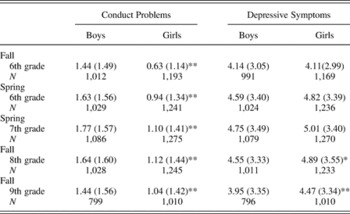
The original sample included 2,969 students (72% White, 18% Black, and 10% other) eligible to participate in the baseline assessment. Special education students with reading problems were not included because a pilot study showed that these students were not able to provide reliable data. Parent consent was obtained in the sixth grade and again before the ninth grade follow-up. The 2,651 (87.8%) eligible students provided consent by their parents in the sixth grade. Of these, 9 became ineligible during the study by failing a grade and 110 were newly classified as special education, leaving a sample of 2,532, of whom 79 moved out of the school district or missed multiple assessments, leaving a final sample of 2,453. Compared with the final sample, participants lost to follow-up were significantly more likely to be black, live with only one parent, and to report drinking. Missing values in major outcomes (CP and DS) at each wave are presented in Table 1 for boys and girls separately. Mplus (Version 3; Muthén & Muthén, Reference Muthén and Muthén2004), which offers maximum likelihood estimation based on the data with missing outcome values through the iterative expectation maximum (EM) algorithm, was used to handle the missing values in data analyses.
Means, standard deviations, and sample sizes of conduct problems and depressive symptoms for boys and girls at five waves

* p < .05. **p < .01.
Procedures
Questionnaires were administered in class and during make-up sessions. Two trained proctors administered data collection in classes of less than 30 students each. As required by the school district, teachers remained to manage the classroom, but they were not involved in administering the survey. To protect confidentiality, students completed a cover page that included their name, survey identification number, birth date, and homeroom teacher's name. This cover page was kept separate from the questionnaires. The returned questionnaires had only an identification number matching the one on the cover page. The study protocol was approved by the Institutional Review Board, National Institute of Child Health and Human Development.
Measures
Background variables
Participants responded to the questionnaires with demographic and contextual items including date of birth, gender, race, mother's education, attendance of free lunch program, family structure, and school attended.
CP
CP were assessed by an index of items asking how often in the past year the youth had been in a physical fight, hurt someone in a physical fight, bullied or picked on someone younger or weaker, carried a weapon, stole something from a person or store, or marked something with graffiti. Each item was rated on a scale with 0 = 0 occurrences, 1 = 1 to 2 times, 2 = 3 to 5 times, 3 = 6 to 9, and 4 = 10 or more times in the past 12 months. Responses were averaged across the items to obtain the measure of CP. The reliability across five waves of measurement was α = .82.
DS
DS were assessed using a subscale from the Weinberger Adjustment Inventory (Weinberger, Reference Weinberger1991). These six items assessed the respondent's level of DS through items such as “I feel so down and unhappy that nothing makes me feel much better,” and “I get into such a bad mood that I feel like just sitting around and doing nothing.” Response categories were never, some of the time, most of the time, or always. Higher scores indicate greater levels of depression. Internal reliability was α = .77 for the first assessment in the fall of the sixth grade and α = .79 across time.
Social competence
Social competence was assessed with nine items developed consistent with the conceptualization of Harter (Reference Harter1982). The items addressed issues such as communication, conflict resolution, and problem solving. Response choices allowed students to indicate if they perceived items to be much harder, a little harder, a little easier, or much easier for them compared to others in their grade (α = .79 in the fall of the sixth grade and α = .80 across five waves). Higher scores indicate higher levels of social competence.
Problem peers
Friends were assessed for problem behavior by asking how many of the respondent's five closest friends participated in smoking, drinking, bullying, being disrespectful to teachers, fighting, cheating, lying to parents, and marking property with graffiti. The average score was used to indicate problem peers. To be consistent with CP as a major outcome in the present study, we excluded those friends who were engaged only in smoking and drinking but did not have other problem behaviors (α = .81 across five waves).
Parent variables
We employed extensive pilot testing and factor analytic procedures to develop reliable student report measures of perceived parenting behavior (Simons-Morton et al., Reference Simons-Morton, Haynie, Crump, Eitel, Saylor and Yu1999). Parental knowledge included six items that focused on how much the parent knows (almost nothing, a little, a lot) about the teen's friends, activities, interests, health habits, free time, and school (α = .76 in the fall of the sixth grade and α = .79 across five waves). Parent–child conflict was assessed with four items adapted from Robin and Foster (Reference Robin and Foster1989), which asked to report about the following (strongly agree, agree, disagree, or strongly disagree): I have a parent or guardian who is hard to get along with, often makes me angry, gets angry at me almost every day, easily loses his/her temper with me (α = .82 in the fall of the sixth grade and α = .79 across time).
GPA and academic failure
Participants' academic grades in ninth grade were obtained from school records on four subjects: math, science, language arts, and social studies, with each scored from 1 to 5. GPA at ninth grade was calculated using the average score from the four subjects (from 1 to 5) subtracted by one, resulting in a range of 0 to 4. Academic failure was a dummy variable derived from the average score (from 1 to 5), where average scores less than 2.5 was defined as failing. The overall failure rate in the sample was 7.74% (10.1% for boys, 6.0% for girls). This dichotomous definition of academic failure is subjective and it was created to compare gender and trajectory groups with percentages of academic failure.
Analysis
To examine the first hypothesis of overall prevalence for adolescent CP and DS, descriptive statistics for CP and DS at each wave were calculated and charted to display the development of CP and DS for both genders. Simple correlations among the covariates, CP, and DS in the fall of the sixth grade were presented to show the bivariate relationship at the baseline of the study. The method of GGMM (Muthén, Reference Muthén and Kaplan2004) was applied to address the major research hypotheses of the study. The identified trajectory membership groups were further classified into high–high (high in both CP and DS), low–low (low in both CP and DS), pure CP, and pure DS groups to examine the second hypothesis about the prevalence of co-occurrence problem and the conditional probabilities of CP and DS.
The third hypothesis concerning the precursors of co-occurring CP and DS was evaluated by three different approaches: specifying precursors as the covariates in latent growth curve (LGC) modeling (e.g., Curran, Reference Curran and Rose2000), examining the odds ratios estimated from the GGMM, and comparing the outcomes in a factorial multiple analysis of variance (MANOVA) with group membership and gender as independent variables. Prior to the mixture modeling of GGMM, unconditional LGC models (without covariates) were estimated with five repeated measures on CP and DS. The purpose of fitting the unconditional LGC models was to determine the shape of the trajectories that would provide guidelines for subsequent analyses. The overall fit indices for the LGC models included the comparative fit index (CFI), the Tucker–Lewis index (TLI), and the root mean square error of approximation (RMSEA) provided by Mplus (Muthén & Muthén, Reference Muthén and Muthén2004). Most researchers regard a model acceptable if CFI and TLI are greater than .9. A model with an RMSEA of less than .05 is regarded as a “good” fit and an RMSEA of less than .08 is “acceptable” (McDonald & Ho, Reference McDonald and Ho2002).
The next step in the analysis was to fit conditional LGC models by including the covariates measured at baseline (MIMIC parallel processing model; e.g., Muthen & Curran, Reference Muthén and Curran1997). For curvilinear models, we applied the method of estimating factor loading by freeing a number of time scores in LGC model (Bollen & Curran, Reference Bollen and Curran2006, p. 98). With only two growth factors specified (intercept and slope), this method facilitates the interpretation of path coefficients leading from the covariates to the growth factors. This conditional LGC model was estimated as a multigroup model for statistical comparisons between boys and girls. The intervention treatment, coded as a dummy variable in the analysis, was treated as a covariate to statistically control for possible treatment effects while evaluating the effects of other covariates.
The final model for GGMM was based on the conditional LGC model by adding two latent categorical variables, one for CP and one for DS trajectory groups, with academic failure in the ninth grade specified as a distal outcome. The Bayesian information criterion (BIC) and Akaike information criterion (AIC) were used to determine the best number of trajectory groups, with a smaller value of BIC or AIC indicating a better fit model. Furthermore, the two latent categorical variables were specified as correlated in GGMM. Line graphs of observed trajectories were displayed to help understand the development of CP and DS in trajectory groups. Predicted membership in trajectory groups was used for categorizing the sample into high–high (high in both CP and DS), low–low (low in both CP and DS), pure CP, and pure DS groups. A two-way factorial MANOVA was conducted to compare group and gender difference in the precursors (the third hypothesis) and in academic achievement at the ninth grade (the fourth hypothesis).
Missing values, which were assumed to be missing at random, were treated in Mplus Version 3 (Muthén & Muthén, Reference Muthén and Kaplan2004) with the EM algorithm. Specifically, a missing value in outcome variables was estimated with the EM algorithm, but a missing value in a covariate would exclude the case from analysis. Because of missing values in the six covariates, the sample sizes in GGMM analysis were 916 boys and 1,104 girls. The mixture modeling process was conducted for boys and girls separately.
Results
Prevalence of CP and DS
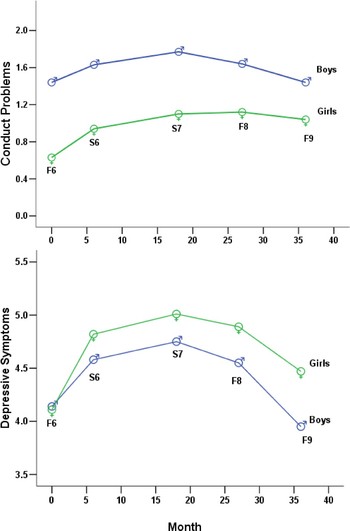
To evaluate the first hypothesis concerning the overall prevalence of CP and DS, descriptive statistics for CP and DS at each wave with comparisons between boys and girls are shown in Table 1. Based on the observed means, trajectories showing levels of CP and DS for boys (N = 1,120) and girls (N = 1,333) are presented in Figure 1. As hypothesized, boys reported significantly (p < .01) higher levels of CP at each time point relative to girls; however, this difference began to narrow starting in the spring of the seventh grade. Beginning in sixth grade, CP increased for both genders and reached higher levels around the end of seventh grade, and then leveled off among girls and slightly declined among boys. As shown in Figure 1, the levels of DS in the sixth grade were similar among boys and girls. It was after sixth grade that the gender difference in DS started to emerge, with girls experiencing more DS than boys. However, this gender difference in DS did not reach statistical significance at sixth and seventh grade. It was not until eighth and ninth grades that girls reported significantly higher DS than boys (see Table 1).
Developmental trajectories of conduct problems and depressive symptoms for boys (N = 1,120) and girls (N = 1,333) from Grade 6 to Grade 9. [A color version of this figure can be viewed online at journals.cambridge.org/dpp]

GGMM
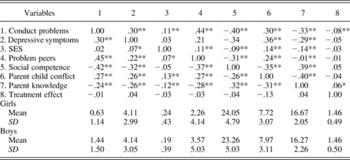
Simple correlations between the precursors (the covariates) and outcomes (CP and DS) at baseline are presented in Table 2. It can be seen from Table 2 that CP and DS are positively correlated with r = .30 (p < .01) for boys and girls, respectively, indicating that higher CP was associated with higher DS in the sixth grade. For both genders, higher CP was significantly related to more problem peers, higher parent–child conflict, lower social competence, and less parent knowledge. DS was significantly correlated with all covariates for boys; but for girls higher DS was only correlated with higher parent–child conflict (r = .36, p < .01) and less parent knowledge (r = −0.29, p < .01) at baseline.
A correlation matrix of the means and standard deviations of covariates and outcome variables measured at baseline

Note: SES, socioeconomic status. The girls' values are above the diagonal and the boys' are below the diagonal.
* p < .05. **p < .01.
Unconditional LGC models were first fit for CP and DS to determine the shape of the trajectories and the variances in the growth factors. The four curvilinear trajectories shown in Figure 1 clearly suggested a quadratic model, which indeed fit significantly better than a linear model (p < .01) for both genders. The CFI and TLI were greater than .98, and the RMSEA was less than .04 in each of the four quadratic unconditional LGC models (CP for boys, CP for girls, DS for boys, and DS for girls). Estimated variances in the intercepts, slopes, and quadratic growth factors in the four fitted models are all significantly different from zero, suggesting individual differences in the pathways of CP and DS. The significant differences in individual pathways justified the application of GGMM to identify heterogeneous subgroups in subsequent analyses.
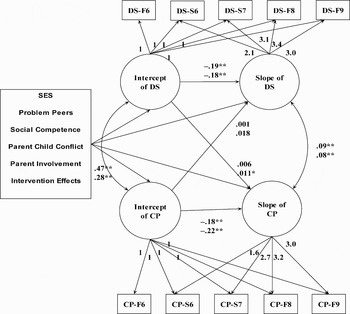
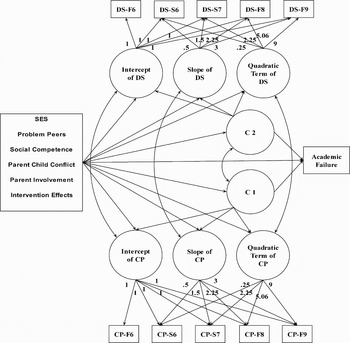
Based on the fit of unconditional quadratic models, conditional parallel processing LGC models (Muthén & Curran, Reference Muthén and Curran1997; Muthén & Muthén, Reference Muthén and Kaplan2004, p. 96) were estimated for boys and girls by incorporating the baseline covariates into the model with paths from each covariate leading to the growth factors of CP and DS (see Figure 2). To apply the “estimating factor loading” method to a quadratic model, three paths from the slopes to the five repeated measures were set free for estimation, with the first (time score = 0) and the last (time score = 3, indicating year) path kept fixed, as shown in Figure 2. This multigroup parallel processing model for boys and girls fit well (CFI = .97, TLI = .96, and RMSEA = .037). The intercepts for CP and DS are significantly correlated (p < .01) with the unstandardized estimates at .28 and .47 for boys and girls, respectively, suggesting a positive association between CP and DS in the sixth grade. The slopes of CP and DS are also significantly associated with the unstandardized estimates at .08 (p < .01) for boys and .09 (p < .05) for girls, indicating that the change of CP is positively related to the change in DS over time. However, the chi-square difference test did not show a significant gender difference in the intercepts or slopes.
A path diagram for a conditional parallel process LGC model for adolescent conduct problems and depressive symptoms from Grade 6 to Grade 9. Unstandardized estimates are shown. The estimates on top are for girls and the estimates on bottom are for boys.

The GGMM was an extension of the conditional quadratic LGC model formed by adding two latent categorical variables (labeled C1 and C2 in the conceptual model diagram in Figure 3) and academic failure in the ninth grade as a distal outcome. The quadratic growth factor was specified in the model with the path loadings squared from that for the slope factor. Latent categorical variables C1 and C2 indicate heterogeneous trajectory groups in CP and DS, respectively, specified as correlated in the model. Each covariate leads directly to C1, C2, and academic failure, which is predicted by the two latent categorical variables.
A path diagram for GGMM of concurrent changes in adolescent conduct problems and depressive symptoms from Grade 6 to Grade 9.

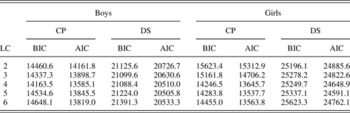
In fitting the GGMM, the first task is to select a best-fit model to determine the number of trajectory groups. As described in the Analysis section, we considered both BIC and AIC indices for this choice with a relatively smaller value of BIC or AIC indicating a better fit model. Table 3 presents the BIC and AIC indices for CP and DS trajectory groups estimated separately for boys and girls. The choice of the model is clear with BIC indices: the four-group model fit the best for CP and DS for both genders. The AIC indices were the smallest for the models with five DS trajectories for both genders. However, only a few adolescents were classified into one of the five DS trajectory groups. Therefore, the GGMM with four CP groups and four DS groups was selected as the best fit model for both genders for subsequent analysis.
Fit indices of general growth mixture modeling for boys and girls

Note: CP, conduct problem; DS, depressive symptom; LC, latent classes; BIC, Baysian information criterion; AIC, Akaike information criterion. Smaller values of BIC and AIC indicate better fit of the model.
Prevalence of the co-occurrence problem
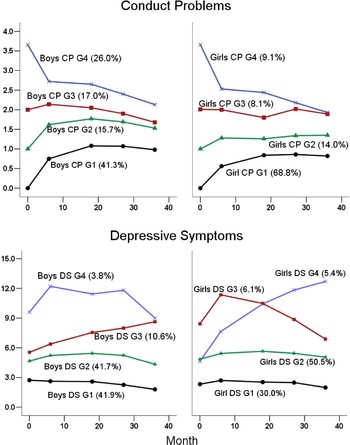
After obtaining the predicted group memberships for each participant from the GGMM analysis, the observed means of CP and DS were calculated for the line graphs in Figure 4. The upper panel shows the developmental pathways of CP for the trajectory groups for boys and girls. We can see that the trajectory patterns are quite similar for boys and girls: adolescents in Group 1 (G1 in Figure 4) reported the lowest CP over time and Group 4 (G4) started high in CP in the sixth grade but was followed by a decline to the ninth grade. Adolescents in Group 2 (G2) and Group 3 (G3) reported medium levels of CP over the period. In trajectory groups with the highest level of CP (boys CP G4 and girls CP G4), boys had a larger percentage (26%) than girls (9.1%). Conversely, in groups with the lowest level of CP (boys CP G1 and girls CP G1), girls had a larger percentage (68.8%) than boys (41.3%). These results show that CP is a relatively more serious problem for boys than for girls.
Line graphs for trajectories subgroups of conduct problems and depressive symptoms for boys and girls. [A color version of this figure can be viewed online at journals.cambridge.org/dpp]

The lower panel in Figure 4 shows the DS trajectory groups estimated by the GGMM. The trajectory patterns are also somewhat similar across gender, except that there was a distinct girls group (girls DS G4, 5.4%) that had low DS in the sixth grade but dramatically increased DS levels over time. There was a boys group (boys DS G3, 10.6%) with straight increase in DS over time, but the DS level was never higher than that for boys DS G4 (3.8%). For both genders, there was a group that reported being almost no DS over time (boys DS G1 41.9%, girls DS G1 30.0%). There was also a group for boys and girls (boys DS G2 41.7%, girls DS G2 50.5 %) that experienced limited but stable DS over time. Only a small percentage of boys (boys G4 3.8%) experienced the highest level of DS over time. About 6.1% of the girls (girls DS G3) had their highest level of DS in the sixth and seventh grades, but the level of DS declined to the ninth grade for this group.
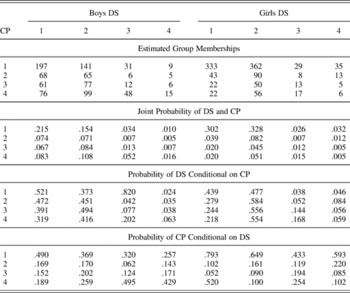
The upper part in Table 4 presents the estimated frequency and joint probabilities of the membership in trajectory groups. For instance, there were 197 boys in CP G1 and DS G1 with a joint probability of .215, showing that approximately 21.5% boys were at the lowest level of CP and DS. On the other hand, there were 333 girls in the same category with a joint probability of .302, indicating that about 30.2% of the girls were in the lowest level of both CP and DS.
Co-occurrence of conduct problems and depressive symptoms for boys (N = 916) and girls (N = 1,104)

Note: DS, depressive symptom; CP, conduct problem.
The joint probabilities show only one aspect of the co-occurrence of CP and DS, whereas conditional probabilities may reveal more meaningful findings for the co-occurrence problem. The lower part in Table 4 reports two sets of conditional probabilities: the probability of membership in each CP group conditional on each DS group, and vice versa. Because the extreme groups are of interest, we first evaluated the probability of the DS conditional on CP for the extreme groups. Among adolescents in the highest level of CP (CP G4 for both genders), there were about 6.3% of the boys and 6.9% of the girls in the highest levels of DS (DS G4), respectively, indicating little difference across gender. By contrast, a different distribution appears when we examine the probability of CP conditional on DS: among adolescents in the highest levels of DS, nearly a half of the boys (42.9%) were in the highest level of CP, whereas only 10.2% of the girls were in the highest level of CP. Clearly, depressed boys are at increased risk of experiencing co-occurrence of CP and DS.
Precursors for co-occurring CP and DS
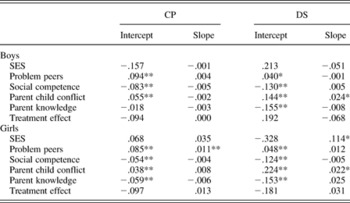
The precursors for the co-occurrence problem were first evaluated with the covariate effects on the growth factors in the LGC model (see Figure 2), and the results are summarized in Table 5. It should be noted that, similar to a multiple regression, the effect of a covariate is adjusted by other covariates in the model. We first evaluate the effects of covariates on the intercepts. Table 5 shows that more peers with behavior problems, higher parent–child conflict, and lower social competence were related to higher CP and DS for both boys and girls at baseline. Higher parent knowledge was related to lower CP and DS for girls, but related only to lower DS for boys. SES showed no significant effects on the intercepts in the model.
Effects of covariates on growth factors for conduct problems and depressive symptoms over time for boys (N = 1,120) and girls (N = 1,333)

Note: Standardized effects are shown. CP, conduct problem; DS, depressive symptom; SES, socioeconomic status.
* p < .05. **p < .01.
Only a few covariates were found to have significant effects on slopes. Parent–child conflict was positively related to the DS slope for both genders, showing that higher parent–child conflict predicted an increase in DS over time. SES (coded 1 for free lunch and 0 for no free lunch) was related to the DS slope for girls indicating that lower SES was associated with an increase in DS over time. Problem peers was significantly related to the CP slope for girls, suggesting that more problem friends in the sixth grade predicted an increase in CP over time.
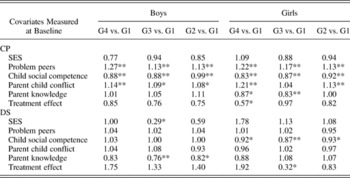
The third hypothesis concerning the precursors was also examined with the odds ratios differentiating trajectory groups predicted by GGMM (see Table 6). Similar to the interpretation of odds ratios in multiple logistic regression models, the odds ratios in Table 6 are adjusted for the effects of other covariates in the model. For example, the odds ratio for problem peers for boys CP G4 versus G1 is 1.27 (p < .01), indicating that one additional problem peer in the sixth grade would increase 27% chance in boys CP G4 relative to G1, holding other covariates constant. For odds ratios of less than 1, the probability decreases relative to the reference group. For example, the odds ratio for social competence for boys CP G4 versus G1 is 0.88, suggesting that with one unit increase in social competence, the chance in boys CP G4 decreases by 1 – 0.88 = 12% relative to G1.
Odds ratios showing the effects of covariates on subgroups for boys and girls

Note: G1–G4, Groups 1–4, respectively; CP, conduct problem; SES, socioeconomic status; DS, depressive symptom. Probability was modeled with the normative group G4 as reference.
* p < .05. **p < .01.
We first evaluated the effects of the covariates that significantly differentiated CP trajectory groups (see top panel in Table 6). Problem peers and social competence differentiated G1 from the other three groups, with less problem friends and more social competence related to increased chances in boys G1 and girls G1 (the groups with the lowest CP levels over time). Parent–child conflict differentiated boys G1 and girls G1 to almost all other groups except for girls G3, with higher levels of parent–child conflict associated with decreased chances in boys G1 and girls G1 groups. Parent knowledge had effects only for girls CP but not for boys, with more parent knowledge related to increased chances in girls G1 relative to girls G4 and G3. SES did not significantly differ among CP groups.
Only a few significant covariates were found to differentiate DS groups (see the bottom panel in Table 6). The most noticeable is social competence, which differentiated girls G1 from all other groups with more social competence related to higher chances of being in girls G1. However, social competence did not significantly differ among boys groups. Parent knowledge differentiated boys G1 from boys G2 and G3, with more parent knowledge related to an increased chance of being in boys G1. However, parent knowledge did not significantly differ among girls groups.
MANOVA evaluating precursors and consequences of the co-occurrence problem
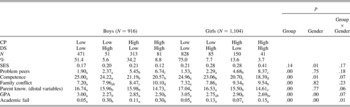
The predicted membership in trajectory groups was used to categorize the sample into new groups to serve as an independent variable in MANOVA comparison. The categorization resulted in four new groups: high–high (high in both CP and DS), CP only, DS only, and low–low (low in both CP and DS). Specifically, for both genders, G1 and G2 were considered low in CP or DS, and G3 and G4 were categorized as high in CP or DS. Sample sizes and percentages for the four new groups are presented in Table 7. For example, Table 7 shows that 471 (51.4%) boys and 828 (41%) girls are in the low–low group.
Results from 4 × 2 factorial multivariate analysis of variance examining gender and group differences

Note: CP, conduct problem; DS, depressive symptom; SES, socioeconomic status. Means with different subscripts are significantly different with p < .05 from post hoc tests.
Group and gender were independent variables in a 4 × 2 factorial MANOVA with precursors and academic achievement as the dependent variables. Results from this factorial MANOVA are presented in Table 7. The two main effects (group and gender) and the interaction (Group × Gender) were all significant with p < .01, which allowed us to examine dependent variables individually while controlling Type I errors. The p values for the two main effects and the interaction for each dependent variable are presented in the last three columns in Table 7. It can be seen that none of the interaction terms is significant except for academic failure. Clearly, for the low–low groups the failure rate was the same between genders; but for the high–high groups, 30% of the boys failed compared with only 15% of the girls failed. This finding suggests gender difference in the adverse consequences of co-occurring CP and DS, where boys may have relatively poorer academic adjustment than girls.
The main effect of gender showed that girls had a higher proportion of having free lunch (0.27 vs. 0.15, p < .01), lower social competence (21.9 vs. 23.0, p < 0.01), higher GPA (2.85 vs. 2.66, p < 0.01), and lower academic failure rates (0.10 vs. 0.19, p < .01). The main effects of group were of major interests in this study, and we were particularly concerned with the comparison between the high–high group and other groups. Because the interaction (Group × Gender) was not significant for individual variables, we present simple effects (boys and girls separately) in Table 7. Post hoc tests showed that except for SES, the high–high group was significantly different in all dependent variables relative to the low–low group, and this finding applies to both boys and girls. Specifically, the high–high group had significantly more problem friends in the sixth grade, lower social competence, higher levels of parent–child conflict, less parent knowledge, lower GPA, and higher rates for academic failure.
Discussion
The co-occurrence of CP and DS is an important topic in developmental psychopathology. Studies on issues related to this topic may reveal more insightful knowledge about the nature of problem behaviors than if we consider them as isolated outcomes. Most previous studies on the topic, however, were based on clinical, at-risk, or male samples, and mostly focused on identifying risk factors. The present study examined various aspects of this co-occurrence problem in a nonclinical, longitudinal sample with a relatively large sample size including both boys and girls. This is one of the few longitudinal studies on the co-occurrence of adolescent CP and DS with both genders. A salient feature of the study is that a person-centered approach, which captures distinctive developmental trajectories of CP and DS, is applied to evaluate the research hypotheses. The inclusion of the covariates at baseline and academic achievement in the ninth grade in the same model increases the accuracy and validity of predicted memberships in trajectory groups (Muthen, Reference Muthén and Kaplan2004).
Overall levels of CP and DS
As hypothesized, boys reported higher CP than girls at all five waves. For DS, girls experienced higher levels than boys except at the baseline where no meaningful difference appeared. The trajectories of CP and DS were curvilinear, especially for DS: the levels of DS reached a maximum around the seventh grade for both genders and declined into the ninth grade. These findings are in line with reports from previous longitudinal studies. Using a nonclinical sample of approximately 550 adolescents, Ge et al. (Reference Ge, Natsuaki and Conger2006) found that DS changed according to a curvilinear pattern for both genders: the DS trajectories increased during early to midadolescence, and then declined in late adolescence. Boys reached their highest DS levels around 13 years old, which is very close to our finding. However, girls were reported to have the highest DS levels at a later age (Ge et al., Reference Ge, Natsuaki and Conger2006, table 2, p. 262). Harrington et al. (Reference Harrington, Rutter and Fombonne1996) presented DS trajectories separated by gender for adolescents from age 11 to 15, with DS measured by self-reported scores from mood and feeling questionnaires. The trajectories (Harrington et al., Reference Harrington, Rutter and Fombonne1996, figure 2, p. 606) show that girls reported higher DS than boys but the difference was the smallest at 11 years old. DS levels increased after 11 years old, and reached their highest level around 14 years old, followed by a decline to age 15 for both genders. Harrington et al. (Reference Harrington, Rutter and Fombonne1996) meaningfully distinguished clinical from nonclinical populations: in clinical samples DS increased after 14 years old (Harrington et al., Reference Harrington, Rutter and Fombonne1996, figure 1, p. 605) while in nonclinical samples it decreased around 14 years old. We used a school-based, nonclinical sample that showed DS levels very similar to the report from Harrington et al. in nonclinical samples. Our findings support Harrington et al.'s argument that studies on adolescent DS should make clear distinctions between clinical and nonclinical populations.
The last wave in our longitudinal data had approximately 26% missing in DS measure (see Table 1). We conducted additional analysis (Weiss, Reference Weiss2005) to examine whether missing values at the last wave were missing at random (Little & Rubin, Reference Little and Rubin2002). We compared DS level at the fourth wave between those missing and not missing at the fifth wave. A t test showed no significant difference with t (2033) = −0.58, p = 0.56. The mean of DS level at the fourth wave is 5.08 and 4.98 for those missing and not missing at the fifth wave, respectively. The finding indicates that bias in estimating DS level because of missing at the fifth wave is limited.
Researchers have consistently reported that adolescent girls experienced more DS than boys, but there is no consensus regarding at what age this gender difference actually begins. Our data show a small gender difference in DS in the sixth grade; however, the gap increased to significant levels in the eighth and ninth grades. Similar findings were reported by Cole et al. (Reference Cole, Martin, Peeke, Seroczynski and Fier1999), who found that gender difference in depression started at 12 years old and depression remained higher among girls than boys during adolescence. Hankin et al. (Reference Hankin, Abramson, Moffitt, Silva, McGee and Angell1998) reported a small gender difference in depression first apparent around 13 years old, with girls greater than boys. This gender difference began increasing at 15 years old. Our study generally replicated these findings, although the report from Hankin et al. states that gender differences in DS begins at an age 1 or 2 years older than our data suggests. Designers of prevention and intervention programs may use this information to pinpoint the appropriate time and potentially increase treatment efficacy.
Consistency between our findings and the previous reports related to overall DS levels, the shapes of DS pathways, and the gender differences in DS demonstrated some validity of the items we used to measure DS in this study. We used a brief questionnaire from the Weinberger Adjustment Inventory (Weinberger, Reference Weinberger1991) with six items summed up into a scale for measuring DS. The questionnaire was not originally designed for the diagnosis of clinical depression, and we used it in a nonclinical sample for gauging adolescent levels of depressive mood in daily life. We argue, following Harrington et al. (Reference Harrington, Rutter and Fombonne1996), that in studies on youth depression and CP, a clear distinction should be made between clinical and nonclinical samples in terms of specific measures and interpretations of findings. This distinction may clear up some inconsistent findings in literature.
Prevalence of co-occurrence of CP and DS
A foremost issue in the study on co-occurring CP and DS is the estimation of prevalence of this co-occurrence problem in the adolescent population. A few studies reported the prevalence from clinical samples, but reports from nonclinical samples are rare. We defined the co-occurrence problem based on developmental trajectories of CP and DS instead of using cross-sectional measures at one time point. As hypothesized, a majority of adolescents experienced little CP or DS over time. However, our major interest is the group with higher levels in both CP and DS. Based on the membership predicted by GGMM, we further classified trajectory groups G1 and G2 into low levels, and G3 and G4 into high levels of CP and DS. Because this definition is somewhat subjective, we provide the following reasons to defend this classification. First, the prevalence estimated with this method is close to previous reports from nonclinical samples. For example, Capaldi (Reference Capaldi1991) classified about 13% of the boys into a group that had high levels of both CP and DS. We had about 8.8% of the boys in the high–high group. Considering that Capaldi (Reference Capaldi1991) used an at-risk sample while our sample is school based, the two estimates are quite close. Second, because there is no distinctive trajectory group for girls that experienced the highest DS at all five waves (see Figure 4), it is appropriate to include the two trajectory groups (girls DS G3 and G4) in one category to indicate high DS. Third, the trajectories clearly show that both G1 and G2 had stable and low levels of CP and DS over time; therefore, it is reasonable to combine the two groups into one category. With this categorization we found 8.8% boys and 3.7% girls in the high–high group and 51.4% boys and 75% girls in the low–low group (see Table 7). The results suggest that boys had a higher prevalence of co-occurring CP and DS than girls in nonclinical populations.
Conditional distributions in CP and DS are of interest because they may reveal the group with highest risk of the co-occurrence problem. The present study found that among adolescents with the highest levels of CP, the percentages of boys and girls with the highest levels of DS are quite similar (6.3% and 6.0%, respectively). Among adolescents with the highest levels of DS, however, 42.9% boys compared with only 10.2% girls reported the highest levels of CP. Clearly, depressed boys were at higher risks of experiencing the co-occurring problem. This finding is informative for educators and parents, who can make themselves aware of the risks related to depressed boys and take appropriate measures. Clinicians working with depressed boys may need to control the levels of CP as a likely co-occurring problem behavior in the treatment of depression.
Recently, Ruchkin et al. (Reference Ruchkin, Sukhodolsky, Vermeiren, Koposov and Schwab-Stone2006) reported a cross-cultural study with a large sample size (N = 3,309) on the prevalence of adolescent DS associated with other psychopathological symptoms. The study found that among depressed adolescents from age 14 to 17, about 6.9% boys and 4.2% girls had severe antisocial behavior, concluding that depressed boys had relatively higher CP levels than depressed girls. The conditional probabilities found in our study is higher than that reported in Ruchkin et al. (Reference Ruchkin, Sukhodolsky, Vermeiren, Koposov and Schwab-Stone2006), probably because we used longitudinal data that defined co-occurrence based on pathways of CP and DS, while Ruchkin et al. (Reference Ruchkin, Sukhodolsky, Vermeiren, Koposov and Schwab-Stone2006) collected data at one time point. Unfortunately, Ruchkin et al. (Reference Ruchkin, Sukhodolsky, Vermeiren, Koposov and Schwab-Stone2006) did not report DS prevalence conditional on CP; therefore, we are unable to make a direct comparison between the two studies.
Etiology of co-occurring CP and DS
Considerable efforts have been made to identify the etiology of adolescent problem behaviors, but most studies treat the behaviors as isolated outcomes instead of co-occurring phenomenon. In this study we sought to examine demographical, psychosocial, and family factors as vulnerable precursors of development in both CP and DS. We recognized that a single factor could not likely be sorted out as the antecedent responsible for the onset and maintenance of the co-occurrence problems. We hypothesized that it was the combination of biological factors (e.g., sex), individual characteristics (e.g., social competence), and family environment (e.g., family conflict or parent knowledge) factors that may be associated with the co-occurrence problem through some additive or interactive mechanisms.
We evaluated this hypothesis by comparing the precursor variables between the high–high group and the other groups. This person-centered method could be more sensitive than variable-centered approaches because only extreme groups were compared. Results from this method showed significant differences in almost all covariates between high–high group and the other three groups, with the high–high group having more problem peers, higher family conflicts, lower social competence, and less parent knowledge. SES was not significant, probably because it was indicated by a dichotomous measure (free lunch or no free lunch), and the variability in social–economic status was not properly represented in the variable. In sum, the results demonstrated that a combination of adverse factors was associated with the occurrence of adolescent CP and DS. This finding supports the multiple-domain model (Greenberg et al., Reference Greenberg, Speltz, DeKlyen and Jones2001) and the transactional model (Cicchetti & Toth, Reference Cicchetti and Toth1998) that a mixture of multiple factors is responsible for the emergence and maintenance of co-occurrence in CP and DS. It also demonstrates the power of a person-centered method when heterogeneity does exist in population.
Consequences of co-occurring CP and DS
Issues related to the consequences of co-occurrence problems are particularly appealing. The comparisons between the high–high group and the “pure” groups may reveal the nature of the co-occurrence of CP and DS: whether it represents the additive effects of the two problem behaviors or it is merely the same underlying entity with two different forms of expressions. Previous studies showed that the co-occurrence was associated with poor academic skills (Capaldi, Reference Capaldi1991) and substance dependence (Marmorstein & Iacona, 2003), but Harrington et al. (Reference Harrington, Rutter and Fombonne1996) demonstrated in a longitudinal study that adolescents with both CP and DS did not show more adverse effects compared to pure CP or pure DS groups at a later time. We used a MANOVA to compare group differences in average GPA and academic failure rates in the ninth grade. The findings showed that the high–high group did significantly more poorly than the low–low group for both genders. One surprising finding was that the average GPA is lowest (2.27) for the pure DS boys, although it was not significantly different from boy's high–high group (2.50). This finding is in line with the seemingly paradoxical finding reported by Harrington et al. that “. . . the subgroup of depressed youth people with the worst overall social outcome (namely, those with comorbid conduct disorder) was at the lowest risk of recurrence of major depression” (p. 614). Is it possible that some aggressive activities alleviate the certain adverse consequences of DS and lead to a lowered risk for major depression (Harrington et al., Reference Harrington, Rutter and Fombonne1996) or to relatively better academic adjustment in the high–high group in the present study? Clearly, further empirical and theoretical work is needed to examine this hypothesis.
Limitations and Conclusions
The data we used in this study have several limitations, so caution should be taken when interpreting and generalizing the findings. The first limitation is that the data were obtained from a single source: self-reporting from the adolescents themselves except for the academic achievement scores that were drawn from school files. Correlations in the data from the same source are likely to be artificially inflated, and Type I errors could be higher than nominal levels. The second limitation is that CP, a major outcome in the study, was measured with items heavily weighted on problems typical for boys, such as fighting and weapon carrying. It is possible that the girls' CP was not adequately measured so the comparisons on CP between boys and girls may not be fair. The third limitation in the data is that we excluded special education students in the study, which may reduce the generalization of the findings. The fourth limitation is that CP and DS, the major outcomes in this study, were measured with a limited number of items, which may reduce measurement reliability. Finally, the fifth limitation is that the data were both right and left censored because of the limitation of data collection period between the sixth and ninth grade. Some important models concerning the development of CP and DS, such as the early versus later onset of CP and DS, are difficult to examine because of this data limitation.
In summary, the present study contributes to the literature that research on co-occurrence of behavior problems should make clear distinctions between clinical and nonclinical samples. In line with the multiple-domain risk model for adolescent CP and the transactional model for adolescent DS, this study found that a mixture of multiple factors, rather than a single factor, is responsible for the co-occurrence problem. Finally, the study found that depressed boys had the highest risk of experiencing co-occurrence problem in CP and DS, although the “pure” depressed boys might have the worst academic adjustment.