


Key Findings
F200Y mutations were identified in high frequency (72%) in Haemonchus contortus.
F200Y and F167Y mutations were found even on farms with little benzimidazole use.
High treatment frequency was considered the most critical risk factor for drug resistance.
The majority of farmers use visual weight estimations to treat their animals.
Introduction
Small ruminant farming is an alternative for smallholders in low- and middle-income countries. Brazil has an estimated herd of 32 million animals, and the state of Paraná (PR) harbors about 3.0% of the sheep and 1.0% of the goat herd of the country (IBGE, 2021a). Gastrointestinal parasite infections affect the quality of life of animals, whereas Haemonchus contortus is the most prevalent pathogenic helminth (Zajac and Garza, Reference Zajac and Garza2020). Control is primarily carried out using broad-spectrum anthelmintics such as the benzimidazole (BZ) and macrocyclic lactone classes. However, inadequate practices such as the treatment of all animals in the herd, the high frequency of treatment (< 45-day interval) and drug alternation, lack of quarantine of newly arrived animals, and the use of incorrect doses are often practised by farmers and field assistants, accelerating the selection of anthelmintic resistance parasite populations (Cruz et al., Reference Cruz, Rocha, Arruda, Palieraqui, Cordeiro, Santos Junior, Molento and Santos2010; Garcia et al., Reference Garcia, Sprenger, Ortiz and Molento2016; Amaral et al., Reference Amaral, Guerra, Santana, Chicoy-Ramirez, Arenal, Lima, Alves, Molento and Faustino2021).
BZ acts by high-affinity binding to β-tubulin, a microtubule subunit protein, inhibiting its polymerisation (Lacey, Reference Lacey1988). Resistance to BZ is associated with single nucleotide polymorphisms (SNPs) at position 200 (TTC to TAC; F200Y) (Kwa et al., Reference Kwa, Veenstra and Roos1994), 167 (TTC to TAC; F167Y) (Silvestre and Cabaret, Reference Silvestre and Cabaret2002) and 198 (GAA to GCA; E198A) (Ghisi et al., Reference Ghisi, Kaminsky and Maser2007) in the H. contortus β-tubulin isotype 1 gene. In Brazil, a few studies have used molecular diagnosis to determine resistance to BZ. Niciura et al. (Reference Niciura, Veríssimo, Gromboni, Rocha, Mello, Barbosa, Chiebao, Cardoso, Silva, Otsuk, Pereira, Ambrosio, Nardon, Ueno and Molento2012) conducted a survey using nested-PCR and ARMS-PCR to assess the frequency of the F200Y in 33 sheep farms in São Paulo, Brazil. The study found frequencies of resistant homozygous (RR) genotypes to vary from 0.1 to 66.7% and resistance alleles from 9.0 to 74.0%. In the same year, Brasil et al. (Reference Brasil, Nunes, Bastianetto, Drummond, Carvalho, Leite, Molento and Oliveira2012) evaluated the variation of the F200Y, F167Y, and E198A in cattle, buffalo, sheep, and goat herds using nested PCR. Using the AS-PCR technique, Nunes et al. (Reference Nunes, Santos, Bastianetto, Oliveira and Brasil2013) evaluated only the frequency of F200Y in H. contortus in buffaloes, goats, and sheep in Minas Gerais, Brazil. Moreover, Santos et al. (Reference Santos, Monteiro, Ribeiro, Macedo, Camurca-Vasconcelos, Vieira and Bevilaqua2014) reported the first study using quantitative real-time polymerase chain reaction (qPCR) to detect BZ mutations. Chagas et al. (Reference Chagas, Sampaio Junior, Pacheco, Cunha, Cruz, Scofield and Goés-Cavalcante2016) also determined a high frequency (31%) of F200Y-resistant alleles in 305 specimens of H. contortus from 12 sheep farms in Pará, Eastern Amazon, Brazil.
Santos et al. (Reference Santos, Vasconcelos, Frota, Ribeiro, André, Vieria, Teixeira, Bevilaqua and Monteiro2017a) used qPCR to detect all three SNPs after the regular use of oxfendazole, ivermectin (IVM), and their combination. Sheep were also experimentally infected with the H. contortus inbred-susceptible-Edinburgh (ISE) isolate, followed by treatment. The isolates resulting from oxfendazole and IVM selection showed a high frequency of F167Y (85.5 and 63%, respectively). In the same year, as Santos et al. (Reference Santos, Monteiro, Ribeiro, Macedo, Araújo-Filho, Andre, Araújo, Vasconcelos, Freitas, Camurça-Vasconcelos, Vieira and Bevilaqua2017b) expanded the surveillance for BZ resistance, they reported the E198A allele mutation for the first time in Brazil. The authors highlighted that testing all three β-tubulin polymorphisms is vital when determining BZ resistance. Lambert et al. (Reference Lambert, Nishi, Mendonça, Souza, Julião, Gusmão and Almeida2017) found the frequencies of resistant alleles for F167Y to be 50% and F200Y 42% in H. contortus from goat herds in Bahia. Amaral et al. (Reference Amaral, Guerra, Santana, Chicoy-Ramirez, Arenal, Lima, Alves, Molento and Faustino2021) determined the mutation frequency at F200Y in adult worms from seven H. contortus populations in Pernambuco.
In Paraná, studies conducted by Thomaz-Soccol et al. (Reference Thomaz-Soccol, Sotomaior, Souza, Castro, Pessôa Silva and Milezewski1996 and Reference Thomaz-Soccol, Souza, Sotomaior, Castro, Milczewski, Mocelin and Pessôa Silva2004) and Cunha Filho et al. (Reference Cunha Filho, Pereira and Yahamamura1998) evaluated the efficacy of anthelmintics in 6, 42, and 10 sheep flocks, respectively, using the faecal egg count reduction test. In all studies, different levels of drug resistance were detected. Cunha Filho et al. (Reference Cunha Filho, Pereira and Yahamamura1998) reported that in 80% of the farms, animals did not rotate pastures and had an average of eight treatments/year. However, the molecular mechanisms associated with BZ resistance have never been investigated in sheep and goat herds in this state.
qPCR is an advancement of conventional PCR and is one of the most widely used clinical techniques for diagnosing diseases, including H. contortus infection. Many other techniques, such as digital PCR, were developed from this technique. Furthermore, PCR is indispensable to exploring BZ resistance in modern methods, such as next-generation sequencing (Baltrušis et al., Reference Baltrušis, Halvarsson and Höglund2018). Even in the face of more current methodologies such as nemabiome (Avramenko et al., Reference Avramenko, Redman, Lewis, Yazwinski, Wasmuth and Gilleard2015), qPCR allows the detection of SNP with high sensitivity and specificity at 1% in parasite populations (Elmahalawy et al., Reference Elmahalawy, Halvarsson, Skarin and Höglund2018; Costa-Junior et al., Reference Costa-Junior, Chaudhry, Silva, Sousa, Silva, Cutrim-Júnior, Brito and Sargison2021). The technique can also be helpful when associated with herd health practices in preventing parasite infection and delaying parasite selection (Veríssimo et al., Reference Veríssimo, Niciura, Alberti, Rodrigues, Barbosa, Chiebao, Cardoso, Silva, Pereira, Margatho, Costa, Nardon, Ueno, Curci and Molento2012).
Although qPCR has already been used in Brazil, the link between SNP frequencies and parasite control practices has never been thoroughly addressed. The objectives of this work are twofold: 1. to determine the presence of polymorphisms associated with BZ resistance in H. contortus isolated from sheep and goats and 2. to identify management practices that may be related to the development of resistance to BZ.
Material and methods
Sampling and study area
Faecal samples were collected from 545 sheep and 124 goats (Boer goats, and Dorper, Texel, Santa Inês, and Île de France sheep) from 18 farms. The animals were distributed in eight municipalities (Foz do Iguaçu, FI; Matelândia, MA; Medianeira, ME; Ramilândia, RM; Santa Terezinha de Itaipu, ST; São Miguel do Iguaçu, SM; Serranópolis do Iguaçu, SI, and Vera Cruz do Oeste, VC) in Western Paraná state (PR) (Figure 1). Farms were randomly selected from the regional office of the Secretary of Agriculture databank. The inclusion criteria were no anthelmintic treatment for at least 100 days before the sampling.
Location of the municipalities with sheep and goat farms in Western Paraná, Brazil. Obs. Corresponding municipalities: 1. Foz do Iguaçu, 2. Matelândia, 3. Medianeira, 4. Ramilândia, 5. Santa Terezinha de Itaipu, 6. São Miguel do Iguaçu, 7. Serranópolis do Iguaçu, 8. Vera Cruz do Oeste.

Table 1 describes the area of each municipality, the number of inhabitants, and the population of sheep and goats. The region has a subtropical climate with an average annual temperature of 24°C and two distinct seasons, a hot and humid summer and a dry and cold winter, according to Köppen-Geiger (Aparecido et al., Reference Aparecido, Rolim, Richetti, Souza and Johann2016). All municipalities are included in the Atlantic Forest biome (IBGE, 2021b). Except for FI, where the main economic activity is tourism, the other cities have their economy based on the agribusiness of cattle, soybean, and corn plantations (IBGE, 2021a).
Municipalities included in the study, total area (km2), population size, main economic activity, and the number of sheep (S) and goats (G) of Western Parana, Brazil

Farm management and health questionnaire
All farmers answered a questionnaire about management and parasite control practices based on Niciura et al. (Reference Niciura, Veríssimo, Gromboni, Rocha, Mello, Barbosa, Chiebao, Cardoso, Silva, Otsuk, Pereira, Ambrosio, Nardon, Ueno and Molento2012). The information included the time the farms have been rearing sheep and goats, total number of animals, breed, whether the pasture is shared with other animals (horses or cattle), and the procedure for handling newly acquired animals (treated and quarantined for a few days, quarantined for a few days, treated and introduced without quarantine, introduced without treatment or quarantine), treatment practices (all herd, after FEC examination, or clinical signs/FAMACHA), frequency of treatments, anthelmintic rotation, history of anthelmintics used, and how the doses of anthelmintics were determined for treatment.
Faecal Sampling and Coproculture
Faeces were collected from at least 50% of the adult animals in each herd. In herds with more than 100 animals, at least 50 animals were sampled. The samples were labeled by the farm’s city name and number and used in the coproculture to obtain third-stage larvae (L3) (Roberts and O’Sullivan, Reference Roberts and O’Sullivan1950). A pooled sample from each property was placed in a 500-ml glass flask, and vermiculite was added and mixed with a spatula to obtain a homogeneous compound. The mixture was humidified, and the flask was covered with a Petri dish and string to allow aeration. The coproculture occurred at room temperature (≥ 22°C) for 10 days. After this period, the flask was filled with warm water (28°C) and inverted over a Petri dish. After 6 h, the L3 was taken with a Pasteur pipette and stored in a 12-ml Falcon tube at 4°C for identification and molecular test.
Morphological identification and quantification of L3
The L3 suspension was centrifuged at 6000×g for 2 min. The supernatant was carefully discarded, and the remaining liquid was homogenized. A 10-μl aliquot of the solution was pipetted onto a microscope slide with 10 μl of Lugol, and a cover slip was added. Genus and species were identified for a minimum of 100 L3. L3 of H. contortus and H. placei have differences of an average length of 730 and 820 μm, tail length of 75 and 100 μm, and the percentage of the filament of the tail sheath extension of 10 and 20 μm, respectively (van Wyk and Mayhew, Reference Van Wyk and Mayhew2013). A pooled sample of each property that presented > 60% of H. contortus was selected for the molecular studies.
DNA Extraction
Genomic DNA was extracted from L3 using a protocol standardized by Santos et al. (Reference Santos, Monteiro, Ribeiro, Macedo, Camurca-Vasconcelos, Vieira and Bevilaqua2014). Larvae (20,000 L3/sample) from each farm were disrupted using 1.0-mm zirconia/silica beads in lysis buffer (0.2% SDS; 50 mM EDTA; 50 mM Tris- HCl, pH 8.0, RNAse at 100 μg/ml and Proteinase K at 0.4 mg/ml) on a BioSpec Mini-BeadBeater-16 (Bartlesville, USA) for 2 min (four 30-s cycles). The lysate was transferred to a new tube and incubated in a dry bath at 56°C for 1 h, followed by adding 5 M potassium acetate and incubating on ice for 2 h. Samples were centrifuged, and the supernatant was transferred to a new tube for DNA precipitation with isopropanol. After another round of centrifugation, the supernatant was discarded, leaving only the DNA pellet. The DNA samples were resuspended in 500 μl TE (1 mM EDTA, 10 mM Tris- HCl, pH, 8.0) and underwent phenol/chloroform purification twice for protein removal. The aqueous phase was collected after centrifugation, and DNA was precipitated with isopropanol, centrifuged, and, after discarding the supernatant, the material was washed with 70% ethanol. The pellet was dried in a dry bath at 37°C. Between 20 to 200 μl of TE (1 mM EDTA, 10 mM Tris-HCl, pH, 8.0) was added and homogenized for DNA resuspension. The samples were stored in a freezer at -20°C until use. The amount of extracted DNA and the presence of protein contaminants were determined by UV spectrophotometry using NanoDrop Thermo Fisher Scientific (Waltham, USA) at 260 and 280 nm, respectively. All centrifugation steps were done at 13,000×g for 15 min. at 4oC.
Quantitative real-time PCR
All tests were performed in triplicates with specific primers for the F200Y, F167Y, and E198A polymorphisms in the β-tubulin isotype 1 gene of H. contortus, according to Santos et al. (Reference Santos, Monteiro, Ribeiro, Macedo, Camurca-Vasconcelos, Vieira and Bevilaqua2014). It is noteworthy that even though the primers were designed for H. contortus, they could probably work for H. placei, as both species interbreed. Quantitative PCR assays were carried out with 12.5 μl 2x Fast Start Universal SYBR Green Master Mix (Roche, West Sussex, UK), 0.3 pMol/μl of each primer (forward and reverse), 25 ng of DNA and distilled water to complete a total volume of 25 μl. Negative controls were performed with distilled water instead of DNA, and genomic DNA from the ISE isolate (Inbred-Susceptible-Edinburgh) was used as a reference for susceptibility. Amplification conditions for F200Y and F167Y were 95°C for 10 min and 35 cycles at 95°C for 15 s and 58°C for 30 s. The amplification of the E198A used only 34 cycles under similar conditions. The dissociation curve was analyzed to detect primer dimers (Santos et al., Reference Santos, Monteiro, Ribeiro, Macedo, Camurca-Vasconcelos, Vieira and Bevilaqua2014).
Analysis of qPCR Data
The cycle in which the detected fluorescence was above the background noise (Cq) for each qPCR reaction was determined by the Eppendorf Realplex 2.2 software (Hamburg, Germany). The allele frequencies were estimated using a previously described formula (Germer et al., Reference Germer, Holland and Higuchi2000), in which the frequency of the resistant allele F = [1/(2ΔCt + 1)]×100, where ΔCt = (Ct resistant allele - Ct susceptible allele). In cases where it was not possible to determine the Cq value for an allele, its frequency was considered zero, and the frequency of its detected counterpart was set to approximately 100%. Parasite populations were considered resistant when the percentage of resistant H. contortus was greater than 10%. Estimations of resistant and susceptible parasites were made assuming that the populations were in the Hardy-Weinberg equilibrium (Barrère et al., Reference Barrère, Keller, Von Samson-Himmelstjerna and Prichard2013).
Descriptive statistics and correlation of management protocols and qPCR
Initially, a descriptive statistical analysis was carried out to visualise the farm data regarding parasite resistance and mutation frequency. The data were plotted for F200Y and F167Y mutations with the frequency of treatments and farm practices. Levene’s test first analysed the association between the frequency of resistant alleles and management to determine whether the relationship between the health variables and the frequency of the SNP had a similar variance (P > 0.05) (https://datatab.net). The Shapiro-Wilk test was performed to determine if the data had a normal distribution (P > 0.05). The one-way analysis of variance ANOVA was performed to verify if there was a difference between the means of the variables (P ≤ 0.05). Statistical analysis was performed using the R software version i388 4.0.2 (www.r-project.org).
Results
Farm Management and Health Questionnaire
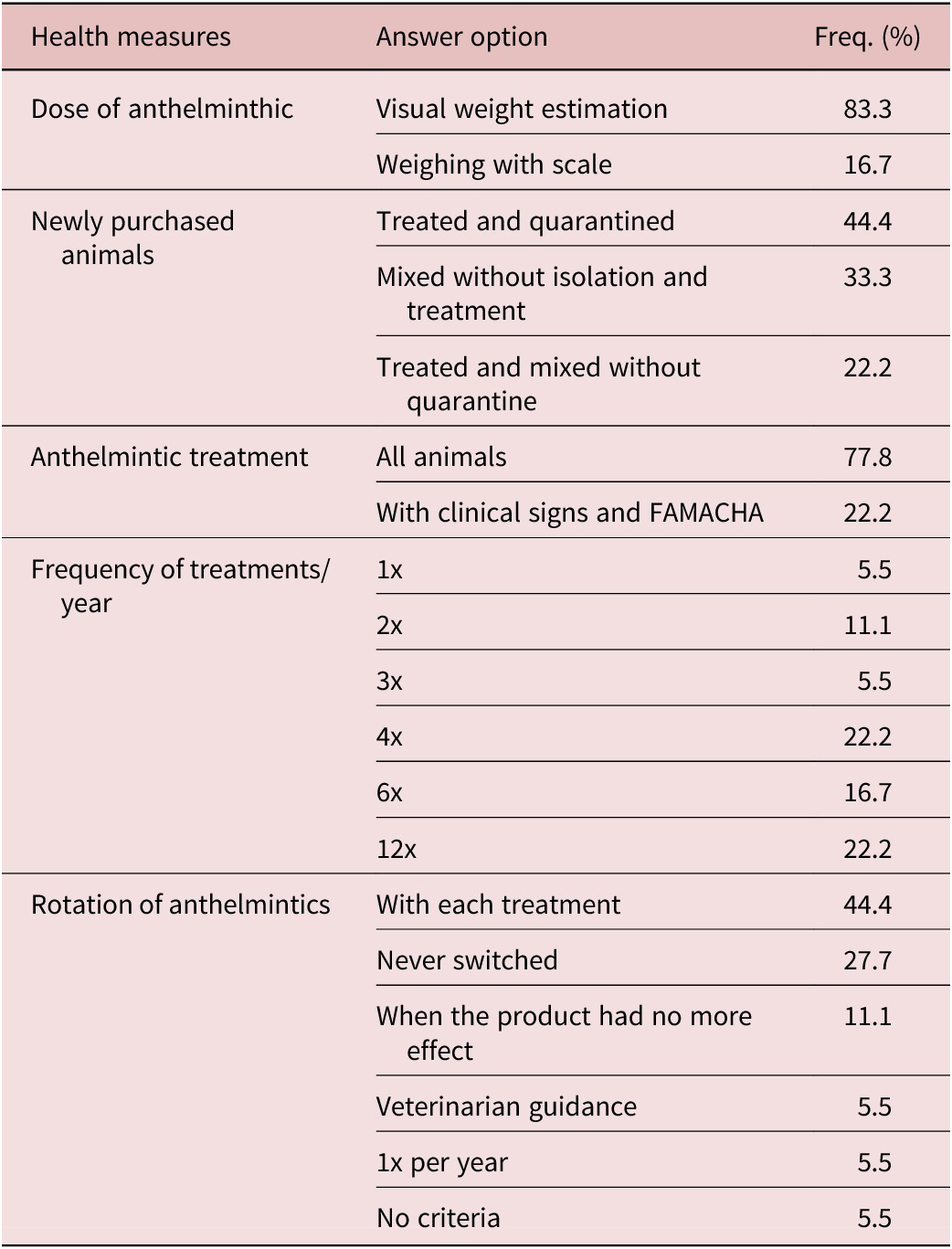
The average time the farmers engaged in the activity was 8.5 years, with a herd size averaging 94 animals. Half of the farms raised crossbred sheep, and the other half raised South African Boer goats. Most farms were semi-intensive, and half adopted grazing rotation based on pasture availability. Levamisole and albendazole were used in 55.5 and 38.8% of the farms, respectively. Monepantel and closantel were reported in 5.55 and 33.3%, respectively.
Regarding macrocyclic lactones, doramectin, moxidectin (MOX), and IVM were reported in 33.3, 27.8, and 16.7% of the farms, respectively. Cattle and horses had sporadic interactions with sheep and goats. The FAMACHA method was used by 22.2% of the farmers. Farmers did not use any laboratory method to decide on parasite control (Table 2).
Frequency (%) of health measures adopted by 18 sheep and goat farmers in Western Paraná, Brazil
Morphological identification and quantification of L3
H. contortus spp. (66.6%) and Trichostrongylus spp. (45.5%) were the most abundant parasites. Infections exclusively by H. contortus or Trichostrongylus spp. were detected in six (33.3%) and five (27.8%) farms, respectively. Mixed infections of H. contortus and Trichostrongylus spp. were detected in four (22.2%) farms, and H. contortus and Cooperia spp. were found in one (5.55%) farm. One (5.55%) farm had a mixed infection of H. contortus, Trichostrongylus spp., and Teladorsagia sp. In all mixed infections, H. contortus had the highest frequency. H. placei was not found in any samples. No L3 were recovered in the municipality of Vera Cruz do Oeste.
Analysis of qPCR data
The qPCR results showed resistant allelic frequencies of up to 72.0 and 23.8% for F200Y and F167Y, respectively (Table 3). The isolates from ST4 (farm 4 of Santa Terezinha de Itaipu) and SI2 (farm 2 of Serranópolis do Iguaçu) presented the highest frequencies of resistant alleles of F200Y. The SI1 and RM1 showed the highest frequencies of resistant F167Y alleles, with 23.8 and 20.7%, respectively. All studied populations showed frequencies of resistant nematodes above 10% for F200Y, with allelic frequencies ranging from 46.4 to 72.0%. Nine populations showed resistant allelic frequencies above 10% for F167Y, varying from 15.7 to 23.8%. The E198A resulted in the detection of susceptible alleles for all isolates. The ISE isolate showed a frequency of 99.7% of susceptible alleles at F200Y and a 100% frequency of susceptible alleles for the F167Y and E198A alleles (Table 3). The dissociation curve analysis showed one well-defined peak per reaction, indicating that only one PCR product was amplified (data not shown).
Average qPCR and cycle quantification (Cq) and allelic frequencies of the F200Y, F167Y, and E198A mutations from Haemonchus contortus of sheep and goat farms in Western Paraná, Brazil

a Municipalities: FI, Foz do Iguaçu; MA, Matelândia; ME, Medianeira; RM, Ramilândia; ST, Santa Terezinha de Itaipu; SM, São Miguel do Iguaçu; SI, Serranópolis do Iguaçu.
b Average Cq (cycle quantification) of the triplicates.
c Susceptible.
d Resistant.
e In cases where it was not possible to determine the Cq value for a given allele, its frequency was zeroed, and the frequency of its detected counterpart was approximately 100%.
Descriptive statistics and correlation of management protocols and qPCR
All examined populations had the F200Y resistant allelic frequencies above 40%, averaging 54.3%. The data revealed that all farms had more than 10% resistant individuals, considered genetically resistant when using the study criteria. Regarding F167Y, farms FA1, ST4, and SI2 showed very low resistant allelic frequencies (< 10%). The only factor these farms had in common was that all animals were mixed breed. This characteristic is noteworthy as the region is hot (> 30-34oC) and dry most of the year. In addition, nine farms showed low frequencies of resistant F167Y, greater than 10%, with a mean of 18.5% but not higher than 25%. It was found that even in farms where BZ was not regularly used, the F200Y was found in high frequencies (Table 4). The frequency of the SNP E198A was not related to any farm management, as only susceptible alleles were found. The correlation between parasite control protocols and the frequency of F200Y and F167Y mutations was not statistically significant (P > 0.05). The comparison of SNP frequencies grouped by general management variables was not statistically significant (P ≥ 0.05).
Allelic frequencies (%) of the F200Y, F167Y, and E198A mutations of Haemonchus contortus in sheep and goat farms (isolates) with and without anthelmintic rotation (yes/no), in Paraná, Brazil
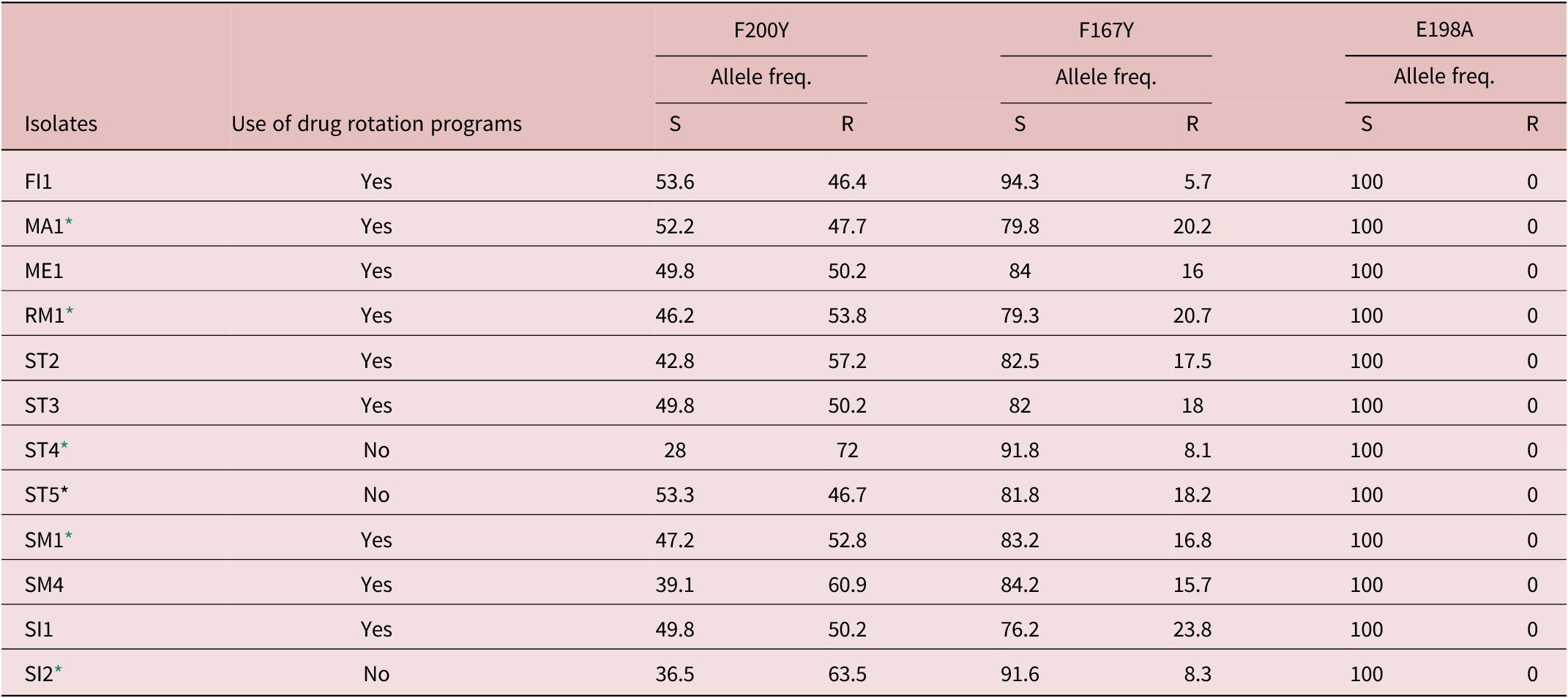
ª Municipality/isolate: FI: Foz do Iguaçu, MA: Matelândia, ME: Medianeira, RM: Ramilândia, ST: Santa Terezinha de Itaipu, SM: São Miguel do Iguaçu, SI: Serranópolis do Iguaçu. S: Susceptible, R: Resistant.
* Farms where BZ was not used.
Discussion
The present study reports the molecular detection of BZ resistance in H. contortus of small ruminants in Western Parana, Brazil, for the first time. The qPCR revealed allele frequencies of β-tubulin isotype 1 for the SNPs F200Y and F167Y related to BZ resistance, using the ISE isolate as a control population. The frequency of SNP F200Y resistance in our study was higher than that reported in previous studies in Brazil (Niciura et al., Reference Niciura, Veríssimo, Gromboni, Rocha, Mello, Barbosa, Chiebao, Cardoso, Silva, Otsuk, Pereira, Ambrosio, Nardon, Ueno and Molento2012; Nunes et al., Reference Nunes, Santos, Bastianetto, Oliveira and Brasil2013; Chagas et al., Reference Chagas, Sampaio Junior, Pacheco, Cunha, Cruz, Scofield and Goés-Cavalcante2016; Santos et al., Reference Santos, Monteiro, Ribeiro, Macedo, Araújo-Filho, Andre, Araújo, Vasconcelos, Freitas, Camurça-Vasconcelos, Vieira and Bevilaqua2017b; Lambert et al., Reference Lambert, Nishi, Mendonça, Souza, Julião, Gusmão and Almeida2017; Fávero et al., Reference Fávero, Santos, Araújo, Ramunke, Krucken, Von Samson-Himmelstjerna and Borges2020). This may be related to climate, management practices, and study time. The climate in Paraná is characterized by hot and humid summers and mild winters, which favor the survival of L3 during most of the year. In contrast, Pará, Bahia, and Minas Gerais have dry and hot weather, with periods that are less optimal for the survival of free-living stages. Consequently, animals in Paraná may be treated more often, increasing the selection for resistant alleles. Moreover, some of the previous data were collected up to 10 years before the present field study, reflecting the actual selection process in Parana.
No management practice was significantly associated with high SNP F200Y and SNP F167Y frequencies in the present study. The data reflect the literature, as concrete high-risk factors are limited when correlating health management and parasite control strategies (Niciura et al., Reference Niciura, Veríssimo, Gromboni, Rocha, Mello, Barbosa, Chiebao, Cardoso, Silva, Otsuk, Pereira, Ambrosio, Nardon, Ueno and Molento2012; Odoi et al., Reference Odoi, Gathuma, Gachuiri and Omore2007; Reynecke et al., Reference Reynecke, van Wyk, Gummow, Dorny and Boomker2011). Chagas et al. (Reference Chagas, Sampaio Junior, Pacheco, Cunha, Cruz, Scofield and Goés-Cavalcante2016) found no significant association with health protocols in sheep infected with H. contortus. Similarly, Lambert et al. (Reference Lambert, Nishi, Mendonça, Souza, Julião, Gusmão and Almeida2017) found no association between health practices and the frequency of resistant alleles in H. contortus in goat farms. Reynecke et al. (Reference Reynecke, van Wyk, Gummow, Dorny and Boomker2011) used a multiple regression algorithm to simulate worm burdens in sheep naturally infected with H. contortus during the summer (rainy season) in South Africa. The authors found that the most critical risk factor associated with high worm burden was sex, which is higher in rams than in ewes. A protective factor found in this study was the early detection and deworming of stragglers when using the FAMACHA method. Farmers are expected to adopt sustainable practices to preserve refugia populations, leaving healthy categories (i.e., adult ewes) without anthelmintics (Molento et al., Reference Molento, van Wyk and Coles2004; Vilela et al., Reference Vilela, Bezerra, Bezerra, Dantas, Alcântara, Oliveira, Nóbrega, Calazans, Feitosa, Braga and Molento2021).
Most farmers treat their animals based on visual weight estimation (15/18). The producers described this practice as facilitating management, mainly in farms with large herds (>200 animals). As a result, administering high doses of anthelmintics is essential in increasing parasite selection pressure (Molento, Reference Molento, van Wyk and Coles2004) and may also influence the frequency of resistant mutations in these herds. We have observed a high allele frequency of SNPs and the lack of quarantine in most farms (55%, 10/18). Therefore, the high prevalence of anthelmintic resistance may result from introducing newly acquired animals to the flock without significant health control. Although the recommendation of quarantine of animals has been widely advocated (Leathwick et al., Reference Leathwick, Hosking, Bisset and Mckay2009), this practice needs to be frequently addressed in the field, as reported here. According to Thomaz-Soccol et al. (Reference Thomaz-Soccol, Sotomaior, Souza, Castro, Pessôa Silva and Milezewski1996), from 1989 to 1994, more than 200,000 heads of sheep were imported from Uruguay and Rio Grande do Sul and were distributed to farmers in Parana as part of an agricultural program. This significant animal movement may have resulted in the introduction of resistant parasite populations (Echevarria et al., Reference Echevarria, Armour and Duncan1991) that could have changed the genetic background in the region.
Concerning treatment strategy and the frequency of BZ mutations, it is noteworthy that even in farms where BZ was not used regularly, the SNP F200Y was found in high frequencies. This data may result from animal movement between farms through sale or reproduction spreading BZ-resistant and cross-resistance (BZ and macrocyclic lactone) parasites, as there is evidence that ivermectin interacts directly with H. contortus tubulin (Ashraf et al., Reference Ashraf, Mani, Beech and Prichard2015). Following this, Mottier and Prichard et al. (Reference Mottier and Prichard2008) reported that IVM and MOX alter the frequency of β-tubulin alleles in H. contortus. Santos et al. (2017) also found corresponding results in sheep treated with IVM and increased allele frequency of F200Y and F167Y in H. contortus. Odoi et al. (Reference Odoi, Gathuma, Gachuiri and Omore2007) have determined risk factors in sheep and goat farms in Kenya. The authors reported the farmer’s education level, the animals’ age category, and the deworming during the preceding month as significant predictors of changing FEC. Niciura et al. (Reference Niciura, Veríssimo, Gromboni, Rocha, Mello, Barbosa, Chiebao, Cardoso, Silva, Otsuk, Pereira, Ambrosio, Nardon, Ueno and Molento2012) have also found that inexperienced farmers, sheep breeds, lack of pasture rotation, entire herd treatment, short drug rotation, and visual dose calculation were associated with the high frequency of resistant genotypes.
The high frequencies observed for F200Y (100%) and F167Y (75%) and how they differ from other regions within the country and worldwide are most likely due to the high genetic diversity observed in H. contortus (Parvin et al., Reference Parvin, Dey, Shohana, Anisuzzaman and Alam2024). We are also reporting a high frequency of concomitant (double) mutations in Brazil. The dispersion of such common mutations could have occurred after local fairs increasing animal movement from sales. Although we did not find the SNP E198A, Zhang et al. (Reference Zhang, Gasser, Yang, Yin, Zhao, Bao, Pan, Huang, Wang, Zou, Zhou, Zhao, Fang and Hu2016) evaluating the three mutations in 192 worms from eight provinces in China, found no F167Y. Barrère et al. (Reference Barrère, Alvarez, Suarez, Ceballos, Moreno, Lanusse and Prichard2012), in a study of 24 artificially infected sheep with H. contortus, found no parasites with more than two mutations. Kotze et al. (Reference Kotze, Cowling, Bagnall, Hines, Ruffell, Hunt and Coleman2012) have determined an exciting shift, showing that the SNP F200Y and E198A started at approximately the same level on the Wallangra isolate, but when increasing thiabendazole concentrations, the E198A frequency increased as the F200Y decreased. Ghisi et al. (Reference Ghisi, Kaminsky and Maser2007) studied 25 β-tubulin alleles cloned and sequenced from H. contortus isolates. All but one isolate carried either the SNP F200Y or the SNP E198A, suggesting that parasites with both mutations are uncommon, differing from our data.
Molecular detection methods contribute to the validation of phenotypic studies (in vitro and in vivo). In the present work, the F200Y allele was the most common polymorphism found in H. contortus. However, the presence of the SNP F167Y can also be considered a strong indication of the lack of BZ efficacy. We are concerned about the reported scenario since the use of BZ drugs was confirmed in 55.5% of the farms. These farms may have used BZ with no signs of reversion (genetic dilution) or loss of resistance mutations (Fissiha and Kinde, Reference Fissiha and Kinde2021). The data also represent the intense animal movement amplifying BZ resistance alleles. Further studies are needed using new technologies for resistance diagnostics (i.e., nemabiome metabarcoding). This technology allows in-depth analysis of the composition of gastrointestinal nematode populations and the prevalence of drug-resistance alleles (Avramenko et al., Reference Avramenko, Redman, Lewis, Yazwinski, Wasmuth and Gilleard2015, Reference Avramenko, Redman, Lewis, Bichuette, Palmeira, Yazwinski and Gilleard2017; Workentine et al., Reference Workentine, Chen, Zhu, Gavriliuc, Shaw, Rijke, Redman, Avramenko, Wit, Poissant and Gilleard2020; Costa-Junior et al., Reference Costa-Junior, Chaudhry, Silva, Sousa, Silva, Cutrim-Júnior, Brito and Sargison2021).
Routine molecular diagnostics of an individual or pooled larvae may help determine the population genetic distribution associated with drug failure. Although isolating one condition that would impose parasite selection is extremely difficult, our data indicate that studies with larger sample sizes and more extended periods of observation (i.e., > three years) would be necessary to establish proper risk factors in any region. The diffusion and implementation of more sustainable parasite control strategies would impact the health and welfare of more than 10,000 sheep and 1,800 goats in the area.
Acknowledgements
The authors thank the Coordenação de Aperfeiçoamento de Pessoal de Nível Superior, CAPES, Brazil, for providing an M.Sc. scholarship to C.M. Prado. The authors also thank Embrapa Caprinos e Ovinos for all the technical support and infrastructure.
Author contribution
C.M.P., M.B.M., and J.P.M. conceived and designed the study. C.M.P. performed the data collection. C.M.P., J.F.V., and G.A.F. performed the molecular experiments. C.M.P. performed statistical analyses. C.M.P., M.B.M., and J.P.M. wrote the article.
Financial support
This research received no specific grant from funding agencies.
Competing interest
The authors declare there are no conflicts of interest.
Ethical standard
This study was approved by the Animal Use Ethics Committee of the Agricultural Sciences Campus of the Federal University of Parana (protocol number 014/2020).



