I. INTRODUCTION
Semiconductor quantum dots (QDs) have shown many valuable applications in energy-efficient lighting, solar cells, and biolabeling and imaging.Reference Li, Wang, Xu, Si, Tao, Lou, Du and Li1–Reference Li, Shen, Li, Niu, Wang and Li3 Their unique optical properties fall between those of bulk semiconductors and individual particles due to quantum confinement, and as a result, those properties correspond directly to the size of the QDs.Reference Li, Shen, Li, Niu, Wang and Li3–Reference Huy, Seo, Lim, Shin and Lee5 This relationship provides the potential for highly specific, tunable nanocrystals of different size regimes.Reference Huy, Seo, Lim, Shin and Lee5,Reference Yu and Peng6 Several approaches to synthesize high-quality QDs, including CdS, CdTe, ZnS, ZnO, and Ag2S, have been developed that result in nanocrystals with some size distribution.Reference Yu, Hu, Wang, Le Piolet, Frotey, Zaman, Wu, Leek, Tao, Wilkinson and Li4–Reference Wang, Wang, Tang, Li, Hou and Teng11 However, the need for single-sized QDs has led to research in producing so-called “magic-sized” quantum dots (MSQDs) exhibiting narrow photoluminescence (PL) peak and unshifting absorption spectra throughout synthesis. These MSQDs appear at fixed absorption peak wave length (nm) positions as a result of homogeneous nucleation and uniformly sized products without further growth; contrasting “regular” QDs, whose particle sizes increase, or grow, with time throughout synthesis period. The nanocrystal growth is evidenced by a continuous red-shift of absorption peak with time for each synthesis batch.Reference Wang, Han and Ke2,Reference Ouyang, Zaman, Yan, Johnston, Li, Wu, Leek, Ratcliffe, Ripmeester and Yu12–Reference Li, Ouyang, Ratcliffe, Pietri, Wu, Leek, Moudrakovski, Lin, Yang and Yu14 Several previous works have shown the ability to produce MSQDs, with CdS and other semiconducting materials, using various approaches. These methods allow for the control of reaction parameters to result in production of regular or MSQDs with desired properties.Reference Wang, Han and Ke2,Reference Yu, Hu, Wang, Le Piolet, Frotey, Zaman, Wu, Leek, Tao, Wilkinson and Li4,Reference Ouyang, Zaman, Yan, Johnston, Li, Wu, Leek, Ratcliffe, Ripmeester and Yu12,Reference Yu13,Reference Niu, Xu, Shen, Li, Wang and Li15,Reference Mandal, Dandapat and De16,Reference Lawrence, Dolai, Nimmala, Dass and Sardar18–Reference Son, Park, Kwon, Yang, Choi, Kim, Yu, Joo and Hyeon21
This investigation demonstrates an approach to synthesize CdS QDs via a one-pot noninjection method, using dodecanethiol (DDT), an organic molecular sulfur, as the sulfur source. Thus far, DDT has been used to produce regular QDs, with size distribution, but has not been utilized as the sulfur source for CdS MSQD production.Reference Li, Wang, Xu, Si, Tao, Lou, Du and Li1,Reference Li, Shen, Li, Niu, Wang and Li3,Reference Niu, Xu, Shen, Li, Wang and Li15 We confirmed that MSQD and regular QDs could be produced independently, based on the relative ratios of the reactants in the system. A major finding is that a low acid-to-Cd molar feed ratio leads to the formation of a Cd precursor conducive to MSQD formation. The unique Cd precursor has a more limited solubility in the solvent, 1-octadecene (ODE), than the Cd precursor resulting from a high acid-to-Cd molar feed ratio. This limited solubility slows the release of Cd2+, causing controlled nucleation without further growth.Reference Yu, Hu, Wang, Le Piolet, Frotey, Zaman, Wu, Leek, Tao, Wilkinson and Li4,Reference Li, Ouyang, Ratcliffe, Pietri, Wu, Leek, Moudrakovski, Lin, Yang and Yu14 The effects of the acid used as a surface capping ligand were also explored for both regular and “magic-sized” CdS QDs. The chain length of the acid can affect the kinetics of the synthesis and result in various sizes of QD particles.Reference Ouyang, Kuijper, Brot, Kingston, Wu, Leek, Hu, Ripmeester and Yu8 Reaction temperature was tested for the ability to tune the product size. The synthesis temperature can affect the reaction by providing for the initial energy of reaction and the stability of the QDs in a solution.Reference Ouyang, Kuijper, Brot, Kingston, Wu, Leek, Hu, Ripmeester and Yu8 Using this method, two “families” (378 and 407 nm) of previously reported MSQD were synthesized with our alternative sulfur source.Reference Wang, Han and Ke2,Reference Li, Ouyang, Ratcliffe, Pietri, Wu, Leek, Moudrakovski, Lin, Yang and Yu14
II. EXPERIMENTAL DETAILS
A. Synthesis of CdS QDs
The following chemicals were used as received: cadmium acetate dihydrate (Cd(OAc)2•2H2O, 99.999%) from Alfa Aesar; 1-dodecanethiol (DDT, >98%), 1-octadecene (ODE, tech. 90%), and lauric acid from Sigma Aldrich; and myristic acid (MA, >99.5%) and stearic acid (SA, >95%) from Fluka. Hexanes (HLPC, 99+%) were obtained from Alfa Aesar. In a typical synthesis, mmol quantities of Cd and acid at varying ratios were loaded in a three-neck round-bottom flask with liquid ODE and heated under inert gas flow until a clear solution was obtained. In all the experiments, except those comparing the acid chain length effect, myristic acid was used as the capping ligand. A S precursor solution of DDT in ODE was then added and the mixture solution continuously stirred to ensure homogeneous mixing. The mixture in the flask reactor was then heated to the target reaction temperature, typically 240 °C and maintained for the desired reaction time. Aliquots of reaction mixture were taken at time intervals throughout the synthesis reaction period, via a syringe, and quenched by dilution in hexane for UV–Vis and PL spectrometry analysis.
B. Optical analysis
The growth and evolution of the nanocrystals were monitored by the UV/Vis absorption and PL emission spectra. The reaction mixture samples were analyzed as is, dispersed in hexane, with no further dilution or purification, unless otherwise specified. Absorption spectra for each experiment were collected using a Varian Cary 5000 UV–Vis–NIR Spectrophotometer (Agilent Technologies, Santa Clara, CA). PL emission spectra were collected using a Jobin Yvon Horiba Fluoromax-4 Spectrofluorometer (Horiba, Kyoto, Japan) at a typical excitation wave length of 350 nm.
C. Transmission electron microscopy (TEM)
TEM samples were deposited on a 200 mesh holey carbon TEM grid and dried in air. TEM images were collected using a Zeiss Libra 200 HT FE MC electron microscope.
III. RESULTS AND DISCUSSION
There are different chemical approaches (such as hot-injection versus noninjection) and chemical formulations (i.e., using various reactant precursors) for synthesizing QDs in the literature. As reported here, our formulation of using octadecene as synthesis solvent media and dodecanethiol (DDT) as a new sulfur source is a unique one, different from previous efforts in the literature. Specifically, we have newly demonstrated the possibility of using this facile approach to be able to produce either MSQDs or regular QDs when conditions (e.g., organic acid-to-Cd molar ratio) are tuned. The greatest advantage of DDT is that it is easy to dissolve in octadecene to form a molecularly homogeneous solution, while solid sulfur requires longer times and an elevated temperature to dissolve in octadecene. In Jidong Wang et al.'s work,Reference Wang, Han and Ke2 the solid sulfur was used as a precursor and the MSQDs emit “white light” (a combination effect of both band gap emission and the defect-related trap emission). In contrast, the photoluminescent emission of our QDs produced from DDT has led to a very different QD product, i.e., a sharp band gap emission with little trap emission. This may indicate that our synthesis route has produced a much lower defect QD using a different molecular sulfur precursor DDT.
In the experiments, salt of Cd(OAc)2•2H2O was used as the Cd source and DDT served as the sulfur source. During dissolution, the Cd salt formed a complex with the acid capping ligand to form a colorless solution; followed by the addition of the sulfur precursor solution (i.e., DDT dispersed in ODE solvent). As the system was heated to the target reaction temperature, the solution turned from colorless to pale yellow, and then with time the reaction mixture turned to an eventual dark yellow-brown hue. This fluorescent color change during the synthesis is indicative of the apparent formation of the CdS nanocrystals.
A. Development of CdS QDs using an organic sulfur molecule
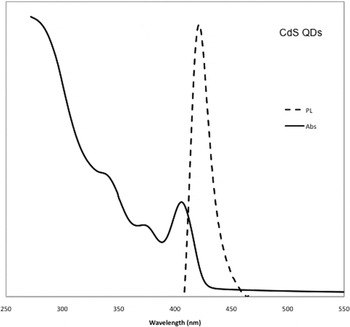
The use of DDT as the sulfur source in QD synthesis has been shown as an alternative to elemental sulfur in the synthesis of regular CdS QDs.Reference Li, Shen, Li, Niu, Wang and Li3,Reference Niu, Xu, Shen, Li, Wang and Li15 Our experiments supplemented the previous work by producing high-quality regular QDs with a distinctive absorption (Abs) spectrum and a narrow PL optical bandwidth in full width half-maximum (fwhm) of ∼18 nm, as seen in Fig. 1. The production of the high quality nanocrystals proved DDT as an adequate S source for regular CdS QD formation. This method was used to explore the other aspects of the synthesis system and is applied in all further experiments presented here, for studying the conditions of regimes for both regular and MSQD formations.
Absorption and emission spectra of CdS QDs dispersed in hexane. The excitation wave length for PL is 350 nm.

B. Determination of regular and MSQD experimental conditions
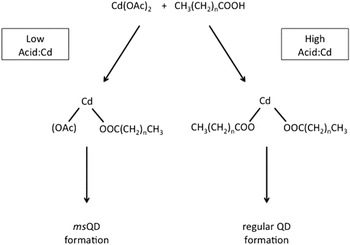
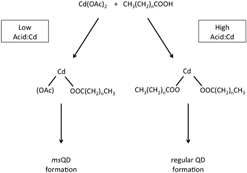
The effect of the solubility of the Cd precursor on the formation of regular versus MSQD formation has been explored in previous work.Reference Wang, Han and Ke2,Reference Yu, Hu, Wang, Le Piolet, Frotey, Zaman, Wu, Leek, Tao, Wilkinson and Li4,Reference Ouyang, Zaman, Yan, Johnston, Li, Wu, Leek, Ratcliffe, Ripmeester and Yu12–Reference Li, Ouyang, Ratcliffe, Pietri, Wu, Leek, Moudrakovski, Lin, Yang and Yu14 The Cd precursor is varied by using a high or low acid-to-Cd molar feed ratio. In this experiment, these ratios were 2 acid:1 Cd and 1 acid:2 Cd, respectively. A low acid-to-Cd molar feed ratio produces an ionic Cd complex in which only one original anion of the Cd salt is replaced by an acid chain. During synthesis, the release of Cd2+ from this complex to react with sulfur to form CdS is controlled by its own solubility in ODE. The interaction between the original anion and Cd2+ is stronger than that of the acid chain with Cd2+. The slow release of Cd2+ provides a condition for controlled nucleation of CdS without further growth, critical for formation of MSQDs.Reference Yu, Hu, Wang, Le Piolet, Frotey, Zaman, Wu, Leek, Tao, Wilkinson and Li4,Reference Li, Ouyang, Ratcliffe, Pietri, Wu, Leek, Moudrakovski, Lin, Yang and Yu14
With a high acid-to-Cd molar feed ratio, the carbon chain acid replaces both anions of the Cd salt. Therefore, the Cd precursor formed has a higher solubility in ODE and a faster release of Cd2+. The uncontrolled release of Cd2+ will result in growth of the CdS nuclei and regular QD formation.Reference Yu, Hu, Wang, Le Piolet, Frotey, Zaman, Wu, Leek, Tao, Wilkinson and Li4,Reference Li, Ouyang, Ratcliffe, Pietri, Wu, Leek, Moudrakovski, Lin, Yang and Yu14 The comparison of these two different QD formation mechanisms is illustrated in Fig. 2. Our experiments tested the integrity of low and high acid-to-Cd molar feed ratios and produced both regular and MSQDs by this approach.
Precursor formation and resulting QDs produced for low and high acid:Cd ratios.

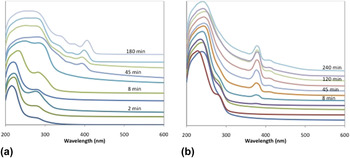
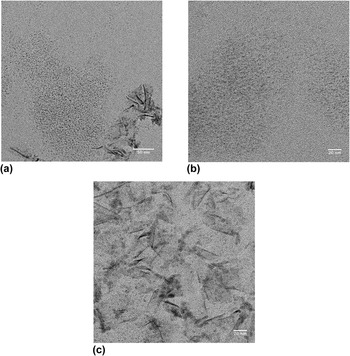
Figure 3 shows absorption spectra for QDs produced under otherwise identical conditions, with varied acid-to-Cd molar feed ratios. From these results, it can be seen that the molar feed ratio of acid-to-Cd is a factor in the system developing into regular QDs versus MSQDs. The experiment was the first of our knowledge to result in high-quality MSQDs using DDT as the sulfur source. In previous work, the combination of the “magic-sized” conditions and the DDT sulfur source is not reported.Reference Wang, Han and Ke2,Reference Li, Ouyang, Ratcliffe, Pietri, Wu, Leek, Moudrakovski, Lin, Yang and Yu14 Figure 4 shows TEM images as physical evidence for the produced high-quality “magic-sized” CdS nanocrystals, further concluding that “magic-sized” CdS QDs could be produced using 1-dodecanethiol. Interestingly, the particle and flake morphology co-exist in some areas of the TEM sample. This is in agreement with a previous reportReference Wang, Han and Ke2,Reference Son, Wen, Joo, Chae, Baek, Park, Kim, An, Yu, Kwon, Choi, Wang, Kim, Kuk, Hoffmann and Hyeon17,Reference Son, Park, Kwon, Yang, Choi, Kim, Yu, Joo and Hyeon21 regarding the possibility of forming the 2D sheet flake assembly from the colloidal particles in the MSQD samples.
(a) Absorption spectra of regular CdS QDs synthesized from a high acid-to-Cd ratio. (b) Absorption spectra of MSQDs synthesized from a low acid-to-Cd ratio.

TEM image of “magic-sized” CdS QDs.

C. Effect of the acid chain length of QD size
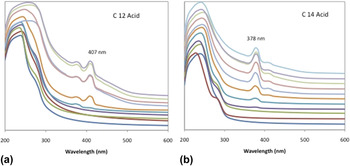
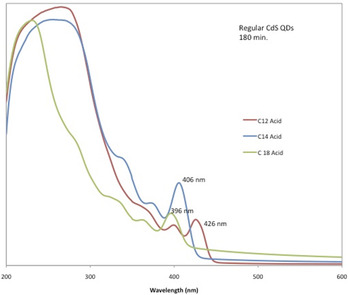
Figures 5 and 6 show the evolution of MSQDs and regular QDs with varying acids used as surface capping ligands, respectively. The use of two different acids, C12 and C14, in synthesizing MSQDs results in the formation of two different families, Family 378 [Fig. 5(a)] and Family 407 [Fig. 5(b)]. With an increase in chain length from C12 to C14, the resulting MSQDs decrease in diameter, evidenced by the shift from Family 407 to Family 378. The longer acid chain provides more steric hindrance and lowers the availability of the Cd precursor to react with sulfur. Nucleation is slowed with less available Cd2+ resulting in smaller nuclei nanocrystals.Reference Ouyang, Kuijper, Brot, Kingston, Wu, Leek, Hu, Ripmeester and Yu8
(a) Absorption spectra throughout synthesis of CdS MSQDs produced with a C12 acid, magic-sized family 407. (b) Absorption spectra throughout synthesis of CdS MSQDs produced with a C14 acid, magic-sized family 378.

Absorption spectra for regular QDs synthesized with acid chain lengths from C12 to C18, conditions otherwise identical.

It is also noteworthy that when synthesizing regular CdS QDs, different acids resulted in different absorption peak positions for the same synthesis time. This finding is demonstrated in Fig. 6 with peak positions as follows: C18 at 396 nm, C14 at 406 nm, and C12 at 426 nm; with all samples taken at 180 min of synthesis time. The steric effects of a longer acid chain on slowing down the dynamic size growth of nanocrystals also hold true for synthesizing regular QDs.
D. Effect of synthesis temperature
The synthesis temperature can affect the kinetics of reaction, providing energy for the reaction to proceed. The threshold of reaction temperature was tested to observe the effect, if any, on the formation and the family size of the QD products. Syntheses were performed in the range of 180–240 °C, at increments of 180, 200, 210, and 240 °C. 180 and 200 °C proved to not be enough heat to produce QDs, witnessed by no apparent absorption or PL spectra of the product solution. The remaining temperatures produced MSQDs, at the same family size 378. The synthesis at 210 °C resulted in lower yield than 240 °C as a result of less energy to release Cd2+ ions into the solution and, therefore, fewer nuclei. From these results, it does not appear that reaction temperature will affect the size of the nanocrystals, and that this established protocol for MSQD formation can be carried out at varying temperatures to optimize the yield.
IV. CONCLUSION AND OUTLOOK
In summary, both regular and magic-sized CdS QDs were successfully produced from the organic sulfur source, 1-dodecanethiol, via a wet-chemistry noninjection approach. Formation of MSQD nanocrystals was confirmed to be more likely with a low acid-to-Cd molar feed ratio, as evidenced by the production of both regular QDs and MSQDs. Further, two families of MSQDs were synthesized by changing the molecular chain length of the acid capping ligand used in the reaction. Families 378 and 407 were produced using this method. 1-dodecanethiol was established as an adequate sulfur source in the synthesis of “magic-sized” CdS QDs. The synthetic protocol developed in this investigation can be expanded to further tune the QD size for target-specific applications as well as to improve the overall production yield of the synthesis.
ACKNOWLEDGMENTS
This work was supported in part by the U.S. Department of Energy (DOE), Office of Science, and Office of Workforce Development for Teachers and Scientists (WDTS) under the Science Undergraduate Laboratory Internship program (SULI), and partially by the DOE/NA-22 program and ORNL-LDRD program. We also acknowledge the collaborative assistance provided by Mussie Alemseghed on synthesis lab assistance, as well as John Dunlap and Bamin Khomami on using TEM at the University of Tennessee, Knoxville. Acknowledgment is given to Jong Keum at the Center for Nanophase Materials Sciences (CNMS) for his XRD analysis of our CdS quantum dot samples although the XRD data were not included in this paper.