INTRODUCTION
Latinos constitute one of the fastest growing segments of Evangelicals in the United States (Lugo and Pond Reference Lugo and Pond2007; U.S. Census Bureau 2012). Although the reasons for Latino conversion to Evangelicalism are varied, there is no doubt recruitment efforts by these groups are playing a critical role (The Economist 2012). For example, a 2009 internal Southern Baptist Convention (SBC) report demonstrates that the SBC recognizes the demographic trends of the growing Latino population and is in the process of making a concerted effort to incorporate more Latinos into their congregations (NAMB Research Workgroup 2009). Eager to expand their flock, Evangelicals may see Latinos as natural recruits given their Christian proclivities and the fact that they are the largest minority group in the United States (Suro et al. Reference Suro, Escobar, Livingston, Hakimzadeh, Lugo, Green, Smith, Cox and Chaudhry2007). Thus, the recent Latino demographic growth constitutes a historical opportunity for Evangelicals to fulfill spiritual missions as well as political goals (Wong, Rim, and Perez Reference Wong, Rim, Perez, Ramakrishan and Bloemraad2008; Menjivar Reference Menjivar1999).
In response to this phenomenon, scholars of American politics have begun to study the political consequences of Latino Evangelical identities (Cadge and Ecklund Reference Cadge and Ecklund2007; Espinosa Reference Espinosa2005, Reference Espinosa2007). While the scholarship is largely underdeveloped and speculative when it comes to determining the impact of Latino Evangelicals on American politics, much more empirical research has been devoted to examining how Latino religious identities shape their political behaviors (Jones-Correa and Leal Reference Jones-Correa and Leal2001; Layman Reference Layman1997; Lee and Pachon Reference Lee and Pachon2007) and attitudes (Kelly and Kelly Reference Kelly and Kelly2005; Pantoja, Barreto, and Anderson Reference Pantoja, Barreto, Anderson, Hayer, Rozell and Genovese2008; Pantoja Reference Pantoja2010). Our study builds and expands on this latter scholarship by examining the way different Christian churches shape Latino immigrant conceptions of America's national identity and their self-identities as Americans. We find that Protestant Latinos (be they mainline or Evangelical) are more likely than Catholic Latinos (the majority of Latinos) to identify as American and to believe that Americans think that being a Christian is a defining feature of American identity.
Our focus on immigrants’ conceptualizations of American identity is a departure from previous studies, but it is no less important because debates over increased immigration and ethnic change largely center on the following questions: What is it that defines us as American and how do contemporary immigrants, namely Latinos, adopt that identity? Critics of immigration and ethnic change contend that Latino norms and values are inconsistent with those of Anglo-Americans (Huntington Reference Huntington2004). Thus, increases in Latin American immigration will invariably fragment America as a result of a clash in values and cultures between Anglos and Latinos. Of course, Latinos, like previous ethnic groups, could assimilate Anglo-American values. However, a changed socio-political context makes that possibility unlikely. Huntington writes, “If this trend continues, the cultural division between Hispanics and Anglos will replace the racial division between blacks and whites as the most serious cleavage in American society. A bifurcated America with two languages and two cultures will be fundamentally different from the America with one language and one core Anglo-Protestant culture that has existed for over three centuries” ( Huntington Reference Huntington2004, 325).
Huntington is not alone in raising concerns over the cultural consequences of contemporary immigration. Writings from the Founding Fathers as well as contemporary democratic theorists generally subscribe to the belief that some type of common bond, usually in the form of shared norms and values, is essential for democratic stability (Dahl Reference Dahl1998; Kymlicka Reference Kymlicka1995; Walzer Reference Walzer1992). In the Federalist No. 2, John Jay wrote:
With equal pleasure I have as often taken notice that Providence has been pleased to give this one connected country to one united people — a people descended from the same ancestors, speaking the same language, professing the same religion, attached to the same principles of government, very similar in their manners and customs …
The writings of Jay, Huntington, and democratic theorists provide a list of “constitutive norms” that define an ideal American (Abdelal et al. Reference Abdelal, Herrera, Johnson and McDermott2006). Schildkraut states, “Constitutive norms generate ideal types that serve as information shortcuts; they set expectations for group members for how we should look, sound, think, act and worship” (Schildkraut Reference Schildkraut2011, 38). Of course, there is no consensus over which traits are most essential for a democracy. For Huntington, the cultural core of American democracy is religiously bound in the form of Protestantism or Christianity. It is widely accepted that Americans have been deeply religious and Christian throughout their history (Putnam and Campbell Reference Putnam and Campbell2010). Even today, the United States is unique among industrialized nations for its religiously Christian fervor (Norris and Inglehart Reference Norris and Inglehart2011). Public opinion polls reveal that two in three Americans (67%) subscribe to the idea that “America is a Christian nation” (The Pew Forum on Religion and Public Life 2006), and recent research demonstrates that the connection between Christianity and Americanism is robust in the general population (Jacobs and Theiss-Morse Reference Jacobs and Theiss-Morse2013). If some democratic theorists and the general public consider Christianity to be a central element of American culture, then it is worth considering whether Latinos subscribe to this definition of Americanism. The extent to which Latinos reject or embrace this conceptualization may help identify one of the potential sources of Anglo-Latino socio-political conflict or commonality. To this end, this study seeks to understand the degree to which Latinos subscribe to the idea of America as a Christian nation and the degree to which they self-identify as American. In addition, this paper explores the factors structuring these beliefs. Specifically, we consider the role of religious institutions in shaping Latino conceptions of Americanism and their adoption of the identity “American.”
Understanding the role of religious institutions in the formation of new identities is critical as churches often serve as socializing agents for new immigrants. Churches may be the institutions best equipped at incorporating immigrants into the fabric of American culture (e.g., Vasquez Reference Vasquez1999; Wong Reference Wong2006). For instance, churches may be places where immigrants connect with others who are farther along the acculturation process, and many churches have programs and services directly tied to making the social, economic, linguistic, and political transition into the United States as easy as possible (Vasquez Reference Vasquez1999). Churches may also serve as bridging institutions normalizing political behavior for new immigrants. For example, during the 2010 Census many churches — both Catholic and Protestant — were enlisted to help the United States government increase Latino census participation (Banks Reference Banks2011; Preston Reference Preston2009). Some organizations — such as the National Coalition of Latino Clergy & Christian Leaders — advocated avoiding the Census as an act of political protest, but the largest Christian organizations with active participation in the immigrant Latino community rejected these calls and took proactive steps to be involved (Banks Reference Banks2011). Recent events and mounting academic research indicate that churches often serve as gateway institutions for immigrants. Thus, investigating how these institutions can affect the formation of an American identity is critical for our understanding of the role of these churches in Latino immigrant incorporation and socialization.
In this paper, we theorize that because religious institutions are important places for immigrants to become incorporated into American culture and politics they will have an impact on how immigrants understand the relationship of Christianity and “being American” as well as the formation of immigrants’ own American identities. In response to the growing practice of Evangelical churches in targeting Latinos — immigrants in particular — we pay particular attention in our analysis to the differences among churches in shaping immigrant conceptions of Americanism and their own identity. We use data from the 2006 Latino National Survey (Fraga et al. Reference Fraga, Garcia, Hero, Jones-Correa, Martinez-Ebers and Segura2006) to test our hypotheses, finding that church affiliation does indeed shape some notions of American identity. Specifically, membership in some churches — Evangelical and Protestant churches in particular — increases the likelihood Latinos believe Christianity is important for being American. Additionally, we find that identifying as a Protestant congregant — Evangelical and mainline Protestant — increases the likelihood of identifying as an American. We conclude with a discussion of the implications of our findings.
PREVIOUS RESEARCH AND PRELIMINARY EXPECTATIONS
In our analysis, we focus specifically on the impact of Christian church membership in shaping Latino immigrants’ conceptions and adoption of American identity. We limit our focus to Christianity for a few reasons. First, the vast majority of Latinos in the United States are Christians. In our sample specifically, approximately 87% of the respondents are Christians.Footnote 1 Second, existing scholarship in this field demonstrates that Christian churches influence political behaviors and attitudes. Furthermore, denominational differences among Christian churches shape the nature of these churches’ influence, with members of Evangelical churches often displaying different behaviors and attitudes than those of their peers. As the research outlined below indicates, there is good reason to expect that Christian church participation plays a role in developing immigrant notions of what it means to be American.
Religion is regarded as an important force shaping American politics. Throughout the nation's history there are so-called “Great Awakenings” or moments when religion is a leading force in national politics (McLoughlin Reference McLoughlin1978). Religious institutions are also intertwined with ethnic politics. For example, through the first half of the 20th Century, the Democratic Party could rely on heavy support from Catholic voters, which was synonymous with Italian and Irish immigrant voters. In fact, until the 1960s American Catholics were largely regarded as foreigners by American Protestants (Ross Sammon Reference Ross Sammon, Hayer, Rozell and Genovese2008). By the second half of the 20th Century, White Evangelical voters were largely aligned with the Republican Party (Wilcox and Robinson Reference Wilcox and Robinson2011). The victories of George W. Bush in 2000 and 2004, a “born-again” Christian, are frequently attributed to strong support by White Evangelicals (Campbell Reference Campbell2006). The partisan leanings of different denominations at various historical junctures suggest that churches play an important role in shaping political beliefs. What role might churches play for contemporary immigrants in the United States?
Religious institutions act as socializing agents for contemporary immigrant communities, shaping their incorporation into the United States (Menjivar Reference Menjivar1999; Reference Menjivar2001; Wong, Rim, and Perez Reference Wong, Rim, Perez, Ramakrishan and Bloemraad2008; Wong Reference Wong2006). Broadly speaking, previous research shows that religious institutions create social capital (Putnam Reference Putnam2001) and are key places for the development of civic skills, political attitudes, and behavior (Verba, Schlozman, and Brady Reference Verba, Schlozman and Brady1995). However, not all churches are equal in this regard. Recent research indicates that Evangelical churches are distinct from others in their impact on political participation. For example, Evangelicals are increasingly adept at mobilizing their members for a variety of political activities despite their historical ambivalence toward overt political action (Wald and Calhoun-Brown Reference Wald and Calhoun-Brown2011). Verba, Schlozman, and Brady (Reference Verba, Schlozman and Brady1995) argue that denominational differences matter and that Latino affiliation with Catholicism explains their lower levels of political participation relative to African-Americans, whose churches provide members with greater civic skills and political messages. Research by Jones-Correa and Leal (Reference Jones-Correa and Leal2001) downplays the significance of denominational differences and notes that frequency of religious attendance is a more robust predictor of Latino political participation.
Just as with political behaviors, religious institutions play important roles in shaping the beliefs and identities of immigrants as they reach America (Hirschman Reference Hirschman2004; Menjivar Reference Menjivar1999; Reference Menjivar2003; Wong Reference Wong2006; Vasquez Reference Vasquez1999). For example, being a member of a Muslim mosque makes identifying with the Republican Party less likely (Barreto and Bozonelos Reference Barreto and Bozonelos2009), while — for Latinos — being a member of an Evangelical or mainline Protestant church increases the likelihood of identifying as a Republican (Kelly and Kelly Reference Kelly and Kelly2005). Pantoja (Reference Pantoja2010) shows that being a born-again Christian is significantly correlated with conservative ideology and that this effect is increased when interacted with religiosity.
Despite this mounting evidence concerning the effect of religious traditions on Latino immigrants’ political behavior and socialization, there is scant work examining the role of these institutions on Latino immigrants’ American identity formation. There is some evidence from ethnographic and qualitative research showing that Evangelical churches help immigrants focus more on being “American” (Menjivar Reference Menjivar1999). For example, in qualitative interviews with congregants and church leaders, Menjivar (Reference Menjivar1999) finds that some Evangelical churches aim both to fulfill their congregants’ spiritual needs while consistently instilling a focus on the United States as their country of allegiance. Thus, while existing qualitative research supports the notion that some churches may shape immigrants’ conceptions of Americanism, there is not yet quantitative research regarding the systematic relationship between these institutions and American identity in the immigrant Latino community. We seek to fill this gap in the literature through an examination of the relationship between church participation (focusing on Christian churches in particular) and Latino immigrant attitudes toward America's identity as a Christian nation and their self-identity as American.
These institutions help immigrants connect to their countries of origin, while still maintaining some semblance of their home countries’ traditions or social connections (Hirschman Reference Hirschman2004). While it is certain that immigrants arrive in the United States with pre-formed orientations toward America, their attitudes regarding America and American identity are likely molded in part by their experiences upon arrival. Given the important role of churches in immigrant incorporation, we suspect that these organizations also play a critical role in shaping political attitudes within the United States.
Scholarly evidence regarding the capacity for religious institutions to affect political attitudes among immigrants is growing. Previous research indicates that religious participation shapes party attachment for many groups. The differences between Evangelical and Catholic traditions are also highlighted in the difference of opinion about social issues for Latinos as well. Kelly and Morgan (Reference Kelly and Morgan2008) use “religious traditionalism” as an explanatory variable for both policy positions and political ideology, finding that more traditional religious values strongly predict support for restricting abortion rights and claiming that the role for women is in the home.
Following existing research, we anticipate that participation in these churches will influence immigrants' attitudes toward American identity. First, we expect that affiliation in Christian churches will shape immigrants' conceptions of American identity, strengthening their belief that Christianity is an important part of being American. We further expect that participation in these churches will influence immigrants' choice to adopt an American identity themselves. As such, our first hypotheses are as follows:
H1A:
Identifying as a Christian congregant will significantly influence immigrant attitudes towards American identity, increasing the likelihood that they connect American identity with Christianity.
H1B:
Identifying as a Christian congregant will significantly influence immigrant identity, increasing the likelihood that they identify as Americans.
Beyond their general impact on attitudes and identity, institutional variation among churches may lead to significant differences in the way immigrant political orientations are formed (Menjivar Reference Menjivar2003). Despite a growing trend toward Protestant churches — particularly charismatic style churches — the Catholic church is the most dominant church in Latin America given the history of colonization by the Spanish and other Catholic European powers (Lee and Pachon Reference Lee and Pachon2007; Vasquez Reference Vasquez1999). Due to its institutional design, the Catholic Church is not necessarily invested in any specific political framework; rather, the Catholic Church is multinational in scope with a hierarchy that operates outside of any one political or ideological system.Footnote 2 Thus, the Catholic Church may be less likely to generate an “American” identity for its parishioners or focus on conceptions of Americanism per se. Research on Catholic churches working in transnational migration suggests that its focus may be fundamentally different than that of Evangelical churches with regard to a focus on American identity (Baia Reference Baia1999). Catholic churches focus on social programs, community action, and engagement for immigrants but do not put much effort into connecting immigrants with the wider-American culture as an end unto itself, focusing instead on creating a pan-ethnic identity (Menjivar Reference Menjivar2003).
In contrast to the Catholic Church, there is evidence that Protestant — Evangelical churches specifically — may significantly shape congregants' beliefs about and adoption of American identity. Research from Hagan and Ebaugh (Reference Hagan and Ebaugh2003) suggest that the Pentecostal churches in immigrants' home countries and the United States often form a network, working to keep connections with immigrants' family and friends in an effort to ease the transition to the United States while simultaneously helping immigrants incorporate more quickly into their new community (Hagan and Ebaugh Reference Hagan and Ebaugh2003). Menjivar (Reference Menjivar1999; Reference Menjivar2003) finds that there are distinct patterns of behavior from Evangelical churches, fostering an American identity at an early point in the incorporation process for Latino immigrants. The key difference between the Catholic churches and the Evangelical churches in this regard is the emphasis of the message to the immigrants about what it means to be in America (Menjivar Reference Menjivar1999; Wong, Rim, and Perez Reference Wong, Rim, Perez, Ramakrishan and Bloemraad2008). As these scholars note, in many Evangelical churches there is a distinct and constant push toward the United States, whereas in the Catholic churches, the institutional focus is less on the United States and more on pan-ethnic identity. Given that Evangelical Protestantism among Latinos is on the rise (Suro et al. Reference Suro, Escobar, Livingston, Hakimzadeh, Lugo, Green, Smith, Cox and Chaudhry2007), these findings may have significant implications for the political attitudes of Latinos migrating to and acculturating in the United States. Based on existing research, we theorize that being associated with Evangelical Christian churches (rather than other churches) may lead Latino immigrants more to closely associate American identity with Christianity and adopt an American identity themselves, generating the following hypotheses:
H2A:
Those Latino immigrants who identify as Evangelical will be more likely than non-Evangelical Latino immigrants to associate being Christian with being American.
H2B:
Those Latino immigrants who identify as Evangelical will be more likely than non-Evangelical Latino immigrants to identify as Americans.
DATA AND FINDINGSFootnote 3
Measures
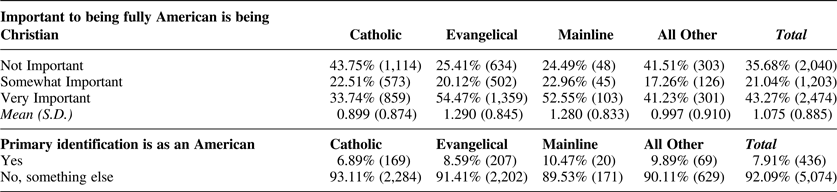
The data are taken from the 2006 Latino National Survey (LNS).Footnote 4 The number of respondents who say they were born in the mainland United States number 2,917, which leaves a total sample size of 5,717 migrants.Footnote 5 To test our hypotheses, we examine responses to a question asking Latino immigrants to categorize their agreement with the question, “When you think of what it means to be fully American in the eyes of most Americans, do you this it is (2 = very important, 1 = somewhat important, 0 = or not important) to be Christian?” This question probes the extent to which Christianity is considered an important aspect of American identity as the respondent understands it. Table 1 displays the distribution for our dependent variable by church membership (Catholic, Evangelicals, Mainline Protestants, and all others).
Distribution of dependent variables by religious affiliation among Latino immigrants (2006 LNS)

Note: Number of responses by religious affiliation reported and totals in parentheses.
As demonstrated in Table 1, Evangelicals and mainline Protestants are clearly distinct in their attitudes about the link between American identity and Christianity. Specifically, a clear majority of Evangelicals (54.47%) and mainline Protestants (52.55%) say it is “very important” to be Christian if one is an American. Comparatively, of the three groups examined, Catholics are the least likely to connect Christianity with Americanism (with approximately 34% agreeing that being Christian is very important for being American), while 31.23% of those are not religious or belong to some other denomination believe Christianity to be very important to being “fully American.”
To test the extent to which religious affiliation affects American identity specifically — that is, calling oneself an “American” — we use a second dependent variable, American. This variable is dichotomous and is constructed from the question asking if the respondent refers to their self as an “American” or some other identity label. If the respondent says they calls his or herself an American we code that as one, while other identities are coded as zero. Thus, this measure captures whether respondents consider “American” to be their primary identity and allows for a direct test of the effect of religious affiliation on identity for Latino immigrants.
The differences among the religious affiliations for American identity are reported at the bottom of Table 1. Comparatively few (7.91%) immigrant respondents to the 2006 LNS called themselves American as a primary identity. Looking at the general breakdown among the religious categories, we see that Catholics have the lowest number of American identifiers at 6.89%, with 8.59% of Evangelicals, and 10.47% of mainline Protestants calling themselves “American” as their primary identity. Next, to clearly identify the impact of church membership on American identity, controlling for alternative explanations, we employ a multivariate analysis.
Multivariate Analysis: Measures
We include a number of independent variables in our multivariate analysis (see the online Appendix for a complete discussion of questions, coding, and summary statistics for each variable). To measure our primary variables of interest — religious denomination — we rely on questions asking the respondents to which type of Christian religious denomination they adhere. In our first model, we examine the impact of being Christian (rather than non-Christian), relying on a binary variable Christian (1 = Christian, 0 = not Christian). We then examine the impact of different Christian denominations on American identity, relying on three binary independent variables for religious tradition dichotomously: Evangelical (1 = Evangelical, 0 = other), Mainline Protestant (1 = Protestant, 0 = other), and Other Religious (1 = Other Religious, 0 = other). Catholic respondents are the omitted category for these estimations because the majority of Latino immigrants — indeed Latinos generally — are Catholic. Thus, we omit them to see the effect of the other religious traditions in comparison to the Catholic norm. Evangelical is developed by combining the respondents who claim they are Protestant and “born-again” (Wald and Calhoun-Brown Reference Wald and Calhoun-Brown2011). The variable Mainline represents those who belong to Protestant denominations, but are not “born-again.” Those who listed themselves as some other religion were included in the Other Religious variable.
In addition to our primary variables of interest, we also include a number of control variables that have been found to significantly influence Latino immigrant beliefs and identities in previous research. First, the rate of attendance may play a role in how these institutions affect beliefs (Djupe and Gilbert Reference Djupe and Gilbert2008; Jones-Correa and Leal Reference Jones-Correa and Leal2001; Verba, Schlozman, and Brady Reference Verba, Schlozman and Brady1995). As such, we include a measure — Attendance — reflecting the rate of religious attendance (0 = Never attend, 1 = Attend on major holidays, 2 = Attend monthly, 3 = Attend weekly, 4 = Attend more than once a week). We also control for political orientations and engagement, which may significantly influence conceptions of Americanism, specifically ideology and the extent to which the respondent is integrated into American society. Ideology an important variable when assessing the behavior and attitudes of Latino immigrants on religious issues (Gibson and Hare Reference Gibson and Hare2012). Conservative is a dichotomous measure indicating if the respondent identifies as such or not. We control for the degree to which a respondent may feel integrated into American society with the variable Integration. This variable ranges from zero to two with zero meaning the respondent's friends and co-workers are “mostly Latino,” one meaning at least some diversity either at work or among friends, and two meaning that the respondent's friends and co-workers are “mostly non-Latinos.”
We control for several demographic characteristics that may shape political orientations, including nation of origin, age, gender, English competence, years spent in the United States, and income. As a number of scholars have demonstrated, nation of origin often significantly influences political behavior and attitudes (Jones-Correa and Leal Reference Jones-Correa and Leal1996; Pantoja and Gershon Reference Pantoja and Gershon2006; Vasquez Reference Vasquez1999; Wong Reference Wong2006). To control for potential differences in our analysis by nation of origin, we include binary variables for the largest groups of immigrants in the survey — specifically those who were born in Cuba, Mexico, Puerto Rico, and El Salvador. Previous research indicates that acculturation in the United States may shape political attitudes among Latino immigrants (e.g., Branton Reference Branton2007). As Latino immigrants become more incorporated in the United States — increasing spend time in the mainland United States, acquiring citizenship, and improving their English skills — their conceptions of what it means to be fully American, as well as their own identities, likely evolve in response to their experiences. As such, we include several measures of incorporation. Specifically, we code for citizenship status — Citizen (1 = naturalized citizen, 0 = non-citizen) — years in the United States — Time (number of years in United States) — and English proficiency — Language (1 = respondent took the survey in English, 0 = respondent took the survey in Spanish).
Just as those who are more incorporated in the United States likely vary from their counterparts in their attitudes, we also expect that immigrants with greater socioeconomic resources to be distinct in their attitudes. To capture socioeconomic status, we employ measures of income and education. To discern the effect of income, we rely on a question asking respondents whether or not they own their home, coding Homeowner as a dichotomous variable (1 = homeowner, 0 = non-homeowners). Education is a categorical variable coded zero to seven with increases representing higher levels of educational achievement (0 = none, 1 = 8th grade or lower, 2 = some high school, 3 = GED, 4 = high school diploma, 5 = some college, 6 = 4-year college degree, and 7 = graduate or professional degree). Finally, gender and age are included as previous research (Verba, Schlozman, and Brady Reference Verba, Schlozman and Brady1995) indicates that men and those who are older may be more engaged in the political system, which may in turn affect their attitudes toward American identity. Age is a continuous variable and gender and Male — is dichotomous (1 = male, 0 = female). These controls can be used as proxies for acculturation and economic mobility (Alba and Nee Reference Alba and Nee2005). We hypothesize that these proxies for acculturation and economic mobility will have a positive effect on seeing America as a Christian nation and their self-identification as American.
RESULTS
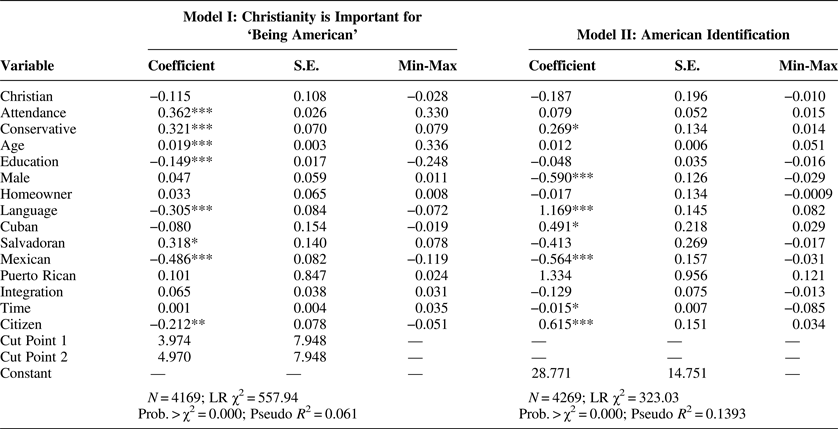
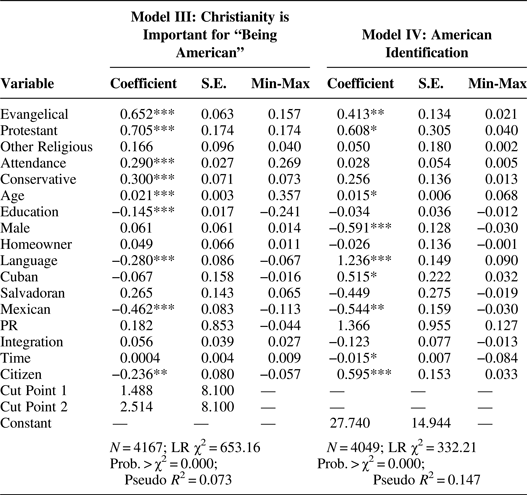
Our hypotheses regarding immigrants' beliefs that being Christian is an important part of being American are tested using ordered logit because the dependent variable is an ordinal level variable ranging from zero to two. Our hypotheses regarding immigrants’ choice to identify primarily as Americans are tested using logistic regression as the dependent variable is binary (Borooah Reference Borooah2002).Footnote 6 Tables 2 and 3 each display two sets of results for respondents: first, the unstandardized coefficients with robust standard errors in parenthesis, and the marginal change in the dependent variables, given a fixed change in each independent variable from its minimum to its maximum value, holding all other variables constant at their means.
Christian affiliation and American identity
*p < 0.05; **p < 0.01; ***p < 0.001; two-tailed sig. test.
Christian denominational differences and American identity

*p < 0.05; **p < 0.01; ***p < 0.001; two-tailed sig. test.
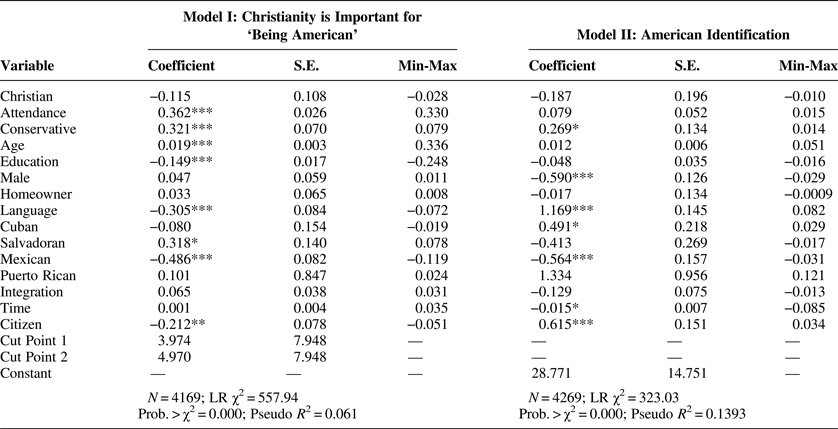
Recall that the first hypotheses predicted that Latino immigrants who called themselves Christian would be more likely to associate Christianity with American identity and identify as Americans themselves. The results displayed in Model I (Table 2) offer little support for our first expectations, indicating that Christian church participation alone exerts no significant influence on American identity among Latino immigrants. Similarly, the results reported in Model II (Table 2) — examining the predictors of immigrant's adoption of American identity — reveal that Christian church membership exerts little impact on immigrant's likelihood of calling themselves Americans. The data presented in Table 2 indicate that immigrants’ beliefs regarding American identity are shaped largely by socio-demographic predictors such as age, language, and citizenship.
While we see little support for our first hypotheses — that participation in Christian churches shapes beliefs regarding the importance of Christianity for being American as well as the adoption of American identity — these null findings may be due in part to denomination differences among Christian congregations. As discussed earlier, Protestant churches — Evangelicals in particular — are often more focused on incorporating immigrants into the American political system than their Catholic counterparts. Collapsing all Christian faiths into a single category (as in Table 2) may mask important differences in their effects on political attitudes. To examine the impact of denominational differences on Latino immigrants’ beliefs regarding American identity (allowing us to test our final two hypotheses), we conduct a second set of analyses employing binary variables for Evangelicals, mainline Protestants and those belonging to some other religious tradition, leaving Catholics as the excluded category.
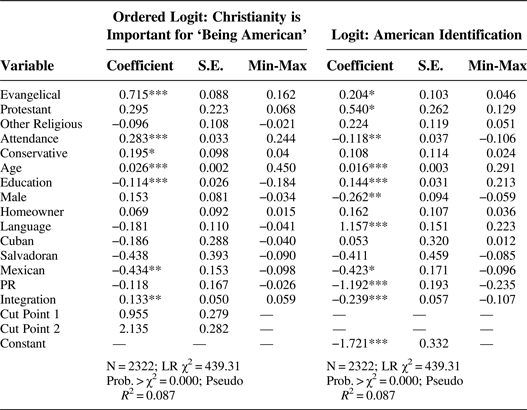
Table 3 displays the results for the basic test of our second set of hypotheses — that among Christians, Evangelicals will be more likely to believe being Christianity is “very important” for being American (Model III) and will be more likely to call themselves American (Model IV). We see some support for our expectations in this table. Evangelicals are significantly more likely to say Christianity is an important factor in being American (when compared to Catholics as the omitted category). Mainline Protestants are also significantly more likely than their Catholic peers to say that being Christian is important for being “fully American,” controlling for the impact of other variables in the model. To extend our first analysis to American identity itself we utilize our second dependent variable, American identity. As in the previous analysis, our data yields partial confirmation for our hypothesis. As demonstrated in Model IV, both Evangelical and mainline Protestant Latinos are more likely to identify as Americans than their Catholic counterparts. The data clearly indicate religious affiliation affects conceptions and adoption of American identity. However, in contrast to our expectations, it appears that the primary differences in Latino immigrants’ beliefs regarding American identity are among Catholics and Protestants of all denominations (rather than simply Evangelicals).
Several of the control variables significantly impact conceptions of Christianity being important for “being fully American in the eyes of other Americans” in Table 3. Church attendance strongly impacts the dependent variable, significantly increasing the likelihood respondents believe being Christian to be an important part of being fully American. This finding is both intuitive and theoretically expected considering that literature on both Anglo and African-American church-goers shows that attendance can affect attitudes and beliefs (Wald and Calhoun-Brown Reference Wald and Calhoun-Brown2011). Conservatism increases the likelihood of linking being Christian to being American, and comports with previous findings on Latino religious traditionalism and conservative ideology (Kelly and Morgan Reference Kelly and Morgan2008). The country-of-origin control variables are largely insignificant with the exception of those immigrants of Mexican descent, who are significantly less likely to associate Christianity with being fully American. The more educated are also less likely to associate Christianity with being American, as are those who are proficient in English and United States citizens. Turning to the final model in Table 3, we see that Age, Language, being Cuban, and being a naturalized citizen are all positive and significant predictors of identifying as an American, measures of incorporation and acculturation, which were anticipated to have positive effects (Alba and Nee Reference Alba and Nee2005). Being a man, being Mexican, and residing in the United States for more time, however, are all negative and significant predictors identifying as an American. The effects of being a Mexican immigrant may be driven by the fact that they are less incorporated and acculturated in the United States relative to Cuban immigrants (Portes and Bach Reference Portes and Back1985; Portes and Rumbaut Reference Portes and Rumbaut2006). We hypothesize that length of residency would increase identification as American; however, it may be that in the present context, anti-immigrant sentiment is driving immigrants who reside longer in the United States away from this identity. A similar effect has been documented between length of residency and a decline in Republican Party identification (Nicholson and Segura Reference Nicholson, Segura, Segura and Bowler2005).
DISCUSSION AND CONCLUSIONS
There are several key trends involving the Latino immigrant population in American politics that inform the research presented here. First and foremost, this population is booming. As the growth of the Latino population is projected to be led by immigrants, understanding how institutions assist immigrants today and — presumably — will engage with these new waves of immigrants is vitally important. Second, there has recently been an increased outreach by Protestant — particularly Evangelical — churches the Latino community, especially among immigrant Latinos. These institutions clearly play an important role in socializing and incorporating immigrants into the United States (Chafetz and Ebaugh Reference Chafetz, Ebaugh, Ebaugh and Chaftez2002; Menjivar Reference Menjivar1999); however, there is also no doubt that many of these churches also have political objectives they seek to meet with these outreach efforts (Wald and Calhoun-Brown Reference Wald and Calhoun-Brown2011). For example, Evangelicals are increasingly mobilized by conservative political candidates (Wald and Calhoun-Brown Reference Wald and Calhoun-Brown2011), and the connection between many Evangelical churches and conservative candidates and issues may significantly influence the political leanings of newly arrived immigrants targeted by these churches. These political developments shape the third key trend, which is the increased scholarly evidence of political and attitudinal differences between Latinos who belong to Evangelical congregations and those who do not (e.g., Menjivar Reference Menjivar1999; Reference Menjivar2003; Pantoja Reference Pantoja2010; Wong, Rim, and Perez Reference Wong, Rim, Perez, Ramakrishan and Bloemraad2008). We know that there is significant plurality in the religious experiences of Latinos in their home countries (Lee and Pachon Reference Lee and Pachon2007; Menjivar Reference Menjivar2001), and we know that identity formation in the United States is a complicated process with myriad influences (Jones-Correa and Leal Reference Jones-Correa and Leal1996). Following these recent trends and research, the analysis presented here adds to our collective knowledge on the role of Christian churches in socializing Latino immigrants by examining the effect of these institutions on immigrants’ conceptions of what it means to “be American in the eyes of other Americans” and on their adoption of an American self-identity.
This research adds to the emerging empirical research investigating the extent to which Christianity is important to being an American (e.g., Jacobs and Theiss-Morse Reference Jacobs and Theiss-Morse2013). However, what has not been investigated before this project is the extent to which immigrants hold that attitude and if there are differences within Christian religious traditions (i.e., Catholicism vs. Protestantism — Evangelical and Mainline). In this paper, we show that religious traditions and institutions have significant effects on beliefs about American identity among Latino immigrants, particularly the extent to which they associate American identity with Christianity and the extent to which they self-identify as American. We show that being a member of Protestant churches (both Evangelical and Mainline) increases immigrants’ likelihood of associating Christianity with “being American” and are more likely to embrace an “American” identity when compared to the Catholic majority. These findings are significant in light of the on-going debates and concerns over the cultural consequences of contemporary immigration, and they are novel because this is the first time the relationship between religious affiliation and these identity constructs have been tested with large-N empirical survey data. Some prominent scholars, like Samuel Huntington, argue that the values and identities immigrants bring to the country are incompatible with those of Anglo-Americans. Consequently, they fear the emergence of a bifurcated America. We find that among Latino immigrants, the first generation, large numbers are becoming Evangelicals and this religious identity quickens their identification as Americans and seeing America as a Christian nation. Again, public opinion polls reveal that two in three Americans (67%) subscribe to the idea that “America is a Christian nation” (The Pew Forum on Religion and Public Life 2006). The empirical evidence presented here, indicating that certain segments of the immigrant Latino population have adoption similar belief, may quell concerns of a divided America.
As with any research, there are caveats one must consider when evaluating the findings of this project. First, deciding where to go to church is not an exogenous treatment (Djupe and Gilbert Reference Djupe and Gilbert2008), so there is always the potential for an endogenous relationship with an attitudinal characteristic. However, because we are dealing with attitudes about identity and American identity itself — both of which are most likely generated after immigrants have come to the United States and adopted a church home — it is unlikely that there is a serious endogeneity threat here. Second, there is always the possibility that the conceptualization of “Evangelical” does not mean anything to immigrants who are not well versed in the American denominational lexicon. The risk of that is also minimized due to the question wording of the survey, which delves into what being Evangelical means, and the fact that we specifically take the “born-again” question as our marker for Evangelicalism. With these caveats in mind, we conclude by discussing avenues for future research.
This project opens more questions than it answers, leaving room for a great deal of future research in this area. First, though we demonstrate a difference with regard to how Latino immigrants understand what it means to be an American, we have not yet extended these conceptualizations to political behaviors. For instance, do those Evangelical Latinos who believe being Christian is important to being American participate more regularly, and if so, how are their political orientations substantively different than those of their peers? Are they more likely than their counterparts to seek citizenship? In other words, future scholarship must focus on understanding the precise political implications of these findings for newly arrived Latino immigrants, paying particular attention to the ways in which the movement towards Protestantism among Latinos will shape future political outcomes in the United States. Finally, an interesting finding among the control variables is that language and naturalization increase the likelihood of identifying as an American, but are negatively related to ranking Christianity as important for being American. This is likely the case because those Latinos who speak English or have naturalized experience a different kind of incorporation. Their incorporation (as previous research indicates) may be more civic in nature and conforms to non-religious understandings of Americanism/American identity. These results suggest that the type of incorporation we identify in this research is a different kind entirely—clearly more religious in nature—and therefore deserves more attention in future research.
APPENDIX
Summary Statistics for all Variables

The effect of Christianity on non-immigrant Latinos’ attitudes and identity

Effects of religious affiliation on non-immigrant Latinos’ attitudes and identity

Questions and Wording from 2006 LNS
DEPENDENT VARIABLES
-
“What do you think of what it means to be fully American in the eyes of most Americans, do you think it is very important, somewhat important, or not important to BE CHRISTIAN?
-
Not important = 0
-
Somewhat important = 1
-
Very important = 2
-
“Of the three previous terms, TERM1 (respondent's self-ID term), TERM2 (respondent's 2nd self-ID), or American, which describes you?”
-
American = 1
-
All other = 0
INDEPENDENT VARIABLES
Religious Affiliation Variables
—Two questions were used to construct these variables.
-
1. “Stop me when I get to the correct one. With what religious tradition do you most closely identify?”
-
2. “Do you consider yourself a born-again Christian, spirit-filled Christian, or involved in the Charismatic movement?”
-
a. Yes = Born Again
-
b. No = Not Born Again
-
-
Catholic = Catholic (‘Born Again’ Catholics omitted)
-
Evangelical = Rs who identify as ‘Born Again’
-
Mainline = Protestants who are not ‘Born Again’
-
Other Religion = Jehovah's Witness, Mormon, Jewish, Don't Identify, Other
Attendance
-
“How often do you attend religious services? Do you attend…”
-
Never = 0
-
Only major holidays = 1
-
Once a month = 2
-
Once a week = 3
-
More than once a week = 4
Heritage
-
“Families of ANSWER FROM (AQS4) origin or background in the United States come from many different countries. From which country do you trace your Latino heritage?
-
Cuba = Cuban
-
Mexico = Mexican
-
El Salvador = Salvadoran
-
Puerto Rico = Puerto Rican
Conservative
-
“Generally speaking, in politics do you consider yourself as conservative, liberal, middle-of-the-road, or don't you think of yourself in these terms?”
-
Conservative = 1
-
All other = 0
Education
-
“What is your highest level of formal education completed?”
-
None = 0
-
8th or below = 1
-
Some high school = 2
-
GED = 3
-
High School Graduate = 4
-
Some College = 5
-
4-year degree = 6
-
Graduate or professional degree = 7
Male
-
Interviewer enters respondent gender…
-
Male =1
-
Female = 0
Homeowner
-
“Do you own or rent your residence in the United States?”
-
Own = 1
-
Rent = 0
-
Other = 0
-
Refused =.
Language Preference
-
“Would you prefer that I speak English or Spanish?”
-
English = 1
-
Spanish = 0
Time in United States
-
“When did you first arrive to live in the U.S. mainland?”
-
Year code, minus 2006
Citizen
-
“Are you a naturalized U.S. citizen?”
-
Yes = 1
-
No = 0
Age
-
Respondent Age
-
18 – 97
Integration
-
“How would you describe your friends? Are they…”
-
Mostly Latinos = 0
-
Mostly other = 1
-
“How would you describe your coworkers? Are they…”
-
Mostly Latino = 0
-
Mostly other = 1
-
—Used to create a three-scale: 0 = non-integrated social network, 1 = somewhat integrated social network, 2 = integrated social network.