On 30 January 1943, Adolf Hitler's close associate Hermann Goering made a radio broadcast to the beleaguered Sixth Army at Stalingrad on the eastern front. He compared the German army to the Spartan soldiers at Thermopylae in 480 bce when they stood, fought, and died to prevent the advance of the Persians (‘the barbarians’) into Greece. Goering's broadcast was not well received. The dispirited and starving listeners described it as ‘our own Funeral Speech’ and some officers joked ironically that ‘the suicide of the Jews’, besieged by the Roman army on the top of Masada in 73 or 74 ce, was a more apt comparison.Footnote 1 This episode raises a host of questions about the reception of classical texts and ideas in later cultures. In this instance, not only was the classical allusion used as a model to sanction expectations of behaviour, but further allusions were used as a counter-text to challenge the rhetoric of the high command. It could be assumed that those involved recognized the allusions and that the classical material provided a site for claims and counter-claims.
At the turn from the twentieth century to the twenty-first, a translation by Edwin Morgan of Racine's Phèdre into modern Scots was staged at the Royal Lyceum Theatre in Edinburgh.Footnote 2 Morgan's translation into a Glaswegian-based Scots was part of a move to give status to the Scots language within the development of classical theatre in Scotland. He also wanted to find out what it was about the play which would survive and transcend what he described as ‘a jolt into an alien register’. The translation and the staging represented the latest point in a continuing commentary on the migration through successive languages and theatrical traditions of the story of Phaedra – Euripides’ Hippolytus, Seneca's Phaedra, and Racine's Phèdre.
The function of reception studies is to analyse and compare the linguistic, functional, and contextual aspects of various kinds of migration.Footnote 3 These examples demonstrate the extraordinary diversity in the range of classical receptions. Each has its own reception history and requires appropriate methods of investigation. Each yields insights into the texts and contexts of ancient works, their subsequent interpretation, and their situation in the modern context of reception. The aim of this Survey is to engage with this rich cultural field by outlining the main features of classical reception studies and summarizing some of the most significant recent developments. This chapter sets out the conceptual and critical framework which the rest of the volume will use in the discussion of specific examples.
The increasing prominence of reception studies as a strand in the disciplines of classics and ancient history in relation to Greek and Roman texts, images, ideas, and material culture is a fairly recent development. Although Rezeptionsgeschichte (reception history) or study of Nachleben (afterlife) has been an important strand in German scholarship, its development in the international field and especially its adaptation in anglophone scholarship has involved significant reshaping of the scope of reception studies and of the sources and methods used. In particular, the emergence of this specialism signalled a move away from previous ways of looking at the relationship between ancient culture and its subsequent interpretation and adaptation. One strand in classical scholarship has been what was called ‘the classical tradition’. This studied the transmission and dissemination of classical culture through the ages, usually with the emphasis on the influence of classical writers, artists, and thinkers on subsequent intellectual movements and individual works.Footnote 4 In this context, the language which was used to describe this influence tended to include terms like ‘legacy’. This rather implied that ancient culture was dead but might be retrieved and reapplied, provided that one had the necessary learning.
More recent research has tended to move away from the study of a linear progression of ‘influences’ and to focus on identifying various kinds of connection and mediation. As a result, the notion of some great chain of influence which linked great works of the Greeks and Romans to their counterparts in Renaissance, Enlightenment, Victorian, and modern ‘high culture’ has largely been superseded. This is partly to be regretted, since studies of transmission of texts and canon formulation and adaptation are valuable adjuncts to other aspects of classical study. They help to explain how and why classical texts have been interpreted in particular times and contexts, thus enabling study of the histories of scholarship and of education in particular places. They also provide raw material for comparative work across different national and cultural contexts.Footnote 5
However, one good reason for the replacement of the methods of ‘the classical tradition’ as the sole means of studying classical texts through time and across languages and places is that such an approach was based on a rather narrow range of perspectives. It might carry an assumption, sometimes tacit sometimes explicit, that these works yielded a ‘meaning’ which was unproblematic, there to be grasped and to be applied in all kinds of situation far removed from the ancient one. The diversity of ancient culture itself is now more widely recognized, and interest has focused on ways in which some aspects were selected and used (‘appropriated’, ‘deployed’) in order to give value and status to subsequent cultures and societies and to inspire new creative work. This kind of study has proved valuable in that it has enabled people to distinguish more readily between the ancient texts, ideas, and values and those of the individuals and societies that appropriated them. So, for example, scholars are less likely to simply equate (or confuse) Greek and Roman cultural practices with those of the Victorians who filtered their appropriations of the ancient world into education, the arts, and social values.Footnote 6 This increased sense of discrimination in examining the interfaces between cultures has had the further valuable effect of liberating the ancient texts for reinterpretation and reworking (‘refiguration’) by new generations of scholars, writers, artists, and thinkers.
It is of course true that ‘guilt by association’ has sometimes remained a potent factor in causing rejection of study of the societies and values of Greeks and Romans. It can hardly be denied, for instance, that Athenian society in the fifth century bce, a society which saw a flowering of the arts, was based on slavery of various kinds (in common with most of the ancient world and much of the modern), nor that the material improvements associated with Roman culture were disseminated as a result of the success of its imperial war machine. Appropriation of the practices, attitudes, and values of Greek heroic figures (mythological and historical) by the modern far right to sanction their attitudes, or of the public buildings, emblems, and propaganda of the Romans by empire-builders and totalitarian regimes, acts as an awful warning of the unlovely effects of uncritical adulation of any culture.Footnote 7 Such issues are of particular concern in reception studies, where the focus is on the (at least) two-way relationship between the source text or culture and the new work and receiving culture. Analysis of the principles and assumptions underlying selectivity, and contextual comparisons between source and receiving conditions, are vital tools, and the theoretical frameworks used to explore and explain the connections are under constant review and modification.Footnote 8
Interest in reception of classical texts is not just a modern phenomenon. Greek and Roman poets, dramatists, philosophers, artists, and architects were also engaged in this type of activity: refiguration of myth; metatheatrical allusion; creation of dialogue with and critique of entrenched cultural practices and assumptions; selection and refashioning in the context of current concerns. Reception within antiquity is an important mediating factor between classical and modern cultures. Greek drama, for instance, did not cease in the fifth century bce. There were important fourth-century and Hellenistic activities, and the Romans, too, selected and adapted in order to create their own cultural traditions of comedy, of distinctive tragedies by Seneca and others, and of pantomime.Footnote 9
Because reception is concerned with the relationship between ancient and modern texts and contexts, as well as with those separated by time within antiquity, it has implications for the critical analysis of both. It used sometimes to be said that reception studies only yield insights into the receiving society. They do fulfil this function, but they also focus critical attention back towards the ancient source, and sometimes frame new questions or retrieve aspects of the source which have been marginalized or forgotten.Footnote 10 Reasons for such marginalizations and repressions are often significant. This means that reception studies have to be concerned with investigating the routes by which a text has moved and the cultural focus which shaped or filtered the ways in which it was regarded.Footnote 11 The field therefore participates in the continuous engagement between the past and the present, and also requires some ‘lateral’ dialogue in which crossing boundaries of place or language or genre is as important as crossing those of time. Relationships may be multiple rather than just binary, and media theory has offered significant insights.Footnote 12 Reception studies, therefore, are concerned not only with individual texts and their relationship with one another but also with the broader cultural processes which shape and make up those relationships, and with how those relationships may be differently perceived and interpreted. This short Survey does not aim to be comprehensive – there are now many useful companions, handbooks, and bibliographical tools available. Instead, the discussions here will be concerned with two main aspects of reception studies: the reception text or artefact itself; and how the reception is described, analysed, and evaluated, including how its relationship to the ancient text has been mediated.
The reception text or artefact itself: the raw material
Reception begins with the artistic or intellectual processes involved in selecting, imitating, or adapting ancient works: how the text was ‘received’ and ‘refigured’ by artist, writer, or designer; and how the later work relates to the source. In relation to this it is necessary to consider the relationship between these processes and the contexts in which they take place. These contexts may include: the receiver's knowledge of the source and how this knowledge was obtained; a writer's or artist's works as a whole; collaboration between the writer/translator or director, the designer, and the actor; collaboration between the auteur, the director, and the film cast; the role of the patron or financier; and the role of the audience/reader/public (both actual and imagined). In other words, factors outside the ancient source contribute to its reception. They have their own agency and introduce new dimensions. The purpose or function for which the new work or appropriation of ideas or values is made is an important factor: for instance, its use as an authority to legitimate something, or someone, in the present (whether political, artistic, social, or educational or cultural in the broadest sense), or to explore a contentious issue, or to project an imaginative response.
How the reception is described, analysed, and evaluated
No description is neutral, and the forms, concepts, and categories used by reception scholars and critics need to indicate the extent to which they are using ancient categories to analyse and judge modern receptions and the extent to which they are using additional criteria. For example, discussion of a modern production of Greek drama would almost certainly consider how the chorus was represented and staged and whether masks were used. It might, but frequently does not, include assessment of the degree of equivalence to other ancient practices, such as how the chorus was awarded and financed – that is, the social and economic values underlying the staging of the play. A different example might be that study of international relations (as a subject and as a practice) would need to consider the extent to which the modern discipline was shaped by the subject matter and approach of the fifth-century historian Thucydides, and the extent of the cultural baggage this imported.
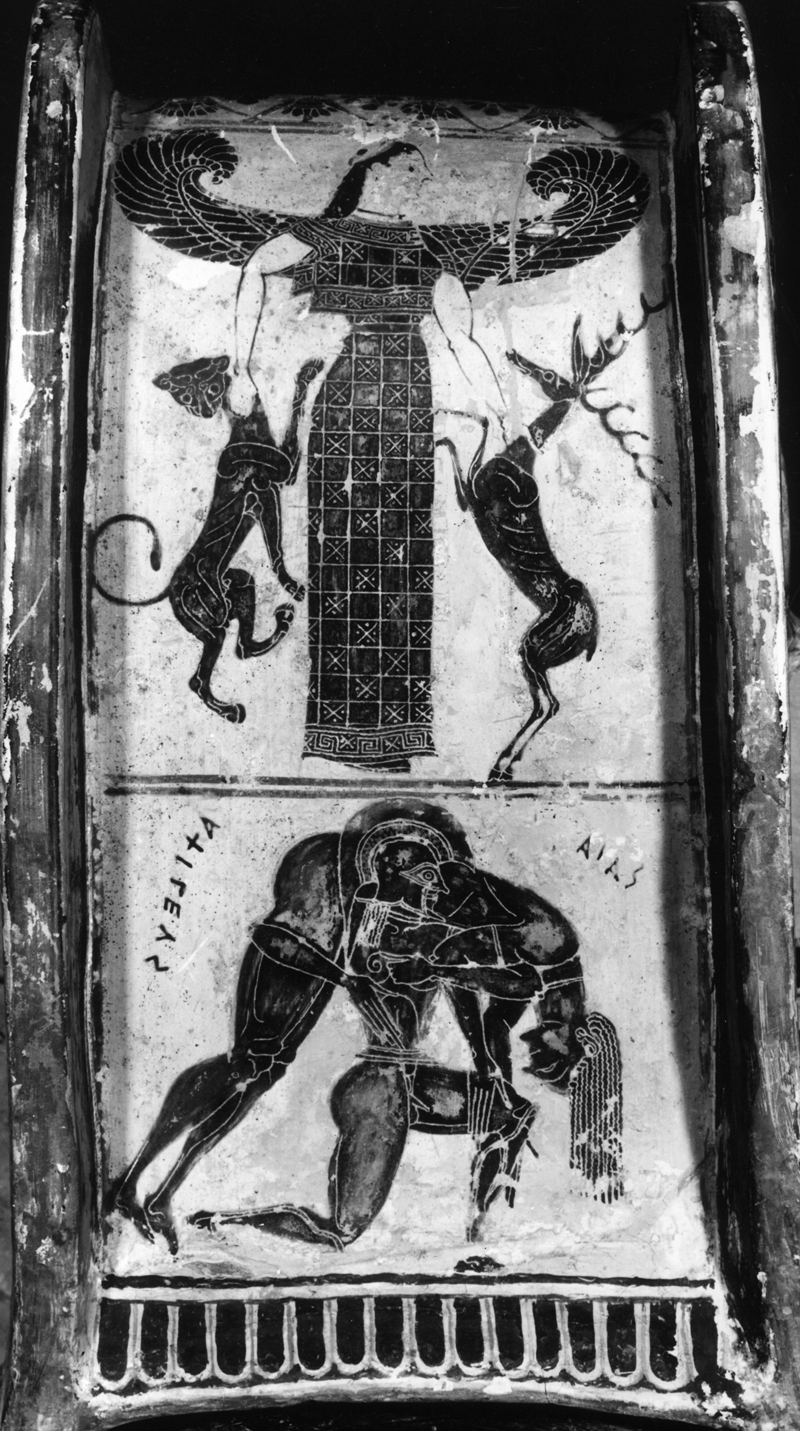
Ajax carries the dead Achilles (both are named in the inscription). Detail from the handle of the François Vase (black-figure volute krater from Chiusi, signed by Kleitias and Ergotimos). Photo: from Beazley Archive, courtesy of the Classical Art Research Centre, University of Oxford.

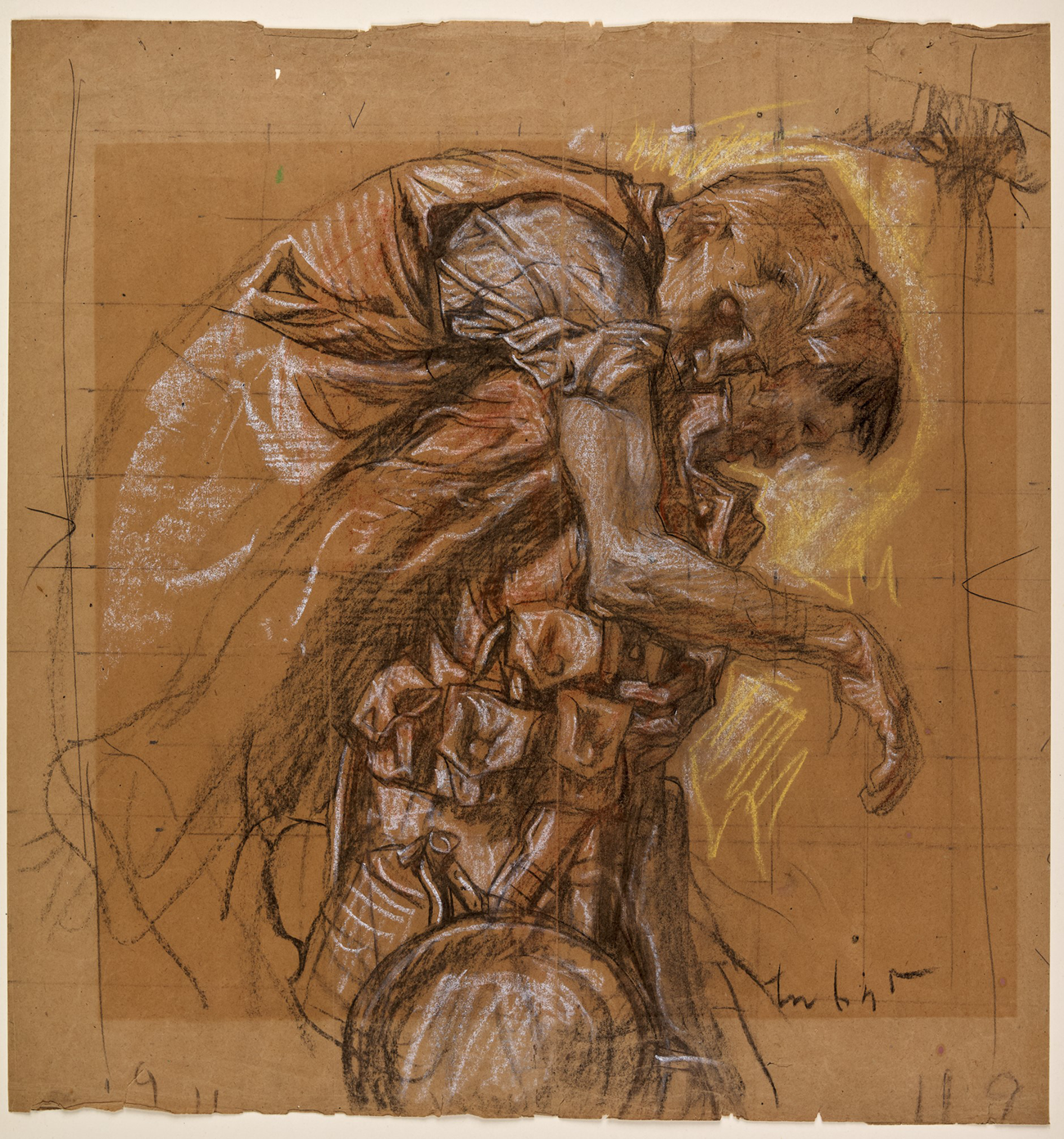
Frank Brangwyn (1867–1956), Study of a Canadian Soldier Supporting a Wounded Comrade. Photo by Birmingham Museums Trust, copyright David Brangwyn. Part of the design for a new parliamentary building in Winnipeg, entitled ‘Canadian War Record’.

Equally, reception studies at all periods have been shaped by current conceptual and theoretical frameworks that shape and define ‘knowledge’. Trends in modern literary and cultural theory, for instance, have stressed ambivalence and indeterminacy in the meaning attributed to texts, and disjunction and fissure in what might earlier have been seen as broader cultural certainties. For those reasons, reception of classical texts is playing an increasingly important part in studies of the cultural politics associated with change: for example, in the emancipation of eastern Europe in the last part of the twentieth century and in postcolonial drama and literature. The nature of the receptions is a significant indicator of cultural change.
In addition to the general influence of literary and cultural theory, there are several theoretical approaches which impact directly on reception issues. Three have been particularly influential. In the 1960s Hans Robert Jauss developed a theory of the ‘aesthetics of reception’ (Rezeptions-ästhetik).Footnote 13 This asserted that the historical character of an artwork could not be captured merely be describing it (as did the Formalists) or examining its production (as did the Marxists). Instead Jauss developed a theory of the interaction of production and reception. This involved dialogue between producer/artist and reader/audience/consumer. To frame this dialogue, he used the notion of a ‘horizon of expectation’.Footnote 14 Jauss's adaptation of the concept focused on a horizon of experience of life and thus rooted the receiver's mindset in their social and cultural context. This was what could be said to shape expectations and interpretations of texts.
A related theoretical response was that of Wolfgang Iser. Iser's main theoretical work appeared in the mid-1970s. While Jauss's background was in literary history, Iser's was in English literature and his work focuses on reader-response as a trigger for the construction of meaning in literary texts (and, by extension, in drama, although comparable theoretical work on audience response is still lacking).Footnote 15 His work covers the input to interpretation of a literary text by both the ‘actual’ reader and the ‘implied’ reader – that is, the reader to whom the structure and language of the text speaks.
The third major theorist whose work has influenced reception studies is Hans-Georg Gadamer. His major work was published in the 1960s and 1970s.Footnote 16 Gadamer's main, although indirect, contribution to reception studies was his theory that the meaning to be attributed to a text is not ‘essential’ – waiting to be drawn out – but constructed as part of the historical nature of understanding (representing a fusion of horizons between past and present). The implications for the study of classical texts are important, since they suggest that the meaning attributed to an ancient text is shaped by the historical impact of its subsequent receptions. Even if one modifies Gadamer's theory to the weaker position that subsequent receptions have at least a contributory effect on the interpretation of ancient texts, this alone would justify a major scholarly role for the study of the histories of aesthetics of reception.
This possibility leads to a fourth theoretical approach which is sometimes used in reception analysis. This is the concept of ‘critical distance’, which uses the distance in time, place, and culture that exists between ancient and modern versions of a text to enable the reader/spectator to move outside the limits of their own society and cultural horizons and thus to see these more clearly and more critically. The concept is important both for envisaging the possibility of the individual or group enlarging horizons of expectation or even transforming them and also for its potential when classical texts are used as critical devices for outwitting censors and enabling current social and political concerns to be addressed through the apparently neutral, ‘distant’ (and safe) medium of classical culture.
Towards a working vocabulary for reception studies
The vocabulary used in this study is centred round the central questions of how the reception in question and its context relate to the classical source and its context.
- Acculturation
assimilation into a cultural context (through nurturing or education or domestication or sometimes by force)
- Adaptation
a version of the source developed for a different purpose or insufficiently close to meet the criteria for a translation
- Analogue
a comparable aspect of source and reception
- Appropriation
taking an ancient image or text and using it to sanction subsequent ideas or practices (explicitly or implicitly)
- Authentic
close approximation to the supposed form and meaning of the source; at the opposite end of the spectrum from invention (i.e. a new work)
- Correspondences
aspects of a new work which directly relate to a characteristic of the source
- Dialogue
mutual relevance of source and receiving texts and contexts
- Equivalence
fulfilling an analogous role in source and reception but not necessarily identical in form or content
- Foreignization
translating or representing in such a way that difference between source and reception is emphasized
- Hybrid
a fusion of material from classical and other cultures
- Intervention
reworking the source to create a political, social, or aesthetic critique of the receiving society
- Migration
movement through time or across place; may involve dispersal and diaspora and acquisition of new characteristics; raises the issue of the impact of mediation through other agencies (contexts, works, creative practitioners, scholars)
- Refiguration
selecting and reworking material from a previous or contrasting tradition or genre
- Translation
literally from one language to another; ‘literal’, ‘close’, and ‘free’ are words used to pin down the relationship to the source, as are phrases such as ‘in the spirit rather than the letter’; translation can also be used metaphorically, as in ‘translation to the stage’ or ‘translation across cultures’; free translations sometimes merge into adaptations or versions
- Transplant
to take a text or image into another context and allow it to develop
- Version
a refiguration of a source (usually literary or dramatic) which is too free and selective to rank as a translation
The approach adopted in this study is not limited by any one of the theoretical positions outlined above, although it is informed by them all. My discussion is framed by these key assumptions:
(i) Receptions do in practice affect perceptions of and judgements about the ancient world, and therefore need to be analysed.
(ii) Receptions within antiquity need to be considered within the same framework of enquiry as subsequent receptions, so that the diversity of ancient culture is more fully recognized and the impact of ancient reception approaches on intervening interpretations is understood.
(iii) Reception studies require us to look closely at the source text and context, as well as at the receiving ones. This does not imply that the source is a yardstick of value but rather that a ‘critical distance’ between source and receptions illuminates all. The traditional practices of classical philology have an important part to play in developing the broader cultural philology needed by reception studies.
(iv) The concept of cultural horizons provides a useful but not constraining framework for reception studies. How cultural horizons, with their assumptions, expectations, aspirations, and transformations, relate to classical material is a crucial area in modern reception studies, which also have to take into account the impact of new technologies and art forms (such as film).
(v) Reception practice and its analysis reveal both commonalities and differences between ancient and modern. The shifting balance between commonalities and differences undermines the crudely polarized positions that classical texts either address universal and unchanging aspects of human nature or that they are remote and alien with nothing of value to offer to postclassical experience.
(vi) Reception of classical material is an index of cultural continuity and change, and therefore has a value beyond its role in classical studies.
(vii) Reception is and always has been a field for the practice and study of contests about values and their relationship to knowledge and power.
The examples discussed in this volume are necessarily selective. Where possible I have focused on material which is widely available and to which readers can develop their own critical response. Art and architecture are mentioned only in passing as they would require a separate and extensively illustrated study. Similarly, philosophy and historiography are only briefly discussed (with further suggestions in the Bibliography). Film gets fuller consideration, partly because it presents issues of analysis and evaluation which are of particular interest in reception studies, and partly because it represents a new aspect not only of classical receptions but also of cultural horizons and the changing technological, knowledge, and recognition bases in which they are embedded.
Developments since the first edition
In the course of the twenty-five years between preparation of the first edition of this work and the time of working on the second edition (2022–3), there have been significant developments in areas that were only briefly seeded in the first edition. Happily, simplistic polarities between ‘classical tradition’ and ‘classical reception studies’ have become less prominent.Footnote 17 Classical reception (and indeed the whole subject areas of classics and ancient history) has become much better integrated with research and teaching in cognate areas such as literature and comparative literature, art history, area studies, museum studies, intellectual history, and postcolonial studies. There are now good opportunities for the study of classical receptions in popular culture, both because of the plethora of material and because that part of the field has moved beyond ‘fan zone’ to a better-theorized and better-framed area of enquiry. A good example is the study of classical material and science fiction.Footnote 18 Popular culture is a field in which the distinctions are now not only between ‘high’ and ‘low’ culture, but also between ‘popular’ and ‘populist’.Footnote 19 Similarly, the presentation of classical material on radio and TV has been extensively researched and has helped in the documentation and evaluation of the impact of Greece and Rome in the public imagination.Footnote 20
The most significant areas that raise often-challenging questions for current and future research and teaching in classics and classical reception include scholarship and its histories; turns; area studies and comparative work; and connections and taxonomies.
Scholarship and its histories
Scholarship is increasingly recognized as a form of reception, and repays scrutiny as such. Concomitant with this is the need for new kinds of commentary that will augment the traditional approaches and which, in particular, will recognize that readers and researchers from other disciplines may have different points of entry into classical networks.Footnote 21
Turns
Cultural and literary studies have been marked by a series of ‘turns’. ‘Turn’ is shorthand for a shift in the focus of enquiry and in the methods and critical frameworks used. In classical reception studies the translation turn, the cultural turn, and the performative turn have all been influential. This last not only gave performance studies a central role but also encouraged reception scholars to consider the implications of performative speech in all situations, including its interaction with the contexts in which language was produced and used. To these ‘turns’ might be added the ‘democratic turn’ and the ‘postcolonial turn’, in which Greek and Roman material is recognized as an agent in resistance to colonial domination. More recently, two more ‘turns’ have proved important. The ‘global turn’ has promoted awareness of the study and use of Greek and Roman material worldwide,Footnote 22 but brings its own problems in concepts and methods and is far from being a panacea for the decentring of classical study and knowledge from many public domains. The ‘existential turn’ is a shorthand name for the concern that the role of Greek and Roman antiquity in the cultural and political histories of western European colonizing regimes has not only destroyed its modern status but also carries a toxic legacy from antiquity itself.Footnote 23 A ‘softer’ term, which nevertheless draws on both global and existential ‘turns’, is ‘postclassical’.Footnote 24
Area studies and comparative work
In addition to existing studies of classical receptions in western and eastern Europe and the United States, Canada, and Australasia, in the last few years there has been important research on Arabic receptions, and on classical receptions and translations in both South America and Russia.Footnote 25 The publication in English of such research has required scholars expert in the necessary modern languages as well as the ancient. This work overturns easy assumptions that anglophone (or indeed European) receptions have exceptional status.Footnote 26 Ongoing research also increases the potential for more reception studies students and researchers to develop skills in comparative analysis; and it reflects the increasing importance of collaborative work, which has been fostered by networks such as the international Arc-Net group on ancient and modern theatre (based in Athens), the Classics and Poetry Now research group, and the international Classical Reception Studies Network.
Connections and taxonomies
The diffusion of Greek and Roman material and the varied starting points from which it is accessed and interpreted by scholars, practitioners, readers, and spectators have required methods and taxonomies that go beyond identifying intertextualities and direct allusions.Footnote 27 They now include, for example, notions of ‘affinity’; ‘association’ (such as responses to places and attributes of iconic figures from myth and history); encounters that may be ‘glancing’ (in which neither text is totally absorbed into the other); ‘ghosting’ (when traces survive into a reception but may lie dormant until resurrected by the reader's or practitioner's sensibility); and improvising and riffing (a term taken from music and used to indicate how a passage or theme may be taken from an ancient text and reworked, exploring variations before returning to the basic theme). All these concepts provide tools for scholars and readers to map how ancient and modern may relate to one another and how those connections have been mediated.
A helpful model is that of the rhizome, in which there are various points of entry that enable connections while also facilitating different pathways. For example, a scholar or pracitioner or student who has a background in modern literature or theatre or international relations may be drawn into the rhizome through an awareness of ‘associations’. In the process, they may acquire knowledge of Greek and Roman material and its contexts that enables them to enter the rhizome at a different point and from a different perspective in the future. The same may apply to the interested general reader. The process also has a reverse side, in which a person knowledgeable in the classics will encounter material from other contexts, times, languages, and genres that extends and refines their own knowledge base and horizons of understanding. Reception scholarship creates and borrows useful terms to highlight phases and levels in these processes: for example, ‘high’ and ‘low’-intensity awareness of Greek and Roman texts and figures. Low-intensity awareness might involve recognition of and some familiarity with the names of key figures such as Achilles, or Herakles, or Pericles, or Augustus, or even of Homer, or Virgil, but without detailed knowledge of the multiple implications of their provenance. For example, the popular idea of Homer might be to mistakenly regard the poet as simply a ‘poet of war’. Low-intensity awareness can be transformed into greater intensity at moments of ‘heightened awareness’, when particular situations, figures, images, and texts take on an enhanced profile – for instance, in times of war or civil conflict, or when leading writers and theatre and film practitioners work with particular texts.Footnote 28
Finally, a crucial development in reception scholarship is the exploration of conduits between classics and other modes of enquiry. One characterization of this is ‘deep classics’.Footnote 29 This Survey aims to outline some of the specific demands on analysis made by this aspect, and to highlight some of the areas where it has particular potential.