Introduction
Macadamia nut (Macadamia integrifolia Maiden and Betche, Proteaceae) production in Hawaii comprises about 25,400 tonnes with an annual value of ∼$46.8 million, making this industry one of the largest agricultural enterprises in the state (HASS, 2005). Production is primarily on the island of Hawaii. A relatively small pest complex reduces yields and quality of macadamia nuts in Hawaii (Jones, Reference Jones2002) with the most important pests being tropical nut borer (Hypothenemus obscurus, Coleoptera: Scolytidae), southern green stink bug (Nezara viridula, Hemiptera: Pentatomidae) and koa seedworm (Cryptophlebia illepida, Lepidoptera: Tineidae). Nezara viridula is generally considered by growers to be a relatively minor pest of macadamia nuts in Hawaii, although sporadic severe outbreaks do occur. Adult N. viridula are able to penetrate the husk and shell of macadamia nuts with their mouthparts; and their feeding on the kernel causes pitting, and sometimes the onset of mold, resulting in rejection of the nuts for commercial use (Jones, Reference Jones2002). Considerable attention has been given to controlling N. viridula and to understanding the ecology of this insect in macadamia orchards and weed habitats in Hawaii (Jones & Caprio, Reference Jones and Caprio1992, Reference Jones and Caprio1994; Shearer & Jones, Reference Shearer and Jones1996; Jones et al., Reference Jones, Westcott, Finson and Nishimoto2001). Jones (Reference Jones2002) reports that N. viridula is unable to complete its life cycle in macadamia trees and requires various alternative food crops, many of which can be weed species, to build up and maintain large populations. Weed management is an important component of N. viridula management. Biological control agents for N. viridula have been introduced into Hawaii, including an egg parasitoid (Trissolcus basalis, Hymenoptera: Scelionidae) and an adult parasitoid (Trichopoda pilipes, Diptera: Tachinidae). The effectiveness of these biological control agents is questionable, however (Jones, Reference Jones1995; Jones et al., Reference Jones, Westcott, Finson and Nishimoto2001). Chemical control is seldom used and is kept as a last resort option. There are no effective procedures or trapping tools for monitoring N. viridula populations in orchards, and damage to the crop is typically used as an indicator of stink bug activity (Golden et al., Reference Golden, Follett and Wright2006).
The time from anthesis to nut drop in macadamia nuts is approximately 30 weeks (Nagao, Reference Nagao1992), and nuts of all stages of maturity can be found on the tree throughout the year. Harvesting occurs in all months of the year, with the most concentrated harvesting taking place during June–February. Most nuts are hand-harvested off the ground, although tree shakers are used on an increasing percentage of land (Jones, Reference Jones2002). Tree shakers are large, tractor-driven implements with a broad inverted umbrella-like bag that encircles the base of a tree and catches nuts shaken from the canopy. Weeds are controlled beneath trees to aid in ground harvesting of fallen nuts but generally not between rows or outside the orchard.
Jones & Caprio (Reference Jones and Caprio1992) examined seasonal patterns in N. viridula damage to macadamia nuts and showed distinct seasonality. They suggested that damage to nuts may have accumulated in the canopy but did not test this hypothesis. Further studies of the temporal and spatial patterns of N. viridula damage in macadamia orchards were subsequently conducted in Hawaii. Jones & Caprio (Reference Jones and Caprio1994) investigated damage levels within canopy samples and on ground collected nuts, showing that 0–14.4% of nuts could be damaged before nut drop, and 11.8–32.5% of nuts from the ground were damaged. Damage early in the year (early May) was 0% in their canopy samples. On only one occasion, late May, was the proportion of canopy damage high (14.4% compared to 32.5% damage on the fallen nuts). They showed that small nuts (10–28 mm diameter) that were fed upon by N. viridula tended to abort early, while larger nuts did not abort (Jones & Caprio, Reference Jones and Caprio1994). Jones and Caprio (Reference Jones and Caprio1994) also concluded that damage accrued by nuts on the ground occurred within a few days of nut drop. It has been generally accepted that essentially all significant damage caused by N. viridula to macadamia nuts in Hawaii occurs once the nuts have fallen from the tree and before they are harvested from the ground (Jones, Reference Jones2002) and that minimal damage is incurred on nuts still within the tree canopy, although Jones & Caprio (Reference Jones and Caprio1994) do state that management of N. viridula both in the canopy and on the ground is necessary to minimize damage. However, during the 2002 season, with unprecedented levels of N. viridula damage, assessments by nut processors of damage from commercial orchards in Hawaii suggested that a large proportion of damage was occurring consistently on nuts in the canopy, which were harvested using tree shakers (MacFarms of Hawaii, unpublished data).
This study, therefore, aimed to revisit the extent of N. viridula damage within macadamia tree canopy and compare damage prior to nut-drop to damage levels on fallen nuts. We also analyzed long-term seasonal trends in N. viridula damage, using quality control data from nut processors, and developed a fixed-precision sampling procedure using early-season damage estimates to predict expected late-season damage levels.
Materials and methods
Study sites
Study sites were located in the southwestern (MacFarms of Hawaii, Captain Cook, Hawaii) and northwestern (Island Harvest, Kapaau, Hawaii) parts of the island. MacFarms is a 1558 ha orchard in the South Kona district, southwest Hawaii, at an elevation of 500–2500 m, and Island Harvest consists of 380 ha of orchards at ~250 m elevation. Both sites are commercial macadamia nut-producing orchards.
Long-term trends
Quality control data from MacFarms (a major grower and processor of macadamia nuts) quantifying damage from various sources (N. viridula, H. obscurus, Cryptophlebia spp., mold, etc.) were analyzed to investigate long-term trends in N. viridula damage. The nuts (n=30 kernels per sub-sample) were sampled from various orchard blocks daily and assessed for damage by the processing facility, which has a quality control person continually conducting sampling. Each sample was returned to the laboratory, dried for 24 h at 60°C, cracked and examined visually for pitting caused by N. viridula feeding (rapid-dry technique). A total of 3182 samples taken between 1997 and 2002 were evaluated for stink bug damage by the quality control facility. Processing quality control data for 972 harvests from the Island Harvest were examined in the same way.
Ground/tree strata sampling
To determine at what stratum N. viridula damage occurred, samples of nuts were taken from within the canopy of macadamia trees and off the ground beneath trees at the two sites.
At MacFarms in September 2002, nuts (15 per tree, 10 trees per sample) were collected from the canopy of trees using a shaker harvester and, by hand from the ground, discriminating recently fallen (green husk) nuts from older (brown husk) nuts on the ground. Fallen nuts with green husks had been on the ground for less than three weeks and those with brown husks for longer than three weeks. Five cultivars were sampled (246, 333, 344, 741 and 800). At Island Harvest (Halawa block) in September 2002, nuts were sampled by randomly collecting 25 nuts from the top, middle and lower thirds of the canopy, and 25 fallen nuts from the ground under each tree. Ten trees were sampled for each of three cultivars (246, 344 and 508).
The rapid-dry technique was used in assessing feeding damage. These data were analyzed using the SAS GLM procedure (SAS Institute, 2001) with stratum and cultivar as main effects. The cultivar×stratum interaction was included in the model to determine whether there was any cultivar effect on damage pattern.
In 2003, samples were collected at MacFarms by shaker harvester and off the ground by hand in six blocks on the farm. The fallen nut samples from the ground were collected before the shaker samples to avoid mixing. Nuts were assessed for N. viridula damage using the rapid-dry technique described above. Mean damage levels were compared using t-tests.
Sampling plan development
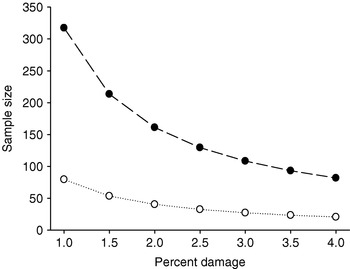
Twenty-four orchard blocks were sampled to construct a fixed-precision sampling plan to detect early-season stink bug damage. Nuts (n=10 or 20 per tree) were randomly collected from 20 or 30 trees per orchard block at MacFarms (South Kona), Island Harvest (northwestern Hawaii, near Hawi), and Mauna Loa orchard (Hilo, Hawaii). Sampled trees were selected along a transect drawn from the edge of the orchard block diagonally across many rows toward the centre of the block. Nezara viridula feeding was quantified after staining the sampled nuts in ruthenium red, by counting external probe sites and using these to estimate the extent of kernel damage. This procedure was shown to be >94% accurate in previous studies (Golden et al., Reference Golden, Follett and Wright2006). Means and variances were calculated for each orchard sampled. A total of 5200 nuts were sampled. Taylor's Power Law (TPL) was used to estimate the variance to mean relationship for nut damage to determine the spatial nature of the damage and so that we could estimate variance at a mean critical proportion of nuts damaged for the purpose of estimating sample size required to reliably detect the threshold damage level. Macadamia nut processors use a 13% N. viridula damage level as a threshold for rejection or downgrading of kernels, but our samples included only samples considerably below this level. However, early-season damage levels that would predict relatively high late-season damage were recorded (3–4%, see section below on predicting damage); and, therefore, estimated sample sizes required for a range of 1–4% damaged nuts were calculated. We used a formula for coefficient of variation (manipulated to solve for sample size, (Binns et al., Reference Binns, Nyrop and van der Werf2000)), where

Optimal sample sizes were calculated for a CV (coefficient of variation) of 0.05 and 0.10 using mean and variance estimates from TPL for critical damage levels from 1 to 4%, the range of damage levels recorded during the sampling.
To develop a procedure for estimating late-season damage levels from early-season samples (the peak harvest period for macadamia nuts in Hawaii is July–September), we used multiple regression analysis (with forward variable selection; SAS Institute, 2001) with late-season damage as the dependant variable. Independent variables were January damage, March damage, mean maximum temperature, rainfall and month (1–12). Data (quality control data, see above 1997–2002) from MacFarms and Island Harvest were analyzed together, in an effort to find a generally applicable model. Climate data were obtained from National Oceanic and Atmospheric Administration meteorological stations nearest to the farms.
Results
Long-term trends
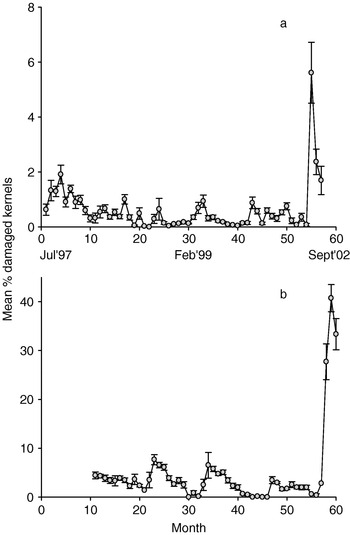
Figure 1 shows percentage damage attributed to N. viridula for the period 1997–2002 at both MacFarms and Island Harvest. While the mean damage at MacFarms (fig. 1a) over this period was low (<1%), there are clear peaks in damage to kernels and considerable variation among blocks at any time. The majority of samples (67.60%) had 0% damage, 31.13% showed 1–4% damage, and less than 1% of samples exceeded 5% damage attributable to N. viridula. These data include all varieties harvested and all orchard blocks harvested within the farms. A comparable pattern was found in the Island Harvest samples (fig. 1b), albeit with higher average damage (4.83±0.23%). Sixty percent of the Island Harvest samples had 0–4% damaged nuts, and 92% had less than 10% damaged nuts. Both study sites showed erratic overall patterns in damage peaks (fig. 1) and clearly highlight the unusually high damage in 2002 that prompted this study.
Long-term N. viridula damage to macadamia nut kernels (mean% damage±SEM), at (a) MacFarms and (b) Island Harvest. Month 0 was July 1997. Each data point is the mean damage level recorded for a sub-sample of nuts from that months' harvest, with largest harvests collected June–February each year.

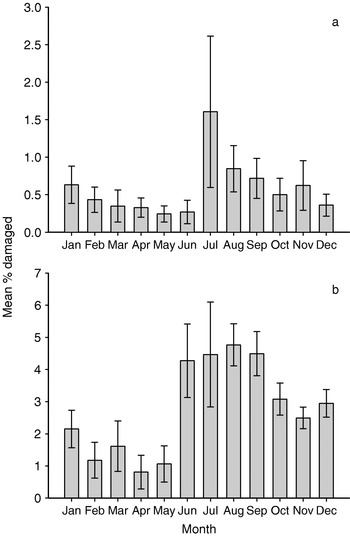
Analysis of these data by month showed a significant peak during late summer (July–August) in mean N. viridula damage levels over the five-year period sampled at MacFarms (fig. 2a) and June–August at Hawaii (fig. 2b). These data are for damage measured on ground-collected nuts, which may have fallen over a protracted period; so these results do not show when the most significant damage occurred, but when it was detected.
Mean monthly N. viridula damage (mean percentage±SEM) at (a) MacFarms and (b) Island Harvest, for data from July 1997 to September 2002.

Strata sampling/ground vs. canopy
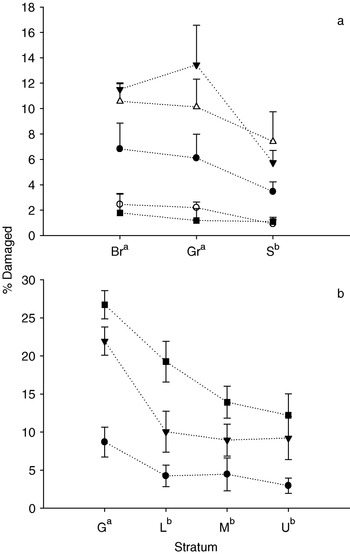
The 2002 samples from MacFarms showed significant differences in damage by strata (F2;49=6.14, P=0.0042, fig. 3a). There was no stratum×variety interaction (F8;49=1.10, P=0.3801), although damage levels among varieties did differ significantly (F4;49=22.46, P<0.0001, fig. 3a). Nuts off the ground consistently showed approximately twice the level of damage compared to nuts from the canopy.
Nezara viridula damage to macadamia kernels collected from tree canopies and ground samples from various cultivars. (a) MacFarms, mean+SEM (Br, husk brown on ground; Gr, husk green on ground; S, shaker/canopy sample; · · · · ·●· · · · · 246a; · · · ·○· · · · 333b; · · · · ·▼· · · · · 344c; · · · · ·△· · · · · 741c; · · · · ·■· · · · · 800b) and (b) Island Harvest, mean±SEM (G, ground collected nuts; L, lower canopy; M, mid-canopy; U, upper canopy; · · · · ·●· · · · · 246a; · · · · ·▼· · · · · 344b; · · · · ·■· · · · · 508c). Different superscript letters above cultivar numbers and strata indicate significant differences for means, Tukey comparisons, P<0.050.

Similarly, at Island Harvest (fig. 3b), there was a significant stratum effect (F3;87=10.59, P<0.0001) and variety effect (F2;87=21.23, P<0.0001, fig. 3B). There was no significant stratum×variety interaction (F6;87=0.89, P=0.5076).
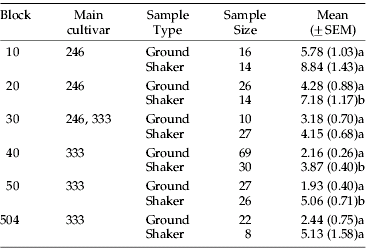
Quality analysis data from MacFarms in 2003 again showed that substantial damage accumulated within the canopy (table 1). Damage levels were consistently higher (although significantly higher in only three of six blocks) in the shaker (canopy) samples than in the ground-collected samples (table 1).
Nezara viridula kernel damage from MacFarms from shaker (canopy) and ground harvested samples for 2003. Samples were collected by block on the farm.

Means for blocks followed by different letters were significantly different (t-test, P<0.050).
Sampling plan development
Regression analysis (TPL) showed a significant linear variance: mean relationship (log s2=1.02 log (mean)–log(0.10), F1;21=54.93, R2=0.73). The slope of the relationship was not significantly different from unity (P>0.05), indicating a random distribution of damage within the orchards. The estimated sample size required to detect 1% damage (with CV of 0.05) was 317 nuts per orchard but dropped to approximately 160 nuts at 2% damage; if CV=0.10 was considered, 2% could reliably be detected with as few as 40 nuts per sample (fig. 4).
Sample sizes required to detect 2% stink bug feeding to macadamia nuts with coefficient of variation (CV) of 0.05 and 0.10 (—●— cv=0.05; · · · · ·○· · · · · cv=0.10).

Multiple regression analysis provided a model to estimate late-season damage (in a particular month of interest) as:

F4;81=18.90, P<0.0001, R2=0.48 (where DamLate is estimated late-season damage (%); DamJan is January damage; MaxTJan is the mean maximum temperature for January (°F); DamMar is March damage (%) and Month is the month of the year 1–12, Jan–Dec, of interest).
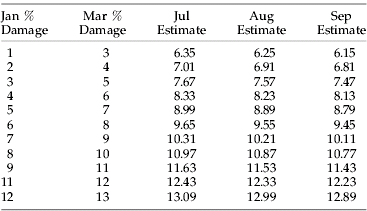
The coefficient of determination was relatively low because of considerable variation arising from pooling the data for both localities (with substantially higher damage from Island Harvest samples). Adding the error term (instead of subtracting) provided reasonably accurate predictions of July damage level, using the data set from both farms (summarized in figs 1 and 2). A series of predicted late-season damage levels, estimated from early hypothetical season damage measurements, is shown in table 2. The estimated damage levels decrease slightly over time (table 2), consistent with the long-term average damage trends shown in fig. 2a and, to a slightly lesser extent, fig. 2b.
Macadamia percentage nut damage forecast for July–September, estimatedFootnote * from hypothetical January and March damage measures, assuming an average temperature of 24°C.
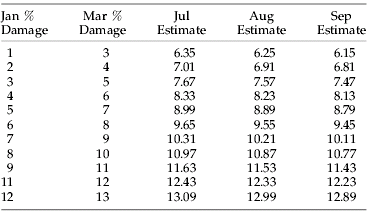
* DamLate=11.91+0.14(DamJan)−0.43(MaxTJan)+0.52(DamMar)−0.1(Month)±3.76. Error of 3.76 was added to provide estimates erring on the side of caution.
Discussion
The long-term data from MacFarms show that, while N. viridula contributes a small proportion of damage to macadamia kernels, on average, there are times when the damage levels escalate and become economically important. While no predictable significant trend in the data was observed for all varieties pooled, there were distinct peaks in each year's damage assessments (fig. 1). It is possible that these peaks occurred on specific varieties while others incurred low damage and that trends in the data are masked by this because of the high variability introduced. Varietal data were not collected by the processors, so further elucidation is not possible at this stage. The Island Harvest data show a comparable pattern with a considerably higher mean percent damage.
The distinct summer (June/July–August) peak in damage observed over the six-year period in our study is similar to patterns in damage reported by Jones & Caprio (Reference Jones and Caprio1992) for a single year. Their samples were nuts that had dropped less than three weeks prior to sampling (Jones & Caprio, Reference Jones and Caprio1992), and they did indicate that it should not be assumed that the damage occurred within one month of nut collection, but rather was cumulative in the tree prior to nut-drop, followed by damage on the ground.
Considerable damage occurred on macadamia nuts in the tree canopy. The fact that nut samples collected from the tree canopy had 50% less damage than those from ground samples from two locations in 2002, and a number of macadamia varieties showed the same stratified pattern in nut damage, show clearly that N. viridula feeding in the canopy is an important source of damage that should not be ignored. Varieties 333 and 800 may be an exception, as there was a smaller or no significant difference between canopy-collected and dropped nuts (fig. 3a). Macadamia nuts require approximately 18 weeks to reach full size, followed by a further 10–12 weeks before nut drop (Hartung, Reference Hartung1939). Harvesting in Hawaii typically begins in June and continues through February, with repeated harvests of trees every 6–8 weeks. Therefore, damage to nuts from shaker and ground harvests in June may have accumulated since February, and any population monitoring or control measures must take this long period of susceptibility into account. Following nut-drop, damage levels would continue to accumulate, so levels of damage on nuts harvested from the ground would include damage while nuts are on the panicle (in the tree canopy), and further damage that occurs after the nuts fall to the ground. While it has been established that ‘larger’ nuts do not abort once damaged (Jones & Caprio, Reference Jones and Caprio1994), it is possible that damaged nuts are more prone to drop early; and ground-collected nuts may, thus, include a large proportion that were damaged in the canopy. However, no data exist to support this. It may be important to suppress N. viridula populations throughout the period that nuts are developing, rather than only following nut-drop; and insecticide sprays should be directed into the tree canopy and not just at weed hosts of southern green stink bug between rows.
It is possible that damage in the canopy becomes more important than damage on the ground during times when N. viridula populations are exceedingly high, as was evidently the case in the 2002 season. It is also possible that the higher damage levels measured from the canopy in our shaker harvest samples for 2003 might be the result of damaged nuts falling more readily. Nevertheless, these results support the assertion that canopy feeding is significant.
A key element to any integrated pest management programme is the ability to monitor population levels so that outbreaks can be anticipated and management decisions made in a timely fashion. Information on monitoring stink bug in tree crops is scarce. At this time, there are no commercially available traps or lures for stink bugs to facilitate monitoring population levels (Golden et al., Reference Golden, Follett and Wright2006). Most information on pest damage in Hawaiian macadamia comes from laboratory analysis of harvest samples at the processor. The problem with using crop loss assessment information from the processor is the lag time; stink bugs may be damaging nuts 3–4 months before harvest and information is usually not available from processor samples until a month after harvest. Therefore, the information comes long after the damage occurs, and the grower has no chance to react to an outbreak. Now that we have established that significant stink bug feeding and damage to the kernel occurs in the tree, indirect measures of population levels can be made by sampling nuts from the tree canopy throughout the year. The recently developed method to stain stink bug feeding probes using ruthenium red dye (Golden et al., Reference Golden, Follett and Wright2006) now offers an effective means of measuring stink bug feeding in batch samples. Taking a random sample of ∼300 nuts per orchard from the canopy in January and March and assessing them for stink bug feeding using the staining technique and quantifying probes on the inside of husks will provide an estimate of damage that can be used in the multiple regression model to estimate expected late-season damage. If predicted damage reaches 13% (or possibly a lower damage level based on gain threshold as a result of changes in market value of the crop), intervention with insecticides should be considered. As this is a nominal threshold based on processor tolerances rather than a quantitative economic injury level, individual growers may elect to intervene at lower predicted damage levels, as dictated by their specific economic circumstances. At low damage levels, a substantial sample size is required to accurately measure damage. The difference between taking a sample of 317 and 160 nuts may become very evident in terms of effort to assess stained probes if many orchards are sampled. Sampling only 100 nuts per orchard would allow reasonable detection of 3% damage. Growers can apply this sampling procedure to measure kernel damage early in the year (January and March) and include local temperature data to arrive at an estimate of late-season (e.g. July, September) damage and plan to take appropriate measures to suppress N. viridula populations if required. An interactive, online damage estimator that will do calculations shown in table 2 will be made available at http://www.hawaiimacnut.org.
Acknowledgements
Hilary Brown and Mark Crawford (MacFarms), and Jim Trump (Island Harvest) allowed us access to their orchards and long-term quality control records. Zona Gabbard and Bob Lower (USDA-ARS, Hilo) provided technical assistance. Support for this work was provided by USDA-ARS, Hatch funding (H-910) and the Hawaii Macadamia Nut Association. Cerruti R2 Hooks, Mark Brown and Vincent P. Jones commented on an earlier version of this manuscript.