Introduction
Over the past few decades, stimulated Brillouin scattering (SBS) has attracted wide attention owing to its broad applications (Garmire Reference Garmire2018), such as phase distortion compensation of SBS phase conjugation mirror (Kuzmin et al., Reference Kuzmin, Khazanov, Kulagin and Shaykin2014), pulse compression (Zhu et al., Reference Zhu, Lu and Wang2015), beam combination and cleanup (Gao et al., Reference Gao, Lu, Zhu and Zhang2015; Kong et al., Reference Kong, Park, Cha, Ahn, Lee, Oh and Kim2015; Cui et al., Reference Cui, Wang, Lu, Yuan, Wang, Chen and Mildren2018), Brillouin amplification (Gökhan et al., Reference Gökhan, Göktaş and Sorger2018), frequency combs (Luo et al., Reference Luo, Tuan, Saini, Nguyen, Suzuki and Ohishi2018), optical signal processing (Pant et al., Reference Pant, Marpaung, Kabakova, Morrison, Poulton and Eggleton2014), and so forth. SBS is a third order nonlinear optical effect, and it depends strictly on the Brillouin gain (i.e., G = gIL, where g is the gain coefficient of the Brillouin medium, I is the pump intensity, and L is the length of the Brillouin medium). The Brillouin gain should exceed some certain values for SBS generation, which is the so-called SBS threshold (Zhu et al., Reference Zhu, Lu and Wang2012, Reference Zhu, Wang and Lu2014). Among the various parameters that affect the SBS characteristics, SBS threshold is very important, and many studies have been conducted about this parameter in recent years (Shi et al., Reference Shi, Tang, Wei, Zhang, Zhang, Shi and Liu2012; Zhu et al., Reference Zhu, Lu and Wang2012, Reference Zhu, Wang and Lu2014; Supradeepa Reference Supradeepa2013; Lu et al., Reference Lu, Zhou, Wang and Jiang2015; Hu et al., Reference Hu, Quan, Wang, Liu, Chen, Zhao and Zhou2016).
SBS is reported to be the main obstacle for power scaling of laser systems with narrow-linewidth, because it has almost the lowest threshold among the nonlinear effects (Lu et al., Reference Lu, Gao, He, Zhang and Hasi2009). Thus, SBS suppression plays an important role in high power single frequency lasers. There are several studies of SBS suppression in fiber laser amplifiers and laser plasma research (Sharma et al., Reference Sharma, Sharma, Rajput and Bhardwaj2009; Dajani et al., Reference Dajani, Zeringue, Lu, Vergien, Henry and Robin2010; Gauniyal et al., Reference Gauniyal, Ahmad, Rawat, Gaur, Mahmoud and Purohit2016). A very popular method for raising SBS threshold is broadening the pump spectrum with phase modulation (Harish and Nilsson, Reference Harish and Nilsson2015). But the frequency modulation to amplitude modulation (FM-to-AM) effect appears at the top of pulse waveform when the phase modulation technique is used (Hocquet et al., Reference Hocquet, Penninckx, Bordenave, Gouédard and Jaouën2008; Huang et al., Reference Huang, Deng, Zhou, Hu, Guo, Wang, Zhao, Zhong and Deng2018). The FM-to-AM effect makes the original smooth laser pulse added with a sinusoidal intensity modulation. When these kinds of laser pulses are used as the pump for SBS studying, the threshold may turns out to be different. We have found scarcely any studies addressed the dependence of the SBS threshold on the temporal intensity modulation of the pump pulse, leaving this field largely untapped.
In this paper, we numerically studied the influence of temporal sinusoidal intensity modulation of the pump pulse on SBS threshold. Based on the classical three-wave-coupled equations describing the SBS process, the SBS threshold is calculated with the change of temporal intensity modulation index and modulation frequency.
Theory
To numerically calculate the SBS threshold, we study the following coupled-wave equations describing the process of SBS generation (Boyd et al., Reference Boyd, Rzazewski and Narum1990):
 $$\displaystyle{{\partial E_{\rm P}} \over {\partial z}} + \displaystyle{n \over c}\displaystyle{{\partial E_{\rm P}} \over {\partial t}} = ig{\rm {\rm \rho}} E_{\rm S}-\displaystyle{1 \over 2}{{\rm \sigma}} E_{\rm P}$$
 $$\displaystyle{{\partial E_{\rm S}} \over {\partial z}}-\displaystyle{n \over c}\displaystyle{{\partial E_{\rm S}} \over {\partial t}} = -ig{{\rm \rho}} ^{^\ast}E_{\rm P} + \displaystyle{1 \over 2}{{\rm \sigma}} E_{\rm S}$$
 $$\displaystyle{{\partial {{\rm \rho}}} \over {\partial t}} + \displaystyle{1 \over 2}{\rm \Gamma} {{\rm \rho}} = \displaystyle{{{\rm i}{{\rm \gamma}} q^2} \over {16{{\rm \pi}} {\rm \Omega} _{\rm B}}}E_{\rm P}E_{\rm S}^{^\ast} + f$$
where E P, E S, and ρ respectively represent amplitude of the pump, Stokes light, and acoustic wave; n is the refractive index of Brillouin medium; c is the velocity of light in vacuum; ω is the angular frequency of the pump; γ is the electrostrictive constant; q is the wave vector of acoustic wave; g is the gain factor; σ is the absorption coefficient of the medium; ΩB and Γ respectively represent the Brillouin frequency shift and Brillouin linewidth; f represents the Langevin noise source that describes the random thermal noise in the medium, and it follows the relation 〈f(z, t)〉 = 0 and 〈f(z, t)f*(z ′, t ′)〉 = Qδ(z − z ′)δ(t − t ′), in which Q = 2kTρ 0Γ/V 2A, k is the Boltzmann constant, T is the temperature of medium, and A is the cross-sectional area of the beam (Boyd et al., Reference Boyd, Rzazewski and Narum1990; Wang et al., Reference Wang, Zhu, Lu and Zhang2016).
By numerically solving the three-wave-coupled equations of (1)–(3), the SBS process can be simulated when the pump is injected into the Brillouin medium. In the algorithm, we use an implicit finite differencing in time and a backward differencing scheme in space similar as the model proposed by Chu et al. (Reference Chu, Kanefsky and Falk1992). The analytical expression for the super-Gaussian-shaped pump pulse added with a sinusoidal intensity modulation caused by the FM-to-AM effect is described as follows:
 $$I_{\rm p}(t) = \vert A_{\rm p}(t) \vert ^2 = I_{{\rm P}0}\cdot \exp \left( {-4\displaystyle{{t-t_0} \over {T_{\rm P}}}} \right)^{20}\cdot \left[ {1 + {{\rm \beta}} \cos \left( {\displaystyle{{2k{{\rm \pi}}} \over {T_{\rm P}}}\cdot t} \right)} \right]$$
where I P0 is the peak intensity of the 20th order super-Gaussian-shaped pump, t 0 represents the central time, T P is the pulse width, β is the temporal modulation index of the FM-to-AM effect, and k denotes the number of the modulation peaks in the top of the pump pulse. The initial condition can be described as follows: the pump pulse is injected from one end of the Brillouin medium, and the other local pump intensity along the longitudinal axis of the medium; none of the Stokes light excited at the beginning and its amplitude is set to be zero; the acoustic wave ρ is a complex Gaussian random distribution function with zero mean.
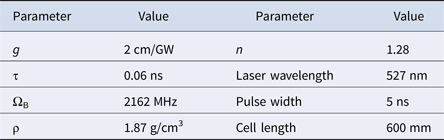
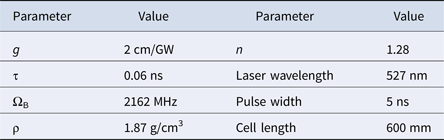
The main parameters of Brillouin medium and laser source used in our calculation are shown in Table 1. Heavy fluorocarbon liquid materials FC-40 is selected as the nonlinear material for the numerically simulation. Among the parameters, refractive index, phonon lifetime, Brillouin frequency shift, and gain coefficient are taken from Wang et al. (Reference Wang, Zhu, Lu and Zhang2015).
Main parameters of Brillouin medium and laser source
Numerical results and discussion
With the proposed numerical model and the main parameters mentioned above, SBS threshold with sinusoidally modulated pump pulses was studied. To describe the temporal modulation of the pump pulse, the distortion criterion, and the modulation frequency are taken into consideration.
The distortion criterion α is defined by the following expression (Hocquet et al., Reference Hocquet, Penninckx, Bordenave, Gouédard and Jaouën2008):
 $${{\rm \alpha}} = 2\displaystyle{{I_{\max} -I_{\min}} \over {I_{\max} + I_{\min}}} \times 100\% $$
where I max and I min represent the peak and valley intensity of the pump in the fluctuation duration. The α factor ranges from 0 to 200%, and α = 0 denotes that there is no intensity modulation of the pump pulse. When different pump pulses with the changing α factors are used, the SBS effect is simulated with the abovementioned modal. Five different distortion criteria of 0, 40, 80, 120, and 160% are used for numerically calculation, and the results are shown in Figure 1.
The influence of distortion criterion α on the SBS generation. (a) Waveforms of pump and corresponding Stokes light, (b) reflectivity versus Brillouin gain, and (c) calculated SBS threshold with different α factors.
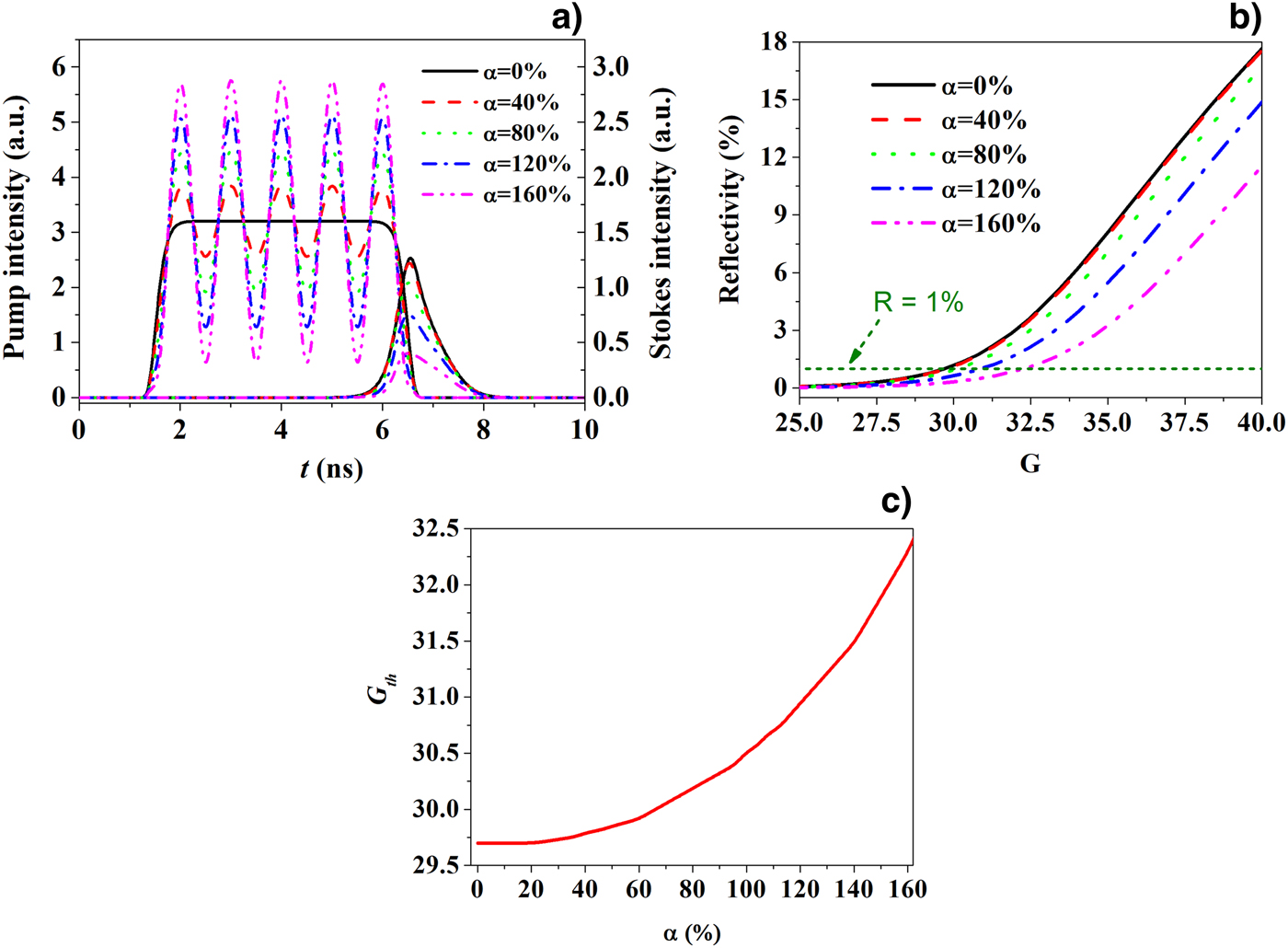
Figure 1a shows the waveforms of the pump and the correspond Stokes light with different distortion criteria and fixed average pump intensity (320 MW/cm2). It can be clearly seen from this figure that the intensity of Stokes pulse changes with the variation of α factor. The higher the value of α, the lower the intensity of the reflected Stokes light. It indicates that the temporal intensity modulation of the pump suppresses the generation of SBS to some extent. The SBS reflectivity versus the Brillouin gain with different α factors are drawn in Figure 1b. The horizontal green dash line denotes the level of SBS reflectivity of 1%, which is a well-known criteria for SBS threshold research. The intersections of this line and the reflectivity curves indicate the related SBS threshold with different value of α. We can see from this figure that the higher the level of the α factor, the higher SBS threshold happens.
To study the relationship between threshold gain and the distortion criterion, the SBS threshold G th with α changes from 0 to 160% are calculated, and the results are shown in Figure 1c. When the intensity modulation factor is below about 30%, the SBS threshold remains almost stable with negligible increase. The threshold value increases exponentially with the α factor when it is higher than 30%. Then, we can draw a conclusion that when the temporal intensity modulation factor is below 30%, the generation of SBS effect will be not influenced. The reason why SBS threshold increase with α can be detailed as follows. The pump pulses shown in Figure 1a can be seen as a stack of five individual short pulses and a long base with a pulse duration of 5 ns. Pulse width of each sub-pulse is about 1 ns, whose related SBS threshold is higher than that of the 5 ns base. The percentage of sub-pulses increases linearly with α. Thus, the total energy reflectivity decreases and the SBS threshold increases with the increasing of α.
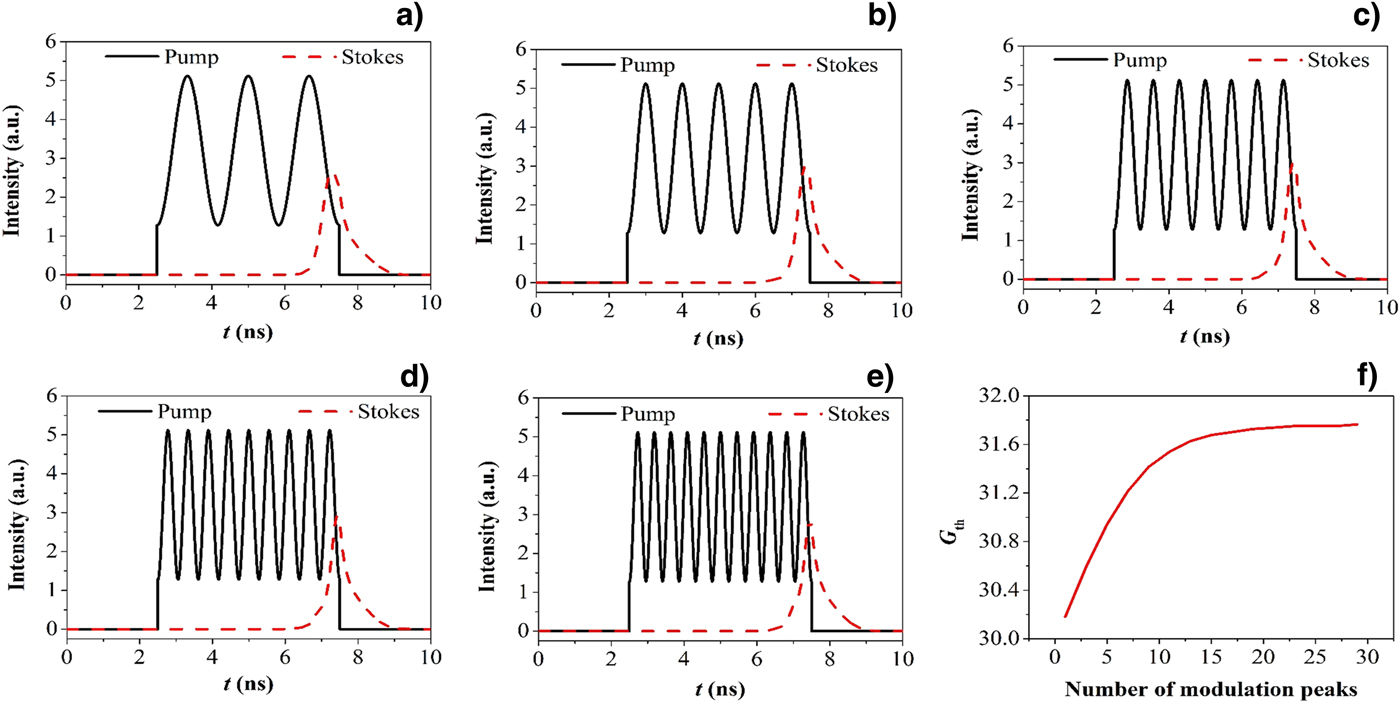
The modulation frequency of the sinusoidal modulated pump pulse can be described by the number of modulation peaks with a fixed pulse duration of 5 ns. For fixed pump average intensity (320 MW/cm2) and pulse width, the waveforms of pump and Stokes light was calculated and shown in Figure 2a–2e with 3, 5, 7, 9, and 11 modulation peaks. It can be seen from the figures that the duration of Stokes pulse shorten with the increase of modulation peaks, and the peak intensity of the Stokes pulse remains nearly the same. That is to say, the reflected energy decreases with the increase of modulation frequency of pump pulse with the same energy. Thus, the higher the modulation frequency, the higher the SBS threshold. The dependence of SBS threshold and the number of modulation peaks are shown in Figure 2f. This figure indicates that SBS threshold increases with the increase of modulation peaks when the number is below nearly 15, and remains stable with larger number of modulation peaks.
The influence of modulation frequency (number of modulation peaks during a 5 ns square pump pulse) on the SBS generation.
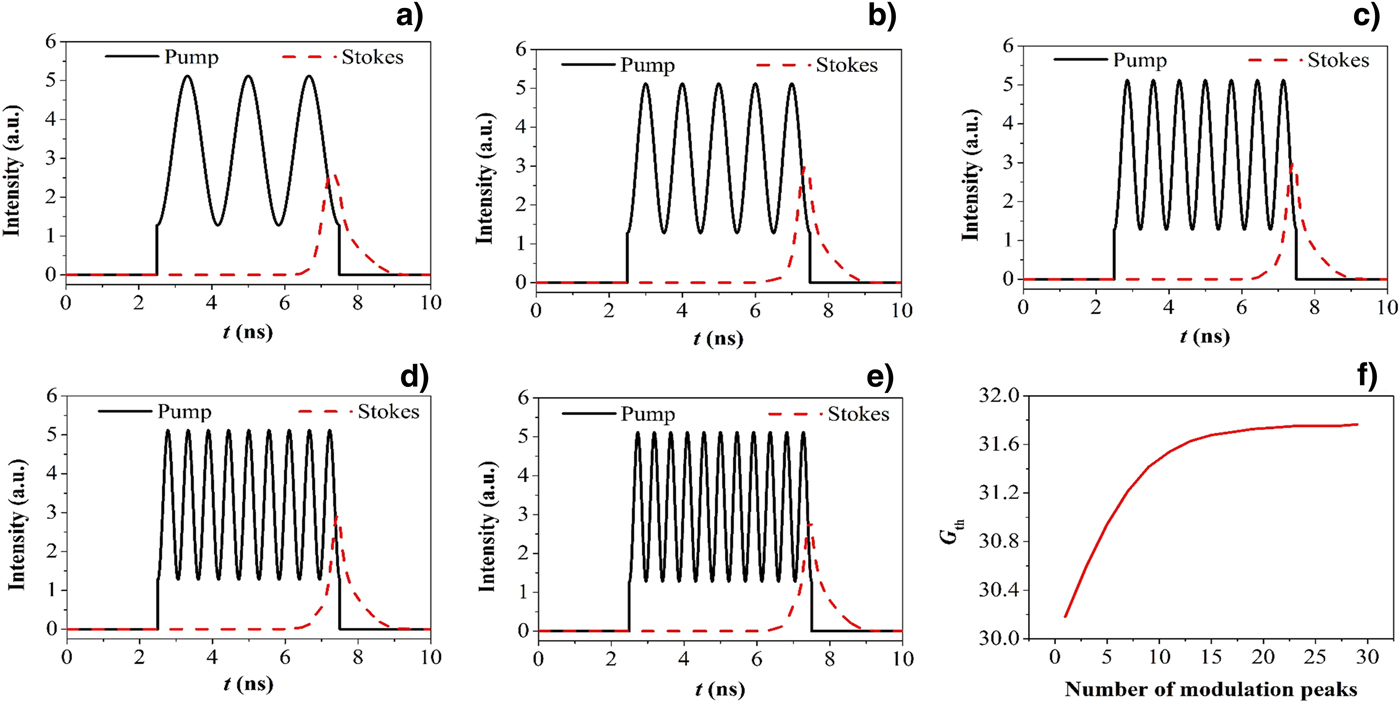
The sinusoidal modulated pump pulse can be considered as a stack of several sub-pulses (see Fig. 2). Each of the sub-pulses excites SBS independently, and the threshold is determined by the total reflectivity. With the increase of the number of the modulation peaks, pulse duration of each peak drops and the transient effect becomes prominent. When the pump pulse width shortens toward the phonon lifetime of the Brillouin medium, the SBS threshold increases dependently (Su et al., Reference Su, Zhou, Lü, Wang, Luo and Xu2014). When the number of modulation peaks is larger than 15, the sub-pulse duration below three times the phonon lifetime and its variation range narrows, which leads to a smooth changing of the SBS threshold (see Fig. 2f).
The FM-to-AM effect caused sinusoidal modulated laser pulse is popular in high power laser systems (Hocquet et al., Reference Hocquet, Penninckx, Bordenave, Gouédard and Jaouën2008). When this kind of laser pulses is used as the pump source, the dependence of SBS threshold on the temporal modulation is necessary to be detailed. The above numerically calculated results illustrate clearly the relationship between SBS threshold and the modulation characteristic of pump pulses, which plays an important role in high power laser applications.
Conclusions
In summary, we studied the dependence of SBS threshold on the sinusoidally modulated properties of pump pulse. Two parameters the distortion criterion and the modulation frequency of pump pulses are taken into consideration, and the SBS threshold is calculated by numerically solving the coupled-wave equations. In our SBS threshold calculation, a 527-nm-wavelength, 5 ns square laser pulse with sinusoidal temporal modulation is used as the pump source, and a 600 mm liquid heavy fluorocarbon material FC-40 is used as the Brillouin medium. The numerically calculated results indicates that: (1) when the distortion criterion is below 30%, the SBS threshold remains almost stable with negligible influence, and the threshold value increases exponentially with the α factor when it is larger than 30%; (2) SBS threshold increases with the shorten of sub-pulse duration, but when the sub-pulse duration is below three times the phonon lifetime, the SBS threshold tends to remain unchanged.
Acknowledgements
This work was supported by the Key Program of Natural Science Foundation of Anhui Provincial Education Department (no. KJ2017A124), the Priming Scientific Research Foundation for the Introduction Talent in Anhui Polytechnic University (no. 2016YQQ016), the Advance Research Program for National Science Foundation of China in Anhui Polytechnic University (no. 2018YYZR14), and the Open Research Fund of Anhui Key Laboratory of Detection Technology and Energy Saving Devices, Anhui Polytechnic University (no. 2017070503B026-A08).