Introduction
The Seismic Risk in Italy
Italy is a country exposed to multiple natural hazards, such as earthquakes, floods, landslides, volcanic eruptions, and fires. It is one of the Mediterranean countries with the highest seismic risk.Reference Crowley, Colombi and Borzi1 This is due to the high population density associated with the relative fragility of older structures and the geographic position at the convergence of the African and Eurasian plates.Reference Crowley, Colombi and Borzi1, 2 According to the Centre for Research on the Epidemiology of Disasters (CRED; Brussels, Belgium), southern Europe is the continental region most frequently hit by earthquakes, with 28 major earthquakes registered from 2007–2017, 12 of them in Italy. In terms of human impact, Italy witnessed the highest burden of earthquakes with 679 deaths and 124,000 people affected, followed by Greece, Serbia, and Spain. Italy was also the country most economically affected with damages mounting to US $27,665,000 (€24.2 million), two-folds greater than Greece in second place.3
According to the Italian Civil Protection Department (Rome, Italy), since 1900, seven earthquakes with a magnitude of 6.5 or higher were registered in Italy. The most famous and disastrous earthquakes in Italian history took place in Val di Noto in 1693, Calabria in 1783, and Messina in 1908. More recently, also in Irpinia in 1980, L’Aquila in 2009, Emilia-Romagna in 2012, and Amatrice-Accumuli-Norcia in 2016. These devastating events took a heavy toll on human lives with more than 3,600 deaths and also caused considerable economic damage estimated at around €80 billion (US $91.4 billion).2
Seismic Risk Awareness in Italy
Attempts are made by the Italian Department of Civil Protection to mitigate the seismic risk in Italy. In 2002, the Italian Civil Protection started seismic checks on schools, as well as interventions and anti-seismic reconstruction of designated buildings, in an attempt to reduce the possible effects of earthquakes. In 2009, the Italian Government allocated €965 million (US $1.1 billion) for interventions of seismic risk prevention on the national basis.2
In addition to mitigation activities, some effort is made to make the Italian population more aware of the risk and the means to prepare for it. The web site of the Italian Civil Protection offers readers with information about seismic risk in both Italian and English. The web site also provides a list of simple household adjustments that can be done to prepare for an earthquake, as well as behavioral rules to follow during one. Moreover, in 2011, the Civil Protection, in collaboration with other organizations, initiated the “I Don’t Risk - Earthquakes” campaign (originally in Italian: “Io Non Rischio - Terremoto”). This national communication campaign was launched through social media and local events and was aimed at reducing seismic-related risks by expanding public knowledge, increasing public awareness, and encouraging the adoption of household adjustment actions.2
Public Preparedness to Earthquakes and Other Emergencies in Italy
The literature provides extensive accounts on the socio-psychological factors that influence preparedness behavior. Particularly in the case of earthquake preparedness, the literature suggests that threat perception components (eg, perception of likelihood, severity, and threat intrusiveness), as well as perception of responsibility, can be considered prime motivators and predictors of households’ adjustment behavior towards earthquakes.Reference Lindell and Hwang4–Reference Bodas, Siman-Tov, Kreitler and Peleg11 The literature suggests that one of the most potent motivators of promoting households’ preparedness for emergencies is prior experience with the threat (eg, earthquakes in this case). Additional important motivators are exposure to relevant information concerning the hazard and means to protect from it.Reference Mileti, Bourque, Wood and Kano12
Several studies explored specifically the case of the Italian public’s preparedness for emergencies. For instance, a study conducted in 2005 reported that Italian residents living in the highest risk areas at the vicinity of the Vesuvio volcano (Campania, Italy) demonstrated high levels of fear coupled with low levels of perceived ability to cope with a possible volcanic eruption.Reference Davis, Ricci and Mitchell13 A later study from 2008 that examined Italians’ preparedness to floods in high-risk areas found an overall fairly good level of preparedness. This was positively associated with risk perception and being informed about the risk.Reference Miceli, Sotgiu and Settanni14
In the context of Italian earthquake hazards specifically, prior studies focused on mapping of the seismic riskReference Crowley, Colombi and Borzi1 or response to actual incidents.Reference Moretti15 The only socio-psychological study found concerning the seismic risk in Italy described human behavior during an actual earthquake incident.Reference Prati, Saccinto, Pietrantoni and Pérez-Testor16 The motivation behind this study relates to the authors’ desire to better understand public preparedness for earthquakes in Italy and to propose policies that will ultimately save more lives and reduce injury rates. Therefore, the objectives of this study were two-fold. The first was to assess the level of households’ preparedness for earthquakes in Italy. The second was to measure the Italian public’s perception of earthquake risk and assess its impact on preparedness behavior.
Methods
Ethical Considerations
This study involved human subjects. However, participants were requested to complete anonymous online questionnaires on a voluntary basis only, and therefore the ethical committee of the University of Eastern Piedmont (Vercelli, Italy) exempted this study from full ethical review or need for formal informed consent (approval number CE 141/18).
Procedure and Sample
A cross-sectional study was conducted using an internet-based survey from December 2017 through March 2018. The survey was administered via the Google Forms platform (Google, LLC; Mountain View, California USA). The choice of online survey was made in light of the multitude of statements included in the questionnaire (∼40 items), some of which are easier to administer in writing as opposed to over the phone. Sampling was conducted through social media, organizational newsletter, and e-mail communications in a “snow-ball” method, in which contacted responders were asked to subsequently forward the link for the online questionnaire to family and friends.
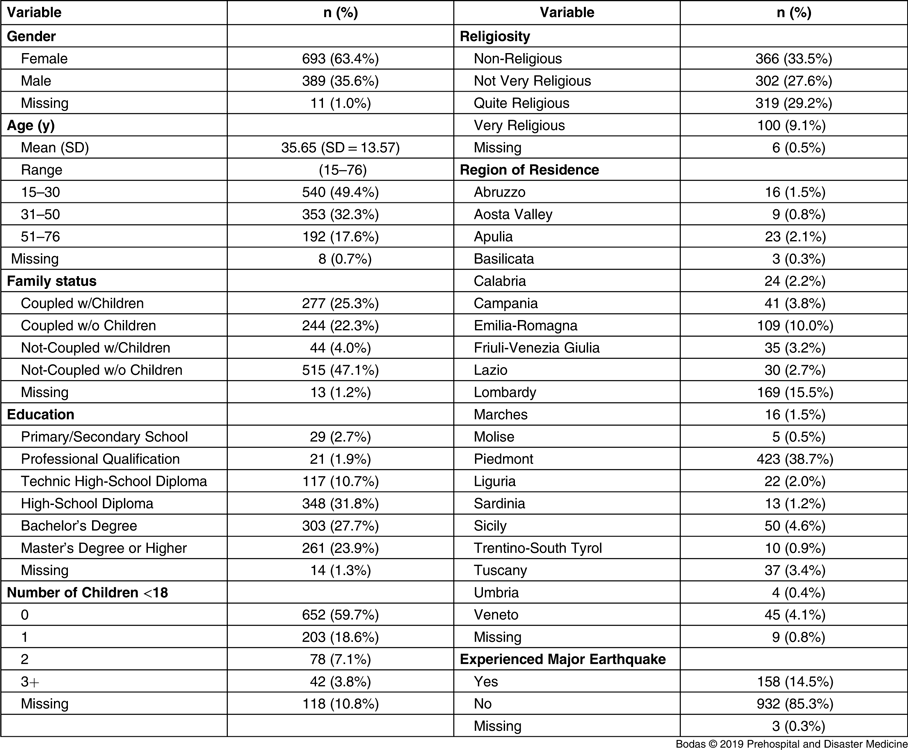
The minimal sample size was pre-determined as 601 participants based on the size of the Italian population (∼61,000,000), a confidence level of 95%, and an acceptable margin of error of four percent.17 The final sample included 1,093 participants from a diverse sociodemographic and geographical background representing the different regions of Italy. The full demographic distribution of the studied sample is presented in Table 1.
Socio-Demographic Distribution of Sample (N = 1,093)

It is important to note that the sample is diverging from the actual distribution in the overall Italian population in two aspects. The first is geographical distribution; in this study’s sample, more than 65% of responses are attributed to the northern part of Italy. The second is education; in this study’s sample, there is over-representation of highly educated people.
Tool
The tool designed for this study was adapted from the Hebrew version utilized and validated in a previous study in Israel.Reference Bodas, Siman-Tov, Kreitler and Peleg11, Reference Bodas, Siman-Tov, Kreitler and Peleg18 A preliminary stage of translation of the tool into Italian language was conducted. The authors jointly evaluated and adapted the language and phrasing of the items from the original questionnaire into Italian context until consensus was reached concerning appropriate wording. To ensure similar understanding of the context by all responders, the questionnaire opened with a statement explaining the definition of a “major earthquake” as one that can cause serious damages, similarly to the earthquakes that hit the Italian regions of Amatrice-Norcia-Visso and l’Aquila in the recent past.
Variables and Outcomes
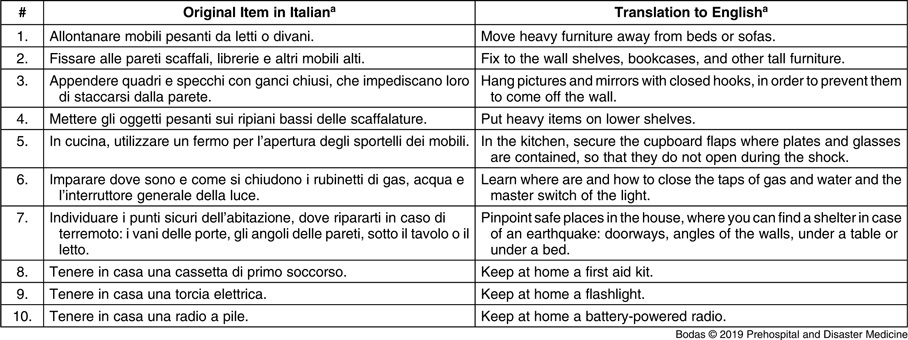
The primary outcome of this study was the Preparedness Index (PI), a score calculated as the number of action items indicated by a participant as complied-with out of a list of 10 earthquake preparedness actions recommended by the Italian Civil Protection (Cronbach’s alpha =0.669).2 The full list is presented in Table 2.
Preparedness Items Recommended by the Italian Civil Protection for Household’s Adjustment to Earthquake

a Both languages are as provided by the Italian Civil Protection Agency (Italian Civil Protection, 2018a).
The secondary outcomes of this study were different threat perception components, including:
1. Sense of Preparedness: a score calculated as the mean score of answers to three items on a five-point Likert scale (Cronbach’s alpha = 0.834), which are translated into English the following way: (a) “To what extent do you think you know how to behave in case of a major earthquake?” (b) “To what extent do you feel emotionally prepared to a major earthquake?” and (c) “To what extent do you feel physically prepared to a major earthquake?”
2. Perception of likelihood of a major earthquake happening in the next year and in the next five years (two items).
3. Severity Index: a score calculated as the mean score of answers to seven items on a five-point Likert scale (Cronbach’s alpha = 0.909), assessing the perception of severity of a major earthquake to: (a) the routine of life in the country; (b) the routine of life in the region in which the responder lives; (c) the family’s routine; (d) responder’s routine; (e) personal belongings (eg, responder’s house); (f) family members (eg, injury or death); and (g) responder him/herself (injury or death).
4. Perception of responsibility to prepare for a major earthquake assigned on a five-point Likert scale to different levels/sectors: responder him/herself, responder’s family, the public, the local authority, the regional government, the Civil Protection, and the State (seven items). And,
5. Frequency of searching for information relating to earthquake risk and preparedness on a five-point Likert scale (one item).
In addition, participants were asked to indicate whether they have experienced a major earthquake before on a dichotomous scale (yes/no). Additional sociodemographic variables were assessed, including gender, age, place of residence, familial status, and affiliation to religion.
Seismic risk level was assessed on a regional basis. Risk indices were obtained from the 2015 data repository of the Italian Civil Protection.19 The database provides risk indices per commune, and thusly, an average score of risk per region was computed and subsequently assigned to each participant in accordance with the region in which he or she resides. For more details, the reader is encouraged to visit the relevant section of the Italian Civil Protection web site.20
Hypotheses
It is hypothesized that despite prior earthquakes, Italian households’ preparedness for earthquakes will be medium and insufficient. It is also hypothesized that several correlations will be found between the level of preparedness of Italian households for earthquakes and different threat perception components, such as perception of likelihood, severity, threat intrusiveness, and perception of personal responsibility. It is expected to see differences in level of preparedness across demographic categories, most prominently between the genders, with men reporting higher levels of preparedness than women.
Statistical Analysis
The statistical analysis of the results was performed using IBM’s SPSS Version 24 (IBM Corp.; Armonk, New York USA). The analysis included both descriptive and analytical methods, and the statistical tests were chosen according to variables distribution. Prior to analysis, indices were generated and their reliability was assessed using Cronbach’s Alpha. Shapiro-Wilk test was used to determine normal distribution of variables. Since all constructs were not normally distributed, mostly non-parametric tests were used. Spearman correlation test (with Bonferroni correction) was used to examine correlations between continuous variables. Mann-Whitney U and Kruskal-Wallis tests were used to compare means of independent variables, according to number of categories. Chi-square test was used to compare proportions of categorical variables.
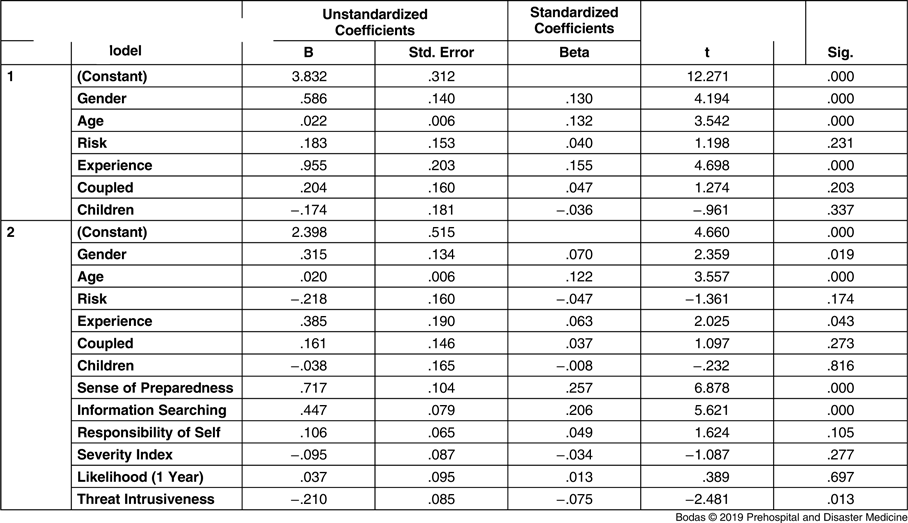
In addition, in order to predict the change in the primary outcome (ie, PI), a linear regression model was applied. Only variables found to be associated with the dependent variable in the univariate analysis were introduced into the analysis following negation of multi-collinearity (VIF<2). Variables were entered in two blocks: the first containing demographics (age c cont.; gender – two categories; risk – two categories; experience – two categories; being in a relationship – two categories; and having children – two categories), and the second containing threat perception components (sense of preparedness index – cont.; severity index – cont.; likelihood for one year – cont.; threat intrusiveness – cont.; responsibility of self – cont.; and search for information – cont.). The analysis was performed in Enter mode. In all statistical analyses performed, a P value of .05 or less was determined as statistically significant.
Results
Primary Outcome
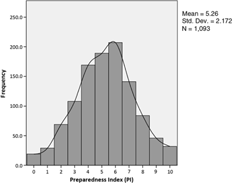
The primary outcome for this study was the PI, indicating the number of the Civil Protection’s earthquake preparedness recommendations that the responder reported to comply with out of a possible 10. In the overall sample (N = 1,093), the mean number of recommendations reported as complied-with was 5.26 (SD = 2.17). The variable’s distribution resembled that of normal distribution in shape (Figure 1), but could not be statistically considered as such, according to Shapiro-Wilk test (W = 0.977; P <.001).
Distribution of Reported Preparedness (Preparedness Index, PI) Indicating the Number of Civil Protection’s Earthquake Preparedness Recommendations Reported as Complied-With by Responders (N = 1,093).

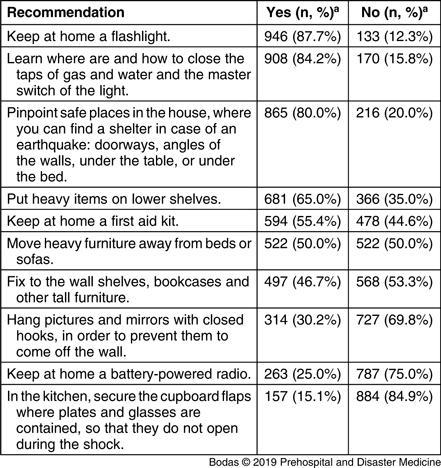
A breakdown of the compliance rates to the difference recommendations for household adjustment for earthquakes reveled that some items were more frequently adhered to than others were. The recommendation most reported as complied-with was keeping a flashlight at home (87.7%). In contrast, the least complied-with recommendation was securing the kitchen cupboard flaps where plates and glasses were contained, so that they would not open during the shock (15.1%). Table 3 provides the complete compliance rates for all items included in this survey.
Reported Compliance with the Italian Civil Protection’s Recommendations for Household Adjustment for Earthquakes (N = 1,093)

a Percentage from valid responses; maximum missing per item: n = 52.
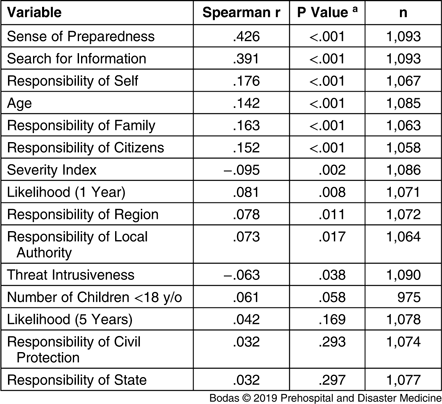
The PI was associated with numerous threat perception components assessed in this study. Of particular importance, the PI was positively correlated with the sense of preparedness index (Spearman r = 0.426; P <.001) and the tendency to search for information about earthquake hazards and preparedness (r = 0.391; P <.001). Table 4 provides the complete Spearman correlation findings.
Spearman Correlations of Reported Earthquake Preparedness (PI) with Demographic and Perception Components

a Adjusted alpha for multiple (15) comparisons = 0.003.
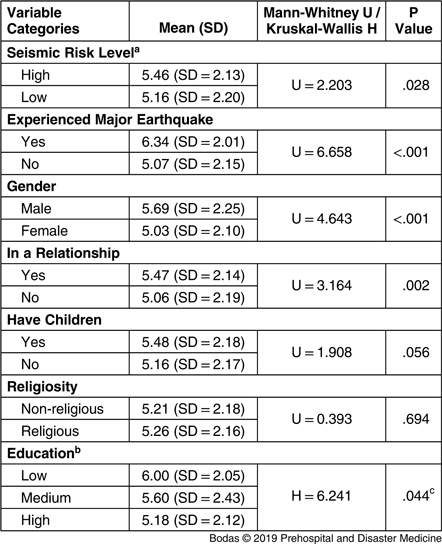
Reporting higher levels of preparedness was also associated with the level of seismic risk at the place of residence. Responders residing in high-risk areas reported complying with a mean of 5.46 (SD = 2.13) recommendations for household adjustment for earthquakes as opposed to responders residing in low-seismic-risk regions who reported a mean of 5.16 (SD = 2.20). This difference was statistically significant according to Mann-Whitney U test (U = 2.203; P = .028). Table 5 provides additional non-parametric comparisons of PI means across sociodemographic variables.
Non-Parametric Comparison of Reported Earthquake Preparedness (PI) Across Demographic Groups

a Risk level of regions was determined according to seismic data provided by the Italian Civil Protection.20
b Low education = Primary/secondary school; Medium education = Professional qualification + Technic high-school diploma; High education = High-school diploma and higher.
c Non-significant after pair-wise multiple comparison correction.
Secondary Outcomes
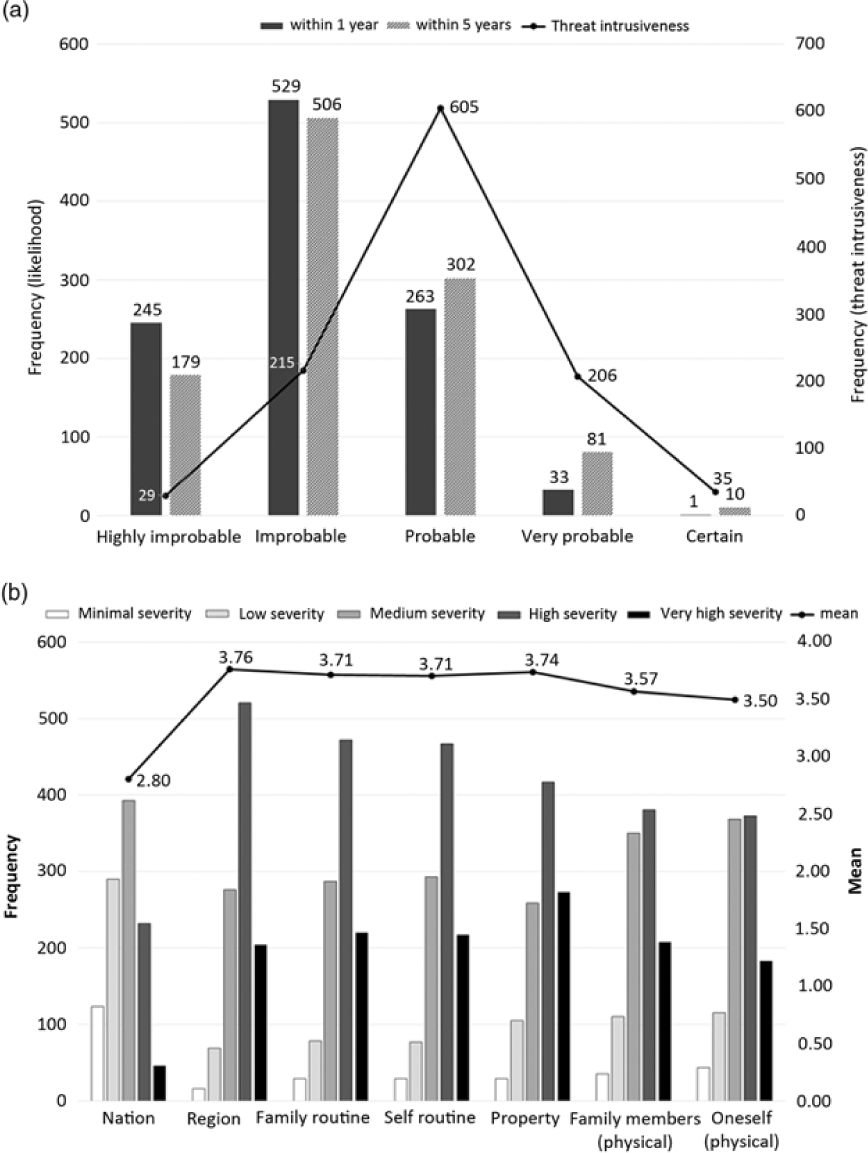
When asked to assess the likelihood of a major earthquake occurring within the next year, 774 (72.3%) participants responded “improbable” or “highly improbable.” This proportion slightly reduced when participants were asked to assess the likelihood of a major earthquake occurring within the next five years (63.5%). When asked to assess the likelihood of being personally harmed by a major earthquake (threat intrusiveness), the majority of responses (605; 55.5%) were the mid-scale option “probable.” Participants also assessed the severity of a major earthquake. A severity index was generated as the mean score of responses to all seven items pertaining to severity. In the overall sample (N = 1,093) the severity index mean was 3.67 (SD = 0.79). Complete data regarding the perception of likelihood, threat intrusiveness, and severity can be found in Figure 2.
Distribution of Responses to Threat Perception Components: (a) Likelihood of a Major Earthquake Occurring (Bars) and being Personally Harmed by it [Threat Intrusiveness] (Line), and (b) Severity of a Major Earthquake to Different Societal and Personal Layers.

Participants also provided their perception concerning the assignment of responsibility to prepare for a major earthquake. Participants tended to assign less responsibility to themselves and more to the Civil Protection and the State. The mean score of responsibility assigned by a participant to him/herself was 3.23 (SD = 1.00), to his/her family was 3.16 (SD = 0.97), to the public as a whole was 3.45 (SD = 0.95), to the local authority was 4.20 (SD = 0.83), to the Civil Protection Agency was 4.29 (SD = 0.88), to the regional government was 4.32 (SD = 0.82), and to the State was 4.46 (SD = 0.84). The mean difference between the assignment of responsibility by a participant to him/herself and to the State was statistically significant, according to independent t-test (t = 30.85; df = 2,142; P <.001). In fact, while 60.7% and 47.3% assigned the highest option of “complete responsibility” to the State and the Civil Protection Agency, respectively, only 8.1% assigned the same level of responsibility upon themselves personally.
When asked to report the frequency of looking for information about earthquakes, 228 (20.9%) participants responded “never” (Per nulla), 474 (43.4%) responded “rarely” (Poco), 260 (23.8%) responded “sometimes” (Abbastanza), 98 (9.0%) responded “quite a lot” (Molto), and 33 (3.0%) responded “very much” (Moltissimo). When asked whether they have experienced a major earthquake, 932 (85.3%) participants responded “No” and 158 (14.5%) responded “Yes.” Of those who did not experience a major earthquake, only 26.4% resided in high-risk areas, whereas 73.6% of those who did experience a major earthquake resided in those areas. This difference in proportions was statistically significant, according to Chi-square test (χ2 = 85.14; df = 1; P <.001).
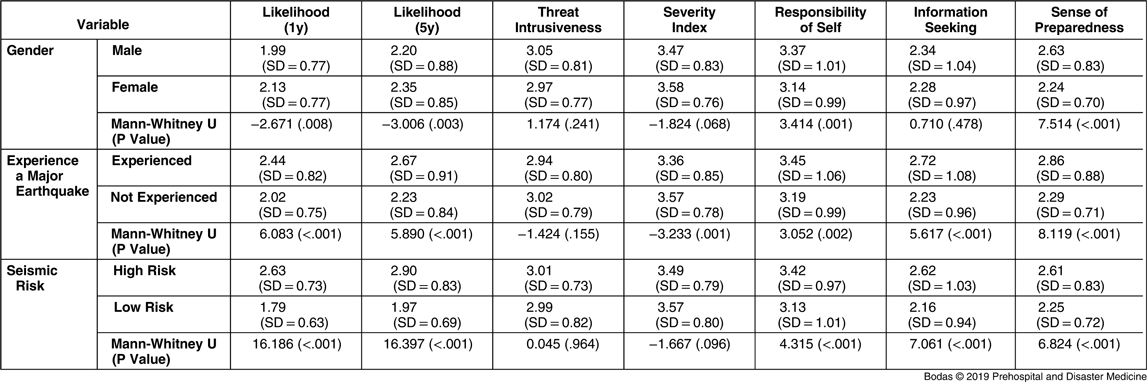
The results indicated several differences between sociodemographic categories with respect to secondary outcomes (Table 6). Of particular importance, the data indicated that women tended to have higher perception of likelihood of earthquake occurrence, whereas men perceived higher levels of personal responsibility to prepare and had a higher sense of preparedness. Differences were also observed between participants who experienced a major earthquake before and those who did not. The former reported higher levels of likelihood perception, self-responsibility, information seeking, and sense of preparedness, whereas the former reported higher levels of severity perception. Similarly, participants residing in high-seismic-risk areas reported greater levels of perceived likelihood, self-responsibility, information seeking, and sense of preparedness. The complete data are provided in Table 6.
Differences in Earthquake Threat Perception Across Different Sociodemographic Variables

The results obtained from the Spearman correlation test indicated a significant negative association between the severity index and sense of preparedness (r = −0.164; P <.001), suggesting that perceiving a major earthquake to be more severe can decrease one’s sense of preparedness, or that having a heightened sense of preparedness reduces the perception of the severity of the risk. In addition, a significant positive association was found between sense of preparedness and seeking earthquake-related information (r = 0.525; P <.001), suggesting that seeking of information can lead to a greater sense of preparedness, or vice versa.
Multi-Variant Analysis
To predict the change in reported preparedness (PI), a linear regression model was used. Only variables found to be associated with the dependent variable in the univariate analysis were introduced into the analysis following negation of multi-collinearity (VIF<2). Variables were entered in two blocks: the first containing demographics (age – cont.; gender – two categories; risk – two categories; experience – two categories; being in a relationship – two categories; and having children – two categories), and the second containing threat perception components (sense of preparedness index – cont.; severity index – cont.; likelihood for one year – cont.; threat intrusiveness – cont.; responsibility of self – cont.; and search for information – cont.). The analysis was performed in Enter mode.
The results suggested that the model was statistically significant (F = 25.61; P <.001) and accounted for 24.2% of the total variance of the dependent variable (Table 7). The multivariate analysis suggested that the only predictors of reported preparedness (PI) were: gender, age, prior earthquake experience, sense of preparedness, searching for information, and threat intrusiveness; the latter, negatively.
Results of Linear Regression Model to Predict Reported Preparedness (PI) for Earthquakes (N = 1,093)

Note: Regression performed in Enter mode with two blocks. The first block included demographic variables (age – cont.; gender – two categories; risk - two categories; experience - two categories; being in a relationship - two categories; having children - two categories), and the second containing threat perception components (sense of preparedness index – cont.; severity index – cont.; likelihood for 1 year – cont.; threat intrusiveness – cont.; responsibility of self – cont.; search for information – cont.). Included in the regression analysis were variables significantly associated with the dependent variable (PI). No collinearity observed between included variables (VIF<2).
Discussion
Primary Outcome (Preparedness Index)
The results of this study suggest a medium-level of preparedness to earthquakes in Italy with a mean of 5.26 (SD = 2.17), which is relatively high compared to that reported in the literature.Reference Bodas, Siman-Tov, Kreitler and Peleg11 In addition, there is a trend towards people with lower education reporting greater levels of preparedness, suggesting that a more representative sample would result with a higher level of reported preparedness.
Breakdown of the PI into the single household adjustment actions reveals that some actions are more frequently adhered to than others. When examining the items pertaining specifically to emergency preparedness, such as securing kitchen cupboards, pictures and mirrors, or having a battery-operated radio in the house, the reported compliance is very low (up to 30.2%). In contrast, most of the participants reported having a flash light and knowing the locations of the main gas and water taps (84.2% or more). However, these are actions one might comply-with not only for preparing for an earthquake, suggesting that some of the reported preparedness is circumstantial, rather than intentional.
The univariate analysis of association between the PI and other variables provide additional insight into the socio-psychological foundations of earthquake preparedness in Italy. Of prime importance are the results suggesting a medium-sized positive correlation between the PI and having a sense of preparedness, indicating Italians know whether they are prepared and suggesting that there is no “lack of awareness.” Thusly, Italians cannot be considered sub-prepared simply because they are not aware of not being prepared. This finding echoes similar findings made in Israel with regards to Israelis perception of preparedness to armed conflicts, although there are more differences than similarities when comparing the two scenarios.Reference Bodas, Siman-Tov, Kreitler and Peleg11, Reference Bodas, Siman-Tov, Kreitler and Peleg18, Reference Bodas, Siman-Tov, Kreitler and Peleg21, Reference Bodas22
Another finding of the univariate analysis of prime importance is the medium-sized positive correlation of the PI with searching for information. This result highlights an important mechanism of preparedness promotion, suggesting that actively searching for seismic-related information is associated with being more prepared. However, the results also suggest that most of the participants do not actively look for such information. While reasons for that were not assessed, it is plausible that making information accessible and reader-friendly might facilitate the promotion of public preparedness.
The results of this analysis highlight some more important insights. First, that people residing in high-seismic-risk areas and who have experienced a major earthquake before are reporting greater levels of preparedness. This finding is in line with recent studies.Reference Becker, Paton, Johnston, Ronan and McClure23 Yet, while somewhat expected, this finding should not be considered obvious, since the literature also suggests that the association between exposure to risk and preparedness is not always applicable to populations enduring a given risk for a prolonged period.Reference Bodas22, Reference Rüstemli and Karanci24 Moreover, the findings of this study demonstrate a possible negative association between perception severity and PI, as well as a negative association between threat intrusiveness and PI. These two findings fit the “Victimization” model, which suggests that frequent exposure to a given threat can lead to preparedness behavior that is governed mostly by fear and appraisal of control.Reference Bodas22, Reference Rüstemli and Karanci24 Therefore, it is plausible that perceiving the threat to be highly severe or highly likely to cause harm may lead to reduction in preparedness through denial-based coping mechanisms.Reference Bodas22
The results of this study suggest that Italian preparedness behavior towards earthquakes is governed by classical threat perception components (eg, higher sense of self responsibility is associated with preparedness), and to some extent, also follows the same patterns suggested for socio-psychology of highly victimized populations, in which anxiety takes a more prominent role and preparedness is therefore harder to promote. This finding calls for a meticulous examination of the socio-psychology behind seismic risk perception and preparedness in Italy to tailor the Civil Protection preparedness-promoting policies for the best outcomes possible.
Secondary Outcomes (Threat Perception)
The results of this study suggest a relatively rational perception of the seismic risk in Italy by participants. This is demonstrated by a relatively low perception of the likelihood of a major earthquake occurring, coupled with the perception of elevated severity of such scenario should it eventuate, which is in accordance with the pattern of damage of earthquakes. In addition, a majority of participants perceive it likely or very likely that they would be harmed from such a scenario if and when it shall happen, suggesting a relatively high threat intrusiveness of the seismic risk by participants. Even though the sample is over-representative of residents from the northern part of Italy, a geographical area in reduced seismic risk, the means of likelihood and threat intrusiveness can be considered low for participants from both high- and low-risk areas (means equal to or lower than 3.00 out of 5.00). Likewise, severity means are relatively high for participants regardless of seismic risk (all means above 3.00).
As observed in other cases, Reference Bodas, Siman-Tov, Kreitler and Peleg11, Reference Bodas, Siman-Tov, Kreitler and Peleg18, Reference Mulilis and Duval25–Reference Shenhar, Radomislensky, Rozenfeld and Peleg27 Italians tend to assign less responsibility for earthquake preparedness upon themselves and their families compared to the assignment of the same responsibility to Civil Protection Agencies or local/national governments. In Italy, the State’s responsibility in the context of emergency response is of particular peculiarity. This may have roots in the poor response of the Italian government to the 1908 earthquake in Messina, which lead the role of the Italian government to be more of an indemnifier for losses, rather than preparing for these events.Reference Alexander28 Given that this notion continues to be widely spread in Italian consciousness, the analysis of the results of the responsibility perception should be done in this context.
The sociodemographic breakdown of the threat perception components provides additional important insights. The differences between genders in terms of reported preparedness and perception evidenced in this paper is in accordance with previous literature.Reference Soffer, Goldberg and Adini9, 20, Reference Fothergill29–Reference Page, Rubin, Amlôt, Simpson and Wessely31 Soffer, et al,Reference Soffer, Goldberg and Adini9 in particular, demonstrated the tendency of Israeli men to have more confidence in their earthquake preparedness level than women. It seems that the same applies in this study, in which men report greater levels of earthquake preparedness, as well as heightened sense of preparedness and self-responsibility compared to women. In contrast, women perceive the likelihood of an earthquake occurring to be higher than men. Similar findings were reported by Miceli, Sotgiu, and SettanniReference Miceli, Sotgiu and Settanni14 in the context of Italian Alpines residents’ perception of flood risk. These well-established differences between the genders regarding threat perception could suggest that a differentiating approach in risk communication strategies is required to adapt messages to different gender-based perceptions of the threat.
Another sociodemographic difference in threat perception relates to prior experience with a major earthquake and residing in high-seismic-risk areas. Compared to participants with no prior experience and those residing in low-risk areas, participants who endured a major earthquake and are residing in high-risk areas have an elevated perception of the likelihood of an earthquake occurring, as well as heightened sense of responsibility, sense of preparedness, and a tendency to search for relevant information. It is possible that higher exposure to the risk, whether through experience or residence in high-risk areas, promotes a culture of readiness. Moreover, it is reasonable to assume that following a major earthquake, there is a process of “building back better,” which can lead to higher levels of preparedness and sense of preparedness.
The results of the multivariate analysis support the findings described above. The multivariate analysis suggests that gender (male), older age, prior earthquake experience, heightened sense of preparedness, and searching for relevant information are predictors of reported preparedness. Of this, the latter two seem to be appropriate candidates for adapting into risk awareness campaigns.
The multivariate analysis is also supportive of the notion made earlier regarding the partial influence of the “Victimization” model in the context of Italians’ preparedness for earthquakes. The analysis indicates that threat intrusiveness is a negative predictor of reported preparedness, suggesting that increased perception of likelihood to being harmed by an earthquake can lead to reduced levels of preparedness. Potentially, this can be caused by funneling the anxiety associated with the threat intrusiveness into a denial-based coping mechanism, which in turn inhibits preparedness behavior.Reference Bodas22, Reference Bodas, Siman-Tov, Peleg and Kreitler32
In summary, this pilot study has been able to demonstrate the complex socio-psychology patterns of earthquake threat perception and preparedness in Italy. It provides some important insights into determinants that govern preparedness behavior among Italians and could facilitate adjusting of preparedness policies and risk awareness campaigns to maximize compliance and increase the level of preparedness of the Italian public. In turn, this can lead to saving more lives if and when a major earthquake happens in Italy.
Limitations
This study has a few main limitations. First, the sample included in this study has over-representation of residents of the northern part of Italy and participants with higher education. For this reason, the conclusions made from this study cannot be generalized to the overall population of Italy. Nonetheless, they provide an important insight into Italian preparedness to earthquakes. The non-representative nature of the sample should also be considered when examining perception-based outcomes, although similar trends of under-estimating the likelihood of earthquakes happening and over-estimating the severity of the threat across risk areas were demonstrated. Second, administration of the questionnaire as an online one, while facilitating rapid and reader-friendly collection of responses, may be a source for biases. For instance, it should be assumed that responders included in the sample are of high computer skills. Third, while validated, the tool used is based on a self-reporting instrument and is therefore subject to reporting biases.
Conclusion
Presumably, this study was the first attempt to assess the socio-psychology behind Italian preparedness for earthquakes. The findings of this study demonstrate a medium- (to possibly high-) level of household preparedness; however, this preparedness might not be attributed to actual engagement of Italians with preparedness efforts, rather to be more circumstantial due to the items included in the assessment. The results highlight important findings in threat perception of earthquakes by Italians. In particular, that Italians perceive major earthquakes to be unlikely to happen, yet extensively severe if and when they do, which is in accordance with the pattern of these events. Differences across sociodemographic variables, in particular gender, exposure to the risk, and searching for information, underline the importance of adapting risk awareness campaigns to meet the requirements of different audiences.
Upon conclusion of this study, a validated tool in Italian now exists to evaluate threat perception and preparedness for earthquakes. Future research can utilize this tool to expand the study to a more representative sample of the Italian population.
Acknowledgments
This study was not funded by any external source. Colleagues at the Università del Piemonte Orientale (Novara, Italy) are thanked for sharing the questionnaire and allowing access to a wide and diverse audience across Italy.