INTRODUCTION
Maintaining coral reef populations in the face of large scale degradation and phase-shifts on reefs depends critically on recruitment (Hughes & Tanner, Reference Hughes and Tanner2000; Coles & Brown, Reference Coles and Brown2007). The present study set out to test the hypothesis that environmental stressors, including hurricanes, bleaching events and close proximity to a major ship channel limit the recruitment and subsequent survival of non-branching corals. While healthy reefs usually have high numbers of coral recruits and juvenile corals, degraded systems typically have limited numbers of young colonies (Meesters et al., Reference Meesters, Hilterman, Kardinaal, de Vries and Bak2001; Smith et al., Reference Smith, Devlin, Haynes and Gilmour2005). Knowledge about coral recruitment helps in understanding how reefs react following disturbance, and provides us with an early warning system for predicting future reef health problems.
Physical (e.g. sedimentation, salinity, temperature, wave energy and substrate availability) (e.g. Loya, Reference Loya1976; Szmant, Reference Szmant1986; Gilmour, Reference Gilmour1999) and biological (e.g. predation, density and size of adult colonies, and reproductive strategy) (e.g. Crabbe et al., Reference Crabbe, Mendes and Warner2002; Vermeij et al., Reference Vermeij, Fogarty and Miller2006; Adjeroud et al., Reference Adjeroud, Michonneau, Edmunds, Chancerelle, de Loma, Penin, Thibaut, Vidal-Dupiol, Salvat and Galzin2009) factors influence coral reproduction, community composition and subsequent recruitment levels. Coral bleaching, the loss of intracellular endosymbionts (zooxanthellae) through either expulsion or loss of algal pigmentation is highly deleterious to coral health, as well as making colonies more susceptible to mechanical damage, disease and mortality (Douglas, Reference Douglas2003). A number of external factors can trigger bleaching including elevated temperature, sediment smothering, reduced salinity and increased ultra violet irradiation (Abrego et al., Reference Abrego, Ulstrup, Willis and van Oppen2008). The fringing reefs around Discovery Bay, Jamaica have seen a number of climate-related challenges in recent years, notably several hurricanes as well as a mass bleaching event in the Caribbean in 2005 (Creary et al., Reference Creary, Alcolado, Coelho, Crabbe, Green, Geraldes, Hibbert, Jones, Jones-Smith, Manfrino, Manuel, McCoy, Weiner and Wilkinson2008; Alvarez-Filip et al., Reference Alvarez-Filip, Dulvy, Gill, Côté and Watkinson2009; Eakin et al., Reference Eakin, Morgan, Heron, Smith, Liu, Alvarez-Filip, Baca, Bartels, Bastidas, Bouchon, Brandt, Bruckner, Bunkley-Williams, Cameron, Causey, Chiappone, Christensen, Crabbe, Day, de la Guardia, Díaz-Pulido, DiResta, Gil-Agudelo, Gilliam, Ginsburg, Gore, Guzman, Hendee, Hernández-Delgado, Husain, Jeffrey, Jones, Jordán-Dahlgren, Kaufman, Kline, Kramer, Lang, Lirman, Mallela, Manfrino, Maréchal, Marks, Mihaly, Miller, Mueller, Muller, Orozco Toro, Oxenford, Ponce-Taylor, Quinn, Ritchie, Rodríguez, Rodríguez Ramírez, Romano, Samhouri, Sánchez, Schmahl, Shank, Skirving, Steiner, Villamizar, Walsh, Walter, Weil, Williams, Woody Roberson and Yusuf2010; Schutte et al., Reference Schutte, Selig and Bruno2010). Despite all these negative factors, there is evidence that prior to 2005 some Discovery Bay reefs were recovering (Idjadi et al., Reference Idjadi, Lee, Bruno, Precht, Allen-Requa and Edmunds2006; Crabbe, Reference Crabbe2009, Reference Crabbe2010a), indicating resilience on these reefs.
In this study I have reconstructed recruitment patterns, using growth modelling (Crabbe et al., Reference Crabbe, Martinez, Garcia, Chub, Castro and Guy2008), for non-branching corals at sites on the north coast of Jamaica near Discovery Bay, and at sites near Kingston Harbour, on the south coast. The north and south coast sites exist in very different environmental conditions. The harbour is a major trans-shipment port for the Caribbean, and in 2002 a major ship channel (East Channel) was constructed close to Rackham's Cay, near Port Royal to accommodate vessels with drafts of up to 14.5 m and beams 42 m (National Environmental Protection Agency, Jamaica, 2002). In addition, the harbour is highly polluted, mostly due to an excessive input of sewage (Wade et al., Reference Wade, Antonio and Mahon1972; Mansingh & Wilson, Reference Mansingh and Wilson1995; Andrews et al., Reference Andrews, Greenaway, Bigg, Webber, Dennis and Guthrie1999; Maxam & Webber, Reference Maxam and Webber2009).
Aquaria are an important refuge for coral conservation (Okubo et al., Reference Okubo, Yamamoto, Nakaya and Okaji2010) and it is important to understand environmental influences on corals so that they can be successfully grown and cultured in artificial environments (Atkinson et al., Reference Atkinson, Carlson and Crow1995; Todd et al., Reference Todd, Sidle and Lewin-Koh2004; Schutter et al., Reference Schutter, Van Velthoven, Janse, Osinga, Janssen, Wijffels and Verreth2008) for both conservation and for the aquarium trade (Schlacher et al., Reference Schlacher, Stark and Fischer2007). Reef structure is as important in aquaria as in the wild (Lenihan et al., Reference Lenihan, Adjeroud, Kotchen, Hench and Nakamura2008; Crabbe, Reference Crabbe2010b). This study on major environmental effects in the field of temperature change and physical damage has implications for aquarists and the maintenance of coral reef species in artificial environments, and may help aquarists in the improvement of the health of their corals.
MATERIALS AND METHODS
Sites and sampling
In order to assess coral surface areas, four haphazardly located transects, each 15 m long and separated by at least 5 m, were laid at between 5 and 8.5 m depth at each of five sites (Rio Bueno (18°28.805′N 77°21.625′W), M1 (18°28.337′N 77°24.525′W), Dancing Ladies (18°28.369′N 77°24.802′W), Dairy Bull (18°28.083′N 77°23.302′W) and Pear Tree Bottom (18°27.829′N 77°21.403′W)) along the fringing reefs surrounding Discovery Bay, Jamaica as described previously (Crabbe, Reference Crabbe2009). Global Positioning System (GPS) coordinates were determined using a hand-held GPS receiver (Garmin (Europe) Ltd., Southampton, UK). Corals 2 m either side of the transect lines were photographed for archive information, and surface areas measured with flexible tape as described previously using SCUBA (Crabbe et al., Reference Crabbe, Mendes and Warner2002, Reference Crabbe, Martinez, Garcia, Chub, Castro and Guy2008). For non-branching corals, this was done by measuring the widest diameter of the coral and the diameter at 90° to that. Depth of samples was between 5 and 8.5 m, to minimize variation in growth rates due to depth (Huston, Reference Huston1985). To increase accuracy, surface areas rather than diameters of live non-branching corals were measured (Crabbe et al., Reference Crabbe, Mendes and Warner2002). Sampling was over as wide a range of sizes as possible. Colonies that were close together (<50 mm) or touching were avoided to minimize age discontinuities through fission and altered growth rates (Hughes & Jackson, Reference Hughes and Jackson1980; Elahi & Edmunds, Reference Elahi and Edmunds2007; Foster et al., Reference Foster, Baums and Mumby2007). In this study Montastrea annularis colonies were ignored, because their surface area does not reflect their age (Hughes & Jackson, Reference Hughes and Jackson1980), and because hurricanes can increase their asexual reproduction through physical damage (Foster et al., Reference Foster, Baums and Mumby2007).
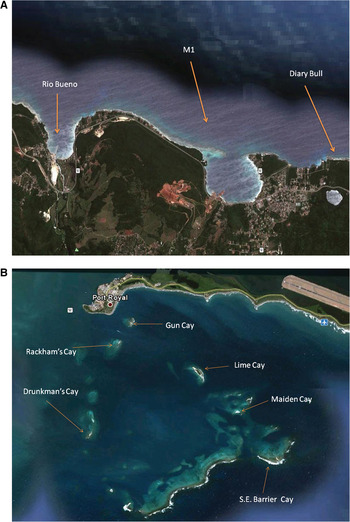
Radial growth rates of non-branching corals at three sites, Rio Bueno, M1 and Dairy Bull (Figure 1A) were calculated for each year from 2000–2008 as described previously (Crabbe et al., Reference Crabbe, Mendes and Warner2002).
Satellite images of the reef sites in Jamaica. (A) Satellite image of three coral reef study sites, Rio Bueno, M1 and Dairy Bull, around Discovery Bay on the north coast of Jamaica, from Google Earth. For Global Positioning System (GPS) coordinates see the text; (B) satellite image of the Cays near Port Royal south of Kingston Harbour, Jamaica, from Google Earth, showing six of the sites used in this study: Rackham's Cay, Gun Cay, Maiden Cay, Drunkman's Cay, south-eastern Barrier Cay, and Lime Cay. The wreck of the ‘Edina’ was south of South Cay. For GPS coordinates see the text.

This work was conducted at Discovery Bay during 15–31 July and 19–30 December 2000, 26 March–19 April 2002, 18 March–10 April 2003, 23 July–21 August 2004, 18 July–13 August 2005, 11 April–18 April 2006, 30 December 2006–6 January 2007 and 30 July–16 August 2008. Surveys were made at the same locations and the same sites each year. Water quality measurements at the sites have been reported previously (D'Elia et al., Reference D'Elia, Webb and Porter1981; Greenaway & Gordon-Smith, Reference Greenaway and Gordon-Smith2006).
Surface areas of non-branching corals selected haphazardly were measured at seven sites south of Port Royal, near Kingston Harbour (Mendes & Woodley, Reference Mendes and Woodley2002). Six of these were fringing reefs around the cays south of Port Royal: south-eastern Barrier Cay (N17°53.714′ W76°48.226′); Lime Cay (N17°54.948′ W76°49.134′); Gun Cay (N17°55.901′ W76°50.141′); Drunkenman's Cay (N17°54.128′ W76°50.736′); the face of the ship channel made in 2002 along the reef of Rackham's Cay (N17°55.571′ W76°50.307′); and Maiden Cay (N17°54.506′ W76°48.728′) (see Figure 1B). A seventh site was the wreck of the ship ‘Edina’, south of the barrier reef (N17°49.525′ W76°50.723′). Depth of samples at six of the sites was between 8 and 12 m and at the ‘Edina’ wreck it was between 22 and 28 m; growth rates were estimated according to depth (Huston, Reference Huston1985). This work was conducted in April 2010.
One or two-factor analysis of variance was used to compare coral data among sites; ± error values represent standard errors of the data. The year of an individual's recruitment was calculated from knowledge about the growth rate (e.g. 3.25 mm/yr for Porites astreoides and 3 mm/yr for Siderastrea siderea) (Hubbard & Scaturo, Reference Hubbard and Scaturo1985; Huston, Reference Huston1985; Carricart-Ganivet et al., Reference Carricart-Ganivet, Beltrán-Torrs, Merino and Ruiz-Zárate2000), taken from sites in the Caribbean at similar depths and visibility to those encountered here, the majority from Huston (Reference Huston1985). For example, a Porites astreiodes colony of measured elliptical surface area 51.8 cm2 was estimated to have recruited (and survived) 23 years ago.
Data on storms, hurricanes and bleaching events impacting Jamaica
Data on storm severity as it impacted the island was obtained from UNISYS (http://weather.unisys.com/hurricane/atlantic/) and the NOAA hurricane site (http://www.nhc.noaa.gov/pastall.shtml). Information on bleaching was obtained from the NOAA coral reef watch site (http://coralreefwatch.noaa.gov/satellite/current/sst_series_24reefs.html) and Creary et al. (Reference Creary, Alcolado, Coelho, Crabbe, Green, Geraldes, Hibbert, Jones, Jones-Smith, Manfrino, Manuel, McCoy, Weiner and Wilkinson2008).
RESULTS
Overall, 1560 individual coral specimens were measured on the north coast, equally distributed between the sites for species and numbers of colonies, including 482 Sidastrea siderea, 89 Sidastrea radians, 277 Diploria labyrinthiformis, 255 Porites astreoides, 25 Colpophyllia natans, 76 Diploria strigosa, 25 Favia fragum, 192 Meandrina meandrites, 71 Agaricia species, 25 Montastrea frankseii and 43 Montastrea cavernosa. On the south coast, 347 individual coral specimens were measured, including 169 Sidastrea siderea, 10 Diploria labyrinthiformis, 68 Porites astreoides, 1 Colpophyllia natans, 41 Diploria strigosa, 30 Meandrina meandrites, 2 Agaricia species and 26 Montastrea cavernosa.
For 1560 non-branching corals at sites along the north coast of Jamaica, from Rio Bueno to Pear Tree, there was a significant difference (t-test; P = 0.04) in estimated coral recruitment in years when there were no storms or hurricanes (38.8 ± 11.3 colonies) by comparison to years when storms and hurricanes impacted the area (16.2 ± 6.4 colonies). For 347 non-branching corals at sites in the Port Royal Cays on the south coast, there was a significant difference (t-test; P = 0.007) in estimated coral recruitment in years when there were no storms or hurricanes (4.7 ± 0.43 colonies) by comparison to years when storms and hurricanes impacted the area (1.5 ± 0.5 colonies).
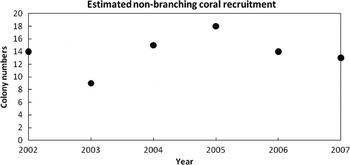
Figure 2 shows the estimated recruitment per year from 2002 to the present for the ship channel made in 2002 by Rackham's Cay. Recruitment on to the side of the ship channel at Rackham's Cay (~100 m from the path taken by large ships) was 14 ± 2.9 colonies for each year from 2002–2007. The majority of new corals recruited at this site were Siderastrea siderea; indeed that was a major species at all the sites studied on the Port Royal Cays. Interestingly, there was little evidence of branching corals at any of these Port Royal sites; only Drunkenman's Cay, Lime Cay and Gun Cay had small (<0.2 m diameter) Acropora cervicornis colonies easily accessible.
Estimated year of recruitment for non-branching coral colonies in the ship channel at Rackham's Cay (2002–2007). Coral surface areas were used to determine estimated year of colony recruitment.

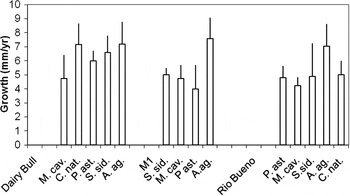
Radial growth rates of non-branching coral colonies are shown in Figure 3 for the three sites on the north coast M1, Dairy Bull and Rio Bueno.
Radial growth rates of non-branching corals at three sites, Rio Bueno, M1 and Dairy Bull, around Discovery Bay at 8.5 m depth (2000–2008). Values are ± 1 SE. Corals were: Montastrea cavernosa (M. cav); Colpophyllia natans (C. nat); Porites astreoides (P. ast); Sidastrea siderea (S. sid); Agaricia species (A. ag).

DISCUSSION
We identified hurricane and bleaching events which were reported to have had an impact in recent years on Jamaica's reefs, these included: major coral bleaching (2005); Hurricanes Charley and Ivan (2004); Hurricanes Emily and Dennis (2005); and Hurricane Dean (2007). In earlier decades, Hurricanes Allen (1980) and Gilbert (1988) were particularly damaging to the island.
On the north coast of Jamaica, a reduction in coral recruitment of non-branching corals was linked to the effects of storm damage, where increasing storm severity was negatively correlated with coral recruitment (Crabbe et al., Reference Crabbe, Mendes and Warner2002). Jamaican non-branching coral recruitment on the north coast took 1–2 years to return to pre-hurricane levels, a much more rapid recovery than seen on Tobago's reefs following the combined effects of Hurricane Ivan and coral bleaching (Mallela & Crabbe, Reference Mallela and Crabbe2009). This could be because there were significantly more degree heating weeks experienced by the reefs of Tobago than of north Jamaica (Eakin et al., Reference Eakin, Morgan, Heron, Smith, Liu, Alvarez-Filip, Baca, Bartels, Bastidas, Bouchon, Brandt, Bruckner, Bunkley-Williams, Cameron, Causey, Chiappone, Christensen, Crabbe, Day, de la Guardia, Díaz-Pulido, DiResta, Gil-Agudelo, Gilliam, Ginsburg, Gore, Guzman, Hendee, Hernández-Delgado, Husain, Jeffrey, Jones, Jordán-Dahlgren, Kaufman, Kline, Kramer, Lang, Lirman, Mallela, Manfrino, Maréchal, Marks, Mihaly, Miller, Mueller, Muller, Orozco Toro, Oxenford, Ponce-Taylor, Quinn, Ritchie, Rodríguez, Rodríguez Ramírez, Romano, Samhouri, Sánchez, Schmahl, Shank, Skirving, Steiner, Villamizar, Walsh, Walter, Weil, Williams, Woody Roberson and Yusuf2010). In Belize, in 1998 coral populations simultaneously experienced a severe coral bleaching event and Hurricane Mitch. A study of coral recruits (Mumby, Reference Mumby1999) found that whilst bleaching alone had no effect on recruitment density or community structure, the combined effects resulted in a 20% reduction of pre-disturbance levels. In Belize, only 1% of recruits showed even partial mortality during the bleaching event of 1998.
The growth rates in this study are similar to those reported by Huston (Reference Huston1985). Over 9 years (2001–2010) this study found no significant difference in coral radial growth rates between the three sites where growth rates were higher: Rio Bueno, M1 and Dairy Bull. They tended to be highest at Dairy Bull reef. Interestingly, from 2001–2004, radial growth rates of Porites astreoides and Sidastrea siderea were significantly (P < 0.02) higher at Dairy Bull than at either M1 or Rio Bueno (Crabbe, Reference Crabbe2008). This could be because of extensive macroaglal growth inhibiting settlement and growth at M1 and Rio Bueno during 2001–2004 (Crabbe, Reference Crabbe2008). Macroalgal cover at these sites was reduced in later years owing to increasing numbers of Diadema antillarum urchins (see e.g. Crabbe, Reference Crabbe2009).
Corals that have been undermined can lose their ability to adapt and regenerate, whether in the wild or in aquaria (Adger et al., Reference Adger, Hughes, Folke, Carpenter and Rockstrom2005). Resilience may be defined as the ability of the system to recover from disturbance and change, while maintaining its function (Carpenter et al., Reference Carpenter, Walker, Anderies and Abel2001; Grimsditch & Salm, Reference Grimsditch and Salm2006); for example a coral reef's ability to recover from a bleaching event. Resilience is a multi-faceted concept (Nyström et al., Reference Nyström, Graham, Lokrantz and Norström2008), and factors that can improve coral reef resilience to environmental stress include good physical structure, good species and functional diversity, good connectivity to larval sources, appropriate substrates for larval settlement and protection from other anthropogenic impacts.
In addition, some coral communities may adapt to chronic stressors, for example sedimentation, over long periods of time (Flood et al., Reference Flood, Pitt and Smith2005). The Kingston Harbour area has been impacted for many decades (Wade et al., Reference Wade, Antonio and Mahon1972; Maxam & Webber, Reference Maxam and Webber2009) and there have been efforts at mitigation, particularly in association with the ship channel, and where the artificial sides are rugose (Gayle et al., Reference Gayle, Wilson-Kelly and Green2005). A combination of these factors, possibly in combination with the corals' ability to acquire resilient coral symbionts (Little et al., Reference Little, van Oppen and Willis2004; Stat et al., Reference Stat, Loh, Hoegh-Guldberg and Carter2008; Cofforth et al., Reference Cofforth, Poland, Petrou, Brazeau and Holmberg2010), may have resulted in the resilient recruitment noted in the ship channel at Rackham's Cay.
This paper presents an overview on the impacts of tropical storms and stressors on coral reefs in the Caribbean. This work suggests that aquarists, as well as marine park managers, should be vigilant to assist coral viability both in aquaria and on coral reefs, and these results are supported by many other studies (e.g. Forsman et al., Reference Forsman, Rinkevich and Hunter2006; Keller et al., Reference Keller, Gleason, McLeod, Woodley, Airamé, Causey, Friedlander, Grober-Dunsmore, Johnson, Miller and Steneck2009; Crabbe et al., Reference Crabbe, Martinez, Garcia, Chub, Castro and Guy2010; Mumby & Harborne, Reference Mumby and Harborne2010).
ACKNOWLEDGEMENTS
I thank Mr Anthony Downes, Mr Peter Gayle, and the staff of the Discovery Bay Marine Laboratory for their invaluable help and assistance, and many volunteers for their considerable help underwater during this project. I am indebted to Mr Camilo Trench and colleagues at Port Royal Marine Station, Jamaica for their invaluable assistance in data collection, and staff of the University of the West Indies, Mona campus, for their logistical help. I would also like to thank Ms Marcia Creary, University of the West Indies, for helpful conversations, and the anonymous referees for their helpful comments. The Royal Society and the Earthwatch Institute funded parts of this study.