When Charles Chesnutt revised his short story “The Goophered Grapevine” for the 1899 collection The Conjure Woman, he added new details about the North Carolina landscape.Footnote 1 In the earlier version, published in The Atlantic in 1887, the Ohio carpetbaggers John and Annie simply arrive at the gateposts of the old McAdoo plantation and ride up the lane “to the open space where a dwelling-house had once stood” (“Goophered Grapevine” [1887]). In the updated story, Chesnutt describes the couple's journey to the plantation past “abandoned fields grown up in scrub-oak and short-leaved pine” and through “solemn aisles of the virgin forest, where the tall pines, well-nigh meeting over the narrow road, shut out the sun” (“Goophered Grapevine” [1899] 5). These additions might seem minor, but their importance was anticipated a few paragraphs earlier when John observed that the nearby town of Patesville “had a considerable trade in cotton and naval stores” (4). These naval stores link the “solemn aisles” of longleaf pine forests to the production of turpentine, North Carolina's most extractive and globally significant cash crop.
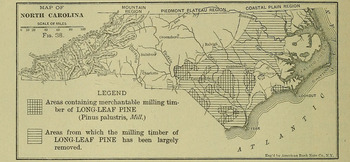
Turpentine is the boiled and distilled sap of the longleaf pine, a species of tree native to the southern seaboard of the United States. Used for everything from naval stores to nasal ointments, pine sap was a regional resource, produced largely by enslaved laborers, that became a global commodity in the eighteenth and nineteenth centuries. Yet by the time that Chesnutt began publishing his short stories in the 1880s, the turpentine industry was on the verge of collapse in North Carolina. Decades of exploitative practices had decimated the old-growth forests that had once covered the eastern third of the state, including the sand hill region near Fayetteville, where Chesnutt's family moved when he was nine years old and where he set most of his fiction (fig. 1). Having extracted all they could from the state, white capitalists moved south into a pine belt that stretched from South Carolina to Texas.Footnote 2 As Jeffrey Myers has demonstrated, Chesnutt was sensitive to the logging of southern forests. What is also true, however, is that logging was often only the terminal stage of a much longer history of the exploitation of the pine forest for turpentine. Across his career, Chesnutt shows how the exploitation of the forest was coextensive with the plantation economy. In doing so, he expands our conceptual understanding of the political ecology of slavery and its aftermath, exposing as a fiction the notion that there were any landscapes in the South left untouched by extractive industry.
A map showing the economic distribution of longleaf pine. From Gifford Pinchot and W. W. Ashe's Timber Trees and Forests of North Carolina, M. I. Winston and J. C. Stewart, 1897, p. 132.

The story of the agricultural plantation, and cotton in particular, has been so prominent in depictions of the South that it has been hard to recognize the ways in which capitalist extraction also affected other southern landscapes. As scholars working at the intersection of ecocriticism and critical race studies have shown, depictions of plantations shaped ideas about racialized labor, most notably through a pastoral mode that served the planter class by characterizing the work of enslaved people as idyllic (M. Bennett; Finseth; Outka; Wagner-McCoy). Critics continue to emphasize the sweeping importance of the slave plantation and its successors to regimes of power as well as to the resistance and agency of the enslaved and their descendants.Footnote 3 By illustrating the effect of turpentine in addition to more familiar and visible commodities, Chesnutt invites us to consider nonagricultural spaces in relation to the plantation model. His depiction of the turpentine forests disrupts the ideological binary that sets the plantation against the wilderness. Forests, he shows, could be just as exploitative as the cultivated plantation, both before and after emancipation.
In doing so, Chesnutt calls attention to extractive southern environments invisible to many of his contemporaries. In noting that Patesville was a hub for the naval stores industry, John in the revised version of “The Goophered Grapevine” begins to recognize how little he knows about the long history of southern trade in pine commodities. He reflects that “this business activity was not immediately apparent to my unaccustomed eyes” ([1899] 4). John is a proxy for northern readers, and in accustoming his readers’ eyes to seeing this business, Chesnutt reveals the larger fictions that were mobilized to keep the horrific realities of turpentine production concealed. During and after Reconstruction the southern woods were marketed to white audiences as restorative, bucolic spaces. To these audiences, what distinguished “virgin” forests from fields of cotton, tobacco, or rice was that forests were not cultivated by human labor, nor could wooded areas be subject to the same kinds of spatial discipline.Footnote 4 Chesnutt's stories illustrate how depictions of forests as recuperative spaces could make them appear separate from the plantation economy's brutal regimes. This illusory separation might explain why, despite the significance of turpentine woods to the southern economy, the labor involved in their cultivation has been relatively ignored in the historiography of the antebellum South, as the historian Jeremy Zallen has noted.
To fully understand the effect of slavery and its afterlives on environmental thought, we must recognize the role of these forests. Scholars like Lawrence Buell and Jedidiah Purdy have emphasized how our environmental imaginations govern the way we see and value the world around us. Reading turpentine “orchards” (as they were known) through Chesnutt's fiction shows us how our contemporary environmental imagination has been shaped by narratives of a restorative forest isolated from the plantation, narratives that provided cover for the violent political economy of the turpentine industry. The relative invisibility of these forest spaces even today is a legacy of the way white supremacy has structured mainstream environmental thought in the United States. Chesnutt offered an ecocritical critique that foregrounded race at a moment—the late nineteenth century—when the most prominent form of discourse about forests was that of conservation, a movement centered on protecting and clearing spaces for white recreation.Footnote 5 His work helps underscore how, as Sandy Alexandre has shown, white violence marked “ostensibly neutral” outdoor spaces as white property (7).
In what follows I first provide an overview of the political ecology of the North Carolina pine woods and then trace how the idea of the healthful southern pine forest arose during the postbellum period. Early in his career, Chesnutt gave the lie to the myth of the bucolic forest, depicting turpentine as a commodity whose economic value drove southern infrastructural modernization. His stories “Po’ Sandy” (1888) and “Uncle Peter's House” (1885) hauntingly illustrate how the brutality against men and trees connects the field and the forest as well as the antebellum and postbellum periods. After the war, the global demand for turpentine ensured the continued wealth of white landowners, and the next section of this essay turns to the sources of white affluence described in Mandy Oxendine (ca. 1896) and The House behind the Cedars (1900). Chesnutt showed how white capital depended on resource extraction at a moment when readers were growing increasingly anxious about forest destruction. The essay's final section shows how Chesnutt taps into these anxieties most acutely in his last novel, The Colonel's Dream (1905). Taking a dim view of a conservationist mentality that sees the forest only for its trees, Chesnutt exposes how white supremacy governed not only the capitalist exploitation of the forest but also the conservationist response. In Chesnutt's fiction, the collapse of the industry, like the end of slavery, signals not reparation but grim continuity under the guise of repair.
Fever Pitch
The thinly fictionalized region of North Carolina where most of Chesnutt's stories take place was known for its pine woods, and even as the turpentine industry collapsed, these woods became a popular site for health tourism.Footnote 6 To understand what Chesnutt's pine forests meant to his contemporaries, we must start by heeding the call of the environmental historian Daegan Miller to adopt a “sylvan literacy” and recover the lost cultural valences of trees. In particular, the North Carolina longleaf was hailed for its useful sap and for its perceived role in producing a healthy climate. Chesnutt's stories address this duality, showing how the capitalists of the so-called new South heralded the health benefits of pine woods while carrying on the resource extraction and labor exploitation that governed antebellum life.
The pine-based industry in the southern colonies developed in the early eighteenth century when the British Parliament encouraged the production of naval stores. The pitch, tar, turpentine, and rosin that caulked ships and prevented rot in ropes helped materially facilitate Britain's sea power by making ships watertight. By the 1760s North Carolina had become the center of production because of both the acreage of the longleaf pine forests that grew in its sandy soil and the relative poverty of that soil for growing other cash crops compared to the soil in neighboring states (Outland 31, 35). As Frederick Law Olmsted noted in his A Journey in the Seaboard Slave States, “In the region where the true turpentine-trees grow . . . there is no soil suitable for growing cotton; and it is only in the swampy parts, or on the borders of streams flowing through it, that there is any attempt at agriculture. The farmer, in the forest, makes nothing for sale but turpentine” (338). Edmund Ruffin, the infamous Virginia senator, slaveholder, and agriculturalist, likewise noted that in North Carolina, “so great [are] the profits of labor, and even of the land, in the turpentine business . . . that capital thus invested has generally yielded more profit than agriculture on the richest land” (81). By the middle of the nineteenth century, pine products were one of the state's largest cash crops. As a result, Olmsted noted, North Carolina planters “oftener see their profit in employing [enslaved workers] in turpentine orchards than in the cotton-fields” (338).
The rising number of applications for pine products also made the trees increasingly profitable. By the nineteenth century the uses of pitch, pine, tar, turpentine, and rosin had diversified considerably. Rosin was used to make paper and soap, and turpentine was used in paints, varnishes, and rubber goods. By 1896 the rubber industry required 3.5 million gallons of turpentine a year (Vance 474). And until kerosene became a cheaper and safer replacement, turpentine was combined with alcohol to make camphine, an illuminant sometimes referred to as a “burning spirit.” Despite its volatility and the risk of explosion, camphine was a popular alternative to whale oil, particularly among poor urbanites in the North. In fact, camphine was the most widely used lamp fuel in antebellum America (Outland 39). Nineteenth-century periodicals also noted the medicinal applications of spirits of turpentine, which was thought to relieve many different maladies, such as cuts (W. L. H.), bowel complaints (Flint 10), mumps, and intestinal worms (Kennedy). Heralding it as a purported cure-all, a number of articles recommended that everyone have a bottle on hand at all times for uses as wide ranging as rheumatism to floor polish (“Uses”).
If extracts of turpentine were thought to remedy whatever ailed, the bottled substance was nonetheless no substitute for the curative effects of spending time in the pine woods. By the second half of the nineteenth century, both the medical establishment and the popular press were heralding pine forests for the health benefits they offered white tourists. The supposedly salubrious qualities of pine forests were part of what Conevery Bolton Valencius has called a “geography of health,” a way of understanding the permeability of environment and self in an era when “injury and illness were the constant accompaniments of daily life” (3, 5). After the Civil War, many middle-class northerners began to view southern environments as attractive vacation destinations in the belief that they were good for the health (Silber 68). When new theories of germs shifted understandings of disease, physical spaces like pine forests were lauded for their antimicrobial qualities in addition to their healthful atmosphere. An 1887 article in Scientific American called pine woods “as sanitary as they are pleasing and beautiful” and compared them to quinine, a powerful antimalarial drug (“Pine Woods”).
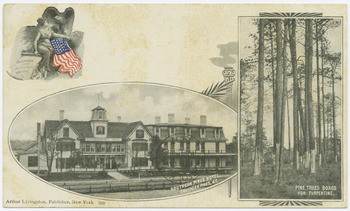
Entrepreneurs were quick to capitalize on such health claims by turning North Carolina into a destination for health tourism (Ayers 61). For instance, an 1892 article from the North Carolina Medical Journal entitled “Our Pine Forests as Factors of Health” asserted, “The fact that piney regions of country are healthy is . . . established beyond cavil or dispute” (Satchwell 393). Today's Pinehurst golf resort opened in 1895 on land that the northern philanthropist James Walker Tufts bought after the turpentine and lumber industries had clear-cut the woods. An advertisement for the resort promoted the healthy “ozone” produced by the pine trees anyway (Advertisement for Pinehurst). Another advertisement for a resort called “Pinebluff” in a 1901 edition of The Sanitarian quotes a “Committee of Medical Experts” who visited the South in 1894 and praised the “long-leaf pine-woods region” for “the invigorating quality of its atmosphere” (Advertisement for Pinebluff). And an early-twentieth-century postcard showcasing the Southern Pines Hotel visually advertised the relation between the hotel and the surrounding trees, putting them side by side under a bald eagle, an American flag, and Lady Liberty holding a scroll with the solicitous phrase “greetings from picturesque America” (fig. 2).Footnote 7 The trees in the postcard, notably, have been “boxed” for turpentine, an act whose violence Chesnutt evokes in his stories.
Postcard in the Durwood Barbour Collection of North Carolina Postcards (P077), North Carolina Collection Photographic Archives, Wilson Library, University of North Carolina, Chapel Hill.

Several of Chesnutt's stories begin with the migration of white characters to North Carolina to improve their health. In the 1887 version of “The Goophered Grapevine,” which Chesnutt later selected as the first story in The Conjure Woman, John and Annie move from northern Ohio, where Chesnutt was born and where he spent much of his adult life. The couple's family doctor suggests Annie's delicate health will be improved with “a change of climate,” and John is assured by a cousin involved in the central North Carolina turpentine business that “climate and soil were all that could be asked for, and land could be bought for a mere song.” More pointedly, in the opening pages of The Colonel's Dream, the white protagonist Colonel French collapses in New York City and his doctor sends him south to recover. “The doctor has prescribed the pine woods,” French tells a concerned friend (12). The North Carolina pine woods work their restorative magic for these white characters—both Annie and French appear to improve in their new environment.
Of course, as Chesnutt knew, nothing could be further from the truth for the laborers who worked the pine woods beginning in the eighteenth century. Across his fiction Chesnutt uses his depictions of turpentine production to challenge this restorative framing. Nowhere is this more apparent than in the harrowing short story “Po’ Sandy.” Critics have long addressed how the story links the sylvan violence of lumber production with the violence committed against enslaved people under the plantation regime. Yet Chesnutt is making a particular point about the cruel logic and legacy of turpentine production.
Felled pine trees are legion in the frame narrative of “Po’ Sandy” to the point of being inconspicuous. The story starts, in fact, with a description of a pine-frame schoolhouse “fronting on the Lumberton plank-road.” Plank roads were roads built out of wooden boards to allow transport across swampy areas, a crucial technology for turpentine production in remote rural areas. Annie decides she wants to build a kitchen detached from the main house “after the usual Southern fashion,” and John decides to save money by reusing much of the lumber from an old schoolhouse on the property (14). When he calculates that the project will nonetheless require more wood, he asks Julius, the freedman living on the McAdoo plantation, to drive him and Annie to the nearby sawmill. They travel by “following the plank-road for about a mile” before turning onto a “half-rotted corduroy road which traversed the swamp” (15). In late-nineteenth-century North Carolina, corduroy roads, made of logs, were often used by turpentine companies to penetrate deeper and deeper into the pine forests, and while Myers has shown that this is a journey into “uncultivated country” (12), the wooden infrastructure in Chesnutt's story reminds us that uncultivated does not mean undeveloped.
As they wait for the foreman of the sawmill to return, the mill workers place a log into the machinery. Julius reacts viscerally, explaining that it reminds him of Po’ Sandy, an enslaved man on the neighboring plantation who had been such a valuable worker that his master's children each wanted Sandy as their “weddin’ present” (Chesnutt, “Po’ Sandy” 16). When their father instead promises to loan Sandy out to each of them in turn, Sandy's wife Tenie, a conjure woman, offers to turn him into some element of the natural world so that he can remain with her. He rejects being turned into a rabbit, a mockingbird, or a wolf, telling her that he would like to “stay in one place,” and they eventually settle on turning Sandy into a pine tree near the swamp (17).
As a pine, Sandy can literally put down roots. Joshua Bennett has observed in this choice a “quotidian” form of resistance, contrasting “sharply with the romance of the heroic, fugitive slave” (qtd. in Bennett et al. 3). In staying put, Sandy defies the slave catchers who assume he has run away. Of course, in the landscape of a robust antebellum turpentine industry that kills pine trees, Sandy's choice to become a tree hauntingly underscores the difficulty of escaping exploitation.
The logic of turpentine production in the antebellum forest worked like that of other cash crops: extract as much from the trees and the laborers as possible without causing unprofitable losses (Outland 85). And while a number of free blacks and poor whites worked in the orchards, many of the laborers were enslaved men who had been hired out for the season (“Making Turpentine”). These men often worked in isolation, responsible for a great number of trees per day, and failure to meet a quota often resulted in lashings. Remoteness meant that few witnessed the abusive conditions. Long hours, dangerous and exhausting work, and inadequate food, water, and housing were just a few of the many hardships. Injuries from axes were common, and isolation made it hard to seek help when accidents occurred.
As a tree, Sandy is vulnerable both to animals—a woodpecker begins to peck at the tree—and to human beings, as when his former master sends another enslaved man to chop a turpentine box. Bleeding trees for sap was incredibly injurious, for whereas cultivators of sugar maples drilled a small hole into the tree to collect the sap, the gum of pine trees was collected by cutting large cavities, or “boxes,” into the base of the trees and then chipping away the bark above the boxes to cause the gum to flow. This process was called “hacking,” and the goal was to cut deeply enough to get the gum running but not so deeply that the tree dies. The boxes were large wounds that allowed pests and disease to bypass the tree's natural defense systems, and most turpentine orchards could be tapped for less than a decade before the trees succumbed. By the turn of the twentieth century new methods of extraction were being sought because, as an article in Scientific American put it, “every one knows that trees from which turpentine has been extracted by the old method—‘boxed’ timber it is called—soon die from the wounds inflicted on them” (“Turpentine Industry”). As Julius reports, Sandy was tortured in this manner: “De man chop a box in dish yer tree, en hack’ de bark up two er th'ee feet, fer ter let de tuppentime run.” The next time Sandy is turned back into a man, Julius notes, he had a big scar on his left leg (Chesnutt, “Po’ Sandy” 18).
Worse is to follow, for when Tenie is sent away to tend to a sick mistress on another plantation, Sandy is chopped down for lumber. When the enslaved workers take the tree to the sawmill, the pine strains against the saw. Tenie returns too late and rushes to the sawed lumber, but there is nothing she can do. This lumber, Julius concludes, was used to build the schoolhouse on the land that John now owns, knowledge that dissuades Annie from using it for her new kitchen.
In following Sandy as a tree from the edge of the swamp to the sawmill, Julius's story connects the development of the lumber industry to an older pattern of forest extraction. Milling dying trees for lumber allowed owners to compound their profits, a process Chesnutt aligns with the exploitation of enslaved labor. Sandy suffers as a tree not only when he is chopped and milled but also when an enslaved worker hacks his bark to make the sap flow. Here and in his later novels, Chesnutt roots the torturous logic of a destructive industry in the antebellum slave economy.
In his first short story, published three years before “Po’ Sandy,” Chesnutt likewise emphasized this continuity. “Uncle Peter's House” shows how the woods remained the basis for wealth in post-Reconstruction North Carolina. The story follows Peter, a freedman who wants to build an exact replica of his former master's house. Peter's attempts are serially impeded by different forms of discrimination, including whites’ refusal to sell him property, bad loans, and violent intimidation by members of the Ku Klux Klan, who burn the frame down. Peter rebuilds, but he slips while working on the house and dies of his injuries, leaving the house unfinished. The story rehearses in a tragic mode the failures of Reconstruction, and as William Gleason highlights, it addresses the relation between architecture and power.
But because Peter builds the house out of local pine, the story also illustrates the way in which the market for pine products continues to drive the local economy after Reconstruction. Eric Sundquist has called the story a “parable of building property in the face of great post-Reconstruction odds” (376). Reading it in material terms, we quickly see how the local trees are translated into wealth. Whereas Peter grew up on a plantation where “the stern exigencies of plantation life sent him out into the fields with the other hands to pick up cotton and drop corn,” the land he eventually purchases is pine forest that has already been tapped for turpentine (Chesnutt, “Uncle Peter's House”). The only person willing to sell to Peter is a northerner who “bought a large tract of land to work the turpentine woods, and had used it up for that purpose.” By the time Peter purchases it, “the tall pines had been stripped of their bark as far up as the turpentine ‘hacks’ would reach.”
In transforming exhausted “turpentine woods” into a clearing with a plantation house surrounded by “a grove of young elms” (harking back to the “patriarchal elms” that surrounded his former master's house), Peter inscribes a familiar plantation structure onto a landscape whose previous geography of exploitation had been far less visible. Put another way, Peter converts the less recognizable extractive geography of the pine woods into the kind of “conspicuously hierarchical” agricultural landscape that would have been immediately recognizable to Chesnutt's readers (Gleason 39). By making a pine plantation into an agricultural one, he signals contiguity between these two spaces. Beyond underscoring the difficulties that Black people faced accruing property in the Jim Crow era, the story highlights the woods as a landscape of continued extraction.
Despite the fact that the land has been used up, Peter is still able to generate both building supplies and money for additional lumber from the pines. In fact, pines remain the most important material resource that enables Peter to reorganize the landscape. After he pays off the mortgage, Peter sells loads of “split pine or black-jack saplings” (Chesnutt, “Uncle Peter's House”). The lumber for the house is a mix of his trees and wood that he purchases: “A few big trees were cut down and hewn into sills for the foundation of the proposed house, and a few others were hauled to the nearest saw mill and sawed into beams, but most of the lumber was bought outright.” Depicting the trade of pine saplings for store-bought wood, Chesnutt emphasizes that the marketplace is central to Peter's project. Yet the lumber Peter buys is still local. The narrator notes that in contrast to the “soft” northern white pine, which would have been ruined by exposure to the elements, the “resinous” Carolina pine would only be strengthened by sun and rain. These qualities make it particularly marketable.
Peter falls while building the house, and after his accident, as he lies dying in the temporary cabin he has built, his family and friends place his bed so that he has a view of the unfinished construction. While Peter gazes toward the house, whose “unpainted pine rafters were gild'd by the glory of the setting sun,” the narrator describes the broader scene: “Up the white strip of sandy road that led to the town toiled a slow ox cart, with its load of turpentine barrels, and beyond this the dusky pines waved in the gentle wind, and seemed to sigh in sympathy with the sufferer, while from the deep recesses of the forest came the faint sound of chopping, and the melancholy croak of frogs.” The passage relates Peter in his last moments to the unabated economic activity all around him, connecting the turpentine barrels headed to market with the faint sound of chopping. This continuous extraction signals the continuous business of making money out of exploiting land and labor, the relentless operations of white supremacy exerting control over southern landscapes, bodies, and personal histories.
The Tar Heel State
If “Uncle Peter's House” and “Po’ Sandy” render visible the incessant violence of commercial activity in forest spaces, Chesnutt's later novels show how local environmental devastation sustains a global market. In both his first novel, Mandy Oxendine, unpublished during his lifetime, and his first published novel, The House behind the Cedars, Chesnutt displays his environmental critique of white supremacist ideology. Chesnutt is often read as a regional writer, but his writings on turpentine illustrate how global commodity demands shaped regional economies and, by extension, ecologies.Footnote 8
Mandy Oxendine opens with a whistle shriek as a train enters the depot in Rosinville, North Carolina. The fictional town is aptly named, because the area beyond the train platform contains “long rows of yellow rosin-barrels, encrusted with amber exudations, glistening in the ardent sunlight” and waiting for transport (3). The train brings Tom Lowrey to the area of North Carolina where Chesnutt sets The Conjure Woman. Key features of its geography, like the Lumberton plank road, are the same in the novel and the collection. The novel's plot follows Lowrey as he hopes to reconnect with his old sweetheart, Mandy Oxendine, whom he left in Sampson County to pursue an education in the North. In the intervening years Mandy, who has light skin, has moved to the Rosinville area and chosen to pass as a white woman. Lowrey seeks a post as the new teacher for the Sandy Run Colored School to be near her again.Footnote 9
Lowrey is picked up from the station by Deacon Pate, and as they move into sand-hill country the source of the town's namesake rosin becomes clear:
Pines, pines, pines covered the low, rolling hills and lined the roadside—long-leaved pines, scarred with turpentine boxes; short-leaved pines of later growth, their degenerate successors, fit for nothing but a poor quality of cord-wood. A scrubby blackjack undergrowth filled the space between the pines, except where it had been cleared away for easier access to the turpentine boxes. The air was rich and heavy with the odor of the pines, and murmurous with their gentle swaying, and at times the cart moved noiselessly over a carpet of brown spikelets and fallen cones.(6)
The bucolic view quickly turns into a violated landscape. The ubiquitous “pines, pines, pines” preside over what the narrator views as a scene of degenerate ecological succession. The undergrowth has been cleared for better access to the turpentine boxes. The longleaf pines, where still standing, are scarred over with boxes, and the shortleaf pines that replace them are “fit for nothing but a poor quality of cord-wood.” Kelly Clasen reads the slashed trees as Chesnutt's warning about ecological destruction, noting that this would have had particular currency in the late nineteenth century, when the idea of limited natural resources was beginning to spread. But in the light of the way that Chesnutt invites readers to think about the parallel lives of Black workers and pine trees in “Po’ Sandy,” the scene also is scarred by intergenerational racial trauma in a world impoverished by industry.
As Lowrey proceeds on his journey, he passes clearings where the pines are being turned into an array of products:
In one hollow, where a creek crossed the road, they passed a turpentine still, and near it a cooper shop, where barrels were made to receive the product of the still. And a little further along they saw between the trees a conical earth-covered mound, the thin column of smoke rising from the top of which revealed a burning tar-kiln. They passed several small cart-loads of pine wood, drawn by mules or stunted oxen, on the way to market. The unenlightened observer would think that so useful a friend as the pine would be treated kindly. But the natives send their women and children out into the woods to cut down the saplings for fire wood.(6)
Like John, who registers the turpentine business through his “unaccustomed eyes,” the narrator here assumes an ethnographic lens, illustrating this activity for the “unenlightened observer.” In a tone of slight rebuke, the narrator describes subsistence living. But the narrator's position is undercut by the correlation of “useful” with “kindly” treatment. The pine's usefulness guarantees that it will be tapped and cut, not treated kindly. Pine trees become turpentine and the barrels that hold it, they become tar and the wood that burns it, and they become cartloads of pine wood. This is an industry with no future, as saplings disappear into conflagration below the kilns.Footnote 10
They also disappear into the schoolhouse where Lowrey teaches—a “rude log structure” made with “unhewn logs” and “unplaned green lumber”—and the church where members of the community gather for religious meetings (13). Since the structure was too small for the evening crowds, the preacher and volunteers had made a “rude canopy of pine boughs” and benches made from “rough outside pieces of pine logs sawed up in the neighboring sawmill” as well as additional seating in the form of pine logs (47). If the use of local materials for such structures is unsurprising, Chesnutt's description nonetheless underscores that the pines were not simply a commodity for export but the material basis for life in central North Carolina.
After an opening sequence saturated with turpentine production, the explicit references to pine give way to a symbolic forest. The real forest remains the setting for the unfolding drama, but as Clasen notes, there appears to be little continuity between the environmental ethos of these early scenes and the later plot, as Tom begins an effort to woo Mandy back (Clasen 63). Mandy is already being courted by a white man and initially spurns Tom, accusing him of having left her “in the woods” among “tu'pentine trees” and the turpentine workers (Chesnutt, Mandy Oxendine 22). Using a violent racial slur for those workers, Mandy's description suggests how the woods are racialized through commodity production.
Like the plot of Mandy Oxendine, the plot of The House behind the Cedars examines racial passing after the Civil War. And as he does in his earlier fiction, Chesnutt begins House against the backdrop of a changing turpentine industry, showing the centrality of the pine market to the region's political economy after the war and the regional effects of the industry's migration southward. The novel begins with John Walden's return from South Carolina to his hometown of Patesville, North Carolina. The light-skinned son of a free Black woman and a white man, John had left Patesville a decade earlier and decided to pass as white. Upon arriving home in Patesville, John, a lawyer, is mistaken by a clerk for a wealthy industrialist, “one of the South Ca'lina bigbugs . . . probably in cotton, or turpentine” (2). This identification signals that the industry has already begun to shift south and that the structures of wealth and power remained tied to commodity capitalism.
In Patesville, John persuades his sister Rena to join him in South Carolina as a white woman, commencing a plot that ends with her death. On their journey back to South Carolina, the siblings encounter local turpentine headed for a global market. They first travel to Wilmington by a river steamer that is loaded with turpentine products. The journey takes a night and a day, and “several times before Rena fell asleep that night, the steamer would tie up at a landing, and by the light of huge pine torches she watched the boat hands send the yellow turpentine barrels down the steep bank in a long string, or pass cord-wood on board from hand to hand” (41–42). When they arrive in Wilmington, Rena observes that in the business portion of the town, “most of the trade seemed to be in cotton and naval stores and products of the sea. The wharves were piled high with cotton bales, and there were acres of barrels of resin and pitch and tar and spirits of turpentine,” waiting to be stowed on ships and sent elsewhere (43). These descriptions of barrels waiting for shipment invite readers to draw a connection between regional production and distant consumption, including, perhaps, their own.
Trade in pine products provides the economic backbone for South Carolina's political elite. John takes Rena back to his new home in the town of Clarence, where pine products play a central role in the local economy, especially in the rituals of the wealthy. John and Rena attend a tournament put on by the Clarence Social Club that draws on chivalric traditions adapted “to a different age and civilization,” just one way in which the white elites in Clarence ritualize their identity through performance (46). From the grandstand John wryly notes that this entails the substitution of local materials for traditional ones. “For instance,” he tells another spectator, “when we build a Greek portico, having no Pentelic marble near at hand, we use a pine-tree, one of nature's columns, which Grecian art at its best could only copy and idealize. . . . For an iron-headed lance we use a wooden substitute . . . while our trusty blades hew their way through wooden blocks instead of through flesh and blood” (47). John emphasizes how the pageantry of the tournament is adapted to reflect the local environment, whose pine materials are also the basis for the South's would-be chivalric culture. But it is pine here, not cotton, that is essential to this “renaissance of chivalry” (47). As John Levi Barnard has illustrated, Chesnutt used the classical tradition as a form of resistance, and the character John here clearly ironizes how the material and cultural basis for the manufacture of white supremacy are extracted from the local pines.Footnote 11 Chesnutt uses Rena's entrance into white society in Clarence to emphasize the point: when Rena drops her handkerchief, a white man catches it on the tip of his wooden lance, commencing a romance that is doomed by his racial prejudice.
Mandy Oxendine and The House behind the Cedars both illustrate how the commodity value of the local pine sustained white supremacy after the war. But Mandy Oxendine also shows how turpentine extraction was not a sustainable industry and was in fact already collapsing in North Carolina. This fact triggered anxieties not only among local capitalists but also among policymakers who saw in regional collapse a threat to national prosperity. As the effects of deforestation in North Carolina and elsewhere became increasingly palpable, the federal government responded with efforts to more intensively manage continental forests for perpetual harvest. Chesnutt's third novel, The Colonel's Dream, exposes conservation as an environmental philosophy invested in sustaining forests for the benefit of white leisure and profit.
Forest Wastelands
By the time that Chesnutt published The Colonel's Dream, the global marketplace had depleted North Carolina's forests and the state's turpentine industry had all but folded and moved south. Chesnutt mediates this collapse through the novel's protagonist, Colonel French, an aristocratic North Carolinian who proudly fought for the Confederacy and then moved to New York City to become a businessman. In the opening pages French, a widower and single father, becomes ill from overwork and moves back to his ancestral hometown of Clarendon, ordered by his doctor to recuperate among the pine woods. While there he decides to revitalize the economy by buying a mill and managing it on paternalistic principles, paying its Black workers a dignified wage. Yet French's anxieties about the wasted landscape around Clarendon connect nostalgia for a plantation pastoral with late-nineteenth-century fears about environmental devastation. That is, French is the model of a late-nineteenth-century capitalist who decries environmental harm without connecting it to human exploitation.
In this light the colonel is a figure who might stand more broadly for the rise of the conservation movement, illustrating the continuity of the southern plantation pastoral and national conservation efforts aimed at preserving the health of white men. Leaders in conservation were also active proponents of social programming and population management, including eugenics (Haraway). White capitalists who believed that the wilderness was essential to the preservation of their own virility and power drove Progressive Era conservationist efforts, which in turn relied on the erasure of the earlier territorial claims made by displaced communities. These efforts increased after the supposed closing of the American frontier, rendering anxieties about deforestation more acute.Footnote 12
French's disapproval of turpentine has no connection to his concern about postemancipation labor conditions. While French desires to enact reform through his utopian mill project, his profound worry about environmental devastation remains fundamentally aesthetic. Shortly after arriving back in town, French reencounters a freedman, Peter, who had been his family's slave during French's childhood. Since emancipation, Peter has lived a precarious existence in two different extractive industries. Remaining by his former master's side until his death, Peter
had worked for a railroad contractor, until exposure and overwork had laid him up with a fever. After his recovery, he had been employed for some years at cutting turpentine boxes in the pine woods, following the trail of the industry southward, until one day his axe had slipped and wounded him severely. When his wound was healed, he was told that he was too old and awkward for the turpentine, and that they needed younger and more active men. (Chesnutt, Colonel's Dream 28)
Peter's history speaks to the dangers of both railroad and turpentine work: exposure and overwork make him sick and an accident leaves him severely wounded. As David Hollingshead has recently argued, through Peter's story Chesnutt illustrates the racialized limits of public understanding about dangerous work.Footnote 13 And yet Peter's precarity barely registers to the paternalistic Colonel French. In fact, as the narrator's free indirect discourse indicates, while French listens, he uses the broad strokes of Peter's story to assess the merits of emancipation. As “the old man's talk rambled on, like a sluggish stream, . . . the colonel's more active mind busied itself with the problem suggested by this unforeseen meeting.” The “problem” as the colonel conceives it, is the question he poses himself: “What good had freedom done for Peter?” Quickly rationalizing that freedom was—almost certainly—better than slavery, French concludes that “Peter had returned home poor and broken, not because he had been free, but because nature first, and society next, in distributing their gifts, had been niggardly with old Peter” (29). French attributes Peter's circumstances to nature and chance, not to systematic racism.
French is anxious about the turpentine industry, but he is troubled mainly by how it scars the landscape. Upon returning to Clarendon, the colonel discovers a countryside wholly transformed by turpentine:
When the colonel had travelled that road in his boyhood, great forests of primeval pine had stretched for miles on either hand, broken at intervals by thriving plantations. Now all was changed. The tall and stately growth of the long-leaf pine had well nigh disappeared; fifteen years before, the turpentine industry, moving southward from Virginia, along the upland counties of the Appalachian slope, had swept through Clarendon County, leaving behind it a trail of blasted trunks and abandoned stills. Ere these had yielded to decay, the sawmill had followed, and after the sawmill the tar kiln, so that the dark green forest was now only a waste of blackened stumps and undergrowth, topped by the vulgar short leaved pine and an occasional oak or juniper. (215–16)
Stills, sawmills, and kilns represent a succession of increasingly extractive industries, and the destruction of the pine forest activates his sense of an aesthetic violation. The countryside has become ugly, in his eyes, symbolized by the “vulgar” shortleaf pine that replaced the “tall and stately” longleaf.
This perspective is in keeping with the pervasive and anxious rhetoric of deforestation from the period. White America perceived the destruction of the forest as a threat not only to the nation's economy but also to its health. “A waste of blackened stumps and undergrowth” is surely not what French's doctor had in mind in prescribing a rest in the pine woods. Describing the business of tapping trees, the folklorist Lee J. Vance observed in 1896 “the great injury that has been done to the prosperity of the South by an industry which is rapidly changing the face of Nature and even the climate of the country” (480). Likewise, an article entitled “Forest Devastation” in The Outlook warned that “the greater question of National deforestation, or, more properly, continental deforestation, must soon be met, or the climate of the United States will be so ruined that extensive poverty among the masses will follow.” Offering a prognostication that sounds eerily prescient of today's climate crisis, the article spells out how deforestation leads to extreme weather that produces “death and a great amount of sickness, and threaten[s] a condition of affairs full of disaster in the future” (Hogeboom 509).
In an 1887 lecture, the chief of the United States Department of Agriculture's Forestry Division noted that even though the nation depended on forests for raw materials, those same forests were crucial in regulating climate, soil, and water conditions. “We can say, without exaggeration,” he explained, “that the progress of the human race in civilization has been largely dependent on this material” (Fernow 226). Positing that nothing less than civilization itself was at stake, he urged forest management on a national scale. Articles in popular periodicals likewise framed the problem nationally, comparing the deforestation in the United States with that of Europe. The New York Times quoted a former senator who had “seen in Europe much of the almost remediless evils of the stripping of the hill and mountain sides of their forests, great and small” (“Forest Preservation” [1891]). The Washington Post described the “irremediable injury [that] has resulted from neglect of Congress and State Legislatures to check the wholesale devastation of woodlands by fire and ax” (“Forest Preservation” [1896]). Concerns about deforestation were expressed largely in this language of finitude—“remediless” and “irremediable”—because forests regrew far more slowly than human beings could strip them. Or as an author put it succinctly for The Lumberman's Gazette in 1883, “three hundred million dollars’ worth a year are being cut in the northern states of a crop which nobody is planting” (“Impending Timber Famine”).
No forests were in greater danger of depletion than the pine woods. The understandably concerned American Artisan and Hardware Record cited worldwide demand as a reason for the industry's potential collapse, calling southern forests “the chief source of supply for the turpentine and rosin consumed by the entire civilized world.” The pine forests had shrunk from “apparently exhaustless resources to a comparatively limited territory” as the center of the business had moved from Wilmington southward, and the total “extinction of our pine forests” was predicted (“Manufacture” 25).
French's response to the ravaged landscape underscores how these calls for forest protection were often detached from issues of labor rights. French learns that Bill Fetters, a former classmate, had risen to power after the Civil War and that he “had worked all that country for turpentine years before, and had only taken up cotton raising after the turpentine had been exhausted from the sand hills.” What upsets French most about this is the depletion of the landscape: “Like the plague of locusts,” French thinks, Fetters “had settled and devoured and then moved on, leaving a barren waste behind him.” French's reaction to this is a sharp contrast to his response a few lines later when French finally espies Fetter's plantation, a place where convict labor has essentially replaced slavery.Footnote 14 Looking down at a “cultivated lowland [that] lay spread before them,” French sees gangs of men at work “with an apparent zeal” and thinks it “a very pleasing scene” (Chesnutt, Colonel's Dream 216). Beholding a pillaged countryside, French is appalled. Beholding from a distance the chain gangs at work in the fields, French is pleased, if later much discomfited when he gets a closer look.
The vista that French takes in—“fields green with cotton and with corn”—is one where seasonal harvests do not immediately foreclose future productivity (216). The wasted sand hills, in contrast, belie the pastoral aesthetic, making resource exploitation legible in the landscape. As Charles Sargent put it in 1882, the forest “is subject . . . to dangers which do not affect other crops of quick maturity; it cannot always be extended at will, or extended or renewed at all except within certain limits. The laws, then, which in the long run regulate the supply of wheat or corn can hardly be depended upon to deal exclusively with the future of the forest” (395). French's anguish at the pillaged pine woods leads him to an uncomfortable recognition of resource extraction in a way that plantation labor did not. But his anxiety for the trees does not produce any feeling for those who work them. In his nostalgia for the “thriving plantations” of a bygone era, French mourns the loss of a pastoral aesthetic that is complicit in the violence against enslaved people. His anguish for the destruction of the forest is set apart from his concern for the suffering of fellow human beings. If “Po’ Sandy” highlights the dual exploitation of men and pines, The Colonel's Dream criticizes the ways in which conservationist discourse, with its exclusive concern for sylvan resources, ignored the people who had been suffering in those landscapes.
Though Chesnutt is often noted for his regionalism, his references to turpentine connect the rural sand hills to Carolina port cities and beyond. His “commodity regionalism,” to borrow Stephanie LeMenager's phrase, allows readers to view global forces from a local vantage point (12). Turpentine, in Chesnutt's formulation, is both a hallmark of one region's political economy and a commodity that circulates globally. Critics have shown how the things that characters consume in fiction—commodities like tobacco, cotton, and mahogany—are tied to violent labor histories (Freedgood). Chesnutt's fiction illustrates the violent production of a less visible commodity. His barrels of turpentine are loaded onto boats and go everywhere in the world, but they seldom reappear. Unlike lumber, turpentine was often an additive or an application. It disappeared into other things—varnishes, noses, the ropes of ships, history.
For nineteenth-century readers this did not mean it was forgotten. Turpentine was a familiar household staple. Commercial advertisements trained readers to recognize its usefulness. Doctors recommended it for ailments large and small. Tourism ads likewise extolled the healthfulness of the pine forests, the same forests that laborers, working in harsh conditions, bled for sap. Antebellum old-growth forests could appear to northern readers as ecological spaces set apart from the extractive economy of the plantation. Chesnutt's stories show readers where their turpentine came from and how turpentine production was coextensive with the plantation economy both before and after the Civil War.
By contrast, the banal ubiquity of turpentine products in the nineteenth century has made their significance harder for twenty-first-century critics to see. Modern scholarship has focused on the agricultural plantation as the heart of economic and political activity in the antebellum South and on the legacy of the plantation during Reconstruction. But as powerful as the plantation was in organizing coerced labor, it was just one part of the southern ecology that was subjected to an extractive regime. Between all clearings in Chesnutt's fiction—plantations, schoolyards, churches, and lumberyards—lie the pine woods. Scholars have often treated these spaces as merely transitory, the backdrop for travel between settled areas. Chesnutt shows their importance as sites where both subsistence living and great wealth were quite literally hacked out of the forest. The pine woods thus figure as a potent symbol of the violent operations of white supremacy.
But Chesnutt's ecological vision encompasses more than the devastated woods. Chesnutt shows his contemporaries how these operations extend beyond resource extraction to what at the time was often framed as its opposite: conservation. As the ravaged pine forests became increasingly hard to ignore, the belief that these forests were integral to white health and prosperity fueled conservationist thought. At the core of Chesnutt's critique is the way in which narratives of restoration perpetuated harm. By bringing attention to the pine woods, Chesnutt highlights the racialized regimes of violence that were conserved long after emancipation.