Introduction
Ivermectin (IVM) is a potent avermectin compound isolated from the fermentation of the soil-dwelling actinomycetes Streptomyces avermitilis. This compound is commonly used to control a wide range of ectoparasites and nematodes of clinical relevance in veterinary and human medicine (Rodríguez-Vivas et al., Reference Rodríguez-Vivas, Pérez-Cogollo, Rosado-Aguilar, Ojeda-Chi, Trinidad-Martinez, Miller, Li, Pérez de León, Guerrero and Klafke2014). IVM has a typical pharmacokinetic profile of a lipophilic molecule with slow degradation (Lifschitz et al., Reference Lifschitz, Virkel, Sallovitz, Sutra, Galtier, Alvinerie and Lanusse2000), and when administered to livestock it is excreted in the faeces almost unaltered, regardless of the route of administration (Fernández et al., Reference Fernández, San Andres, Porcel, Rodriguez, Alonso and Tarazona2009). Consequently, numerous investigations have documented that residues of IVM released into the environment, particularly with respect to its use in grazing cattle, can cause acute or chronic toxicity in a diverse range of non-target invertebrates that feed or breed on dung, especially fly larvae and dung beetles (Wardhaugh et al., Reference Wardhaugh, Mahon, Axelsen, Rowland and Wanjura1993; Iwasa et al., Reference Iwasa, Nakamura, Fukaki and Yamashita2005; Lumaret et al., Reference Lumaret, Alvinerie, Hempel, ScallanaB, Claret and Römbke2007; Blanckenhorn et al., Reference Blanckenhorn, Puniamoorthy, Schäfer, Scheffczyk and Römbke2013). Depending on climatic conditions half-lives of IVM can vary from 14 to 56 days in soil and soil/faeces substrates (Bull et al., Reference Bull, Ivie, MacConnell, Gruber, Ku, Arison, Stevenson and VandenHeuvel1984; Halley et al., Reference Halley, VandenHeuvel and Wislocki1993).
IVM was first introduced into the Latin American veterinary pharmaceutical market as an injectable formulation at a concentration of 1% (recommended dose of 0.2 mg kg−1 live weight). More recently, with the goal of providing antiparasitic activity beyond that of the standard formulation, more concentrated (3.15 and 4%) long-acting formulations for therapeutic use in cattle (dosed at 0.63 and 0.8 mg kg−1, respectively) have been released into the veterinary market (Lifschitz et al., Reference Lifschitz, Virkel, Ballent, Sallovitz, Imperiale, Pis and Lanusse2007; Alegria-Lopez et al., Reference Alegria-Lopez, Rodriguez-Vivas, Torres-Acosta, Ojeda-Chi and Rosado-Aguilar2015). As a result, larger amounts of the active ingredient must be excreted in the faeces of treated cattle. Despite the fact that numerous scientific studies have shown the toxic effects of avermectin compounds (doramectin, abamectin, IVM) when released into the environment, there have continued to be increased concentrations of commercial formulations for these endectocides (Davey et al., Reference Davey, Pound, Miller and Klavons2010; Alegria-Lopez et al., Reference Alegria-Lopez, Rodriguez-Vivas, Torres-Acosta, Ojeda-Chi and Rosado-Aguilar2015; Cruz et al., Reference Cruz, Lopes, Maciel, Felippelli, Fávero, Teixeira, Carvalho, Ruivo, Colli, Sakamoto Massamitsu, da Costa and De Oliveira2015).
To date, most toxicity studies to assess the deleterious effects of IVM and related compounds on dung beetles have been conducted using test organisms from Old World temperate (Wardhaugh et al., Reference Wardhaugh, Longstaff and Morton2001; Hempel et al., Reference Hempel, Scheffczyk, Schallnaß, Lumaret, Alvinerie and Römbke2006; Lumaret et al., Reference Lumaret, Alvinerie, Hempel, ScallanaB, Claret and Römbke2007; O'Hea et al., Reference O'Hea, Kirwan, Giller and Finn2010) and tropical zones (Sommer & Steffansen, Reference Sommer and Steffansen1993; Krüger & Scholtz, Reference Krüger and Scholtz1997; Dadour et al., Reference Dadour, Cook and Hennessy2000); however, very little is known about the sensitivity of native dung beetles in tropical America to residual avermectin compounds in faeces of treated cattle.
Recently, Pérez-Cogollo et al. (Reference Pérez-Cogollo, Rodríguez-Vivas, Delfín-González, Reyes-Novelo and Ojeda-Chi2015a ) described the lethal and sublethal effects of IVM-spiked dung (0.001–10 mg kg−1 dung fresh weight) on Onthophagus landolti Harold (Coleoptera: Scarabaeidae). The authors found that the toxic effects of IVM on O. landolti were associated mainly with reduced fecundity and less dung-removal by adult beetles as well as reduced survival and slower development of offspring. However, some concentrations of IVM used for that study were higher than the maximum concentration of IVM excreted after cattle treated with IVM-1% as described by Fernández et al. (Reference Fernández, San Andres, Porcel, Rodriguez, Alonso and Tarazona2009). To date, the level of excretion of IVM in cattle faeces after treatment with long-acting injectable formulations has not been determined, nor has its effect on dung beetles.
The present paper describes the effect of faeces from cattle treated with two injectable formulations of IVM on the survival and reproduction of O. landolti. This beetle species, originally described from Colombia and Venezuela, extends its distribution range as far north as Texas (Escobar, Reference Escobar1997; Hernández et al., Reference Hernández, Maes, Harvey, Vílchez, Medina and Sánchez2003; Delgado & Márquez, Reference Delgado and Márquez2006). Adult O. landolti are highly abundant in grazing areas and remain active throughout the year (Andresen, Reference Andresen2005; Verdú et al., Reference Verdú, Moreno, Sánchez-Rojas, Numa, Galante and Halffter2007; Basto-Estrella et al., Reference Basto-Estrella, Rodríguez-Vivas, Delfín-González and Reyes-Novelo2014). O. landolti is suitable as a test organism for toxicity tests, as it is easy to rear and handle in the laboratory and has a short life cycle (Pérez-Cogollo et al., Reference Pérez-Cogollo, Rodríguez-vivas, Delfín-González, Reyes-Novelo and Morón2015b ).
Material and methods
Animal treatments and faeces sampling
In April 2014, 16 non-lactating crossbred cows (Bos taurus × Bos indicus) were divided at random into two groups of eight animals each. None of the cows had been treated with any parasiticide for at least 4 months prior to the start of the experiment. Both groups received a single dose of IVM by subcutaneous injection in the neck region, as follows: Group one (cow weight (mean ± SE), 556.7 ± 27.7 kg) was treated with IVM-1% injectable solution (Ivomec®, batch number AF156/12, expiration April 2017) at the recommended dose of 0.2 mg kg−1, and Group two (cow weight, 551.2 ± 25.4 kg) was treated with IVM-3.15% (Ivomec Gold®, batch number AA315/12, expiration April 2015) at the recommended dose of 0.63 mg kg−1. Neither pain nor irritation were observed at the injection sites after treatment. The animals were then rotated in eight paddocks with a mixture of star grass (Cynodon nlemfuensis) and Leucaena leucocephala and were given 1.5 kg of commercial concentrate per cow daily. All animals grazed at the cattle ranch of the Campus de Ciencias Biológicas y Agropecuarias of the Universidad Autónoma de Yucatán (CCBA-UADY), in Mexico (20°51′49″N, 89°37′12″W). All animals received water ad libitum.
To prevent cross contamination of faecal samples among collection times, animals from each group were placed into separate pens during the morning. Faeces from both groups (15 kg d−1 per group) were collected from the floor immediately after defecation at: 1 day before treatment, 3, 6, 14, 28, and 35 days post-treatment (dPT). These time points were chosen because after a single subcutaneous injection, IVM reaches maximal faecal excretion 3–5 dPT, and thereafter declines to low levels. Therefore, with those collection times we could have varying concentrations of IVM in the samples. The dung for each treatment was bulked, mechanically stirred for 10 min, and stored at −20°C for at least 21 days before its use. For each group, three 50 g samples were taken from the bulked faeces at the same time points, except at 35 dPT with IVM-1%, which was not included in this trial since IVM excretion at this point would have dropped to very low levels (Fernández et al., Reference Fernández, San Andres, Porcel, Rodriguez, Alonso and Tarazona2009). Two of these samples were used for analysis of IVM residues and the other for determination of moisture content. Faeces collected one day before treatment from both groups of cows were used as control groups in the bioassays.
Dung IVM analysis
Analysis of residual IVM in dung samples was performed by high performance liquid chromatography (HPLC) with fluorescence detection. Sample preparation was adapted from Fernández et al. (Reference Fernández, San Andres, Porcel, Rodriguez, Alonso and Tarazona2009). Briefly, 5 g of sample (wet weight) with 0.25 ml of internal standard solution (0.5 µg ml−1 abamectin in acetonitrile, ACN), and 20 ml of ACN were mechanically stirred (30 min, room temperature) and centrifuged (5 min, 5000 rpm).
Then, 15 ml of the supernatant was diluted in 30 ml of MilliQ water and 0.05 ml of triethylamine to extract IVM and abamectin using solid phase extraction (SPE) cartridges (Strata-X 33 µm 60 mg 3 ml−1, Phenomenex). The SPE cartridges were previously activated with 5 ml ACN and 5 ml ACN/water MilliQ 30/70, and after washing (5 ml ACN/water MilliQ 30/70), IVM was eluted from the SPE cartridges with 5 ml of ACN and evaporated to dryness. The dried residue was then derivatized with 1-methylimidazole (Sun et al., Reference Sun, Diao, Zhang and Shen2005). Calibration curves were obtained from control dung samples spiked with IVM in the 5–400 ng g−1 range and extracted in parallel with dung samples. Calibration curves were prepared daily by mixing 5 g of control dung with 0.25 ml of the working solutions for each time point. After extraction and derivatization, 100 µl were injected into the HPLC system. High performance liquid chromatography conditions were replicated as described by Fernández et al. (Reference Fernández, San Andres, Porcel, Rodriguez, Alonso and Tarazona2009).
Culturing of the test organisms
Two hundred and sixty adults of O. landolti were caught in June 2014 by direct inspection of cattle dung pats at the cattle ranch of the CCBA-UADY. Only adults without signs of mites and free-living nematodes were selected for breeding at the dung beetle laboratory at the CCBA-UADY. Eighty pairs (female/male) of adult beetles were allocated in groups of five couples per terraria, which consisted of transparent plastic boxes with a size of 20 × 12 × 6 cm3 (with ventilation holes for air exchange at the top) and approximately 550 g of previously sifted (mesh opening size: 1.19 mm), autoclaved (20 psi for 15 min) and moistened soil. About 80 g of control dung was supplied for each terrarium. Unused dung was replaced with previously thawed dung twice weekly. After 10–15 days, terraria were emptied to recover brood masses constructed, which were incubated between layers of moist soil in plastic containers (9 cm diameter × 11 cm high). These containers were inspected every 3 days to remove emerged (F 1 generation) beetles, which were grouped by sex in terraria, under the same conditions above described, until sexual maturity was reached (about 2 weeks) (Pérez-Cogollo et al., Reference Pérez-Cogollo, Rodríguez-Vivas, Delfín-González, Reyes-Novelo and Ojeda-Chi2015a ). This procedure was repeated until no more beetles emerged (4 weeks).
Beetle bioassays
Both bioassays, one for IVM-1% (four treatments plus a control) and another for IVM-3.15% (five treatments plus a control) were conducted in parallel. A total of 143 terraria with the same specifications described above were established; 13 terraria (replicates) per treatment (days after IVM injection). A pair of mature, unmated F 1 O. landolti (male/female, chosen at random, each 12–16 days of age) was placed in each terrarium.
At the beginning of the bioassays (i.e. day one), 30 g of thawed dung corresponding to the day of collection following the treatment of the cattle was placed into each terrarium. On days four and seven, unused dung was removed and replaced with a portion (30 g) of newly thawed dung. On day 10, residual dung was removed and the soil was sieved to record the number of surviving adults and brood masses constructed. Recovered brood masses were buried within layers of moist soil inside cylindrical plastic containers (9 cm diameter × 11 cm high). To allow egg hatching in the brood masses constructed by the beetles at the end of the breeding period, all brood masses were incubated for 3 days, and then were manually opened to record immature stages found within, and their survival was recorded. Larvae were considered dead if they did not move when repeatedly touched. The bioassays were carried out under laboratory conditions at 27 ± 3°C, 60–70% relative humidity, and at natural day lengths.
To preserve the larvae, they were removed from brood masses, fixed in Pampel solution for 48 h and definitively preserved in 70% ethanol solution (Neita-Moreno & Morón, Reference Neita-Moreno and Morón2008). The width of the cephalic capsule of the larvae was measured using a stereoscopic microscope (Leica EZ4®) with an ocular micrometer. Classification of larvae into three instars (referred to here as L-I, L-II and L-III) was performed using the ranges of cephalic width established for O. landolti by Pérez-Cogollo et al. (Reference Pérez-Cogollo, Rodríguez-vivas, Delfín-González, Reyes-Novelo and Morón2015b ).
Statistical analysis
The effect of IVM treatment on the survival of adult beetles and larvae was evaluated using a binomial model with a logit link function (GLIMMIX PROCEDURE). Treatments comprised entirely of 100% or 0% of adult/larval survival were excluded from analyses due to lack of variability. Least significant differences (5% level) were calculated where a treatment effect was indicated. All of the data analyses were performed using SAS statistical software ver. 9.2 (2004, SAS Institute Inc., Cary, NC).
Fecundity was defined as the number of brood masses constructed by a pair of beetles during the first 10 days of the bioassay (i.e. the initial number of eggs laid). The number of brood masses was determined as they were manually opened and the presence of a larva was verified. The effect of IVM treatment on fecundity irrespectively of adult survival, was analyzed using a linear Log model with a Poisson's distribution (GLIMMIX PROCEDURE) (SAS Institute, 2004).
Differences were assessed between treatment group least-square means for adult survival, fecundity and larval survival using corrected P-values based upon the Bonferroni method. Significance was set at P < 0.05.
Results
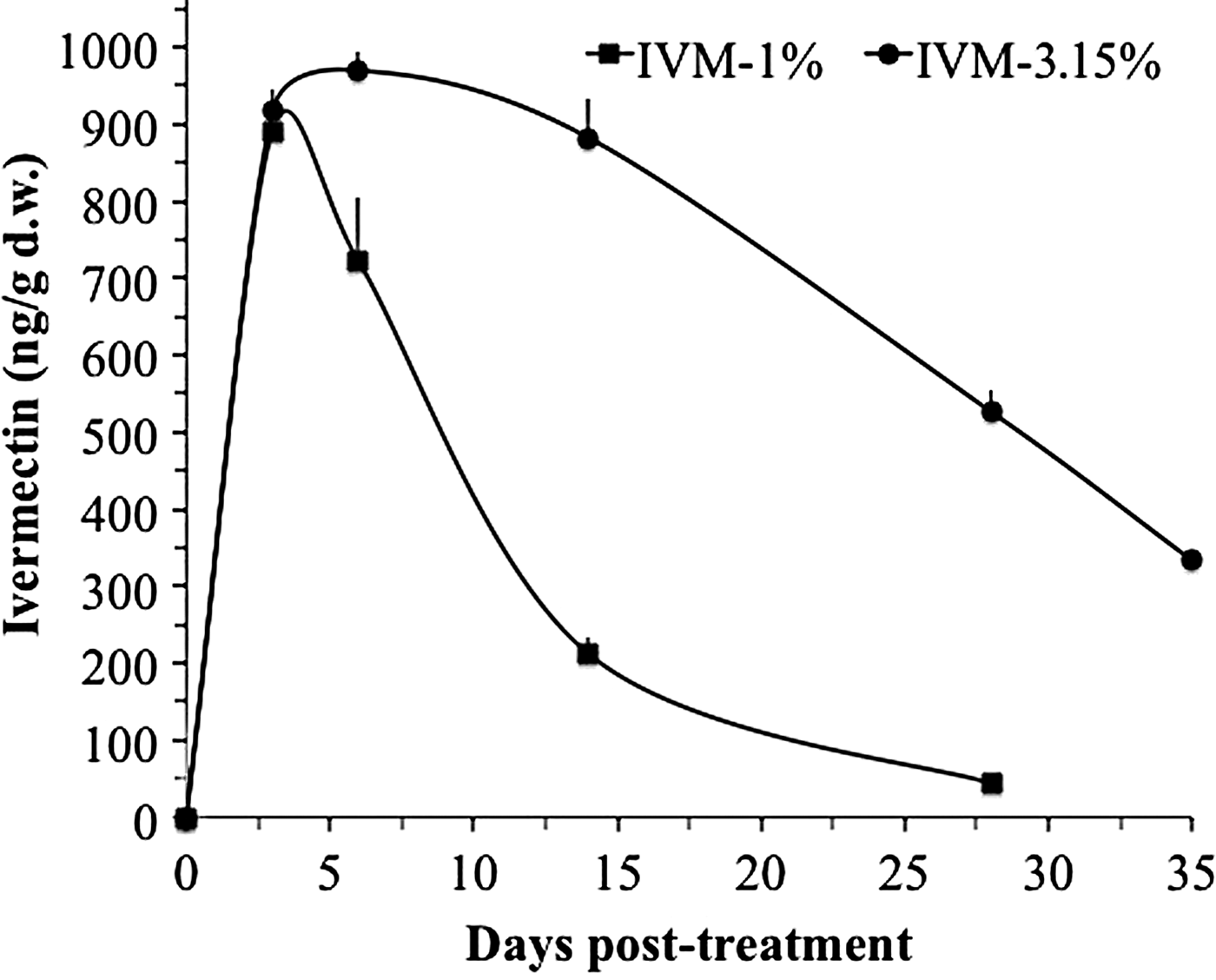
The concentrations (±SD) of IVM in bulked faeces as a function of time after a single subcutaneous injection given to two groups of cattle (IVM-1% and IVM-3.15%) are presented (fig. 1). IVM residues in the bulked faeces after treatment with IVM-1% attained their maximum concentration at 3 dPT (890 ± 55 ng g−1 dry weight (d.w.)), followed by a marked decline. The lowest concentration was obtained at 28 dPT (43.9 ± 0.6 ng g−1 d.w.). In contrast, faecal samples from cows treated with IVM-3.15% attained their maximum concentration at 6 dPT (969.5 ± 1.9 ng g−1 d.w.), but then had a subtle decline. The lowest concentration was obtained at 35 dPT (333.4 ± 12.3 ng g−1 d.w.). The largest arithmetic difference in IVM concentration between IVM-1% (212.0 ± 21.8 ng g−1 d.w.) and IVM-3.15% (882.1 ± 49.1 ng g−1 d.w.) was observed at 14 dPT.
Ivermectin concentration, determined by high performance liquid chromatography, in bulked faeces from two groups of cattle after a subcutaneous injection with either IVM-1% (0.2 mg kg−1) or IVM-3.15% (0.63 mg kg−1). d.w., dry weight.

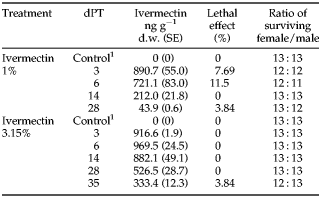
Table 1 shows the lethal effect and sex survival ratio of adult O. landolti exposed to dung collected after treatments with IVM-1% and IVM-3.15%. Adult survival was not significantly affected by residual IVM after treatment with IVM-1% (F 2.74 = 0.51, P > 0.05). Most adult beetles exposed to dung from cattle treated with IVM-3.15% survived, except for one dead beetle at 35 dPT, therefore statistical analysis was not performed.
Adult survival of F 1 Onthophagus landolti, fed over a 10-day period with cattle faeces collected after a subcutaneous injection of IVM-1% (0.2 mg kg−1) or IVM-3.15% (0.63 mg kg−1). Ivermectin treatments and controls were composed of 13 replicates (terraria), each one with a pair of female/male beetles (N = 26).

dPT, days post-treatment; d.w., dry weight; SE, standard error.
1 1 day before treatment with IVM.
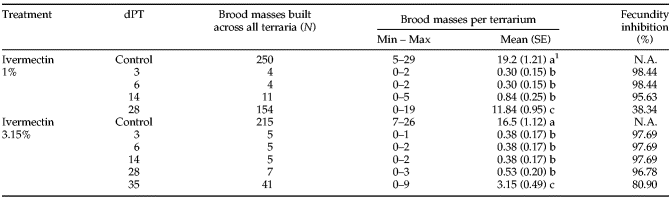
Residual IVM in dung from cattle treated with IVM-1% significantly affected fecundity of O. landolti (F 4.60 = 58.15, P < 0.05). Beetles from the control group had significantly higher brood mass production relative to 3, 6, 14 and 28 dPT (P < 0.05). Brood mass production of beetles fed on dung collected 28 dPT was significantly higher than those fed on dung 3, 6 and 14 dPT (P < 0.05), in which brood mass production was almost completely suppressed (table 2). Likewise, fecundity of O. landolti beetles was negatively affected by the residual IVM in dung from cattle treated with IVM-3.15% (F 5.72 = 65.55, P < 0.05). Beetles exposed to dung collected up to 35 dPT with IVM-3.15% exhibited a significantly reduced fecundity relative to the control group (P < 0.05, in all cases). Brood mass production in beetles exposed to dung collected at 35 dPT, was significantly higher than fecundity of beetles at 3, 6, 14 and 28 dPT (table 2). Significant reduction of fecundity was found when O. landolti was exposed to dung collected from 3 to 14 dPT from cattle injected with IVM-1% (>95%) and from 3 to 28 dPT with IVM-3.15% (>97%). Lower fecundity inhibitions at 28 (38.34%) and 35 (80.90%) dPT were observed in beetles exposed to residual IVM after cattle treatment with IVM-1% and IVM-3.15%, respectively (table 2).
Brood mass production (fecundity) of Onthophagus landolti during a 10-day period of feeding on cattle faeces, which were collected after administration of a subcutaneous injection of IVM-1% (0.2 mg kg−1) or IVM-3.15% (0.63 mg kg−1).

dPT, days post-treatment; N.A., not applicable; SE, standard error.
1 Rows within the same column for each IVM treatment that do not share the same letter are significantly different (P < 0.05).
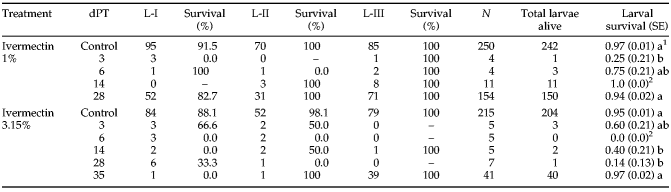
Table 3 shows the effect of IVM on overall survival of larvae developing in brood masses laid within dung collected from cattle treated with either IVM-1% or IVM-3.15%, as well as the number of larvae corresponding to L-I, L-II and L-III instars and their respective survival expressed as percentages. Larval survival was significantly affected by IVM excreted in dung from cattle treated with IVM-1% (F 3.408 = 5.48, P < 0.05). Survival of larvae developing in broods from control dung was significantly higher than survival of larvae from dung at 3 dPT (P < 0.05). However, larval survival for the control group was not statistically different from 6 and 28 dPT (P > 0.05). Larval survival at 28 dPT was significantly higher than at 3 dPT (P < 0.05) (table 3). Larvae exposed to dung collected 14 dPT exhibited 100% survival, therefore this group was not included in the analysis. Accordingly, larval survival was significantly affected by IVM voided in dung from cattle treated with IVM-3.15% (F 4.268 = 8.31, P < 0.05). Larval survival for the control group did not differ significantly from 3 and 35 dPT (P > 0.05). However, larval survival obtained from control dung, and at 35 dPT, was significantly higher than at 14 and 28 dPT (P < 0.05). In contrast, survival of larvae at 3, 14 and 28 dPT was not statistically different (P > 0.05). All larvae from dung collected at 6 dPT were dead, hence this group was not included in the analysis. Despite some experimental groups having no or very few larvae to accomplish a reliable statistical analysis; a pattern toward an increased mortality of the L-I and L-II instars was observed in both bioassays (table 3). Moreover, most of the surviving L-I and L-II instars from treated groups showed slow movements and their integument was drier than those specimens in the control groups and with a yellowish appearance. In contrast, all L-III were alive and did not show any variation in behavior or colour pattern in both bioassays.
Survival of larvae of Onthophagus landolti developing in brood masses produced with faeces collected from cattle treated with injectable formulations of IVM-1% (0.2 mg kg−1) or IVM-3.15% (0.63 mg kg−1).

dPT, days post-treatment; L-I, first instar; L-II, second instar; L-III, third instar; SE, standard error.
1 Rows within the same column for each ivermectin treatment that do not share the same letter are significantly different (P < 0.05).
2 Not included in the statistical analysis due to no variability in larval survival.
Discussion
The excretion profile of IVM in dung from cattle treated with IVM-1% presented herein is consistent with results found by Fernández et al. (Reference Fernández, San Andres, Porcel, Rodriguez, Alonso and Tarazona2009). Although both IVM-1% in plasma (Lifschitz et al., Reference Lifschitz, Virkel, Ballent, Sallovitz, Imperiale, Pis and Lanusse2007) and IVM-1% in faeces herein followed a first-order kinetic process, IVM-3.15% in faeces did not follow this kinetic process. In this study cows treated with IVM-3.15% attained their maximum concentration in faeces 3 days later than the maximum peak found with IVM-1%, and then had a subtle decline. Excretion profile with IVM-3.15% in this study appeared to follow a similar pattern of absorption when the same formulation (Ivomec Gold®, Merial) was injected in cattle (Lifschitz et al., Reference Lifschitz, Virkel, Ballent, Sallovitz, Imperiale, Pis and Lanusse2007). The vehicle in which the endectocide molecules are formulated plays a relevant role in their pharmacokinetics (Lanusse et al., Reference Lanusse, Lifschitz, Virkel, Alvarez, Sánchez, Sutra, Galtier and Alvinerie1997; Lifschitz et al., Reference Lifschitz, Virkel, Pis, Imperiale, Sánchez, Alvarez, Kujanek and Lanusse1999; González et al., Reference González, Sahagún, Diez, Fernández, Sierra and García’2009). The oil-based vehicle used in the long-acting formulation (IVM-3.15%) favours a slow absorption from the subcutaneous site and therefore in faecal excretion (González et al., Reference González, Sahagún, Diez, Fernández, Sierra and García’2009). The novel oil-based vehicle used in the long-acting 3.15% might explain the similar maximum concentration of IVM in faeces when cows were treated with both IVM formulations.
The amount of IVM detected in dung remained above 500 ng g−1 (d.w.) over 4 weeks after dosing with IVM-3.15%. This level of excretion for such an extended period after a single injection of IVM in grazing cattle causes concern, since these concentrations are very close to the LC50 of larval stages of Aphodius beetles (Lumaret et al., Reference Lumaret, Alvinerie, Hempel, ScallanaB, Claret and Römbke2007, Reference Lumaret, Errouissi, Floate, Römbke and Wardhaugh2012). Additionally, even 5 weeks after treatment (333 ng IVM g−1 dung d.w.) IVM concentration was 2.5-fold higher than the LC50 for the less sensitive species of sepsid flies (Diptera: Sepsidae) (Blanckenhorn et al., Reference Blanckenhorn, Puniamoorthy, Schäfer, Scheffczyk and Römbke2013), which are generally more susceptible to macrocyclic lactones than Coleoptera (Floate et al., Reference Floate, Wardhaugh, Boxall and Sherratt2005).
To our knowledge, this is the first laboratory-based investigation to assess the adverse effects of residual IVM from cattle treated with commercial IVM formulations on dung beetle species native to the neotropics. Although in this study we also tested a more concentrated injectable formulation (3.15%) than the standard IVM-1%, our results indicated that survival of mature adult O. landolti was not negatively affected by residual IVM in faeces. Similar results were observed for dung beetle species of the genera Copris, Onitis, Caccobius and Aphodius, when fed with IVM-treated cattle dung (Wardhaugh & Rodriguez-Menendez, Reference Wardhaugh and Rodriguez-Menendez1988; Krüger & Scholtz, Reference Krüger and Scholtz1997; Iwasa et al., Reference Iwasa, Maruo, Ueda and Yamashita2007; O'Hea et al., Reference O'Hea, Kirwan, Giller and Finn2010). Pérez-Cogollo et al. (Reference Pérez-Cogollo, Rodríguez-Vivas, Delfín-González, Reyes-Novelo and Ojeda-Chi2015a ) reported 30% mortality in adult O. landolti after a 10-day exposure time to faeces spiked with 6.22 mg IVM kg−1 dung d.w., however, in the present study, the maximum level of IVM voided in faeces (0.969 mg kg−1 d.w.) after treatment of cattle with IVM-3.15% was 6.4-fold lower.
One of the main sublethal effects on adult dung beetles caused by residues of avermectin compounds in faeces of treated cattle is fecundity inhibition (Strong & Wall, Reference Strong and Wall1994; Dadour et al., Reference Dadour, Cook and Hennessy2000; Wardhaugh et al., Reference Wardhaugh, Longstaff and Morton2001). In the present study, we observed high fecundity inhibition of beetles at 14 dPT for both IVM formulations. This finding might be related to the high IVM concentration in dung (>200 ng g−1 d.w.); moreover, lower fecundity inhibitions (38.3%) were observed when IVM-1% 28 dPT was excreted at low levels (43.9 ng g−1 d.w.). In this sense O. landolti seems to be highly sensitive to IVM, since fecundity of beetles was almost completely suppressed when IVM in faeces was >200 ng g−1 d.w. In contrast, fecundity of beetles from other species such as Caccobius jessoensis and Liatongus minutus was not reduced at any period post-treatment even though they were exposed to higher concentrations of IVM, and for a longer exposure time (Iwasa et al., Reference Iwasa, Nakamura, Fukaki and Yamashita2005, Reference Iwasa, Maruo, Ueda and Yamashita2007). Similarly, IVM had a short negative effect over time on fecundity of Euoniticellus intermedius, which was reduced only when fed on faeces from cattle collected 3 days after an injection of IVM-1% at 200 µg kg−1 (Krüger & Scholtz, Reference Krüger and Scholtz1997). A remarkable outcome in our study was observed at 35 dPT (IVM-3.15%) in which most larvae found within brood masses were third instars; this suggests that O. landolti beetles were able to oviposit during the first days of the bioassays but stopped thereafter, perhaps due to their intoxication with IVM faecal residues. Further studies over longer time periods are required to determine when fecundity is not inhibited by IVM excreted in dung.
The methodology used in this study allowed us to more accurately explore larval survival of each of the three instars of O. landolti, since waiting until emergence of imagoes generally implies a period of at least 35 days (Pérez-Cogollo et al., Reference Pérez-Cogollo, Rodríguez-Vivas, Delfín-González, Reyes-Novelo and Ojeda-Chi2015a , Reference Pérez-Cogollo, Rodríguez-vivas, Delfín-González, Reyes-Novelo and Morón b ). As a consequence, opening remaining brood masses in which death has occurred (especially at the beginning of immature stages) can hinder the ability of discriminating between instars due to decomposition of tissues and excessive fungal growth.
Regarding larval survival, results herein showed that deaths were only recorded in L-I and L-II instars, furthermore most of those still alive at the end of the bioassay showed signs of intoxication, especially in those treatments in which IVM residues were detected above 500 ng g−1. Meanwhile, those larvae that could molt into L-III instars in both bioassays seemed healthy. However, it is noteworthy to acknowledge that the third instar period was only partially monitored, as even the older larvae (i.e. from brood masses constructed during the first 2–3 days of the bioassays) must have molted into third instar only a few days before brood masses were opened, as, according to Pérez-Cogollo et al. (Reference Pérez-Cogollo, Rodríguez-vivas, Delfín-González, Reyes-Novelo and Morón2015b ), the duration of the third instar O. landolti lasts 10–13 days. Results herein regarding larval survival are in accordance with Sommer et al. (Reference Sommer, Grønvold, Holter and Nansen1993) who found that Digitonthophagus gazella (formerly, O. gazella) larvae developing in cattle dung at 2 and 7 dPT (with IVM dosed at 0.2 mg kg−1) were killed as first instars. Those authors argued that IVM might have caused paralysis of the first instar larvae, as they showed no mandibular wear, which indicates they were not able to feed properly. The early intoxication with IVM might be due to absorption through the larval integument (Sommer et al., Reference Sommer, Grønvold, Holter and Nansen1993).
Additionally, the difference observed between adult and larval survival can be explained by the fact that larvae have biting mouthparts and feed on whole faeces (Floate et al., Reference Floate, Wardhaugh, Boxall and Sherratt2005; Lumaret et al., Reference Lumaret, Errouissi, Floate, Römbke and Wardhaugh2012), whereas most adult beetles have specialized mouthpart that screen out the larger fragments of organic materials. Because IVM attaches strongly to the particulate phase of digesta, filter-feeding adults are likely to imbibe less IVM than their bulk-feeding larvae (Holter & Scholtz, Reference Holter and Scholtz2007; Lumaret et al., Reference Lumaret, Errouissi, Floate, Römbke and Wardhaugh2012).
In Latin America, the widespread use of avermectins, in some cases routine treatment of cattle regardless of their ecto- or endoparasite burdens (Cruz et al., Reference Cruz, Lopes, Maciel, Felippelli, Fávero, Teixeira, Carvalho, Ruivo, Colli, Sakamoto Massamitsu, da Costa and De Oliveira2015), is expected to continue rising. This is especially due their convenience (wide spectrum), accessible prices and lack of effective alternatives (Perez-Cogollo et al., Reference Perez-Cogollo, Rodriguez-Vivas, Ramírez-Cruz and Rosado-Aguilar2010; Rodríguez-Vivas et al., Reference Rodríguez-Vivas, Pérez-Cogollo, Rosado-Aguilar, Ojeda-Chi, Trinidad-Martinez, Miller, Li, Pérez de León, Guerrero and Klafke2014). Moreover, with increasing reports of treatment failure and parasite resistance to IVM (Canul-Ku et al., Reference Canul-Ku, Rodriguez-Vivas, Torres-Acosta, Aguilar-Caballero, Perez-Cogollo and Ojeda-Chi2012; Alegria-Lopez et al., Reference Alegria-Lopez, Rodriguez-Vivas, Torres-Acosta, Ojeda-Chi and Rosado-Aguilar2015; Alonso-Díaz et al., Reference Alonso-Díaz, Arnaud-Ochoa, Becerra-Nava, Torres-Acosta, Rodriguez-Vivas and Quiroz-Romero2015; Cruz et al., Reference Cruz, Lopes, Maciel, Felippelli, Fávero, Teixeira, Carvalho, Ruivo, Colli, Sakamoto Massamitsu, da Costa and De Oliveira2015) it is highly probable that producers will increasingly market more concentrated commercial formulations of IVM (i.e. injectable IVM-3.15% and IVM-4%, dosed at 0.63 and 0.8 mg kg−1, respectively) to compensate for the reduced efficacy of IVM against resistant populations of ticks and gastrointestinal nematodes of cattle. Therefore, higher amounts of IVM will be excreted in the faeces of treated cattle. Additionally, in the Mexican tropics, Canul-Ku et al. (Reference Canul-Ku, Rodriguez-Vivas, Torres-Acosta, Aguilar-Caballero, Perez-Cogollo and Ojeda-Chi2012) found that it is common to employ IVM to control parasites at the beginning of the rainy season, which, according to Basto-Estrella et al. (Reference Basto-Estrella, Rodríguez-Vivas, Delfín-González and Reyes-Novelo2014), coincides with the highest activity period of Scarabaeinae dung beetles. Consequently, the frequent use and popularity of IVM among farmers raises serious concerns because residues in the dung may result in reduction of dung beetle populations.
Based on our results it is possible to conclude that residual IVM in dung from cattle treated with injectable formulations (IVM-1% and IVM-3.15%) has a detrimental effect on the fecundity of adult O. landolti up to 4 weeks post-treatment and on the subsequent larval survival.
Acknowledgements
The authors wish to thank Iris Trinidad and Melina Ojeda Chi for their technical assistance during the bioassays. This project was funded by CONACYT (128870). We are very grateful to CONACYT-Mexico for supporting Luis Carlos Pérez-Cogollo in his PhD studies at the CCBA-UADY.