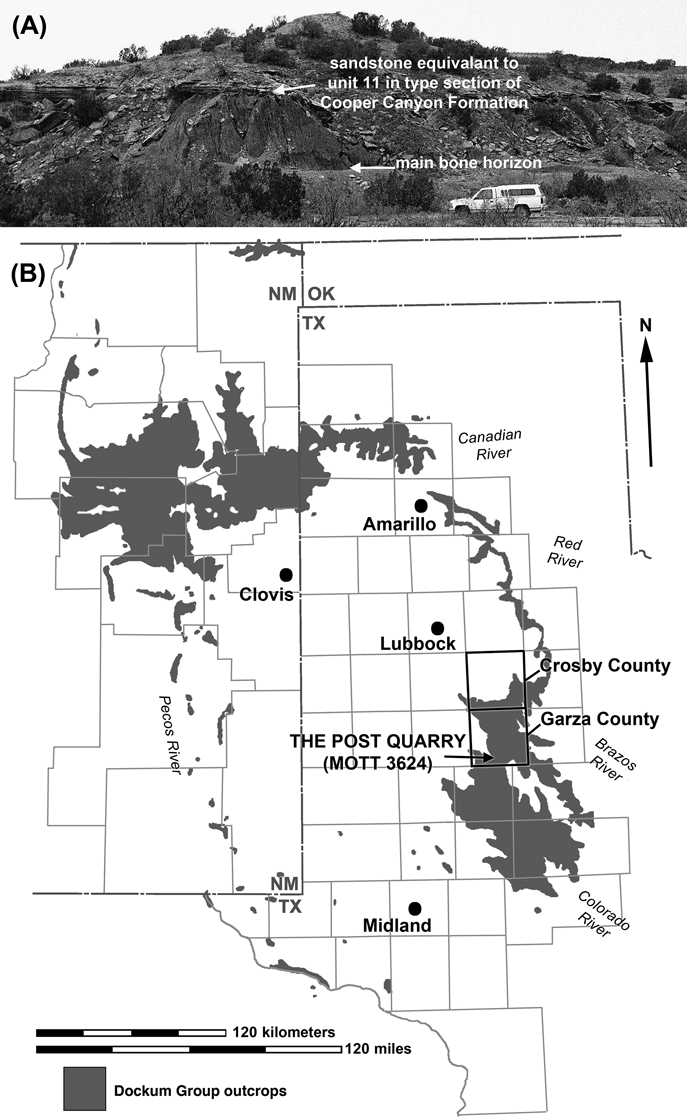


The Post Quarry (Museum of Texas Tech, Lubbock, Texas locality 3624) in southern Garza County, western Texas (Fig. 1), lies within the type section of the Cooper Canyon Formation of the Dockum Group (Fig. 2), and is one of the richest and most taxonomically diverse Upper Triassic vertebrate localities in the world. The Post Quarry was excavated first by workers from the Dallas Museum of Nature and Science (then the Dallas Museum of Natural History), under the direction of Charles E. Finsley in the late 1970s. However, more extensive excavations were conducted by workers from Texas Tech University under the direction of Sankar Chatterjee during the early 1980s and sporadically throughout the 1990s (Small Reference Small, Lucas and Hunt1989a; Long & Murry Reference Long and Murry1995, pp. 16–17). All fossils from the Post Quarry are reposited in the collections of those two institutions (Long & Murry Reference Long and Murry1995, p. 222; Martz Reference Martz2008, pp. 441–453).
(A) The Upper Triassic Post Quarry, with the main bone bed and the sandstone equivalent to unit 11 (the Dalby Ranch sandstone) in the Cooper Canyon Formation type section of Lehman et al. (Reference Lehman, Chatterjee and Schnable1992) labelled. (B) Map of outcrops of the Upper Triassic Dockum Group (shaded in grey) in western Texas and eastern New Mexico (after Lehman Reference Lehman1994a, fig. 1). Abbreviations: MOTT=Museum of Texas Tech locality.

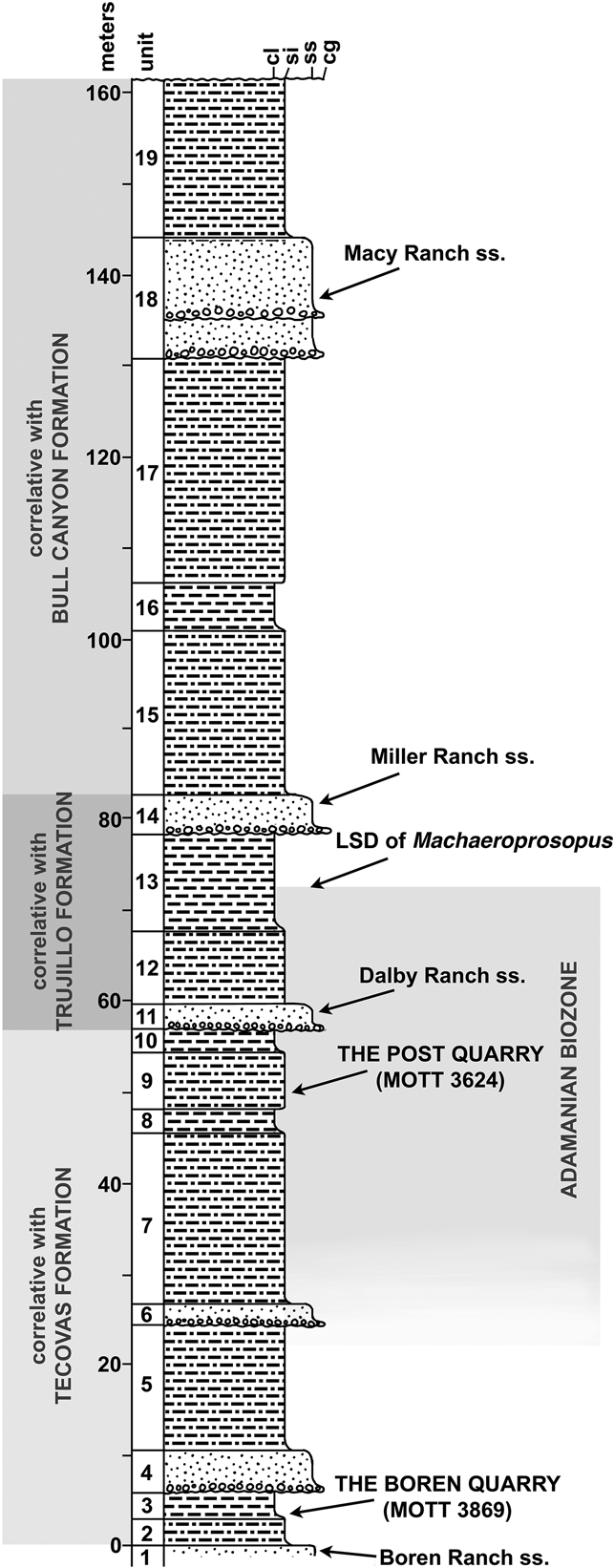
Type section of the Cooper Canyon Formation of the Dockum Group, modified from Lehman et al. (Reference Lehman, Chatterjee and Schnable1992, fig. 2), with important sandstone beds and the stratigraphic horizons of important fossil localities labeled. The Adamanian biozone is shaded on the right; the precise lower boundary is uncertain, because the LSD of Leptosuchus is unknown. Parts of the section that are equivalent to formations in Crosby County and the Texas Panhandle are labelled along left edge. Unit lithologies are generalised. Abbreviations: cg = conglomerate; cl = claystone; LSD = lowest known stratigraphic datum, MOTT = Museum of Texas Tech locality; si=siltstone; ss=sandstone.
In a series of papers published throughout the 1980s and 1990s, Chatterjee and various graduate students at Texas Tech University described components of the Post Quarry vertebrate assemblage. Those workers identified the remains of metoposaurids (Davidow-Henry Reference Davidow-Henry1987Reference Davidow-Henry, Lucas and Hunt1989), tritheledontids (or “ictidosaurs”) (Chatterjee Reference Chatterjee1984), “poposaurs” (Chatterjee Reference Chatterjee1985), aetosaurs (Small Reference Small1985, Reference Small, Lucas and Hunt1989b), “fabrosaur” ornithischians (Chatterjee Reference Chatterjee1983), phytosaurs, pterosaurs, protorosaurs, squamates, “podokesaurs”, and “coelurosaurs” (Chatterjee Reference Chatterjee and Padian1986a). The “coelurosaurs” included the controversial Protoavis and Shuvosaurus, considered by Chatterjee (Reference Chatterjee1991, Reference Chatterjee1993, Reference Chatterjee1995, Reference Chatterjee1999) to represent the earliest known avian and ornithomimid theropods respectively. Over the past twenty years, various aspects of the Post Quarry assemblage have been revised (Long & Murry Reference Long and Murry1995; Rauhut Reference Rauhut, Sachs, Rauhut and Weigert1997; Bolt & Chatterjee Reference Bolt and Chatterjee2000; Atanassov Reference Atanassov2002; Martz Reference Martz2002, Reference Martz2008; Small Reference Small, Norman and Gower2002; Lehane Reference Lehane2005; Lehman & Chatterjee Reference Lehman and Chatterjee2005; Parker Reference Parker2005a; Mueller & Parker Reference Mueller, Parker, Parker, Ash and Irmis2006; Nesbitt & Norell Reference Nesbitt and Norell2006; Weinbaum Reference Weinbaum2007, Reference Weinbaum2011, Reference Weinbaum2013; Mueller & Chatterjee Reference Mueller and Chatterjee2007; Nesbitt et al. Reference Nesbitt, Irmis and Parker2007; Nesbitt & Chatterjee Reference Nesbitt and Chatterjee2008). However, to date, there has been no detailed overview of the Post Quarry assemblage incorporating those revisions into existing vertebrate systematic and biostratigraphic contexts.
Within the framework of the Late Triassic land vertebrate “faunachrons” (Lucas & Hunt Reference Lucas, Hunt, Lucas and Morales1993; Lucas Reference Lucas1998, Reference Lucas and Lucas2010), the Post Quarry vertebrate assemblage was previously considered representative of the Revueltian land vertebrate “faunachron” (e.g. Chatterjee Reference Chatterjee and Padian1986a; Lucas Reference Lucas1998; Sues & Fraser Reference Sues and Fraser2010, pp. 146–148), largely because the Cooper Canyon Formation was accepted as correlative with the Bull Canyon Formation of New Mexico, which contains a Revueltian vertebrate assemblage (e.g. Lucas Reference Lucas1998, Reference Lucas and Lucas2010; Hunt Reference Hunt, Lucas and Ulmer-Scholle2001). However, recent lithostratigraphic revisions (Martz Reference Martz2008) have cast doubt on this correlation. Here, we identify each member of the Post Quarry vertebrate assemblage using synapomorphies, and re-evaluate the biostratigraphic importance of the quarry in light of these taxonomic and lithostratigraphic revisions.
Institutional Abbreviations. AMNH, American Museum of Natural History, New York; DMNH, Museum of Nature and Science, Dallas, Texas; GR, Museum of Ghost Ranch, Abiquiu, New Mexico; MNA, Museum of Northern Arizona, Flagstaff, Arizona; NMMNH, New Mexico Museum of Natural History and Science, Albuquerque, New Mexico; PEFO, Petrified Forest National Park, Arizona; SMNS, Staatliches Museum für Naturkunde, Stuttgart, Germany; TTU-P, Texas Tech University Paleontology, Lubbock, Texas; UCMP, University of California Museum of Paleontology, Berkeley, California; UMMP, University of Michigan Museum of Paleontology, Ann Arbor, Michigan.
1. Previous work
1.1. Geological setting
The Post Quarry lies within the Upper Triassic Cooper Canyon Formation of the Dockum Group of western Texas. Lucas (Reference Lucas and Morales1993, Reference Lucas, Lucas and Ulmer-Scholle2001) suggested abandoning the use of the term “Dockum Group” for Upper Triassic strata in western Texas because he claimed that the historical usage of the term was confusing and inconsistent. However, nearly all workers have applied the term “Dockum” consistently and clearly to the Upper Triassic sequence exposed around the southern High Plains (Llano Estacado) in the drainages of the Brazos, Colorado, Red, Canadian, and Pecos rivers of eastern New Mexico and western Texas (Fig. 1B; e.g. Drake Reference Drake1892; McGowan et al. Reference McGowan, Granata and Seni1979, Reference McGowan, Granata, Seni, Reynolds and Dolly1983; Murry Reference Murry and Padian1986, Reference Murry, Lucas and Hunt1989; Dubiel Reference Dubiel, Caputo, Peterson and Franczyk1994; Lehman Reference Lehman1994a, Reference Lehmanb; Lehman & Chatterjee Reference Lehman and Chatterjee2005). We continue to use “Dockum Group” here.
The northerly exposures of the Dockum Group in northeastern New Mexico and the Texas Panhandle (Figs 1B, 3B) consist of: a basal sandstone-dominated unit (the Santa Rosa Formation, and/or Camp Springs Conglomerate); a lower mudstone-dominated unit (the Tecovas Formation and/or Garita Creek Formation); a middle sandstone-dominated unit (the Trujillo Formation); and an upper unit of interbedded mudstone and sandstone (the Bull Canyon Formation). In northeastern New Mexico, the Bull Canyon Formation is in turn capped by the Redonda Formation, another unit of interbedded mudstone, sandstone, and carbonate which is absent in Texas (e.g. Lehman Reference Lehman1994a; Lucas et al. Reference Lucas, Anderson and Hunt1994, Reference Lucas, Heckert, Hunt, Lucas and Ulmer-Scholle2001; Lehman & Chatterjee Reference Lehman and Chatterjee2005). The proper name for the unit directly above the Trujillo Formation has been contentious, as is the interpretation of how units of the Dockum Group correlate between southern and northern exposures in Texas and eastern New Mexico (e.g. Lehman Reference Lehman1994a, Reference Lehmanb; Lucas et al. Reference Lucas, Anderson and Hunt1994; Lucas & Anderson Reference Lucas and Anderson1995); these issues are of critical importance to the stratigraphic position of the Post Quarry (Martz Reference Martz2008).
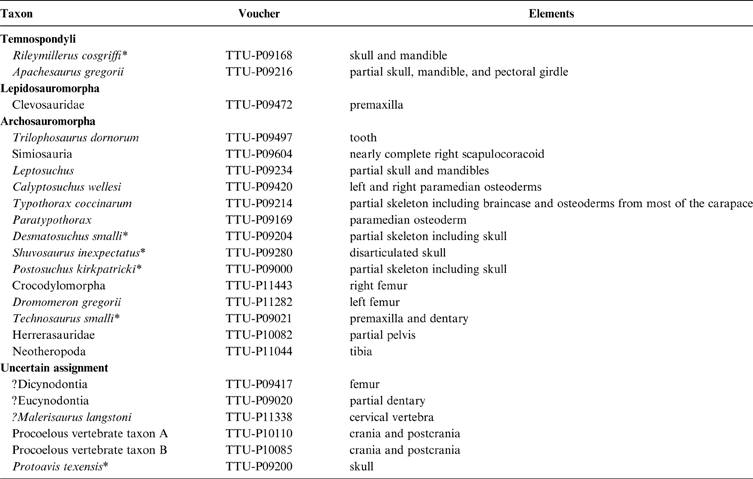
Voucher specimens for the vertebrate assemblage of the Post Quarry. The asterisk identifies holotype specimens from the quarry.
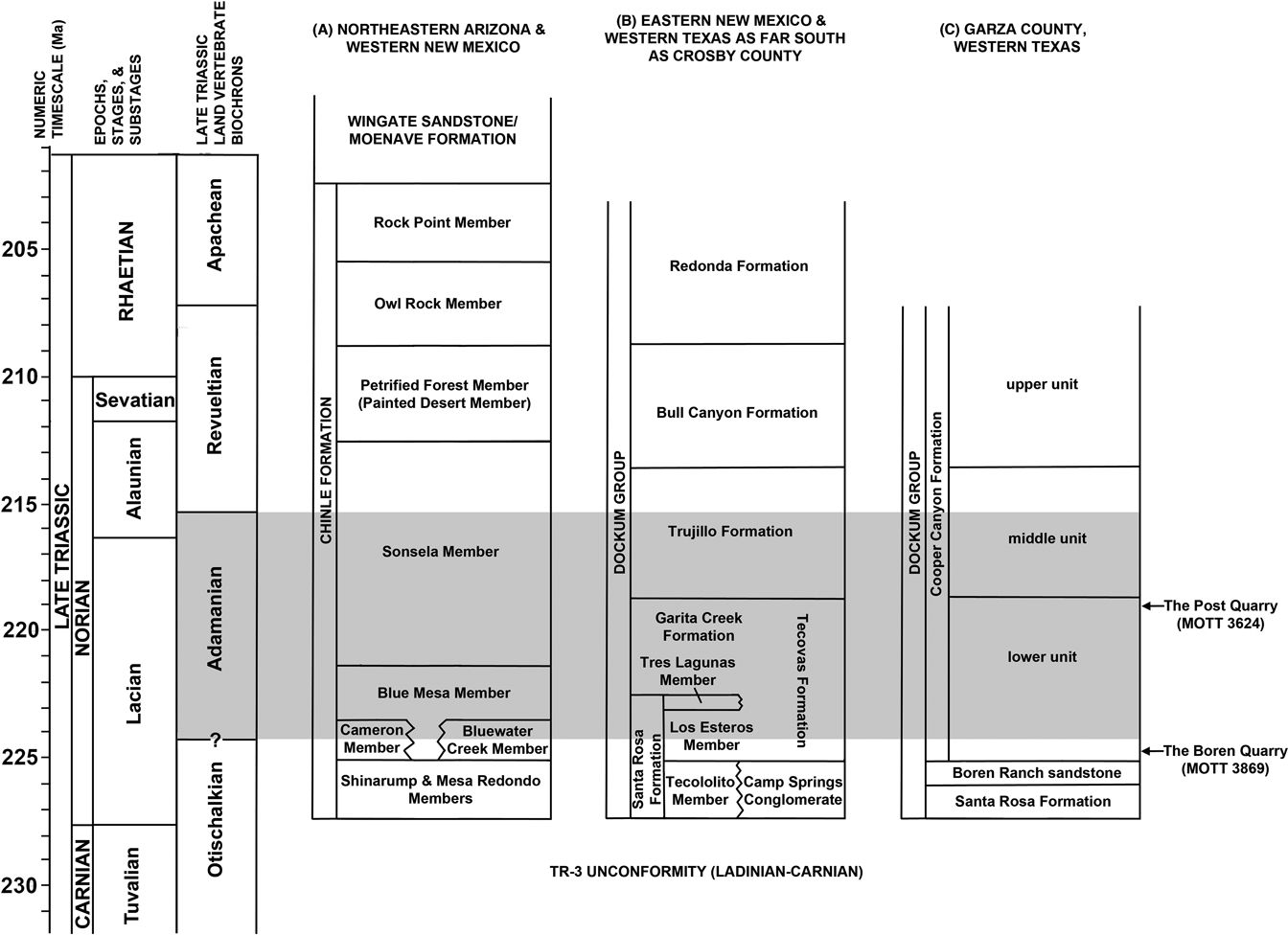
Tentative and approximate geochronologic correlation of Upper Triassic sections from parts of Arizona, New Mexico, and Texas. Lithostratigraphic units are linked to the Late Triassic land vertebrate biozones using vertebrate fossils in all three sections. However, the lithostratigraphic and biostratigraphic units are linked to the numeric timescale exclusively through the Chinle Formation of Arizona and New Mexico (A) based on the recent calibrations of Ramezani et al. (Reference Ramezani, Hoke, Fastovsky, Bowring, Therrien, Dworkin, Atchley and Nordt2011) and Irmis et al. (Reference Irmis, Mundil, Martz and Parker2011), because published high-resolution radioisotopic dates are unavailable from the Dockum Group (B, C); the assumption is made that biozones are approximately isochronous across the western United States. The numeric timescale is linked to the chronostratigraphic stages and substages of the Late Triassic Epoch, based on recent radioisotopic and magnetostratigraphic calibrations (Muttoni et al. Reference Muttoni, Kent, Olsen, Di Stefano, Lowrie, Bernasconi and Hernández2004, Reference Muttoni, Kent, Jadoul, Olsen, Rigo, Galli and Nicora2010; Furin et al. Reference Furin, Preto, Rigo, Roghi, Gianolla, Crowley and Bowring2006; Hüsing et al. 2010). Abbreviations: MOTT=Museum of Texas Tech locality.
Chatterjee (Reference Chatterjee and Padian1986a) proposed the name “Cooper Member” (and at the same time lowered the Dockum to formation status) for what he thought was the upper unit of interbedded mudstone and sandstone above the Trujillo Formation in southern Garza County, western Texas, and he identified a 16-metre-thick type section for the Cooper Member at the Post Quarry. This unit was later renamed the Cooper Canyon Formation by Lehman et al. (Reference Lehman, Chatterjee and Schnable1992), who re-measured a 160-metre-thick type section (Figs 2, 3C) that encompassed not only Chatterjee's (Reference Chatterjee and Padian1986a) original type section, but virtually the entire Upper Triassic section in southern Garza County. Lehman et al. (Reference Lehman, Chatterjee and Schnable1992) identified a sandstone unit at the base of the Cooper Canyon Formation as the Trujillo Sandstone (Figs 2, 3C; unit 1 in Lehman et al.'s Reference Lehman, Chatterjee and Schnable1992 type section; the “Boren Ranch sandstone” of Frehlier Reference Frehlier1986). Between the publications of these two papers, Lucas & Hunt (Reference Lucas, Hunt, Lucas and Hunt1989) provided the name Bull Canyon Formation for the upper unit in northeastern New Mexico. Although these authors debated the priority of the names “Bull Canyon Formation” and “Cooper Canyon Formation” at length (Lucas & Anderson Reference Lucas, Anderson and Crick1993; Lehman Reference Lehman1994a, Reference Lehmanb; Lucas et al. Reference Lucas, Anderson and Hunt1994), all agreed that they were stratigraphically equivalent.
Recent revisions to the stratigraphy of southern Garza County revealed that the Cooper Canyon Formation type section of Lehman et al. (Reference Lehman, Chatterjee and Schnable1992) is only partially correlative with the Bull Canyon Formation (Figs 2, 3B–C; Martz Reference Martz2008). Sandstones occurring in the middle of the type section of the Cooper Canyon Formation (units 11–14 in Lehman et al.'s Reference Lehman, Chatterjee and Schnable1992 type section; the “Dalby Ranch sandstone” and “Miller Ranch sandstones” of Frehlier Reference Frehlier1986; Martz Reference Martz2008) have been traced by the senior authors (J. Martz and B. Mueller) through northern Garza County and into southern Crosby County (Fig. 1B). Here, they were observed to be roughly correlative with the Trujillo Formation, which stratigraphically overlies the Tecovas Formation (e.g. Heckert Reference Heckert2004; Lehman & Chatterjee Reference Lehman and Chatterjee2005). As a result, the Bull Canyon Formation is correlative only with the upper part of the Cooper Canyon Formation type section (units 15–19 in Lehman et al. Reference Lehman, Chatterjee and Schnable1992; Martz Reference Martz2008), and the Tecovas Formation is correlative with the lower part of the Cooper Canyon Formation type section and likely the “Boren Ranch sandstone” (units 1–10 in Lehman et al. Reference Lehman, Chatterjee and Schnable1992), although the latter might also be partially correlative with the Santa Rosa Formation (Martz Reference Martz2008).
The Post Quarry lies near the top of the lower unit of the Cooper Canyon Formation (Figs 2, 3C), approximately eight metres below a ledge-forming sandstone (Fig. 1A) (Lehman & Chatterjee Reference Lehman and Chatterjee2005, fig. 6B) that occurs at the same stratigraphic position as the “Dalby Ranch sandstone” (Martz Reference Martz2008), and about 50 metres above the “Boren Ranch sandstone”, which Lehman et al. (Reference Lehman, Chatterjee and Schnable1992, figs 1–2, table 1) originally mapped as the Trujillo Formation. Therefore, the Post Quarry is stratigraphically equivalent to the upper part of the Tecovas Formation, not to the Bull Canyon Formation.
1.2. Depositional setting and taphonomy
Nearly all of the vertebrates from the Post Quarry were recovered from a 30-centimetre-thick bed within a thicker unit of reddish mudstones (Fig. 1A) overlying a conglomerate composed of reworked intrabasinal carbonate nodules (Chatterjee Reference Chatterjee1985, Reference Chatterjee and Padian1986a; Lehman & Chatterjee Reference Lehman and Chatterjee2005). The only specimens not recovered from the main bone bed, the holotype and paratype of Protoavis texensis, were recovered a few metres above the main bone horizon, also in reddish mudstones (Chatterjee Reference Chatterjee1991). The Post Quarry bone bed represents a small bedload-dominated channel and floodplain deposits associated with a larger mixed-load meandering channel system (Frehlier Reference Frehlier1986; Lehman & Chatterjee Reference Lehman and Chatterjee2005). Vertebrate fossils consist of disarticulated but generally associated skeletal elements showing a slight amount of preferential orientation, but with little evidence of hydraulic sorting (Chatterjee Reference Chatterjee1985; S. Chatterjee unpublished field notes and quarry maps housed at the Museum of Texas Tech University). The Post Quarry assemblage appears to be an autochthonous high-diversity assemblage that has not undergone post-mortem winnowing or concentration, although the skeletons were exposed long enough to decay and disarticulate (Lehman & Chatterjee Reference Lehman and Chatterjee2005). At least one specimen (TTU-P9002, the paratype of Postosuchus kirkpatricki) shows evidence of scavenging (Weinbaum Reference Weinbaum2007).
1.3. The Post Quarry and Late Triassic vertebrate biochronology in western North America
For most of the past century, it was recognised that there are stratigraphically distinct faunas within the Upper Triassic strata of the Western Interior of North America. Initial observations (e.g. Huene Reference Huene1926; Camp Reference Camp1930; Langston Reference Langston1949) were expanded by Joseph Gregory (Colbert & Gregory Reference Colbert and Gregory1957; Gregory Reference Gregory1957, Reference Gregory, Kelly and Trauger1972), who recognised four sequential faunas primarily based on phytosaur taxa that were distinguished by the morphology of the temporal region. Taxonomic revisions to phytosaurs and aetosaurs established further distinctions between the middle two faunas (Long & Ballew Reference Long, Ballew, Colbert and Johnson1985; Long & Padian Reference Long, Padian and Padian1986; Ballew Reference Ballew, Lucas and Hunt1989).
Lucas & Hunt (Reference Lucas, Hunt, Lucas and Morales1993) formalised these faunas as biochronologic units termed the “Late Triassic land vertebrate faunachrons”, which are (from oldest to youngest): Otischalkian, Adamanian, Revueltian, and Apachean (Fig. 3). Several important revisions of the faunachrons within western North America were made by Lucas (Reference Lucas1998), Hunt et al. (Reference Hunt, Lucas, Heckert, Lucas, Zeigler, Lueth and Owen2005), and Parker & Martz (Reference Parker and Martz2011). Following the recommendations of Parker & Martz (Reference Parker and Martz2011, p. 235), the “faunachrons” will be treated as biozones rather than biochrons here, bounded by the lowest stratigraphic datums (LSDs) of their defining phytosaur taxa. Given that the utility of the Late Triassic land vertebrate biozones for global correlation has been questioned (e.g. Langer Reference Langer2005; Rayfield et al. Reference Rayfield, Barrett, McDonnell and Willis2005, Reference Rayfield, Barrett and Milner2009; Schultz Reference Schultz and Koutsoukos2005; Irmis et al. Reference Irmis, Martz, Parker and Nesbitt2010, Reference Irmis, Mundil, Martz and Parker2011; Desojo & Ezcurra Reference Desojo and Ezcurra2011; Olsen et al. Reference Olsen, Kent and Whiteside2011; Parker & Martz Reference Parker and Martz2011), this present paper will restrict its discussion to western North America.
Prior to the discovery and description of the Post Quarry vertebrate assemblage, only the lower two biozones (the Otischalkian and Adamanian) were thought to occur in the Dockum Group of Texas, although the upper two biozones (the Revueltian and Apachean) were recognised in the Dockum Group in New Mexico (Gregory Reference Gregory1957, Reference Gregory, Kelly and Trauger1972; Murry Reference Murry and Padian1986, Reference Murry, Lucas and Hunt1989). Chatterjee (Reference Chatterjee and Padian1986a) identified the Post Quarry assemblage as representing the Revueltian “upper fauna.” This identification was partially a result of Chatterjee's (Reference Chatterjee and Padian1986a) correlation of the “Cooper Member” (Cooper Canyon Formation sensu Lehman et al. Reference Lehman, Chatterjee and Schnable1992) with the Bull Canyon Formation of New Mexico (Lucas & Hunt Reference Lucas, Hunt, Lucas and Hunt1989), which contains Revueltian vertebrate assemblages (e.g. Gregory Reference Gregory, Kelly and Trauger1972; Lucas Reference Lucas1998; Hunt Reference Hunt, Lucas and Ulmer-Scholle2001).
However, Chatterjee (Reference Chatterjee and Padian1986a) also based the age assignment on the phytosaur skull recovered from the Post Quarry (TTU-P9234), which he assigned to Nicrosaurus using the phytosaur classification of Gregory (Reference Gregory1962). This work distinguished phytosaurs primarily on the presence or absence of a rostral crest. According to Chatterjee (Reference Chatterjee and Padian1986a), Rutiodon (sensu Gregory, Reference Gregory1962) occurred in both the Revueltian “upper fauna” and in the Adamanian “lower fauna” with early diverging phytosaurs (e.g. Elder Reference Elder1978; Murry Reference Murry1982), making it unreliable as an index fossil. Conversely, Nicrosaurus was hypothesised to be the only phytosaur that occurred in the Revueltian “upper fauna”, making it a more reliable index fossil. However, the only North American leptosuchomorph (sensu Stocker Reference Stocker2010) assigned to Nicrosaurus under the rostrum-based classification (Gregory Reference Gregory1962; Westphal Reference Westphal and Kuhn1976; Murry Reference Murry1982, pp. 243–244) was Smilosuchus gregorii (sensu Long & Murry Reference Long and Murry1995; Stocker Reference Stocker2010), a non-pseudopalatine leptosuchomorph characterizing the Adamanian, not the Revueltian (e.g. Lucas Reference Lucas1998; Parker & Martz Reference Parker and Martz2011).
Murry (Reference Murry1982, Reference Murry and Padian1986) also identified Nicrosaurus as occurring at the Post Quarry based on distinctive rectangular osteoderms similar to osteoderms originally assigned to Nicrosaurus in the German Stubensandstein (the Lowenstein Formation) by Meyer (Reference Meyer1861, pp. 341–342, pl. 43, figs 4–7). Gregory (Reference Gregory1953) suggested that the German osteoderms belonged instead to an aetosaur similar to Typothorax. Although Gregory (Reference Gregory1962) later revised his opinion and considered the osteoderms to be phytosaur, Long & Ballew (Reference Long, Ballew, Colbert and Johnson1985) confirmed his original suspicions and named the aetosaur Paratypothorax andressi (emended to Paratypothorax andressorum; Heckert & Lucas Reference Heckert and Lucas2000, p. 1563). Later the Post Quarry specimens were also assigned to Paratypothorax and accepted as an aetosaur (Small Reference Small, Lucas and Hunt1989a, Reference Small, Lucas and Huntb; Long & Murry Reference Long and Murry1995; Martz Reference Martz2008). Paratypothorax occurs in both the Adamanian and Revueltian biozones (e.g. Lucas Reference Lucas1998, Reference Lucas and Lucas2010; Heckert et al. Reference Heckert, Lucas, Hunt, Spielmann, Lucas and Spielmann2007; Parker & Martz Reference Parker and Martz2011).
2. Methods
An apomorphy-based approach is used for identification of vertebrates from the Post Quarry, following the works of Bell et al. (Reference Bell, Head, Mead and Barnosky2004, Reference Bell, Gauthier and Bever2010), Bever (Reference Bever2005) and Nesbitt et al. (Reference Nesbitt, Irmis and Parker2007), and the framework set forth by Nesbitt & Stocker (Reference Nesbitt and Stocker2008). This testable approach utilises the presence of discrete apomorphies in a phylogenetic framework to determine the taxonomic placement of individual specimens, and minimises the influence of geographic and stratigraphic influences that are inherently circular (Bever Reference Bever2005; Bell et al. Reference Bell, Gauthier and Bever2010).
The phylogeny of Archosauriformes has undergone major revisions in recent years and merits some discussion, because this clade dominates the Post Quarry assemblage. This study follows Nesbitt (Reference Nesbitt2011) in placing Phytosauria outside of crown-clade Archosauria, and the interrelationships of phytosaurs follows Stocker (Reference Stocker2010, Reference Stocker2012). It is worth noting that confusion regarding the phylogeny of Pseudosuchia has been largely due to the complex taxonomic history of Postosuchus kirkpatricki (Chatterjee Reference Chatterjee1985), Shuvosaurus inexpectatus (Chatterjee Reference Chatterjee1993) and “Chatterjeea elegans” (Long & Murry Reference Long and Murry1995), the type specimens of which all come from the Post Quarry (see Long & Murry Reference Long and Murry1995; Gower Reference Gower2000; Weinbaum Reference Weinbaum2002, Reference Weinbaum2007; and Nesbitt Reference Nesbitt2011 for detailed discussions). This paper follows Weinbaum & Hungerbühler (Reference Weinbaum and Hungerbühler2007) and Nesbitt (Reference Nesbitt2007, Reference Nesbitt2011) in recognising a distinct poposauroid clade, with rauisuchids being allied more closely with crocodylomorphs, whereas the aetosaur phylogenetic framework follows Parker (Reference Parker2007) and Desojo et al. (Reference Desojo, Ezcurra and Kischlat2012). The dinosauromorph systematic framework is based on recent revisions to the western North American Upper Triassic record (e.g. Ezcurra Reference Ezcurra2006; Irmis et al. Reference Irmis, Nesbitt, Padian, Smith, Turner, Woody and Downs2007b; Nesbitt et al. Reference Nesbitt, Irmis and Parker2007, Reference Nesbitt, Irmis, Parker, Smith, Turner and Rowe2009a).
3. Systematic palaeontology of the Post Quarry
Temnospondyli Zittel, 1888 sensu Yates & Warren, Reference Yates and Warren2000
Stereospondyli E. Fraas, Reference Fraas1889sensu Yates & Warren, Reference Yates and Warren2000
“Trematosaurian clade” Schoch, Reference Schoch2008
Rileymillerus Bolt & Chatterjee, Reference Bolt and Chatterjee2000
Rileymillerus cosgriffi Bolt & Chatterjee, Reference Bolt and Chatterjee2000
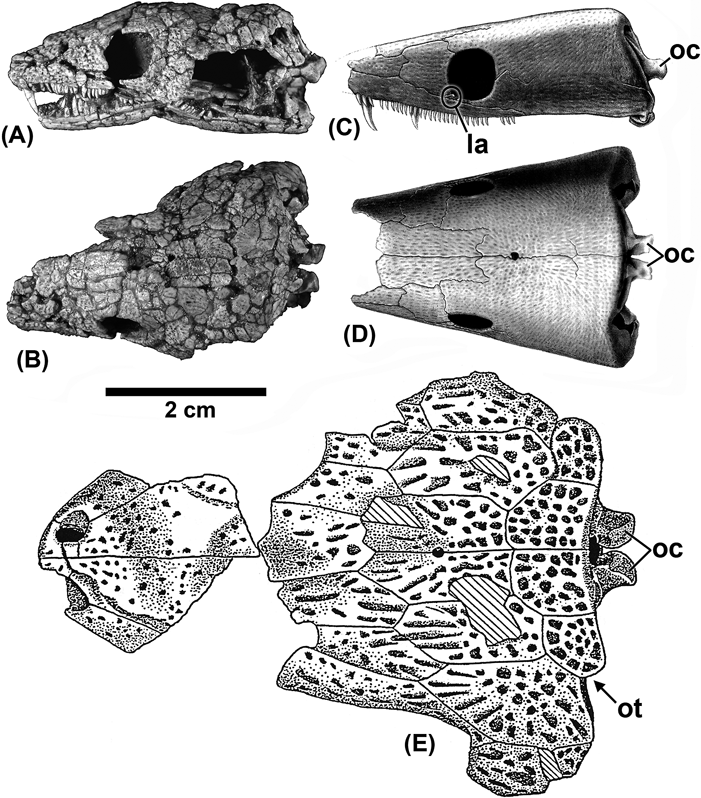
Temnospondyls from the Post Quarry: Rileymillerus cosgriffi holotype skull (TTU-P09168) in left lateral (A) and dorsal (B) views; reconstruction of same in left lateral (C) and dorsal (D) views from Bolt & Chatterjee (Reference Bolt and Chatterjee2000, fig. 2); (E) Drawing of Apachesaurus gregorii skull (TTU-P09216) in dorsal view, modified from Davidow-Henry (Reference Davidow-Henry, Lucas and Hunt1989, fig. 1). Abbreviations: la=lacrimal; oc=occipital condyles; ot=otic notch.
Holotype. TTU-P09168 skull and mandible.
Referred specimen. TTU-P09170 partial axial skeleton found near holotype skull.
Discussion. To date, only two temnospondyls are recognised from the Upper Triassic of western North America that are not metoposaurids, Latiscopus disjunctus from the Otis Chalk locality in Howard County (Wilson Reference Wilson1948) and the very similar Rileymillerus cosgriffi (Bolt & Chatterjee Reference Bolt and Chatterjee2000) from the Post Quarry. The type and only known individual of Rileymillerus (TTU-P09168; Fig. 4A–D) is a tiny (approximately 35 mm long), nearly complete skull and mandible with an associated series of vertebrae (TTU-P09170). Rileymillerus can be identified as a stereospondyl in part because of its bilobed exoccipital condyle (Fig. 4D; Schoch Reference Schoch2008, character 62:1); moreover, it may be closely related to metoposaurids based on the presence a small lacrimal confined to the anterior part of the orbit (Fig. 4C; Schoch Reference Schoch2008, pp. 88, 103). The skull of Rileymillerus is distinguished from contemporaneous metoposaurids by: the lack of lateral line grooves; a highly derived ascending lamina of the pterygoid; the absence of tabular horns or distinct otic notches; and the relatively unflattened nature of the skull (Bolt & Chatterjee Reference Bolt and Chatterjee2000).
Metoposauridae Watson, Reference Watson1919
Apachesaurus Hunt, Reference Hunt and Morales1993
Apachesaurus gregorii Hunt, Reference Hunt and Morales1993
Referred specimen. TTU-P09216 partial skull, mandible, and pectoral girdle.
Discussion. The only metoposaurid material from the Post Quarry (TTU-P09216, Fig. 4E) (Davidow-Henry Reference Davidow-Henry, Lucas and Hunt1989; Long & Murry Reference Long and Murry1995) was misplaced while on loan, and its current whereabouts are unknown. Fortunately, a natural mold remains in the Texas Tech collection, and the specimen was photographed and figured (Davidow-Henry Reference Davidow-Henry, Lucas and Hunt1989, fig. 1, plate 4C–D; Hunt Reference Hunt and Morales1993, fig. 13F). This specimen was assigned to Apachesaurus gregorii (Hunt Reference Hunt and Morales1993). Although the specimen does not preserve the orbits, lacrimals, quadrates, parasphenoid, dorsal intercentra, or ilia, which are used to diagnose Metoposauridae and Apachesaurus (Hunt Reference Hunt and Morales1993; Milner Reference Milner, Fraser and Sues1994; Zanno et al. Reference Zanno, Heckert, Krzyzanowski, Lucas, Heckert and Lucas2002), the shallow otic notches (Fig. 4E) are autapomorphic for A. gregorii (Hunt Reference Hunt and Morales1993), supporting referral to that taxon.
Diapsida Osborn, Reference Osborn1903
Neodiapsida Benton, Reference Benton1985
Lepidosauromorpha Benton, Reference Benton1983sensu Gauthier et al., Reference Gauthier, Kluge, Rowe and Benton1988
Lepidosauria Haeckel, Reference Haeckel1866sensu Gauthier et al., Reference Gauthier, Kluge, Rowe and Benton1988
Sphenodontia Williston, Reference Williston1925
Clevosauridae Fraser, 1993 sensu Bonaparte & Sues, Reference Bonaparte and Sues2006
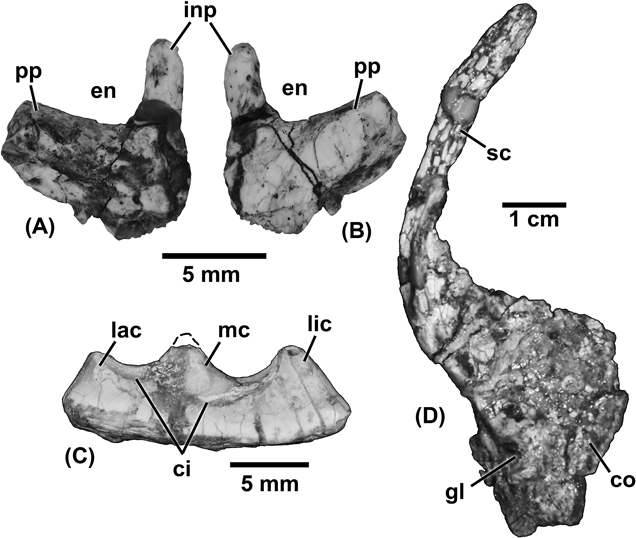
Small diapsids from the Post Quarry: Clevosaurid sphenodontian left premaxilla (TTU-P09472) in medial (A) and lateral (B) views; (C) Trilophosaurus dornorum tooth (TTU-P09497) in anterior or posterior view; (D) Simiosaurian right scapulocoracoid (TTU-P09604) in lateral view. Abbreviations: ci=cingulum; co=coracoid; en=external nares; gl=glenoid; inp=internarial process; lac=labial cusp; lic=lingual cusp; mc=medial cusp; pp=posterior process; sc=scapula.
Referred specimen. TTU-P09472 left premaxilla.
Discussion. Both lepidosauromorphs and non-archosauriform archosauromorphs are known from the Post Quarry, although this material is awaiting more detailed description by two of the authors (N. Fraser and B. Mueller, unpublished data). A left premaxilla (TTU-P09472; Fig. 5A–B) is entirely consistent with Clevosaurus (Fraser Reference Fraser1988; Säilä Reference Säilä2005; Bonaparte & Sues Reference Bonaparte and Sues2006) and Godavarisaurus (Evans et al. Reference Evans, Prasad and Manhas2001), but distinct from other sphenodontians, because it bears a well-developed posterior process underlying the anterior part of the maxilla and forming the entire posterior margin of the external naris.
Archosauromorpha Huene, Reference Huene1946sensu Benton, Reference Benton1985
Trilophosaurus Case, Reference Case1928
Trilophosaurus dornorum Mueller & Parker, Reference Mueller, Parker, Parker, Ash and Irmis2006
Referred specimen. TTU-P09497 tooth.
Discussion. TTU-P09497 (Fig. 5C), an isolated tooth, possesses the diagnostic crown morphology of Trilophosaurus dornorum (Mueller & Parker Reference Mueller, Parker, Parker, Ash and Irmis2006). Species of Trilophosaurus are distinguished primarily on differences between their transversely expanded teeth (Murry Reference Murry1987; Heckert et al. Reference Heckert, Lucas, Rinehart, Spielmann, Hunt and Kahle2006; Mueller & Parker Reference Mueller, Parker, Parker, Ash and Irmis2006; Spielmann et al. Reference Spielmann, Lucas, Heckert, Rinehart, Hunt, Lucas and Spielmann2007, Reference Spielmann, Lucas, Rinehart and Heckert2008). In T. dornorum and T. buettneri, the cusps are of subequal height (the central cusp is tallest in T. jacobsi). However, in T. dornorum the medial cusp is connected to both the labial and lingual cusps by a cingulum (Fig. 5C); this is unlike the condition in both T. buettneri and T. jacobsi. Also, the medial cusp of T. dornorum is offset more labially than that of T. buettneri and T. jacobsi. Moreover, the teeth and dentaries of T. dornorum are larger and more robust than in the other species, and there are fewer teeth posterior to the lateral process of the maxilla than in T. buettneri (Mueller & Parker Reference Mueller, Parker, Parker, Ash and Irmis2006).
Spielmann et al. (Reference Spielmann, Lucas, Heckert, Rinehart, Hunt, Lucas and Spielmann2007) questioned the validity of T. dornorum and claimed that it was a junior synonym of T. jacobsi. They argued that T. jacobsi was the only species present in the Kahle Trilophosaurus Quarry in Borden County, Texas, and that the larger specimens of Trilophosaurus from that locality showing the diagnostic features of T. dornorum (including its relatively large size) are referable to T. jacobsi (Spielmann et al. Reference Spielmann, Lucas, Heckert, Rinehart, Hunt, Lucas and Spielmann2007, p. 239). However, it was not made clear why they assigned these teeth to large individuals of T. jacobsi instead of recognizing T. dornorum as a valid species co-existing in the Kahle Quarry with T. jacobsi. Specimens showing an intermediate size and morphology between T. jacobsi and T. dornorum and/or a mosaic of characters from both species could indicate that T. dornorum merely represents large individuals of T. jacobsi, but Spielmann et al. (Reference Spielmann, Lucas, Heckert, Rinehart, Hunt, Lucas and Spielmann2007) presented no evidence in support of this. We recognise the distinctiveness of T. dornorum from other species, pending a more detailed study of the Kahle Quarry material that places T. dornorum in the range of variation of T. jacobsi.
Simiosauria Senter, Reference Senter2004
Referred specimen. TTU-P09604 nearly complete right scapulocoracoid, TTU-P9606 partial left scapulocoracoid preserving glenoid.
Discussion. Two scapulacoracoids collected at the Post Quarry (TTU-P09604 and TTU-P09606) (Fig. 5D) are referable to Simiosauria (the clade including Drepanosauridae) based on their long, slender, and anteriorly oriented scapular blades (Senter Reference Senter2004, character 44:1). These elements are very similar to the scapulacoracoids identified as drepanosaurid from the Ghost Ranch Coelophysis Quarry in New Mexico (GR 1113; Harris & Downs Reference Harris and Downs2002). However, the Post Quarry scapulacoracoids are much larger; the length from the distal end of the right scapula to the middle of the glenoid in TTU-P09604 (Fig. 5D) is 71·4 mm, compared to 40 mm in GR 1113 (Harris & Downs Reference Harris and Downs2002). As with GR 1113, the suture between the scapula and coracoid is difficult to discern, and there is no coracoid foramen (Harris & Downs Reference Harris and Downs2002). It has been suggested that cervical vertebrae from the Post Quarry assigned to Protoavis (Chatterjee Reference Chatterjee1995) may belong to a drepanosaurid (Renesto Reference Renesto2000; Renesto et al. Reference Renesto, Spielmann, Lucas and Spagnoli2010); that identification will be addressed below.
Archosauriformes Gauthier et al., Reference Gauthier, Kluge, Rowe and Benton1988
Phytosauria Meyer, Reference Meyer1861sensu Doyle & Sues, Reference Doyle and Sues1995
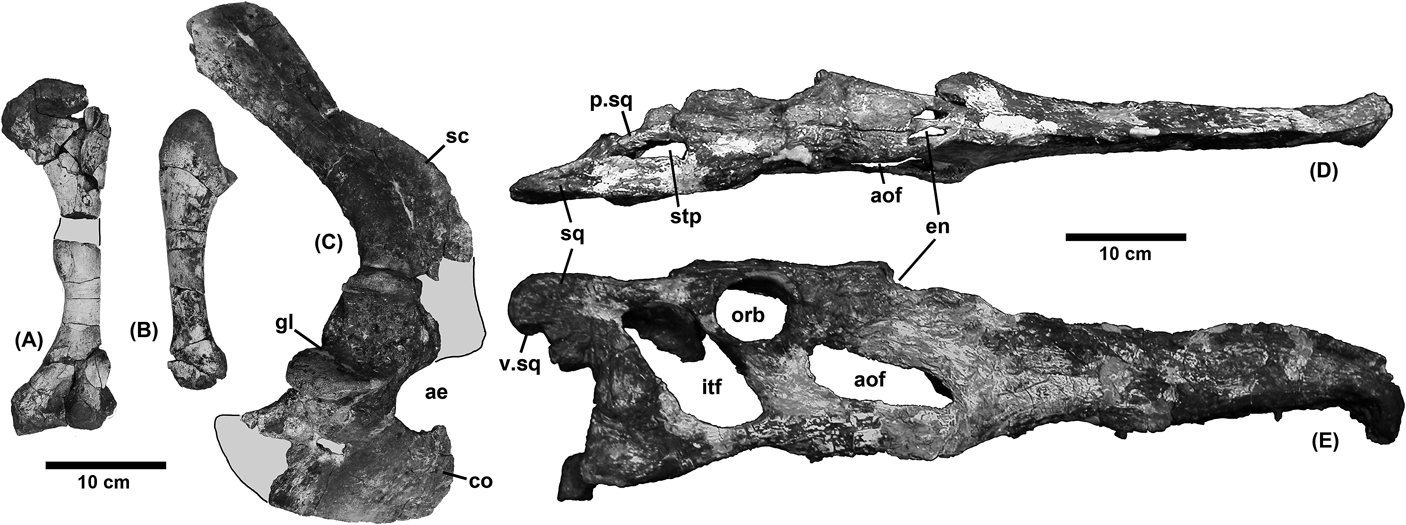
Phytosaurs from the Post Quarry: (A) left humerus (TTU-P09231) in anterior view; (B) right ulna (TTU-P09231) in lateral view; (C) right scapulocoracoid (TTU-P09236) in lateral view; Skull of Leptosuchus (TTU-P09234) in dorsal (D) and right lateral (E) views. Abbreviations: ae=anterior emargination; aof=antorbital fenestra; co=coracoid; en=external nares; gl=glenoid; itf=infratemporal fenestra; orb=orbit; p.sq=parietal process of the squamosal; sc=scapula; sq=squamosal; stp=supratemporal fenestra; v.sq=ventral edge of squamosal.
Referred specimens. TTU-P09231 left humerus, right ulna, proximal end of left ulna; TTU-P09236 almost complete right scapulocoracoid.
Discussion. Appendicular elements from the Post Quarry (Fig. 6A–C) can be identified as phytosaur based on several autapomorphies. The humerus (TTU-P09231, Fig. 6A) has the distinctive asymmetry of phytosaur humeri in which the lateral edge is almost straight (e.g. Long & Murry Reference Long and Murry1995, fig. 49); in most archosaurs, the proximal and distal ends of the humerus are more laterally expanded. The ulnae (also TTU-P09231; Fig. 6B) are mediolaterally compressed and lack the lateral radius tuber present in archosaurs (Nesbitt Reference Nesbitt2011, character 237:0). The scapula (TTU-P09236, Fig. 6C) possesses a pronounced crescentic eminence on the anterior edge typical of phytosaur scapulae (e.g. Long & Murry Reference Long and Murry1995, fig. 30) with a deep anterior emargination, and lacks a coracoid foramen and the biceps tubercle present in archosaur coracoids (Sereno Reference Sereno1991b; Long & Murry Reference Long and Murry1995; Nesbitt Reference Nesbitt2011, character 225:0). Because Chatterjee's unpublished quarry notes do not make clear how closely associated these elements were with the cranial remains (TTU-P09234) (assigned below to Leptosuchus), and because systematic variation in phytosaur postcrania is poorly understood, these elements can be assigned only to Phytosauria.
Phytosauridae Doyle & Sues, Reference Doyle and Sues1995
Leptosuchomorpha Stocker, Reference Stocker2010
Leptosuchus Case, Reference Case1922
Referred specimen. TTU-P09234 partial skull and mandibles.
Discussion. TTU-P09234 (Fig. 6D–E) includes the only phytosaur skull from the Post Quarry. This specimen was originally assigned to Nicrosaurus (Chatterjee Reference Chatterjee and Padian1986a; Simpson Reference Simpson1998) because of the presence of a crested snout. It was later assigned to Leptosuchus (Lehman & Chatterjee Reference Lehman and Chatterjee2005) without explanation. Much of the left side of the skull and most of the braincase are missing (Fig. 6D). However, the right side of the skull is nearly complete, although it is in need of extensive preparation. TTU-P09234 also includes most of both mandibles.
The posterior border of the external naris is positioned posterior to the anterior border of the antorbital fenestra (diagnostic of Phytosauridae) (Stocker Reference Stocker2010, character 2:2). Although partially reconstructed, the supratemporal fenestrae is depressed, with the parietal process of the squamosal positioned below the level of the skull roof (diagnostic of an unnamed clade containing Rutiodon carolinensis, Protome batalaria, and Leptosuchomorpha) (Stocker Reference Stocker2010, Reference Stocker2012, character 32:1). This differs from the fully depressed supratemporal fenestra present in the pseudopalatines Machaeroprosopus (sensu Parker et al., Reference Parker, Hungerbühler and Martz2013; this volume) and Mystriosuchus (Long & Murry Reference Long and Murry1995; Hungerbühler Reference Hungerbühler2002; Stocker Reference Stocker2010, character 32:2). The occiput is not well enough preserved to determine if a subsidiary opisthotic process is present as in Pravusuchus and pseudopalatines (Stocker Reference Stocker2010). The posterior process of the squamosal is greatly expanded dorsoventrally and rounded posteriorly, as is typical for non-pseudopalatine leptosuchomorphs (Stocker Reference Stocker2010, Reference Stocker2012, character 25:2).
The dorsal edge of the squamosal of TTU-P9234 is extremely narrow mediolaterally (Fig. 6D) and a distinct posterior process of the squamosal bears a horizontal ventral edge (Fig. 6E), similar to the condition in Leptosuchus crosbiensis (UMMP 7522; Stocker Reference Stocker2010, character 28:1); this is distinct from Smilosuchus adamanensis and S. gregorii in which the posterior process of the squamosal is shorter and broader in dorsal view, and lacks a horizontal ventral edge (Long & Murry Reference Long and Murry1995; Stocker Reference Stocker2010).
Although the squamosal of TTU-P9234 is similar to those of Leptosuchus crosbiensis (UMMP 7522) and Leptosuchus studeri (UMMP 14267), there are subtle differences between those specimens and TTU-P9234, in both the squamosal and other regions of the skull, that indicate that TTU-P9234 may be a distinct taxon. Compared to UMMP 7522, the posterior process of the squamosal is shorter anteroposteriorly in TTU-P9234. The postorbital-squamosal bar is slightly wider in dorsal view because of a medially expanded flange of the squamosal (Stocker Reference Stocker2010, character 26:1), thus concealing more of the supratemporal fenestra in dorsal view than is concealed in Leptosuchus crosbiensis (UMMP 7522) and Leptosuchus studeri (UMMP 14267). The ventral surface of the premaxilla is more undulatory than in Leptosuchus crosbiensis (UMMP 7522) but similar to the amount of undulation in Leptosuchus studeri (UMMP 14267). Further comparisons are difficult until TTU-P09234 is re-prepared thoroughly.
Archosauria Cope, Reference Cope1869sensu Gauthier & Padian, Reference Gauthier, Padian, Hecht, Ostrom, Viohl and Wellnhofer1985
Pseudosuchia Zittel, Reference Zittel1887–1890sensu Gauthier, Reference Gauthier1986
Aetosauria Marsh, Reference Marsh1884sensu Parker, Reference Parker2007
Stagonolepididae Lydekker, Reference Lydekker1887sensu Heckert & Lucas, Reference Heckert and Lucas2000
Calyptosuchus Long & Ballew, Reference Long, Ballew, Colbert and Johnson1985
Calyptosuchus wellesi Long & Ballew, Reference Long, Ballew, Colbert and Johnson1985
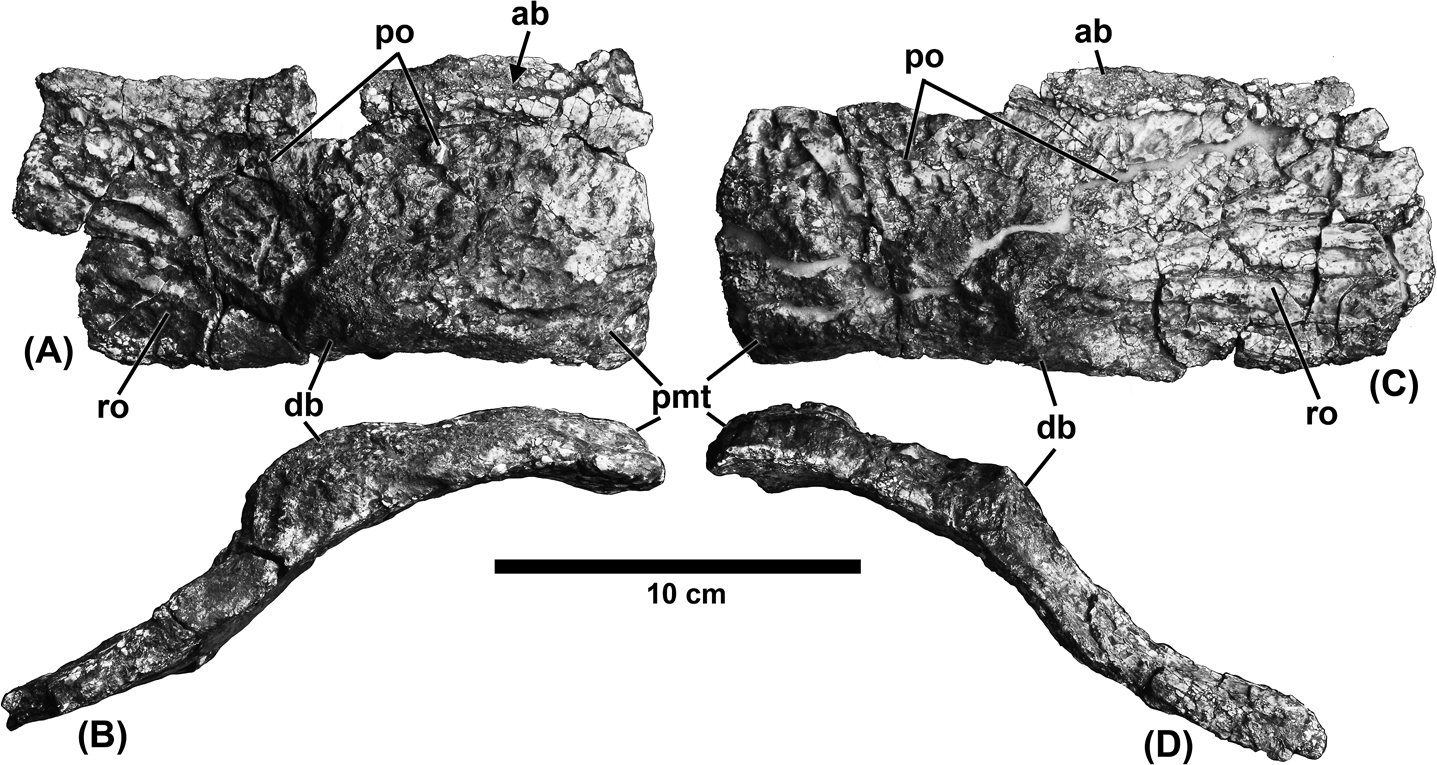
Calyptosuchus wellesi paramedian osteoderms (TTU-P09420) from the Post Quarry: left paramedian in dorsal view (A) and posterior view (B); right paramedian in dorsal view (C) and posterior view (D). Abbreviations: ab=anterior bar; db=dorsal boss; pmt=posteromedial thickening; po=pitted ornamentation; ro=radiating ornamentation. Anterior is at the top of the page for (A) and (C).
Referred specimen. TTU-P09420 (in part) left and right paramedian osteoderms.
Discussion. Two paramedian osteoderms (TTU-P09420; Fig. 7) from the Post Quarry were originally suggested by Martz (Reference Martz2008) to be unusual Paratypothorax osteoderms. However, subsequent re-preparation revealed a combination of characters that allows assignment of this specimen to Calyptosuchus wellesi (Long & Ballew Reference Long, Ballew, Colbert and Johnson1985). The ornamentation consists of a combination of widely separated pits and fainter radial ornamentation (also seen in Adamanasuchus and the paratypothoracisin Tecovasuchus; Martz & Small Reference Martz and Small2006; Lucas et al. Reference Lucas, Hunt, Spielmann, Lucas and Spielmann2007). The osteoderms possess a raised anterior bar (as in all non-desmatosuchine aetosaurs e.g. Parker Reference Parker2007). The osteoderms are much thicker than present in most non-desmatosuchine aetosaurs, possess a massive blunt boss which extends to the posterior margin of the osteoderm, and possess a distinctive thickening at the posteromedial corner. These latter characters are restricted to dorsal and caudal paramedian osteoderms of Calyptosuchus wellesi (Long & Murry Reference Long and Murry1995; Parker Reference Parker2003) and are distinct from the European taxon Stagonolepis (contra Long & Murry Reference Long and Murry1995; Heckert & Lucas Reference Heckert and Lucas2000, Reference Heckert and Lucas2002a; Parker & Martz Reference Parker and Martz2011, p. 240).
Typothoracisinae Parker, Reference Parker2007
Typothorax Cope, Reference Cope1875
Typothorax coccinarum Cope, Reference Cope1875
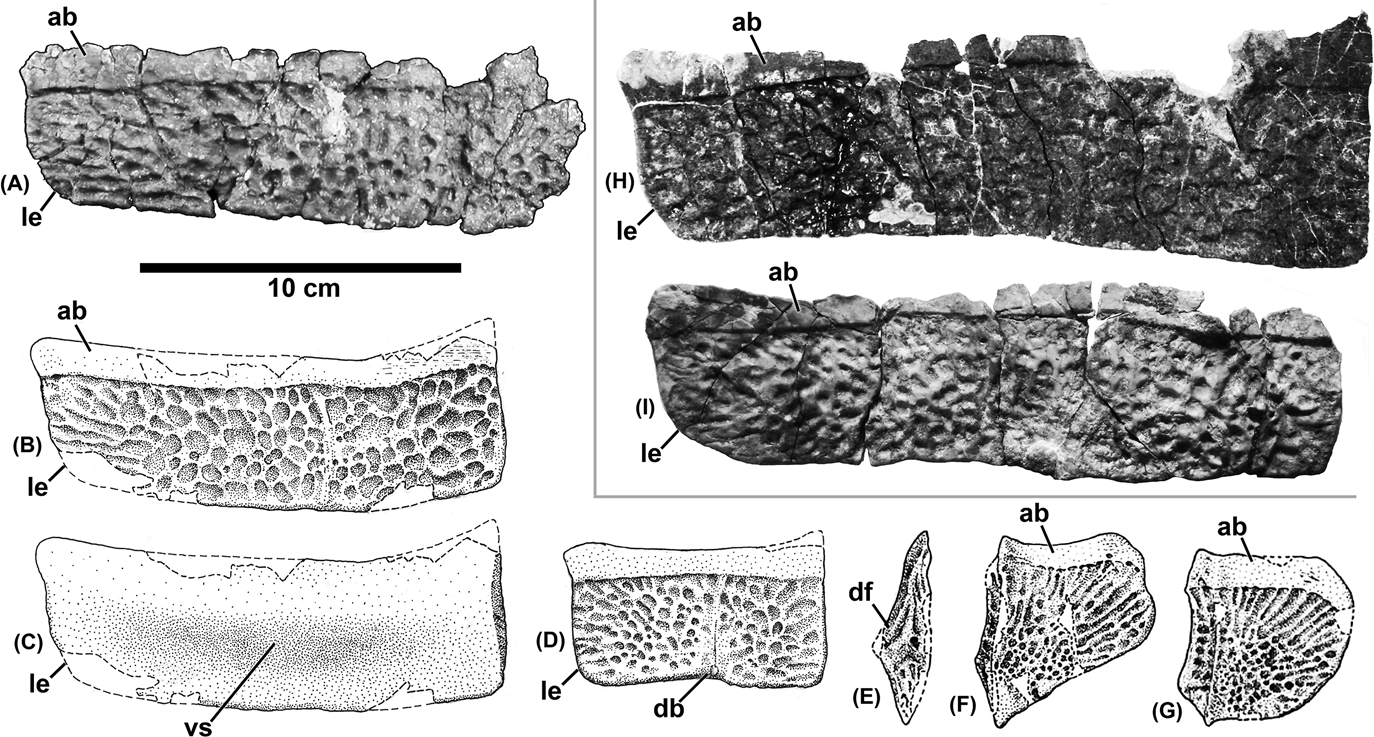
Typothorax osteoderms. Selected osteoderms of the Post Quarry specimen (TTU-P09214): mid-dorsal or anterior caudal paramedian osteoderms in dorsal (A–B) and ventral (C) views; caudal paramedian osteoderm in dorsal view (D); pre-caudal lateral osteoderm in dorsal view (E) and lateral view (F), caudal lateral osteoderm in lateral view (G). (H) Typothorax antiquum (NMMNH P-36075, holotype) from the (?)Santa Rosa Formation, mid-dorsal or anterior caudal paramedian osteoderm in dorsal view. (I) Typothorax coccinarum (PEFO 33980) from the Petrified Forest Member (=Painted Desert Member), mid-dorsal or anterior caudal paramedian osteoderm in dorsal view. Abbreviations: ab=anterior bar; db=dorsal boss; df=dorsal flange; le=lateral edge; vs=ventral strut.
Referred specimens. TTU-P09214 partial skeleton including braincase and osteoderms from most of the carapace.
Discussion. TTU-P09214 (Fig. 8A–G) is a small specimen of Typothorax described by Small (Reference Small, Lucas and Hunt1989b) and Martz (Reference Martz2002) and considered by both to represent a sub-adult of the type species, T. coccinarum. TTU-P09214 is represented by: a partial skull (including a braincase and dentary); vertebrae from most of the column; much of the appendicular skeleton; and numerous paramedian, lateral, and probable ventral and appendicular osteoderms (Small Reference Small, Lucas and Hunt1989b; Martz Reference Martz2002).
TTU-P09214 possesses numerous apomorphies of Typothoracisinae: paramedian osteoderms with a width/length ratio greater than 2 (Fig. 8A–C); and lateral osteoderms with a fairly distinctive suite of characters, including a dorsal flange on the pre-caudal lateral osteoderms that is triangular or tongue-shaped (Fig. 8E) (Parker Reference Parker2007). Autapomorphies of Typothorax present in TTU-P09214 include distinctively pitted paramedian osteoderms (Fig. 8A–B, D), a strongly developed ventral strut on the paramedian osteoderms (Fig. 8C), and pointed dorsal bosses on the posterior edge of the caudal paramedian osteoderms (Fig. 8D) (Long & Ballew Reference Long, Ballew, Colbert and Johnson1985; Long & Murry Reference Long and Murry1995; Heckert & Lucas Reference Heckert and Lucas2000; Martz Reference Martz2002; Heckert et al. Reference Heckert, Lucas, Rinehart, Celesky, Spielmann and Hunt2010).
Typothorax coccinarum is best known from extensive material from the Canjilon Quarry in the Petrified Forest Member (=Painted Desert Member of the Petrified Forest Formation sensu Lucas, Reference Lucas and Morales1993) of north-central New Mexico (Long & Murry Reference Long and Murry1995; Martz Reference Martz2002) and two articulated specimens from the Bull Canyon Formation of northeastern New Mexico (Heckert et al. Reference Heckert, Lucas, Rinehart, Celesky, Spielmann and Hunt2010); these stratigraphic units are all Revueltian (Lucas Reference Lucas1998; Hunt Reference Hunt, Lucas and Ulmer-Scholle2001), which is to say that they fall between the lowest stratigraphic occurrences of the phytosaur taxa Machaeroprosopus and Redondasaurus.
Another putative species, T. antiquum (Fig. 8H; Lucas et al. Reference Lucas, Heckert, Hunt, Heckert and Lucas2002), is alleged by some workers to occur in the Santa Rosa and Garita Creek (=Tecovas) Formations of New Mexico (Hunt & Lucas Reference Hunt, Lucas, Bauer, Kues, Dunbar, Karlstrom and Harrison1995; Lucas et al. Reference Lucas, Heckert, Hunt, Heckert and Lucas2002; Hunt et al. Reference Hunt, Lucas, Heckert, Lucas, Zeigler, Lueth and Owen2005). The paramedian osteoderms of T. antiquum were distinguished from those of T. coccinarum by Lucas et al. (Reference Lucas, Heckert, Hunt, Heckert and Lucas2002, p. 222) in being relatively narrow with a width/length ratio of 2–3 (compared to 4 in T. coccinarum), and in possessing “coarser”, “shallower” and “less dense” ornamentation (interpreted by Parker & Martz Reference Parker and Martz2011 to mean that the pits were spaced farther apart; see Parker & Martz Reference Parker and Martz2011, fig. 7a–c). The lateral osteoderms of Typothorax antiquum were distinguished from those of T. coccinarum by Lucas et al. (Reference Lucas, Heckert, Hunt, Heckert and Lucas2002, p. 222) because they possess “more pronounced radial ridges” and “broader, shallower, and less numerous pits.” According to Lucas et al. (Reference Lucas, Heckert, Hunt, Heckert and Lucas2002) and Hunt et al. (Reference Hunt, Lucas, Heckert, Lucas, Zeigler, Lueth and Owen2005), Typothorax antiquum is not only morphologically distinct from T. coccinarum, but biostratigraphically distinct in being restricted to the Adamanian biozone (i.e. below the lowest occurrence of Machaeroprosopus).
Lucas et al. (Reference Lucas, Heckert, Hunt, Heckert and Lucas2002) did not discuss the possibility that Typothorax antiquum might represent a subadult of T. coccinarum, with the differences between them being ontogenetic. However, a subadult status for T. antiquum is suggested by the fact that the holotype (NMMNH P-36075) is approximately 70–86% the size of the Canjilon Quarry specimens (based on femur length; see Lucas et al. Reference Lucas, Heckert, Hunt, Heckert and Lucas2002, table 6 and Martz Reference Martz2002, table 4.5).
TTU-P09214 (Fig. 8A–G) is an even smaller specimen of Typothorax, being approximately 94% the size of NMMNH P-36075 and 65–81% the size of the Canjilon Quarry specimens (based on femur length; Lucas et al. Reference Lucas, Heckert, Hunt, Heckert and Lucas2002, table 6; Martz Reference Martz2002, table 4.5) The specimen shows at least some of the same osteoderm characters considered by Lucas et al. (Reference Lucas, Heckert, Hunt, Heckert and Lucas2002) to distinguish T. antiquum from T. coccinarum. In particular, the widest paramedians have a width/length ratio of approximately 2.5 (Fig. 8A–C), there are less numerous pits on both the paramedian and lateral osteoderms (Fig. 8A–B, D, F–G) and more deeply incised grooves (forming more pronounced ridges in between) on the lateral flanges of the lateral osteoderms (Fig. 8F–G). However, the pits are just as closely spaced in TTU-P09214 as in large specimens of Typothorax coccinarum (compare Fig. 8A–B, D with Parker & Martz Reference Parker and Martz2011, fig. 7a–c). TTU-P09124 and NMMNH P-36075 share an additional difference from most large specimens of Typothorax coccinarum; the lateral edges of the widest paramedian osteoderms in the smaller specimens are rounded (Fig. 8A–C, H), whereas most large T. coccinarum paramedian osteoderms have straight lateral edges, considered diagnostic of adult size by Martz (Reference Martz2002).
The Giving Site (Petrified Forest National Park, Arizona locality 231) in Petrified Forest National Park, which occurs in the Petrified Forest Member of the Chinle Formation, has produced three Typothorax specimens of different sizes interpreted as an ontogenetic series (Parker Reference Parker, Parker, Ash and Irmis2006, pp. 54–55). In all three specimens, the widest paramedian osteoderms have rounded lateral edges, and the paramedian osteoderms of the mid-sized specimen (PEFO 33980; Fig. 8I) are similar in size and morphology to TTU-P09214. Therefore, TTU-P09214 is morphologically similar both to a putative Adamanian specimen (NMMNH P-36075, Fig. 8H) and an undoubted Revueltian specimen (PEFO 33980; Fig. 8I) of Typothorax. Therefore, we agree with Parker & Martz (Reference Parker and Martz2011, p. 240) that morphologic variation within Typothorax has not been demonstrated to show a compelling stratigraphic signal (contra Lucas et al. Reference Lucas, Heckert, Hunt, Heckert and Lucas2002; Hunt et al. Reference Hunt, Lucas, Heckert, Lucas, Zeigler, Lueth and Owen2005). We assign TTU-P09214 to Typothorax coccinarum following Small (Reference Small, Lucas and Hunt1989a, Reference Small, Lucas and Huntb), Long & Murry (Reference Long and Murry1995) and Martz (Reference Martz2002), and remain dubious as to the validity of T. antiquum.
Martz (Reference Martz2002) suggested that the relatively small size, incompletely fused neurocentral sutures (particularly in the cervical vertebrae), and the incompletely ossified laterosphenoid in TTU-P09214 compared to the Canjilon Quarry specimens, suggested that TTU-P09124 had not achieved full size. However, Irmis (Reference Irmis2007) considered the dorsal and caudal vertebrae neurocentral sutures of TTU-P09214 to be fully closed and more consistent with an animal approaching maturity than with a juvenile or subadult. Currently, histological work is being conducted that may help resolve the stage of maturity of TTU-P09214 (Sarah Werning pers. comm.).
Paratypothoracisini Parker, Reference Parker2007
Paratypothorax Long & Ballew, Reference Long, Ballew, Colbert and Johnson1985
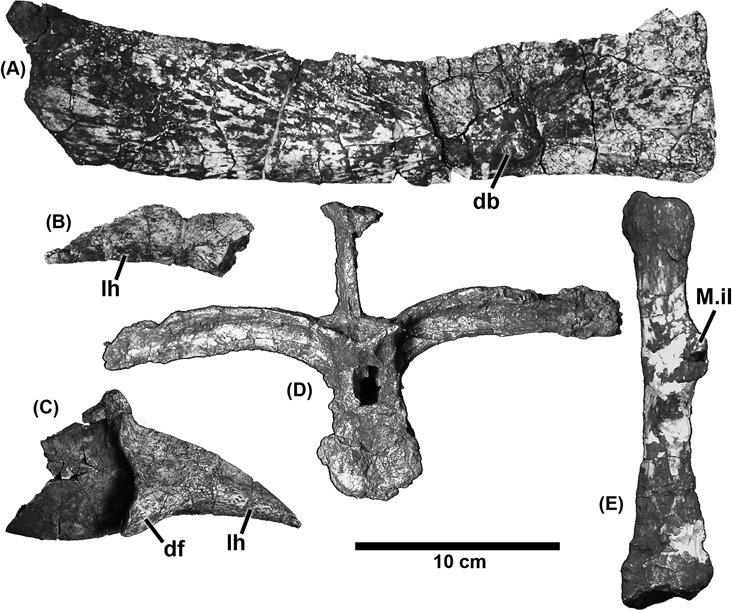
Paratypothorax from the Post Quarry: (A) dorsal paramedian osteoderm (TTU-P09169) in dorsal view; (B) partial lateral osteoderm (TTU-P09215), identified by Small (Reference Small, Lucas and Hunt1989b) as a dentary in dorsal view; (C) lateral osteoderm (TTU-P12540) in dorsal view; (D) dorsal vertebra (TTUP-09416) in anterior view; (E) right fibula from (TTUP-09416) in medial view. Abbreviations: db=dorsal boss; df=dorsal flange; lh=lateral horn; M.il=attachment for M. iliofibularis.
Referred specimens. DMNH 9894 incomplete lateral osteoderm; DMNH 9896 part of a paramedian osteoderm; DMNH 9900 paramedian osteoderm; DMNH 9914 caudal paramedian osteoderm; DMNH 9919 three paramedian osteoderm fragments; DMNH 9921 lateral osteoderm fragments; DMNH 9922 two lateral osteoderm fragments; DMNH 9927 bosses from paramedian osteoderms; DMNH 9928 lateral osteoderms, DMNH 9931 lateral end of paramedian osteoderm; DMNH 9934 two paramedian osteoderm fragments; DMNH 9939 massive incomplete pelvis with two sacral vertebrae; DMNH 9942 block containing at least six paramedian osteoderms; several lateral osteoderms, ribs, and appendicular elements; DMNH 9986 partial paramedian osteoderm; TTU-P09169 complete paramedian osteoderm; TTU-P09215 incomplete paramedian osteoderm, lateral osteoderm horn, chevron, osteoderm fragments, possible skull fragments; TTU-P09416 (in part) vertebra and fibula associated with TTU-P12540 and Desmatosuchus elements; TTU-P11599 incomplete paramedian osteoderms; TTU-P12540 several paramedian and lateral osteoderms.
Discussion. Numerous osteoderms and associated postcranial material are referable to Paratypothorax (Fig. 9; Small Reference Small, Lucas and Hunt1989b; Long & Murry Reference Long and Murry1995). These specimens possess several apomorphies of Typothoracisinae: paramedian osteoderms that have width/length ratios exceeding 2 (Fig. 9A) and lateral osteoderms with a fairly distinctive suite of characters, including a dorsal flange that is triangular or tongue-shaped (Fig. 9C; Parker Reference Parker2007). The specimens also exhibit apomorphies of Paratypothoracisini, including dorsal eminences on the paramedian osteoderms that are strongly offset medially and rarely extend to the posterior margin of the osteoderm (Fig. 9A), as well as lateral osteoderms that have a pronounced, dorsoventrally flattened horn and a tongue-shaped dorsal flange (Fig. 9B–C; Martz & Small Reference Martz and Small2006; Parker Reference Parker2007). Apomorphies of Paratypothorax present in the Post Quarry specimens include: paramedian osteoderms that have width/length rations exceeding 4; a radiating ornamentation of grooves and pits; an anterior bar which is only weakly raised; and a prominent dorsal boss on the dorsal and caudal paramedians (Fig. 9A; Long & Ballew Reference Long, Ballew, Colbert and Johnson1985; Hunt & Lucas Reference Hunt and Lucas1992; Long & Murry Reference Long and Murry1995; Heckert & Lucas Reference Heckert and Lucas2000; Lucas et al. Reference Lucas, Heckert, Rinehart, Harris, Lucas, Spielmann, Lockley, Kirkland and Milner2006; Martz & Small Reference Martz and Small2006; Parker Reference Parker2007).
TTU-P09169 (Fig. 9A) is the only complete Paratypothorax paramedian osteoderm from the quarry. TTU-P12540 is a semi-articulated partial carapace that unfortunately was damaged during collection; this specimen includes the most complete Paratypothorax lateral osteoderm from the quarry (Fig. 9C). TTU-P09416, a specimen consisting largely of Desmatosuchus material, also includes an elongate and gracile fibula and a dorsal vertebra with elongate transverse processes (Fig. 9D–E); these differ from Desmatosuchus, in which the fibulae are more robust with a more pronounced crest for the M. iliofibularis (Long & Murry Reference Long and Murry1995, figs 95–96) and the transverse processes on dorsal vertebrae are shorter (Fig. 10C). TTU-P09416 was closely associated with TTU-P12540 (S. Chatterjee, unpublished field notes), and these elements probably belong to the same individual of Paratypothorax. DMNH 9942 (Long & Murry Reference Long and Murry1995, fig. 113A–E) consists of several semi-articulated paramedian and lateral osteoderms, as well as ribs and appendicular elements. The element of TTU-P09215 identified by Small (Reference Small, Lucas and Hunt1989b) as a dentary is the spike of a lateral osteoderm (Fig. 9B); no cranial material of Paratypothorax has yet been identified from the Post Quarry. With the exception of TTU-P12540 and TTU-P09416, there is no information on association between any of the Post Quarry Paratypothorax material, so the number of individuals is unclear.
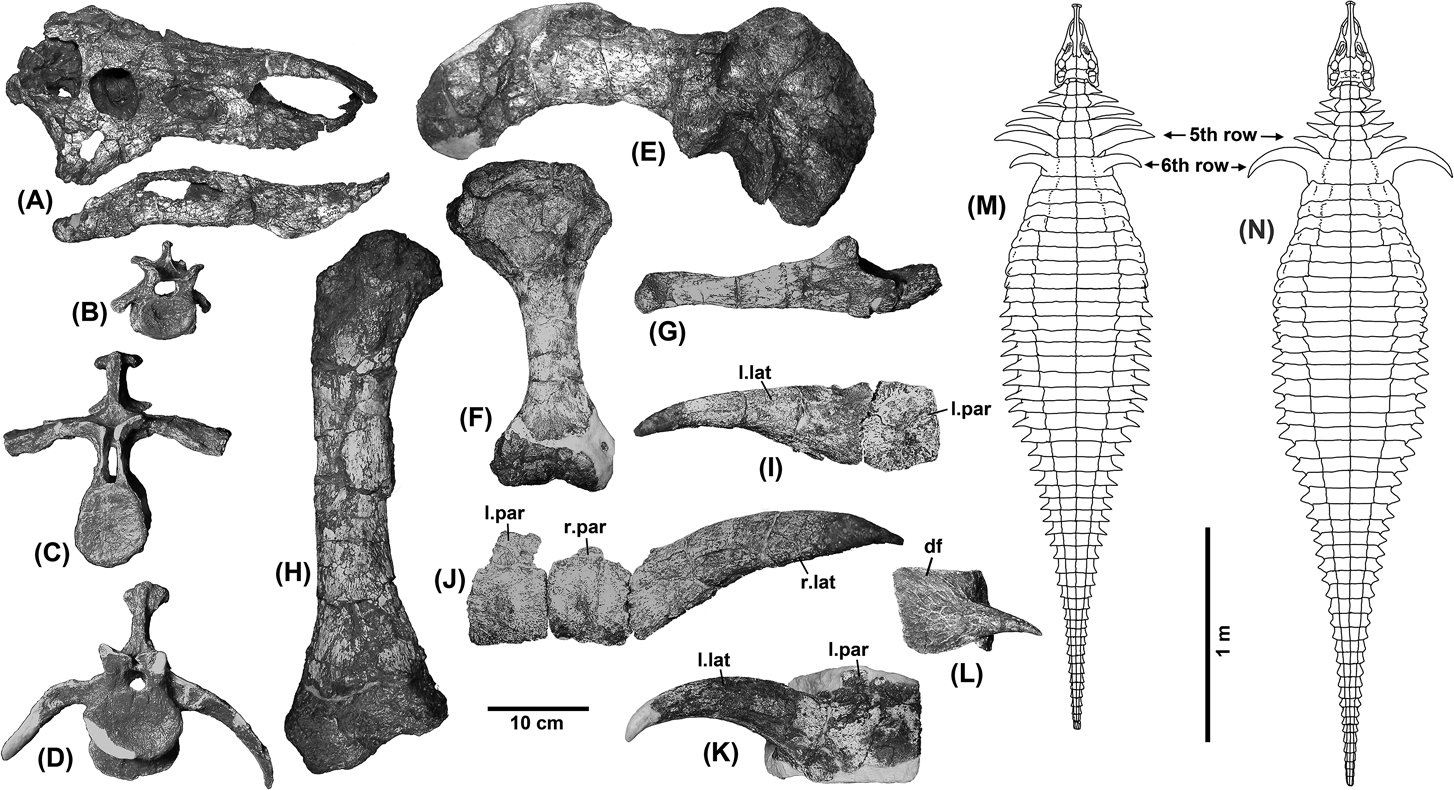
Desmatosuchus smalli holotype (TTU-P09204) from the Post Quarry: (A) skull and mandible in right lateral view; (B) cervical vertebra in anterior view; (C) dorsal vertebra in anterior view; (D) anterior caudal vertebra in anterior view; (E) right scapulocoracoid in lateral view (rotated 90° counterclockwise from anatomical position); (F) left humerus in anterior view; (G) right ulna in medial view; (H) right femur in anterior view; (I) articulated left cervical paramedian and lateral osteoderms interpreted by Parker (Reference Parker2005a, fig. 2A) as from the fourth or fifth row; (J) articulated right cervical paramedian and lateral osteoderms interpreted by Parker (Reference Parker2005a, fig. 2B) as being sixth row and interpreted here as being fifth row; (K) fused left cervical paramedian and lateral osteoderm interpreted here as being sixth row; (L) left pelvic or anterior caudal lateral osteoderm figured by Parker (Reference Parker2005a, fig. 5A). Dorsal carapace reconstruction of Desmatosuchus smalli (M) and D. spurensis (N), scaled to the holotypes (TTU-P09204 and UMMP 7476 respectively). Abbreviations: df=dorsal flange; l.lat=left lateral osteoderm; l.par=left paramedian osteoderm; r.lat=right lateral osteoderm; r.par=right paramedian osteoderm.
The Post Quarry Paratypothorax material received only brief discussion by Small (Reference Small, Lucas and Hunt1989b), who did not assign it to a particular species of Paratypothorax. Long & Murry (Reference Long and Murry1995, pp. 108–114) provided a more thorough description of the DMNH material, and also compared the Post Quarry osteoderms with those of PEFO 3004 (a specimen from the Chinle Formation of Petrified Forest National Park; Lucas et al. Reference Lucas, Heckert, Rinehart, Harris, Lucas, Spielmann, Lockley, Kirkland and Milner2006) and the German genoholotype (SMNS un-numbered Paratypothorax andressorum, Long & Ballew Reference Long, Ballew, Colbert and Johnson1985). Long & Murry (Reference Long and Murry1995, p. 114) noted that the German genoholotype material differs from the Post Quarry and Petrified Forest specimens in having much larger and more bulbous bosses on the dorsal paramedian osteoderms, and the Post Quarry material differed from the German and Petrified Forest specimens in having more elongate and recurved horns on the lateral osteoderms. They considered PEFO 3004 to be intermediate in form between the German and Post Quarry specimens because the bosses on the dorsal paramedian osteoderms are relatively small compared to the German genoholotype, whereas the horns on the lateral osteoderms are not as elongate as in the Post Quarry specimens. Long & Murry (Reference Long and Murry1995), Long & Ballew (Reference Long, Ballew, Colbert and Johnson1985) and Small (Reference Small, Lucas and Hunt1989b), assigned the North American material to Paratypothorax sp. rather than identifying a new species. The North American material may represent a distinct species from the genoholotype (W. Parker and J. Martz, unpublished data).
Desmatosuchinae Huene, Reference Huene1942sensu Heckert & Lucas, Reference Heckert and Lucas2000
Desmatosuchus Case, Reference Case1922
Desmatosuchus smalli Parker, Reference Parker2005a
Holotype. TTU-P09204 partial skeleton consisting of an almost complete skull, complete mandible, badly eroded dorsal vertebra and some caudal vertebrae, complete right scapulocoracoid, complete left humerus, partial pelvis, complete right femur, partial left femur, two complete tibiae which may be too small to belong to the same skeleton, possible large metapodial; numerous paramedian and lateral osteoderms.
Referred material. DMNH 1160-8 lateral osteoderm spike; DMNH 9889 osteoderm fragments; DMNH 9890 anterior caudal vertebrae; DMNH 9893 partial paramedian osteoderm with complete lateral edge; DMNH 9906 incomplete anterior caudal vertebra; DMNH 9909 incomplete lateral osteoderm horn; DMNH 9910 nearly complete lateral osteoderm horn; DMNH 9913 caudal vertebra; DMNH 9939 extremely large partial sacrum; DMNH 9940 several fragmentary paramedian osteoderms and fragment of a lateral osteoderm; DMNH 9941 nearly complete paramedian osteoderm; DMNH 9998 incomplete lateral osteoderm horn; TTU-P09023 excellent skull missing the snout; TTU-P09025 partial skull; TTU-P09204 extensive but mostly fragmentary osteoderms, ribs, probable interclavicles; TTU-P09207 incomplete skull; TTU-P09225 proximal humerus; TTU-P09226 four incomplete lateral osteoderms and two rib fragments; TTU-P09229 some excellent paramedian osteoderms and numerous osteoderm fragments; TTU-P09416 (in part) good cervical, dorsal, and caudal vertebrae, and an excellent scapulocoracoid; TTU-P09419 vertebrae and appendicular material including a partial pelvis, fragmentary osteoderms; TTU-P09420 (in part) mostly disarticulated skull, several cervical vertebrae and lateral osteoderms; TTU-P10083 right humerus and ulna, incomplete lateral osteoderm.
Discussion. The excellent Post Quarry Desmatosuchus material includes multiple skulls, postcranial elements, and osteoderms (Fig. 10A–L; Small Reference Small1985, Reference Small, Lucas and Hunt1989b, Reference Small, Norman and Gower2002). Apomorphies of Desmatosuchinae present in this material include paramedian osteoderms with thickened “tongue and groove” articulations for the lateral osteoderms, cervical paramedians that are longer than wide (Fig. 10I–J), lateral osteoderms which almost all possess elongate spines (Fig. 10I–K), and dorsal laterals that have a dorsal flange larger than the lateral flange (Fig. 10L; Long & Ballew Reference Long, Ballew, Colbert and Johnson1985; Long & Murry Reference Long and Murry1995; Parker Reference Parker2008; Desojo et al. Reference Desojo, Ezcurra and Kischlat2012). Apomorphies shared by the Post Quarry specimens and the genoholotype of Desmatosuchus (UMMP 7476 Desmatosuchus spurensis Case, Reference Case1920; Reference Case1922; Small Reference Small1985, Reference Small, Norman and Gower2002; Parker Reference Parker2008) include an oval and reduced infratemporal fenestra (Fig. 10A), a last presacral vertebra fused to the sacrum, paramedian and lateral osteoderms with depressed anterior laminae rather than raised anterior bars, paramedian osteoderms with a randomly pitted pattern and a dorsal boss usually situated in the middle of the osteoderm, and lateral spines which are especially massive and recurved in the cervical series (Fig. 10I–K) and to a lesser extent in the sacral region (Fig. 10L; Long & Ballew Reference Long, Ballew, Colbert and Johnson1985; Long & Murry Reference Long and Murry1995; Small Reference Shubin, Crompton, Sues and Olsen2002; Parker Reference Parker2005a, Reference Parker2008). Desmatosuchus is also large for an aetosaur (estimated adult length four metres or more).
Small (Reference Small1985, Reference Small, Lucas and Hunt1989b, Reference Small, Norman and Gower2002) and Parker (Reference Parker2005a, Reference Parker2008) recognised that there were differences between the Post Quarry material and D. spurensis (Case Reference Case1920; Parker Reference Parker2008). Parker (Reference Parker2005a) considered these differences sufficient to erect a new species for the Post Quarry specimens, D. smalli. This species is distinguished from D. spurensis by: the absence of a shallow transverse sulcus connecting the supratemporal fenestrae; a highly reduced antorbital fossa; a shallow median pharyngeal recess on the parabasisphenoid; a large gap between the basal tubera and basipterygoid processes; exoccipitals that do not meet on the floor of the braincase; a maxillary tooth count of 10–12; anterior cervical lateral osteoderms with extremely elongate lateral spines (Figs 10I–J, M); and re-curved spines on the sacral and anterior caudal lateral osteoderms (Fig. 10L, M) (Small Reference Small, Lucas and Hunt1989b, Reference Small, Norman and Gower2002; Parker Reference Parker2005a). The holotype for Desmatosuchus smalli (TTU-P09024; Fig. 10A–K) and a referred specimen (TTU-P09023; Small Reference Small, Norman and Gower2002, fig. 1C), both include excellent skull and extensive postcranial material (including paramedian and lateral osteoderms) described by Small (Reference Small1985, Reference Small, Norman and Gower2002) and Parker (Reference Parker2005a); an unpublished quarry map housed at the Museum of Texas Tech shows that the holotype material was associated.
There are five or six cervical osteoderm rows in Desmatosuchus (Fig. 10M; Parker Reference Parker2008). Parker (Reference Parker2005a, fig. 2B) interpreted the largest of the cervical lateral spines of TTU-P09204 (Fig. 10J) as being the sixth and last of the cervical series. Parker (Reference Parker2005a) noted that this large cervical spine differed from the last cervical spine in D. spurensis in being less re-curved and unfused to its adjacent paramedian. However, another lateral spine in TTU-P09204 (Fig. 10K) does have these features, suggesting that this may actually be the homologue of the sixth cervical spine in D. spurensis. The spine interpreted as the sixth cervical spine of D. smalli by Parker (Reference Parker2005a) is likely the penultimate in the cervical series. On the basis of this new interpretation, revised reconstructions of D. smalli and D. spurensis are provided in Fig. 10M–N.
The Post Quarry is remarkable among North American localities in the amount of aetosaur cranial material known, most of which is usually referred to Desmatosuchus (Small Reference Small, Lucas and Hunt1989b; Reference Small, Norman and Gower2002); however, this cranial material has not been completely prepared and described, and the possibility cannot be discounted that some belongs to Calyptosuchus and/or Paratypothorax.
Paracrocodylomorpha Parrish, Reference Parrish1993sensu Weinbaum & Hungerbühler, Reference Weinbaum and Hungerbühler2007
Poposauroidea Nopsca, Reference Nopsca1928
Shuvosauridae Chatterjee, Reference Chatterjee1993sensu Nesbitt, Reference Nesbitt2011
Shuvosaurus inexpectatus Chatterjee, Reference Chatterjee1993
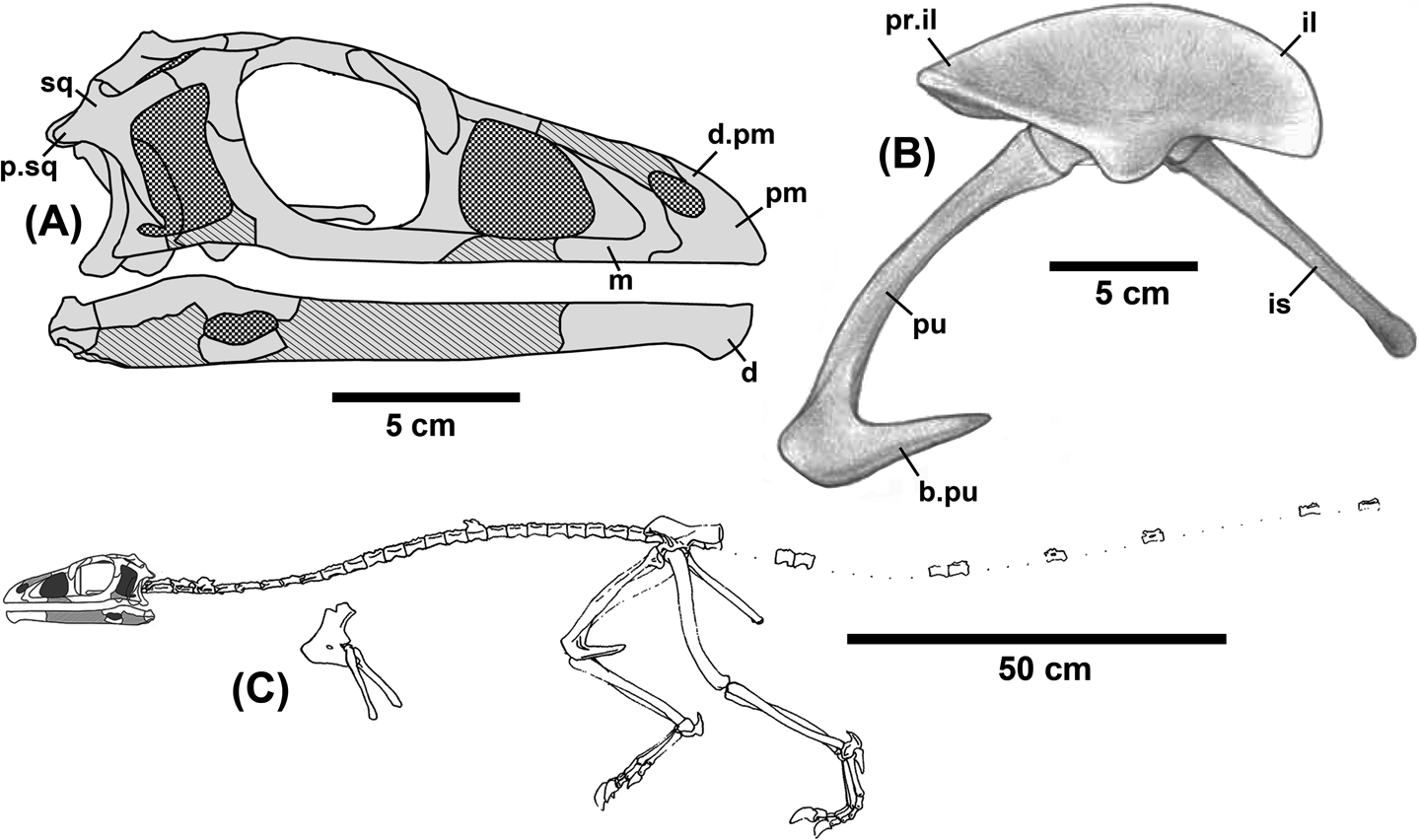
Shuvosaurus inexpectatus from the Post Quarry: (A) skull reconstruction modified from Lehane (Reference Lehane2005, fig. 32A) based on TTU-P09280 and TTU-P09281 in right lateral view; (B) pelvic reconstruction from Weinbaum (Reference Weinbaum2007, fig. 6.1) in left lateral view; (C) skeletal reconstruction modified from Long & Murry (Reference Long and Murry1995, fig. 162) and Lehane (Reference Lehane2005, fig. 32A), based on TTU-P09001 and TTU-P09280 in left lateral view. Abbreviations: b.pu=boot of the pubis, d=dentary, d.pm=dorsal process of the premaxilla, il=ilium; is=ischium; m=maxilla; pm=premaxilla; pr.il=preacetabular process of the ilium; p.sq=parietal process of the squamosal; pu=pubis; sq=squamosal.
Holotype. TTU-P09280 disarticulated skull.
Paratypes. TTU-P09281 anterior portion of dentaries; TTU-P09282 braincase and other cranial fragments.
Referred specimens. TTU-P09001 incomplete postcranial skeleton (holotype of Chatterjeea elegans Long & Murry, Reference Long and Murry1995); TTU-P09003-TTU-P09011 postcranial material; TTU-P09021 (in part) posterior mandible (formerly part of holotype of Technosaurus smalli); TTU-P09235 vertebra; TTU-P09419 (in part) femur and possible vertebrae kept with Desmatosuchus material; TTU-P10969 right quadrate; TTU-P11045 scapula.
Discussion. Long & Murry (Reference Long and Murry1995) recognised that the small “rauisuchian” specimens that Chatterjee (Reference Chatterjee1985) had considered to be juveniles of Postosuchus were actually a distinct, much smaller taxon allied with Poposaurus. They named the new taxon Chatterjeea elegans (holotype TTU-P09001; Fig. 11B–C), and also suggested that a bizarre, edentulous, skull from the Post Quarry that Chatterjee (Reference Chatterjee1993) had named Shuvosaurus inexpectatus (holotype TTU-P09280; Fig. 11A) actually belonged to the Chatterjeea postcrania (see also Weinbaum Reference Weinbaum2002). Although Chatterjee (Reference Chatterjee1993), Rauhut (Reference Rauhut, Sachs, Rauhut and Weigert1997, Reference Rauhut2003) and Lehane (Reference Lehane2005) all noted features of the Shuvosaurus cranial material which argued for theropod affinities, the discovery of a closely related taxon, Effigia okeeffeae with associated cranial and postcranial material (Nesbitt & Norell Reference Nesbitt and Norell2006; Nesbitt Reference Nesbitt2007), showed clearly that Shuvosaurus and Chatterjeea are the same animal. Characters uniting Shuvosaurus and Effigia within Shuvosauridae (sensu Nesbitt Reference Nesbitt2007, Reference Nesbitt2011) include: edentulous jaws; a posteriorly elongate dorsal process of the premaxilla (Fig. 11A); a smooth and unornamented skull roof; greatly elongated parabasisphenoid; elongate cervical vertebrae (Fig. 11C); three or more sacral vertebrae; a vertically oriented ilium with a thin dorsal edge and a long preacetabular process; a slightly perforate acetabulum; and an enormous pubic boot (Fig. 11B) (Chatterjee Reference Chatterjee1993; Long & Murry Reference Long and Murry1995; Nesbitt Reference Nesbitt2007, Reference Nesbitt2011). Shuvosaurus is distinguished from Effigia by: the absence of a posterior process on the premaxilla; the absence of posterior fossae on the lacrimal and squamosal; the possession of a posterior process on the squamosal; a longer dentary (Fig. 11A); the possession of ventral keels on anterior cervical vertebrae; a larger coracoid foramen; and a stouter ulna (Nesbitt Reference Nesbitt2007, Reference Nesbitt2011).
Loricata Merrem, Reference Merrem1820sensu Nesbitt, Reference Nesbitt2011
Rauisuchidae Huene, Reference Huene1936sensu Sereno, Reference Sereno2005
Postosuchus Chatterjee, Reference Chatterjee1985
Postosuchus kirkpatricki Chatterjee, Reference Chatterjee1985
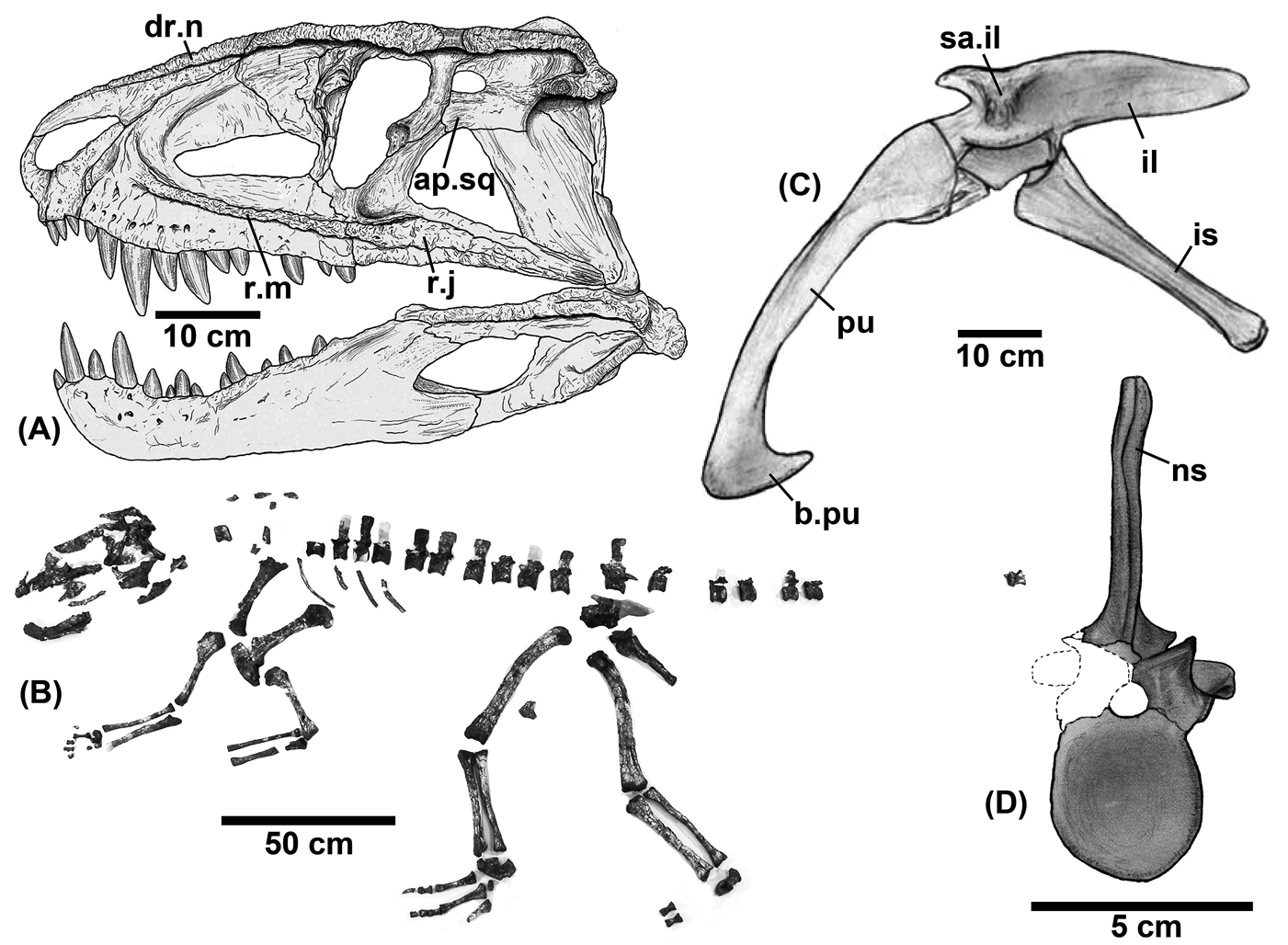
Postosuchus kirkpatricki from the Post Quarry: (A) skull reconstruction modified from Weinbaum (Reference Weinbaum2011, fig. 1) based on TTU-P09000 and TTU-P09002 in left lateral view; (B) skeleton of TTU-P09002 in left lateral view; (C) pelvic reconstruction modified from Weinbaum (Reference Weinbaum2002, fig. 5.25) in left lateral view; (D) mid-dorsal vertebra of TTU-P09002 in anterior view modified from Weinbaum (Reference Weinbaum2007, fig. 5.5F). Abbreviations: ap.sq=anterior process of the squamosal dividing the lateral temporal fenestra; b.pu=boot of the pubis; dr.n=dorsolateral ridge of the nasal; il=ilium; is=ischium; ns=neural spine; pu=pubis; r.j=ridge on the jugal; r.m=ridge on the maxilla; sa.il=supraacetabular buttress of the ilium.
Holotype. TTU-P09000 nearly complete skull, most of the pectoral and forelimb elements, some vertebrae, pelvic, and hindlimb elements.
Paratype. TTU-P09002 most of the skull and appendicular skeleton, and several vertebrae.
Discussion. The Post Quarry holotype and paratype material (TTU-P09000 and TTU-P09002; Fig. 12) are the two most complete and representative specimens of Postosuchus kirkpatricki (Chatterjee Reference Chatterjee1985; Long & Murry Reference Long and Murry1995; Weinbaum Reference Weinbaum2007, Reference Weinbaum2011, Reference Weinbaum2013). Postosuchus kirkpatricki is the only formally named rauisuchid from western North America, although Heptasuchus clarki (Dawley et al. Reference Dawley, Zawiskie and Cosgriff1979) from the Popo Agie Formation of Wyoming may be closely related with Batrachotomus, a non-rauisuchid loricatan (sensu Nesbitt, Reference Nesbitt2011).
Although Peyer et al. (Reference Peyer, Carter, Sues, Novak and Olsen2008) were equivocal about the referral of postcranial elements from the Post Quarry to Postosuchus, several lines of evidence corroborate the association of this material (Chatterjee Reference Chatterjee1985; Weinbaum Reference Weinbaum2011; Nesbitt Reference Nesbitt2011). Several characters of the postcranial elements support referral to Paracrocodylomorpha, Loricata, and Rauisuchidae (sensu Nesbitt, Reference Nesbitt2011), including: an absence of spine tables on the dorsal vertebrae (Fig. 12D); a ventrally deflected ilium with a rugose supraacetabular crest; and an elongate pubis with an expanded boot (Fig. 12C; Weinbaum Reference Weinbaum2007; Reference Weinbaum2011; Nesbitt Reference Nesbitt2011). Quarry maps (Chatterjee Reference Chatterjee1985, fig. 22) indicate that the skulls and postcrania were closely associated for both the holotype and paratype specimens. Moreover, there is a consistent size difference between the holotype and paratype elements (the cranial and postcranial elements of the latter are all smaller), and paired elements within each specimen compare in size (Fig. 12B), indicating that they are not chimeras.
The skull of Postosuchus has many similarities with the European rauisuchids Teratosaurus and Polonosuchus (Weinbaum & Hungerbühler Reference Weinbaum and Hungerbühler2007; Brusatte et al. Reference Brusatte, Butler, Sulej and Niedźwiedzki2009; Nesbitt Reference Nesbitt2011; Weinbaum Reference Weinbaum2011). Postosuchus is united with other rauisuchids (sensu Nesbitt, Reference Nesbitt2011) in possessing: a distinct ridge on the dorsolateral margin of the nasal; an anteroventral process of the squamosal that contacts the postorbital to bisect the lower temporal fenestra; a rounded and bulbous longitudinal ridge on the jugal (Fig. 12A); and two keels on the ventral surface of the axis (Weinbaum Reference Weinbaum2007; Reference Weinbaum2011; Nesbitt Reference Nesbitt2011). Possible cranial autapomorphies of Postosuchus kirkpatricki are a rounded, rugose ridge on the maxilla continuous with that on the jugal (Fig. 12A), and a foramen on a fossa on the medial side of the ascending process of the maxilla (Weinbaum Reference Weinbaum2011).
Crocodylomorpha Walker, Reference Walker1968sensu Sereno, Reference Sereno2005
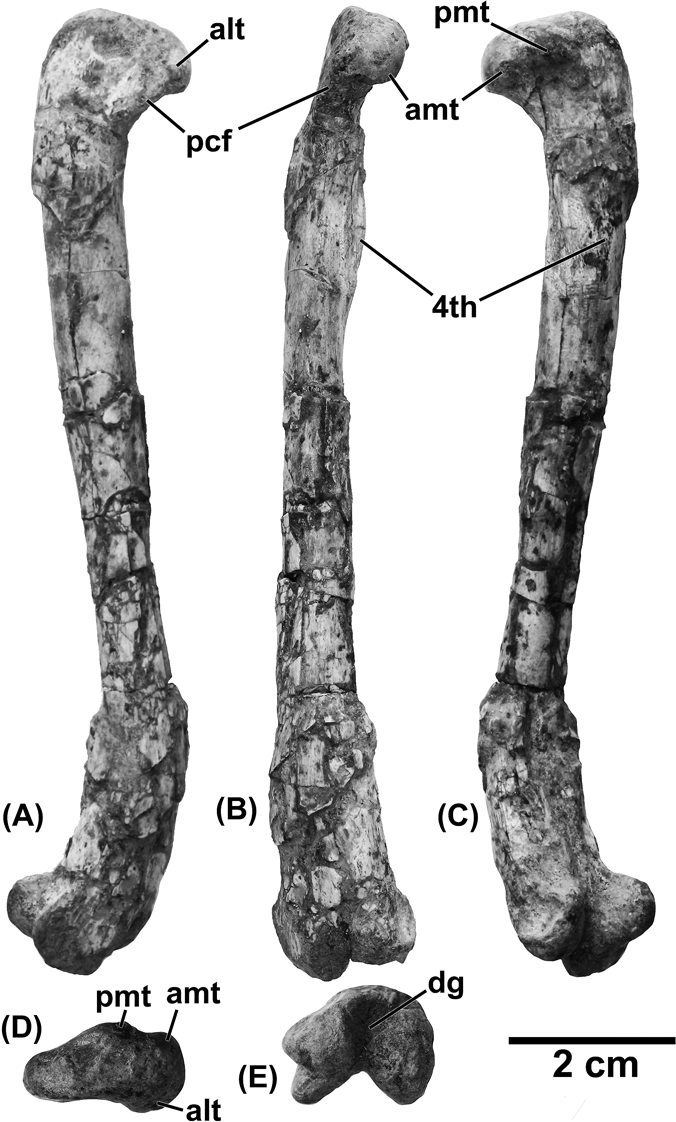
Crocodylomorph right femur (TTU-P11443) from the Post Quarry, in anterolateral (A), posterolateral (B), posteromedial (C), proximal (D) and distal (E) views. Abbreviations: 4th=fourth trochanter; alt=anterolateral tuber; amt=anteromedial tuber; dg=distal groove; pcf=proximal condylar fold; pmt=posteromedial tuber.
Referred specimen. TTU-P11443 complete right femur.
Discussion. A short, gracile right femur (Fig. 13) was found as an isolated element in the quarry and is the only evidence of a crocodylomorph from the Post Quarry. The proximal end of the femur bears a distinct anterolateral tuber, equally sized anteromedial and posteromedial tubera, and the proximal surface is distinctly rounded (Fig. 13D), as in the early crocodylomorph Hesperosuchus agilis (AMNH FR 6758). A small ridge of bone extending from the head of the femur to the shaft is present (=proximal condylar fold of Nesbitt Reference Nesbitt2011; Fig. 13A) and is characteristic of crocodylomorphs and at least some rauisuchids (Nesbitt et al. Reference Nesbitt, Turner, Erickson and Norell2006; Nesbitt Reference Nesbitt2011). The fourth trochanter is mound-like (Fig. 13B) and consistent with that found in the early crocodylomorph Hesperosuchus agilis (AMNH FR 6758). The distal surface seems to bear a groove between the medial and lateral condyles (Fig. 13E) similar to Hesperosuchus agilis (AMNH FR 6758); however, the distal surface is damaged, so it is not clear that this groove is natural. Therefore, we assign TTU-P11443 to Crocodylomorpha, but cannot assign it to a more exclusive clade.
Dinosauromorpha Benton, Reference Benton1985sensu Sereno, Reference Sereno1991b
Lagerpetidae Arcucci, Reference Arcucci1986sensu Nesbitt et al., Reference Nesbitt, Irmis, Parker, Smith, Turner and Rowe2009a
Dromomeron Irmis et al., Reference Irmis, Nesbitt, Padian, Smith, Turner, Woody and Downs2007b
Dromomeron gregorii Nesbitt et al., Reference Nesbitt, Irmis, Parker, Smith, Turner and Rowe2009a
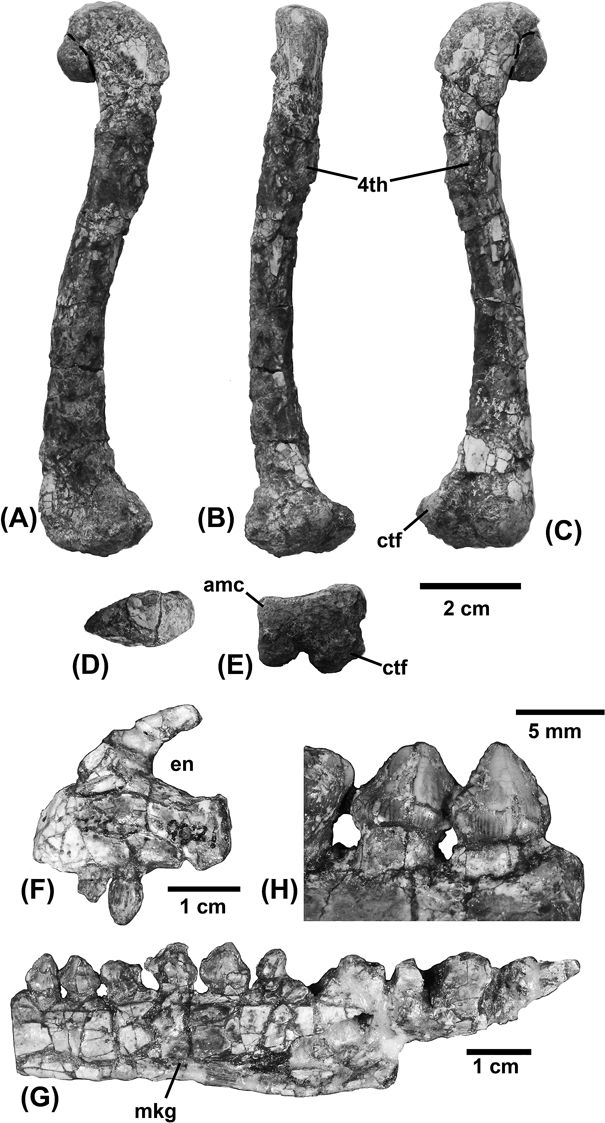
Non-dinosaurian dinosauromorphs from the Post Quarry: Dromomeron gregorii left femur (TTU-P11282) in anterolateral (A), posterolateral (B), posteromedial (C), proximal (D) and distal (E) views; Technosaurus smalli holotype (TTU-P09021): left premaxilla in lateral view (F); right dentary in medial (lingual) view (G); anterior dentary teeth in labial view (H). Abbreviations: 4th=fourth trochanter of the femur; amc=anteromedial corner of the distal end of the femur; ctf=crista tibiofibularis, en=external nares; mkg=Meckelian groove.
Referred specimens. TTU-P11282 complete left femur.
Discussion. A left femur of a lagerpetid (Fig. 14A–E; TTU-P11282) from the Post Quarry is nearly complete, although the surface is poorly preserved and the medial end of the head has been broken and displaced ventrally. TTU-P11282 shares with other lagerpetids an enlarged crista tibiofibularis (Fig. 14C, E; Sereno & Arcucci Reference Sereno and Arcucci1994; Irmis et al. Reference Irmis, Nesbitt, Padian, Smith, Turner, Woody and Downs2007b; Nesbitt Reference Nesbitt2011; character 326:1) and the absence of the anterolateral tuber on the proximal portion of the femur (Sereno & Arcucci Reference Sereno and Arcucci1994; Irmis et al. Reference Irmis, Nesbitt, Padian, Smith, Turner, Woody and Downs2007b; Nesbitt Reference Nesbitt2011; character 302:1). Furthermore, TTU-P11282 shares the following character states with Dromomeron romeri and D. gregorii: a hook-shaped femoral head (Nesbitt et al. Reference Nesbitt, Irmis, Parker, Smith, Turner and Rowe2009a); a distinct scar oriented mediolaterally on the anterior surface of the distal portion of the femur (Nesbitt et al. Reference Nesbitt, Irmis, Parker, Smith, Turner and Rowe2009a; Nesbitt Reference Nesbitt2011; character 322:1); and a squared off anteromedial corner of the distal end of the femur (Fig. 14E) (Nesbitt et al. Reference Nesbitt, Irmis, Parker, Smith, Turner and Rowe2009a; Nesbitt Reference Nesbitt2011; character 327:1). TTU-P11282 lacks the sharp, proximodistally oriented ridge at the anteromedial corner of the distal end of the femur characteristic of Dromomeron romeri (Irmis et al. Reference Irmis, Nesbitt, Padian, Smith, Turner, Woody and Downs2007b), and the fourth trochanter of TTU-P11282 is damaged but appears to be mound-like as in D. gregorii (Fig. 14B). Therefore, the Post Quarry femur is assigned to Dromomeron gregorii.
Dinosauriformes Novas, Reference Novas1992
Referred specimens. TTU-P11127 tibia.
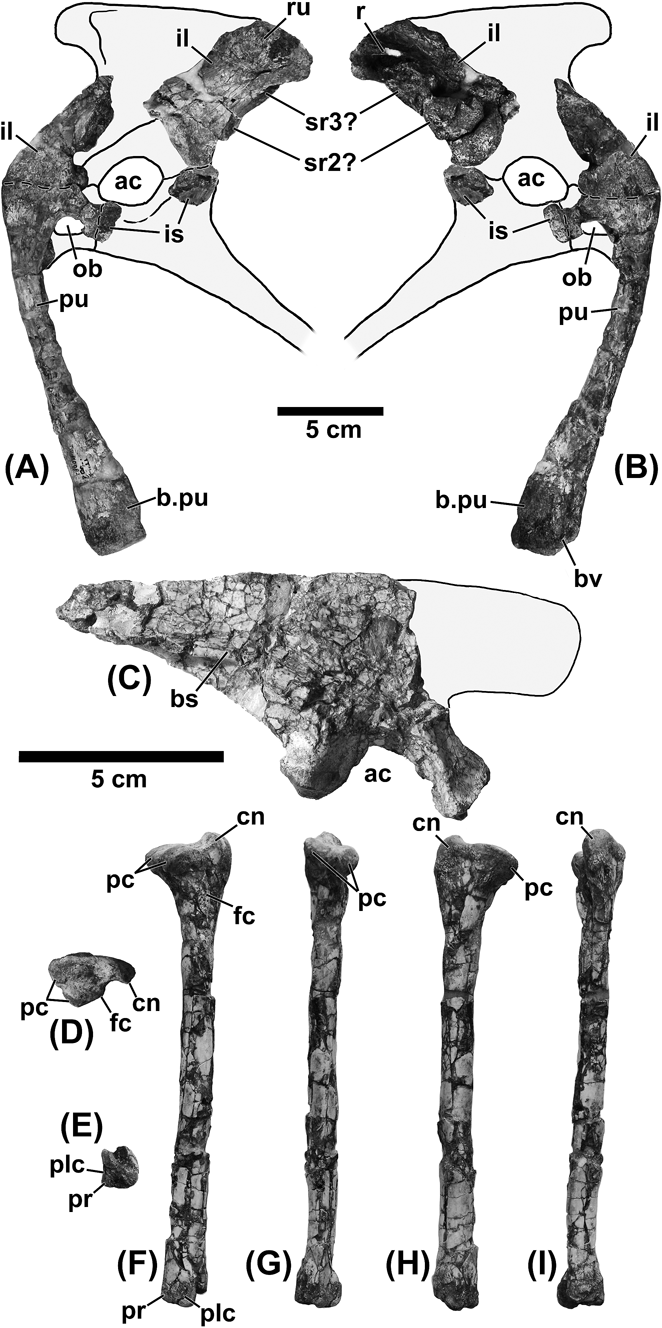
Discussion. Nesbitt & Chatterjee (Reference Nesbitt and Chatterjee2008) described a tibia from the Post Quarry (TTU-P11127) that they identified as a basal dinosauriform, and possibly as being a “Silesaurus-like taxon.” Although the tibia lacks a fibular crest, which is present in Silesaurus, it has an anteriorly projecting, straight cnemial crest identifying it as dinosauriform (Nesbitt et al. Reference Nesbitt, Irmis, Parker, Smith, Turner and Rowe2009a: character 248:1). Even though the tibia is consistent with the morphology in silesaurids, there are no character states that unite TTU-P11127 exclusively with silesaurids.
Silesauridae Nesbitt et al., Reference Nesbitt, Sidor, Irmis, Angielczyk, Smith and Tsuji2010
Technosaurus smalli Chatterjee, Reference Chatterjee1984
Holotype (in part). TTU-P09021 premaxilla and partial right dentary with teeth (other elements originally included in holotype by Chatterjee Reference Chatterjee1984 are discussed below).
Discussion.Technosaurus smalli was the first specimen assigned to Ornithischia from the Triassic of North America (Chatterjee Reference Chatterjee1984). The original type specimen (TTU-P09021) consists of a premaxilla (Fig. 14F), a dentary containing teeth (Fig. 14G–H), a posterior mandible, a vertebra, and an astragalus. However, the posterior portion of a mandible assigned to the specimen by Chatterjee (Reference Chatterjee1984) belongs to Shuvosaurus (Irmis et al. Reference Irmis, Parker, Nesbitt and Liu2007a; Nesbitt et al. Reference Nesbitt, Irmis and Parker2007), and the vertebra and putative astragalus are non-diagnostic (Sereno Reference Sereno1991a). The tooth-bearing premaxilla and dentary which formed the primary basis for Chatterjee's (Reference Chatterjee1984) identification of Technosaurus as a “fabrosaurid” ornithischian possess several distinctive characters that have been used to identify it as an ornithischian or silesaurid (Sereno Reference Sereno1991a; Nesbitt et al. Reference Nesbitt, Irmis and Parker2007). The dentary (Fig. 14G) was designated the lectotype by Hunt & Lucas (Reference Hunt, Lucas, Fraser and Sues1994).
The dentary teeth of Technosaurus are similar to ornithischian teeth in having subtriangular and striated crowns, which become larger posteriorly, and a strong constriction between the crown and root (Fig. 14H) (Sereno Reference Sereno1991a); however, these characters are also shared between Technosaurus and known silesaurids (Irmis et al. Reference Irmis, Parker, Nesbitt and Liu2007a; Nesbitt et al. Reference Nesbitt, Irmis and Parker2007). Moreover, the dentary teeth of Technosaurus lack a cingulum, which is present in all early ornithischians but absent in non-ornithischian taxa with otherwise similar teeth (Irmis et al. Reference Irmis, Parker, Nesbitt and Liu2007a; Nesbitt et al. Reference Nesbitt, Irmis and Parker2007). Both Nesbitt et al. (Reference Nesbitt, Irmis and Parker2007) and Irmis et al. (Reference Irmis, Parker, Nesbitt and Liu2007a) argued that the premaxilla and the lectotype dentary belong to the same taxon, likely the same individual (contra Sereno Reference Sereno1991a). Furthermore, Nesbitt et al. (Reference Nesbitt, Irmis and Parker2007) and Irmis et al. (Reference Irmis, Parker, Nesbitt and Liu2007a) suggested a close relationship between silesaurids and Technosaurus but failed to provide synapomorphies shared between the two taxa. After additional preparation and a clearer understanding of silesaurid evolution (Nesbitt et al. Reference Nesbitt, Sidor, Irmis, Angielczyk, Smith and Tsuji2010), it is clear that Technosaurus shares two unique character states with silesaurids: a Meckelian groove in the anterior half of the dentary restricted to the ventral margin of the dentary (Fig. 14G) (Nesbitt et al. Reference Nesbitt, Sidor, Irmis, Angielczyk, Smith and Tsuji2010: character 85:1); and teeth fused to the dentary (Fig. 14H;=ankylothecodont sensu Motani et al., Reference Motani, Callaway and Nicholls1997) (Nesbitt et al. Reference Nesbitt, Sidor, Irmis, Angielczyk, Smith and Tsuji2010: character 104:0). We assign Technosaurus to Silesauridae based on those two stated synapomorphies.
Dinosauria Owen, Reference Owen1842sensu Padian & May, 1993
Saurischia Seeley, Reference Seeley1887sensu Gauthier, Reference Gauthier1986
Theropoda Marsh, Reference Marsh1881sensu Gauthier, Reference Gauthier1986
Herrerasauridae Novas, Reference Novas1992sensu Sereno, Reference Sereno2005
Theropods from the Post Quarry: herrerasaurid partial left pelvis (TTU-P10082) in lateral (A) and medial (B) views; (C) neotheropod right ilium (TTU-P10071) in lateral view; neotheropod right tibia (TTU-P11044) in proximal (D), distal (E), medial (F), posterior (G), lateral (H) and anterior (I) views. Abbreviations: ac=acetabulum; b.pu=boot of pubis; bs=brevis shelf; bv=beveled surface; cn=cnemial crest; fc=fibular crest; il=ilium; is=ischium; ob=obturator foramen; pc=posterior condyles; plc=posterolateral concavity; pr= posterior ridge; pu=pubis; ru=rugosity; sr2?=second? sacral rib; sr3?=third? sacral rib.
Referred specimens. TTU-P10082 partial left ilium, nearly complete left pubis and fragment of left ischium.
Discussion. A partial theropod pelvis (Fig. 15A–B) (TTU-P10082) was identified as Coelophysis bauri by Lehman & Chatterjee (Reference Lehman and Chatterjee2005). However, Nesbitt & Chatterjee (Reference Nesbitt and Chatterjee2008) noted that the specimen shares many similarities with Herrerasaurus, Staurikosaurus and Chindesaurus, and possesses no apomorphies exclusive to Coelophysis bauri. The fully perforate acetabulum of TTU-P10082 places the specimen within Dinosauria (Langer & Benton Reference Langer and Benton2006; Nesbitt et al. Reference Nesbitt, Irmis, Parker, Smith, Turner and Rowe2009a; Nesbitt Reference Nesbitt2011). Furthermore, TTU-P10082 lacks a brevis shelf on the ilium (Fig. 15A) (Nesbitt et al. Reference Nesbitt, Irmis, Parker, Smith, Turner and Rowe2009a: character 196:0), a local synapomorphy of Herrerasauridae (Langer & Benton Reference Langer and Benton2006). Among herrerasaurids, the absence of a pubic tubercle (ambiens process) and bevelling on the ventral side of the distal end of the pubis as in TTU-P10082 (Fig. 15B) are shared uniquely with Staurikosaurus (Bittencourt & Kellner Reference Bittencourt and Kellner2005; Nesbitt & Chatterjee Reference Nesbitt and Chatterjee2008); however, TTU-P10082 likely represents a new taxon closely related to Staurikosaurus with a unique combination of characters, including the possible possession of three sacral ribs (Fig. 15B), whereas other herrerasaurids only possess two (Nesbitt & Chatterjee Reference Nesbitt and Chatterjee2008). However, the pelvis is poorly known in Chindesaurus, and therefore, it is possible that the Post Quarry specimen belongs to that taxon (Nesbitt & Chatterjee Reference Nesbitt and Chatterjee2008).
Neotheropoda Bakker, Reference Bakker1986sensu Sereno, Reference Sereno1998
Referred specimens. TTU-P11044 left tibia; TTU-P10071 right ilium.
Discussion. Nesbitt & Chatterjee (Reference Nesbitt and Chatterjee2008) assigned a nearly complete ilium (Fig. 15C) (TTU-P10071) to a “coelophysoid” theropod based on the presence of a brevis shelf (a ridge extending from the supra-acetabular crest/rim to the posterior portion of the ilium; Langer & Benton Reference Langer and Benton2006; Nesbitt et al. Reference Nesbitt, Irmis, Parker, Smith, Turner and Rowe2009a; character 197:1). However, as traditional Coelophysoidea (including Dilophosaurus) appears to be paraphyletic (Rauhut Reference Rauhut2003; Smith et al. Reference Smith, Makovicky, Hammer and Currie2007; Nesbitt et al. Reference Nesbitt, Irmis, Parker, Smith, Turner and Rowe2009a), the distribution of character 197:1 of Nesbitt et al. (Reference Nesbitt, Irmis, Parker, Smith, Turner and Rowe2009a) is plesiomorphic for neotheropods. Therefore, TTU-P10071 cannot be exclusively assigned to “Coelophysoidea” and is assigned only to Neotheropoda.
Nesbitt & Chatterjee (Reference Nesbitt and Chatterjee2008) also referred a left tibia (Fig. 15D–I) (TTU-P11044) to Theropoda. Here, we refine this assignment based on a more robust phylogenetic hypothesis of early dinosaur relationships (Nesbitt et al. Reference Nesbitt, Irmis, Parker, Smith, Turner and Rowe2009a). The complete tibia bears a distinct cnemial crest, expanded dorsal to the proximal surface of the tibia (Fig. 15D, F, H) (Nesbitt et al. Reference Nesbitt, Irmis, Parker, Smith, Turner and Rowe2009a; character 249:1); the posterior condyles of the tibia are separated from the cnemial crest by a concave surface (Fig. 15D) where the cnemial process is proximally expanded (Nesbitt et al. Reference Nesbitt, Irmis, Parker, Smith, Turner and Rowe2009a; character 249:1); the posterior face of the distal end has a distinct proximodistally oriented ridge (Fig. 15E–F) (Nesbitt et al. Reference Nesbitt, Irmis, Parker, Smith, Turner and Rowe2009a; character 256:1); the posterolateral margin of the distal end is concave (Fig. 15E–F) (Nesbitt et al. Reference Nesbitt, Irmis, Parker, Smith, Turner and Rowe2009a; character 255:1); and the lateral side of the proximal tibia has a dorsoventrally oriented crest (=fibular crest; Fig. 15D–F) that extends from the proximal articular surface (Nesbitt et al. Reference Nesbitt, Irmis, Parker, Smith, Turner and Rowe2009a; character 253:1). All of these character states indicate that the tibia belongs to a neotheropod.
Enigmatic specimens
?Dicynodontia Owen, Reference Owen1860
Possible therapsids from the Post Quarry: (A) possible dicynodont left femur (TTU-P09417) in anterior view; (B) possible eucynodont left mandible with teeth (TTU-P09020, holotype of “Pachygenelus milleri”) in lateral view; (C) possible eucynodont right mandible fragment with teeth (TTU-P9245) in lateral view; (D) possible eucynodont tooth (TTU-P010826). Abbreviations: lp?=possible lower postcanine; se=serrated edge.
Referred specimen. TTU-P09417 left femur.
Discussion. A left femur (TTU-P09417; Fig. 16A) has the general form of a dicynodont femur. However, the element needs extensive preparation, and no uniquely dicynodont apomorphies have yet been identified. The femur is approximately 11·3 cm long. It has a medially offset and somewhat spherical head, a large, well-developed greater trochanter that extends distally for 41·9 mm (37%) of the femoral length, and distal condyles that are about 36·1 mm wide with a well-developed inter-condylar fossa. Unlike the medial condyle, the lateral condyle has a distinct lateral projection and extends more distally than the medial condyle. This distinguishes TTU-P09417 from the femur of Placerias gigas, in which the lateral condyle does not project as strongly laterally or distally (Camp & Welles Reference Camp and Welles1956).
?Eucynodontia Kemp, Reference Kemp1982
Referred specimen. TTU-P09020 partial dentary with teeth (holotype of “Pachygenelus” milleri); TTU-P09245 partial mandible with tooth; TTU-P10826 tooth.
Discussion.Pachygenelus (type species P. monus) is a tritheledontid genus known from South Africa and Nova Scotia (Gow Reference Gow1980; Shubin et al. Reference Shubin, Crompton, Sues and Olsen1991). Chatterjee (Reference Chatterjee1983) reported a second species, Pachygenelus milleri, from the Post Quarry. The holotype (Fig. 16B; TTU-P09020) is a dentary fragment containing a few emergent tooth crowns, the best preserved of which Chatterjee (Reference Chatterjee1983) identified as the second postcanine. Another tooth from the Post Quarry (TTU-P09245; Fig. 16C) has an identical crown. These crowns have no cingulum and are mediolaterally compressed with a smoothly recurved main cusp and two posterior cusps. Chatterjee (Reference Chatterjee1983) erroneously reported three posterior cusps, the main basis for identifying TTU-P9020 as a new species; however, some of the lower postcanines of Pachygenelus monus have two posterior cusps (Gow Reference Gow1980), as do the lower second and third postcanines of the trithelodontid Chaliminia (Martinelli & Rougier Reference Martinelli and Rougier2007).
Shubin et al. (Reference Shubin, Crompton, Sues and Olsen1991, p. 1063) claimed that the referral of TTU-P09020 to Pachygenelus was dubious because it “lacks any diagnostic cynodont characters because all the teeth are fused to the jaw and there are no cingula on the postcanine teeth.” TTU-P09020 does indeed lack a cingulum on either the lingual or buccal surface of the best-preserved tooth. However, although cingula are present and well developed on the posterior lower postcanines of Pachygenelus monus (Gow Reference Gow1980), they are absent on the lower postcanines of the tritheledontids Riograndia, Irajatherium, and possibly Chaliminia (Bonaparte et al. Reference Bonaparte, Ferigolo and Ribeiro2001; Martinelli et al. Reference Martinelli, Bonaparte, Schultz and Rubert2005; Martinelli & Rougier Reference Martinelli and Rougier2007).
The claim by Shubin et al. (Reference Shubin, Crompton, Sues and Olsen1991) that the teeth of the Post Quarry specimens are fused into the socket is also questionable. The dentary is somewhat damaged around the base of the teeth, and matrix remains in place around the crown that cannot be removed without damaging the tooth, obscuring the nature of the tooth implantation. Although Hopson (personal communication to Sidor & Hancox Reference Sidor and Hancox2006, p. 334) suggested that TTU-P09020 is a fish, this identification is dubious because the tooth crown does not resemble that of any known fish from the Upper Triassic of western North America.
TTU-P09020 and TTU-P09245 could still belong to a tritheledontid although probably not referable to the tritheledontid clade Pachygenelinae because of the lack of a cingulum (Martinelli & Rougier Reference Martinelli and Rougier2007). However, similar postcanines have also been reported in non-tritheledontid eucynodonts (e.g. Abdala & Giannini Reference Abdala and Giannini2002).
Another specimen from the Post Quarry consisting of an isolated crown (Fig. 16D; TTU-P10826) is similar to those just described, but differs in possessing three posterior cusps and a serrated anterior edge. Although no tritheledontids have been reported as possessing serrated teeth as in TTU-P10826, such teeth do occur in other eucynodonts (e.g. Martinez et al. Reference Martinez, May and Forster1996).
All three of the Post Quarry specimens very likely belong to eucynodonts, as we are unaware of any other Late Triassic vertebrates with similar dental morphology. However, given that dental convergence is well documented in Upper Triassic vertebrates (Irmis et al. Reference Irmis, Parker, Nesbitt and Liu2007a; Nesbitt et al. Reference Nesbitt, Irmis and Parker2007), the referral of these teeth to Eucynodontia is provisional.
?Malerisaurus Chatterjee, Reference Chatterjee1980
?Malerisaurus langstoni Chatterjee, Reference Chatterjee1986b
Problematic diapsids from the Post Quarry: (A) putative Malerisaurus cervical vertebra (TTU-P11338) in left lateral view; “Procoelous vertebrate taxon B” cervical vertebra (TTU-P10085) in dorsal (B), left lateral (C) and posterior (D) views; Protoavis texensis holotype (TTU-P09200) braincase in posterior (E) and anterior (F) views; TTU-P09201 cervical vertebrae in dorsal (G, I) and left lateral (H, J) views. Abbreviations: cca=concave anterior condyle; cvp=convex posterior condyle; di=diapophysis; fm=foramen magnum; hyp=hypapophysis; met=metotic strut; ns=neural spine; oc=occipital condyle; pa=parapophysis; pop=paroccipital process; ptr=posterior tympanic recess; r.di=ridge extending posteriorly from the diapophysis; vag=opening for vagal canal.
Referred specimen. TTU-P11338 cervical vertebra.
Discussion.Malerisaurus is a putative Upper Triassic “protorosaur” described from India and western North America (Chatterjee Reference Chatterjee1980, Reference Chatterjee1986b). Evans (Reference Evans, Currie and Koster1988) and Rieppel et al. (Reference Rieppel, Fraser and Nosotti2003) were hesitant about the assignment of Malerisaurus to Protorosauria because of the poor preservation of the skull, although they accepted that the taxon is probably some kind of archosauromorph. It is also worth noting that the material referred to the type species Malerisaurus robinsonae from the Maleri Formation of India (Chatterjee Reference Chatterjee1980), includes the remains of at least two, and possibly three, quite different taxa (N. Fraser, unpublished data). While some elements do suggest protorosaurian affinities, a complete reassessment of the material is required.
Recently, Spielmann et al. (Reference Spielmann, Lucas, Hunt, Heckert, Harris, Lucas, Spielmann, Lockley, Kirkland and Milner2006) claimed that the holotype of Malerisaurus langstoni (TMM 31099-11; Chatterjee Reference Chatterjee1986b) is a chimera composed of trilophosaur, aetosaur, phytosaur, and rhynchosaur material. However, Spielmann et al. (Reference Spielmann, Lucas, Hunt, Heckert, Harris, Lucas, Spielmann, Lockley, Kirkland and Milner2006) based their referral of particular elements on non-diagnostic plesiomorphies found in a variety of archosauromorphs, and their reinterpretation of these elements has other puzzling aspects (e.g. the element they identified as a Trilophosaurus prefrontal is a pterygoid with clear alveoli, SJN and NF pers. obs.). Therefore, the assignment of the Malerisaurus langstoni holotype to Trilophosaurus is poorly supported. Several characters of Malerisaurus langstoni may distinguish it from Trilophosaurus (B. Mueller & S. Nesbitt, unpublished data), although the holotype requires extensive re-preparation and re-description.
A cervical vertebra (TTU-P11338; Fig. 17A) from the Post Quarry shows some of the features of TMM 31099-11 that may distinguish the latter from Trilophosaurus (B. Mueller pers. obs.) including: closely appressed apophyses (Chatterjee Reference Chatterjee1980, Reference Chatterjee1986b): ridge-like, antero-posteriorly extending diapophyses; and a centrum that is amphicoelous rather than procoelous.
Procoelous vertebrate taxon A
(not figured)
Referred specimens. TTU-P10110 associated cranial and postcranial elements including partial skull, partial pelvis, articulated hindlimb, and two sacral vertebrae; TTU-P10111 through TTU-P10198; TTU-P10218 through TTU-P10223; TTU-P10288 through TTU-P10342 all individual cervical, dorsal, sacral, and caudal vertebrae.
Procoelous vertebrate taxon B
Referred specimens. TTU-P09489 partial left maxilla; TTU-P09490 partial right maxilla; TTU-P10085 partial skull with two cervical vertebrae; TTU-P10086 left vomer; TTU-P 10087 left pterygoid; TTU-P10088 through TTU-P10095, TTU-P01343 individual cervical vertebrae.
Discussion. Atanassov (Reference Atanassov2002) described two new small vertebrates (informally referred to here as “procoelous vertebrate taxon A” and “procoelous vertebrate taxon B”) possessing similar and highly distinctive procoelous vertebrae with characteristic spine tables (Fig. 17B–D) from the Dockum Group of western Texas. A formal description is currently being prepared for publication. Most material for the two taxa comes from the Post Quarry, where these isolated procoelous vertebrae were abundant (Atanassov Reference Atanassov2002). However, some vertebrae were also associated with cranial and postcranial elements. The associations appear to represent single individuals because of the presence of corresponding left and right elements in both taxa, and good articulation of the vertebral series, pelvis, and hindlimb in one of the specimens (Atanassov Reference Atanassov2002). A number of similar vertebrae from both the Post Quarry and Boren Quarry differ slightly from the material described by Atanassov (Reference Atanassov2002) and may belong to closely related taxa.
The apparent presence of an antorbital fenestra and the dental morphology show these taxa are members of Archosauriformes, and the phylogenetic analysis by Atanassov (Reference Atanassov2002) resolved them as ornithodirans allied with pterosaurs; this placement was based largely on the hindlimb morphology, including an advanced mesotarsal ankle in which the astragalus has an ascending process (Atanassov Reference Atanassov2002). However, we have provisionally excluded these taxa from our discussion of Ornithodira until the description and analysis are formally published.
Protoavis Chatterjee, Reference Chatterjee1991
Protoavis texensis Chatterjee, Reference Chatterjee1991
Holotype. TTU-P09200 skull.
Paratype. TTU-P09201 partial skull and articulated postcrania.
Discussion. Chatterjee (Reference Chatterjee1991, Reference Chatterjee1999) identified the putative bird Protoavis texensis from the Post Quarry (Fig. 17E–J), suggesting a surprisingly early radiation for tetanuran, coelurosaurian, and avian theropods. Protoavis has been hypothesised to be a chimera (e.g. Ostrom Reference Ostrom, Schultze and Trued1991; Chiappe Reference Chiappe1995; Sereno Reference Sereno1997; Padian & Chiappe Reference Padian and Chiappe1998; Paul Reference Paul2002), although this would not preclude some of the material from being avian (Witmer Reference Witmer, Schultze and Trued1991). The femur of TTU-P09200 and the astragalus and calcaneum of TTU-P09201 belong to a theropod, albeit probably a “coelophysoid” (non-tetanuran neotheropod) rather than a bird (Hunt et al. Reference Hunt, Lucas, Heckert, Sullivan and Lockley1998; Paul Reference Paul1988; Nesbitt et al. Reference Nesbitt, Irmis and Parker2007).
Renesto (Reference Renesto2000) suggested that Protoavis might be a drepanosaurid based on alleged similarities, particularly in the cervical vertebrae (Fig. 17G–J), with Megalancosaurus. However, the identification of the cervical vertebrae of Protoavis as belonging to a drepanosaurid is questionable, because the Italian drepanosaurid material is crushed two-dimensionally (e.g. Renesto et al. Reference Renesto, Spielmann, Lucas and Spagnoli2010). This distortion makes it problematic to compare the Italian specimens with Protoavis. Indeed, it makes comparisons between the Italian drepanosaurid material and the uncrushed specimens from Cromhall Quarry in the United Kingdom (Renesto & Fraser Reference Renesto and Fraser2003) problematic for the same reasons (M. Atanassov, pers. obs.), although the cervical vertebrae of Protoavis (Fig. 15G–J) and the Cromhall Quarry specimens are very similar. Although skeptical of the avian affinities of Protoavis, Chiappe (Reference Chiappe1995) and Witmer (Reference Witmer, Gauthier and Gall2001) acknowledged that the cervical vertebrae were heterocoelous with a prominent hypapophysis (Fig. 15G–J), and that the dorsal vertebrae had large vertebral canals; these characters are present in avians, although not restricted to the clade.
Renesto (Reference Renesto2000) also noted that drepanosaurid skulls and the reconstructed skull of Protoavis (based on Chatterjee Reference Chatterjee1991, Reference Chatterjee1993) shared a pointed snout, inflated postorbital region, and a downturned mandible tip; however it is worth noting these are the same general similarities that Feduccia & Wild (Reference Feduccia and Wild1993) used to suggest an affinity between the drepanosaurid Megalancosaurus and Archaeopteryx, a hypothesis that is almost universally rejected (e.g. Chiappe Reference Chiappe1995; Paul Reference Paul2002). Paul (Reference Paul2002) claimed that the quadrates of Protoavis and the Italian drepanosaurid material are similar, but made no additional comparisons. Indeed, two-dimensional crushing of the skulls in the Italian drepanosaurids (e.g. Renesto Reference Renesto2000; Renesto & Binelli Reference Renesto and Binelli2006; M. Atanassov pers. obs.) makes comparison with the beautifully preserved braincase of Protoavis (Fig. 17E–F) (TTU-P9200) problematic. The only particular reason to consider the cranial material of Protoavis drepanosaurid is the association with potentially drepanosaurid-like vertebrae, but if Protoavis is indeed a chimera, there is no particular reason to assume the cranial material is drepanosaurid, even if the vertebrae are.
The most detailed discussions of the Protoavis cranial material other than that of Chatterjee (Reference Chatterjee1991, Reference Chatterjee1999) are those of Witmer (Reference Witmer, Schultze and Trued1991, Reference Witmer, Gauthier and Gall2001, Reference Witmer, Chiappe and Witmer2002), Currie & Zhao (Reference Currie and Zhao1993) and Currie (Reference Currie1995), who all noted striking similarities between the braincase of Protoavis and various coelurosaurian theropods. Witmer (Reference Witmer, Chiappe and Witmer2002) suggested that Protoavis represents a range extension for the Coelurosauria (though not necessarily Aves) based on the presence of: a posterior tympanic recess (Fig. 17F); a large cerebellar auricular fossa; a metotic strut; and the opening of the vagal canal into the occiput (Fig. 17E). Although Nesbitt et al. (Reference Nesbitt, Irmis and Parker2007, pp. 223–224) suggested that the coelurosaurian characters of the braincase of Protoavis are convergent, the presence of these characters has not been refuted.
Most of the authors of this paper are not convinced concerning the avian or even coelurosaurian affinities of Protoavi s. Bizarre bauplans and evolutionary convergence were rampant among archosauriforms during the Triassic (e.g. Renesto Reference Renesto2000; Nesbitt & Norell Reference Nesbitt and Norell2006; Nesbitt Reference Nesbitt2007), and the convergent evolution of coelurosaurian apomorphies is entirely possible. In considering Protoavis a well-nested bird, it is difficult to ignore the absence of other putative tetanuran theropod fossils in pre-Jurassic deposits and the absence of pre-Cretaceous birds more derived than Archaeopteryx (e.g. Chiappe Reference Chiappe1995). Nonetheless, multiple coelurosaurian characters have been identified in Protoavis (Chatterjee Reference Chatterjee1991, Reference Chatterjee1999; Currie & Zhao Reference Currie and Zhao1993; Witmer Reference Witmer, Chiappe and Witmer2002), and the identification of Protoavis as belonging to any particular non-avian group (including Drepanosauridae) is premature.
4. Discussion
4.1. Post Quarry: an exceptionally diverse vertebrate assemblage
The Post Quarry macrovertebrate assemblage is dominated by pseudosuchian archosaurs, especially aetosaurs, the poposauroid Shuvosaurus, and the rauisuchid Postosuchus (Chatterjee Reference Chatterjee1985, Reference Chatterjee and Padian1986a; Long & Murry Reference Long and Murry1995, Small Reference Small, Lucas and Hunt1989a, Reference Small, Lucas and Huntb; Lehman & Chatterjee Reference Lehman and Chatterjee2005). However, the phytosaur Leptosuchus, a crocodylomorph and a diverse dinosauromorph assemblage (including lagerpetids, silesaurids, herrerasaurids and early neotheropods) are also present. With the exception of the dinosauromorphs, the microvertebrate assemblage is the most strongly impacted by the taxonomic revisions of the past decade, and is now recognised to contain: small temnospondyls; sphenodontians; non-archosauriform archosauromorphs (Trilophosaurus, simiosaurians, and possibly protorosaurians); possible dicynodonts and eucynodonts; and enigmatic taxa with procoelous vertebrae possibly representing non-dinosauromorph ornithodirans. This vertebrate assemblage (possibly even the small temnospondyls Apachesaurus and Rileymillerus; Hunt Reference Hunt and Morales1993, p. 92, Bolt & Chatterjee Reference Bolt and Chatterjee2000) is overwhelmingly terrestrial in habit. The Post Quarry assemblage is notable in its rarity or absence of fish, temnospondyls, phytosaurs, and the small aquatic archosauriform Vancleavea (Parker & Barton Reference Parker and Barton2008; Nesbitt et al. Reference Nesbitt, Stocker, Small and Downs2009b).
The Post Quarry has interesting similarities to the main bone-producing horizon at the Placerias Quarry in the Chinle Formation of Arizona. The Placerias Quarry is also a remarkably dense bone bed dominated by disarticulated, but associated, skeletons of terrestrial macrovertebrates (especially dicynodonts, aetosaurs, paracrocodylomorphs and dinosauromorphs; Camp & Welles Reference Camp and Welles1956; Jacobs & Murry Reference Jacobs, Murry and Jacobs1980; Long & Murry Reference Long and Murry1995; Fiorillo et al. Reference Fiorillo, Padian and Musikasinthorn2000; Nesbitt et al. Reference Nesbitt, Irmis and Parker2007) in which aquatic macrovertebrates and microvertebrates mostly occur at stratigraphic levels slightly distinct from the main bone horizon (Camp & Welles Reference Camp and Welles1956; Fiorillo et al. Reference Fiorillo, Padian and Musikasinthorn2000). The Placerias Quarry has been interpreted as a mass mortality assemblage in which the animals may have concentrated around an ephemeral water source and have been killed by drought (Fiorillo et al. Reference Fiorillo, Padian and Musikasinthorn2000). This scenario could also explain the similar autochthonous assemblage at the Post Quarry (Chatterjee Reference Chatterjee1985), though a detailed taphonomic study of the Post Quarry has not yet been undertaken. Both the Chinle Formation and Dockum Group have been interpreted as having been deposited in a sub-humid or sub-arid climate with seasonally variable precipitation (e.g. Ash Reference Ash, Breed and Breed1972; McGowan et al. Reference McGowan, Granata and Seni1979; Frehlier Reference Frehlier1986; Dubiel Reference Dubiel, Caputo, Peterson and Franczyk1994; Therrien & Fastovsky Reference Therrien and Fastovsky2000; Lehman & Chatterjee Reference Lehman and Chatterjee2005), which is consistent with this scenario.
4.2. Biostratigraphic position of the Post Quarry assemblage
The Post Quarry contains Leptosuchus, a non-pseudopalatine leptosuchomorph, and also falls stratigraphically below the LSD of Machaeroprosopus (=Pseudopalatus; see Parker et al. Reference Parker, Hungerbühler and Martz2013, this volume) in southern Garza County (Martz Reference Martz2008). This makes the Post Quarry Adamanian by definition (Lucas Reference Lucas1998; Parker & Martz Reference Parker and Martz2011). Because TTU-P09234 is the only Leptosuchus specimen known from southern Garza County and fossil localities are rare within the lower unit of the type section of the Cooper Canyon Formation (Martz Reference Martz2008), it is difficult to place the base of the Adamanian biozone with precision (Fig. 2). The Boren Quarry (Museum of Texas Tech, Lubbock, Texas locality 3869), which lies near the very base of the Cooper Canyon Formation (Figs 2, 3C), contains multiple non-phytosaurid phytosaurs (Lehman & Chatterjee Reference Lehman and Chatterjee2005; Stocker Reference Stocker2013, this volume) but none referable to Leptosuchomorpha. Therefore, the Boren Quarry probably lies within the Otischalkian biozone, and the base of the Adamanian biozone (i.e. the LSD of Leptosuchus) occurs somewhere within the lower unit of the Cooper Canyon Formation.
Other aspects of the Post Quarry vertebrate assemblage are distinctly Adamanian, or at least pre-Revueltian, including the presence of putative dicynodonts, Calyptosuchus wellesi and the dinosauromorph Dromomeron gregorii (Lucas Reference Lucas1998; Nesbitt et al. Reference Nesbitt, Irmis, Parker, Smith, Turner and Rowe2009a; Parker & Martz Reference Parker and Martz2011). Virtually all known occurrences of Trilophosaurus are also pre-Revueltian (Parker & Martz Reference Parker and Martz2011, p. 249, contra Spielmann et al. Reference Spielmann, Lucas, Rinehart and Heckert2008). Additionally, the lower unit of the Cooper Canyon Formation correlates lithostratigraphically with the Tecovas Formation (Martz Reference Martz2008), which also contains a characteristically Adamanian vertebrate assemblage that includes Leptosuchus (e.g. Case Reference Case1922; Murry Reference Murry, Lucas and Hunt1989; Long & Murry Reference Long and Murry1995; Lucas Reference Lucas1998; Heckert Reference Heckert2004). As with the lower unit of the Cooper Canyon Formation, the lowermost Tecovas Formation may fall within the Otischalkian biozone (Fig. 3B; Heckert Reference Heckert2004, p. 37).
The Post Quarry contains the most diverse aetosaur assemblage in the world; only the Placerias Quarry in the Chinle Formation of Arizona shows comparable diversity for a single locality (Long & Murry Reference Long and Murry1995; Parker Reference Parker2005b; Irmis Reference Irmis, Nesbitt, Parker and Irmis2005). The striking diversity of aetosaurs in the Post Quarry is consistent with that seen in Adamanian localities elsewhere (e.g. the Blue Mesa Member at Petrified Forest National Park, hereafter PEFO, and the Placerias Quarry; Long & Murry Reference Long and Murry1995; Parker & Martz Reference Parker and Martz2011). Desmatosuchus smalli is known otherwise only from the lower Revueltian Martha's Butte beds near PEFO (Parker Reference Parker2005a, Reference Parker, Parker, Ash and Irmis2006; Parker & Martz Reference Parker and Martz2011), which suggests that both D. smalli and Paratypothorax had stratigraphic ranges extending from the Adamanian into the lower Revueltian. The Post Quarry occurrence of the characteristically Revueltian aetosaur Typothorax corroborates that the taxon is at least a rare component of Adamanian vertebrate assemblages, something previously confirmed at PEFO, where the taxon occurs in the uppermost Adamanian (Parker & Martz Reference Parker and Martz2011). Other reported occurrences of Typothorax in pre-Revueltian strata (Hunt et al. Reference Hunt, Lucas, Heckert, Lucas, Zeigler, Lueth and Owen2005) have not been convincingly documented (Parker & Martz Reference Parker and Martz2011, p. 249).
The high dinosauromorph diversity present in the Post Quarry is consistent with that recognised in Otischalkian, Adamanian, and Revueltian localities elsewhere in western North America (Irmis et al. Reference Irmis, Nesbitt, Padian, Smith, Turner, Woody and Downs2007b; Nesbitt et al. Reference Nesbitt, Irmis and Parker2007, Reference Nesbitt, Irmis, Parker, Smith, Turner and Rowe2009a; Parker & Martz Reference Parker and Martz2011). TTU-P10082 (Nesbitt & Chatterjee Reference Nesbitt and Chatterjee2008) is the only confirmed Adamanian herrerasaurid in North America. Herrerasaurid material, referred to Chindesaurus previously, was recognised only from the Otischalkian Otis Chalk localities in the “Colorado City Member” of western Texas, and from Revueltian localities in the Petrified Forest Member of Arizona and New Mexico (Novas Reference Novas1992; Long & Murry Reference Long and Murry1995; Hunt et al. Reference Hunt, Lucas, Heckert, Sullivan and Lockley1998; Langer Reference Langer, Weishampel, Dodson and Osmólska2004; Nesbitt et al. Reference Nesbitt, Irmis and Parker2007). As previously discussed, TTU-P10082 may belong to Chindesaurus or a new taxon with affinities to Staurikosaurus.
4.3. Possible taxonomic variation within the Adamanian biozone
There are indications of taxonomic variation within the Adamanian biozone, although this is currently a weak hypothesis requiring further testing. The Chinle Formation of PEFO in northeastern Arizona and the Dockum Group of southern Garza County (including the Post Quarry) are the only two areas in western North America where sufficiently detailed biostratigraphic data have been presented for the evaluation of Late Triassic biochronologic hypotheses (Parker Reference Parker, Parker, Ash and Irmis2006; Martz Reference Martz2008; Parker & Martz Reference Parker and Martz2011), and where the base of the Revueltian biozone (i.e., the LSD of Machaeroprosopus) has been documented with precision. However, because of the rarity of Leptosuchus specimens and poor stratigraphic sampling of vertebrate localities within the lower part of the Cooper Canyon Formation of southern Garza County (Martz Reference Martz2008), inferences of biostratigraphic variation within the Adamanian biozone must rely primarily on the Chinle Formation of PEFO (Parker & Martz Reference Parker and Martz2011).
In PEFO, the Adamanian biozone extends from the upper Blue Mesa Member into the lower part of the Sonsela Member (Heckert & Lucas Reference Heckert, Lucas, Heckert and Lucas2002b; Parker Reference Parker, Parker, Ash and Irmis2006; Parker & Martz Reference Parker and Martz2011). The exceptionally diverse Placerias and Downs Quarries (Camp & Welles Reference Camp and Welles1956; Jacobs & Murry Reference Jacobs, Murry and Jacobs1980; Kaye & Padian Reference Kaye, Padian, Fraser and Sues1994; Long & Murry Reference Long and Murry1995; Fiorillo et al. Reference Fiorillo, Padian and Musikasinthorn2000; Heckert & Lucas Reference Heckert and Lucas2003; Irmis Reference Irmis, Nesbitt, Parker and Irmis2005) and the Blue Hills localities (Long & Murry Reference Long and Murry1995; Heckert et al. Reference Heckert, Lucas, Krzyzanowski, Heckert and Lucas2002) are located approximately 50 km southeast of PEFO, in the vicinity of St. Johns. These localities also occur in the upper Blue Mesa Member (Heckert & Lucas Reference Heckert and Lucas2003; Irmis et al. Reference Irmis, Mundil, Martz and Parker2011, supplemental data; Parker & Martz Reference Parker and Martz2011, p. 250, contra Lucas et al. Reference Lucas, Heckert and Hunt1997), and provide additional information on the vertebrate assemblage at this stratigraphic level. Parker & Martz (Reference Parker and Martz2011, pp. 241–243, table 1) provided voucher specimens for Adamanian occurrences of most of the taxa discussed below; voucher specimens are only provided for taxa below when not previously assigned by Parker & Martz (Reference Parker and Martz2011).
Taxa known from both the upper Blue Mesa Member and lower Sonsela Member (but not from the overlying Revueltian biozone) in northern Arizona include: dicynodonts; Trilophosaurus dornorum; the aetosaur Calyptosuchus; paratypothoracisin aetosaurs similar to Tecovasuchus (Irmis Reference Irmis, Nesbitt, Parker and Irmis2005; Parker Reference Parker2005b; Heckert et al. Reference Heckert, Lucas, Hunt, Spielmann, Lucas and Spielmann2007); and the poposauroid Poposaurus gracilis (UCMP 25962 from the Placerias Quarry, Long & Murry Reference Long and Murry1995). Taxa so far known with certainty only from the Blue Mesa Member within the Adamanian biozone are: the dicynodont Placerias (multiple specimens from the Placerias Quarry; Camp & Welles Reference Camp and Welles1956); Trilophosaurus buettneri and T. jacobsi (MNA V3192 from the Placerias Quarry; Murry Reference Murry1987); the non-pseudopalatine leptosuchomorph phytosaur Smilosuchus adamanensis; and the aetosaurs Desmatosuchus spurensis, Acaenosuchus, and Adamanasuchus. Taxa so far known only from the lower Sonsela Member at PEFO are: the non-pseudopalatine leptosuchomorphs Smilosuchus lithodendrorum and Pravusuchus hortus; and the aetosaurs Paratypothorax and Typothorax (both of which extend into the upper Sonsela Member/Revueltian biozone). The aetosaur Desmatosuchus smalli is also known from the upper Sonsela Member/Revueltian biozone near PEFO (MNA V697; Parker Reference Parker, Parker, Ash and Irmis2006, p. 54; Parker & Martz Reference Parker and Martz2011, p. 249), though it has not yet been found within the Adamanian biozone in Arizona.
The presence of Desmatosuchus smalli, Typothorax, Paratypothorax and Trilophosaurus dornorum (but not other species of Trilophosaurus) in the Post Quarry, which lies in strata equivalent to the uppermost Tecovas Formation, suggests that the locality might be approximately equivalent to the lower Sonsela Member in Arizona (Fig. 3). The Tecovas Formation further north within Texas has not produced any of these taxa (e.g. Murry Reference Murry, Lucas and Hunt1989; Long & Murry Reference Long and Murry1995; Lucas Reference Lucas1998; Heckert Reference Heckert2004), but has produced Trilophosaurus buettneri and Desmatosuchus spurensis, suggesting that known localities in the Tecovas Formation might be slightly older than the Post Quarry, and closer in age to localities in the Blue Mesa Member.
Given the tentative nature of these conclusions, we do not advocate formally subdividing the Adamanian biozone/biochron at this time. Moreover, even if subdivision becomes more defensible with increased collection and more detailed biostratigraphic data, we do not advocate the use the St. Johnsian and Lamyan “sub-faunachrons” of the Adamanian proposed by Hunt et al. (Reference Hunt, Lucas, Heckert, Lucas, Zeigler, Lueth and Owen2005). Hunt et al. (Reference Hunt, Lucas, Heckert, Lucas, Zeigler, Lueth and Owen2005) considered the LSD of Machaeroprosopus (=Pseudopalatus) to be stratigraphically lower than the LSD of T. coccinarum, so that the ranges of Machaeroprosopus and non-pseudopalatine leptosuchomorphs overlapped. However, this model was based on flawed lithostratigraphic and biostratigraphic data from PEFO (Raucci et al. Reference Raucci, Blakey, Umhoefer, Parker, Ash and Irmis2006; Parker & Martz Reference Parker and Martz2011). The LSD of Machaeroprosopus (e.g. PEFO 34042, PEFO 5080; “Pseudopalatus” sensu Parker & Martz, Reference Parker and Martz2011, pp. 242, 244) occurs at or slightly above that of Typothorax coccinarum (PEFO 34918; Parker & Martz Reference Parker and Martz2011, p. 244) and there is no evidence of any stratigraphic overlap between Machaeroprosopus and non-pseudopalatine leptosuchomorphs (Parker Reference Parker, Parker, Ash and Irmis2006). Therefore, Hunt et al.'s (Reference Hunt, Lucas, Heckert, Lucas, Zeigler, Lueth and Owen2005) redefinitions for the Adamanian and Revueltian are untenable and conceptually different from the subdivision we propose here.
4.4. Geochronologic age of the Post Quarry vertebrate assemblage
Recent revisions to the Late Triassic timescale and new radioisotopic dates from the Chinle Formation (Fig. 3) have revised our understanding of the age of the Adamanian biozone. The Carnian-Norian boundary was dated to approximately 216 Ma (Ogg Reference Ogg, Gradstein, Ogg and Smith2004), but more recent radioisotopic and magnetostratigraphic data from Upper Triassic marine strata and the Newark Supergroup of eastern North America (Muttoni et al. Reference Muttoni, Kent, Olsen, Di Stefano, Lowrie, Bernasconi and Hernández2004; Furin et al. Reference Furin, Preto, Rigo, Roghi, Gianolla, Crowley and Bowring2006; Hüsing et al. Reference Hüsing, Deenen, Koopmans and Krijgsman2011) re-dated the late Carnian (Tuvalian)-earliest Norian (Lacian) boundary to approximately 228 Ma. For sub-stages of the Norian, the Lacian–Alaunian and Alaunian–Sevatian boundaries were re-dated to approximately 216·4 Ma and 211·8 Ma respectively (Hüsing et al. Reference Hüsing, Deenen, Koopmans and Krijgsman2011), with the late Norian (Sevatian)–Rhaetian boundary falling somewhere between 207–210 Ma (Muttoni et al. Reference Muttoni, Kent, Jadoul, Olsen, Rigo, Galli and Nicora2010; Hüsing et al. Reference Hüsing, Deenen, Koopmans and Krijgsman2011). Based on these revised dates and recent radioisotopic dates from the Chinle Formation in Arizona (Irmis et al. Reference Irmis, Mundil, Martz and Parker2011; Ramezani et al. Reference Ramezani, Hoke, Fastovsky, Bowring, Therrien, Dworkin, Atchley and Nordt2011), the Chinle Formation is probably entirely post-Carnian (Irmis et al. Reference Irmis, Martz, Parker and Nesbitt2010, Reference Irmis, Mundil, Martz and Parker2011; Olsen et al. Reference Olsen, Kent and Whiteside2011); this revises previous interpretations of the lower part of the Chinle Formation and Dockum Group as Carnian based on pollen and vertebrate fossils (e.g. Lucas Reference Lucas1998, Reference Lucas and Lucas2010).
The base of the upper Blue Mesa Member in PEFO was recently dated to 223 Ma (Ramezani et al. Reference Ramezani, Hoke, Fastovsky, Bowring, Therrien, Dworkin, Atchley and Nordt2011) and beds within the lower Sonsela Member in PEFO to approximately 219 Ma (Ramezani et al. Reference Ramezani, Hoke, Fastovsky, Bowring, Therrien, Dworkin, Atchley and Nordt2011); the uppermost Blue Mesa Member or lower Sonsela Member of eastern New Mexico has been dated to about the same age (Irmis et al. Reference Irmis, Mundil, Martz and Parker2011), and the Adamanian-Revueltian turnover within the Sonsela Member to approximately 215 Ma (Dunlavey et al. Reference Dunlavey, Whiteside and Irmis2009; Ramezani et al. Reference Ramezani, Hoke, Fastovsky, Bowring, Therrien, Dworkin, Atchley and Nordt2011). The base of the Adamanian biozone probably occurs in the lower Blue Mesa Member, giving a minimum age range for the Adamanian biozone in Arizona of 223–215 Ma (late Lacian to earliest Alaunian). If the Post Quarry is equivalent to localities in the upper Adamanian biozone (lower Sonsela Member) in PEFO, this suggests a plausible age range of 220–215 Ma for the Post Quarry (Fig. 3).
5. Acknowledgements
This paper is dedicated to Dr. Wann Langston, Jr. for his important work on vertebrate fossils from the Dockum Group. We thank Sankar Chatterjee, Bryan Small, Andy Gedeon, Doug Cunningham and Mariana Ivanova for collection and preparation of much of the Post Quarry material. Tony Fiorillo (Museum of Nature and Science, Dallas, TX) provided access to specimens. We also thank our peer-reviewers, as well as Axel Hungerbühler and Hans-Dieter Sues for additional comments. This is Petrified Forest National Park Paleontological Contribution No. 32.