Background
In the past several decades, the incidence of Enterobacteriaceae harboring resistance mechanisms against multiple antibiotic agents—mainly Klebsiella pneumoniae (KP) and Escherichia coli (EC)—has increased on a global scale. Klebsiella pneumoniae colonizes the human gastrointestinal and urinary tract, as well as the skin and upper airways. It is one of the most frequent pathogens causing hospital-acquired infections of the bloodstream, the urinary tract, the lower respiratory tract, the surgical site, and more. In recent years, data have revealed rising numbers of KP isolates that are resistant to 1 or more major antibiotics class. Thus, infections caused by multidrug-resistant KP (MDR-KP) are increasingly associated with higher morbidity, mortality, and healthcare costs, mainly due to inadequate and limited treatment options.Reference Ducomble, Faucheux and Helbig1 Strains for which no treatment options remain are increasingly reported, and MDR-KP has been classified as “critical” by the World Health Organization; it is on the global priority list of antibiotic-resistant bacteria that guides research and development of new antibiotics.2
With fewer and fewer treatment options, prevention of transmission in healthcare settings is becoming ever more important. Here, we discuss reasons for ongoing transmission of MDR-KP in healthcare settings, which results in the successful spread and establishment of this pathogen, which is now one of the most important causes of healthcare-associated infections worldwide.
Definition of multidrug resistance
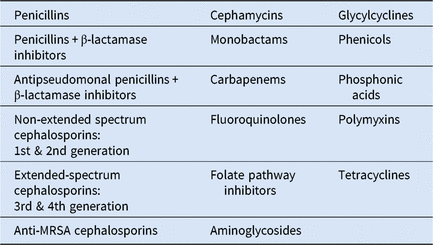
In 2012, an international expert proposalReference Magiorakos, Srinivasan and Carey3 for interim standard definitions for acquired resistance suggested defining Enterobacteriaceae as multidrug resistant when it proves nonsusceptible to at least 1 agent in >2 antimicrobial categories (Table 1). This definition was used for this review.
Antimicrobial Categories as Suggested by an International Expert Proposal for Interim Standard Definitions for Acquired ResistanceReference Magiorakos, Srinivasan and Carey3

The diversity of definitions for MDR-KP represents a challenge to infection control efforts. Among members of the Society for Healthcare Epidemiology of America (SHEA), 66 members have provided 22 unique definitions for this term.Reference Drees, Pineles, Harris and Morgan4 A common terminology, however, provides the basis for any global effort to control MDR-KP. Setting rules for labeling multidrug-resistant gram-negative bacteria has been a cornerstone for building a regional system for alerting infection preventionists about patients with multidrug-resistant gram-negative bacteria, which may contribute to reducing subsequent spread.Reference Rosenman, Szucs and Finnell5
A shuttle for resistance genes
Compared with other Enterobacteriaceae such as EC, KP appears to be more efficient in assembling a variety of different resistance mechanisms providing one of the preconditions for successful global dissemination.Reference Navon-Venezia, Kondratyeva and Carattoli6 Klebsiella pneumoniae is able to accumulate different resistance mechanisms through vertical gene transfer to daughter cells or through horizontal transfer of mobile genetic elements, such as plasmids and transposons. These elements contain a variety of different antibiotic resistance and virulence genes, making it possible for already resistant strains to gain even more resistance mechanisms over time. Klebsiella pneumoniae may also harbor gene clusters promoting biofilm production and resistance to arsenic, copper, and silver, which may be relevant to infection control issues.Reference Navon-Venezia, Kondratyeva and Carattoli6 The most frequently detected resistance genes code for extended-spectrum β-lactamases (ESBLs), carbapenemases such as oxacillinase-48-type carbapenemase (OXA-48), Verona integrin-encoded metallo-β-lactamase (VIM), New Delhi metallo-β-lactamase (NDM), and most importantly, Klebsiella pneumoniae carbapenemase (KPC), which in combination with KP ST258 has become very prevalent, causing numerous hospital outbreaks.Reference Cuzon, Naas and Truong7 However, resistance mechanisms of MDR-KP are not limited to genes encoding antibiotic-hydrolyting enzymes; they also encompass genes conferring resistance by alteration of cell permeability such as efflux pumps, target modification, porin loss, and modification of enzymes. Selective pressure exerted by the ever increasing use of antibiotic agents leads to a highly diverse population of MDR-KP spreading across the globe.Reference Navon-Venezia, Kondratyeva and Carattoli6 A specific combination of clonal lineages acquiring defined plasmids and resistant genes seems to be key to the successful global spread of KP. Adler et al showed that a strain, which was ertapenem resistant but did not harbor a carbapenemase after losing its plasmid carrying a blakpc gene, was no longer able to survive in a specific institution. In contrast, the carbapenemase-producing KP remained persistent in that institution.Reference Adler, Paikin and Sterlin8
Increasing antibiotic use and subsequent selective pressure led to clonal expansion of high-risk clones, which are further spread over the food chain, companion animals, environment, hospitals, medical travel, and by establishing silent colonization in long-term-care and nursery homes. Importantly, plasmids harbored by MDR-KP can be transmitted not only to other clones of KP but also to other gram-negative species.Reference Navon-Venezia, Kondratyeva and Carattoli6
Leading causes of healthcare-associated infections
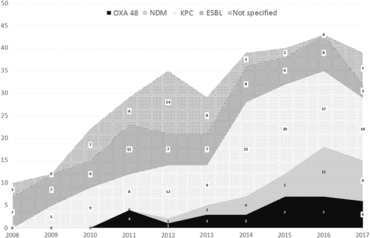
Klebsiella pneumoniae has established itself as one of the leading causes of healthcare-associated infections in Southeast Asia,Reference Ling, Apisarnthanarak and Madriaga9 in Europe, where ESBL-producing KP has reached endemic rates of up to 50%,10 and in the United States,Reference Magill, Edwards and Bamberg11 where MDR-KP have been reported in every state as of 2017.12 In line with this finding, the basic reproductive number of KP has been estimated at 2, suggesting a higher transmission capacity than has been reported for many other important nosocomial pathogens including viruses such as Ebola, Middle East respiratory syndrome coronavirus (Mers CoV), influenza, and bacteria such as methicillin-resistant Staphylococcus aureus (MRSA) and Clostridium difficile.Reference Campbell, Strang, Ferguson, Cori and Jombart13 However, estimates of the basic reproductive number of KP in this study were based on a single outbreak report, which limits its generalizability to other settings.Reference Sypsa, Psichogiou, Bouzala, Hadjihannas, Hatzakis and Daikos14 The number of MDR-KP outbreaks published in PubMed has steadily increased from 2008 to 2016 most probably due to the novelty of emerging resistant mechanisms, but they also reveal its transmission potential. Arguably, the plateauing effect recorded in 2017 reflects lack of novelty rather than a true reduction in outbreaks, thus indicating publication bias (Fig. 1).
Number of outbreaks with multidrug-resistant Klebsiella pneumoniae stratified according to different resistance mechanisms published in Pubmed over a ten-year period (2008–17).

Recommended infection control interventions
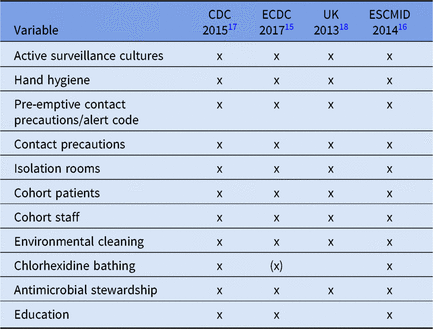
Numerous guidelines have been published by different international and national societies, highlighting some of the key interventions to control transmission of MDR-KP in healthcare settings.Reference Magiorakos, Burns and Rodriguez Bano15–18 The most important components include active surveillance cultures, hand hygiene promotion, preemptive contact precautions, contact precautions for known carriers, isolation rooms, patient cohorts, staff cohorts, environmental cleaning, antibiotic stewardship, education, and chlorhexidine bathing (Table 2). All of these components have been shown to be successful in containing outbreaks of MDR-KP in healthcare institutions.Reference Campos, Albiero and Ecker19,Reference Munoz-Price, Hayden and Lolans20 However, MDR-KP are on the rise. Why are we failing at controlling this pathogen and what are the specific challenges for infection control?
Core Components of Infection Control Interventions for Control of Multidrug-Resistant Gram-Negative Organisms in Healthcare Settings, as Proposed by Different National and International Organizations

Note. UK, United Kingdom; ESCMID, European Society for Clinical Microbiology and Infectious Diseases; CDC, Centers for Disease Control and Prevention; ECDC, European Center for Disease Prevention and Control.
Reasons for failure of infection control measures
In an outbreak investigation reporting one of the largest outbreaks of KPC-KP in a tertiary-care center in Germany, a research group pinpointed key elements maintaining transmission.Reference Kaiser, Finstermeier and Hantzsch21 The outbreak was initiated after repatriating a patient with ventilator-associated pneumonia from Greece. Ten days after being referred to the German hospital, KPC-KP was recovered from bronchoalveolar lavage. A contaminated positioning pillow in the surgical ICU served as a reservoir for KPC-KP over a 12-month period. Subsequent cases with late identification of carriage, sharing of rooms and nursing staff, referrals causing satellite outbreaks in regional hospitals, and establishment of additional environmental reservoirs contributed the successful transmission of the KPC-KP. In most patients, gastrointestinal carriage was absent after 6 months, yet carriage could be observed up until 40 months after earliest detection of KPC-KP.Reference Lubbert, Lippmann and Busch22
In the following sections, we further discuss the key elements maintaining outbreaks investigated in this study: failure of standard precautions to interrupt transmission, late identification of KPC-KP in the index case, delayed screening of contacts, establishment of silent reservoirs, and transfer to surrounding hospitals provoking satellite outbreaks.
Failure of standard precautions
Standard precautions are the basis of all infection control measures. Their importance has been reinforced by an interventional study looking at different interventions to reduce colonization and transmission of MDR bacteria in intensive care units (ICU).Reference Derde, Cooper and Goossens23 Improved hand hygiene plus unit-wide chlorhexidine body washing reduced the acquisition of antimicrobial-resistant bacteria, particularly MRSA, but additional screening and isolation of carriers did not further reduce acquisition rates. However, when analyzing the subgroup of multidrug-resistant Enterobacteriaceae, none of the interventions resulted in a reduction of acquisition, suggesting that in addition to standard precaution, even contact precautions may fail to contain multidrug-resistant Enterobacteriaceae and further considerations as detailed in the following may need to be considered.
The transmissibility of antibiotic-resistant Enterobacteriaceae in an ICU setting has been estimated to be nearly 4 times higher for non-EC Enterobacteriaceae than for EC.Reference Gurieva, Dautzenberg, Gniadkowski, Derde, Bonten and Bootsma24 One reason that MDR-KP is more transmissible than other Enterobacteriaceae may be its ability to survive in a hospital environment. This survival potential was shown in a pediatric population where 470 environmental samples were taken. Among them, 19 yielded ESBL-producing bacteria.Reference Guet-Revillet, Le Monnier and Breton25 Klebsiella pneumoniae was the most frequently isolated species, and ESBL-KP carriage or infection was the only risk factor associated with surface contamination in this trial. These findings have been further supported by a study conducted in France, where contamination of the environment was significantly higher in patients colonized or infected with ESBL-KP than other ESBL-producing Enterobacteriaceae (ESBL-PE).Reference Gbaguidi-Haore, Talon, Hocquet and Bertrand26 Such data support the proposition that infection control measures need to be tailored to the different members of the family of Enterobacteriaceae.
Late identification of carriers
In the German outbreak,Reference Kaiser, Finstermeier and Hantzsch21 the index patient was identified 10 days after hospital admission. Late identification of carriers has also been understood as a key issue, triggering an outbreak of KPC-KP occurring in Finland in 2013 involving 9 patients.Reference Kanerva, Skogberg and Ryynanen27 The index case was not identified for almost 4 months because this patient did not feature any risk factors known for MDR-KP such as travel abroad.
Early identification of carriers is key for timely implementation of contact precaution measures to prevent ongoing transmission, but how can we improve early detection of carriers? Although the implementation of screening protocols seems to be the obvious answer, many questions around screening remain unanswered at this point, including which patients need to be screened, how screening is to be performed, and at which time point screening is most specific.
Who to screen. The European Center for Disease Control (ECDC) published guidelines in 2017Reference Magiorakos, Burns and Rodriguez Bano15 providing recommendations on who to screen by asking several key questions at hospital admission. These questions include (1) history of an overnight stay in a healthcare setting within the last 12 months, (2) whether the patient been dialysis-dependent or received cancer therapy within the last 12 months, (3) known history of MDRE, and (4) whether the patient epidemiologically linked to a carrier of MDRE. If any of these answers is yes, the patient is to be placed under preemptive contact precautions and screened. Although these recommendations are reasonable, few institutions have the capacity for enough patient isolations when most admitted patients are affected. More restrictive screening and preemptive isolation recommendations may result in lower sensitivity with improved feasibility, resulting in a better cost–benefit ratio.
In the United States, active screening of patients with known risk factors for carriage of MDR organisms is suggested by the Centers for Disease Control and Prevention (CDC), yet no specific guidelines similar to those published by the ECDC exist.17 According to the 2006 Healthcare Infection Control Practices Advisory Committee (HICPAC) guidelines for management of multidrug-resistant organisms in healthcare settings, it is advisable for acute-care facilities in nonendemic regions (1) to screen microbiological records of the 6–12 preceding months for carbapenem-resistant Enterobacteriaceae (CRE), (2) to perform point prevalence culture surveys in high-risk areas in case unrecognized CRE cases occurred to identify subsequent cases of CRE, and (3) to perform active surveillance cultures of patients with epidemiologic links CRE cases.28,29
Where to screen. To reduce false-negative screening results, the most frequently colonized body sites should be screened, yet data investigating which sites to screen are limited. When systematically screening colonization sites for ESBL-PE, urine was the site mostly colonized (83% of all cases), followed by rectum (69%), groin (35%), and throat (13%). Among this population, 24% of all carriers were only detected as such by screening the urine; however, most ESBL-PE (ie, 86%) were E. coli, thus limiting generalizability to other Enterobacteriaceae.Reference Tschudin-Sutter, Frei, Dangel, Stranden and Widmer30 In a subsequent study, the rectum was not colonized in 14% of all ESBL-PE carriers without reporting differences between different Enterobacteriaceae.Reference van Prehn, Kaiser, van der Werff, van Mansfeld and Vandenbroucke-Grauls31 Among patients in Thailand, a high prevalence of ESBL-PE colonization in rectal specimens followed by groin, throat, and nasal cavity was shown, yet urinary samples were not investigated.Reference Rattanaumpawan, Choorat, Takonkitsakul, Tangkoskul, Seenama and Thamlikitkul32 Considering that most guidelines recommend screening by performance of rectal swabs only, a notable number of colonized patients might remain undetected when urinary sample screening is not additionally performed. Further studies are needed to confirm sites needing to be considered by screening protocols to increase sensitivity.
When to screen. A recent study found that patients screened on admission had a 6% probability of being positive for KP, whereas patients screened at least 3 days after admission had a probability of 19%.Reference Gorrie, Mirceta and Wick33 Thus, patients may also need to be screened after admission and repeatedly during a hospital stay and not just at hospital admission, as recommend by most guidelines. Although detection of acquisition in the hospital might play a role, selection pressure under antibiotic treatment seems more likely.
How to screen. Minimizing the interval between patient admission and initiation of contact precaution is a crucial factor in infection control. However, turnaround time of screening results and time to patient isolation remain major challenges.
A recent study by Ducomble et alReference Ducomble, Faucheux and Helbig1 investigated whether polymerase chain reaction (PCR) could be performed directly from rectal swabs without waiting for cultures, which could decrease time to contact isolation precautions from 5 to 1.5 days, turnaround time from 8 days to 1.5 days, and confirmed patient days in isolation of patients with KPC-KP increased from 72% to 90%.
In a study by Oueslati et al,Reference Oueslati, Girlich, Dortet and Naas34 a PCR-based test performed directly from bacterial colonies detected the carbapenemases mostly found in MDR-KP with high sensitivity and specificity within 2 hours, improving turnaround time, which might lead to faster identification of antibiotic resistant strains and thus not only reduce time to isolation but also reduce inadequate antimicrobial treatment.
Silent reservoirs
The establishment of silent reservoirs is another key issue to consider regarding transmission of MDR-KP. Contamination of a positioning cushion, possibly endoscopes and mobile hemodialysis machines, were considered crucial in the continuation of the German outbreak.Reference Kaiser, Finstermeier and Hantzsch21
A French study reported an outbreak entertained by similar reservoirs.Reference Pantel, Richaud-Morel, Cazaban, Bouziges, Sotto and Lavigne35 MDR-KP survived on a mattress but also in sinks leading to ongoing transmission. The transmission of resistance mechanisms not only occurs within the species itself but also in transmission of resistance genes to other pathogens. This phenomenon was revealed by Conlan et al,Reference Conlan, Thomas and Deming36 who found evidence of horizontal transfer of carbapenemase-encoding plasmids between KP, Enterobacter cloacae, and Citrobacter freundii in the hospital environment.
Endoscopes are an important reservoir to consider in an outbreak investigation. An OXA-204 carbapenemase Enterobacteriaceae outbreak was related to endoscopes in France.Reference Potron, Bernabeu and Cuzon37 The outbreak involved 2 different species, KP and EC. Among all 22 patients affected by the outbreak, among the clusters of KP isolates, which were transmitted by endoscopes, patients actually went on to transmit their KP to others by patient-to-patient transmission, whereas the EC isolates were no longer transmitted. These results support the findings on superior transmissibility of KP compared to other Enterobacteriaceae.
Interventions targeting wastewater hospital plumbing fixtures by installing hopper covers and sink tap devices in adult ICUs, demonstrated a decrease in patients acquiring KPC, pointing to the hospital wastewater as an important source for transmission.Reference Mathers, Cox and Kitchel38
Removal of sinks and introduction of water-free patient care was shown to decrease the rates of gram-negative colonization in an ICU after discovery of an outbreak of ESBL-producing E. cloacae.Reference Hopman, Tostmann and Wertheim39 Colonization rates dropped significantly from the preintervention period to the postintervention period, most clearly in patients with increased lengths of stay in the ICU. These findings indicate that a way to enhance control of MDR-KP might be by introduction of water-free patient care.
No-touch disinfection systems may be an effective tool to prevent establishment of silent reservoirs.Reference Ali, Muzslay, Bruce, Jeanes, Moore and Wilson40 Overall, 95% of 214 sites were contaminated with bacteria after manual terminal disinfection, with high numbers of bacteria being present on the floor, bed control panels, and the nurse call buttons. Enhanced disinfection using hydrogen peroxide vapor aerial decontamination systems reduced surface contamination to low levels. Yet introduction of these systems leads to prolongation of turnover time and higher costs.
Transfer within and between institutions
A complex exposure network summarizing pathways of a moderate amount of patients maintaining an outbreak of KPC Enterobacteriaceae through numerous transfers between nursing homes, acute-care institutions, and long-term acute-care hospitals revealed the emergence and rapid regional spread of MDR-KP.Reference Won, Munoz-Price and Lolans41
In another study, patients hospitalized in geriatric care wards were systematically screened for carriage of KP.Reference Gorrie, Mirceta and Wick42 Unique different lineages of KP in the majority of patients were detected, and these lineages were susceptible to most antibiotic agents. However, they also found clusters of MDR-KP strains with minimal nucleotide divergences. These clusters were attributable to ESBL producers carrying blaCTX-M-15 , which are clones associated with hospital-acquired ESBL infections worldwide. Linking these data with the epidemiologic data suggested that these strains were actually transmitted within the referral hospital, indicating that screening of transfer patients might be a solution for MDR-KP infection control, yet viability of these procedure seems to go beyond the scope of hospital capacity looking at the immense frequency of interfacility referrals, which again underscores the need for amended screening algorithms.
The number of patient transfers between facilities and the number of genetic links has also been modeled in a study investigating an outbreak of MDR-KP. Phylogeny indicated that a strain of MDR-KP was brought into each facility multiple times by various intrahospital transmission routes, suggesting that patient sharing perpetuated the regional outbreak.Reference Snitkin, Won and Pirani43 Consequently, the density of patient transfers alone is predictive of interfacility transmission. Thus, implementation of pathogen surveillance by whole-genome sequencing might help to identify facilities within a patient-sharing network and lead to targeted investigation and infection control intervention.
Despite this knowledge, only 70% of all laboratories in the United Kingdom flag positive results of MDR-KP on patient records, and only 30% of laboratories feature a system in place for alerting neighboring trusts.Reference Trepanier, Mallard and Meunier44 Protocols for transfer from hospital including MDR-KP notification are only available for 75% of laboratories.
Clear communication about the MDR-KP status of patients at transfer between facilities is crucial so that each institution is able to conduct infection control measures at hospital admission directly. Rosenman et alReference Rosenman, Szucs and Finnell5 provided data of an automated system to notify healthcare workers in case a patient with a known history of an MDR-organism was admitted to an emergency room or an inpatient setting. The automated system recorded substantial crossover of affected patients between institutions within a short time and provided information to help reduce time to isolation. Notably, these findings rest on the premise that we have a clear definition of MDR organisms.Reference Rosenman, Szucs and Finnell5
Meaningful outbreak investigation
Among 95 MDR-KP outbreaks screened, only 14 (14.7%) investigations reported a source. Outbreak investigation is ultimately required and helpful when outbreaks with phylogenic clones can be linked to epidemiologic data, ideally revealing a source and transmission pathways. Such reports provide a meaningful resource for other institutions and settings struggling with similar outbreaks, enabling them to benefit from prior lessons learned. In contrast, merely reporting phylogenetic relationships add little value. The ORION statement provides a framework for transparent reporting of outbreaks, and promotion of its use is likely to result in more meaningful outbreak reporting.Reference Stone, Cooper and Kibbler45
In addition, the worldwide database for nosocomial outbreaks (https://www.outbreak-database.com) is an effective tool for collecting information on outbreaks. It serves as a valuable resource, free of charge, to retrieve parameters of interest in association with specific outbreaks.Reference Vonberg, Weitzel-Kage, Behnke and Gastmeier46 Unfortunately, this database is used infrequently: from 2008 to 2017, only 31 outbreaks using the search terms Klebsiella pneumoniae in combination with different resistance mechanisms (ie, ESBL, NDM, KPC, OXA) were entered, whereas 295 outbreaks were identified in PubMed. Promotion of its use by leading medical journals and automated cross referencing to published outbreak reports may result in a more complete collection and resource.
In summary, MDR-KP has established itself as one of the leading causes of healthcare-associated infections, providing tremendous challenges for infection control. Several key factors have been identified as contributors to the perpetuation of MDR-KP outbreaks, which has led to its successful global dissemination. Future strategies need to tailor standard precautions to the specific aspects of transmissibility of MDR-KP. These include further investigations on environmental interventions aiming to reduce silent reservoirs. Targeted measures include the development of more useful recommendations regarding which patients to screen for carriage, including how, when, and where screening should be performed. Clear communication of MDR-KP patient status has to be available during transfers to other medical facilities, ensuring early implementation of precaution measures. In addition, a consensus on MDR-KP definition, screening performances, and meaningful documentation of outbreak investigations is crucial for future infection control and prevention.
Author ORCIDs
Sarah Tschudin-Sutter, 0000-0003-4875-5368
Acknowledgments
None.
Financial support
This work was funded by the Division of Infectious Diseases and Hospital Epidemiology, University Hospital Basel, Basel, Switzerland.
Conflicts of interest
All authors report no conflicts of interest relevant to this article.