How do conflicts and their resulting casualties influence voting behaviour in democratic states? Do mounting casualties lead to electoral turnover or are incumbents retained because the public refuses to ‘change horses’ during the conflict? History shows that incumbent parties are punished for costly conflicts. For example, both Presidents Truman and Johnson declined to seek re-election in the face of mounting costs and their parties lost hold on office. Yet President Bush and Prime Minister Tony Blair were both re-elected in the face of an unpopular conflict and increasing casualties. This raises the question: do casualties from interstate conflicts and military interventions help or hurt incumbent governments’ re-election chances?
While evidence reveals that casualties affect the public's support for conflict involvement and support for the incumbent government, there is little research on how conflicts and casualties shape voting behaviour, especially beyond the United States. In addition, existing research rarely compares one conflict and its consequences to another conflict, and therefore inferences and subsequent generalizations are difficult to make. Finally, most research fails to compare periods of relative peace to periods of violence. While earlier research has shown that casualties lead to declining support for governments, is this decline in support any different from that which occurs for governments not engaged in foreign conflicts? Given the lack of cross-national research examining the effects of casualties on voting, this research fills an important gap.
To explain the relationship between casualties and voting, I present a theoretical framework based on the investment model of commitment.Footnote 1 I propose that the degree of partisan satisfaction, the alternatives presented and the resources, or investments made in the conflict determine voting outcomes. Specifically, I argue that, in large part, partisanship and partisan strength, shape voter satisfaction and the attractiveness of alternative candidates during times of conflict. In addition to how partisanship influences the voting calculus, the amount of resources, or investments made – as measured by casualties – may make individuals more committed to sustaining the course of action and retaining the incumbent. I argue that as casualties mount, some voters will probably view casualties as an investment when weighing the costs and benefits of continuing the conflict. Subsequently, these individuals are more likely to support the incumbent at the next election.
I test my expectations using two analyses. The first analysis uses mass-level data of elections in twenty-three democratic countries between the years 1948 and 2005 and tests whether mounting casualties increase vote share. In the second analysis, I use British Election Survey (BES) data from 2004 to 2008 as an individual-level test of the theoretical framework. I find that under certain conditions, increasing casualties have a positive effect on incumbent vote share. I conclude with a discussion of the implications of the results and avenues for future research.
Casualties and domestic politics
Wartime casualties affect domestic politics. Research examining the relationship between casualties and public support for continuing a foreign conflict suggests that as casualties mount, support declines.Footnote 2 For example, Gartner and Segura argue that the death of a solider from one's own state produces more salient information for a voter in that state about the costs of war, increasing the likelihood of an individual opposing the conflict.Footnote 3 Besides altering support for the conflict, mounting casualties can depress executive approval. Mueller and others show that public support for the government decreases as casualties rise.Footnote 4 Casualties also influence incumbent politicians’ electoral fortunes as increasing casualties may move the publicly stated positions of American senators and their challengers.Footnote 5 As a group, these studies reveal that increasing casualties erode public support for the conflict and government, and also alter the policy positions of elected officials.
However, recent research on war, casualties and voting questions whether casualties always lead to declining incumbent support and subsequent vote loss. At the heart of this question is how people use information about a conflict, such as casualties, to evaluate the incumbent's policies and then cast their votes. Two prominent explanations of the relationship between conflict, casualties and support come from Gelpi, Reifler and Feaver and from Berinsky.Footnote 6 Gelpi, Reifler and Feaver argue that voters use both retrospective and prospective evaluations of conflict depending on what aspect of the conflict they are evaluating. They argue that voters use retrospective evaluations when assessing whether the conflict was justified, or as they state in their study of Iraq, ‘voters are judging whether the decision to invade Iraq was the right one.’Footnote 7 However, voters use prospective criteria when assessing the likelihood of the success of the conflict at a given point in time. Their results show that voters largely relied on retrospective evaluations of whether the conflict was the ‘right thing to do’ when voting for Bush in the 2004 presidential election in the United States. Interestingly, prospective assessments of the success of a conflict did not directly predict vote share. Instead, prospective assessments of success predicted an individual's willingness to tolerate casualties. Their analysis highlights that the likelihood of success, which they tie directly to casualty tolerance, or a voter's ‘willingness to pay higher costs’, did not independently influence vote choice. This implies that, contrary to the results of Mueller and others, casualties may not erode support for the conflict or support for the incumbent. What is absent from their work, however, is an assessment of how individuals determine the correctness of a conflict or the probability of its success.
Berinsky contends that elite discourse and partisan attachments drive an individual's support or opposition for a conflict.Footnote 8 Berinsky, building on Zaller's model of opinion formation, explains how partisan politics shapes an individual's evaluation of war.Footnote 9 He argues that evaluations of whether a conflict was justified and estimations of success and support are shaped by domestic political processes, specifically elite debate and an individual's partisan predispositions. He posits that events by themselves do not shape support for a war. Rather, ‘attachments to groups and patterns of elite discourse – the stated positions of leading Democrat and Republican politicians – will play a large role in determining public support for war.’Footnote 10 He modifies Zaller's model, arguing that one-sided discourse can also induce partisan polarization. Partisans are more likely either to support or to oppose a conflict, even if there is little elite debate or if messages about the conflict emerge from only one political party. For example, he shows that because the Iraq War was seen as Bush's war, self-identified Republicans were likely to support the conflict while self-identified Democrats were likely to oppose it.
Other evidence from the US conflict in Iraq also shows that the cost of conflicts and partisan politics alters voters’ choices. For example, Grose and Oppenheimer examine the connection between whether a candidate for office supported or opposed the war, the progress of the war and voting outcomes. They infer that during the 2006 congressional elections, district casualties affected Republican incumbents more than they affected Democrats regardless of whether the Democratic incumbent supported the war.Footnote 11 In another study of the 2006 election, Grose, Malhotra and Oppenheimer examined individual vote choice and the Iraq War, finding that rather than casualties, partisanship was the best single predictor of vote choice.Footnote 12 Kriner and Shen found that statewide casualties generally had a negative impact on 2006 US Senate incumbent success. However, they did not control for other national issues such as disenchantment with the Republican party.Footnote 13 For example, although Iraq was a national issue in 2006, a CNN exit poll showed that while 57 per cent of the public thought Iraq was either very important or extremely important, 74 per cent of the public felt that corruption in government was also very or extremely important.Footnote 14
While these studies generally show a negative relationship between casualties and voting, albeit conditioned by partisanship, other evidence demonstrates a positive relationship. Norpoth and Sidman maintain that the Iraq conflict helped President Bush in the 2004 presidential election by extending the rally effect.Footnote 15 They argue that high casualties did not translate into declining approval and subsequent vote loss. Rather, they contend that the opposition that emerged initially from the conflict, regardless of increasing casualties, altered approval. Furthermore, they posit that American wars do not systematically determine election outcomes with just as many wars leading to vote gain as vote loss for incumbent presidents and their parties. In another study of the 2004 US election, Karol and Miguel note that Bush improved on his 2000 electoral victory. Of course, they conjecture that he should have won by a slightly greater margin.Footnote 16 They also note that declining vote share was most obvious in ‘blue’ states, where voters were likely to oppose Bush anyway.
In sum, analyses of the 2004 and 2006 elections demonstrate that assessments of battlefield conditions as well as partisan politics can affect the vote choices of individuals. On the one hand, consistent with Gelpi, Reifler and Feaver's argument, individuals’ use of criteria, such as the ‘rightness of the conflict’ or casualties, can affect voting behaviour. On the other hand, Berinsky's argument that partisan politics colour the way that individuals assess conflicts and subsequently support or oppose the incumbent government is also borne out. Below, I present a model of vote choice that accounts for both individual's partisan leanings as well as their assessments of conflict based on the costs of war (casualties). I argue that, for some individuals, partisan leanings will dominate the decision of an individual to support or oppose a conflict and subsequently the incumbent. However, for other individuals, factors such as the resources expended and the alternatives available will figure more prominently in their calculus, making them more likely to support the incumbent.
The investment model, conflict and incumbent support
To explain incumbent government support in the face of rising casualties, I draw on the investment model of commitment from psychology.Footnote 17 The investment model states that commitment comes from attraction to and satisfaction with a relationship plus the resources expended. Specifically, commitment to a relationship is a function of the relative value of the outcome of the relationship (both costs and benefits), the quality of the available alternatives to the current relationship and the magnitude of the investment in the relationship. This article is not the first to draw on the investment model in terms of explaining relationships between individuals and foreign policy events in democratic states. For example, Hoffman et al. employ this model to explain how audience costs affect foreign policy at the individual level.Footnote 18 Below, I outline the investment model of commitment and then integrate the three factors: investments, satisfaction and alternatives into a model of individual vote choice during conflict.
The investment model states that investments are concrete (e.g. people, wealth) or intangible resources (e.g., time and effort, reputation) that are lost or diminished if a relationship is dissolved or a policy action is terminated.Footnote 19 The investment model states that commitment increases over time as more resources are committed to the relationship. This then increases the costs of withdrawing from the relationship. Rusbult states that investments are of two types, extrinsic and intrinsic. Extrinsic investments are the tangible, current costs and benefits of maintaining the relationship. Intrinsic investments are the prior investment such as emotions, money etc., and should increase commitment. Rusbult states that because both types are non-portable, they would be lost on dissolution of the relationship. This means that as investments increase, individuals should be less likely to leave the relationship.Footnote 20
In addition to the investments made in the relationship, the investment model highlights the role of satisfaction in determining commitment. The satisfaction one derives from a relationship, or course of action, is often the principal glue that holds the arrangement together. If someone is continually satisfied with a relationship, the individual is unlikely to end it. However, if someone becomes dissatisfied with the arrangement, then this is weighed against the investments already made in the relationship to determine whether to maintain, alter or even dissolve the relationship. If satisfaction was the only factor determining whether to maintain or support some policy, then as casualties accrue and conflicts continue, voters might want a change in policy and/or government. However, investments and alternatives also factor into the decision. As investments increase, people become more committed to the relationship. Also, if the alternatives to the current course of action, or current government, appear no better or even worse, people are also likely to maintain the commitment. Using these three factors, the investment model explains why people, even if they are less than satisfied with an outcome, continue to support the commitment.
I posit that individuals, depending on their satisfaction with the incumbent government, will see a conflict and its resulting casualties as an investment. As those investments increase, they are less likely to abandon the conflict even if they are not entirely satisfied with the incumbent government and its prosecution of the conflict. Below, I use the investment model of commitment to derive hypotheses about casualties and incumbent vote choice at both the micro and macro levels. Specifically, I posit that an individual's degree of partisan commitment largely determines their satisfaction or dissatisfaction with the incumbent. In terms of alternatives, I argue that while partisan attachments can shape whether the incumbent government is an attractive choice to voters, I assert that as casualties mount, incumbents can gain an electoral advantage over challengers, thus increasing their attractiveness to voters.
Conflict and investment
Nincic and Nincic were among the first to articulate how the public views the cost of military conflict differently when casualties are increasing and therefore support declines.Footnote 21 Building on Mueller's work on casualties and declining approval, they reason that voters act as consumers, while the government regards the costs of conflict from an investor's perspective.Footnote 22 In their economic metaphor, a voter, or consumer, expects to ‘operate within a known environment, anticipating full, equal and immediate value for his payment’, while the government, as an investor, ‘is willing to accept some risk in return for greater future benefit’.Footnote 23 In their model, they contend that voters, as consumers, agree to support a war expecting greater returns at a manageable price as long as the promised relationship between objectives and costs does not deteriorate.Footnote 24 If the costs change or exceed certain limits, this constitutes a new transaction and support for the policy (i.e., conflict) is withdrawn.Footnote 25 This is similar to Gelpi, Feaver and Reifler's argument about conflict support and casualties, in which they propose that voters weigh the costs of a conflict against the overall benefits.
However, recent work challenges the idea that individuals (voters) act as consumers and demonstrates that voters might see casualties as an investment. In their analysis of the war in Iraq, Boettcher and Cobb examine how the framing of casualties affects whether individuals are more likely to act as investors or consumers.Footnote 26 Their results show that individuals with a sense of personal commitment to the war experienced increasing casualty tolerance in reaction to ‘investment’ frames, while individuals who questioned the intervention in Iraq experienced decreasing casualty tolerance. In other words, ‘investment’ frames bolster previous positions.
Sullivan, Tomz and Hoffman et al. all highlight that individuals do not necessarily act as consumers when evaluating foreign policies.Footnote 27 For example, Sullivan, analysing the survey results of thirteen American and British military interventions in the era following the Second World War, states that ‘neither the risk of casualties nor the danger of getting bogged down in prolonged ground engagement dampens support for sustaining the fight’.Footnote 28 Her results reveal that individuals are more likely to support a conflict when the rate of casualties increases from one period to the next. This stands in contrast to the ‘voters as consumers’ model. Using experimental research, Tomz argues that citizens are concerned with the relationship between costs, the international reputation of the country and its leaders.Footnote 29 He maintains that individuals are less likely to abandon a conflict given the international reputation costs, even in the face of negative information. These works are in contrast to the ‘voters as consumers’ notion that states that the public should abandon a policy when the bad outweighs the good. In addition, Hoffman et al. use the investment model to explain when individuals might be more or less committed to supporting US membership in international organizations. My research leads me to expect that individuals, after accounting for partisanship and satisfaction, may view casualties as investments.
Satisfaction and partisanship
I argue that the lens of partisan politics shapes a voter's satisfaction with a conflict and the incumbent. While a great deal of research connects individuals’ views of policy performance to vote choice, other factors beyond policy performance affect how individuals vote. A primary factor determining vote choice is what Campbell et al. termed ‘perceptual screens’.Footnote 30 Voters’ perceptual screens bias their views on a policy based on their prior support for a party or candidate. Individuals structure their opinions of policy success based on their political beliefs or affiliations rather than policy success structuring political views. For example, Wlezien, Franklin and Twiggs note that if people voted on the pure basis, say, of a country's economic performance, then large vote swings of at least half the electorate would be common.Footnote 31 However, this is not the case.
Evidence shows that voters decide whether they like a policy or not on the basis of party or candidate preference.Footnote 32 For example, partisan loyalties and ideological biases affect whether voters evaluate the state of the economy, positively or negatively, regardless of true national economic conditions. A recent study by Anderson, Mendes and Tverdova using 1997 British general election panel data shows that vote choice during the election influenced their post-election economic views suggesting that voter preferences shape perceptions of policy success and are not exogenous.Footnote 33
As noted above, the conventional wisdom is that increasing casualties lead to declining support for war. However, because of perceptual screens, supporters of the opposition are predisposed to oppose the incumbent and oppose the war. For the US conflict in Iraq, Berinsky and Druckman concur with this noting, ‘the forces that shape public opinion about war … do not differ from those found to shape opinion on other political issues and events, including partisan political conflict, elite rhetoric, and individual-level variables such as sophistication.’Footnote 34
Using the investment model, I argue that strongly partisan supporters of the incumbent will support the incumbent and strongly opposed partisans will oppose the incumbent. As a result, it is most likely that weak partisans will use both investments and alternatives in their voting calculus. Moreover, while Keith et al. reveal that, on average, weak partisans and partisan leaners are likely to vote according to their party preference, Petrocik notes that while weak and leaning partisans are likely to vote along partisan lines, they are also more responsive to short-term electoral forces than are strong party identifiers.Footnote 35 Thus, on key issues, like war and casualties, these voters are less likely to rely solely on partisan cues when evaluating a policy and subsequently voting.Footnote 36 If partisan attachments do not cloud voters’ judgement, then I anticipate that these individuals are more likely to emphasize the investment aspect of the conflict in terms of resources expended.
Alternatives
The investment model highlights that in addition to the resources expended and satisfaction with the policy or party, better alternatives need to be present for people to break their commitment or vote against the incumbent. My expectation is that conflicts can create an electoral advantage for incumbents, reducing the attractiveness of alternatives, in two ways. First, conflicts with increasing casualties will make alternative governments and their policy prescriptions less attractive. I expect that among weak partisan and undecided voters, ‘an individual will derive the highest utility from the party perceived to have the best probability of implementing the issue or policy goal’, which, I argue, is the incumbent.Footnote 37 Secondly, conflicts with casualties are likely to heighten the importance of national security, which also gives an advantage to the incumbent. Recent research shows that people are more likely to project strong leadership traits on incumbents during times of crisis, even if the leader does not possess those qualities.Footnote 38
While challengers may oppose the conflict, they may not be able to come up with clear policy differences or credible policy alternatives that are better than the existing policies when juxtaposed against the investments already made. As Ansolabehere, Snyder and Stewart and Groseclose all note, challengers are often forced to adopt more extreme positions than incumbents.Footnote 39 Therefore, if challengers cannot come up with a credible or more attractive alternative, the incumbent should increase their electoral advantage at the next election. This is also consistent with recent work on incumbency advantage by Moen and Riis who demonstrate, using a formal model, that incumbents have an electoral advantage among non-partisan voters.Footnote 40 They show that an incumbent can more credibly signal their policies to the electorate than the challenger can. In addition, other research highlights how national security crises also create an incumbent advantage. Merolla, Ramos and Zechmeister argue that incumbent leaders benefit from crises because people are more likely to project leadership qualities onto incumbents and, at the same time, place greater emphasis on the importance of these traits when voting.Footnote 41
The following scenario highlights this argument. An executive enters a conflict that results in high casualties, perhaps higher than anticipated. However, the increased investment, highlighted by the higher casualties, begins to narrow the acceptable policy options available to the challenger. As the election approaches, the challenger has to develop a policy for the conflict. The most likely options are either to exit the conflict or somehow modify the policy to defray the costs of the conflict. If the challenger chooses the option of quitting the conflict, then he or she must convince the electorate of the benefits of giving up despite the fact that soldiers have given their lives for, what the challenger would have to admit, is an essentially worthless cause. It is unlikely that voters will see this as an attractive alternative given the rise in casualties and the updating voters will have made regarding the investments already made. Proposing unilateral withdrawal is unlikely to garner challenger support.Footnote 42
The other option for the challenger is to come up with a new policy to win the conflict. However, Glazer and Lohmann argue that incumbents can gain an electoral advantage by committing to policies that are salient to an election.Footnote 43 They argue that by doing so, the incumbent reduces the potential options for the challenger and forces the challenger to take extreme or less credible positions. For example, the challenger might promise, ‘to try harder’ or ‘invest more’ in the conflict or to include more allies. However, these options may not seem like very credible alternatives given the existing effort and commitment of the incumbent. Voters may notice that allies were not involved before now, and query why they should want to become involved now. Will additional allies make a large enough contribution to ensure either success or a quick victory? All told, challengers have a difficult time proposing credible alternative policies that will lead to a successful outcome and recoup the investment. Couple this with the projection of leadership qualities on the incumbent and the challenger faces a tough road to electoral victory.
While weak partisan voters may disagree with the conflict, given the lack of credibility about the challenger's proposed course of action, the investments made and their perception of leadership, they should be more likely to support the incumbent. This may explain the adage about why voters are less likely to ‘switch horses’ during wartime.Footnote 44 In addition, as Weisberg and Christenson note in their analysis of the 2004 US presidential election, voters saw George W. Bush as being stronger in leadership than John Kerry was, even though a majority disapproved of his handling of the conflict in Iraq, which is consistent with this argument.Footnote 45
From the above, I develop the following hypotheses. The theoretical expectation is that increasing casualties makes it more likely that voters who do not have strong partisan leanings will act in conjunction with the investment model and support the conflict. An observable implication at the mass level is that incumbent vote share should increase as the number of casualties increase. I express this as the following hypothesis:
HYPOTHESIS 1: Incumbent vote share increases with higher casualties in an ongoing conflict.
While at the mass level I expect an overall increase in incumbent support, at the individual level the theoretical framework states that this increase in support is most likely from weak partisans. Strong partisans will continue to view the conflict largely through perceptual lenses and support or oppose the incumbent depending on their relationship with the incumbent government.
I expect weak partisans to be more responsive to short-term electoral forces. However, I do not have any expectations about pure independents. For example, Keith et al. argue that they tend to be the most apathetic and uninvolved of all voter groups, as well as the least educated, meaning they are unlikely to vote.Footnote 46 Nevertheless, some independents are involved in politics. Dennis has identified four types.Footnote 47 The first are the anti-party independents. These individuals feel that the current parties are no longer able to represent voter interests and have become inefficient institutions. Politically autonomous independents believe that it is best to be politically independent in order to make sound, unbiased choices. Partisan neutral independents see no differences between the major parties. Finally, partisan variable independents demonstrate a lack of consistency in terms of partisanship and behaviour. Given the four types of independents and how they vote, it is unclear how they will vote as a group, if they vote at all. Therefore, the theoretical expectations are largely about weak partisans. I expect that weak partisans are likely to see rising casualties in terms of an investment and should become more likely to support the incumbent as casualties mount. I express this as the following hypothesis:
HYPOTHESIS 2: As casualties mount, weak partisans become more likely to vote for the incumbent government.
This argument stands in contrast to recent work that casualties may represent sunk costs. For example, Gelpi, Feaver and Reifler infer that some of the responses from different surveys on support in the face of mounting casualties may demonstrate the ‘sunk costs’ thinking of respondents in the war in Iraq.Footnote 48 ‘As the United States pays higher costs in Iraq, the public may become more determined to ensure that those losses are not in vain.’Footnote 49 However, this is not the same logic as the investment model, which argues that commitment occurs as investments increase in conjunction with satisfaction and the alternatives. The sunk cost argument is where an individual attempts to recoup losses by committing more resources to the problem. At the heart of this argument is the willingness to incur more casualties to ‘recoup’ existing casualties, which is part of the pathology of the sunk-cost trap. Interestingly, both arguments lead to an expectation that rising casualties lead to a greater tolerance of casualties and political support for the incumbent. However, the investment model highlights that the investments, in this case the casualties suffered, is only part of the calculation, in contrast to the sunk-cost argument, which implies that all individuals might view the conflict this way.
Research design
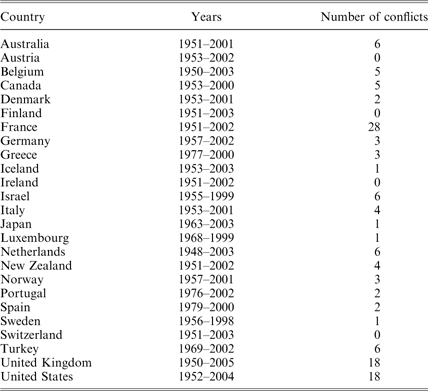
To test the hypotheses, I have performed two different analyses. To test Hypothesis 1, I have analysed data from twenty-three democratic countries between the years 1948 and 2005, with the unit of analysis being an election (see Appendix Table A1 for list of countries).Footnote 50 I examine how the cumulative number of casualties within an election cycle affects incumbent vote share. To test Hypothesis 2 and to address concerns about testing individual-level theory with aggregate data, I analyse individual-level survey data. In this analysis, I use monthly BES data between 2004 and 2008 to examine the relationship between partisan strength, cumulative casualties and incumbent support. The two analyses allow for the testing of the more general argument about conflict and incumbent vote share in terms of both its micro-level foundations and its macro-level implications.
In the first analysis, I employed a panel-estimate approach using country dummy variables with panel-corrected standard errors, rather than specifying a laundry list of country-specific factors. The country dummies capture the slow changing or static variations between countries that may affect vote share. I use this modelling strategy because standard regression models assume fixed intercepts across states and uncorrelated error terms, making these models inadequate for analysing cross-sectional data. In the second analysis, I use a probit model controlling for survey-specific effects over time.
The dependent variable is Incumbent Vote Share. This variable measures the net electoral vote of the incumbent party or parties. For multiple party coalitions, this measure considers the vote share, or the combined vote shares, of the top three parties within the coalition. A careful investigation of the historical development (i.e., name changes) of the parties was used to calculate the most accurate vote change. The vote share scores are of continuous, existing parties although the names of the parties may change from election to election. For example, many parties underwent name changes ahead of the Belgian parliamentary elections in 1981. However, these newly named parties did not constitute new parties. The Incumbent Vote Share measure is the percentage of vote that the incumbent party or parties receive in the current election.
The key explanatory variable is Logged Casualties.Footnote 51 I use the UCDP/PRIO Armed Conflict Dataset V4 to identify conflicts and determine the number of casualties.Footnote 52 I use the UCDP/PRIO data because they include both interstate as well as extra-state conflicts such as colonial wars of independence. Also, the UCDP/PRIO data provide casualty statistics for each combatant in a dispute. Finally, each case in the data must reach the minimum twenty-five casualties threshold. Therefore, I avoid many of the minor conflicts or disputes that show up in the Militarized Interstate Dispute data, such as fishing disputes between the United States and Canada.Footnote 53 Logged Casualties is the total number of casualties incurred by the state during the election cycle. I employ the logged measure because I agree with prior research that there is a substantive difference, for example, between the first twenty-five casualties and the 4,000th and 4,025th casualties.Footnote 54 From this variable, I create the measures, Logged Ongoing Casualties and Logged Prior Casualties. Logged Ongoing Casualties measures the number of casualties in a current conflict that intersects with an election. Logged Prior Casualties are casualties from conflicts that ended before the election. These measures help account for variation in salience effects of current versus completed conflicts.
While the key independent variable is logged cumulative casualties, some conflict participants may not incur any casualties. Therefore, I control for whether the country was involved in any conflicts during the election cycle. For this, I create two measures. One is called Past Conflicts. This variable counts the number of conflicts a state engaged in during the election cycle but ended prior to the election. I also create the measure Ongoing Conflict that accounts for conflicts that continue through an election.
I also account for conflict duration. Cumulative casualties are likely to be correlated with time. By controlling for duration, Gartner and Segura state that the logged casualty measure should be insignificant if the casualty measure is just capturing duration and its consequences.Footnote 55 If the casualty measures are still significant, this implies the theory that it is more likely to be correct that casualties, and not conflict duration, are driving the results. Secondly, longer wars may have different impacts than shorter conflicts due to fatigue and war weariness.Footnote 56 I use the average duration of conflicts in the election cycle, measured in months. If a conflict is still under way during an election, I calculate the months from the onset of the conflict to the election.Footnote 57 I call this measure Conflict Duration.
I include a number of factors that also affect incumbent vote share.Footnote 58 I include a measure of the vote share of the incumbent parties in the prior election. I also include a measure of the Effective Number of Electoral Parties. The ‘effective’ number of parties in the system affects party-system fragmentation and individual partisan attachments. Huber, Kernell and Leoni posit that the greater the number of parties in the political system, the weaker partisan attachments are likely to be among voters reducing incumbent vote share.Footnote 59
I also control for the length of tenure of the executive. Fair notes that, for US presidential elections, longer executive tenure leads to a decrease in incumbent vote share.Footnote 60 Similarly, Palmer and Whitten control for government duration in their model of incumbent vote share.Footnote 61 I control for executive tenure using the log of total days in office as determined by the Archigos dataset.Footnote 62 Another factor I account for is the variability of election timing. Governments may call elections early if conditions are favourable, which should increase vote share. Therefore, I include a measure of the Constitutional Inter-election Period (CIEP), which is the time left before the next mandated election must be called. Finally, I control for economic conditions by including measures of Inflation and Unemployment. Declining economic conditions should lead to voters punishing incumbent governments.Footnote 63
To test Hypothesis 2 and the individual-level foundations of the theory, I perform an additional analysis using monthly British surveys from May of 2004 through December of 2008. While this analysis does not explicitly account for the alternative policies put forward by challengers, satisfaction (partisan strength) and investments (casualties) are accounted for in the model. I think this provides a reasonable indirect test of the general theory.
The dependent variable is derived from the vote intention question. It is coded 1 if the respondent states that they would vote for Labour in the next election and 0 otherwise. The combined log of cumulative casualties from the conflicts in Afghanistan and Iraq is used to measure casualties. Also included is a measure of partisan strength called Weak Partisan. This measure takes the value of 1 if the respondent answered ‘not very strongly’ to the strength of party ID question and 0 if they responded ‘fairly strong’ or ‘very strong’. This measure is multiplied with the casualty measure to test whether higher levels of cumulative casualties make incumbent support more or less likely among weak partisans. Two other individual-level measures are included that might affect incumbent evaluation. The first measure is the respondent's evaluation of whether Britain will be successful in Iraq. This variable ranges from 0 to 10, with larger values indicating more positive outlooks on success. The second measure controls for the level of attentiveness to politics by the respondents. Basinger and Lavine, as well as Kam, argue that more informed, weak or non-partisan voters are more likely to use information to make prospective rather than retrospective voting decisions.Footnote 64 For this measure, the respondent is asked to rate the degree to which they pay attention to politics with 0 signifying ‘no attention’ and 10 ‘a great deal of attention’. In addition, I examine whether the partisanship of the respondent matters. Do partisan effects persist even among weak partisans? Is it only some weak partisans who are more inclined to support the incumbent, such as individuals who associate with Labour, while those who are closer to the Conservative party still are unmoved by casualties?Footnote 65
Finally, factors related to the British conflicts are included. A monthly measure of time since the British joined the conflict in Afghanistan is included to control for the duration of the conflict. I include the number of troops deployed in a given month, which may also be an indicator of salience.Footnote 66 The time until the next mandated election and the tenure of the prime minister, in months, are also used. These account for any temporal changes due to an approaching election and ‘the costs of governing’.Footnote 67 Finally, monthly indicators of unemployment and inflation are added to the models to account for any effects the economy may have on the vote choice.Footnote 68
Results
I posited that increasing casualties makes it more likely that voters will act as investors and support the conflict, increasing incumbent vote share. I further hypothesized that partisan strength affects this choice as strong partisans of the governing parties continue to support the government while strong partisans of the opposing parties continue to support the opposition. As such, only weak partisans should become more likely to support the incumbent as casualties mount.
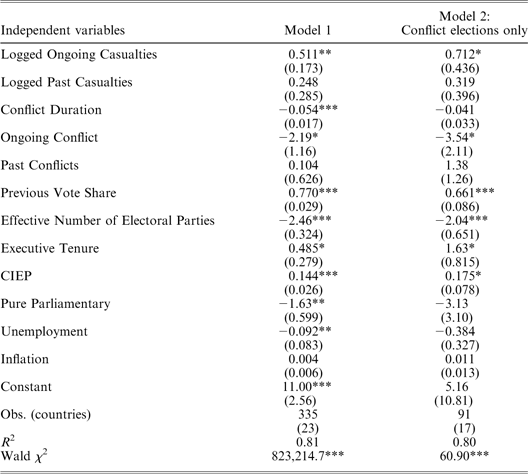
The Effect of Casualties and Conflict on Incumbent Vote Share

Notes: *p < 0.05, **p < 0.01, ***p < 0.001, one-tailed test. Panel Corrected Standard Errors in parentheses.
Models 1 and 2 show the results of the cross-national analyses. These results support the first hypothesis that casualties from ongoing conflicts increase incumbents’ vote shares. Model 1 examines all elections in the data, whether there was a conflict during the election cycle or not. In Model 1, the coefficients for ongoing casualties and ongoing conflicts are both statistically significant. A unit shift upwards in the log of ongoing casualties increases vote share by 0.5 per cent. Also, the ongoing conflict measure is significant, indicating that ongoing conflicts reduce vote share by more than 2 percentage points. The conflict duration measure is negative and significant, highlighting that longer conflicts reduce incumbent vote share. This is consistent with the war-weariness hypothesis. The past conflict and past casualties measures are both insignificant, indicating that conflicts, once finished, have little effect on incumbent vote share. This is consistent with the mixed evidence of studies that examine whether war helps or hurts leader tenure among democratic states.Footnote 69
In terms of the control variables, the previous vote share measure is positive and significant as expected, with each 1 per cent vote share in the previous election translating into a 0.77 per cent vote share in the next election. The four political system measures, the number of electoral parties, CIEP, whether the system was pure parliamentary or not, and the tenure of the executive are significant as well. As expected multiparty systems and pure parliamentary systems reduce vote share, because they tend to reduce partisan attachments, making voters less likely to support the incumbent.Footnote 70 The election timing measure is positive and significant, revealing that early elections increase vote share. This is consistent with expectations about governments calling elections when political tides are favourable. The executive tenure measure is also positive and significant, indicating that the longer an executive is in office, the greater the incumbent vote share. Finally, unemployment is negative and significant, though the inflation measure is not significant.
Model 2 examines only those election cycles where a country was involved in a conflict. Both the ongoing conflict and ongoing casualty measures are significant and in the same direction as in Model 1, while the prior conflict and casualty measures remain insignificant. The coefficient for the logged ongoing conflict measure is larger than in Model 1, indicating that, when comparing election cycles where the conflict occurred, increasing casualties helps the incumbent more than when compared to non-conflict election cycles. At the same time, the previous vote share measure, while positive and significant, is smaller, suggesting an increase in prospective voting. Comparing the previous vote share in Model 2 with the that of Model 1, the results suggest that incumbents, in periods of peace, earn a higher baseline vote share from incumbency than they do when involved in a conflict. However, when comparing the casualty measures, the difference between Models One and Two suggests that incumbents recoup any vote share loss due to the onset of the conflict as casualties accrue. This may explain why conflict may seem bad for sitting executives, especially if casualties from the conflict are unaccounted for in empirical models. All of the political variables, except the pure parliamentary measure, remain significant and in the same direction as in the prior model.
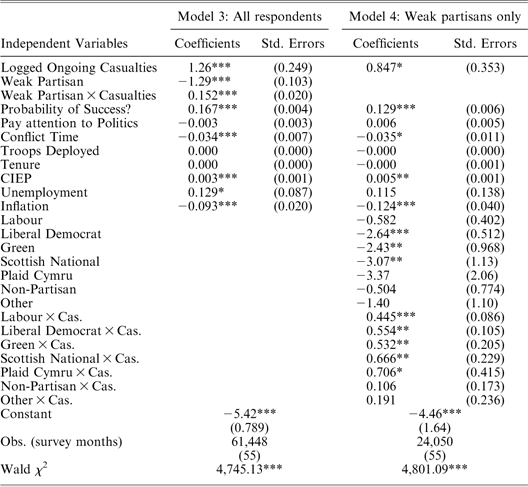
At the macro level, increasing casualties appear to increase incumbent vote share. However, where is this new support coming from? Are individuals with strong party attachments to major opposition parties and minor parties out of government switching to support the incumbent, or is the increased incumbent support coming from individuals with weak partisan attachments and political independents? To examine which voters become more likely to support the incumbent as casualties increase and test Hypothesis 2, Table 2 presents the probit estimates of the effect of cumulative British casualties on vote intention at the individual level.
The Effect of Casualties on Incumbent Vote Intention for British Individuals

Note: *p < 0.05, **p < 0.01, ***p < 0.001, one-tailed test. Clustered Standard Errors in parentheses.
According to the investment model, the expectation is that weak partisans should be more likely to vote for the incumbent as casualties increase. Model 3 presents the results for all respondents over the fifty-five survey months. Since I have some aggregate data across surveys, I cluster on the survey. First, looking at the constituent parts of the interaction term, the logged casualty measure is positive and significant, while the weak partisan measure is negative and significant and the interaction term is positive and significant.Footnote 71 The probability of success measure is positive and significant, suggesting that individuals who think that success is likely are also likely to support the incumbent. The conflict duration measure is negative and significant, suggesting that conflict duration has an independent effect on the probability of supporting the incumbent. The political attention measure is insignificant as are the conflict related measures. The CIEP measure is positive, suggesting that the further away the next election, the more likely an individual will vote for the incumbent. Unemployment is positive and significant. This is most likely due to the large percentage of strong Labour supporters in the data and these voters are likely to see Labour as the party best able to solve unemployment issues. At the same time inflation is negative and significant, suggesting that as inflation grows, voters are more likely to punish the Labour party, given that the Conservative party should be better equipped to handle rising inflation.
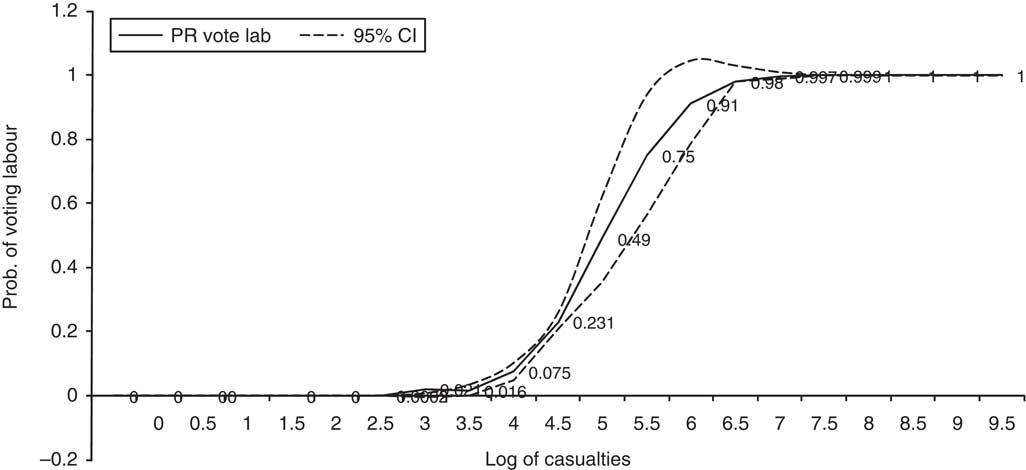
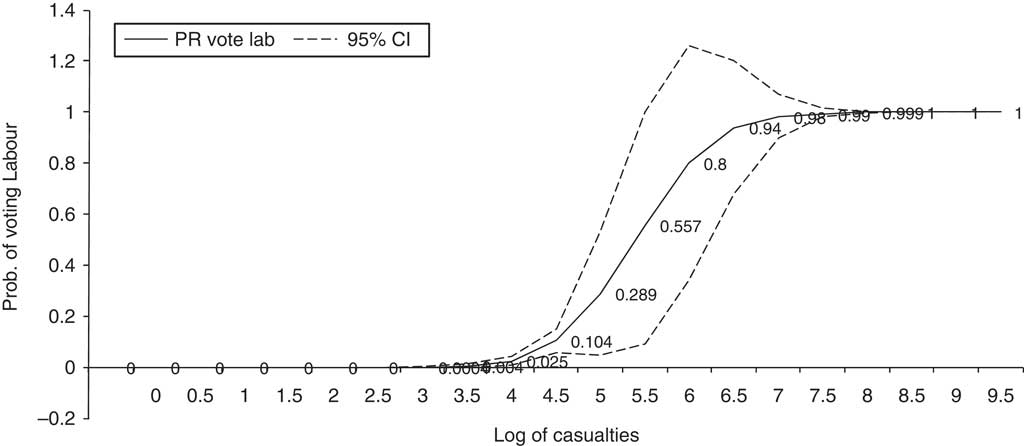
The results of the model suggest that weak partisans are initially less likely to support the incumbent. However, as the number of casualties rises, they become more likely to support the incumbent. To better interpret this interaction, Figure 1 plots the predicted probability of weak partisans voting for the incumbent as casualties rise.Footnote 72 The numbers in the figure are the predicted probabilities of voting for Labour across levels of casualties. The figure shows that as casualties rise, weak partisans become more and more likely to vote for the incumbent party. Specifically as casualties approach the ‘100-killed’ mark (the logged value is approximately 4.6), weak partisans shift from being less likely to vote for the incumbent to more likely to vote for the incumbent.
The probability of a Labour vote for weak partisans: by casualty level

While Model 3 compares weak partisans to strong partisans, do specific partisan attachments among weak partisans affect voting? As noted above, prior scholarship suggests that weak partisans are, in many ways, no different from strong partisans. For example, are the results of Model 3 being driven largely by weak Labour partisans who might be more inclined to vote for Labour regardless of the level of casualties? Model 4 addresses this concern by restricting the sample to only those respondents who identified themselves as weak partisans. In addition, a series of dummy variables are included in the model to account for the partisanship of the respondents. These are then interacted with the casualty measure. The comparison category for these variables is weak conservatives. An alternative strategy would have been placing each of the parties on a left–right dimension as is sometimes done in the American politics literature. However, given the relative narrowness of some of these parties, I instead chose to account for each party individually. Model 4 shows that the coefficients of the interaction terms between each party and the level of casualties are positive and statistically significant. Only the category labelled ‘other’ and those individuals identified as without party are not statistically significant. Yet, given that many of the constituent terms are negative, it is unclear whether increasing casualties have a positive influence on the probability of voting for the incumbent.
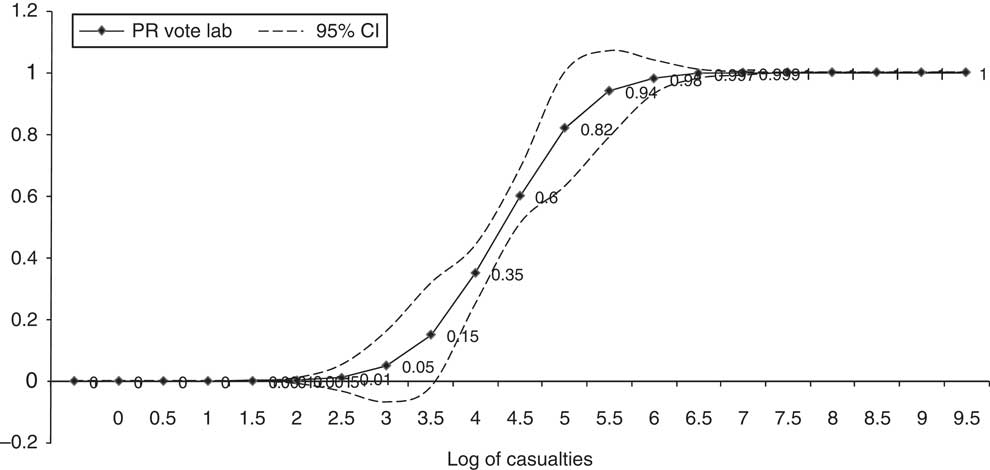
To examine whether partisan identity, beyond just partisan strength, interacts with increasing casualties to influence voting, I plot the predicted probability of a weak partisan voting for the incumbent broken down by the three major parties in the United Kingdom, the Labour party, the Conservative party and the Liberal Democratic party. Figures 2, 3 and 4 show these relationships.
The probability of a Labour vote for weak Labour partisans: by casualty level

The probability of a Labour vote for weak Liberal Democrats: by casualty level

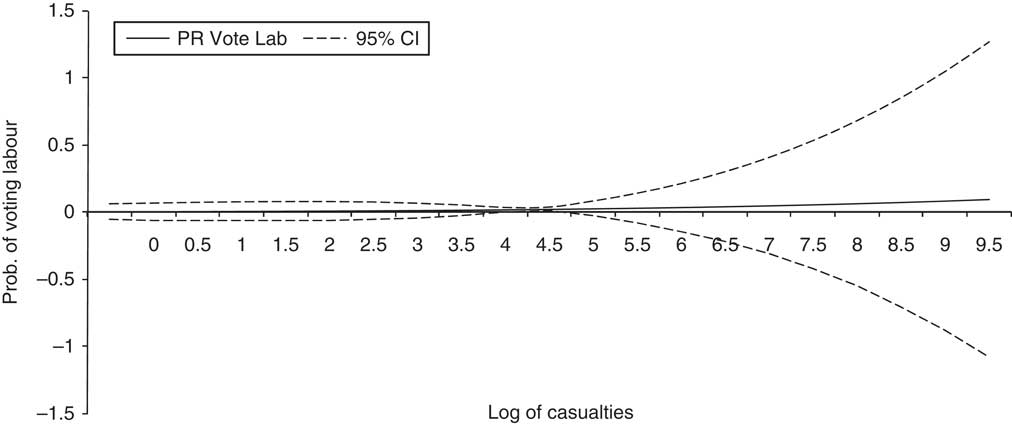
The probability of a Labour vote for weak Conservatives: by casualty level

Figures 2 and 3 show the relationship between casualty levels and voting for the incumbent Labour party for Labour and Liberal Democrat weak partisans, respectively. The patterns portrayed in each graph are very similar, except that weak Labour voters are quicker compared to weak Liberal Democrats to shift to voting for the incumbent as casualties rise. Interestingly, casualties have no effect on weak Conservative voters. Figure 4 shows that while the confidence intervals widen once casualties increase to 150, the line of the predicted probability stays relative flat and the lower confidence interval remains below zero. The figures suggest that weak partisans, in many ways, act similarly to strong partisans. For example, weak Conservative partisans were never more likely to vote for Labour. However, the figures suggest that, at least in the British example, weak partisans who did not associate with the two dominant parties, such as Liberal Democrats, became more likely to vote for Labour as casualties mounted.Footnote 73
Discussion
The analyses reveal that casualties do not necessarily lead to declining incumbent vote share. This stands in contrast to research suggesting that increasing casualties lead to declining support for both the conflict and the incumbent government. Consistent with Sullivan's recent work suggesting that increasing casualty rates correlate with increased support for the conflict, the results show that increasing casualties can increase incumbent vote share.Footnote 74
While the analyses confirm previous findings that international events influence domestic political processes, as a point of departure from previous studies focusing largely on public opinion, I show that international events specifically affect voting outcomes. Also, the analyses presented here reach beyond the context of previous studies focused solely on the United States. The results show that a more general pattern of conflict and casualties on voting outcomes exists.
While prior research suggests that casualties have a negative influence on citizens’ support for a conflict, the main result from the analyses is that as the number of casualties increases, incumbent vote share also increases. According to the investment model, as the costs of a conflict increase, voters either remain loyal to their parties or support the incumbent government in the next election. As costs mount and investments increase, some voters become less willing to quit or abandon the conflict even after accounting for partisan attachments. This makes it more likely that voters will retain the incumbent because challengers’ policies are unattractive alternatives when compared to the investments made by the country. This leads weak partisan voters to support the incumbent. At the same time, strong supporters of the incumbent government continue to support the government while those that oppose the incumbent government continue to do so.Footnote 75
However, with this explanation comes a serious implication for leaders choosing to use conflict as a policy tool to gain electoral support. The results suggest that the increased costs of war may fortify an incumbent's fortunes, although it is important to note that longer conflicts and the presence of a conflict reduce incumbent vote share. But, if a high level of casualties alters voter's perceptions, then governments may not quit when a conflict appears to be going poorly.Footnote 76 The government might commit more resources and try harder even if it means increasing casualties during the inter-election period. However, these results only appear to hold for elections that occur during a conflict, suggesting that ending a conflict before an election provides little electoral help for the incumbent. This result is consistent with the ‘Gambling for Resurrection’ hypothesis of Downs and Rocke, in which an incumbent uses information asymmetries to secure electoral victory when involved in an interstate conflict.Footnote 77 In addition, the analysis highlights that the longer any conflict continues, the more likely incumbent vote share will decline. While it is speculative, this may have been what prior studies have captured given that they have usually examined only one conflict at a time rather than casualties across space and time.
Moreover, the results are consistent with Norpoth and Sidman's analysis of the 2004 US presidential election. Bush would have fared worse at the polls had he followed an early exit strategy from Iraq. Instead, the Iraq conflict forced weak partisan voters to evaluate the Iraq conflict based on investments and alternatives. This is consistent with recent research in international relations on executive competency. Voters may interpret an early exit from a conflict in which an executive commits a great deal of resources and loses lives as a policy failure, which is likely to result in electoral punishment. At first glance, these results may appear inconsistent with Williams, Brule and Koch's evaluation of party support and Militarized Interstate Dispute (MID) onset.Footnote 78 They find that a new MID coupled with a declining economy further erodes incumbent party support. However, the cross-national models demonstrate that conflicts by themselves can reduce government vote share. It is only as investments increase that incumbent governments overcome this decline in the polls.
The analyses correspond with the work of Gelpi, Feaver and Reifler and of Berinsky.Footnote 79 As a group, they suggest that casualties, by themselves, do not create shifts in opinion. Rather, the nature of the conflict, the likelihood of success and the debate over the conflict all affect public support. The individual-level models of British survey respondents suggest that voter evaluations of the likelihood of success are prime indicators of incumbent support, which fits with the evaluation of Gelpi, Feaver and Reifler.Footnote 80 At the same time, the role that partisanship plays is consistent with Berinsky's argument. Yet, the results show that, for some weak partisans, increasing casualties provide additional information beyond evaluations of success or partisan leanings, such that it increases the likelihood of voting for the incumbent. The results of the individual level of analyses are also consistent with work on weak partisanship and voting. For example, even in the face of rising casualties, weak Labour partisans were still more likely to vote for Labour while Conservatives were unlikely to vote for Labour. The results were also consistent with Keith et al.'s work that weak partisans are still more likely to vote as partisans than anything else.
The analysis also has implications for decision-making theories such as prospect theory.Footnote 81 According to prospect theory, once in the domain of losses (casualties), individuals (voters) should be more risk acceptant and willing to try alternative strategies to regain those losses or at least stem the tide of losses. However, the analysis shows that as losses increase, the voting public seems willing to stick with the incumbent. As such, some voters see casualties as investments and are unwilling to stray from the course once so much has been invested. This suggests one of two things for prospect theory: first, individuals, once in the domain of losses, may prefer the known to the unknown (the incumbent to the challenger); secondly, if the challenger prefers peace to continuing the conflict, voters may choose to support the incumbent, given that the challenger's policies imply that the investments may have been for naught. Given that voters have already been consumers of the incumbent's policy choices, challengers must offer quality policy alternatives in order to unseat the incumbent.
Conclusion
I began the analysis trying to fill a gap in the literature about the effects of casualties on voting. Overall, the results are promising and open many avenues for future research. The analyses advance the understanding of how casualties affect political behaviour in the form of vote choice, rather than just public opinion and the tenure of leaders. International events influence more than just public opinion; they have a direct influence on electoral outcomes. The results highlight that while people may not approve of a conflict, the casualties that incurred during the conflict do not necessarily translate into a loss at the polls for those in power. The theory suggests that as casualties mount, voters transition from consumer to investor and the results, at both the mass and individual levels, are consistent with this expectation. Moreover, the theoretical expectations and results are consistent with recent research on the United States and Iraq. Also, the analyses reach beyond the context of the United States, suggesting that the results from prior studies of the relationship between conflict and political behaviour are applicable to other countries.
However, many aspects of elections, party politics and international events remain outside the scope of this study. For example, how do casualties affect polarization within political systems, for both political parties and the electorate? How do casualties affect the mobilization of individuals in terms of whether they are likely to vote? These questions provide further grist for the mill about how international events influence domestic political processes.
Countries and Years under Investigation