Nosocomial transmission of germs is a major public health issue.Reference Pittet, Allegranzi, Storr and Donaldson 1 Because most germs may be transmitted by direct contact, reducing the per-contact risk by improving hygiene has been at the heart of prevention strategies.Reference Pittet, Allegranzi and Sax 2 , Reference Derde, Cooper and Goossens 3 To further reduce risk, it may be necessary to alter the structure of contacts itself, as proposed in theoretical studies.Reference Ueno and Masuda 4 – Reference Hornbeck, Naylor, Segre, Thomas, Herman and Polgreen 6
Yet, contacts leading to nosocomial transmission are poorly characterized in hospitals: they are often assumed to occur at random within the wards,Reference Cooper, Kypraios, Batra, Wyncoll, Tosas and Edgeworth 7 or, at best, equated with attendance of the same ward at the same date among carriers of the same strains.Reference Köser, Holden and Ellington 8 , Reference Gardy, Johnston and Sui 9 Indeed, no convenient way to record contacts existed before advances in communication technologies made it possible to record high-resolution close-proximity interaction (CPI) networks.Reference Salathé, Kazandjieva, Lee, Levis, Feldman and Jones 10 CPIs correlate with contacts measured in more traditional waysReference Lucet, Laouenan and Chelius 11 and are not affected by the reporting bias inherent to self-reporting.Reference Smieszek, Barclay and Seeni 12 They may therefore provide a good proxy for between-humans contacts and inform on interactions leading to transmission.Reference Obadia, Silhol and Opatowski 13
Here, we report on a longitudinal, observational study, in which all participants were monitored for 4 months to continuously record CPIs and weekly detect Staphylococcus aureus carriage. The study took place in a long-term care facility (LTCF) in France. LTCFs, where patients usually stay for extended periods, present a large prevalence of carriage. As such, they have long been identified as a potential reservoir of antibiotic-resistant bacteria such as S. aureus.Reference High, Bradley and Gravenstein 14 – Reference Bilavsky, Lerman and Rabinovich 17
We conducted a nested case-control analysis to identify CPI-related risk factors associated with S. aureus transmission. Our objective was to identify CPI patterns that were associated with colonization. To that aim, we studied both local features of the CPI network (restricted to an individual of interest and his direct contacts) and global network measures. We also investigated whether the joint analysis of CPIs and bacterial carriage provided more information on the risk of colonization than mere CPI patterns.
METHODS
Study Organization and Setting
The I-Bird (Individual-Based Investigation of Resistance Dissemination) study took place from May 1 through November 1, 2009, in a 200-bed follow-up care and rehabilitation hospital in Berck-sur-Mer, France. During the study, 329 distinct patients stayed in the hospital and the total hospital staff comprised 261 healthcare workers (HCWs). They were all informed of the study and could refuse to participate or cease participation at any time. All participants (patients and HCWs) agreed to wear a small wireless sensor that recorded their CPIs and to undergo weekly nasal swabs to monitor S. aureus carriage. Usual hygiene procedures in France rely mostly on hand hygiene (alcohol-based hand rub, hand washing, and gloving for nursing cares) and do not implement routine screening for bacterial carriage. The complete i-Bird study protocol is detailed in the online supplementary text.
S. aureus Carriage and Incident Colonization Episodes
S. aureus isolates were spa-typedReference Frénay, Bunschoten and Schouls 18 and tested for resistance to 20 antibiotics (see online supplementary text). Methicillin was used to distinguish between methicillin-sensitive (MSSA) and methicillin-resistant S. aureus (MRSA). Two strains were considered identical if they had the same spa-type and antibiotic resistance profile.
Incident colonization in a patient was defined when a strain was present that had not been carried the preceding week or, in case of multiple carriage, that had not been carried in the 2 preceding weeks.
Recording CPIs Within the Hospital
Patients and staff wore a small wireless sensor at all times while in the hospital, recording the identity of others in a 1.5-m range, front-facing for at least 30 s. The radio signal propagated in all directions but could sometimes be shielded by the body of participants. Patients wore the sensors on the wrist or ankle to limit positioning effects in the recordings. The sensor design is detailed in the online supplementary text. Recording was discontinued for 2 days on 3 occasions to replace sensor batteries.
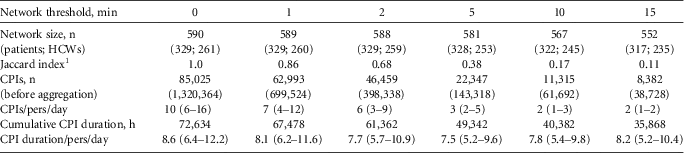
There were 2,740,728 distinct CPIs recorded over the 4 months. These defined a dynamic (time-varying) network of interactions between participants, where individuals (nodes) were linked (edge) if a CPI had been recorded between them. This “full CPI network” was pruned of all CPIs lasting less than d min, varying d systematically between 0 and 15 min. In the text, we report the results for the network of all CPIs at least 5 min long.
The 1-hop CPI neighborhood of an individual included all his direct CPI contacts in the network; the 2-hop neighborhood included his 1-hop neighborhood and all the CPI contacts of his direct CPI contacts.
Case and Controls Definition
The case-control study was nested in the longitudinal follow-up of the LTCF patients. A case was defined as a patient with incident colonization. Eight matched controls were selected as patients present in the LTCF at the date of the case’s incident colonization but who were neither colonized with S. aureus at this date nor the week before.
Statistical Analysis
We used conditional logistic regression to analyze factors associated with incident MRSA colonization. Our primary aim was the investigation of individual and CPI-related factors, including the following:
-
∙ Age, sex, Functional Independence Measure score,Reference Keith, Granger, Hamilton and Sherwin 19 history of MRSA carriage detected during the study,
-
∙ Number and occupation of CPI neighbors, duration of CPIs, density of links, centrality, number of neighbors-of-neighbors,
-
∙ Combination of network topology as above with carriage status: same MRSA strain or any MRSA strain carriage.
Time at risk was defined as the time between inclusion and date of incident colonization episodes (cases) or date of selection (controls). Functional Independence Measure scores were recoded as quartiles. For all network measures, the networks were aggregated over 1 week (the time interval between swabs) by pairs of participants. The betweenness centrality (the fraction of all shortest paths connecting pairs of participants passing through the person of interest) was computed using the whole network. We analyzed CPI durations directly (hours) and apportioned according to occupation of the contacts (patients or HCWs in contact with the case). As a sensitivity analysis, all analyses were repeated with various pruned CPI networks. The Jaccard index,Reference Jaccard 20 a measure of the percentage of common edges in 2 networks, was used for comparisons.
Ethics
Authorizations were obtained in accordance with French regulations regarding medical research and information processing. All French institutional review board–equivalent agencies accorded the i-Bird program official approval (CPP 08061; Afssaps 2008-A01284-51; CCTIRS 08.533; CNIL AT/YPA/SV/SN/GDP/AR091118 N°909036). Signed consent was not required by the French ethics committees to which the project was submitted.
RESULTS
The median (range) age of patients was 58.5 (24.5–102.8) years, with a median (range) length of stay of 33 (1–158) days. The median (range) number of swabs collected in patients was 5 (1–16) and in HCWs was 8 (1–13). The full CPI network was dense, linking 20% of all possible pairs of individuals and clustered according to wards. Most CPIs were short (Table 1). As the CPI network was pruned of short CPIs, the Jaccard index decreased less quickly than the number of links, showing that most short CPIs doubled with a longer interaction with the same person. The CPI network based on CPIs longer than 5 min included a quarter of all CPIs (26%) but still had 38% edges in common with the full CPI network.
Characteristics of Complete and Thinned Close-Proximity Interaction (CPI) Networks

NOTE. Values are median (interquartile range) unless stated otherwise. HCW, healthcare worker.
1 The Jaccard index (a measure of similarity between networks) corresponds to the percentage of edges in common between 2 networks G 1 and G 2 . Here, we show Jaccard(G d , G 0 ), that is, the fraction of edges in common between a (pruned) network G d and the full CPI network G0.
Incident Colonization Episodes
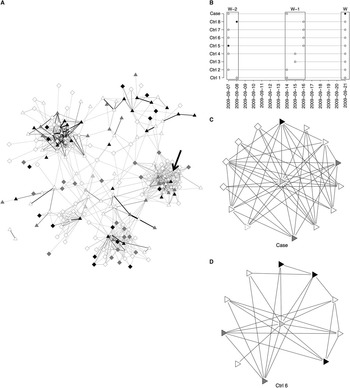
Overall, 4,175 swabs were obtained from the participants. S. aureus prevalence of carriage was 37.1% (1,550 swabs in 363 participants) with few instances of multiple carriage (90 swabs from 65 participants showed 2 strains). Various strains (n=114) were isolated multiple times in different participants, indicating that transmission occurred. There were 237 incident colonization episodes in patients: 144 involved MRSA and 93 MSSA. Only MRSA episodes were investigated. After excluding episodes for which sensor data was not available at the time of sampling, 106 MRSA episodes were left for analysis. Eight controls were matched to each case unless too few were available (those cases were matched to 7 [n=1], 6 [n=1], 5 [n=6], 2 [n=4], and 1 [n=2] controls). Five cases were discarded because they could not be matched to any control. Fig. 1 illustrates the selection of cases and matching controls and the comparison of their neighborhoods.
Case-control matching in the reference close-proximity interaction network. A , An example close-proximity interaction (CPI) network in the week preceding a positive swab specimen in a case (identified by the arrow). Patients are shown as triangles and healthcare workers as diamonds and are colored according to their colonization status (white: noncolonized; dark gray: methicillin-sensitive Staphylococcus aureus; black: methicillin-resistant S. aureus [MRSA]). Two individuals are linked with an edge when a CPI exists between them. Thicker edges correspond to larger cumulated times of interaction. The case and matched controls are shown in light gray. B , Longitudinal swab specimen results in the case and matched controls at the date of case incidence (week W) and 2 preceding weeks (W-1 and W-2), colored according to colonization status (white: noncolonized; black: MRSA). C , Subnetwork centered on the case (from panel B) and restricted to his direct contacts (1-hop neighborhood). D , Subnetwork centered on a matched control (from panel B) and restricted to his direct contacts (1-hop neighborhood).

Individual Risk Factors for MRSA Colonization
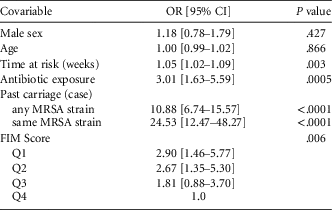
Age or sex did not affect the risk of MRSA colonization (Table 2). Cases had been at risk for a longer time than controls (53.6 d vs 61 d, P=.002), with a 5% (95% CI, 2%–9%) increase per additional week (P=.003). Patients with lower functional ability scores were more prone to MRSA colonization. A history of previous MRSA carriage was more frequent in cases (OR, 24.53 [95% CI, 12.47–48.27], P<.0001). Antibiotic exposure was associated with increased incidence (OR, 3.01 [95% CI, 1.63–5.59], P=.0005).
Individual Risk Factors of MRSA Colonization in Patients

NOTE. FIM, Functional Independence Measure; MRSA, methicillin-resistant Staphylococcus aureus; OR, odds ratio.
Network-Level Risk Factors for MRSA Colonization
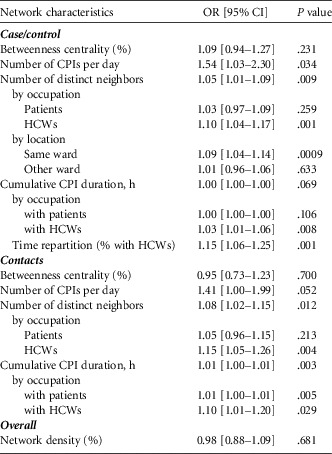
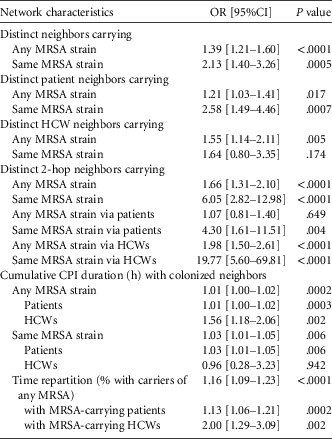
Having more distinct neighbors during the preceding week was associated with an increased colonization risk (OR, 1.05 [95% CI, 1.01–1.09) for 1 additional neighbor, P=.009; Table 3), more so with HCW neighbors than with patient neighbors. The risk was larger with neighbors in the same ward (OR, 1.09 [95% CI, 1.04–1.14], P=.0009) and with night shift staff (OR, 1.29 [95% CI, 1.04–1.59], P=.019).
Network-Level Risk Factors of MRSA Colonization in Patients

NOTE. Depending on the characteristic, odds ratios (ORs) were computed for 1 more neighbor, 1 more hour cumulative close-proximity interaction (CPI) duration, or a 10% increase. HCW, healthcare worker; MRSA, methicillin-resistant Staphylococcus aureus.
Increased cumulated CPI duration with HCWs was associated with increased incidence (3% more per hour) as well as a higher share of one’s CPIs spent with HCWs (OR, 1.15 [95% CI, 1.06–1.25] for a 10% increase, P=.001). The betweenness centrality was not associated with the risk of colonization and neither was the density of the 1-hop neighborhood.
Interestingly, having CPI with contacts who themselves had many CPIs was associated with an increased colonization risk.
Associations were found at all levels of pruning of the full CPI network, with increasing ORs as shorter CPIs were discarded (Fig. 2).
Close-proximity interaction (CPI) network topology and methicillin-resistant Staphylococcus aureus (MRSA) colonization. The odds ratios are for the number of contacts for incidence of MRSA colonization, according to occupation. White squares correspond to CPI network topology-only measures. Diamonds correspond to the joint analysis of carriage and CPI network topology when neighbors carry any MRSA strain (white) or the same MRSA strain as the case (black).

Joint Use of Individual Status and Carriage Data
We analyzed jointly the characteristics of CPIs with carriage status for the risk of colonization (Table 4). The associations were generally stronger than above for CPIs with a neighbor carrying the same MRSA strain (OR, 2.13 [95% CI, 1.40–3.26]), and larger for patients’ contacts than for HCWs’ contacts. Such associations were also found when considering carriage of any MRSA strain, although smaller (OR, 1.4 [95% CI, 1.2–1.6]). Longer CPIs with colonized patients led to an increased risk (OR, 1.03 [95% CI, 1.01–1.05], P=.006).
Joint Microbiological and Network-Based Risk Factors of MRSA Colonization in Patients

NOTE. Depending on the characteristic, odds ratios (ORs) were computed for 1 more neighbor, 1 more hour cumulative close-proximity interaction (CPI) duration, or a 10% increase. HCW, healthcare worker; MRSA, methicillin-resistant Staphylococcus aureus.
A strong association was found with the number of carriers at 2-hops (OR for same strain, 6.1; OR for any strain, 1.7). Connection to such carriers via an HCW was associated with a larger risk than via another patient.
Here again, keeping only longer CPIs in the network generally led to stronger associations (Fig. 2). In HCWs, the strongest association was found when considering the network of all CPIs longer than 1 min—that is, keeping a large portion of short CPIs.
Investigating Confusion Factors for Contacts and MRSA Incidence
Patients with higher dependence or a history of incident MRSA colonization had CPI with more neighbors in the preceding week (analysis of variance, P=.005). These 2 characteristics were also associated with an increased colonization risk. After adjustment on the Functional Independence Measure score, the association of colonization with the number of distinct HCWs and longer CPIs with HCWs remained with similar odds ratios. Likewise, accounting for previous MRSA carriage did not change the associations. Cases still had had more CPIs during the week (OR, 1.02 [95% CI, 1.00–1.03] for 1 more neighbor; P=.02).
DISCUSSION
The characteristics of CPIs between individuals, especially between patients and HCWs, were associated with the risk of incident MRSA colonization in patients. Given our understanding of MRSA transmission,Reference Pittet, Allegranzi and Sax 2 these associations are expected and provide indication that CPIs capture contacts relevant to the spread of MRSA. However, summary characteristics of the overall network such as density did not correlate with MRSA incidence because they remained approximately constant over time. Centrality was not associated with incidence either, although theoretical studies suggest a major role in transmission.Reference Ueno and Masuda 4
Whether CPIs provide a good proxy for contacts leading to transmission is debated. Indeed, interactions with little risk of transmission (talking) and those at higher risk (nursing care) may lead to the same CPI records. However, this lack of specificity should lead to no association of CPIs with incidence because the same patterns would be found in case and in controls. Here, we found an association and it was the strongest for CPIs of longer duration. Yet, contacts alone cannot explain MRSA incidence unless contacts are carriers. The increased associations when considering CPIs with carriers of the same strain strengthened the case for using CPIs as a proxy for contacts leading to transmission.
Irrespective of the carried MRSA strain, CPI with a MRSA carrier was associated with increased incidence. It is known that MRSA carriage in HCWs is linked with poor adherence to infection control measures, exposure to highly prevalent patients, high work load, and other organizational factors.Reference Albrich and Harbarth 21 HCWs colonized with a specific MRSA strain may be prone to be transient carriers and transmit other MRSA strains, because transient carriage of S. aureus is common among HCWs.Reference Blok, Troelstra and Kamp‐Hopmans 22 – Reference Cookson, Peters, Webster, Phillips, Rahman and Noble 24 In our study, transient carriage was likely underdocumented, in part owing to the frequency of swabbing (once a week only) and also because hand carriage, for example, was not tested. Therefore, we investigated only incident episodes in patients.
The results support the role of HCWs as vectors of MRSA dissemination.5,6,25 CPIs with HCWs were indeed associated with higher incidence than CPIs with other patients. Long contacts, common in nursing care, were the most associated with MRSA incidence, as often hypothesized.Reference Salathé, Kazandjieva, Lee, Levis, Feldman and Jones 10 , Reference Meyers, Pourbohloul, Newman, Skowronski and Brunham 26 , Reference Newman 27
We tried to limit the effect of biases in our design and analysis. Whereas a few MRSA clones accounted for most episodes (MRSA overall prevalence was 16.6%, with >60% belonging to spa-types t777 or t008), MSSA carriage, although common, showed fewer identical strains carried by different individuals so that the study of transmission was less relevant (data not shown). Control periods were contemporaneous with case-defining periods to ensure equal S. aureus colonization pressure.Reference Harris, Samore, Lipsitch, Kaye, Perencevich and Carmeli 28 Classification bias (missed incident cases) may have occurred because the sensitivity of MRSA detection in swabs is not 100%. However, all results were unchanged in the analysis when limiting to the first incident episode in each case. No differential effect was expected in the CPI measurements because the carriage status of participants was not known at the date of CPI collection. An overall change in behavior, for example increased adherence to hygiene practices, may have occurred (Hawthorne effectReference Pittet, Simon, Hugonnet, Pessoa-Silva, Sauvan and Perneger 29 , Reference Eckmanns, Schwab and Bessert 30 ). Yet the protocol was little intrusive, with no external observer to remind of the ongoing study. Initial changes, if any, were likely to have waned over the 6-month-long data collection to yield CPIs illustrative of typical behaviors. Duration of hospital stay, functional status, and previous MRSA carriage were associated with both the number of contacts and MRSA incidence. Adjusting on these variables in the analysis did not change the results concerning association with contacts, suggesting no confusion from these. HCW compliance with hygiene measures was not considered explicitly in our study. Hygiene compliance is more common during prolonged interactionsReference Boyce and Pittet 31 – Reference Lau, Tang, Mak and Leung 34 and yet this is where we found the strongest associations. This could indicate that compliance may alter the overall prevalence rather than the nature of interactions leading to transmission.
Patients from LTCFs may frequently travel to other hospitals, acting as a reservoir for MRSA introduction in other facilities.Reference Lee, Bartsch and Wong 35 In LTCFs, social interactions between patients occur more frequently than in acute care hospitals. We nevertheless found that CPIs with HCWs were associated with MRSA incidence, a result that is relevant in other settings.
We presented evidence that CPIs measured by electronic devices are associated with an increased risk of MRSA incidence. In our study, these devices were well accepted and worn for extended periods by all participants. The results suggest that routine CPI monitoring could be used to document in-hospital contact patterns and identify situations at increased risk. It could be a useful complement to microbiologic surveillance in identifying origins and destination of transmission.
Members of the i-Bird Study Group
The following people are members of the i-Bird Study Group: Anne Sophie Alvarez (AP-HP, Paris, France), Audrey Baraffe (AP-HP, Paris, France), Mariano Beiró (Universidad de Buenos Aires, Buenos Aires, Argentina), Inga Bertucci (AP-HP, Paris, France), Pierre-Yves Boëlle (Univ. Pierre et Marie Curie, Paris, France), Camille Cyncynatus (AbAg, Chilly-Mazarin, France), Florence Dannet (AP-HP, Paris, France), Marie Laure Delaby (AP-HP, Paris, France), Pierre Denys (AP-HP, Paris, France), Matthieu Domenech de Cellès (Univ. Pierre et Marie Curie, Paris, France), Eric Fleury (ENS Lyon, Lyon, France), Antoine Fraboulet (Insa, Lyon, France), Jean-Louis Gaillard (AbAg, Chilly-Mazarin, France), Didier Guillemot (Univ. Versailles Saint-Quentin, Versailles, France), Jean-Louis Herrmann (Univ. Versailles Saint-Quentin, Versailles, France), Boris Labrador (AP-HP, Paris, France), Jennifer Lasley (Inserm, Paris, France), Christine Lawrence (AP-HP, Paris, France), Judith Legrand (Univ. Paris Sud, Orsay, France), Odile Le Minor (Institut Pasteur, Paris, France), Caroline Ligier (Institut Pasteur, Paris, France), Lucie Martinet (Inria, Lyon, France), Karine Mignon (AbAg, Chilly-Mazarin, France), Lulla Opatowski (Univ. Versailles Saint-Quentin, Versailles, France), Catherine Sacleux (AP-HP, Paris, France), Jérôme Salomon (CNAM, Paris, France), Laura Temime (CNAM, Paris, France), Thomas Obadia (Univ. Pierre et Marie Curie, Paris, France), Marie Perard (AP-HP, Paris, France), Laure Petit (Institut Pasteur, Paris, France), Laeticia Remy (AP-HP, Paris, France), Anne Thiebaut (INSERM, Paris, France), Damien Thomas (AbAg, Chilly-Mazarin, France), Philippe Tronchet (AP-HP, Paris, France), and Isabelle Villain (AP-HP, Paris, France).
ACKNOWLEDGMENTS
Financial support. European Commission under the Life Science Health Priority of the 6th Framework Program (MOSAR network contract LSHP-CT-2007-037941); French Government through the National Clinical Research Program and the Investissement d’Avenir program, Laboratoire d’Excellence “Integrative Biology of Emerging Infectious Diseases” (grant ANR-10-LABX-62-IBEID). The study sponsors had no role in study design, data collection, data analysis, data interpretation, or writing the report.
Potential conflicts of interest. All authors report no conflicts of interest relevant to this article.
Supplementary Material
To view supplementary material for this article, please visit http://dx.doi.org/10.1017/ice.2015.89