Introduction
Paternal ages at birth of offspring are increasing globally. Numerous studies also show that advancing paternal age is associated with psychiatric disorders such as autism (Reichenberg et al. Reference Reichenberg, Gross, Weiser, Bresnahan, Silverman, Harlap, Rabinowitz, Shulman, Malaspina, Lubin, Knobler, Davidson and Susser2006; Durkin et al. Reference Durkin, Maenner, Newschaffer, Lee, Cunniff, Daniels, Kirby, Leavitt, Miller, Zahorodny and Schieve2008; Hultman et al. Reference Hultman, Sandin, Levine, Lichtenstein and Reichenberg2011; Sandin et al. Reference Sandin, Schendel, Magnusson, Hultman, Suren, Susser, Grønborg, Gissler, Gunnes and Gross2015), schizophrenia (Malaspina et al. Reference Malaspina, Harlap, Fennig, Heiman, Nahon, Feldman and Susser2001; Byrne et al. Reference Byrne, Agerbo, Ewald, Eaton and Mortensen2003; Ek et al. Reference Ek, Wicks, Svensson, Idring and Dalman2014) and bipolar disorder (Frans et al. Reference Frans, Sandin, Reichenberg, Lichtenstein, Langstrom and Hultman2008; Menezes et al. Reference Menezes, Lewis, Rasmussen, Zammit, Sipos, Harrison, Tynelius and Gunnell2010). However, the research findings on the links between advancing paternal age and psychiatric disorders have not always been replicable and it has been difficult to distinguish the effect of paternal age from the maternal age effect since advancing maternal age also has been linked to autism spectrum disorders (ASD) and psychosis (El-Saadi et al. Reference El-Saadi, Pedersen, McNeil, Saha, Welham, O'Callaghan, Cantor-Graae, Chant, Mortensen and McGrath2004; Croen et al. Reference Croen, Najjar, Fireman and Grether2007; Lopez-Castroman et al. Reference Lopez-Castroman, Gomez, Belloso, Fernandez-Navarro, Perez-Rodriguez, Villamor, Navarrete, Ginestar, Currier, Torres, Navio-Acosta, Saiz-Ruiz, Jimenez-Arriero and Baca-Garcia2010; Idring et al. Reference Idring, Magnusson, Lundberg, Ek, Rai, Svensson, Dalman, Karlsson and Lee2014; Lopez-Castroman, Reference Lopez-Castroman2014) There have also been reports on links between advancing paternal age and the mental health of grandchildren (Frans et al. Reference Frans, McGrath, Sandin, Lichtenstein, Reichenberg, Langstrom and Hultman2011, Reference Frans, Sandin, Reichenberg, Langstrom, Lichtenstein, McGrath and Hultman2013). These associations may be caused by the increased rate of de novo mutations that accumulate in male germ cells as men age and may be transmitted to the offspring (Crow, Reference Crow2000).
In addition to the ‘de novo mutation hypothesis’, other explanations have been suggested. One hypothesis suggests that the effect is cause by unknown factors associated with delayed fatherhood (Ek et al. Reference Ek, Wicks, Svensson, Idring and Dalman2014) and a maternal age effect might be involved in mediating the effect. Moreover, the association between advancing paternal age at birth and disorders in offspring might be confounded by psychiatric disorders in the father (Granville-Grossman, Reference Granville-Grossman1966; Petersen et al. Reference Petersen, Mortensen and Pedersen2011). Individuals with genes predisposing for mental illness are more likely to have children with similar disorders. If a genetic liability for psychiatric disorders also is associated with a selection into late fatherhood this would result in a non-causal association between paternal age and psychiatric disorders in the child. This alternative explanation is plausible under the following conditions: (1) high paternal age is, at least in part, under genetic influence and (2) individuals with a psychiatric disorder or individuals genetically related to patients have children at older ages.
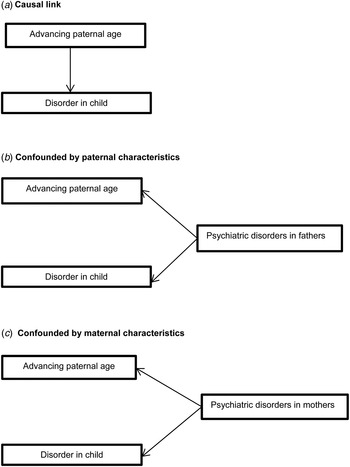
In addition, it is possible that women with mental disorders (or a genetic liability for mental disorders) systematically have children with older men. Since these women are more likely to have children with similar disorders this mating pattern could result in an association between late fatherhood and mental disorders in the children. If this is true; we would expect spouses of women with psychiatric disorders to become fathers at older ages. These possible mechanisms behind the paternal age effect that forms the basis of our analyses are graphically outlined in Fig. 1.
The suggested mechanisms behind the paternal age effect that forms the basis of our analyses. (a) Causal link. (b) Confounded by paternal characteristics. (c) Confounded by maternal characteristics.

The first aim of this study was to estimate how much of the variance in advancing paternal age at childbirth that is due to genetic and environmental components. To our knowledge, no previous studies have focused on late fatherhood as a phenotypic trait. We also wanted to see if the relative impact of these components is stable over time. Further, if genetic influences are important for advancing paternal age at childbirth our second aim was to test the alternative hypotheses suggested in Fig. 1. More specifically, test if ages at fatherhood are higher among (1) individuals with psychiatric disorders, (2) healthy siblings of individuals with psychiatric disorders, (3) men having children with women with psychiatric disorders or (4) men having children with healthy women with siblings with psychiatric disorders.
Materials and method
Heritability analyses
The Swedish Twin Register, one of the world's largest twin databases, was established in the late 1950s and enables identification of more than 1 94 000 twins, born since 1886 (Magnusson et al. Reference Magnusson, Almqvist, Rahman, Ganna, Viktorin, Walum, Halldner, Lundstrom, Ullen, Langstrom, Larsson, Nyman, Gumpert, Rastam, Anckarsater, Cnattingius, Johannesson, Ingelsson, Klareskog, de Faire, Pedersen and Lichtenstein2013). The Swedish Multi-Generation Register includes all Swedish citizens born in Sweden since 1 January 1932 and ever registered as living in Sweden after 1960 and enables identification of biological children of a proband. The registers were followed until 31 December 2009. By linking the Twin Register to the Multi-Generation Register we identified male twins and linked date of their offspring's birth. To avoid censoring of data, we only included male twins born between 1920 and 1960 with at least one child. We considered 1920 to be an appropriate start because the oldest individuals were aged 12 years when the Multi-Generation Register enabled identification of their children (1932). Still, the majority of men included in this cohort are having their children after 1940. The coverage of parents of individuals born in Sweden 1940 in the Multi-Generation Register is 90% for mothers and 85% for fathers, increasing to almost 98% for fathers and 100% for mothers around 1960 (Statistics Sweden, 2011) We consider these numbers to be representative of the Swedish population as a whole and consider it highly unlikely that left censoring would lead to a misclassification of paternal ages in these analyses. The total numbers of twins included in the analyses were 14 679.
Advancing paternal age was defined as having a child at age ⩾40 years. There is no universally accepted definition of advanced paternal age but within genetic counselling advancing paternal age is often referred to as fathers aged ⩾40 years. However, risk for de novo mutation increases linearly with paternal age and therefore, the cut-off at 40 years has no biological impact (Toriello & Meck, Reference Toriello and Meck2008). The analyses were conducted separately for advancing paternal age being defined as individuals having their first child at age ⩾40 years. Among pairs where both men had had children we observed the number of (1) concordant pairs not having these outcomes, (2) discordant pairs where one had and the other did not have the outcomes, and (3) concordant pairs having the outcome, for monozygotic (MZ) and dizygotic (DZ) twin pairs separately. From these values we calculated casewise concordance rates (i.e. given that a twin had the outcome we calculated the probability that their co-twin also had the outcome) and tetrachoric correlations, for comparative purposes we also included ages 35 and 45 as alternative cut-offs. By using the twin model we estimated how much of the phenotypic variation of late fatherhood that is due to genetic and environmental factors. This was done by comparing MZ twins that are genetically identical with DZ twins who share approximately half of their segregating genes. The standard twin model assumes that the heritability of a trait is due to three components: additive genetics (A), shared environmental factors (C) and non-shared environmental factors (E). When similarities are greater between MZ than DZ twins this indicates a genetic effect. Similarities between twins that are not explained by genetic effects are assumed to be caused by shared environment and within-pair differences reflect the effect of non-shared environment and measurement error (Neale & Cardon, Reference Neale and Cardon1992). In order to estimate if the parameters describing the ACE model were stable over time we allowed the relative contributions of A, C and E to vary with offspring birth year (Purcell, Reference Purcell2002).
The twin model was fitted in three different steps. The first model estimated the effects of genes and environment which were allowed to vary with time. In the second model, we assumed no effect of shared environment. In the final model we added the constraint that A and E estimates were constant over time. In all models we adjusted the prevalence for birth year by including a linear and quadratic effect. We used likelihood ratio tests to examine fit of the different models. The heritability and environment parameters were estimated along with their 95% confidence intervals (CIs). The analyses were also conducted separately for advancing paternal age defined as having the first child at age ⩾40 years. The twin analyses were performed with R statistical software by employing OpenMx (Boker et al. Reference Boker, Neale, Maes, Wilde, Spiegel, Brick, Spies, Estabrook, Kenny, Bates, Mehta and Fox2011).
Age at childbirth in association with psychiatric disorders
In order to collate a sample of affected individuals with extensive coverage of psychiatric disorders associated with paternal age, we selected individuals born in Sweden between 1955 and 1960 with at least one child. The Patient Register covers practically all psychiatric inpatient care since 1973 and therefore, inpatient treatment in adulthood of individuals born since 1955 is not subjected to left censoring. To reduce right censoring of offspring births we selected 1960 as an upper limit for our birth cohort. Spouses of individuals in our birth cohort were allowed to have been born outside the cohort. Our cohort was followed with regards to diagnoses between the ages 12–18 (January 1973) and 49–55 (December 2009), ages where most people with adult ASD, schizophrenia and bipolar disorder are diagnosed. Psychiatric diagnoses before adulthood (for instance childhood autism) were not examined and it is questionable if the results are generalizable to psychiatric patients who only receive diagnoses during childhood. However, individuals with severe, childhood onset, autism are unlikely to have children and would therefore not have been eligible for the study. We consider the follow-up time to be extensive. For the youngest men in our study (born 1960), the follow-up time ends when these men are 49 years. It is possible that some men father children at ⩾50 years. However, considering how rare fatherhood is at the age ⩾50 years we do not think that this censoring has a great impact on our findings.
To ensure that the individuals in our sibling sample were healthy they had to be included in the cohort born 1955–1960. However, their affected siblings were defined as any individual receiving a diagnosis of psychiatric diagnosis with no restriction regarding birth year.
We defined affected individuals as having at least one diagnosis of schizophrenia, bipolar disorder and/or ASD in the Patient Register. The diagnoses were coded according to International Classification of Diseases (ICD) and we included ICD-8 and ICD-9 codes 295–299 (except 296.2 and 296B for unipolar depression) as well as ICD-10 codes F20–F29, F30–F31 and F84. Healthy individuals were defined as individuals not having any of these disorders.
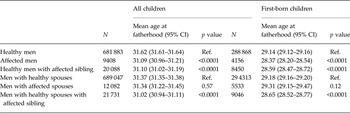
The ages at childbirth of six different groups were examined: (1) healthy men, (2) affected men, (3) healthy men with an affected sibling, (4) men with healthy spouses, (5) men with affected spouses, and (6) men with healthy spouses with an affected sibling. The number of individuals in each group is described in Table 1.
Mean ages at fatherhood in individuals with or without psychiatric disorders

N, Number of individuals; CI, confidence interval.
Mean ages at birth of the child, including all children from each man, were calculated and we tested group differences with linear regression. Groups 2 and 3 were compared to group 1 whereas groups 5 and 6 were compared to group 4. It is possible that decreased fertility after disorder onset could result in a lower average age at fatherhood. In order to test this, the analyses were also conducted separately when only including ages at birth of the first child. In a sensitivity analysis we also examined ages of men with an affected sibling and an affected spouse. We also conducted analyses were we separated between specific psychiatric diagnoses.
Additionally, we performed logistic regression analyses after grouping ages at birth of the child into 10-year categories: <20, 20–29, 30–39 and ⩾40, using 20–29 years as the reference group. We estimated odds ratios (ORs) along with their 95% CIs. Again, groups 2 and 3 were compared to group 1 whereas groups 5 and 6 were compared to group 4. In a set of subanalyses, ages at the birth of the first child were analysed separately.
The study was approved by the regional ethics committee in Stockholm, Sweden.
Results
Heritability analyses
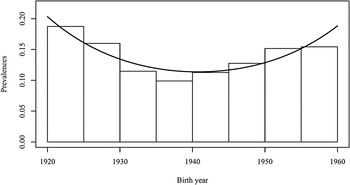
In Supplementary Table S1 the numbers of concordant and discordant pairs are presented together with casewise concordance rates and tetrachoric correlations. The prevalence of late fatherhood varied across birth year strata (Fig. 2). The likelihood ratio tests showed that none of the two submodels had a significantly worse fit than the base model suggesting no effect of shared environment and that that the relative contributions of additive genetic and non-shared environmental effects were stable across birth year strata (Supplementary Table S2). The heritability of becoming a father at ⩾40 years was estimated to be 0.33 (95% CI 0.25–0.40) and the effects of non-shared environment was 0.67 (95% CI 0.60–0.75).
Prevalences in fatherhood ⩾40 years over time in the twin sample. Note: The line represents a modelled linear + quadratic effect.

We repeated the modelling in order to estimate the genetic and environmental effects on becoming a first-time father at ⩾40 years. Again, likelihood ratio tests showed no significant reduction in fit for the constrained model as compared to the base model, indicating no effect of shared environment and that the relative importance of A and E were stable over time. The estimated heritability for becoming a first-time father at ⩾40 years was 0.46 (95% CI 0.27–0.62). Moreover, the effects of non-shared environment were estimated to be 0.54 (95% CI 0.38–0.73).
Age at childbirth in association with psychiatric disorders
Table 1 describes mean age at childbirth in relation to psychiatric disorders in the parental generation. Fathers with a psychiatric diagnosis were not older, instead they were significantly younger when they had their children as compared to healthy individuals from the same birth cohort (p < 0.0001). Healthy fathers with affected siblings were also significantly younger than healthy fathers without affected siblings (p < 0.0001). There were no statistically significant difference in age at childbirth in spouses of affected and unaffected mothers (p = 0.57). However, mothers with affected siblings had spouses who became fathers at a younger age as compared to the reference group (p < 0.0001). The differences between the groups were similar when age at the birth of the first child was analysed separately (Table 1). Sensitivity analyses where we stratified on psychiatric disorders showed that independent of psychiatric disorders, affected men were more likely to become fathers at younger ages. Interestingly, men with a spouse affected with autism were more likely to be older at fatherhood compared to the reference group (Supplementary Table S3).
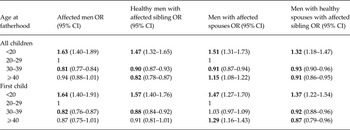
By categorizing ages of fathers at childbirth into 10-year intervals we calculated ORs and 95% CIs for age at childbirth, using men that become fathers between 20 and 29 years as the reference category (Table 2). When comparing affected men to healthy men we saw that affected men had a statistically significant increased likelihood of becoming a father as teenagers and less likely to become fathers at the ages 30–39. Siblings of affected individuals were more like to become teenage fathers and less likely to become fathers at ages ⩾30 years.
Logistic regression analyses on ages at fatherhood

OR, Odds ratio; CI, confidence interval.
The odds ratio of becoming a father at a certain age in comparison with unaffected men or men with an unaffected spouse.
Men with affected spouses were more likely to become teenage fathers compared to men with healthy spouses. Moreover, they were less likely to become fathers between 30 and 39 years but had a slightly increased risk of becoming a father at ages ⩾40 years. Healthy women with affected siblings were also more likely to have children with teenaged men. Further, their partners were significantly less likely to become fathers at older ages compared to men with healthy spouses. We examined if loss to follow-up affected the results but found no evident differences after removing all fathers who died or migrated during the study period. When examining how psychiatric status of the man affected age at fatherhood, 79 410 (11%) were excluded in these analyses due to migration or death. When examining how psychiatric status of the spouse affected age at fatherhood, 64 643 (11%) observations were excluded.
Discussion
Advancing paternal age has on numerous occasions been associated with schizophrenia, bipolar disorder and ASD. However, the mechanisms behind these associations remain unclear. While it is commonly suggested that the associations are causal, others believe that the association is confounded by a genetic liability of psychiatric disorders in the parent. In this study we indirectly tested the hypothesis suggesting that a genetic liability of psychiatric disorders in the parent explain the paternal age effect.
If a genetic liability for psychiatric disorders is linked to systematically having children at older ages we would expect late fatherhood to be, at least in part, influenced by genes. Indeed, our twin analyses showed that late fatherhood is a heritable trait and that the phenotypic variance is influenced both by genes and non-shared environment. Although the prevalence of late fatherhood varied over time, the relative importance of these components remained stable.
Many of the studies showing associations between advancing paternal ages and mental disorders adjust for a history of psychiatric disorders in the parents. However, the adjustments might be influences by missing data on parental psychiatric health. Moreover, these adjustments do not include individuals that are unaffected but genetically related to individuals with mental disorders and thus, might transmit a genetic liability for psychiatric disorder to their offspring. In this study we explored the effect of advancing paternal age on mental disorders by examining the pattern of age at fatherhood in patients and their genetically related siblings.
We aimed to test if men with a genetic liability for psychiatric disorders were older at the birth of their children, since this might explain why we see an association between advancing paternal age and psychiatric disorders in the offspring. Our results showed the opposite; men with disorders linked to advancing paternal age are generally having children at younger ages. The same trend was found in healthy individuals to affected siblings suggesting that young fatherhood might not only be a consequence of these disorders but that familial factors associated with these disorders might influence at what age a man have children.
We also speculated that women with disorders linked to advancing paternal age or their genetically related relatives might systematically have children with older mates. Women with psychiatric disorder were more likely to have children with teenage men or men aged >40 years but less likely to have children with men between 30 and 39 years. We assume that the slightly greater chance of fatherhood at age >40 years in this category is too small to counterbalance the younger paternal ages in other individuals with a genetic liability for psychiatric disorders and explain the paternal age effect. Moreover, mean ages at birth of the child were practically identical in spouses of affected women as compared to spouses of healthy women.
It is striking that both men with psychiatric disorders, healthy siblings as well as spouses of both women with psychiatric disorders and healthy siblings are more likely to become teenage fathers. It is possible that the association between younger fatherhood is explained by underlying sociodemographic factors associated with both psychiatric illness and teenage fatherhood. The associations may also be a result of individuals affected with psychiatric disorders or their relatives being more prone to deviate from social and reproductive norms. Although most research on teenage parenthood focus on the negative effects associated with early motherhood there have been reports on how teenage fatherhood is associated with negative consequences for both fathers and offspring. These negative effects include both socio-demographic outcomes as well as health outcomes (Thornberry et al. Reference Thornberry, Smith and Howard1997). The finding that men with psychiatric disorders having children at younger ages may be of importance when understanding the negative effects associated with teenage fatherhood.
Previous studies have found a reduced fertility in individuals with schizophrenia, bipolar disorder and ASD (Svensson et al. Reference Svensson, Lichtenstein, Sandin and Hultman2007; Power et al. Reference Power, Kyaga, Uher, MacCabe, Langstrom, Landen, McGuffin, Lewis, Lichtenstein and Svensson2013). If the link between younger age at fatherhood among individuals with these disorders simply was due to individuals having a reduced fertility after the disorder onset we would not expect healthy siblings to become fathers at earlier ages, but our data show that siblings of affected individuals are also younger when they become fathers. Moreover, age at birth of the first child was younger in affected families, contradicting that these findings are explained by a decreased fertility after disorder onset.
The results of this study contradict the hypothesis suggesting that the paternal age effect is explained by men with psychiatric disorders having children at older ages. Instead, they are in line with the hypothesis suggesting that paternal age is causally linked to psychiatric conditions in the offspring. It has been suggested that the association between advancing paternal age and psychiatric disorders are a result of the increased burden of de novo mutations in germ cells of older men (Crow, Reference Crow2000). Others suggest that epigenetic alterations that occur as paternal age advances may be casually related to the susceptibility of psychiatric disorders (Sipos et al. Reference Sipos, Rasmussen, Harrison, Tynelius, Lewis, Leon and Gunnell2004; Curley et al. Reference Curley, Mashoodh and Champagne2011). Moreover, paternal exposure to toxicant and nutritional state as well as age, have been found to influence the development in offspring and even of grand-offspring (Curley et al. Reference Curley, Mashoodh and Champagne2011). In addition, this study does not address maternal age and we cannot rule out that maternal age effects are involved in the mechanism behind the paternal age effect.
When examining psychiatric disorders and age of the father at childbirth, our cohort consisted of men born between 1955 and 1960 with at least one child. In order to be identified as having a child all individuals included in these analyses must have been alive and Swedish residents during adulthood. Psychiatric disorders were defined as having, on at least one occasion, a diagnosis of schizophrenia, bipolar disorder or ASD in the Swedish Patient Register. Not all disorders linked to advancing paternal age were included in the study which could limit the results of the findings. The validity of ICD diagnoses recorded in the Swedish Patient Register has been examined by comparing diagnostic register code with medical records. The positive predictive value for most somatic and psychiatric diagnoses is approximately 85–95% (Ludvigsson et al. Reference Ludvigsson, Andersson, Ekbom, Feychting, Kim, Reuterwall, Heurgren and Olausson2011).
When analysing psychiatric disorders and age of fathers at childbirth, we had a rather narrow cohort in regards to birth year, limiting the generalizability of these findings. We know that parental ages have changed over time and are strongly correlated with socio-economic variables and use of contraceptives. The offspring of individuals in this cohort are conceived in post-contraceptive times and therefore it is possible that these results are not generalizable to pre-contraceptive times.
Conclusion
In summary, our results show that paternal age is in part a heritable trait. However, our data suggests that the association between advancing paternal age and psychiatric disorders in offspring is not confounded by men with psychiatric disorders or healthy men with affected siblings with are systematically having children at older ages. Instead, these individuals are more likely to become fathers at younger ages. Similarly, women with psychiatric disorders or healthy women with affected siblings are not systematically having children with men that are older than the average father. It is still possible that the link between advancing paternal age and mental disorders is not causal and that the hypothesis suggesting that that the association is explained by new mutations is wrong. However, our findings suggest that the association is not explained by psychiatric disorders in the parents.
Supplementary material
For supplementary material accompanying this paper visit http://dx.doi.org/10.1017/S0033291716001744.