I. Introduction
The term ‘transplant’ is a medical analogy that has gained general acceptance in the socio-legal literature (Nelken, Reference Nelken, Nelken and Feest2001, p. 16). It is a useful way of thinking abstractly about the phenomenon of ‘borrowing’, ‘copying’ or ‘mirroring’ the laws or rules or institutions of one society for use in another (Cotterrell, Reference Cotterrell, Nelken and Feest2001, p. 73). If the transplanted law or institution does not fit easily into the legal order and society of its new host, it has become usual to describe the situation as a ‘rejection’, which is often difficult to separate from the fact that it may take a long time for a law to change from being a ‘law in the books’ into ‘law in actual operation’ (Watson, Reference Watson1976, p. 82).
However, outright organ rejection of the kind that occurs in a human body is rare in the practice of institutional transplants in society. Instead, the recipient society tends to retain the new law or institution while modifying it, so that over time it turns into a different institution: adoption becomes adaptation. The process is complex and involves a variety of factors. There are many dissimilarities between countries, and they affect the institutional transplantation at every stage: in the causes that may prompt the proposal and its acceptance on both sides, in the variety of ways in which it may be sponsored and set up, and in the range of social characteristics within the receiving society that will determine what happens as soon as the new institution begins to function (Kahn-Freund, Reference Kahn-Freund1974).
The interest in understanding and assessing the process of legal transplantation is by no means new. It has been developed on the basis of fundamental socio-legal questions such as the autonomy of law and of legal institutions, the dependence of law and institutions upon the distinctive characteristics of a particular legal culture, the external factors that determine the interaction between two different legal orders, and the methodological complexity involved in any attempt to define and assess the success and failures of the transplanting strategy.
As early as the eighteenth century, Montesquieu made a distinctive effort to grapple with the variety of variables that determine change. He produced a substantial (if highly impressionistic) list of non-legal factors that affect the operation of the law in general and used it to support his thesis that the laws of one country cannot fit readily into the legal system of another. In his account, climate, topography, the location and size of the territory, the degree of liberty, the way of life, religion, cultural and social inclinations, wealth, and the number and activities of the population all have a bearing on the law. There were also legal factors to consider, in particular the systemic point that laws are not only related to one another in a logical fashion but also related to their origins, to the purposes of the legislator, and to the order of things on which they are established (Montesquieu, Reference Montesquieu and Cohler1989).Footnote 1
In the last three decades many writers have moved to the extreme position of arguing that only in exceptional cases can the institutions of one country be successfully used somewhere else. For example, studying the transfer of laws from the metropolis to the colonies, Robert Seidman (Reference Seidman1978)Footnote 2 questioned the value of the transferring English law to Commonwealth Africa. He proposed what he termed the ‘Law of Non-Transferability of Laws’ as a proposition affirming that legal transplants fail to induce behaviour in their new home similar to that induced in their original site. His ‘law’ had a few corollaries, such as the proposition that although laws are addressed to an addressee and prescribe a particular behaviour, the response of an addressee will depend not only on the prescription but also on other factors. Seidman offers a list of them: custom, geography, history, technology and other local conditions that were different in Africa from those in England (pp. 31, 35). Any or all of these factors could have an impact on the law so that it ‘grew differently, even though they were not in themselves a function of the law’ (Roberts-Wray, Reference Roberts-Wray1960, p. 69). Another corollary was that in colonial times, British lawyers tended to impose the law that they were familiar with and consequently regarded as ‘good law’ (Seidman, Reference Seidman1978, p. 33). They may have been correct to the extent that it may indeed have worked well for the colonial power with all its devices of control, but today it does not seem surprising that English law could not by itself foster behaviour in English-speaking Africa similar to that which it successfully fosters in England. Similarly, Koopmans argued that when a political system is transplanted to another country its operation is inevitably affected by numerous factors that restrict the extent to which it can operate effectively; it might not even ‘work’ at all:
‘In Britain the role of the opposition and of the back-benchers in Parliament, the prospect of general elections, and the fear of ferocious press reactions do more to keep rulers within bounds than the existence of the bar and bench together. The same system shows its weakness, however, when transferred to a different soil. That system did not, for example, work in the same way when it was applied in Northern Ireland, and it was a conspicuous failure when transplanted to Africa.’ (1986, p. 268)
A contrasting view is that law can operate in isolation from the society around it and therefore that differences between countries do not form any obstacle to the successful transplanting of laws and institutions from one to another.Footnote 3 Watson's numerous writings state the view that legal rules can be easily transported from one society to another.Footnote 4 He notes that at the time when Roman law successfully spread right across Europe, the sources available to those who introduced it or to the law professors who taught it offered no guidance on how to ensure the operation of those rules in practice. Whether in both Rome itself or in its empire, the authorities were only interested in the rules in themselves and not in their operation (Reference Watson1977, p. 105). Allott brings examples of 'post-reception' colonial courts in Africa, which continued to cite English case-law and to rely on English scholarship for guidance long after they had received their body of law from England and established their own legal apparatus to operate it. He reports that they displayed an almost submissive attitude to sources of law that were alien to their own society (Reference Allott1957, p. 23). Walton argues that law does not grow out of the ‘common consciousness’ of the people of a particular country, paraphrasing the expression of the nineteenth century German jurist von Savigny (Walton, Reference Walton1927, pp. 183–84). Confronted by such arguments, Cotterrell points out that if it is indeed the case that law can move from one society to another and remain unchanged by the change in context then we will have to doubt the possibility of a sociology of law (Reference Cotterrell2006, pp. 109–121).
Renewed interest in this field was rekindled in the early 1990s after the mass collapse of communism. Many observers, inside the newly formed post-communist countries as well as outside them, saw an imperative need to put forward schemes that would assist the transitional societies. The process was commonly launched under the auspices of international agencies and aid donors. That effectively meant that Western governments and the international consultants on their staff became very active in facilitating the often massive borrowing of laws and institutional models from their own countries for re-use in the many societies of the post-communist world. However, neither the immense scale of this massive undertaking of social engineering nor its apparently expert management could secure the results expected.
In our case the inquiry was conducted into the policy-driven projects that sought to introduce the model of institution of dispute resolution, the UK Press Complaints Commission (UK PCC), in one instance to two Russian cities, Nizhny Novgorod and Rostov-on-Don, as a UK/Russia project,Footnote 5 and in another to SarajevoFootnote 6 as a UK/Bosnia project. Our purpose was to examine and assess what had been eventually produced in Russia and Bosnia as a result of the three-city effort to build a new social construct resembling a Western institution.
In order to support this research, we conducted an on-site inquiry six months after the completion of the projects in Russia and after eleven months of the Western involvement in Bosnia. We timed the research to be carried out in the follow-up period so that we could distinguish from among the many variables in play those that had the most pronounced effect in shaping the structure and operation of the new institutions. In particular we identified, compared and contrasted three sets of variables: the actors and agencies involved in the social engineering process; the strategies used in the separate projects; and the specific features of the socio-political environments surrounding the transplanted structures. It would be unrealistic to pretend that we or indeed anyone could offer a comprehensive and definitive answer to the question of what determines the outcome of any one transplant, but we have set out here our considered account of the factors that we judge to be among ‘the most likely suspects’.
The data presented in this article were collected during visits to all three locations. The data was drawn from the appropriate documents and from in-depth interviews in Nizhny Novgorod and Rostov-on-Don in Russia, and Sarajevo in Bosnia. Altogether seventy-eight interviews were conducted in Russia (forty-six in Rostov-on-Don, thirty-two in Nizhny Novgorod), twenty-six in Bosnia, and eight in London. The respondents were all relevant players such as members of the councils, international experts, local media industry people and journalists. The interview records were analysed in conjunction with research into the various source materials produced by the councils themselves, such as their agendas and minutes, their formally promulgated decisions, their websites and their published codes of conduct. We also examined the various reports produced by the organisations driving the transplantation projects, and of course the relevant secondary literature which has grown to substantial proportions in the past decade.
II. Social engineering in progress
The transplanted model
The UK Press Complaints CouncilFootnote 7 – the model that was adopted for emulation – was an institution of alternative dispute resolution set up by the British print media industry in 1991 in order to replace and improve upon an earlier body, the British Press Council, which had been in place since 1951 (Leonardi, Reference Leonardi2004; Cohen-Almagor, Reference Cohen-Almagor2001). The principal role of the PCC in Britain was to consider and resolve grievances that readers might put forward about things that had been published about them. The issues to be dealt with by the UK Press Complaints Council ranged from the simple need to correct small errors and omissions to the more potentially offensive reports that might lead to claims of defamation and result in editors having to defend their actions in court.
When the idea that the media industry itself should run its own institution of dispute resolution emerged in the middle of the twentieth century, it grew out of two movements that were gaining in popularity and coming together at the time. One was the new market liberalisation doctrine that businesses rather than the state should take charge of regulation (Cunningham and Rees, Reference Cunningham and Rees1997; Campbell, Reference Campbell1999; Humphreys, Reference Humphreys1996). The other was the rising public interest in a set of procedures known as Alternative Dispute Resolution, or ADR (Palmer and Roberts, Reference Palmer and Roberts1998).
The ADR movement was a reaction to the allegedly overstretched power of the legal institutions in several Western societies. Its basic premise was that the vast majority of disputes do not need to go to court. Adjudication of a dispute through a court is costly, time-consuming and unnecessarily formal. It is even capable of exacerbating the very problem it is meant to solve, because it is logical that each party should look for ways to strengthen its side of the case. By using ADR instead, the parties can find fast and inexpensive resolution of a case through informal mediation and settlement carried out within the community of people among whom the dispute occurs. Dealing with disputes this way would break the monopoly of lawyers over dispute management and thereby shift power in society from legal elites to ordinary people.
While ADR was becoming fashionable, similar ideas were being put forward from a quite different perspective by free-market advocates. In their view, an excess of regulation by the state in advanced Western economies had become damaging to commercial enterprise, and they were certain that the economy would be more prosperous without it. They argued that state interference could be replaced by self-regulation for most problems. Instead of dispute settlement according to laws enforced by the government, disputes should be resolved by the people involved in the industries themselves by means of internal co-ordination, codes of ethics and schemes for monitoring compliance by each firm.
The transplanted institutions at the receiving end
The main finding of the project was that the newly established institutions in both Russia and Bosnia had adopted new identities that diverged from the British model. Contrary to the ADR philosophy that lay at the heart of the UK PCC – to take the entire procedure of managing complaints away from the law, minimise bureaucracy, and preclude government agency involvement – all three institutions at the receiving end tended to embrace the law and relish the formality of their procedures.Footnote 8 With that established as the main finding, it should be noted that there were significant differences between the new Bosnian institution and the two Russian councils, which together moved in a somewhat different direction in near-identical fashion to each other.
Russian Media Complaint Councils
The evidence that we gathered suggests that in the Russian cities of Rostov-on-Don and Nizhny Novgorod the two newly set up Media Complaint Councils (MCC) had set themselves up as civil imitations of official state courts (Kurkchiyan, Reference Kurkchiyan2009). In both cases they saw their task as to adjudicate the cases rather than to mediate between the parties. Their procedures tended to be formal, the language used by those who argued cases for the 'complainants' and 'defendants' was legalistic, and the formulation of verdicts was intentionally quasi-judicial.
In both Rostov-on-Don and Nizhny Novgorod, the procedure followed by the council would start with a preliminary examination of the complaint received and then consider a written response from the defendant, relayed by the secretary of the MCC. Then a lawyer and a linguistFootnote 9 would be invited to conduct an expert assessment and report back to the Council their view as to whether or not there had been a breach of the Media Law in that particular case. This would be followed by a Council meeting to which both disputing parties would be invitedFootnote 10 and the expert reports would be discussed. The outcome of the Council meeting would be framed as a verdict on the issue of whether the Law was breached or not. Once promulgated, the Council's finding and its justification would be publicised through the media outlet involved in the dispute.
The language that was routinely used in the phrasing of the verdicts was remarkably formal, given that it was usually written by a non-lawyer. Phrases such as ‘this cannot be described as a criminal act',Footnote 11 or ‘[the journalist] acted in accordance with the norms of both International and Russian law',Footnote 12 are typical instances of the manner in which cases were judged and the findings expressed. The same self-consciously judicial style was used by many of the respondents whom we interviewed, including those who had no legal background. Even though their ‘legal’ assessments of the cases often sounded amateurish they were not inhibited about getting engaged in earnest legal argumentation. It was clear that the members and staff of both Russian Councils, and the people affected by their operations, saw their task as one of adjudication in a quasi-legal fashion.
Consequently, there was no desire to distance lawyers from the process of dispute resolution, as had been intended in the basic vision of the way in which the new institutions should function. On the contrary, lawyers were not only encouraged to act as expert assessors of the issues at stake in particular cases but also recruited as members of the Council. It should be borne in mind, however, that the MCCs were low-budget institutions. The lawyers attracted to the work were not the successful, high-earning members of their profession but rather those who were struggling to compete and would willingly produce an expert report for a modest fee.
Evidently, an effort was made at the outset to put in place an agreed ethical code of conduct for use as the standard framework for handling complaints. Even though such a code was compiled in both Councils, neither of them seemed to take it seriously at any stage thereafter. It was rarely cited as an authoritative source in making judgments and its principles were not taken on board as a set of guiding norms.
The Russian vision of the ideal relationship with the state also differed sharply from that of the British counterpart. The UK PCC had a distinct identity as a civil organisation funded by media outlets precisely in order to maintain independence from government. Against this, from their inception both Russian Councils actively sought recognition, patronage and financial support from the state. When we asked our interviewees why this was, we were given explicit and attributable answers together with hints at various implicit reasons. When we analysed the responses in detail, we found that they could be sorted into three categories. The first was money: from the moment that the Western funding supplied to launch the Councils came to an end, they began to struggle financially. Financial support was sought from local government, but in vain. The second was the precautionary principle: right from the start there was a conviction among those involved that nothing could ever be achieved in Russia without official blessing. The third was that there was a perceived need for ongoing patronage. It was taken for granted that the surest route to authority and prestige for the institution would be to cultivate a positive relationship with key individuals who were as highly placed as possible.
The problem of authority was a profound one. From the moment they were conceived, the Russian MCCs faced a challenge in trying to gain legitimacy in the media community. Only a minority of editors formally agreed to co-operate with the MCCs, and most of them came on board only after being persuaded to do so in private. The persuasion was carried out by local activists who were already involved in the project, using an informal network of personal relationships. But if the newspaper editors could not immediately see the Councils' potential usefulness for self-regulation, what other role was attributed to them?
Study of the way in which the two MCCs were actually operating yielded at least some insights into their new role, both in respect of the way in which each transplanted institution adapted itself to its new setting and of the way in which the Russian players who determined its fate did so by attributing new meanings to it. The Councils very quickly became hybrid institutions: part private agency engaged in legal consultancy, and part NGO (non-governmental organisation) engaged in educational activities. And they had evidently also formed an ambition to pre-empt or even to control the activities of the real courts within their area of interest.
The manner in which the new MCCs had settled into operation was as follows. In many instances before taking a dispute to court (or being summoned to court as a defendant) individuals and organisations would first take their cases to an MCC. Their purpose in doing this was to get access to the legal expertise that they believed they would need later when they put their case in court. The semi-formal procedure of the council was being used as a testing ground for the formal court. Its judgments and its support personnel were both being retained as resources for the more serious battle to come. Pronouncements issued by the councils would then be presented to a judge as evidence, on the understanding that they had been legitimised by having the institutional label of an MCC attached. A clear example of this was a case in which the Council in Nizhny Novgorod conducted an expert evaluation of one of its region's newspapers. It did so in response to a demand for redress by a former editor after she had been dismissed for inadequate performance. The Council arranged for a content analysis to be conducted on six months' editions of the paper, and in due course issued a verdict that ‘the articles are fully in line with the statute of the newspaper. The newspaper was performing important socio-humanistic and educational functions, had a sophisticated structure, and projected an identifiable image.’ It was expected that this conclusion would then be submitted to the formal court by the former editor in support of her case.
It remains to sum up our observation of the way in which the Rostov-on Don and Nizhny Novgorod press councils evolved during their first few years. The major conclusion was that both had lost the character and role that was intended by their designers. They were not becoming Russian equivalents to the British self-governing media institution: an informal, low-cost mechanism of dispute mediation, applying moral norms and principles that had been carefully considered and agreed within the media community. Instead, the new institutions were seen as a kind of ‘civil court', put in place in order to question, explain and influence the implementation of law by the state court.
The Bosnian Press Complaints Commission
The picture was different in Bosnia. The evidence we gathered suggested that the Bosnian Press Complaints Commission (PCC) had reconstructed itself as a body that aspired to merge with the state institutions and seemed likely to become a government agency itself in the near future. Despite this, the procedures used in the Bosnian PCC nevertheless tended to be informal. As intended, the styling of the verdicts mirrored the formats used by the British PCC, and specific articles of the new code of ethics were featured prominently. There was little attempt to cite the law or to simulate a court. Lawyers as such seemed to be kept out of the dispute resolution process altogether, in much the same fashion as in the UK PCC.
In Bosnia, the procedure followed by the Commission would start with a preliminary examination of the complaint that had been lodged and then move to hearing the justification by the journalists or editor against whom the complaint was made. The Commission's decision would be made on the basis of the relevant article of the ethical code and the verdict would be framed as a yes or no answer to just one question: Was there a breach of the code or not? The Commission's finding and its justification would then be publicised through the media outlet involved in the dispute and made available on the PCC website.
Two examples from Bosnia can illustrate the manner in which the Bosnian PCC functioned. One case concerned the publication of distressing photographs in a newspaper, and the Commission's treatment of it demonstrates the problem-solving language typically used in the phrasing of a Bosnian PCC statement. The authority of the code was expressly invoked to reach a decision, and some practical advice was added for the benefit of editors:
‘The Council believes that the Press Code provides clear guidelines to editors on how to report on similar cases. Such professional reporting would not cause negative comment from readers or in any way distress the families or friends of the victim.’Footnote 13
The other case demonstrates the effort made to ensure that the interpretation complied with the rules set out in the code. The finding reiterates the insistence of the code of ethics that is vitally important ‘to protect media freedom of journalistic reporting’.Footnote 14 Similarly didactic language based on an interpretation of the code was used spontaneously by many of the people that we interviewed.
However, the stylistic similarities of the Bosnian PCC to its British forebear give a misleading image of its probable future. In contradiction of the British vision of using self-regulation as a tool capable of easing law and government out of the journalistic arena, those involved in the Bosnia PCC wanted to achieve just the opposite. They intended the PCC to merge with the state structure, gain coercive power, and become an agency of state regulation. As one of the Commission members put it to us:
‘The idea of the Council is good. But it is useless if the Council cannot punish offenders. What is needed is an institution that is somehow attached to the state.’Footnote 15
There was an assumption that regulation needs to be at least backed up by the power of government if it is to have any chance of keeping the highly disorganised environment of the Bosnian media under a degree of control. And, just as in the Russian cases, it was generally taken for granted that if the institution is to acquire the authority and prestige it needs in the Bosnian environment, it must cultivate a positive relationship with the government as a whole and with individual members of the political elite.
The council did retain its intended role as a dispute resolution body, but only in part. Other roles became equally important: that of an NGO engaged in a trade association for the industry, using demands for stricter regulation as a means to enable the weaker outlets to gain recognition and to compete with their more successfully commercial fellows in the market. And as another way to promote the industry, Commission members and staff felt the need to move closer to the state institutions. While we were conducting our research in Sarajevo, the Commission was successfully negotiating the delegation of a major task from the State Electoral Commission. The agreement ensured that the PCC would become the institution empowered by law to deal with any and all complaints against media coverage of politics in the run-up to elections. This was viewed as a significant step by the PCC towards obtaining state status. In brief, what we observed in Bosnia was an attempt to transform a self-reliant institution designed to strengthen civil society into a state institution that would extend the regulatory powers of government. In the form taken by the Bosnian PCC at the time of our research, it was thought appropriate for it to offer mediation services, but that was seen as nothing more significant than an interim stage.
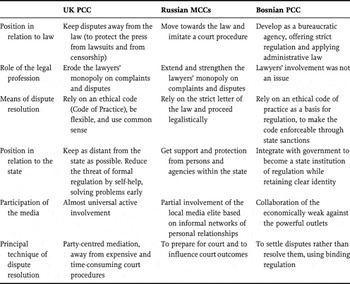
In summary, Table 1 presents the main similarities and differences between the newly established institutions in Russia and Bosnia contrasted with the initial British model for the transplant.
Profiles of the UK PCC and its transplanted versions in Russia and Bosnia

III. Factors influencing the outcome of the transplantation
Having discovered that not only had both the Russian and Bosnian transplants evolved away from the initial British model of PCC, but also in different directions in the two countries, the next task was to ask what factors determined these outcomes.
We identified two sets of factors to explain why the institutions had evolved in the ways that they had. First, there were forces in play that came from the local environment and were therefore external to the transplantation process itself. They can be grouped together under the umbrella concept of ‘legal culture' (Friedman, Reference Friedman1975, p. 194; Nelken, Reference Nelken and Clarke2006; Bell, Reference Bell2001, pp. 2–17). Legal culture is the way that people think about law, and it predetermines how they relate to it. In particular the concept is used to describe a set of assumptions, habits and values. In practical terms legal culture determines the rules of the local game in any society, and the outcome of any new social undertaking such as an institutional transplant must inevitably be shaped by them. The legal culture predetermines a community's ability and willingness either to absorb the innovation or to turn against it.
In this article we will not seek to analyse the impact of legal culture on the transplant in detail.Footnote 16 However, it should be noted that in both Bosnia and Russia the fundamental idea of self-regulation was introduced almost from scratch into societies that had no pre-existing awareness of the concept.Footnote 17
The second set of variables consists of the process of borrowing itself. Broken down into stages, the process comprises the initiation of a project by particular actors and agencies; the strategy they choose for it and its implementation; and the reaction to the project within the local industry and within the wider political context, in terms of those who might support it and those who might oppose it. We have analysed the contribution of the variables that were significant at each stage in shaping the final outcomes of the transplants in both Russia and Bosnia.
Actors and agents
Research into the impact of the key players is crucial, and an investigation into this variable is ‘one of the most fruitful questions in the sociological study of changes in legal culture’ (Nelken, Reference Nelken, Nelken and Feest2001, p. 23). Therefore our question was who or what is doing or undergoing the adaptation?
In both Russia and Bosnia, we observed international consultants working alongside local people. In fact the collection of agents labouring to introduce the idea of self-regulation in its British variety were either the same people in both countries, or people from the same organisations.
In the Russian case, the initiators and the leaders of the project were a group of British academics. They obtained funding from DFID,Footnote 18 and in co-operation with a Moscow-based MMLPIFootnote 19 identified local actors in Nizhny Novgorod and Rostov-on-Don who might be interested in triggering the project locally. Then they invited a team of experts to channel the merits of the idea to the Russian actors. The experts consisted of leading figures in British media, staff from the UK PCC, and spokesmen for a variety of self-regulatory institutions in the UK, such as the readers' editor of a prominent daily newspaper.
In Bosnia, the initiation was different. The transplant was delivered as one item among many in a large package of post-conflict reconstruction projects sponsored by international organisations (Thompson and De, Luce Reference Thompson, de luce, Price and Thompson2002; Pinker and Durmo, Reference Pinker and Durmo2005, pp. 12–14). At various stages a whole series of organisations became involved either as a sponsor or as a monitoring agency.Footnote 20 The UK PCC was called upon to be the lead agency in giving the direct assistance needed to set up councils in Bosnia. To do the job the UK PCC committed its own senior personnel and also invited others from the British print media industry. This meant that many of the same people who been appointed as consultants for the Russian projects were also serving in the same role in Bosnia.
It was clear throughout the research that in both Russia and Bosnia the same message went out, delivered to similar audiences by the almost the same group of people acting in almost the same role as international consultants. The only significant difference was in the sponsorship. The Bosnian project was the product of global high politics: an operation conducted by the international community in an effort to help Bosnia to recover from a major political catastrophe. It was accordingly granted a much higher status in the receiving country than had been enjoyed by the Russian endeavour that preceded it. It gained far more attention, enjoyed more generous resources, and found itself being much more closely monitored by its international sponsors.
Like the international consultants, the occupational and background profiles of the people involved as local actors in the transplants into Russia and Bosnia did not yield much in the way of contrast. In all three projects they were drawn from local groups that had experience of human rights advocacy, together with a selection of individuals active in building civil society, a few academics and some media professionals.
The main difference that we identified between the local actors in Russia and Bosnia was in their level of familiarity with the basic principles of self-regulation. Initially, the principles of media self-regulation were equally alien and unknown in both countries. But when the policy interventions introduced the idea of self-regulation and sparked discussion about it, the Bosnian actors were more heavily exposed to the concept and the varieties of its implementation in the world. The international presence in Bosnia was far stronger, and much greater resources were allocated in the direction of the Bosnian local actors than towards either of the Russian local groups. In Bosnia, almost every member involved in the transplant project participated frequently both in local project activities and in a substantial number of relevant international forums and discussions; in conversation they typically offered lists of the international events that they had attended. The Russian actors, in contrast, had been provided with a much smaller array of learning opportunities and as a result they had less experience, less knowledge and less understanding. Their sources were mainly limited to information obtained during a small number of meetings abroad and the technical briefings given in Rostov and Nizhny Novgorod by visiting experts as part of their project. Broader discussions of topics such as the role of a free press in civil society and democracy, so characteristic of Bosnia, hardly ever took place in the two Russian locations.
This was particularly clear when the focus of our interviews was on the role and potential of the ethical code to be used as a ground for making judgments in disputed cases. For the internationally coached Bosnian actors this had become an accepted area of debate that could be discussed smoothly, while in Russia any talk about ethical codes sounded out of place. Our respondents found it a distinctly uncomfortable topic and tended to change the subject when it came up.
This brings us to the conclusion that in these particular cases the main factor, and probably the only significant factor, that differentiated the actor profiles of the local groups involved in Bosnia and Russia was the extent and intensity of their exposure to the foundational values and the basic principles that supported the transplanted institution.
But it is striking that despite the relatively privileged background of the Bosnian local actors, even the extensive training given on the issue did not ensure that the concept would be internalised without significant transformation. Although the Bosnian actors did take the principles of their ethical code on board, it did not follow that they would use it in the way that it was used in Britain. Instead they reinterpreted its role in no less significant a manner than it was reinterpreted in Russia. Instead of viewing the code as a set of moral rules to be internalised so that they could guide independent professionals in their self-reliant decisions, they treated it as an external regulatory instrument prescribing behaviour that was henceforth to be strictly monitored, judged and enforced by outside bodies backed by the state. As a result, if in the Russian cases the purpose of an ethical code was simply ignored and the transplanted council behaved like a court handing down authoritative adjudications, the Bosnian interpretation was that the transplanted council was to be a government regulatory agency enforcing soft lawFootnote 21 that happened to be presented as an ethical code.
The strategies of transplantation
This section deals with the way in which the outcome of each transplant was affected by the processes by which it took place. The processes consist of the level and manner of the foreign involvement, the length of the project, and the way in which it was implemented.
The Russian projects were launched in Rostov-on-Don and Nizhny Novgorod at the end of 2001, when the recipients of technical assistance were formed into local NGOs as a first step. For an introductory period, each became a supportive platform upon which the local actors could stand as they introduced the idea of self-regulation and cultivated support for it. After that, each NGO turned itself into a secretariat for the newly formed Media Complaints Council in their city. Throughout the process the staff of the NGOs drew on their Western funding and advice to initiate campaigns, invite local people to conferences and meetings, give interviews and issue press releases, and set up training workshops. The entire effort was designed to disseminate information as widely as possible about the self-regulatory approach in principle and the idea of a press council as its practical application.
In Russia the two local NGOs were given a great deal of freedom to select the group of players or stakeholders whom they judged to be best fitted to help them to build up the necessary momentum, both to promote the idea of media self-regulation and to set up the Media Complaints Councils that would deal with complaints. The Western partners were careful to limit their involvement to that of transmitters of ideas and experience. At no time were any Western leaders of the project or their advisors directly involved in establishing the procedures of the Councils, or in making Council decisions, or in the day-to-day operations. The Russian actors started by searching through their personal and professional networks so that they could invite the co-operation of everyone who was either involved in media affairs in some way, or who seemed to be interested in the new project. By this means they eventually surrounded themselves with a group made up of local politicians, leaders in the local media industries, academic linguists and lawyers. By the beginning of the third and final project year, the idea of setting up an institution to resolve media disputes on a voluntary basis was deemed to have reached a sufficient degree of maturity. The two Media Complaints Councils were established and the codes of conduct required by the project were formally adopted in both cities.
But in Bosnia the level of foreign intervention in the project was higher at the outset, and remained high throughout. It started with preparatory work in 1999, when international organisations combined their resources to bring all the various associations of journalists in the country together around a single table. Coaxed by their international mentors, the associations then reached an agreement on a code of ethics for the journalistic profession in Bosnia. This first meeting of all the journalism associations served to identify the stakeholders who would later be involved in the transplant proper. The prospective members of the planned Commission in Bosnia were invited to come on board in 2000, and the Bosnian Press Complaints Commission became official in 2001 when the secretariat was formally established.
The local actors in Bosnia worked much more closely with the international experts and over a longer period of time than the Russian players did. In particular, the input from the UK PCC was major: for the first five years of the Bosnian Commission's history, the chairman was actually a British citizen, drawn from the UK PCC. This meant that British experts were not merely providing the same kind of informal advice as in the Russian projects, but that one of them was prominently involved in the Commission's decision-making. Predictably, the structure of the Bosnian council closely resembled that of the UK PCC and throughout its transition period its operational routine did so as well.
Crises appeared immediately after the removal of financial support by the international donors and the end of the British leadership that went with it. Management automatically passed to local actors. A new chairman, a Bosnian, was appointed in April 2005 and his title was changed to that of director. For some months the Commission's operations almost stopped while it proceeded to critically reassess the five years it had spent under British guidance, and eventually decided that it had produced ‘form without content … not adjusted to the reality of Bosnia’.Footnote 22 There was a strongly felt sentiment among our informants that the five-year introductory period had been tolerated only ‘to keep the Western representatives happy’.Footnote 23 The council then underwent a drastic reshaping and emerged with its purposes, resources and mode of operation all redefined.
By the time of our research in 2006 the Commission was already into the second of its local directors, and the new incumbent was considering the future of the Commission. She had formulated the goals of obtaining government funding and developing a state-supported enforcement mechanism. The plan for working with the electoral committee, with all complaints on media conduct that were made to the electoral body during an election to be referred automatically to the Press Complaints Commission, was presented to us as the main achievement of the new policy and an important step in the right direction for the evolving body.
Comparison of the strategies of the transplantation of the Western PCC model into Russia and into Bosnia shows that the main differences were in their durations (three years in Russia, five years in Bosnia) and more importantly in the degree of direct foreign involvement. The major conclusion that we have drawn from the study of the impact of the two strategies is that the more intensive and prolonged participation of foreigners not only had a limited effect, but may well have provoked frustration and resistance in the long run. As a result of the direct management by a British expert at the beginning of the Bosnian Commission's operations the British model was followed closely, but only up to the point in time when foreign monetary donations were cut off. The changes that immediately followed were fundamental and in practical terms it is possible to view them as a second foundation of the institution. As soon as participation of the British partner ended, the Bosnian institution took its own path of development, and that path moved it away from what it was expected to be.
The media industry and local politics
Now we will consider the significance of the socio-political environment and the state of the media community for the outcome of the transplant.
By almost every conceivable test the media in both Russia and in Bosnia were at an early stage of formation as an industry at the time of the transplant. The media landscape in both countries consisted of a large number of small, isolated outlets, lacking any significant form of institutional co-ordination or grouping around mutual interests (Media Sustainability Index 2004, pp. 198–99). Although some trade union associations had been set up in both countries, they were weak, loose organisations. There was nothing that resembled the British Editors Association, the Press Standards Board of Finance in London, the formidable trade unions that support journalists, print workers and distributors in Britain, or any of the other sturdy institutional frameworks that facilitate industrial co-operation.
In both countries, the quality of the media was very poor. Their chaotic editorial content was shot through with confused accounts (often actually fabricated) of political and economic intrigues and conspiracies that frequently violated principles of journalistic integrity. Proprietors and senior staff tended to interpret the idea of press freedom as a release from restraints, including moral restraint (Richter, Reference Richter2005, p. 24). As was common in the post-communist part of the world, in both Russia and Bosnia nearly all the radio stations, television channels, newspapers and magazines were owned by or aligned with specific political, economic or occasionally ethnic interests. The comment of an American media watchdog that ‘journalism continued to be jeopardized by a relatively low standard of professional ethics, a reliance on foreign donations for survival, and the fact that most media outlets appeal only to narrow ethnic constituencies’ (Freedom House, pp. 41–42) was applicable to the Russian and Bosnian media in equal measure.
It was also a common view in Russia and Bosnia that the option of introducing formal regulation and using the law to enforce it would be a relatively hopeless project, at least in the short term. The legal systems were seen as corrupt, lacking in public respect and even in the respect of the professionals who worked in them. However, it was apparent – at least to foreign observers – that the media in both countries formed an industrial sector essential to modern democratic and civilised life, and as such it was in serious need of effective regulation of some kind. In those circumstances it seemed reasonable to search for an alternative to the legal methods of achieving orderly relationships. Self-regulation presented itself as a good solution.
The local media leaders in both countries met the proposal with considerable scepticism. Although they agreed in principle that some rules should be imposed to improve the quality and reliability of reporting, not many of them believed that self-regulation could work. The main reason they gave us, both in Russia and in Bosnia, was that the media outlets were not self-supporting. They did not pay their way by selling copies and advertisements as their equivalents did in Western countries. They were almost entirely funded by political parties, individual politicians, industrialists or businessmen with interests in sectors remote from the media. As the editors repeatedly pointed out to us, they must either satisfy their proprietor's demands or go out of business (Vartanova, Reference Vartanova, Price, Richter and Yu2002). It followed that no one at any newspaper or electronic outlet had an incentive to conform to the restraints suggested for them by the newly inaugurated councils.
There were some differences, nevertheless, between Russia and Bosnia despite their pronounced similarities in terms of media ownership and low-quality output. The differences stemmed from the different political situations in the two countries and the specific features of the locations.
In Bosnia, the international community intervened and ruled the country directly after the ethnic conflict ended in 1995. The impact of the international presence in the years that followed was considerable, including the systematic monitoring of the media with the object of discouraging or preventing expressions of ethnic intolerance.
Nevertheless, a harsh form of nationalism continued to run high. It affected both local politics and the informal economy on which the majority of the people depended. In this volatile post-war environment, one of the Sarajevo newspapers managed to achieve considerable popularity and power on the basis of a fervent nationalist ideology. Like other media outlets, it was owned and supported by a handful of wealthy and influential individuals. In just a few years, the paper built an empire controlled from a large, suitably gleaming office tower that symbolised its power.
The situation wherein just one newspaper controlled a disproportionate market share and exercised a monopolistic influence pushed the rest of the outlets closer to each other; for them co-operation became necessary for survival. Their insecurity benefited the Bosnian PCC project insofar as it was seen as an anti-monopoly coalition, a weapon that might possibly be used to confront the pressure of the strong rival. Such a perception directly contradicted the official rationale of the transplant project, but it nevertheless won the day. Responding to the majority need, the Bosnian PCC brought together a substantial number of the weak media outlets. They were low in popularity, small-scale in readership and weak in financial capacity, but they were enabled by the Commission to combine together to oppose the only popular outlet in the country–which was itself excluded from the ‘club’. To a considerable extent, this expedient subplot undermined the credibility of the Commission from the beginning. In the view of many of our respondents, its potential to function as a regulatory tool was negligible from the outset.
Despite these considerable shortcomings, it would be accurate to state that there were local forces within the Bosnian media community that had genuine incentives to do what they could to make a success of the new institution. As one interviewee put it, ‘the press commission began just as an international game, but the media has accepted the idea’.Footnote 24 Such local attitudes acted in combination with the efforts and resources of the international players to produce a better-shaped structure for the Bosnian PCC than its Russian opposite numbers.
In the Russian case, the project was initiated after a full decade of transition when the country had been effectively stabilised in its new form. Although the governing centre was beginning to regain some of the formidable power it had lost in 1989, the political and economic landscape right across the country at the end of the 1990s consisted of fragmented and competing groups led by powerful individuals who were accustomed to using individual media outlets for their own purposes (Richter, Reference Richter, Price, Richter and Yu2002, p. 266; Belin, Reference Belin and Brown2001, p. 323; Coulloudon, Reference Coulloudon1999, p. 30). Because the media professionals had no resources of their own, they routinely published or broadcast fictional or biased reports that came to be known as ‘ordered’ stories. Their dependent status forced them to be more interested in maintaining a good relationship with their ‘sponsor’ than in engaging in any form of industrial co-operation. The media outlets that did get involved in MCC activities were committed to it almost entirely on the basis of a pre-existing personal relationship between the editors and the local actors responsible for setting up the institution. This finding led us to conclude that the Rostov and Nizhny projects were not sustainable in their original form in the long run.
V. Concluding remarks
One of the most valuable and far-reaching lessons that we learned from the project was how unpredictable the outcome is, regardless of the amount of effort put into it by the external actor. One should not underestimate the element of social inertia in any society and its ability to resist rather than absorb an innovation that is not of its own creation. The research suggests that the outcome of a transplant, regardless of how simple and straightforward a project it may appear to be, will always be determined by domestic forces in the receiving society rather than by the best efforts of the transplant initiators. It is necessarily a product of a complex interplay between the many factors involved in the transplanting process itself and those that make up the local legal culture.
More often than not, any resemblance to the originating model becomes so slight that in the end, as some commentators have suggested (Gnes, Reference Gnes1997, p. 33), it is difficult to trace the new institution back to its origin unless you already knew where to look. Our case-studies lead us to agree that the term that Teubner (Reference Teubner1998) suggests, ‘irritation’, best describes what happens in practice when an attempt is made anywhere to reproduce the successful experience of another country by means of a policy driven by misguided faith in the potency of deliberate social engineering.
This is not to dismiss the importance of the backing and the financial support received by the transplanted institution. We would argue that the outcome is more positive than it seems. In both of the case-studies under scrutiny the idea of media self-regulation had been successfully introduced to many people. Before 1990 such an idea would have been alien, yet in a very few years after 1999 in Bosnia and 2001 in Russia it became the subject of informed debate in relevant circles within the cities involved in the projects.
In Bosnia, the degree of international involvement in the new institution was so considerable that it gave the PCC a chance to be integrated into the existing formal institutional structure. The point is demonstrated by the fact that as soon as the Bosnian PCC began to stand on its own feet it negotiated a standing contract under election law to resolve disputes affecting the press during elections.
In the Russian cities we found that self-regulation had been added as a topic to the curriculum in the local universities, where members of the next generation of journalists were studying. That meant in turn that much of their source material would of necessity have to be Western in origin. In both Rostov-on Don and Nizhny Novgorod we met research students who were analysing various aspects of Western approaches to media self-regulation as part of their PhD theses.
It therefore seems to us that the transplant has achieved a vital result: even if the councils were now to disappear the concept will persist. The experiment has channelled the idea into the society, attracted intellectual attention to it, and encouraged self-reflection in the media community. It will no doubt take time before the idea of genuine media self-regulation has been socially digested, domesticated and restyled into a form that will be appropriate for the evolving Russian social configuration.
If this conclusion is extended from the institutions and locations under analysis here to the general practice of institutional transplantation, the immediate implication is that if the expectation is an immediate result then an institutional transplant is certain to be disappointing. But if development is viewed not as a short-term building project but as a long-term strategy to be coaxed to fit its cultural and attitudinal context, then what it becomes can be judged only by its longer-term and deeper effects. In such a subtle area of societal structure and management, institutional transplanting has to be seen not as a construction to be done and dusted in just three years, but as a gentle, slow and steady pressure that over time will help to push local social changes in the preferred direction.