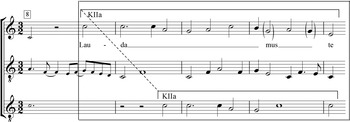
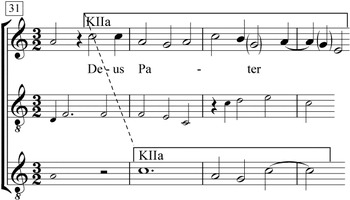
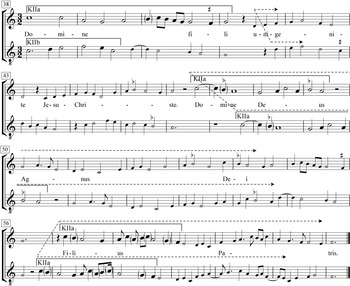
The musical ‘motto’ or ‘head motive’ of the cyclic Mass Ordinary was first identified by Manfred Bukofzer, who succinctly described it as ‘a brief characteristic motive in one or more voices that recurs at the beginning of each movement in the same or only slightly varied form’, but has ‘no influence on the further course and structure of the composition’ beyond the initial measures.Footnote 1 Over sixty years have passed since Bukofzer penned this definition – one that has, to date, remained more or less unexamined. Although the terms ‘motto’, ‘head motive’ and ‘secondary head motive’ have become assimilated into analytical vocabulary, much remains to be discovered about the history, development and function of these musical tags.
Evidence for the origins of the cyclic Mass motto may be found in a handful of Gloria–Credo and Sanctus–Agnus Mass pairs in Bologna Biblioteca Liceo Musicale Q15 (olim 37) and Turin Bibl. naz. J.II.9.Footnote 2 While most of these Mass pairs (by composers such as Guillaume Du Fay, Arnold de Lantins and Johannes de Lymburgia) share common clefs, mensurations, signatures and/or finals, nine of forty-two are unified by motto beginnings.Footnote 3 By the 1420s, mottos began to appear at the openings of movements in certain Franco-Flemish Mass cycles (known as ‘motto Masses’) by Du Fay, Lantins, Lymburgia, Johannes Reson, Reginaldus Libert and Etienne Grossin. The motto Mass was later eclipsed by the English tenor cantus firmus Mass – a composition that incorporated borrowed melodies (from chant, chansons, instrumental pieces or motets) into the tenor line of each of its five movements.Footnote 4 Often overlooked is the fact that the motto continued not only to be used, but also developed as a compositional device throughout the fifteenth and sixteenth centuries. It remained an important fixture in all Mass subgenres, assuming a crucial role in the freely composed variety ‘without a name’, commonly known as the sine nomine Mass.Footnote 5
Over the years, certain scholars have expanded Bukofzer's definitions of the Mass motto. Edgar Sparks and Charles Hamm, for example, first identified ‘secondary head motives’ in interior subsections of fifteenth-century Mass Ordinary settings of the Missa Ave regina caelorum by Dufay and the Missa sine nomine by Johannes Reson.Footnote 6 Years later, Adelyn Peck Leverett found ‘variable head motives’ with similar discantus-voice melodic contours but different rhythmic and contrapuntal profiles in a small group of Masses in the Trent 89 and 91 manuscripts.Footnote 7 Although these studies have elucidated many important aspects of fifteenth-century Mass composition, a vital question has been left unanswered: what do we actually know about the motto? Or, more aptly put: what do we think we know about the motto? The present investigation seeks to reassess commonly held notions pertaining to the formal construction, placement, repetition and variation of mottos in the sine nomine Mass repertory of the fifteenth century. The list below takes stock of ideas that have circulated over the years regarding the motto.Footnote 8
1 One fundamental motto unifies an entire sine nomine Mass.
2 All initial statements of mottos are first encountered in the Kyrie.
3 A motto can involve any number of voices; it can be found in a single voice or in multiple voices.
4 Mottos are usually brief.
5 Mottos are primarily found at the opening of Mass movements.
6 Sometimes, a secondary motto can be encountered at the beginning of a subsection of a movement.
7 Sine nomine or motto Masses are unsophisticated compared to works with a cantus prius factus.
The validity of these ideas will be tested against examples from early sine nomine Masses by John Benet, Johannes Reson, John Bedingham and Johannes Lymburgia, and from mid-century repertory (c.1460–66) found in Trent 89, including Masses by Barbingant and Jo. Bassere and the anonymous Missa Fa-ut (known elsewhere as the Missa Prolatio perfecta).Footnote 9 This study aims to update and refine our understanding of the motto and presents a preliminary step towards establishing a new analytical vocabulary – one that accounts for how composers applied a richer and more multifaceted approach to motto construction, arrangement, repetition and variation than has been previously recognised.
Motto identification
Labelling
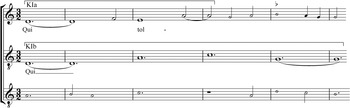
Contrary to previously held notions, most sine nomine Masses are actually unified by multiple mottos. Mottos can appear in single-voice and multi-voice forms and, besides appearing at the beginnings of Mass movements, they commonly serve as inaugural gestures to Mass subsections as well. In the labelling system devised below, two criteria are essential to motto identification: positional context and repetition. The motto, in its initial and at least one of its repeated forms, must be located at the beginning of a movement or at the beginning of a subsection of a movement.Footnote 10 In most cases, the ‘beginning’ constitutes the first sounding semibreve, while in other cases, a motto might be delayed by a few semibreves. Furthermore, the motto should be repeated at least once. Repetition, however, need not be strict. A controlled measure of flexibility is permitted when identifying what exactly constitutes repetition.Footnote 11 When identifying repetition, rhythm is the least important parameter, as it is the most variable in fifteenth-century motto repetition. Consistencies in pitch sequence and melodic contour, on the other hand, are of paramount importance. Motto identification is then based on careful consideration of at least one other secondary consideration – namely, contrapuntal context, texture, rhythm and/or text.
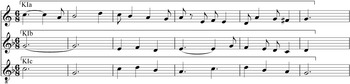
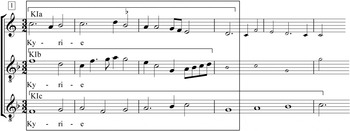
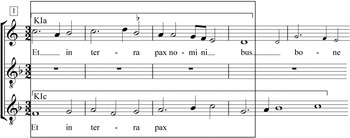
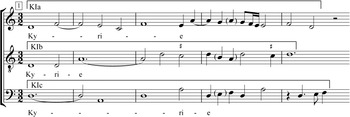
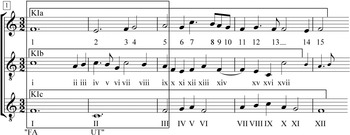
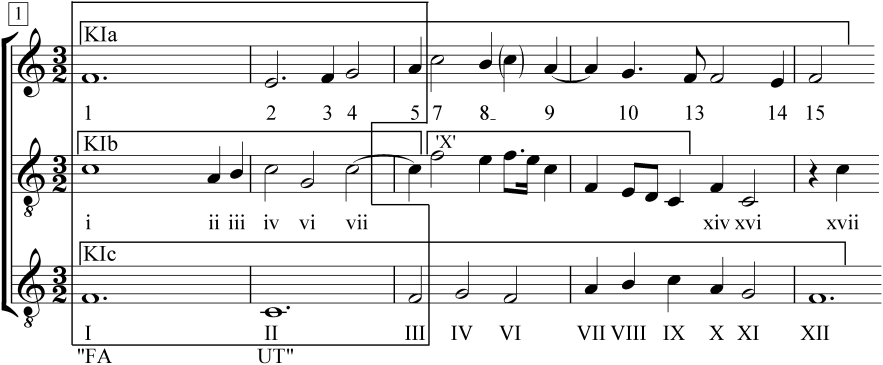
Example 1 shows how motto labels are applied to the opening Kyrie of the Reson Mass. Each label identifies the movement, subsection and voice in which the motto is initially encountered. The first letter indicates in what movement the motto originates (K: Kyrie – G: Gloria – C: Credo – S: Santus – A: Agnus). A Roman numeral specifies further the subsection of the movement (e.g. subsection I, II or III of the Kyrie), followed by the voice in which the motto is situated (a for Superius, b for Contratenor and c for Tenor).Footnote 12
Johannes Reson, Opening of Kyrie: Melodic Motto labels KIa, KIb, and KIc.

Annotating varied repetition
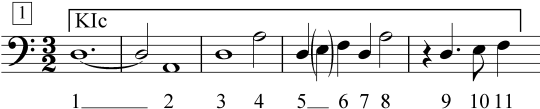
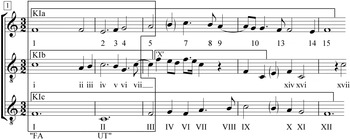
In all the musical examples below, strict repetition is distinguished from varied repetition, motto pitches from non-motto pitches and repeated material from non-repeated material. Normal-sized note heads are used for repeated material while small note heads represent free, non-repeated material (see Ex. 2).Footnote 13 Melodic mottos are indicated with a square bracket and motto label. Parentheses are used to indicate non-repeated notes within a melodic motto (see Exs. 6 and 7). When varied repetition is more difficult to detect, melodic mottos are annotated with Arabic, lowercase and uppercase Roman numerals (see Exs. 13–16).
Annotation of repeated material and non-repeated material.

Because of the flexibility of motto identity, the first form of the motto (i.e. as presented in the Kyrie movement) is not viewed as the ‘ur-form’.Footnote 14 Instead, the ‘full’ motto always constitutes the longest repeated form. This means that a motto can progressively expand or contract through multiple repetitions in a Mass. It is not a fixed motivic entity, but is always in flux; expanding, contracting and merging with other motivic material. In fact, in many sine nomine Masses, mottos are transformed in a successive manner, so that each new permutation grows out of a previous statement. A motto can undergo so many alterations over the course of a Mass that by the time it reaches its final form, if heard without the context of all of its varied restatements, repetition can be, admittedly, difficult to recognise. When heard within this context, however, much is revealed about fifteenth-century approaches to contrapuntal repetition and variation.
Motto vocabulary
Motto module
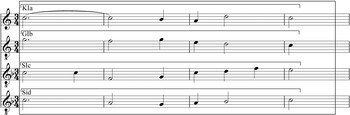
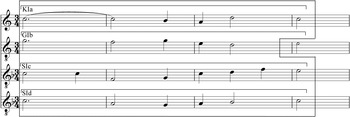
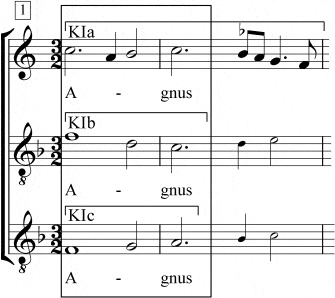
While some mottos appear in single-voice forms, most are found in multi-voice combinations. There are two main varieties of repetitive multi-voice mottos: the motto module and the motto constellation. ‘Modules’ have formerly been defined and identified by Jessie Ann Owens and Peter Schubert in music of the sixteenth century.Footnote 15 A motto module comprises a group of melodic mottos that sound simultaneously in two or more voices and, when repeated, maintain the same vertical intervals and contrapuntal relationships. In a pioneering cyclic Mass by Johannes Lymburgia motto modules are located at the opening of the Sanctus and Agnus movements (see Exs. 3 and 4). Here, ‘modular activity’ is outlined with boxes.
Lymburgia, Missa Sine Nomine, Sanctus I: Motto Module.

Lymburgia, Missa Sine Nomine, Agnus I: Motto Module.

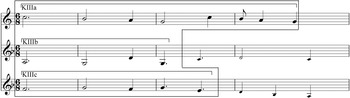
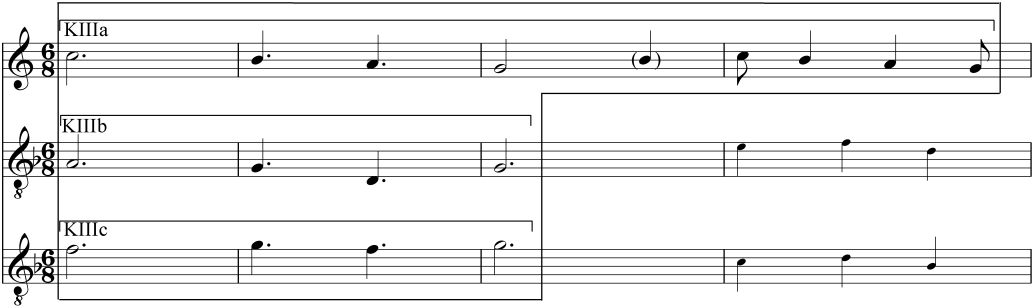
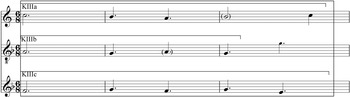
The Missa sine nomine by Johannes Reson presents motto modules in the third subsection of the Kyrie, Sanctus and Agnus, respectively (Exs. 5–7).Footnote 16
Reson, Missa sine nomine, Kyrie III, KIII Module.

Reson, Missa sine nomine, Sanctus III, KIII Module.
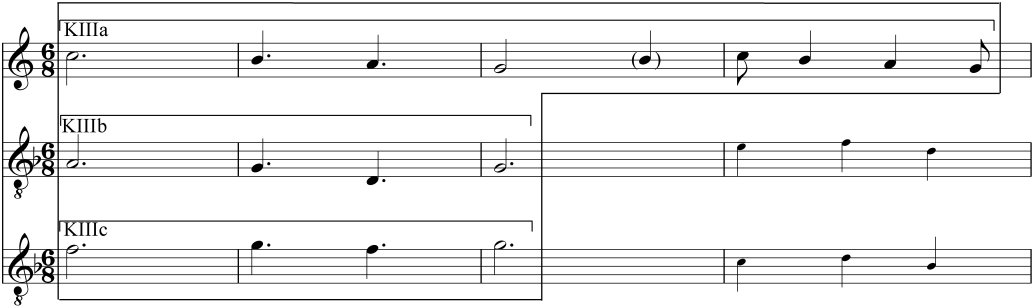
Reson, Missa sine nomine, Agnus III, KIII Module.

Motto modules can also be found at the opening of each of the five movements of a sine nomine Mass by mid-century composer Jo. Bassere (see Exs. 8–12). For eachrepetition, KI's rhythmic, melodic and contrapuntal profile is maintained. The only exceptions are found in the Gloria, where the motto module is reduced to a two-voice texture (superius and tenor) and at the opening of the Agnus, where it is heard in abbreviated form.
Jo. Bassere, Missa sine nomine, Kyrie I, initial presentation of KI Motto Module.

Jo. Bassere, Missa sine nomine, Gloria I, KI Motto Module.

Jo. Bassere, Missa sine nomine, Credo I, KI Motto Module.

Jo. Bassere, Missa sine nomine, Sanctus I, KI Motto Module.

Jo. Bassere, Missa sine nomine, Agnus I, KI Motto Module.

Motto constellation
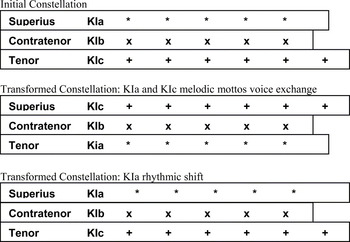
A motto constellation comprises a group of melodic mottos sounded simultaneously or successively at the beginning of a Mass movement or Mass subsection. Melodic mottos in motto constellations are always found clustered together but, unlike the module, the constellation's melodic mottos may recur in any arrangement, in various states of rhythmic displacement and in any vertical or contrapuntal combinations. When reiterated, a constellation always undergoes motto transformation to take on a new, altered form. Figure 1 illustrates hypothetical paradigms in which motto constellations are transformed through an array of variation techniques. As shown, motto transformation can occur when a melodic motto shifts to a new voice and/or when rhythmic, melodic or harmonic modifications are made. Sometimes an individual melodic motto in a constellation is delayed because it is preceded by a few semibreves of rest or because a number of introductory pitches are added to ornament the opening.
Examples of Motto Transformation.

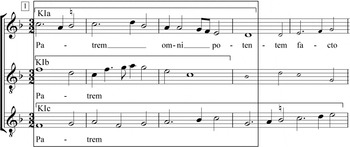
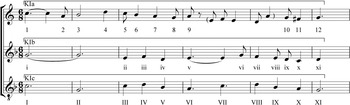
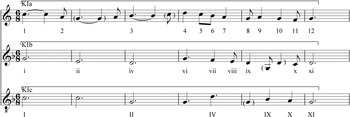
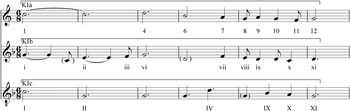
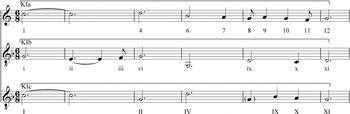
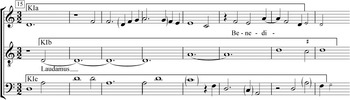
Examples 13–16 reveal the KI-motto constellation and all its various permutations throughout Johannes Reson's Missa sine nomine. Example 13 presents the initial motto constellation made up of KIa, KIb and KIc melodic mottos. The motto constellation manifests itself in numerous ways throughout Reson's Mass and is often disguised through melodic ornamentation, rhythmic variation and new contrapuntal combinations. The Kyrie presents the most elaborate version of the constellation, while the mottos in Examples 14–16 are more condensed.
In an early English sine nomine Mass by John Benet, a motto constellation is found at the opening of the Gloria and Agnus movements (see Exs. 17 and 18). Agnus I features an instance of motto transformation, involving the delayed motto entry of GIb, which enters after the sounding of two introductory pitches.
Internal motto
Not all mottos are entirely dependent upon positional context. In some cases, multi-voiced mottos that initially appear at the beginnings of Mass movements or subsections, when reiterated, can be found at other points in the contrapuntal texture as well. Mottos that appear in positions other than the beginnings of movements or subsections are called internal mottos. In order to qualify as internal mottos, they have to establish themselves as regular mottos by way of two or more appearances at the openings of movements or subsections. Furthermore, internal mottos must be musically highlighted (a) with long or expanded note values, (b) with a cadence directly preceding or following, (c) with rests in one or more voices, (d) by coinciding with the start of a textual phrase and/or (e) by participating in a point of imitation.
Barbingant's Missa sine nomine features examples of internal mottos. The Mass opens with a lengthy three-voice motto constellation in the Kyrie movement (see Ex. 19).Footnote 17 Spanning fourteen semibreves, each of the voices that make up the KI constellation has a distinctive contour. The superius outlines a third from d to f, makes its way up to a and concludes with a descent to d. The tenor begins with a fifth leap from D to a, followed by repeated neighbour tone motion d-c(#)-d, d-(c#)-d. The low contratenor voice, with its alternation between D–A–D (no less than three times), outlining both the plagal octave, with the fourth below and the fifth above, has the most distinctive contour.
Reson, Missa Sine Nomine, Kyrie I: KI Motto Constellation.

Reson, Missa Sine Nomine, Gloria I: KI Motto Constellation.

Reson, Missa Sine Nomine, Credo I: KI Motto Constellation.

Reson, Missa Sine Nomine, Sanctus I: KI Motto Constellation.

Benet, Missa sine nomine, no. 1, GIa Motto Constellation.

Benet, Missa sine nomine, no. 1, Agnus I (NB: GIa (Ex. 17) features interpolated notes (marked with parentheses) while the entry of GIb is delayed).

Barbingant, Missa sine nomine, opening of Kyrie movement, KI Constellation.

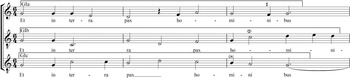
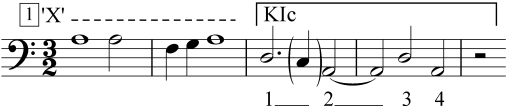
In the Gloria and Credo, the KI constellation appears as an internal motto wherein motto entry is delayed until the third line of text. In the case of the Gloria movement ( Ex. 20), the KI motto constellation articulates the words: ‘Laudamus te, Benedicimus te’. Of all the melodic mottos that comprise the KI constellation, the tenor (KIb) statement is the most emphatic. Here, the leap of a fifth from D to a in long note values (ten and six semibreves, respectively) signals to the listener and performer that something significant is occurring. If this particular Mass were of the cantus firmus variety, the long-note tenor line would certainly coincide with the entry of the cantus prius factus. In this particular case, however, a prolonged tenor note highlights the fact that this is an internal occurrence of the KI constellation. A comparison between Ex. 19 and Ex. 20 reveals that KIa in the latter example features ornamental pitch addition on the second pitch (f), while KIc outlines the original fourth and fifth leaps between D and a.
Barbingant, Missa sine nomine, third line of text in Gloria I, Internal Motto
KI Constellation at ‘Laudamus te’.

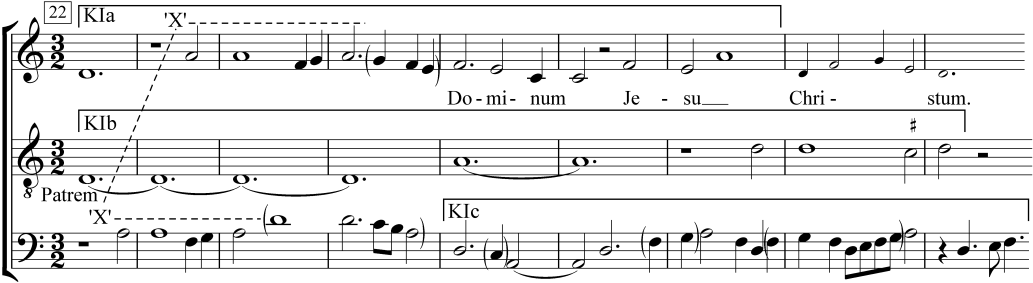
It is not difficult to see the similarities between the internal motto of Barbingant's Gloria movement and that found at measure 22 at the words ‘Dominum Jesum Christum’ in the Credo movement (see Ex. 21). In both examples, Barbingant lays out the tenor's melodic motto (KIb) in long note values.
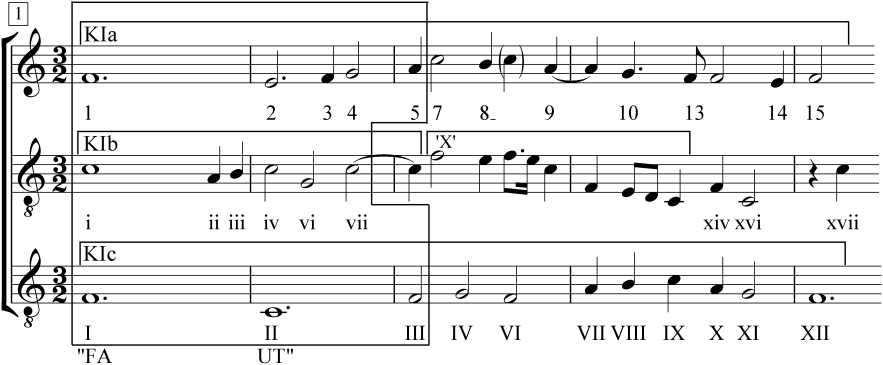
Barbingant, Missa sine nomine, third line of text in Credo, Delayed Motto Entry of ‘KI constellation’ with imitative/ornamental inserted passage ‘X’ at Patrem/Dominum Jesu Christum'.
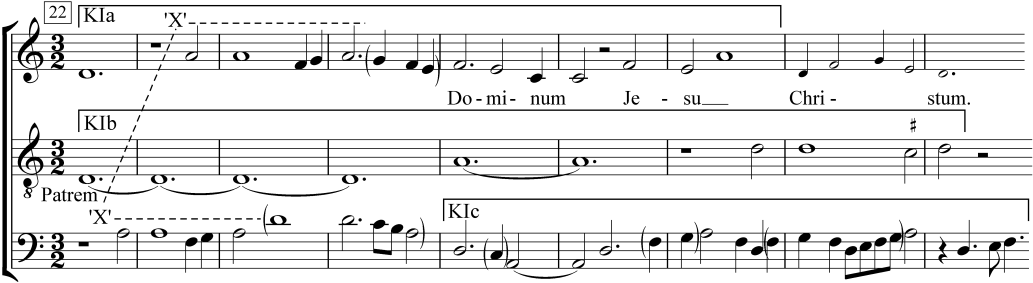
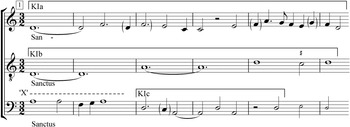
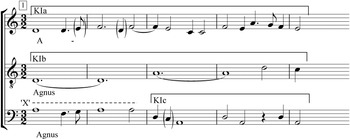
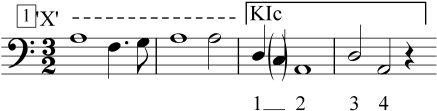
The Credo adds another motivic layer to the KI constellation in the form of a short imitative passage labelled ‘X’ (strictly imitated at the octave) that ornaments the second note of the KIa melodic motto. This ornamental motive later recurs at the opening of both the Sanctus and the Agnus movements as a melodic motto prefix (Exs. 22 and 23) – each time in conjunction with restatements of the KI constellation. In this way, motive ‘X’ becomes an ‘add-on’ to the original KI constellation.
Barbingant, Missa sine nomine, opening of Sanctus, KI Constellation with ‘X’ Motto Prefix.

Barbingant, Missa sine nomine, opening of Agnus, KI Constellation with ‘X’ Motto Prefix.

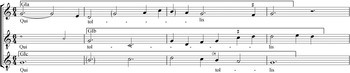
Although the KIa and KIb melodic mottos that comprise the KI constellation of Examples 22 and 23 are modelled closely on the initial Kyrie motto of Example 19, the identity of the lower-contratenor motto as KIc is not nearly as obvious. A comparison of contratenor lines at the openings of movements and subsections (Ex. 24), however, reveals that KIc takes varied shapes and forms over the course of the Mass.
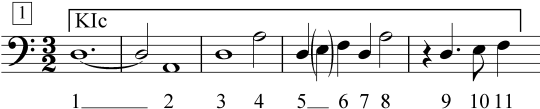

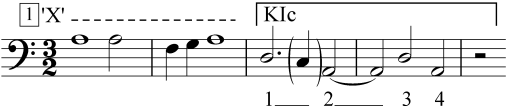
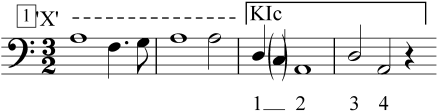
The KIc motto undergoes such dramatic alterations that by the time it reaches its final form in the Agnus movement, if viewed without the context of all of its varied statements, it is difficult to recognise a connection between Examples 24a and 24d. This is a wonderful illustration of how a motto can subtly change and merge with other motivic material. In this Mass, Barbingant's motto does not exist as an iconic, self-contained or isolated symbol. Instead, the motto expands and contracts through a series of variation procedures whereby each new permutation develops from a previous motto statement.
It is possible that composers purposely used internal mottos as a means of articulating salient words and phrases of Mass Ordinary text. Indeed, rhetorically motivated internal mottos are manifest in many sine nomine Masses of the fifteenth century, suggesting that the practice of highlighting references to the Holy Trinity (and its constituent parts) with musical mottos may actually reflect those gesticulations intrinsic to rituals associated with the liturgy. Kneeling, genuflecting and bowing are part of a long-standing gestural tradition associated with the Catholic Mass. Of significance to this study is the time-honoured practice of partially bowing when mention is made of Jesus Christ, the Father, the Holy Ghost or the Virgin Mary.Footnote 18 Musical mottos may have assumed symbolic significance through their association with certain significant words in the Mass. Seen in this way, the motto would have served the ritual function of eliciting a bow from the celebrant(s), the symbolic function of signifying the Holy Trinity, the spiritual function of inducing group contemplation of the Lord's name and the musical function of linking all five movements of the Mass Ordinary.
The constellation + module hybrid
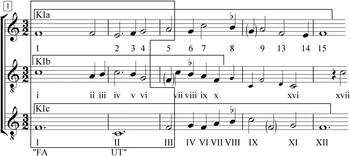
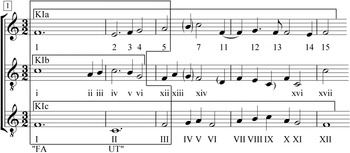
Most early fifteenth-century sine nomine Masses feature motto constellations that almost always undergo melodic, rhythmic and contrapuntal variation. Later in the century, mottos assume a more straightforward and literal form, featuring fewer rhythmic changes and a smaller number of inserted pitches. From 1450 onwards, the motto constellation is slowly replaced by the motto module. At times, composers combine these two motto-types to create the constellation + module hybrid. Examples 25–29 illustrate the KI constellation + module hybrid found in the Missa Fa-ut, a Mass that has been deemed ‘the most tightly structured of the motto Masses.’Footnote 19 For the first six to eight semibreves, KI begins as a module (the modular portion of KI is outlined with a box). Thereafter, KI becomes a constellation (the superius and tenorvoices are similarly matched in each movement while the contratenors are more varied).
Missa Fa-ut, Kyrie I, initial presentation of KI Constellation + Module.

Missa Fa-ut, Gloria I, KI Constellation + Module.

Missa Fa-ut, Credo I, KI Constellation + Module.

Missa Fa-ut, Sanctus I, KI Constellation + Module.
Missa Fa-ut, Agnus I, KI Constellation + Module.

Motto imitation
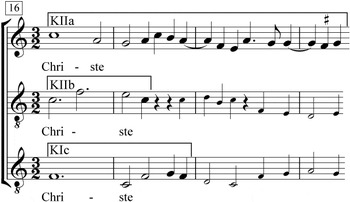
In many sine nomine Masses, imitation interacts with and articulates the entry of internally positioned mottos through a procedure called motto imitation. The Missa Fa-ut has several examples of motto imitation. The KII constellation first appears at the opening of the second Kyrie subsection with a partial statement of the ubiquitous ‘Fa-Ut’ tenor motto (F-C-F) KIc (see Ex. 30).
Missa Fa-ut, Kyrie II, KII Motto Constellation.

Missa Fa-ut, Gloria I, ‘Laudamus te.’ Entrance of KIIa' articulated with rests and motto imitation.

Missa Fa-ut, Gloria I, ‘Deus Pater.’ KIIa in Motto Imitation.

Missa Fa-ut, Gloria II, ‘Domine fili,’ KIIa in Motto Imitation.

KIIa is revisited in the Gloria articulating the words ‘Laudamus te’ in a passage of motto imitation between superius and tenor (Ex. 31). Here and elsewhere appearances of KIIa as an internal motto are often signalled by introductory rests or by the repetition of C.
KIIa is also heard as an internal motto in the Gloria I section at the words ‘Deus Pater’ where motto imitation occurs between the superius and tenor (Ex. 32), and again in the ‘Domine fili’ GII-subsection. The richly imitative texture and tightly integrated motivic structure of this latter Gloria subsection (shown in its entirety in Ex. 33) exemplifies how the composer of the Missa Fa-ut sensitively responds to the text ‘Domine fili unigenite Jesu Christe. Domine Deus Agnus Dei Filius Patris.’ Here, the Son and the Father (‘Lord Son only begotten Jesus Christ … Son of the Father’) meld in a passage where KIIa imitation assumes symbolic and spiritual meaning. The use of imitation may be seen to reflect what Christopher Reynolds has identified as a compositional trend that characterises works from the ‘last decades of the century … before imitative counterpoint became the stylistic norm’.Footnote 20 During this period, Reynolds argues, ‘composers had more freedom to use imitation as an expressive tool for interpreting those portions of the Mass that either described unity between separate entities (between Father and Son, for example) or actions such as leading and following.’Footnote 21
Reassessing the motto
The musical examples from the case studies examined above spring from a group of approximately eighty extant sine nomine Masses – works that have received relatively little attention when compared to the more popular cantus firmus Mass.Footnote 22 The labelling system and musical terminology help to navigate through some of the more standard motto-types and variation techniques that can be found in this repertory. With the motto constellation, counterpoint is varied through melodic ornamentation or pitch deletion, rhythmic variation and/or contrapuntal transformations, whereas with the motto module, all contrapuntal relationships between voices are strictly repeated. In the early fifteenth century, the motto constellation is favoured; after the mid-fifteenth-century, mottos assume a more straightforward and literal form through the constellation + module hybrid and motto module.
The motto varies in length and can be brief (as remarked by Bukofzer) but, more often than not, it constitutes a full musical ‘phrase’ that is typically articulated with a punctuating intermediary cadence. Initial motto statements may be encountered at the beginning of any or all Mass movements or at the head of subsections within movements. Therefore, given how frequently non-KI ‘subsection’ mottos are encountered in the sine nomine Mass repertory, it hardly seems appropriate to use the term ‘secondary’ motto. Indeed, most prominent sine nomine Mass mottos are initially introduced at the opening of all three Kyrie subsections and at least a couple Gloria subsections, meaning that it is typical for a Mass to be unified by a collection of KI, KII, KIII, GI and GII mottos.Footnote 23
Besides punctuating the openings of Mass movements, the motto can also recur at other locations as an internal motto. In order to highlight the aural experience of an internal motto, composers routinely employed rests, cadences, long-note values and imitation. This latter technique, called motto imitation, is particularly widespread when imitative textures begin to come into vogue in mid-century Mass repertory and beyond.Footnote 24 When motto imitation is employed, often one or two distinctive melodic mottos of a multi-voice motto constellation or motto module (i.e. the FA-UT in the Missa Fa-Ut) are treated as a subject, thus permitting a ‘working-out’ of motivic material as the motto overlaps with itself and sounds in multiple voices of the Mass texture.
The works featured in the analyses above not only enhance our understanding of how the sine nomine motto is used, but also offer insight into techniques governing fifteenth-century contrapuntal repetition and variation. It turns out that decades before the impact of the English cantus firmus Mass was felt on the continent, English and continental composers were already well-versed in sophisticated compositional techniques that involved repetition and variation. Unlike the lengthy repetitive cantus prius facti of the cantus firmus Mass, however, the sine nomine Mass employs short repetitive motivic units. The fact that these units are so small means that their deployment is much freer in that they can be repeated, varied and combined in countless forms and positions throughout a Mass. As is the case with the single-line tenor cantus firmus, the multi-voice motto is also highly variable and prone to pitch deletion, addition and rhythmic manipulation. Unlike variation of a cantus firmus, however, mottos often transform from movement to movement in a successive manner, so that each new permutation grows out of a previous statement. Mottos of the sine nomine Mass are often contrapuntal multi-voice units, suggesting a precedent for repetition and variation techniques in a Mass subgenre that became popular much later in the fifteenth century – the Parody Mass, which is also based on the repetition of contrapuntal blocks. One Mass-type borrows and the other is freely composed, but both use similar techniques of contrapuntal repetition and variation. Typically characterised as a relatively isolated, self-contained and static motivic unit, the motto is revealed to have a very different profile. It is a great testament to the spirit of compositional experimentation that no two sine nomine Masses are alike. In fact, given the variability of the mottos in the analyses featured in this study, at times, the designation ‘motto’, though still viable, does not truly capture the more subtle nuances of its internal structure, function and formal placement. Nonetheless, more exact vocabulary at least permits us to qualify some of those nuances, as it answers where, how and in what contexts mottos repeat, thus providing another small step towards understanding compositional process in early Renaissance music.