Introduction
Cognitive impairment is one of the most important psychopathological features in both major depressive disorder (MDD) and bipolar disorder (BD), particularly during major depressive episodes (MDE). Over the past few decades, the number of studies addressing neurocognitive functioning in mood disorders has grown exponentially,Reference Russo, Mahon and Burdick1 with increasing scientific interest about the influence of cognitive impairment on the course of these disorders,Reference Stordal, Lundervold and Egeland2, Reference Basso and Bornstein3 determining a more severe impairment of global functioning and a higher degree of overall disability.Reference Dickerson, Boronow and Stallings4–Reference Albert, Brugnoli and Caraci8 Furthermore, cognitive impairment is currently considered a crucial therapeutic target in depression, in order to achieve cognitive remissionReference Bortolato, Miskowiak and Köhler9 and recovery.Reference Farkas10
From a cognitive perspective, many studies have demonstrated that depressed patients exhibit a wide range of cognitive deficits both in MDD and BD. These deficits do not necessarily depend on the mood stateReference Biringer, Mykletun and Sundet11, Reference Iverson, Brooks and Langenecker12 and mainly regard the domains of memory,Reference Czepielewski, Massuda and Goi13–Reference Bearden, Glahn and Monkul18 attention,Reference Maalouf, Klein and Clark14, Reference Belleau, Phillips and Birmaher19–Reference van der Meere, Borger and van Os21 executive functions,Reference Martinez-Aran, Penades and Vieta22–Reference Baudic, Tzortzis and Barba25 and language.Reference Raucher-Chene, Achim and Kaladjian26
However, few studies have directly compared the cognitive profiles of patients with MDD with those of BD patients.Reference Bearden, Glahn and Monkul18 In addition, these studies included patients regardless of illness phase and produced conflicting evidence, showing, in some cases, different cognitive alteration profiles between unipolar and bipolar patients (in terms of both expression and severity), and overlapping deficits in other cases.Reference Xu, Lin and Rao27 For instance, in a study comparing three groups of patients with MDD, BD-I, and BD-II, Xu et al. (2012) found similar patterns of cognitive dysfunction during acute depression across the three groups, but observed a globally greater cognitive impairment in BD-I compared to BD-II and MDD.Reference Xu, Lin and Rao27 Daniel et al. (2013) confirmed that both patients with MDD and BD-I showed some cognitive deficits in relation to information-processing speed compared to healthy controls, but they could not find any specific difference between the two subtypes of mood disorder.Reference Daniel, Montali and Gerra28 Moreover, overlapping alterations in bipolar and unipolar patients were observed by Hermens et al. Reference Lee, Hermens and Porter29 Finally, while some authors have shown greater deficiency in executive functions in bipolar versus unipolar patients,Reference Borkowska and Rybakowski30 at least one study has not shown significant differences in this domain.Reference Gruber, Rathgeber and Braunig31 Indeed, in literature there is also evidence for a higher degree of cognitive impairment in unipolar compared to bipolar depression, regarding memory, executive functions, and decision-making,Reference Taylor Tavares, Clark and Cannon32 as well as executive functions and psychomotor speed in drug-naive patients.Reference Mak, Lau and Chan33
Based on the above, to date, the presence of distinctive profiles between unipolar and bipolar depression from a cognitive perspective is still debated. In clinical settings, however, that would add useful elements to the differential diagnosis between these two nosographic entities, which are often confused and misdiagnosed.Reference Ghaemi, Sachs and Goodwin34 Currently, the elements considered suggestive of bipolarity during depression are mainly represented by psychopathological symptoms and clinical variables (e.g. the presence of irritability, psychomotor agitation, emotional lability, rapid thoughts, psychotic symptoms, and atypical depressive symptoms including hypersomnia and hyperphagia),Reference Ghaemi, Sachs and Goodwin34, Reference Yatham35 but do not comprise any cognitive specifier.
The limited evidence about the distinctive characteristics of cognition in MDD and BD may actually reflect the presence of methodological biases of the aforementioned studies (above all, the enrollment of patients during different phases of illness) and the lack of sensitivity of classical statistical methods in the analysis of potential differences.
For these reasons, in the present study, the problem of the differential diagnosis between the cognitive profiles of unipolar and bipolar depression was addressed by conducting a network analysis, an innovative analytical model that is gaining growing interest in the study of psychopathology. Thus, our main objective was to evaluate the differences between the cognitive profiles of patients with MDD and BD during depression, by performing a network analysis of the cognitive domains of the Montreal Cognitive Assessment (MoCA).Reference Nasreddine, Phillips and Bedirian36 A secondary objective was to confirm the usefulness of the MoCA as a cognitive screening tool in depression, and then after remission, by estimating the rate and severity of cognitive impairment in a naturalistic sample of depressed outpatients.
Methods
Eligibility for the study
The present study had a prospective, observational design, and it was conducted in a naturalistic setting, namely, the Centre for the Diagnosis and Treatment of Depressive Disorders (CTDD) of the ASST Fatebenefratelli-Sacco in Milan, an outpatient, tertiary psychiatric service dedicated to the treatment of affective disorders. Both outpatients and patients undergoing day-hospital care between January 2016 and December 2017 were considered eligible.
The design of this study fitted most of the methodological criteria defined by the International Society for Bipolar Disorders (ISBD) task force, as stated in the guidelines for the study of cognitive disorders in BD,Reference Miskowiak, Burdick and Martinez-Aran37 as well as those previously proposed by Burdick and colleagues,Reference Burdick, Ketter and Goldberg38 although it was conceived before their publication.
Both subjects of male and female gender, above the age of 18, with a current diagnosis of MDE within MDD, BD-I, or BD-II were considered eligible for the study. Diagnoses were formulated through a structured clinical interview complying with the criteria of the Diagnostic and Statistical Manual of Mental Disorders-Fifth Edition (DSM-5).39 Exclusion criteria included clinically relevant learning or reading disability/dyslexia/illiteracy, diagnosis of cognitive disorder, history of moderate to severe head injury, uncontrolled thyroid dysfunction, recent alcohol or substance abuse, concomitant therapy with high-dose anticholinergics and with benzodiazepines at a dosage equal or higher than diazepam 7.5 mg/day, electroconvulsive therapy (ECT) within 6 months from the enrolment into the study.
The main demographic and clinical characteristics of the sample were collected in an electronic database through a retrospective chart review, in both traditional records and computerized form or, when necessary, through a direct interview with the subject enrolled in the study.
All subjects enrolled into the study underwent a structured interview to complete the collection of data regarding the main demographic and clinical features. One psychiatrist (MFB) and three residents (CG, RZ, VC) were trained to perform the psychopathological and cognitive assessment with the tests described later. The assessment was performed at two time-points: at the time of entry into the study (depression) and at remission (remission). All subjects enrolled in the study provided informed consent to the collection of personal and sensitive data, as well as the consent to undergo the psychometric evaluation and the cognitive test described later.
Psychopathological assessment
The severity of depressive symptomatology was assessed using the 21-item-Hamilton Depression Rating Scale (HDRS)Reference Hamilton40 at the time of entry into the study (depressive phase) and at clinical remission (remission, defined as a HDRS total score of less than 8 according to literature). In addition, at the time of entry into the study (depression) and at remission (remission), the severity of the anxious component was assessed with the Hamilton Anxiety Rating Scale (HARS).Reference Hamilton41 Clinical remission was considered complete upon the achievement of a concomitant score of HDRS<8 and HARS<7.
Cognitive screening: the MoCA
In this study, cognitive performance was assessed with the MoCA, administered during the depressive phase and after clinical remission (as defined above).
The MoCA is a short screening tool developed by Nasreddine et al. (2005) for the identification of mild cognitive impairment (MCI), a clinical condition of increased risk for the subsequent development of Alzheimer’s disease or other forms of dementia.Reference Nasreddine, Phillips and Bedirian36
The MoCA examines six different cognitive domains: executive functions, visuospatial abilities, attention, verbal fluency, memory, and spatio-temporal orientation. Through the measurement of different cognitive domains, the total score of the MoCA, which varies from a minimum of 0 to a maximum of 30, provides a global assessment of the cognitive performance of the subject. In relation to the years of educations, a score equal to or above 26 is considered normal,Reference Nasreddine, Phillips and Bedirian36 and a supplementary point is added if years of education are less than 12. The average time to administer the test is usually around 10–15 min.
The MoCA has good internal consistency with a Cronbach’s alpha value of 0.83.Reference Nasreddine, Phillips and Bedirian36 Furthermore, the sensitivity and the specificity of the MoCA in identifying MCI are 90% and 87%, respectively. Finally, the positive (VPP) and negative (VPN) predictive value of the MoCA are 89% and 91%, respectively, for MCI [40].
Among cognitive screening tests, the Mini Mental State Examination (MMSE)Reference Folstein, Folstein and McHugh42 is the most commonly used for the detection of cognitive impairment. However, the MMSE is considered less sensitive in detecting deficits in executive functions, attention, and visuospatial domains.Reference Nasreddine, Phillips and Bedirian36, Reference Mitchell43 Compared to the MMSE, the MoCA includes several tasks specifically aimed at evaluating executive functions, attention,Reference Smith, Gildeh and Holmes44 and memory.
The MoCA has proven to be a sensitive tool for screening patients with other forms of dementia, such as vascular dementia,Reference Freitas, Simoes and Alves45 dementia associated with Parkinson’s disease,Reference Hoops, Nazem and Siderowf46 and finally frontotemporal dementia.Reference Freitas, Simoes and Alves47 With respect to psychiatric disorders, the MoCA has been used successfully to evaluate cognitive impairment in patients with depression, BD, and schizophreniaReference Yang, Abdul Rashid and Quek48, Reference Musso, Cohen and Auster49 as well as in depressed patients undergoing ECT.Reference Moirand, Galvao and Lecompte50
Statistical analysis
The Kolmogorov–Smirnov and Shapiro–Wilk tests were performed to test the assumption of normal distribution of the clinical and sociodemographic variables, as well as that of HDRS, HARS, and MoCA scores.
In MDD, with the exception of age, D(61) = 0.074, p = 0.200, HDRS score in the depressive phase, D(61) =0.078, p = 0.200, and HARS score in the depressive phase, D(61) = 0.071, p = 0.200, data regarding all other variables violated the assumption of normal distribution.
In BD, a normal distribution was found for age, D(33) = 0.100, p = 0.200, age of onset, D(33) = 0.111, p = 0.200, MoCA score in depressive phase, D(33) =0.142, p = 0.087, HDRS score in the depressive phase, D(33) = 0.090, p = 0.200, HARS score in the depressive phase, D(33) = 0.127, p = 0.195, and HDRS score in clinical remission phase, D(33) = 0.128, p = 0.186. Data regarding all other socio-demographic and clinical variables violated the assumption of normal distribution. Thus, based on these preliminary analyses, non-parametric tests were used for the statistical analyses described here.
Demographic and clinical characteristics were compared between the two groups using Mann–Whitney U non-parametric test for continuous variables and Chi-square (χ 2) test for dichotomous variables.
Then, Mann–Whitney U test was used to analyze the differences between the scores of the single cognitive domains of the MoCA between the two groups and between the total scores of the scales for depression and anxiety. These analyses were conducted for both the depressive and remission-related scores. Furthermore, the statistical significance of the change of the MoCA total scores and of the individual cognitive domains from the depressive phase to clinical remission was calculated using the Wilcoxon signed-rank test.
For the two groups of patients with MDD and BD, the matrix of Spearman rho (ρ) correlation coefficients between the six MoCA domains (memory, executive functions, verbal fluency, orientation, attention, visuospatial abilities) was calculated.
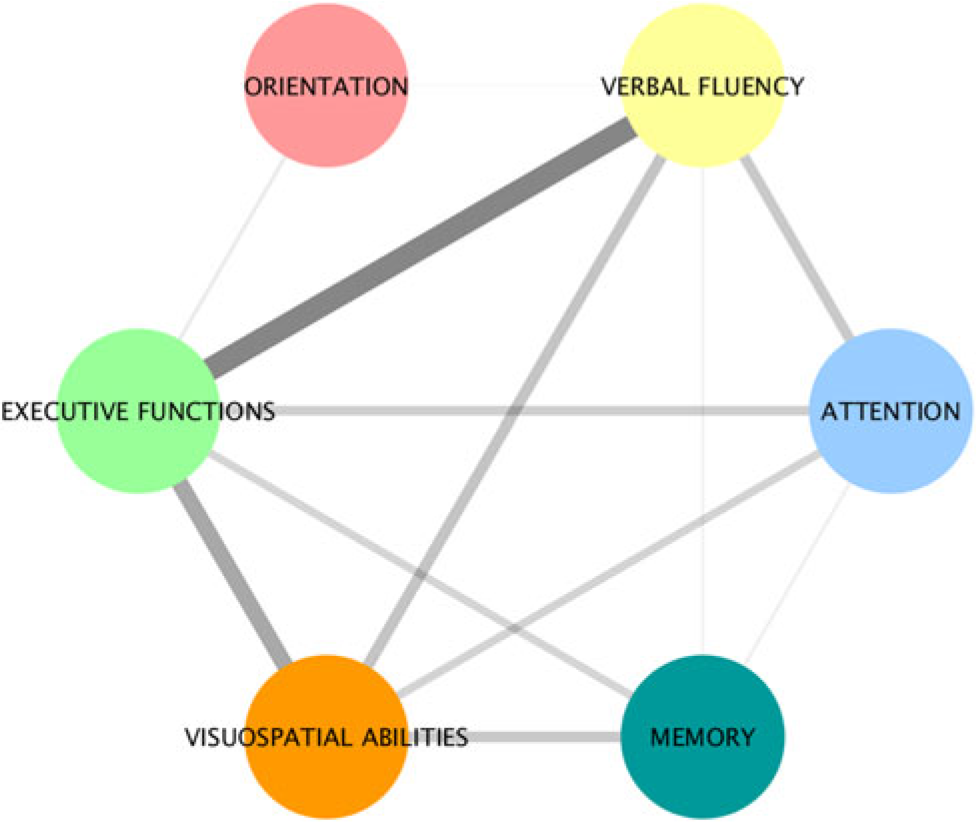
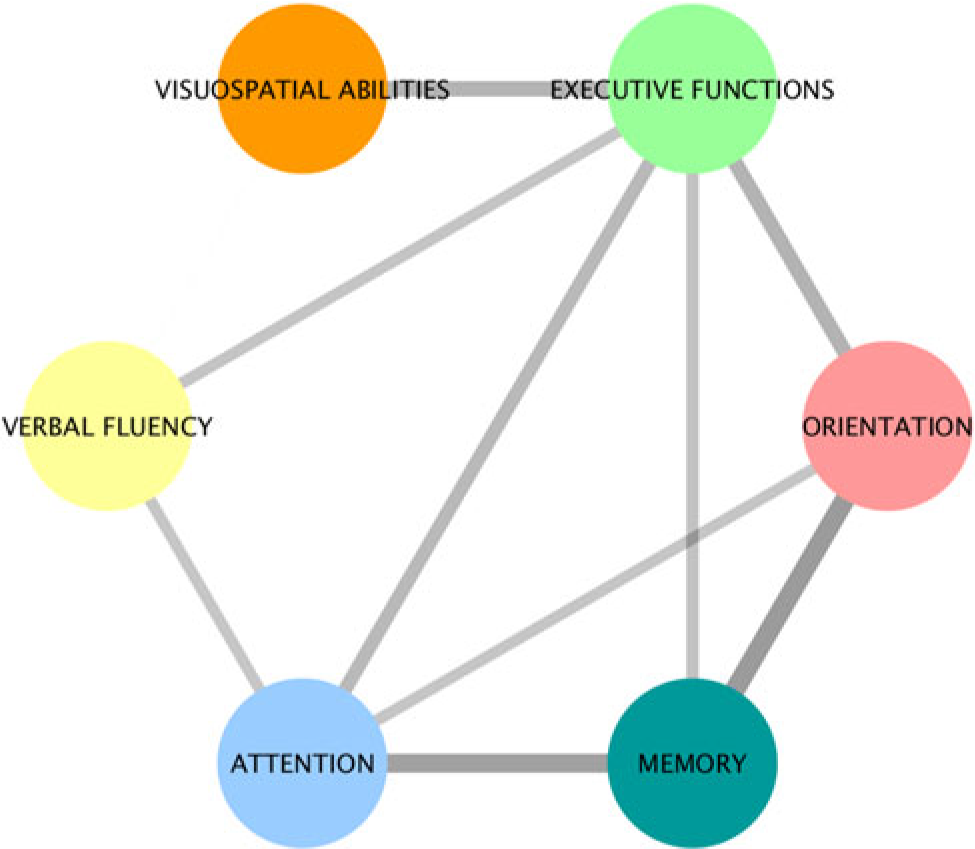
In addition, for each of the two groups examined, we constructed a network graph in which the nodes represent the six cognitive domains of the MoCA and the edges represent Spearman’s rho correlation coefficients between the domains. The cognitive networks for unipolar and bipolar depression were thus constructed. Within both networks, only the connections corresponding to a coefficient ρ ≥ 0.20 were represented. Furthermore, in order to allow an immediate graphical comparison, the nodes within the networks have been arranged using a circular layout.
Finally, through a network analysis, for each network we calculated three metrics defined as follows:
Network density: corresponding to the average of the correlation coefficients, network density expresses the degree of intercorrelation between the symptoms of a network, and therefore their tendency to present themselves simultaneously;Reference Koenders, de Kleijn and Giltay51
Closeness centrality: a parameter indicating how easily all the other nodes of a network can be reached starting from the node examined, that is, the average distance of that node from all the others. The nodes with the highest closeness quickly affect the other nodes and they are more influenced by the other nodes;Reference Galderisi, Rucci and Kirkpatrick52, Reference Costantini, Epskamp and Borsboom53
Betweenness centrality: it expresses the number of times a node is involved in the shortest path length between two other nodes. The nodes with a high betweenness are those that facilitate connections within a network.Reference Galderisi, Rucci and Kirkpatrick52, Reference Costantini, Epskamp and Borsboom53
For all the analyses, the level of statistical significance was defined as p < 0.05. Statistical analyses were performed using IBM SPSS version 22.0, while network analysis and the construction of the network graph were obtained using RReference Epskamp, Cramer and Waldorp54 and Cytoscape version 3.2.1.Reference Shannon, Markiel and Ozier55
Results
Sample characteristics
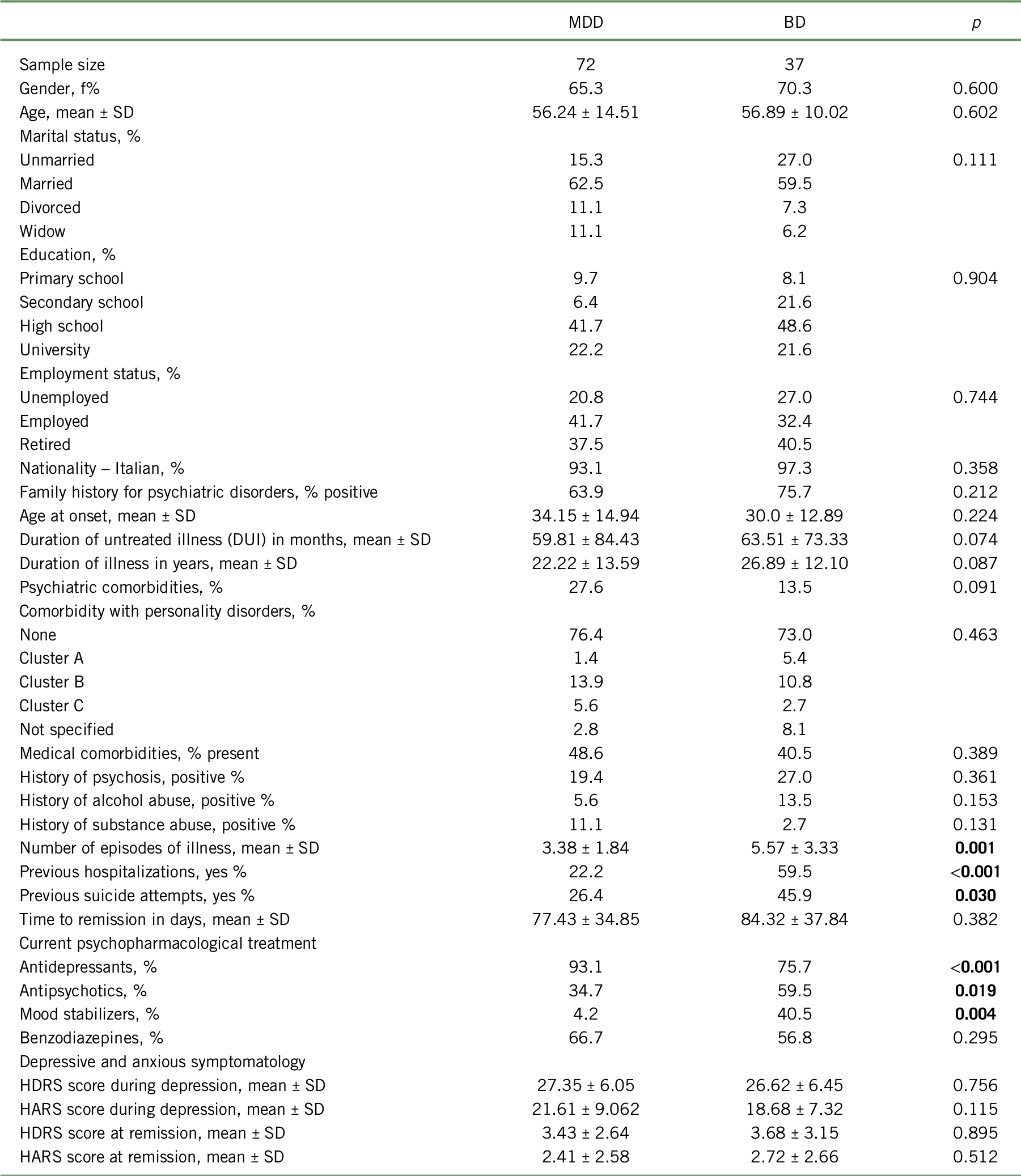
A total of 109 outpatients with a MDE were enrolled in the study: 72 patients (66.1%) diagnosed with MDD and 37 patients (33.9%) diagnosed with BD. The two groups of patients were homogeneous with regard to most of the main demographic and clinical variables (see Table 1).
Demographic and clinical characteristics of the two groups

Note: Bold values indicate p < 0.05, according to non-parametric and chi square tests.
The two groups significantly differed with regard to previous hospitalizations (χ 2 = 14.924, p < 0.001), previous suicide attempts (χ 2 = 4.688, p = 0.030), and number of mood episodes (U = 566.0, Z =−4.028, p < 0.001). Moreover, some differences emerged in terms of current medication status, as patients with BD were more frequently treated with antipsychotics (χ 2 = 5.541, p = 0.019) and mood stabilizers (χ 2 = 23.096, p < 0.001), but less frequently with antidepressants (χ 2 = 8.224, p = 0.004) compared to patients with MDD. However, there was no difference in treatment with benzodiazepines (χ 2 = 1.097, p = 0.295). The aforementioned differences likely reflected the naturalistic context in which the study was conducted because, in clinical practice, MDD and BD are characterized by a different course of illness and by different treatment strategies. We took into consideration these differences by conducting some analyses to weigh their impact on the variables examined in the present study.
During depression, mean HDRS score and mean HARS were, respectively, 27.35 ± 6.05 and 21.61 ± 9.062 for MDD, and 26.62 ± 6.45 and 18.68 ± 7.32 for BD. Therefore, the study sample presented with moderate to severe depressive symptomatology and with mild to moderate anxious symptomatology, as expected from the recruitment in a day-hospital service that is specifically dedicated to the treatment of severe forms of depression. No statistically significant differences emerged between the two groups with respect to depressive symptomatology (U = 1265.5, Z = –0.311, p = 0.756) nor with respect to anxious symptomatology (U = 1054.5, Z = –1.557, p = 0.115).
Cognitive performance during depression
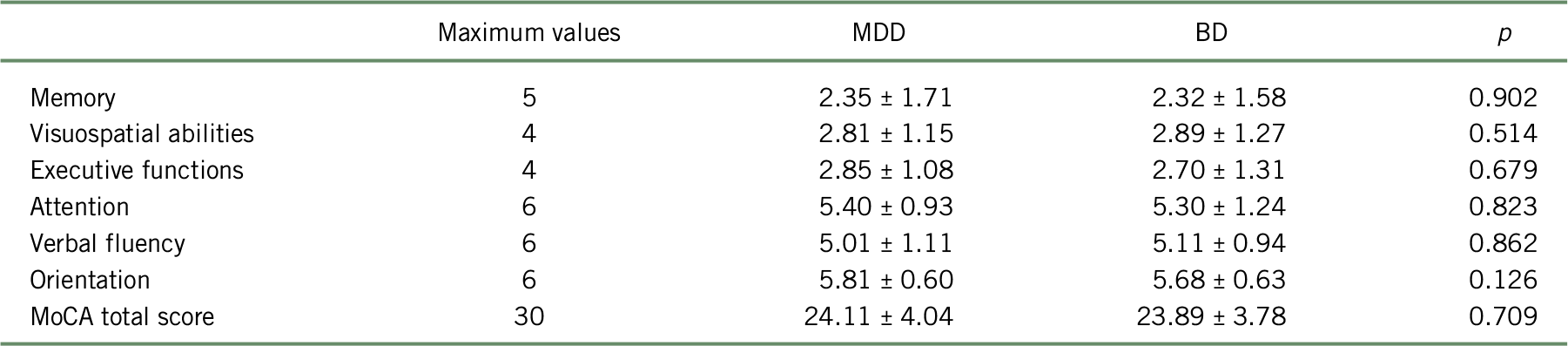
The mean MoCA total score (adjusted for education level) in the entire sample was 24.04 ± 3.94, lower than the normality cutoff of 26, as defined by the normative studies of the test. Globally, 55.9% of the subjects enrolled for the study had MCI, defined as a MoCA score of less than 26. In the two groups, 54.2% of patients with MDD and 59.4% of patients with BD had cognitive impairment, with a mean MoCA score of 24.11 ± 4.04 and 23.89 ± 3.78 respectively, and no statistically significant difference between them (U = 1274.0, Z = –0.373, p = 0.709).
Analyzing the single cognitive domains of the MoCA, the total score of the memory domain was, respectively, 2.35 ± 1.71 and 2.32 ± 1.58 for MDD and BD, with no statistically significant differences between the two groups (U = 1313.0, Z = – 0.124, p = 0.902).
During depression, no statistically significant difference emerged between unipolar and bipolar patients, even considering single domains, as shown in Table 2.
Mean scores of MoCA single domains during depression

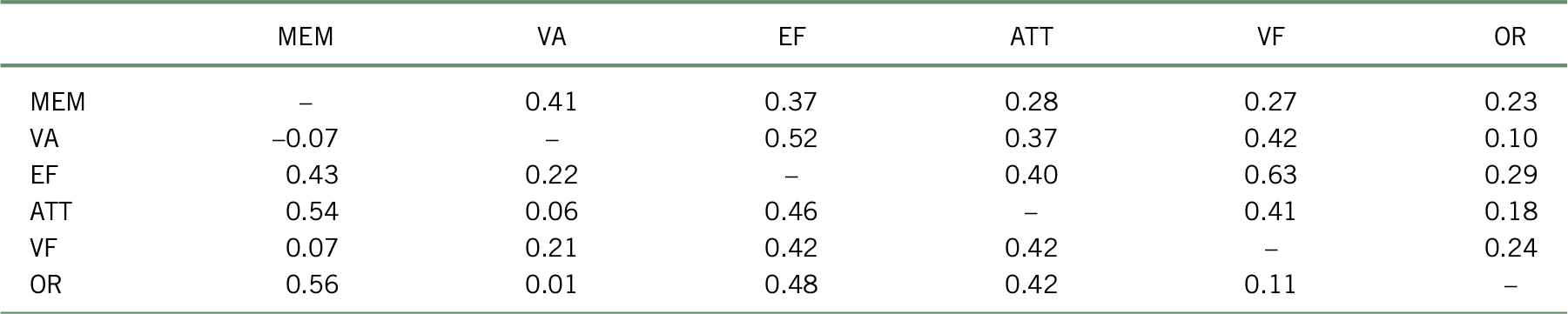
Matrix of Spearman’s rho correlation coefficients between the MoCA domains in MDD and BD during depression

BD: coefficients below diagonal; MDD: coefficients above diagonal; MEM: memory; VA: visuospatial abilities; EF: executive functions; ATT: attention; VF: verbal fluency; OR: orientation.
Cognitive performance after clinical remission
On average, MDD and BD patients achieved remission after 77.43 ± 34.85 days and 84.32 ± 37.84 days, respectively, with no statistically significant difference between the two groups (U = 1195.5, Z = – 0.875, p = 0.382). At the time of clinical remission, the mean MoCA total score in the sample was 25.94 ± 2.60. In patients diagnosed with MDD the mean score was 25.81 ± 2.65, while it was 26.22 ± 2.50 in patients with BD. Therefore, once remitted, patients with MDD remained on average below MoCA threshold of normality, whereas patients with BD achieved normal levels. Anyway, this difference was not statistically significant (U = 1188.0, Z = –0.930, p = 0.353). Analyzing the single cognitive domains of the MoCA, there were no statistically significant differences between the two groups in any cognitive domain: memory (U = 1301.0, Z = – 0.206, p = 0.837), visuospatial skills (U = 1241.5, Z = –0.608, p = 0.543), executive functions (U = 1249.5, Z = –0.611, p = 0.541), attention (U = 1319.0, Z = –0.115, p = 0.908), verbal fluency (U = 1255.5, Z = –0.540, p = 0.589), orientation (U = 1250.0, Z = –0.855, p = 0.393).
Change in cognitive performance between depression and remission
All subjects enrolled in the study showed improvement in overall cognitive performance between depression and remission. There was indeed a statistically significant change in MoCA score both in the group of patients with MDD (Z = −7.326, p < 0.001) and in the group of patients with BD (Z = 3.773, p < 0.001).
Taking into consideration the single MoCA domains separately, in MDD patients there was a statistically significant improvement in the domains of memory (Z = –4.273, p < 0.001), executive functions (Z = –3.431, p = 0.001), and attention (Z = –2.389, p = 0.017), while there was no statistically significant variation in the domains of visuospatial abilities (Z = –0.576, p = 0.564), verbal fluency (Z = –1.531, p = 0.126), and orientation (Z = –0.401, p = 0.688).
Likewise, in BD, there was a statistically significant variation in memory (Z = –3.559, p < 0.001), executive functions (Z = –3.431, p = 0.001), and attention (Z = –2.234, p = 0.020), while no significant changes were found in any other domain: visuospatial abilities (Z = –0.530, p = 0.596), verbal fluency (Z = –1.554, p = 0.120), and orientation (Z = –1.734, p = 0.083).
Correlations between MoCA domains
We calculated the matrix of Spearman’s rho (ρ) correlation coefficients (given the non-parametric distribution of the variables) among the scores of the six MoCA domains, both for MDD and for BD patients (see Table 3).
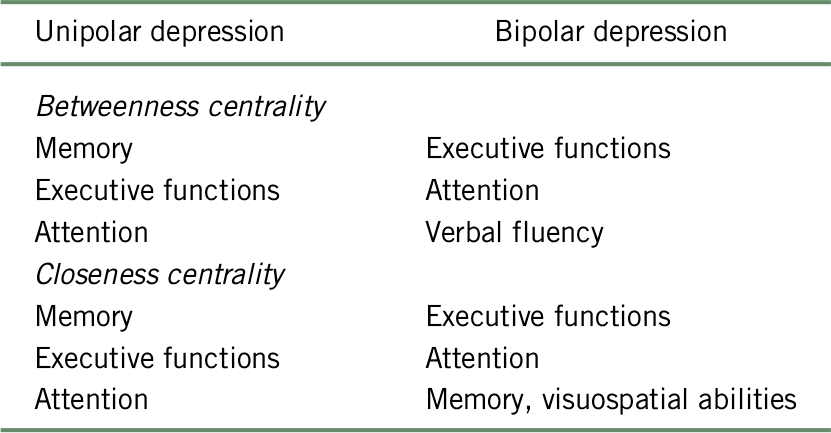
Top three domains with the highest betweenness centrality and closeness centrality in the two groups

In patients with unipolar depression, 11 of the 14 correlation coefficients between cognitive domains were statistically significant. In the bipolar group, a lower proportion of statistically significant correlations emerged compared to unipolar patients (8 out of 15). After transforming MoCA single domains’ score into z scores and calculating Spearman’s ρ correlations between them, no statistical significant differences emerged between the single domains’ correlations in MDD and BD patients.
Network analysis of MoCA domains
As described in the “Methods” section, the matrix of intercorrelations between the domains of the MoCA was used to construct a network graph for unipolar depression and one for bipolar depression. The two graphs are shown in Figures 1 and 2: the six nodes represent the domains of the MoCA, while the edges express the correlation existing between the two domains they connect. The higher the correlation value the thicker the line connecting the nodes. Within the networks, only moderate to strong correlations were expressed (ρ > 0.20).
The unipolar depression network.

The bipolar depression network.

The number of edges differed between the two networks: in fact, there were 13 edges in the network of unipolar depression and 10 in that of bipolar depression.
As previously described, three statistical parameters were calculated for each of the two networks: density, betweenness centrality, and closeness centrality. The so-called network density is mathematically corresponding to the average of the correlation coefficients between the domains. High density can be clinically interpreted as the patients’ tendency to have homogeneous patterns of cognitive impairment, affecting multiple domains at the same time, because if the density is higher, a patient developing deficits in one single domain is more likely to develop deficits in the other domains. In our study, the network of patients with unipolar depression had a higher density (ρ = 0.34 ± 0.13; 95% CI: 0.26–0.41) than the network of patients with bipolar depression (ρ = 0.29 ± 0.12; 95% CI: 0.17–0.41).
In Table 4, cognitive domains with the highest closeness centrality and betweenness centrality are reported. These two metrics can be calculated for each node of the network and, with different meanings, they express the specific role of that node within the network of symptoms.
As described in the section on statistical analysis, closeness centrality is a parameter that expresses the ease with which all the other nodes of a network can be reached from the node examined, that is, the average distance of that node from all the others. The betweenness centrality, on the other hand, expresses the number of times a node is involved in the shortest passage (or shortest path length) between two other nodes. The nodes with a high betweenness are those that facilitate connections within the network, while those with the highest closeness affect the other nodes faster and they are in turn more influenced by the other nodes.Reference Galderisi, Rucci and Kirkpatrick52, Reference Costantini, Epskamp and Borsboom53
In the unipolar depression network, the domain with the highest closeness and betweenness was memory, followed by the domains of executive functions and attention, respectively.
On the other hand, in the network of bipolar depression, the domain of executive functions was the one with the highest closeness and betweenness, followed by attention. Verbal fluency was the third domain for betweenness, while memory and visuospatial skills were third in closeness.
Discussion
To our knowledge, this is the first study investigating the distinctive features of unipolar and bipolar depression from a cognitive perspective, through the application of an innovative statistical approach, such as the network analysis. Until now, research implementing network analysis in psychiatry has mainly focused on the interaction between psychopathological symptoms in mood and anxiety disorders,Reference Cramer, Waldorp and van der Maas56 and more recently on schizophrenia.Reference Galderisi, Rucci and Kirkpatrick52 To date, there are no studies in literature that have applied network analysis to the investigation of cognitive impairment in depression.
Consistently with available literature, the results of our study confirmed that patients suffering from depression, regardless of longitudinal diagnosis, experience mild cognitive impairment. In fact, in our sample, more than one out of two depressed patients presented with cognitive impairment. Confirming the usefulness of MoCA as a screening measure in depression, our result was consistent with epidemiological studies reporting a prevalence of cognitive impairment in MDD around 25%–50%,Reference Gualtieri and Morgan57 even though the real prevalence of cognitive alterations in depression is not fully clarified yet.Reference Douglas, Gallagher and Robinson58, Reference Trivedi and Greer59 In a recent publication, Douglas et al. (2018) found variable prevalences of 14.7%–52.9% and 32.2%–64.4% in outpatients with MDD and BD, respectively, in the depressive phase depending on the applied definition of cognitive impairment,Reference Douglas, Gallagher and Robinson58 and therefore substantially consistent with our epidemiological finding.
The main objective of our study was to highlight the distinctive features of unipolar and bipolar depression from a cognitive perspective, as to date evidence on this topic is scarce and contrasting.
Using classical statistical techniques, we found overlapping patterns of cognitive impairment between patients with MDD and BD, quantitatively in terms of severity and qualitatively in terms of profile of involved domains. This result is consistent with what has been previously reported by several authors: Bearden et al. (2006),Reference Bearden, Glahn and Monkul18 for instance, showed similar patterns of cognitive deficits in unipolar and bipolar patients, which did not appear to depend on the clinical status but rather related to a common pathophysiological genesis, regarding temporal lobe dysfunction; Hermens et al. (2010), analyzing the neurocognitive profile of young unipolar and bipolar patients, observed overlapping alterations primarily linked to verbal memory impairmentReference Hermens, Naismith and Redoblado Hodge15; moreover, Daniel et al. (2013) had shown that performance on neurocognitive tests did not differentiate patients affected by MDD from those suffering from BD-I.Reference Daniel, Montali and Gerra28 Finally, similar neurocognitive alteration patterns have also been reported by Xu et al. (2012)Reference Xu, Lin and Rao27 and, previously, by Sweeney et al. (2000).Reference Sweeney, Kmiec and Kupfer20
One strength of the present study lies in the enrollment of unipolar and bipolar patients during the acute depressive phase, whereas the samples of the aforementioned studies were heterogeneous and constituted by patients in different phases of illness (i.e. depressive/manic and euthymic). Furthermore, compared to the present study, most of the mentioned studies were conducted on smaller samples.
Of note, cognitive assessment is generally obtained through the administration of extensive batteries of neuropsychological tests, while we characterized it by implementing a cognitive screening test of quick and easy administration. Although neuropsychological tests may be preferable in order to perform a more comprehensive analysis of a patient’s cognitive deficits, in our opinion, the results of the present study confirm the usefulness of the MoCA as a screening tool in everyday clinical practice, avoiding the risk of confining cognitive assessment solely to research contexts.
With reference to the main objective of our study, the application of network analysis provided additional information, compared to what has been produced with traditional statistical methods, on the differential cognitive alterations characteristic of unipolar and bipolar depressed patients. In fact, the results of network analysis suggest the existence of distinct cognitive deficits in unipolar versus bipolar depression. Indeed, our findings suggest a wider involvement of the various cognitive domains in patients with MDD compared with BD, expressed by a greater density of the unipolar depression network compared to that of bipolar depression. A network is a dynamic entity that highlights the role of each variable with respect to the others, and in clinical terms a greater density means a greater reciprocal influence of the various domains on each other and the simultaneous presence of multiple deficits in the single patient. Thus, our results suggest that patients with unipolar versus bipolar depression would present a greater predisposition to have a wider range of cognitive deficits, involving multiple domains at the same time. It is important to underline that this result does not represent an estimate of the severity of cognitive impairment: in fact, in patients with unipolar depression, the individual domains could be quantitatively less compromised than in bipolar patients, in which cognitive alterations could be more severe and specific in single isolated domains. Consistent with this result, in a direct comparison study, Taylor Tavares and colleagues (2007) demonstrated a broader spectrum of cognitive impairment in drug-free patients with MDD (including changes in executive functions, set-shifting, and working memory) compared to bipolar patients.Reference Taylor Tavares, Clark and Cannon32 Furthermore, a more recent study indicated that young patients with bipolar II depression had a relatively intact cognitive profile with more isolated and specific deficits compared to patients with unipolar depression.Reference Mak, Lau and Chan33 In addition, network metrics provided additional information regarding the role of each cognitive domain. For instance, it is interesting to note that the three domains with the greatest centrality in the unipolar depression network (memory, attention, and executive functions) are the same domains for which statistically significant differences emerged, compared to healthy controls, in a meta-analysis of 24 clinical trials (784 total patients) conducted by Rock et al. (2014).Reference Rock, Roiser and Riedel60 In particular, in the network of unipolar depression, memory is the cognitive domain with the higher centrality. This means that patients with memory impairment more often present other concomitant cognitive changes and that the dysfunction in memory is the cognitive symptom that plays a “gluing” role with the other deficits in unipolar patients. Otherwise, memory does not seem to play such an important role in BD. This is consistent with the findings of a meta-analysis by Xu et al. (2012), in which, during the depressive phase, patients with MDD and BD-I had greater impairment in visual memory than BD-II patients, but no difference emerged in terms of attention, executive functions, and information-processing speed.Reference Xu, Lin and Rao27 Moreover, in a network-analytic model, where symptoms are considered in their dynamism and the centrality of a symptom is representative of its ability to bring out other symptoms, the fact that memory plays such a central role in MDD may align with the evidence that alterations in memory occur in healthy subjects prior to the development of full-blown depressive symptomatology.Reference Mannie, Barnes and Bristow61 In our networks, executive functions emerged among the cognitive domains with the greatest centrality in both unipolar and bipolar depression, though in the latter they represent the cognitive domain with the highest betweenness centrality. In clinical terms, the centrality of executive dysfunctions underlines the importance that alterations in this specific domain play in determining the global cognitive impairment of a bipolar patient. A possible interpretation, in fact, is that a bipolar patient who manifests alterations in executive functions would be more at risk of presenting other cognitive deficits than a patient presenting with isolated memory deficits. In this specific case, the application of the network analysis allows a deeper knowledge of the “dynamic” role of executive functions with respect to classic psychometrics. In fact, if on one hand there were no statistically significant differences between MDD and BD in terms of alteration of executive functions, the network analysis highlighted the most central role played by this cognitive domain in bipolar patients. Indeed, executive dysfunctions have been repeatedly described as one of the main cognitive impairments in BD,Reference Goswami, Sharma and Khastigir62, Reference Levy, Manove and Weiss63 with similar patterns in BD-I and BD-II,Reference Dickinson, Becerra and Coombes24 and they significantly contribute to the disability associated with the disease. Another difference between MDD and BD emerging from the network analysis regarded the more specific role of verbal fluency in bipolar compared to unipolar depression. This is consistent with literature reporting a moderate dysfunction affecting verbal fluency in bipolar patients.Reference Bora, Yucel and Pantelis64 In fact, there is evidence that the alteration of verbal fluency appears in the early stages of BD and worsens with the progression of mood episodes in BD,Reference Lee, Hermens and Scott65 but not in MDD. Still, from network analysis the relevance of attention in both types of depression emerged. In fact, attention deficit has been repeatedly described in MDD and BD, both during the first episodes of illnessReference Lee, Hermens and Porter29 and in remission.Reference Clark and Sahakian66 Our sample did not present a significant alteration in the domain of attention; however, attention is a moderator of performance in each cognitive test, and this could further explain its central role in the networks. Finally, the domains of orientation and visuospatial skills were the most peripheral in both networks. Clinically, therefore, alterations in these domains would emerge only secondarily to alterations in other domains: they would have weak influence on other cognitive functions and would not represent useful markers in order to distinguish bipolar from unipolar depression.
Of note, in this study, we evaluated cognitive performance at two time-points: during acute depression and at remission. With regard to the course of cognitive impairment between these two phases, we found a significant improvement of cognitive function in both unipolar and bipolar patients. Anyway, at remission, the mean MoCA score for MDD patients was just above the threshold of normality, while it was just below it for BD patients, even though such difference was not statistically significant. It is known that in MDD the improvement of cognitive function does not proportionally correspond to the improvement of psychopathological symptoms. For this reason, remitted patients often present with residual cognitive symptoms beyond the single mood episode during euthymia. Moreover, in a previous study by our group,Reference Palazzo, Arici and Cremaschi67 we reported the presence of specific cognitive deficits in adult euthymic patients with BD-I and BD-II. In this perspective, the borderline MoCA scores at the time of remission (which was defined on the basis of the HDRS and HARS scores) might depend on the relatively unstable clinical condition patients were at the time of evaluation and might reflect the tendency of cognitive symptoms to recover slower than affective symptoms after an MDE.
Reported findings need to be interpreted in light of the following methodological limitations: first of all, the enrollment of a control group would have allowed for the comparison of the cognitive performance of BD and MDD patients with that of healthy controls. Second, there were different treatment patterns between the two groups, due to the naturalistic environment in which the study was conducted. Third, the sample size was relatively limited, in particular with regard to reproducibility of network analysis. For this reasons, further clinical trials on selected drug-free populations are warranted to confirm the evidence emerging from our study.
Conclusion
In conclusion, during depressive episodes, patients with MDD and BD have similar patterns of cognitive impairment in terms of severity and cognitive domains involved, particularly regarding executive functions and memory. However, the application of the innovative approach of network analysis has allowed us to identify some distinctive features between unipolar and bipolar depression: in particular, memory deficits seem to have a more specific role in unipolar depression, whereas executive functions are altered in both subtypes of mood disorders, though with a more prominent role in bipolar depression. Furthermore, attention plays the role of moderator of cognitive function in both MDD and BD, and can therefore be interpreted as a state variable associated with depression itself, rather than a trait variable peculiar of one single mood disorder.
Funding
The present study was not funded by any institution or company.
Disclosures
Prof. Dell’Osso has received speaker fees from Lundbeck, Angelini, and FB Health. All other authors declare no conflict of interests.