The benefits of cochlear implantation for improving the reading outcomes of profoundly deaf children have been supported by a number of studies. For example, several research reports have shown that the reading comprehension levels of deaf children who use cochlear implants (CIs) are within 1 SD of hearing norms (Geers, Reference Geers2003; Spencer, Brittan, & Tomblin, Reference Spencer, Brittan and Tomblin2003; Spencer, Gantz, & Knutson, Reference Spencer, Gantz and Knutson2004). This is in stark comparison to prior research from hearing aid users, which consistently has shown average reading attainment levels of around 9 years for deaf adolescents at the end of compulsory education (Allen, Reference Allen, Schildroth and Karchmer1986; Conrad, Reference Conrad1979; Marschark & Harris, Reference Marschark, Harris, Cornoldi and Oakhill1996). The ways in which cochlear implantation might enhance reading for profoundly deaf children are less well understood. In hearing children, phonological awareness (PA), the ability to identify and manipulate speech sounds, is known to play an important causal role in the development of reading (Ehri, Reference Ehri, Grough, Ehri and Treiman1992; Frith, Reference Frith, Patterson, Coltheart and Marshall1985; Goswami & Bryant, Reference Goswami and Bryant1990; Hatcher et al., Reference Hatcher, Hulme, Miles, Carroll, Hatcher and Gibbs2006; Hatcher, Hulme, & Ellis, Reference Hatcher, Hulme and Ellis1994). A reasonable assumption, therefore, is that a cochlear implant enhances reading development because it enables enhanced auditory speech perception (Meyer, Svirsky, Kirk, & Miyamoto, Reference Meyer, Svirsky, Kirk and Miyamoto1998), thereby facilitating the development of robust PA.
Prior to the advent of cochlear implantation, PA was assumed to be absent or partial in deaf children. One source of evidence was the apparent reliance of deaf children on orthographic knowledge to make phonological judgments (Conrad, Reference Conrad1979). Hearing aided deaf children have been found to recruit orthographic knowledge during tasks that tap into the most accessible levels of PA, namely, syllable and rhyme levels (Campbell & Wright, Reference Campbell and Wright1988; Sterne & Goswami, Reference Sterne and Goswami2000; Transler, Leybaert, & Gombert, Reference Transler, Leybaert and Gombert1999). The recruitment of spelling knowledge takes place even when the stimuli used in the experiments are pictures. For example, Campbell and Wright showed that deaf adolescents were more likely than younger reading level (RL)-matched hearing control children to judge that the picture pair bomb and comb rhymed. Orthography did affect the judgments made by the hearing children, but significantly less strongly than for the deaf children. Sterne and Goswami (Reference Sterne and Goswami2000) showed that both deaf and hearing children were more likely to make correct yes/no judgments about whether picture pairs shared the number of syllables when the orthography of the pair matched the syllable length (e.g., as in the pair leaf and tail [“yes” judgment] or the pair caterpillar and toast [“no” judgment]). Leybaert (Reference Leybaert, Marschark and Clarke1993) has suggested that deaf children's reliance on orthographic knowledge during phonological tasks would diminish if their underlying phonological representations were enhanced. It seems plausible that CIs should enable such enhancement. We therefore set out to explore the influence of orthographic knowledge on the development of PA by deaf children with CIs.
In hearing children, the critical skills of word decoding are known to depend on the development of PA (Foy & Mann, Reference Foy and Mann2006). In our previous report on the development of PA in CI users, we found that CI users did develop syllable and rhyme awareness, and that these levels of awareness developed prior to phoneme awareness (James et al., Reference James, Rajput, Brown, Sirimanna, Brinton and Goswami2005). This sequence of development followed the developmental pattern reported for hearing children (Carroll, Snowling, Hulme, & Stevenson, Reference Carroll, Snowling, Hulme and Stevenson2003; Fowler, Reference Fowler, Brady and Shankweiler1991; Goswami & Bryant, Reference Goswami and Bryant1990). In hearing children, PA is hypothesized to develop as a consequence of lexical restructuring processes intrinsic to spoken language development (e.g., Metsala & Walley Reference Metsala, Walley, Metsala and Ehri1998). In deaf children, interactions with orthography as they learn to read may also play an additional and important role. Both spoken language development and orthographic knowledge may influence PA in predictable ways, depending on the “grain size” of the phonological unit (syllable, rhyme, or phoneme; Ziegler & Goswami, Reference Ziegler and Goswami2005), for both hearing and deaf children.
LEXICAL RESTRUCTURING AND THE DEVELOPMENT OF PA
According to some theories, the ability to succeed in PA tasks at different grain sizes is related to the representational status of words in the mental lexicon (Fowler, Reference Fowler, Brady and Shankweiler1991; Metsala & Walley, Reference Metsala, Walley, Metsala and Ehri1998; Swan & Goswami, Reference Swan and Goswami1997; Ziegler & Goswami, Reference Ziegler and Goswami2005). For example, according to the lexical restructuring model (LRM; Metsala & Walley, Reference Metsala, Walley, Metsala and Ehri1998) the development of well-specified phonological representations is a byproduct of increases in receptive vocabulary size. Early in development, phonological entries in the mental lexicon are proposed to code fairly global phonological characteristics, such as syllable number and intonation contour. As more and more words are acquired, these global features are thought to become insufficient for distinguishing between the increasing number of similar-sounding words, necessitating the development of phonemic-based representation. According to the LRM, receptive vocabulary growth drives lexical units toward phonemic representations. Consistent with LRM, Metsala (Reference Metsala1999) found that 3- to 4-year-old children performed better in a phoneme blending task with target words from dense neighborhoods. She also reported that older children showed neighborhood density effects in a speech gating task, requiring less information to recognize words from dense neighborhoods (Metsala, Reference Metsala1997). Hence, words from denser neighborhoods appear to have better specified phonological representations.
Ziegler and Goswami (Reference Ziegler and Goswami2005) suggested that words in the mental lexicon were represented at different phonological “grain sizes” during development: syllable, rhyme, and phoneme. The dominant grain sizes early in development were the larger grain sizes, corresponding to the linguistic units of syllable and onset/rime. In their psycholinguistic grain size theory, Ziegler and Goswami (Reference Ziegler and Goswami2005) argued that it was necessary to add the concept of grain size to the LRM. They proposed that phonemic representation emerged largely as a consequence of the orthographic learning required to read an alphabetic script. According to their psycholinguistic grain size theory, as more and more vocabulary items are acquired, the number of similar sounding words (neighborhood density) for a particular lexical entry increases, and this phonological similarity is one developmental driver for the representation of the larger grain sizes of syllable and rime. This effect of neighborhood density might be predicted to be particularly evident in onset/rime tasks, because it has been found that in spoken English at least, the majority of phonological neighbors (similar-sounding words) are in the same neighborhood because they rhyme (De Cara & Goswami, Reference De Cara and Goswami2002). According to Ziegler and Goswami (Reference Ziegler and Goswami2005), the preliterate brain may thus depend on phonological similarity in terms of onsets, vowels, and codas for lexical restructuring. The literate brain may develop fully specified phonemic representations as a consequence of orthographic learning. According to Ziegler and Goswami's theory, orthographic learning becomes a mechanism for the development of PA at the phonemic level. In hearing children who are literate, orthographic information has been found to be recruited automatically during phoneme awareness tests (Castles, Homes, Neath, & Kinoshita, Reference Castles, Homes, Neath and Kinoshita2003).
ORTHOGRAPHY AS A MECHANISM FOR DEVELOPING PA IN CI USERS
Demonstrations that hearing children use orthography when making phonemic judgments suggests that deaf children are also likely to use orthographic knowledge to learn about phonemes. CI users certainly show age-appropriate orthographic learning. Vermeulen, van Bon, Schreuder, Knoors, and Snik (Reference Vermeulen, Bon, Schreuder, Knoors and Snik2007) found that children with CIs (N = 50, mean age = 12 years, 9 months [12;9]) performed at a level equivalent to a normative sample of age-matched hearing children on a simple lexical decision test (distinguishing words from legal nonwords). There is also evidence for orthographic learning from the studies conducted by Geers (Reference Geers2003). She gave a large sample (N = 181) of 8- to 9-year-old children using implants a rhyme judgment task that used written words rather than pictures as stimuli. The written word pairs were of four kinds: similar spelling, no rhyme (men/man); dissimilar spelling, rhyme (word/bird); dissimilar spelling, no rhyme (big/school); and similar spelling, rhyme (year/dear). Geers reported that the participants made up to three times more errors for dissimilar rhyme spellings (word/bird) compared to pairs like big/school and year/dear, and that they made twice the number of errors on word/bird trials compared to pairs like men/man. This pattern of results suggests that phonological processing was weak in the CI users because they were relying on orthographic knowledge to make rhyme judgments. This pattern is essentially similar to that reported for deaf children who used hearing aids by Campbell and Wright (Reference Campbell and Wright1988). Taken together, these data suggest that orthographic processing is an area of relative strength in CI users. Therefore, orthographic processing might support phonologically based processing to an even greater extent in deaf children than in hearing children. Accordingly, both orthographic learning and receptive vocabulary development (which hypothetically would lead to lexical restructuring via increased phonological neighborhood density) should affect the development of PA in deaf CI users. In turn, this enhanced PA should affect their reading development.
LANGUAGE DEVELOPMENT AND PHONOLOGICAL DEVELOPMENT IN CI USERS
Alternatively, given the research findings of a strong association between language and reading in CI users, improved language outcomes might in themselves enhance reading in CI users. Rather than acting indirectly through increased vocabulary size and enhanced PA, improved language outcomes might lead to a concomitant rise in RLs via a direct language-literacy route, such as that described for hearing children by Dickinson, McCabe, Anastasopoulos, Peisner-Feinberg, and Poe (Reference Dickinson, McCabe, Anastasopoulos, Peisner-Feinberg and Poe2003). Receptive language, whether measured at the word, sentence, or discourse level, is always reported to be significantly and strongly associated with reading comprehension in deaf children (Boothroyd & Boothroyd-Turner, Reference Boothroyd and Boothroyd-Turner2002; Connor & Zwolan, Reference Connor and Zwolan2004; Crosson & Geers, Reference Crosson and Geers2001; Geers, Reference Geers2003; Tomblin, Spencer, & Gantz, Reference Tomblin, Spencer and Gantz2000). In addition, some studies with CI users who were educated in mainstream public schools with sign-language interpreters also reported enhanced reading outcomes. Spencer and her colleagues (Spencer et al., Reference Spencer, Gantz and Knutson2004) reported the results of a retrospective study of speech, literacy, and vocational outcomes for 27 adolescents and young adults who had received an implant during childhood. The results were reported from the time when the young people were in the 10th grade and beyond. Spencer and colleagues' data showed that for these 27 CI users, reading outcomes at the end of compulsory education were equivalent to standardized norms for hearing children (both the median result and the spread of scores). For example, the median standard score on a hearing test of reading comprehension (Woodcock) for the whole group was 89 ± 17, and the median standard score of the 24 adolescents who were defined as consistent users of their implants was 99 ± 17. The normalization of variation is particularly noteworthy given the characteristically wide variation that is known to exist in populations of deaf children, including those who use CIs. Although we only have correlational evidence at this point, these data suggest that language per se, and not just phonological sensitivity for spoken language, might have a direct and positive relationship with literacy in children who are deaf. Deaf children might use other aspects of language to support reading in a compensatory fashion, and PA might not, in fact, predict reading in deaf samples.
CONTRIBUTIONS OF NONVERBAL ABILITY TO READING DEVELOPMENT IN CI USERS
A final point to consider is the potential role that nonverbal IQ might have in the development of speech, language, and literacy in children with CIs. Geers and colleagues (Geers, Reference Geers2002, Reference Geers2003; Geers et al., Reference Geers, Brenner, Nicholas, Uchanski, Tye-Murray and Tobey2002) showed that nonverbal IQ made a significant contribution to the variance in speech perception, speech production, spoken language, and reading in children with CIs. In fact, for each of these outcome measures, nonverbal IQ showed a larger standardized coefficient than other family variables such as socioeconomic status (ranging from 0.34 for reading to 0.20 for spoken language; Geers, Reference Geers2002). In relation to reading, Geers (Reference Geers2003) found that child and family characteristics including the child's nonverbal IQ accounted for 25% of unique variance in reading (word attack and comprehension). Only overall language ability (45% of unique variance) and phonological processing (26% of unique variance, but based on written tasks) accounted for more reading variance. Yet many studies with CI users (including the study by Vermeulen and colleagues, Reference Vermeulen, Bon, Schreuder, Knoors and Snik2007) either do not report or do not control for participants' nonverbal IQ levels. As we have argued before, it is crucial to consider potential interactions with nonverbal cognitive ability when assessing language outcomes in children with CIs (James, Rajput, Brinton, & Goswami, Reference James, Rajput, Brinton and Goswami2008). Speech perception and language abilities may interact with nonverbal ability. For example, when Geers (Reference Geers2002) held nonverbal IQ constant in her study, the age of implant did not account for a significant proportion of the variance in speech perception, speech production, spoken language, or reading outcomes. For typically developing children without reading difficulties, there is a known association between nonverbal IQ and reading (Pammer & Kevan, Reference Pammer and Kevan2007). Of interest, Geers (Reference Geers2003) also reported that communication mode did not make a substantial contribution to reading variance after demographic characteristics (which included nonverbal IQ) were accounted for. Yet, whether a child uses sign-based communication or oral communication has often been the focus of inquiry with respect to language and literacy development in deaf children (Miller, Reference Miller1997). It is possible that nonverbal IQ may be more worthy of researchers' attention.
THE PRESENT STUDY
In the present study, we set out to explore the roles of vocabulary and orthography in the development of PA by CI users. In hearing children, orthography has mainly been shown to influence the development of PA at the phonemic level (although see Goswami, Ziegler, & Richardson, Reference Goswami, Ziegler and Richardson2005, for a study demonstrating effects at the rime level). In deaf children, however, the inquiry has to extend back into the earliest levels of phonological development. We therefore designed tasks to assess the influence of orthographic knowledge at each phonological grain size, syllable, rime, and phoneme. Each task had trials based on words that were orthographically congruent (e.g., sock/clock) versus trials that were based on words that were orthographically incongruent (e.g., hair/pear). The tasks were similar with respect to the cognitive operation required by the child, which was matching to sample. Because our primary group of interest was the children with CIs, the tasks had to be as simple as possible to avoid floor effects. Nevertheless, this raised the possibility of finding ceiling effects in the hearing children. We gave the same tasks to typically developing hearing children, matched either for age to the CI users, or for RL (hence, this group was younger than the CI children). The age-matched group had similar levels of literacy instruction and exposure to print as the CI group, whereas the RL-matched group had less exposure. The RL-matched group had developed similar levels of real word reading to the CI users; nevertheless, it should be noted that the CI children had less well-developed vocabularies than these younger typically developing children.
If PA depends on vocabulary development, in accordance with the proposals made by the lexical restructuring theories, then the significantly lower language abilities of the deaf children should also mean significantly lower levels of PA. CI users would hence be predicted to show poorer PA than both typically developing groups, at all grain sizes, because of their impoverished vocabulary. If PA depends on orthographic knowledge in CI users, then we should find an orthographic effect at all grain sizes (i.e., no interaction between orthographic congruency and PA level). In contrast, hearing children might be expected to show such an interaction, because the orthographic congruency of trials might only impact on phoneme judgments. With regard to predictors of reading, we set out to use regression models to explore the possibility that PA is a significant predictor of word reading variance in deaf children using CIs. Given the research linking oral language and reading, particularly in deaf children, it was essential to include vocabulary development and nonverbal IQ as copredictors of reading in the regression models. If deaf children rely only on a direct language link for reading, then PA should not predict a significant proportion of variance in word reading in deaf children. In contrast, we might expect to find both PA and oral language to be significant predictors in hearing children.
METHOD
Participants
The sample of CI users was identified by applying a set of inclusion criteria to the entire population of children implanted at two centers in the United Kingdom (Great Ormond Street Hospital and the South of England Cochlear Implant Centre). Children were selected if (a) they had a congenital hearing impairment, (b) they were considered to have general learning abilities within the normal range by the specialist clinicians in the implant centers, (c) they were monolingual in spoken English or bilingual in spoken English and British Sign Language, (d) they were rated as good users of their CI (see Archbold, O'Donoghue, & Nikolopoulos, Reference Archbold, O'Donoghue and Nikolopoulos1998), (e) they had been using their CI for at least 3 years, and (f) they were fitted with a CI during early childhood (not later than age 7). A total of 36 children in the two implant centers met the entry criteria. We sent information about the study and consent forms to the parents/carers of all these children. Twenty-one parents/carers provided written consent for their children to be included in the study. One participant was later excluded from the study because results from a nonverbal reasoning assessment (British Ability Scales [BAS] Matrices; Elliott, Reference Elliott1996) indicated that nonverbal reasoning was more than 2 SD below the mean. Testing of a further participant was delayed because he was too young to participate in testing. Nineteen children fitted with CIs participated in the study. All the CI users had the Nucleus-22 CI with an ESPrit-22 speech processor and were using the same speech encoder strategy (SPEAK). Eleven of the CI users used oral communication in their educational placements and 8 used manual-based communication. All of the children had unaided pure tone audiometric results characteristic of profound hearing impairment (M = 114.4 dB HL, range = 97.5–125 dB HL). All of the participants used hearing aids prior to CI fitting. The average age of diagnosis was 10 months (SD = 6 months). The average age of implant fitting (i.e., the date on which the external components of the implant became operational) was 4;7 (SD = 1;7). The average duration of CI use at the start of the study was 3;8 (SD = 3;5).
Two groups of hearing children were recruited from a school in southeast London. The school was chosen on the basis of convenience for data collection. A group was matched to the CI group on chronological age (CA comparisons). A second group of hearing children was matched to the CI group on RL (RL comparisons). The children in the RL comparison group were matched to the CI users on the basis of word reading ability using the Word Reading Test from the BAS (Elliott, Reference Elliott1996). Each CI user had a yoked hearing control with a similar reading age. Similar was deemed to be an age equivalent score that was ±3 months. All the hearing children met the following criteria: (a) they had word reading skills within the normal range, standard scores were not more than 1 SD above or below the mean, (b) they had no known history of special needs, and (c) they had no known history of hearing impairment. In line with school policy, parents and carers were informed in writing about the study via the school. Parents and carers were asked to inform the school if they did not wish their child to be included in the study. One parent did not wish her child to be included in the study for medical reasons associated with an early history of fluctuating hearing impairment.
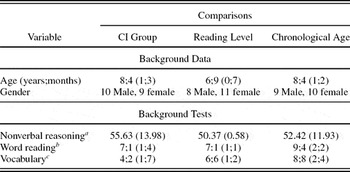
Three standardized assessments were administered to test: (a) nonverbal reasoning, for which we used the BAS Matrices Test (Elliott, Reference Elliott1996); (b) reading, for which we used the BAS Word Reading Test (Elliott, Reference Elliott1996); and (c) knowledge of vocabulary, for which we used the British Picture Vocabulary Scales (BPVS; Dunn & Dunn, Reference Dunn and Dunn1982). The results of these tests together with background variables on the three groups are in Table 1.
Background details and standard measures at Time 1

Note: CI, cochlear implant. There were 19 participants in each group. All participants completed all of the background tests.
aNonverbal reasoning standard score is reported, and the mean is 50.
bWord reading age equivalent score is reported.
cVocabulary age equivalent score is reported, which is derived from the raw score.
All groups had nonverbal reasoning scores that fell within the normal range (mean score = 50, SD = 10). With an α level of .05, there were no statistically significant differences in nonverbal reasoning between the CI group and either of the comparison groups.
Procedure
Testing of all the participants was conducted in a quiet room at the child's school, apart from a few cases where it was not possible to visit the CI users at school. Here testing was conducted at the child's home. Every child completed four sessions in total over 2 consecutive days. There were two testing sessions a day. One session was conducted in the morning and one session was conducted in the afternoon. The duration of each session was between 30 and 40 min. The first session was used to administer the standardized assessments of reading, vocabulary knowledge and nonverbal reasoning. Each of the three experimental tasks (syllable, rhyme, and phoneme awareness) was completed in separate sessions. The order of administration of the tests of PA was counterbalanced (i.e., some children had the phoneme test first, then the syllable test, then the rhyme test, others had the rhyme test first, then the syllable test then the phoneme test, etc.).
Experimental tests of PA
Three tests of PA were designed for this study (syllable, rhyme, and phoneme). Full information on the tests is given in James et al. (Reference James, Rajput, Brown, Sirimanna, Brinton and Goswami2005). A matching to sample design was used for all three tests to keep the cognitive demands equivalent. To avoid a possible confound attributable to impoverished vocabulary knowledge, all items used in the tests were highly familiar and thought to be acquired within the first 3 years of childhood. We acquired our own data on the age at which a child born deaf might be likely to acquire the items used in the tests (cues and targets). Twenty adults who were familiar with the language development of deaf children were asked to rate all the items (cues and targets) in the PA tests. Ten of the adult raters were themselves deaf and the remaining were hearing people working in the field of deaf education. The age of acquisition rating was done on a 7-point scale ranging from 1 (0–2 years old) to 7 (age 13 and older). Intermediate points on the scale were identified with 2-year age bands. The tasks were designed to investigate the contribution of orthographic knowledge on phonological judgments, by contrasting orthographically congruent trials with orthographically incongruent trials. A sample of trials from the syllable, rhyme, and phoneme tests are in Appendix A. Details of the psycholinguistic properties of age of acquisition and neighborhood density of the cue and target items for each test are given in Appendix B. The tasks were presented on a laptop computer. All items were presented as simple black and white line drawings. The written word corresponding to the items was never presented.
Each test of PA consisted of six components: a receptive vocabulary check, a naming test, familiarization of phonological concept, training trials, computer training trials, and the experimental trials. The components were administered in this fixed order. For example, as part of the familiarization process for rhyme, the children were told We are going to think about words and we are going to think about how words sound. I know that you are deaf and it's difficult for you to think about sounds, but I want us to try. My name is Deborah. This is my favourite animal (a picture of a zebra was placed in front of the child). It's a zebra. Deborah (pause) zebra. Why do you think I like the zebra? Responses that were linked to the sounds of the two words were reinforced. For example, if the child said that the words sounded the same or that they rhymed then the experimenter said, Yes, you're right, Deborah and zebra sound the same at the end. If a child reasoned that the experimenter liked the zebra because of some semantic attribute of the animal, for instance, because it was stripy, then the experimenter said, Yes zebras are stripy, but remember we are thinking about the way words sound, listen again to the words Deborah (pause) zebra, why do you think I love the zebra? If a child was still unable to make a judgment based on the sounds of the two words the experimenter repeated the two words. The onsets were never segmented from the rime. Emphasis was given to the rime unit by prolonged production of the vowel. Further information on the six components of the PA tests is given in Appendix C.
The first named author carried out all testing. In the case of the deaf children, instructions were given in the child's preferred communication mode (i.e., oral communication or sign-based communication). The first author is proficient in British Sign Language and a practicing Speech and Language Therapist and is trained in the delivery of psychometric assessments with special populations. Before an experimental test was administered all participants were reminded of the need for speed and accuracy. During the experimental trials some children sought approval of their choice from the experimenter. Noncontingent feedback was given. The child received no indication of whether the choice was correct or incorrect.
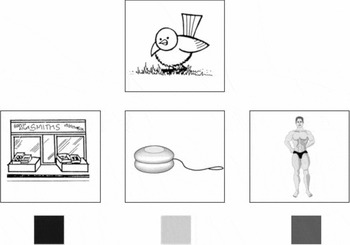
Syllable test. This test assessed awareness of syllable number. Children were asked to choose the picture that was the same length as the cue picture from three alternatives. It consisted of 27 trials in total. Each trial comprised four line drawings (a cue, a target, and two distracters; see Figure 1). The cue was presented first at the top of the computer screen. Then the target and the two distracters appeared in a left to right sequence underneath the cue. All four pictures remained on the screen until the participant made a choice. To reinforce the vocabulary pretest and remind the child of the intended lexical forms, the experimenter named the pictures as they appeared on the screen. This precluded the possibility that the child might make a judgment using unintended labels (e.g., birdie/market for the target pair bird/shop). The trials were presented in random order. The position of the target item was counterbalanced across the three serial positions. The test consisted of nine monosyllabic cues, nine disyllabic cues, and nine trisyllabic cues. Care was taken to ensure that on the di- and trisyllabic trials the target item was not always an object that could be considered conceptually the longest or biggest item of the three choices. The possible use of orthographic knowledge during this task was controlled by making sure that in one-third of the trials all of the pictures represented objects whose written form had the same number of letters. For example, a monosyllabic trial might comprise the four pictures: a torch (cue); a nurse (target); and two distracters, a camel and a tiger. On this trial orthographic knowledge could not lead to a correct judgment, because all the words had the same number of letters. Trials like this are referred to as orthographically incongruent (O−), because the orthographic form is incongruous with the phonological judgment. In the remaining 18 trials, orthographic knowledge could have led to a correct judgment. These trials are referred to as orthographically congruent (O+). The internal reliability of this test is good (Cronbach α = .89).
A trial from the syllable test. Trial items are bird, shop, yoyo, and body. Participants made their selection by pressing a color coded key on a button box. In this example, the participant had to choose the item that had the same number of syllables as the item at the top of the screen (i.e., bird). The correct choice in this trial was shop.

Rhyme test. This test consisted of 24 trials. Children were asked to choose the picture that rhymed with the cue picture from three alternatives. The presentation of the trials was the same as that already outlined for the syllable test. It should be noted that all word pairs rhymed in British English (see English rhyme database published by DeCara & Goswami, Reference De Cara and Goswami2002). To examine the effect of orthographic knowledge, we manipulated the similarity of the rime spelling of the cue and target items. For example, in an orthographically incongruent trial, a picture of a key might be the cue, a picture of the sea would be the target, and the two distracters pictures could be farm and king. If a child relied on knowledge of the shared letters in the words rather than awareness of the shared rime sound, then performance on trials like this should be at chance level. There were an equal number of orthographically congruent and incongruent trials in the rhyme test. The internal reliability of this test is good (Cronbach α = .94).
Phoneme test. This test probed awareness of phonemes in the word initial position. Children were asked to choose the picture that began with the same sound as the cue picture. There were 28 trials in total. Trial presentation was the same as that described above for the syllable and rhyme tests. In half of the trials the cues had singleton onsets (as in cough and ladder) and in the other half the cues had clustered onsets (as in skirt, queen, and star). To control for the use of orthographic knowledge, the similarity of the spelling of the initial phoneme was manipulated. In half of the trials the spelling of the initial phoneme of the target and cue was different (as in the pair queen/cot). These are the orthographically incongruent trials (O−). In the remaining trials the spelling of the initial phoneme was the same (as in the pair finger/fox). These are designated orthographically congruent trials (O+). The internal reliability of this test is good (Cronbach α = .92).
RESULTS
Descriptive statistics: Group performance
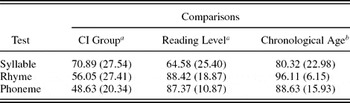
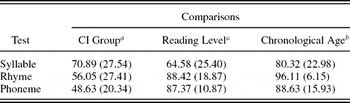
The means and standard deviations for the syllable, rhyme, and phoneme tests for all three groups are given in Table 2. All group means were above 33% for all three tests (i.e., the score that could be achieved by guessing). All group means were significantly above chance with the exception of the phoneme test score for the deaf group. Hence, both hearing comparison groups were significantly above chance on all three tests, whereas the CI group performed at a level significantly above chance on the syllable and rhyme tests only. It is interesting to note that, despite the RL match, PA was better in the younger RL-matched group than the CI users at the smaller grain sizes of rime and phoneme. As will be recalled, this younger hearing group also had significantly better receptive language skills than the older deaf group. Histograms and boxplots were generated for each PA test by group. There were no outlying scores in the CI group. In this group the distribution of scores across the tasks was relatively normal, with a slight negative skew on the syllable test. In the hearing comparison groups, the distribution of scores was negatively skewed on the rhyme and phoneme tests. The median correct score ranged from 93% to 100% in both hearing comparison groups for the rhyme and phoneme tests, indicating ceiling level performance in some cases.
Mean (standard deviation) percentage of correct scores on the experimental
Note: CI, cochlear implant. There were 19 participants in each group. All parti-cipants completed all of the experimental tests.
aReading age = 7 years, 1 month (7;1).
bReading age = 9;4.
Comparison of group performance
Because of the nonnormal distributions of the data in the hearing comparison groups, a series of nonparametric Mann–Whitney U tests were conducted to compute the significance of the group differences on the three PA tasks. A total of six tests were computed, so the associated significance level was set at .008. Comparing the CI group to the RL comparison group, there was no significant difference on the syllable test (z = −1.024; ns), a significant difference on the rhyme test (z = −3.927; p < .001, two tailed), and a significant difference on the phoneme test (z = −4.878; p < .001, two tailed). The comparisons with the CA group showed no significant difference on the syllable test (z = −.939; ns), a significant difference on the rhyme test (z = −4.942; p < .001, two tailed), and a significant difference on the phoneme test (z = −4.776; p < .001, two tailed). Aside from the planned comparisons between the CI users and hearing groups, comparisons between the two hearing groups showed that the only difference to reach conventional significance level (α = .05) was on the syllable test (z = −2.286; p < .05, two tailed). The performance of the older hearing children in the CA group was higher than the performance of the RL group.
Orthographic effect on PA
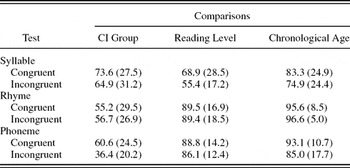
The mean performance levels of each group for the orthographically incongruent trials and the congruent trials are shown in Table 3 for each linguistic level, expressed as a percentage of total trials of that type. Again, all group means were significantly above chance level (33%), with the exception of the CI group for the incongruent phoneme trials.
Mean (standard deviation) performance on congruent and incongruent trials expressed as a percentage of correct scores for total trials

Note: CI, cochlear implant. Congruent trials are those where orthographic knowledge can be used to aid judgement (e.g., knowing cat and fat rhyme), and incongruent trials are those where orthographic knowledge cannot be used to aid judgement (e.g., knowing knee and night have the same initial phoneme).
Repeated measures analysis of variance (ANOVA)
The patterns of variance in the experimental tasks differed. This was due to the near ceiling performance on the rhyme and phoneme tasks in the two hearing groups. This difference in variance was significant, and meant that the assumptions required for computing a single mixed ANOVA were not met. Therefore, the effect of orthography on PA was explored separately for each group using repeated measures ANOVA with two within subjects variables (2 × 3, orthography; congruent or incongruent and linguistic level; syllable, rhyme, phoneme).
CI group. There was a significant main effect of whether a trial was orthographically congruent or incongruent, F (1, 18) = 25.27, p < .001, η 2 = .58. Performance on the orthographically congruent trials was significantly higher than performance on the orthographically incongruent trials. There was also a significant main effect of the type of PA task on performance, F (2, 36) = 7.36, p < .01, η 2 = .29. Pairwise comparisons, adjusted for multiple comparisons using the Bonferroni correction showed that there was a significant difference between performance on the syllable task and the phoneme task. There was a significant interaction between orthographic congruency and PA task, F (2, 36) = 11.02, p < .001, η 2 = .38. This indicates that orthographic congruency had a different effect on PA judgments depending on the linguistic level of the PA task. To break this interaction down pairwise comparisons were conducted using paired t tests. The alpha value was adjusted for multiple tests according to the Bonferroni correction and set at .02. These revealed that the effect of orthographic congruency was not significant on the syllable task (t = 2.233, p < .05) or the rhyme task (t = −0.463, p = .65). There was a highly significant effect of orthography on the phoneme task (t = 5.664, p = .000).
RL comparison group. There was a significant main effect of whether a trial was orthographically congruent or incongruent, F (1, 18) = 6.04, p < .05, η 2 = .25. Performance on the orthographically congruent trials was significantly higher than performance on the orthographically incongruent trials. There was also a significant main effect of the type of PA task on performance, F (2, 36) = 21.06, p < .001, η 2 = .54. Pairwise comparisons, adjusted for multiple comparisons using the Bonferroni correction showed that there were significant differences in performance between the syllable task and the rhyme task and between the syllable task and the phoneme task. Performance on the syllable task was significantly lower than performance on both the rhyme and phoneme tests in this group. There was a significant interaction between orthographic congruency and PA task, F (2, 36) = 3.54, p < .05, η 2 = .16. This indicates that orthographic congruency had a different effect on PA judgments depending on the linguistic level of the PA task. To break this interaction down pairwise comparisons were conducted using paired t tests. Alpha was adjusted for multiple tests according to the Bonferroni correction and set at .02. These revealed that the effect of orthographic congruency was significant on the syllable task (t = 2.549, p < .02), but not on the rhyme task (t = .028, p = .98) or the phoneme task (t = .791, p = .44).
CA-matched group. There was a significant main effect of whether a trial was orthographically congruent or incongruent, F (1, 18) = 7.24, p < .05, η 2 = .29. Performance on the orthographically congruent trials was significantly higher than performance on the orthographically incongruent trials. There was also a significant main effect of the type of PA task on performance, F (2, 36) = 10.78, p < .001, η 2 = .37. Pairwise comparisons, adjusted for multiple comparisons using the Bonferroni correction, showed that there was a significant difference between performance on the syllable task and the rhyme task (performance was lower on the syllable task) and between the syllable task and the phoneme task (performance was lower on the syllable task). There was no significant interaction between orthographic congruency and PA task, F (2, 36) = 2.96, ns, η 2 = .14. This indicates that orthographic congruency had a similar effect on PA judgments regardless of the grain size, despite the apparent trend in the syllable and phoneme tasks.
In summary the data from all three groups showed main effects of orthographic congruency and grain size. The orthography effect arose in all three groups because orthographic congruency significantly aided PA judgments. This occurred despite the fact that all the tasks were based on pictures. There was a significant main effect of PA level, but this main effect arose for different reasons in the groups. The main effect of PA level in both hearing groups arose because the scores on the syllable test were significantly lower than scores on the rhyme and/or phoneme tests. This is unusual, given the typical hearing sequence of development of PA from syllable to rhyme to phoneme (Ziegler & Goswami, Reference Ziegler and Goswami2005). In the CI group, the main effect arose because scores on the syllable test were significantly higher than scores on the phoneme test. The interaction between orthography and PA level was significant in the CI and RL groups. The orthographic manipulation significantly improved phoneme performance in the CI group, and syllable performance in the RL group. Orthographic congruence did not appear to have an impact on rhyme awareness for any of the three groups.
Multiple regression analyses
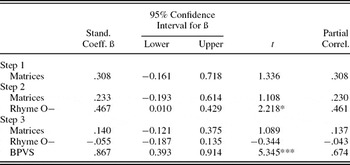
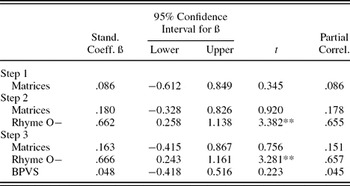
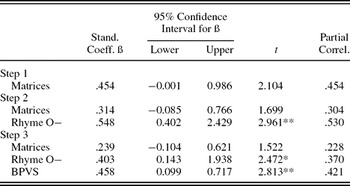
To explore the potential predictors of reading in the groups a series of hierarchical multiple regressions were computed. The standard score from the BAS word reading test was the dependent variable. The number of participants in each group (N = 19) meant that a maximum of three independent variables were included. The three predictor variables were matrices nonverbal reasoning standard score, rhyme awareness (percentage of incongruent rhyme trials correct) and receptive vocabulary (BPVS standard score). The blockwise entry method was used. The predictor variables were entered in a separate block in the order given above (matrices, rhyme, BPVS). The order of entry was the same for each group. Rhyme was the PA level chosen for inclusion because performance on the orthographically incongruent phoneme trials was not above chance in the CI group and syllable awareness has not been found to be a good predictor of word reading for older children in English. Influential cases were identified through the Cooks' distance statistic and cases that had values >1 were considered. There was one case with a Cooks' distance >1 in the RL-matched group and this case was excluded from the analysis. A summary of the results from these analyses are in Tables 4, 5, and 6.
Multiple regression analysis: Block method, cochlear implant group, and dependent variable standard reading score

Note: BPVS, British Picture Vocabulary Scales (Dunn & Dunn, Reference Dunn and Dunn1982).
*p < .05. ***p < .001.
Multiple regression analysis: Block method, reading matched group, and dependent variable standard reading score

Note: BPVS, British Picture Vocabulary Scales (Dunn & Dunn, Reference Dunn and Dunn1982).
**p < .01.
Multiple regression analysis: Block method, age-matched group, and dependent variable standard reading score

Note: BPVS, British Picture Vocabulary Scales (Dunn & Dunn, Reference Dunn and Dunn1982).
*p < .05. **p < .01.
A comparison of the standardized coefficients of beta across the three groups at Step 3 of the regression models show that the three predictor variables varied in their contribution to predicting variance in word reading standard score. In the CI group, nonverbal IQ alone was not a significant predictor of word reading variability. When rhyme awareness and nonverbal IQ were entered together, then rhyme awareness was a significant predictor of variance in reading, accounting for 21% of unique variance. When nonverbal IQ, rhyme, and receptive vocabulary were entered together, then receptive vocabulary became the significant predictor of reading development, accounting for 45% of unique variance. In the RL group, rhyme awareness was the only significant predictor of reading variance, whether it was entered with nonverbal IQ or with both nonverbal IQ and vocabulary (rhyme accounted for 43% of unique variance in reading outcomes for the younger hearing children). In the CA-matched group receptive vocabulary (18% of unique variance) and rhyme awareness (28% of unique variance) were both significant contributors to reading variance. The confidence intervals were relatively wide for all groups, particularly in both hearing groups, and this is likely to be attributable to the low number of participants.
DISCUSSION
We set out to explore the role of orthography in the development of PA by deaf children with CIs and the roles of both PA and vocabulary in their development of word reading skills. Our findings indicate that orthographic learning does help deaf children to develop phoneme-level PA skills, and that nonorthographic rhyme awareness plays a role in their reading development. However, in the current study, PA played a less significant role than vocabulary development in deaf children's reading. Overall, our regression model predicted 76% of the variability in deaf children's reading with three predictors: nonverbal IQ, rhyme awareness, and receptive vocabulary. We now discuss these different findings in more detail.
With respect to orthography, our data show that orthographic congruency significantly enhanced PA for all groups of children, whether deaf or hearing. Orthographic effects occurred even though the children were making judgments about pictures. This supports theoretical proposals that orthographic learning restructures the phonological lexicon (Goswami et al., Reference Goswami, Ziegler and Richardson2005; Ziegler & Goswami, Reference Ziegler and Goswami2005). Once the brain is literate, orthography and phonology are always coactivated, even in spoken language tasks (Ziegler, Ferrand, & Montant, Reference Ziegler, Ferrand and Montant2004). Our data suggest that this model also applies to deaf children and to picture judgments. However, orthographic congruency interacted with the grain size of the task (syllable, rhyme or phoneme). In the younger hearing children who were at an early stage of formal literacy instruction, the orthographic nature of the trials (congruent with phonological judgment or incongruent with phonological judgment) only had a significant effect on syllable judgments. Based on prior research with hearing children, we might have expected the largest orthographic effect to be evident on phoneme judgments. However, the phoneme judgment task was performed too well by the hearing children to reveal potential differences, with high-performance levels even for the incongruent trials. The expectation of orthographic effects at the phoneme level was instead reflected in the results from the CI group. The CI users could not reliably make phoneme judgments without orthographic support. Of interest, the orthographic manipulation had no impact on rhyme awareness in any of the groups.
These findings with respect to orthography are important, because most prior studies of PA in deaf children who already have some reading competence have not controlled for potential orthographic effects (the Harris & Beech, Reference Harris and Beech1998, study of PA in deaf prereaders was an exception). In the current study, deaf children demonstrated above-chance phonological performance at the grain sizes of syllable and rhyme for the orthographically incongruent items. Rhyme awareness in incongruent trials was also significantly associated with reading, showing a link between a nonorthographically contaminated measure of rhyme awareness and reading in young deaf children. The relationship was still significant when nonverbal reasoning was controlled, but not when vocabulary development was controlled. Our sample size was small, however, and it seems likely that phonological development and vocabulary development will be reciprocally related to each other as well as to reading as the mental lexicon develops in deaf children who use implants. Further studies with larger samples and younger deaf children are likely to be valuable, as research with deaf children affords a unique way of approaching theoretical questions surrounding the origin of phonological representations.
With respect to vocabulary, we were interested in the possibility that receptive language development might play a direct role in the reading development of deaf children who use implants. The results from the multiple regression models provide support for a direct role. Although PA of rhyme was a significant predictor of deaf children's reading when IQ was controlled, once vocabulary entered the equation, rhyme awareness lost its significance. In interpreting this result, it is noteworthy that although the CI group and the RL group were matched on word reading ability, their receptive vocabulary scores were very different. The average vocabulary level of the older CI users was around 4 years, despite the fact that their average reading age was around 7 years (average chronological age = ~8 years). To determine whether receptive language development plays a special role in determining reading development in CI users, a comparison with 4-year-old hearing children with similar language levels would be required, an age at which reading skills are rarely found.
If the development of PA depends largely on lexical restructuring processes in the mental lexicon, the simple prediction would be that the delayed vocabulary development of the CI users should mean significantly impaired phonological development, at all grain sizes. This was not the case, as the CI group had good syllable awareness, showing equivalent performance to both RL and CA hearing controls. One explanation could be that syllable awareness is already well developed in typically developing hearing children of 4 years with age-appropriate vocabularies (see Goswami & Bryant, Reference Goswami and Bryant1990). Our deaf participants had receptive vocabularies at the 4-year level. At the smaller grain sizes of rhyme and phoneme, the CI group had poorer PA than both CA and RL controls. As the absolute language levels of the CI users were so low, it is possible that their poorer phonological skills at the smaller grain sizes of rhyme and phoneme were indeed a result of their smaller vocabularies. Most hearing 4-year-olds have good rhyme skills, but the youngest hearing comparison group here were 7-year-olds. Hence, as the deaf children get older and their vocabularies improve, the relationships among receptive language development, phonological development, and reading development may be consistent with the predictions made by LRMs. It is remarkable that despite having both lower language levels and lower phonological abilities than the RL controls, the deaf CI users had managed to achieve equivalent reading outcomes (and as a group, they were within 1 SD of hearing norms; see James et al., Reference James, Rajput, Brinton and Goswami2008). This suggests that deaf CI users were recruiting other sources of information to help them to learn to read, for example, speech reading skills (see Kyle & Harris, Reference Kyle and Harris2006).
Of importance, our findings at the rhyme level suggest that the recruitment of orthographic knowledge during PA tasks is not a necessary phenomenon for either deaf or hearing children. Leybaert (Reference Leybaert, Marschark and Clarke1993) had suggested that deaf children's reliance on orthography during PA tasks would diminish if phonological representations were stronger. The findings from the typically developing children do not support this view, however, because the orthographic manipulation of trials still had a significant effect on the PA judgments in hearing children who had relatively robust phonological representations (the group matched for CA to the deaf children). Our findings indicate that the use of orthographic knowledge may be related to the linguistic level of the PA task. In particular, our data from deaf and hearing children suggest that rhyme awareness may be impervious to orthographic influences. We now consider possible explanations for this striking finding.
According to both Metsala and Walley (Reference Metsala, Walley, Metsala and Ehri1998) and Zeigler and Goswami (Reference Ziegler and Goswami2005), vocabulary expansion plays a causal role in the development of well-specified phonological representations. A concept central to both theories is the importance of phonological neighborhood densities. Both theories predict that as vocabulary size increases, better specified phonological representations should develop for words that have a large number of similar-sounding neighbors in the mental lexicon, compared to words that have a smaller number of phonological neighbors. This is necessary to identify and produce these words quickly and accurately. De Cara and Goswami (Reference De Cara and Goswami2002) showed that for all the monosyllabic words of English, the majority of similar-sounding words are similar because they rhyme. Thus, they argued that the rime has a special status in English when compared to other phonological units, namely, single phonemes or onset-vowel units (comprising the initial consonant phonemes plus the vowel in CVC words). It is clear from the data on our item characteristics (shown in Appendix B) that the cue and target items used in the rhyme test had a large number of phonological neighbors. In fact, they had considerably more similar-sounding neighbors than the items from either the syllable or phoneme tests. Given that a high proportion of those similar-sounding words must be rime neighbors (De Cara & Goswami, Reference De Cara and Goswami2002), the absence of an orthographic effect in our rhyme task could potentially be explained by phonological neighborhood density. As the words used in the rhyme test were drawn from dense phonological neighborhoods, their rime units may have been readily available for conscious manipulation during the rhyme task, irrespective of the spellings of those rimes. In future studies, this possible phonological neighborhood density effect should be tested directly.
Finally, a clinical motivation for this study was to explore the relationship between vocabulary, PA, and reading in deaf children with CIs when differences in nonverbal intelligence were controlled. Given the theoretical association between lexical development and PA (Metsala & Walley, Reference Metsala, Walley, Metsala and Ehri1998) and the well-attested finding of a strong and positive association between vocabulary knowledge and reading in deaf children (Connor & Zwolan, Reference Connor and Zwolan2004; LaSasso & Davey, Reference LaSasso and Davey1987; Moores & Sweet, Reference Moores and Sweet1990), we wanted to investigate the link between PA and reading within the context of the developing lexical system rather than just the context of innate differences in ability. As outlined in the introduction, nonverbal IQ is a potentially powerful predictor of language and reading outcomes in children using CIs, so we included nonverbal reasoning in the multiple regression analyses. The data show that in this sample, nonverbal IQ made a nonsignificant contribution to the models across all groups. However, the confidence intervals were wide, and this suggests that a similar study with larger numbers of participants might indeed replicate Geers' findings of a significant contribution from IQ to reading in deaf children. It is therefore still important for this variable to be included in future research with CI users. From a clinical perspective, understanding the contribution of innate nonverbal skill with outcome is important because it will help in the task of setting and achieving expectations postimplantation. Finally, it would be interesting to investigate the role of phonological versus language development and their potential interactions in promoting and attenuating growth at different stages in the literacy development of deaf children. To address the questions that are important in the clinical and pedagogical fields, longer term monitoring of CI users that charts the dynamic relationship between speech processing, language, and literacy development within the context of functional literacy attainment is required.
SUMMARY AND CONCLUSION
The development of PA by deaf children is stronger than might be expected given their significantly lower language levels compared to hearing children. If PA depends solely on the lexical restructuring of vocabulary items, as suggested by LRMs, then CI users should show poorer PA than both typically developing groups, at all grain sizes. In the current study, syllable awareness in CI users was well developed despite their limited vocabulary. Orthographic learning does not appear to be the sole source of PA in deaf children either. If PA depends on orthographic knowledge in CI users, then we should have found an orthographic effect at all grain sizes (syllable, rhyme, phoneme). Instead, orthographic knowledge only had a significant impact on PA at the phoneme level. In particular, rhyme awareness in deaf CI users did not depend on orthographic support. Rhyme awareness was also a significant predictor of word reading variance in deaf children using CIs. When deaf children's vocabulary development and nonverbal IQ were included as copredictors of reading in the regression model, then vocabulary development was the strongest associate. Hence, both PA (rhyme awareness) and oral language development appear to contribute to reading development for deaf CI users. Nevertheless, vocabulary makes a direct contribution to reading development that is independent of PA.
APPENDIX A
Examples of phonological awareness test trials

Note: The distracters were chosen to consist of semantically related and phonologically related items. Analyses of the results showed that neither the nature of the distracters nor the number of related distracters had an impact on performance levels. O−, orthographically incongruent; O+, orthographically congruent; s, semantically related distracter; ph, phonologically related distracter.
APPENDIX B
Age of acquisition and neighborhood density

Note: Means (standard deviations) are provided for age of acquisition. Medians and ranges are given for neighborhood density because the mean was not an accurate measure of the midpoint of the data. There was no significant difference in the age of acquisition ratings for the cues, F (1, 78) = .899, ns, or the targets, F (2, 78) = .107, ns between the tests. The number of phonological neighbors did differ between the tasks. There was a significant main effect of test on the number of phonological neighbors in the cue items, F (2, 69) = 8.07, p < .001. Post hoc tests showed that this difference arose because there were significantly more neighbors in the rhyme test compared to the syllable test. There was a significant main effect of test on the number of phonological neighbors in the target items, F (2, 67) = 9.70, p < .001. Post hoc tests showed that this difference arose because there were significantly more neighbors in the rhyme test compared to the syllable test and the target items in the phoneme test had more neighbors than the target items in the syllable test.
APPENDIX C
PRETEST COMPONENTS
1. The receptive vocabulary check consisted of all the pictured items (cues, targets, and distracters) in the experimental trials. Pictures were grouped into sets of four using a random number generation system. Four black and white line drawings were presented on a card. Participants pointed to the picture that was named by the experimenter. On completion, familiarization for any unknown items was provided. For the deaf participants it was necessary to give training for approximately 10% of the items. The hearing participants recognized all the vocabulary.
2. The naming check consisted of each picture used in the experimental tests. The pictures were presented on a single card. Participants named all the items. Semantic strategies were used to facilitate naming of items when necessary. This level of support was required for a minority of items (i.e., 10–15%) for the deaf participants and was occasionally required for some of the younger hearing participants. The naming check was administered to ensure that participants were able to generate the intended label for the pictures used in the task. The ability to do this could not necessarily be implied from performance on the receptive vocabulary check.
3. Familiarization in PA concept was not assumed. The familiarization scripts for all three tests were structured in a similar way. Training began with the experimenter using her own name to highlight the relevant phonological unit (i.e., syllable, rhyme, or phoneme). Then the child's own first name was used. At this second stage the child was encouraged to actively engage in the training by either clapping out syllables, generating a rhyming string or generating words with the same initial phoneme. First names were used at this early stage in order to support attention and increase participant's motivation to take part in an unfamiliar and potentially difficult task.
The following set phrases were used:
Syllable: long/short words, chunks
Rhyme: sound the same at the end
Phoneme: sound at the beginning
The technical words syllable, rhyme, and phoneme were only used if a child used them first.
4. Three training trials using picture cards were given. Feedback was provided after each trial and incorrect trials were repeated once.
5. Four practice trials were given on the computer in order to familiarize the child with the computer and with making a speeded response using the button box. Feedback was given at the end of the block of practice trials. No trial was repeated.
We reasoned that giving practice trials in card format as well as on the computer was necessary. If only the computer practice trials had been administered there was a risk that making the push button response on the computer could have been distracting for the child. This might have limited the participants' opportunity to benefit from corrective feedback.
ACKNOWLEDGMENTS
We are grateful to the clinicians at Great Ormond Street Hospital Cochlear Implant Programme and the South of England Cochlear Implant Centre at the University of Southampton. We thank Valerie Hazan and Tony Sirimanna for their involvement in this study. We are indebted to the teachers and speech and language therapists in the many communities in which we worked for their encouragement and support. Many thanks are due to all the children and families who took part in this study. Support for this research was provided by a Child Health Research Trust PhD studentship to Deborah James, supervised by Usha Goswami. Research at the Institute of Child Health and Great Ormond Street Hospital for Children NHS Trust benefits from R&D funding received from the NHS Executive.