Introduction
Social exclusion can be extremely hard to solve as different forms of exclusion require different solutions. People may be excluded economically, socially, culturally, and politically. Kabeer explains that the economically disadvantaged demand a redistribution of resources.Footnote 1 In comparison, the culturally disadvantaged mobilize around the question of identity and demand recognition.Footnote 2 Or, as Fraser explains, class injustice requires redistribution as remedy whereas status injustice requires recognition.Footnote 3 Those groups that experience economic and cultural disadvantages, such as the Dalits (described by Kabeer as ‘bivalent collectivities’), demand both redistribution and recognition.Footnote 4 Yet a tension exists between the politics of identity or recognition and the politics of redistribution because one may not correlate with the other.Footnote 5
Cash transfers are a grant given by governments to citizens facing adversity in order to improve their lives. In the short term, they reduce poverty and ameliorate suffering; in the medium term, they enable poor people to exercise agency and plan ways to increase their productivity and income; in the longer term, they create a generation of healthier and better educated people who are more able to seize economic opportunities and contribute to economic growth.Footnote 6 They can also serve as a buffer for shocks and crises. The greatest impact is felt when cash transfers are delivered in full, on time, and at minimum inconvenience (in terms of distance to pay-points, queuing time, access costs, and security risks).Footnote 7 However, the important role of cash transfers in building inclusive states is under-researched, particularly in Nepal.
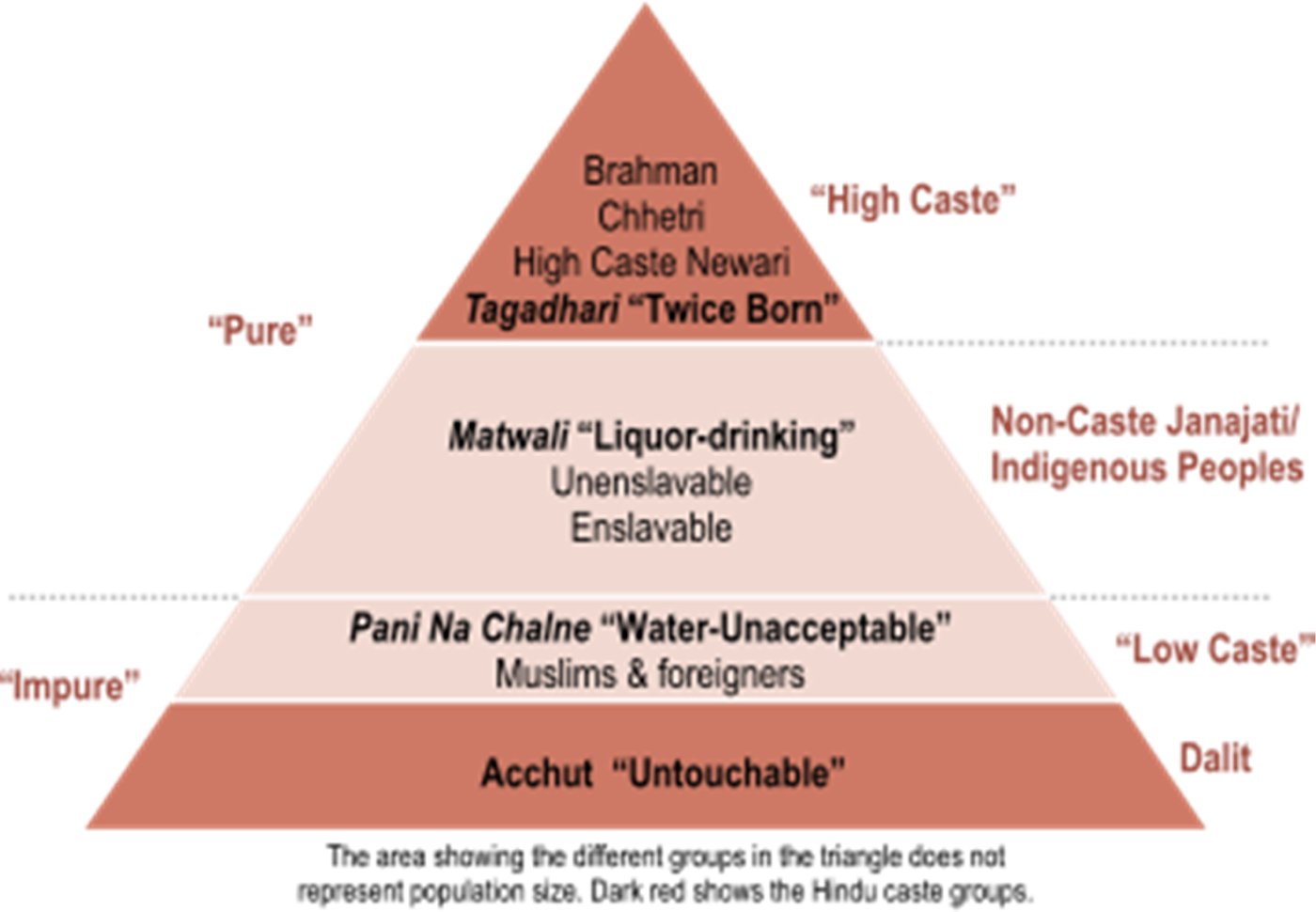
The ways in which cash transfers can be used to overcome durable problems of exclusion and inequality in countries like Nepal, with deep, historical forms of exclusion and which are also fragile and conflict-affected, are unknown. Thus Nepal presents a useful opportunity to study cash transfers and their ability to overcome some of the country's structural inequality and exclusion. The practice of social inclusion in Nepal is associated with horizontal inequalities between upper caste groups and those lower down the caste hierarchy (see Figure 1). The Hindu caste system and Rana monarchy favoured upper caste groups and allowed them to run the state apparatus.
Nepal's caste pyramid. Source: Bennett, L. and Sharma, S. (2006). Unequal Citizens: Gender, Caste and Ethnic Exclusion in Nepal, DFID and World Bank, Kathmandu, p. 6, http://documents.worldbank.org/curated/en/201971468061735968/Summary, [accessed 28 May 2019].

For centuries, the caste system and its legacy have excluded and discriminated against lower caste DalitsFootnote 8 and indigenous ethnic groups, known collectively as Janajatis.Footnote 9 Social exclusion can be seen as ‘the denial [or non-realisation] of full personhood and full citizenship to certain groups on the basis of who they are, where they live or what they believe’.Footnote 10 Exclusion in Nepal is both deeply entrenched and geographical. Those who live in areas peripheral to Kathmandu are aware of their lack of visibility and how this manifests as exclusion from resource allocation and other state benefits. This is particularly true for the Madhesh region in the Terai area of Nepal.Footnote 11
Shortly after the birth of democracy in 1990, Nepal's first cash transfer system was initiated, independently of donor assistance. The non-contributory universal age pension was introduced by Nepal's first government, the United Marxist Leninist (UML) Party in 1994. This was introduced to silence negative political commentary about communists neglecting old people and because it was seen as the fastest way to reach large numbers of people and thus build legitimacy.Footnote 12 Pensions for the aged were also introduced in India and Bangladesh at around the same time, but these were targeted at the poor. Although subsequent governments have increased the benefit types and amounts paid, there is a strong alignment between communist governments and democracy.Footnote 13
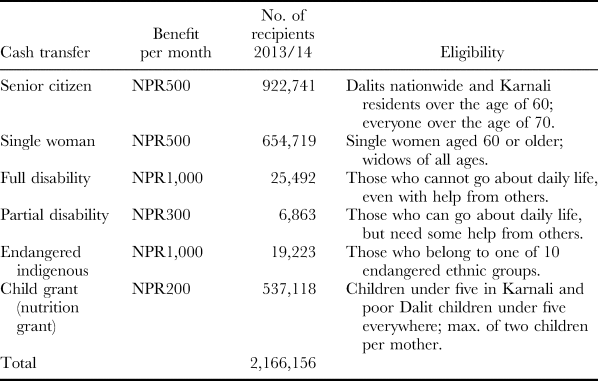
Under the Maoist regime (which officially established Nepal as a democratic republic in 2009), cash transfer expenditure increased from 0.6 per cent of GDP in 2008 to 3 per cent of GDP in 2010.Footnote 14 It developed a distinct caste/ethnicity focus, reflecting the Maoists’ insurgency rhetoric of caste and ethnic inclusion, and not just class politics.Footnote 15 Although transfer amounts are small, they reach a large number of citizens (see Table 1). All these cash transfers can contribute to social inclusion, although the Endangered Indigenous Allowance is the only one that has social inclusion as an objective.Footnote 16 Given the Maoist association with cash transfers, they are a cause of high politics in Nepal's post-conflict political turmoil.Footnote 17
Cash transfer by eligibility criteria, benefit amount, and number of recipients.

Source: Author's own tabulation from data collected from the Ministry of Federal Affairs and Local Development (MoFALD), 28 November 2013.
Three cash transfers are the focus of this article:
• the universal, non-contributory Old Age Allowance of NPR500 (US$5) per month for all citizens over the age of 70 and over 60 for Dalits;
• the Single Women's (Widows) Allowance of NPR500 (US$5 per month); and
• the Child Grant (NPR200 per month) given to Dalits nationwide who have children below the age of five.
Beginning with a historical overview of Nepal, this article explains Nepal's cash transfer implementation process and the many challenges encountered by a fragile and weak state. An introduction to citizenship theory precedes the methodology. This is followed by a short introduction to Dalits and five case studies that represent the diversity of Dalit experiences in accessing cash transfers and their encounters with local governance. Dalits encounter the most extreme forms of exclusion and intersecting inequalities and yet claim the most inclusive benefits. Additional results are presented that provide a view of the state ‘from below’ and reveal citizenship construction and the subjective and experiential aspects of structural discrimination. The article concludes that cash transfers can have important effects on individual notions of inclusion and citizenship for highly marginalized and historically excluded segments of the population.
Post-conflict cash transfers
Nepal is a post-conflict country struggling to transition into a modern, inclusive federal democratic republic. In 1996 a 10-year ‘People's War’ led by the Maoists began, with the objectives of bringing about the abolition of the monarchy and the inclusion of traditionally excluded groups. After the Comprehensive Peace Agreement (CPA) was signed in 2006, social inclusion became ‘a project of overarching importance that affected the structure of society and its primary social ties’.Footnote 18 In 2008 the former rebel fighters (Maoist Party) formed their government with a Madheshi Party coalition and promised to create a ‘naya (new) Nepal’ that was both democratic and inclusive, and to reform its exclusive Hindu feudalist foundation. Social inclusion is analogous with building a federal democratic republic.
Cash transfers have been used in a number of post-conflict countries as a peace dividend.Footnote 19 Yet, adverse effects can arise when providing social assistance in fragile and conflict-affected situations, specifically in terms of targeting, social cohesion, and patterns of domination where the conflict has roots in social divisions—all of which have a bearing on social inclusion and cohesion.Footnote 20 Cash transfers can lead to greater stigmatization of vulnerable groups and can create new forms of social tensions, depending on how effectively they are implemented.Footnote 21 Their effectiveness could be limited in states like Nepal that are weak, clientelistic, and corrupt, but the evidence around these causal chains is missing.
The anthropology of ‘the gift’ emphasizes the way in which exchanges or gifts between groups have traditionally been used to build wealth and alliances, along with relationships and social solidarity between people.Footnote 22 Mauss argues that social welfare programmes in modern market economies may be recovering some aspects of the morality of ‘the gift’. Instead of just being a market exchange—cash for citizenship—government-led cash transfers in welfare states can build a sense of citizenship, trust, and connection to the state.Footnote 23 Gifts create obligations to give, to receive, and to reciprocate.
Much has been written about cash transfers creating dependency, fatalism, and laziness, most of which has been empirically refuted.Footnote 24 Meanwhile, Ferguson treats dependency as more akin to sharing than as either a gift or market exchange and thus normalizes dependency.Footnote 25 Ferguson also argues that establishing and maintaining dependence on wealthy others is, in fact, productive for those excluded from benefiting from state and market forms of assistance. Dependency is a livelihood strategy for those with limited options. Ferguson's ideas, like this article, are grounded in local meanings, discourses, and aspirations, and thus regard cash transfers as ‘catalysts’ that enable recognition (for they are too small to substitute for income or to lead to a more negative fatalistic version of dependency).
However, where relationships are unequal, such as in patronage states, cash transfers cannot be assumed to be given without expectation of return. It is more likely in fragile and conflict-affected states with weak state-society relationships that cash transfers may create unequal obligations and permanent indebtedness, possibly without reciprocity. Moreover, in states that lack accountability and where corruption exists, exploitation, or adverse incorporation, may accompany cash transfers. In capitalist countries with weak states, such as Nepal, cash transfers and other state-led forms of social protection can be used to embed capitalism in social relations. So rather than being rights-based and promoting citizenship, cash transfers cement clientelism and a more negative, hard-to-escape form of dependence.Footnote 26 If this is the case in Nepal, then the potential of social protection to make a contribution to building inclusive states will be limited.
The Secure Livelihoods Research Consortium (SLRC) found that the way in which services are delivered (participatory, accountable, etc.) in Nepal is as important to citizens as what is delivered.Footnote 27 Citizens’ expectations can be different in post-conflict countries where there is often a lack of trust, especially in state and public institutions.Footnote 28 Oosterom found that strong claims on local governments without the capacity to respond were counterproductive and even fostered hostility.Footnote 29 Managing the gap between expectations and what is realistically able to be delivered is a unique challenge in fragile environments that affects social protection delivery and the way in which citizens perceive cash transfers.Footnote 30
Conflict-related forms of insecurity, and wider human security issues including protection from intimidation and coercion, and not just economic protection, have not been well considered by social protection programmes in fragile states.Footnote 31 In comparison, the state-building literature scrutinizes ways to achieve state legitimacy and how to foster positive, mutually constructive relations that improve the political and social fabric of society.Footnote 32 Vij suggests that social protection programmes implemented in states with patronage-based systems should use participatory governance and social accountability tools to ensure effectiveness and social inclusion,Footnote 33 whereas Hoddinott et al. argue that ‘there is little to be gained from attempts to either bypass or work with entrenched patronage systems’.Footnote 34
The role of state-building processes is to present opportunities to redefine or strengthen citizenship for marginalized groups and include their voice and rights in new policies and legislation under development.Footnote 35 This is similar to the goals of transformative social protection, which argues that it can be designed in a certain manner to empower citizens. It is often rights-based and seeks to transform existing inequities through sensitization, empowerment, and advocacy, along with transfers.Footnote 36 However, there is some debate in the literature about what ‘transformation’ actually means. It may mean changing the structural distribution of power and resources that keep people poor and excluded, or it may be more about personal empowerment and the meaning of citizenship. Understanding how cash transfer beneficiaries perceive the cash transfers helps us to understand whether social protection contributes to inclusive state building.
There are 75 districts in Nepal. District development committee (DDCs) are one of a number of government bodies responsible for district governance in Nepal and oversight of 3,915 village development committees (VDCs). The Ministry of Federal Affairs and Local Development (MoFALD) oversees the local bodies and administers the five cash transfers. One DDC may have 40–50 programmes that they manage and implement with separate budget line items for administration, monitoring, and evaluation. The cash transfers are the only programme without additional funds allocated for these purposes. Although the Office of the Auditor General checks the financial trail down to the DDC level, they do not ensure that beneficiaries actually receive the correct amount at the right time.
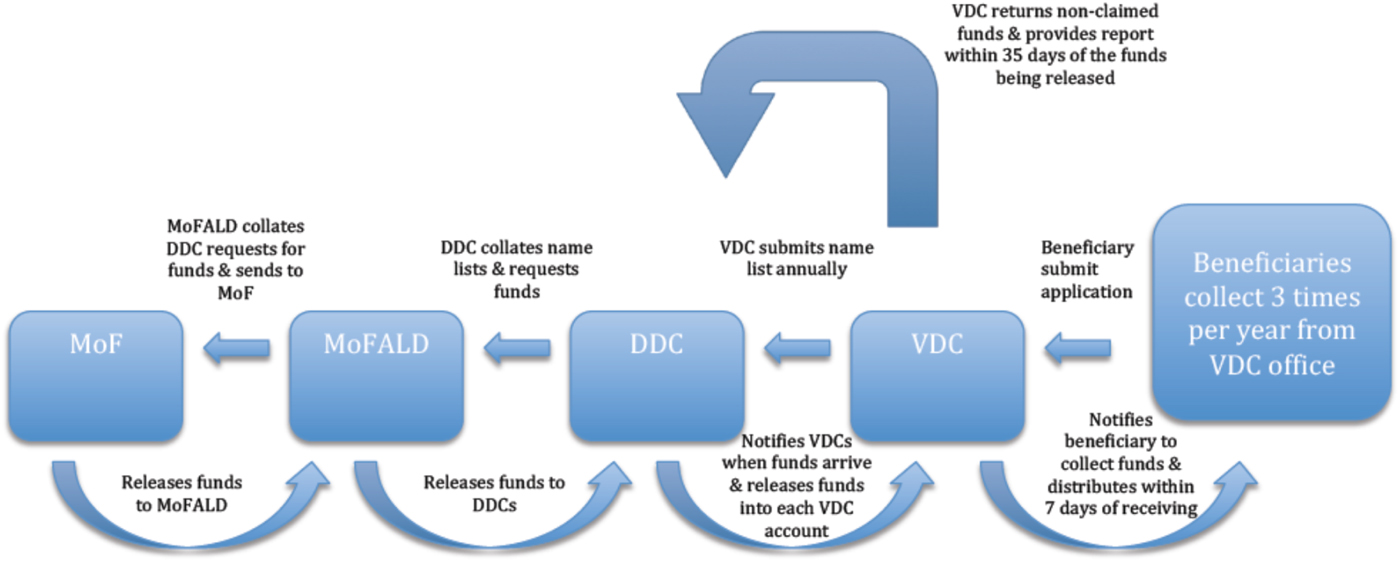
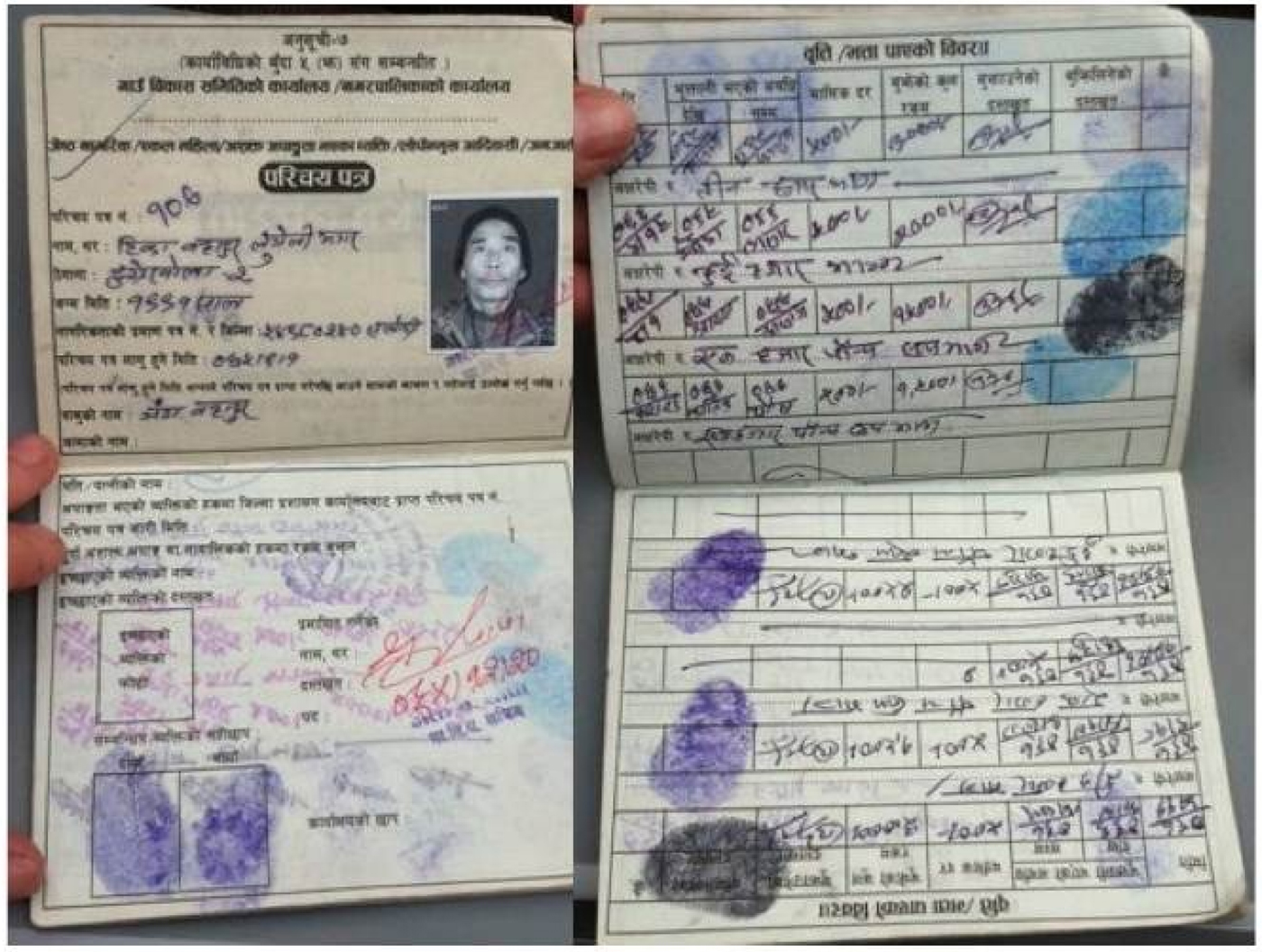
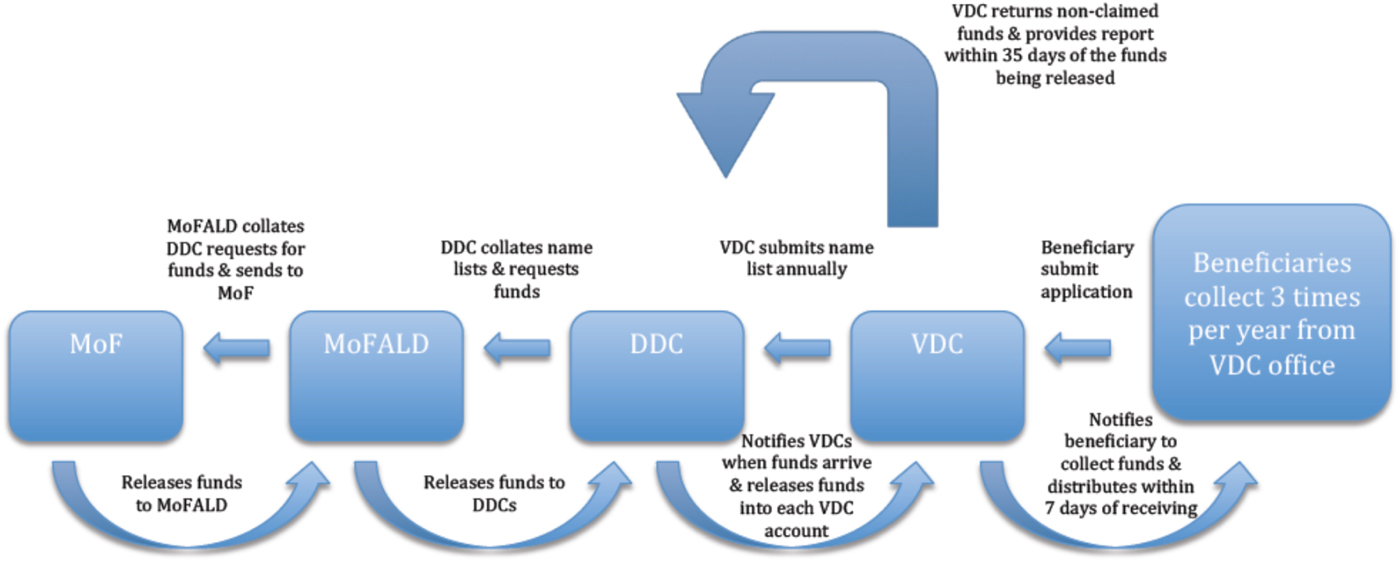
In Nepal, beneficiaries wait in line to receive their allowance from the VDC secretary, the lowest tier of government officer, who manually dispenses the allowances three times per year. The cash transfer implementation process is outlined in Figure 2. According to the Social Security Operational Procedures (SSOP),Footnote 37 the dates for disbursement are the week of Martyr's Day, Democracy Day, and before Dashain,Footnote 38 highlighting the state's desire to communicate a sense of nationalism through the cash transfers. Beneficiaries wait from 10 minutes up to all day (depending on where they live) and must provide their thumbprint in an identity book (see Figure 3) to receive their cash.
Cash transfer implementation process. Source: This flow chart was developed by a researcher to provide a graphic explanation of the process.
Identity book. Source: Photo by the author.

The literature on Nepal's cash transfers is scarce but what is available does suggest that a weak state will affect the delivery of cash transfers. A public expenditure tracking survey of cash transfers found ‘between NPR63 (widow) to NPR134 (fully disabled) were reported to have been deducted from monthly entitlement amounts’.Footnote 39 A UNICEF-commissioned, mid-line survey of the Child Grant found that, despite the government's SSOP stating the cash transfers should be paid every quarter, this did not happen.Footnote 40 The survey showed that 79 per cent of households received only one instalment, 13 per cent received two instalments, and six per cent had not received any payments in the previous 12 months. A survey on social security benefits found a 13–20 per cent leakage rate due to multiple listings and ghost, dead, or migrated recipients.Footnote 41 By all accounts, Nepal's cash transfers are irregularly given. If a citizen is entitled to a cash transfer but cannot receive it, regardless of the reason, this is likely to have a negative impact on how included they feel.
Perhaps surprisingly, the literature also suggests that cash transfers have ‘important social effects’ as well as ‘indicative implications for notions of citizenship’ in Nepal.Footnote 42 Uprety found that the senior citizen allowance recognizes ‘the importance of older people in Nepali society’, contributes to their inclusion in family and community life, and reduces dependence.Footnote 43 Thus, although cash transfers contribute to citizens’ feelings of inclusion in Nepal, it is not clear why. It is important to understand the way in which redistribution through cash transfers may help to build a sense of inclusion in Nepal because many other efforts at inclusive state building have been undermined.Footnote 44
Citizenship
Citizenship formation is relevant to the design and implementation of policy interventions like cash transfers.Footnote 45 Yet, the process of citizenship formation is varied in character and outcome because people interpret the relationship and actions of the state differently.Footnote 46 Thus, citizenship can be linked to encounters and experiences. The rights-based literature confirms this: ‘rights are shaped by actual struggles informed by people's own understandings of what they are justly entitled to’.Footnote 47 Nyamu-Musembi describes this as an actor-oriented approach to citizenship.Footnote 48 Eyben and Ladbury describe a ‘seeing like a citizen’ approach in terms of how they interact with and view the institutions of the state.Footnote 49
The way in which excluded groups come to define their identity and their citizenship status can be based upon their experience of exclusion.Footnote 50 Adverse incorporation into patron–client relationships may create dependency; however, if incorporation into a patron's web is the only way to access more opportunities, then it may bring a sense of achievement and security. This may explain why the literature on Nepal cites some cash transfer beneficiaries claiming that they feel a sense of social inclusion despite not receiving their full entitlement.
Consequently, clientelism has been described as a form of citizenship practice, whereby clients engage ‘with the state in the person of the politician’.Footnote 51 Through clientelism (a set of strategies), citizens attempt to make politics, and politicians, more representative and responsive.Footnote 52 Therefore, a relationship between dependency and a sense of subjectivity in clientelist states can exist.Footnote 53 Political forms of exclusion and incorporation can be entwined in complex and multiple ways.Footnote 54
Particular kinds of states produce certain trajectories and experiences of citizenship.Footnote 55 Much of the promotion of citizenship within development programmes, such as those developing voice and empowerment, rests on the hope that a proactive citizenry will be able to successfully demand accountability and thus produce more effective states.Footnote 56 This is obviously a desired outcome in Nepal. However, it can be difficult to achieve. The state's relationship with excluded groups can determine how citizenship is practised and also how the state responds to attempts by excluded groups to claim their rights.Footnote 57 Even the way in which excluded groups mobilize and are represented may be constrained by the state.
Excluded groups are accustomed to using unofficial channels and informal practices to have their day-to-day needs met as formal processes may not function in their interests. For excluded groups to begin to use legitimate channels, they need to be aware of their rights and see an increase in accountability. Government processes and the repercussions of using legitimate channels cannot be higher than using the more familiar informal practices and unofficial channels. This is relevant because transformative social protection suggests citizens need to claim their right to benefits to feel empowered and included. However, transformative social protection also seeks changes to the structural distribution of power and resources that keep people poor and excluded. It implies that poor people should use state-sanctioned channels to claim their rights because it leads to structural transformation.
Nonetheless, using state processes may not be the only way in which citizenship is constructed. The horizontal view of citizenship stresses that the relationship between citizens is as important as the vertical relationship between the individual and the state.Footnote 58 A societal understanding of citizenship explains how members in sub-national areas may find a greater sense of inclusion and citizenship in their immediate community.Footnote 59 Thus, for many excluded groups, their identity and allegiance will be connected to their local area, mother tongue, or familial group, rather than the nation. Someone can belong to different kinds of collective associations and can define their identity on the basis of participation in activities associated with these different kinds of membership.Footnote 60
Thus, if Nepal distributes cash transfers to Dalits, then this may empower them, regardless of how much of the transfer goes missing or whether they feel able to demand their rightful entitlement. Depending on how different groups encounter and interpret this, these schemes may ‘result in a (re)negotiation of their sense of self as a citizen vis-à-vis the state’.Footnote 61 Kabeer argues that the way to build inclusive societies will be illuminated by understanding the meanings and experiences that excluded groups ascribe to citizenship.Footnote 62 Citizenship formation is central to overcoming the exclusions and inequalities associated with uneven development.Footnote 63
Study design
The history of the fertile Madhesh/Terai region is one of ‘entangled territories, recurring disputes and conflicted claims to land, taxes and political authority’.Footnote 64 Bernardo explains that the boundary between Nepal and India was redrawn on different occasions, resulting in a loss of territory in some instances and a regaining of territory at other times.Footnote 65 Many in the Nepali government consider the Madheshis to be more like northern Indians than Nepalese and do not trust their loyalty to Nepal's interests. As I note elsewhere, ‘borderlands are often contested landscapes and Nepal's uneasy relationship with its powerful Indian neighbour creates further challenges for the Madhesh’.Footnote 66
Following significant migration into this fertile area in the 1960s, some inhabitants of the Madhesh region became indentured or were heavily taxed until they gave up their land.Footnote 67 This peasantry process is not unique to the Madhesh and has existed across Nepal for centuries.Footnote 68 The patron-client mentality that accompanies these processes is hard to overcome. In fact, there are now many different forms of patron-client relations in Nepal: those based on agrarian inequalities, the caste system, and ritual hierarchies, and those that can develop between local officials and service seekers.
Despite Nepali being the second or third language for many Madheshis, most government officials who are posted to the Madhesh do not speak the local language, only Nepali. Madheshis face ‘rampant racism and discrimination’ in modern Nepal and continue to be subjected to systematic forms of state exclusion such as being denied government services and citizenship.Footnote 69, Footnote 70 There are also a range of dialects within the Madhesh. Those who speak dialects of Maithili have to use a more formal, well-off Maithili dialect when they encounter elites and government officials from the area.Footnote 71 Those whose mother tongues are minority languages tend to have lower literacy rates, further limiting their ability to communicate with the majority of the Terai region population.Footnote 72
The district of Sarlahi was chosen for beneficiary interviews because it has low human development indicators, lies in the Madhesh region, and is affected by conflict. The porous border with India means arms are readily available in the Terai,Footnote 73 although paved roads are rare. Many hill immigrant ‘Pahadis’ fled the Madhesh area in 2007 in fear of their lives during a violent uprising.Footnote 74 A number of Madheshis, especially youths or those from lower castes, had their first encounters with politics through joining politically motivated armed groups.Footnote 75
Sarlahi has 99 VDCs and a total population of 769,729, of whom 389,756 are male and 379,973 are female.Footnote 76 The male-to-female ratio is close to 1:1 (102.57) according to official Central Bureau of Statistics (CBS) data, but according to the Help Nepal Network, in reality it is more like 1:2, mainly due to male migration for work.Footnote 77 In 2011 there were 19,355 widows, a high figure potentially attributable to the conflict and migration-related deaths associated with poor working conditions.Footnote 78 The literacy rate was 46.30 per cent in 2011, up from 36.17 per cent in 2001; only 123,477 females are able to read and write compared to 192,691 males.Footnote 79 In terms of sanitation, 97,720 of the 132,844 households still do not have a toilet and only 61,859 households have electricity. In 2011 child marriage was still a concern with 1,710 children married below the age of 10; 35,629 marrying between the ages of 10 and 14; and 224,558 marrying between the ages of 15 and 19.Footnote 80
The data presented in this article were collected over a two-week period in January 2014 in Sarlahi, Nepal. A total of 41 beneficiaries were interviewed, 19 of whom are Dalits. As the Single Women's Allowance and Child Grant are paid to women, only four male Dalits were interviewed, thus limiting the ability to make gender comparisons. Out of the 19 Dalits interviewed, 17 were Hindu, one Christian, and one had no religion. Seven had Nepali as a mother tongue, three Bajika, and nine Maithili. The average age of interviewees was 52 and the age range was 20–97 years. Family names are significant because there is also a hierarchy within Dalit society, with surnames indicating a person's place in it. While details of this will not be discussed in this article, the family names are included here as they are significant for Dalits: Biswokarma (four), Damai (two), Ram (four), Mushar (five), and Das (four). Five case studies are included in the article: those of a single woman, two old-age pensioners, and two Child Grant recipients. The interviews had two parts: open-ended questions and a survey covering demographics and Likert scales.
Dalits
Dalits face acute exclusion. The percentage of poor among Dalits is close to double the percentage for non-Dalits. Among Terai Dalits the poverty rate is 40.2 per cent, despite favourable geographical conditions.Footnote 81 Dalits have a life expectancy rate seven years lower than the rest of the population, and in contrast to the 24 per cent of the Nepali population who are landless, 90 per cent of Dalits are landlessFootnote 82 and collectively own only one per cent of arable land.Footnote 83 Dalits have low educational attainment: education above Standard Leaving Certificate (SLC) level is 17.6 per cent for the population and 3.8 per cent for Dalits; education above a Bachelor's degree is 3.4 per cent for the population and 0.4 per cent for Dalits.Footnote 84 Hill castes have an average literacy rate of 76 per cent; Hill Dalits have a 61.9 per cent literacy rate compared to 34.6 per cent for Terai Dalits.Footnote 85 All Dalits face exclusion and those who reside in the Madhesh/Terai are the most disadvantaged of all. It is their experience of being cash transfer beneficiaries that will be examined in this article.
Dalits have traditionally been locked into patron-client relationships. These traditional forms of semi-feudal labour relations have weakened significantly since the conflict when Maoists freed many bonded labourers, and since NGOs working on labour rights raised awareness of unequal labour relationships.Footnote 86 Migration and new opportunities for non-agricultural labour have further weakened these ties, although they have not disappeared completely.Footnote 87 Many labouring households have not been able to enhance their economic status on a significant or a sustainable basis because household expenses have also increased, along with dependence on the market and high costs related to migration.Footnote 88 Patron-client relationships of exploitation had reciprocity built in and offered a level of security and safety during hard times that is not found in market-based arrangements.Footnote 89 Although Dalits have different employment opportunities in 2014, these may not necessarily be lucrative or more secure.
The practice of Untouchability still strongly segregates Dalits from others at the local level, despite being declared illegal in the 1990 Constitution. As Cameron explains, ‘the laws against caste-based discrimination are not enforced [and] weekly reports of abuse and violence against Dalits are inevitably accompanied by reports of a weak police investigation, or of no investigation at all’.Footnote 90 Dalits represent 13 per cent of the population but Dalit organizations claim this figure is closer to 20 per cent. Many Dalits change their surnames to escape the stigma associated with being Untouchable and do not identify as Dalit to census enumerators.Footnote 91 As Folmar argues, Dalit identity is complex and contested, and also has its own hierarchy and identity categories.Footnote 92, Footnote 93
Dalit experiences of social protection and responses to poor governance are not universal. While the category of ‘Dalit’ is used to define a group of beneficiaries, their experiences and responses vary. Some remain passive about perceptions of elite capture of state resources and poor service delivery, while others are angry or active. Some explain the rationale for the challenges they face in accessing their transfers by citing their caste—‘because we are Dalit’—but others suggest it is their lack of education or poverty that prevents them from claiming their rights. While it might be easy to assign a passive status to Dalits, this is contested by the (limited) research on Dalits of Nepal. Folmar writes that,
The social and political strategies Dalits employ in everyday life to bow to, quietly accept, dissent to or resist high caste domination are numerous. At times a single action embodies several goals, even polar opposites, behaviours that seemingly accept the system but subtly challenge it.Footnote 94
It is important to remember there is enormous diversity of experience in Nepal. Dalit identity is multifaceted and not fixed, and it changes with time and according to the individual.Footnote 95
Case studies
The following case studies highlight the everyday experience of being Dalit and, specifically, the experience of being a Dalit cash transfer beneficiary. It is important to note that the respondents use ‘state’ and ‘government’ interchangeably in some cases. Specific questions that were asked of all respondents to help define state and government include: ‘What do you think is the state?’, ‘What are the functions of the state?’ The responses to these questions vary from, ‘I don't know’ (in most cases), to, more frequently, ‘the country’ or ‘Nepal’, and, occasionally, ‘the king’. Despite Nepal becoming a republic, the monarchy and the idea of a king or, more specifically, the idea of a distant and powerful rule-making entity exists in respondents’ minds. Some questions relating to local officials and local elections collectively show a lack of knowledge about governance and state functioning. Yet respondents are able to articulate, in their own words, the difference between local officials/government (VDC secretaries and other civil servants) and a central/federal government/entity that makes the rules. They also distinguish between political leaders and local elites who have a separate function and can help to link commoners (citizens) to ‘the state’ and local governance officers. Respondents also show some level of understanding of what the role of a local government official should be. A discussion on state and governance follows the case studies.
Case study one—Single Women's (Widows) Allowance
A Hindu widow, aged 65 with a family name of Ram and Bajika as her mother tongue,Footnote 96 has an income of NPR400–500 per month (US$4–5), not including the cash transfer, which she earns from doing odd jobs for other families (housework, cooking, etc.). She has no land, lives alone, and is illiterate. She has been receiving the widow's allowance for two years and was first told of her eligibility by the VDC secretary's assistant. It was very hard for her to obtain the Single Women's Allowance at first because she had to seek help from different political leaders at every step: registering her husband's death, obtaining her citizenship papers, and applying for the allowance. She paid everyone who ‘helped’ her with the associated paperwork, which cost her close to NPR3,000 (US$30) in total, but she would not have received the transfer had she not paid them. However, once she registered with the VDC office she only waited three months for her first instalment, which is a shorter time frame than many other participants. She considers the VDC secretary to be ‘the worst guy. The government pays him and so do we.’ She says the VDC secretary takes half her transfer; however, her identity book does not support this and she confirmed that the last instalment amount recorded in her book was the amount received. She waits in line for two hours on average to collect the allowance but has occasionally waited all day.
At times she considers the transfer to be income, but not always. She usually spends the transfer paying back the debt she accrues at the pharmacy. She complains that medicine is very expensive because she pays Indian prices but earns Nepali rupees. If there is money left after this, then she will buy food.
She networks with the Bajika Dalit community, has recently joined informal groups (she attributes this to the cash transfer giving her more time), and regularly talks to other widows. In particular, she compares the amount of cash she receives to that of other widows to ensure they receive the same amount. However, she feels ‘alone in her family’. She worries a lot about her lack of income, debt, natural disasters, living standards, her safety, and not having anyone to care for her. She describes her broader Dalit community as operating parallel to the main community of non-Dalits. She experiences stigma, exclusion, and humiliation from the main community, but support and inclusion from her Dalit community. She scored 14 on the Rosenberg scale, indicating problematically low self-esteem.Footnote 97
She believes the government looks after the poor but that the money they give is too little. She said, ‘Our ego is hurting. We are lower caste and the government feels bad for their lack of care for Dalits and that is why they give it.’ She believes the transfer is a right and feels proud to obtain it. She feels equal to others when she gets the money but also says that ‘Those with the power have taken all the rights.’
She is not sure if local elections will make a difference and on a Likert scale is only just satisfied with the state's trustworthiness. She is totally unsatisfied with the government's unresponsiveness to complaints (‘If I say left, the government will go right’) and says that, ‘You need money to complain because you have to buy political support or no one listens to you.’
Case study two—Dalit Child Grant
A 20-year-old Hindu woman with the family name of Bishwokarma receives the Child Grant. Another villager told her she was eligible to receive the payment. Her mother tongue is Nepali. She has a four-year-old boy and is pregnant with her second child. She has a household of six people, four of whom are dependants. They own nine katha of land, two oxen, and two cows, which generate her income. Not including the Child Grant, the household earns up to NPR5,000 (US$50) per month. She never went to school and is illiterate.
She lives on a remote hillside and rarely goes to the market or events in town. It takes her one-and-a-half hours to walk down the hill to the VDC office where she usually waits in line for her instalment for another hour to an hour-and-a-half. She does not have a payment book so just shows the officer her child's birth certificate to receive the payment. In the first year she received only half of her entitlement. She has learned that she receives less if she goes alone to collect the payment, so she usually goes with a group of villagers. Although the family and their neighbours (who are also beneficiaries) have phones, no attempt is made to inform them of instalment day. She usually finds out it is instalment day when one of her neighbours goes down to the village and hears or sees the cash being dispensed. She explains,
Sometimes we go late because no one tells us when it is being given out. If we are late we are told to go back home because the money has already been returned. We hear that if the money is not allocated in time then it goes back but we really don't know.
She spends the money on food or clothes for her child and says that the money is not enough to pay for school supplies or medicine. She worries a lot about natural disasters and debt. She scored within the normal range on the Rosenberg self-esteem scale (19).
Her perception of local government is not positive and she does not feel that local elections would bring improvements. She thinks that the VDC secretary would prefer it if people did not go and collect their money. She said, ‘We beneficiaries have to go and prod him.’ She says that people are treated differently by government officials depending on who they know. Nevertheless, she thinks the state is trustworthy and she is happy with the cash transfer system. She feels that the central government looks after the poor well enough and on average is responsive to complaints. She does not really know why the government gives the cash to different people but feels that these transfers change the relationship disadvantaged people have with the state because people think better of the government when they receive an allowance. She believes that her child had a right to the transfer.
Case study three—Dalit Child Grant
This mother's family name is Ram and she is 25. She completed class five and her mother tongue is Bajika. There are four people in her household, two of whom are dependent. The total household income is NPR1,500 (US$15) per month from doing labouring jobs and other informal sector work. The Child Grant is not included in this figure because she does not count it as income as it is ‘for the child’. She waited four days for her child's birth certificate and then received her first Child Grant instalment three months later.
She finds the state totally untrustworthy and unresponsive to complaints, and says it does not look after the poor properly. She feels that the cash transfer is too little and the Child Grant should be paid beyond the age of five. She complained to the VDC secretary that the money is not enough and he said, ‘When the government gives me more, I will give you more’, which she finds unsatisfactory. She has not had other encounters with government offices or officials.
She lives close to the VDC office and her neighbours tell her when it is instalment day; she usually waits between half an hour to an hour to collect her instalment. She said that on one occasion the VDC secretary dispensed the transfer from the district headquarters and it took her three hours to walk there and she did not eat until she got home again. She mainly spends the payment on food or clothes for her child and believes that market prices increase on instalment day. She thinks that she receives less money than she is entitled to, but the amount she mentioned was in fact more than her actual entitlement. The perception (incorrect in this case) of being tricked out of money plagues Dalits who are aware of their low status and struggle to access correct information.
In terms of equal opportunity, she explains that, ‘Even in our own community we are not the same so how can we be the same in the wider community? … Untouchability won't change.’ She thinks that maybe in the future the government will give the payment to all children until they are grown, but followed this up by saying that she would probably not get this opportunity because she gets the payment now. She explains how she worries, specifically, about missing out on opportunities as this is a common occurrence and, generally, a lot about many things. Her self-esteem score was 16, just inside the normal range.
She is optimistic about local elections, stating ‘At least if there is a local election the local leader will see all the problems.’ She thinks that the treatment people receive from public officials depends on who they know, and is worried for her child. She says that if she had a link with a Dalit NGO or someone important, then she would receive services fast. Her child will probably never have such a connection and this causes her great concern for the future. She does not feel that the transfers change the relationship Dalits have with the state. She says, ‘For the poor or Dalit we will always be the same, we will never feel equal and Untouchability will always be there … it is so difficult for the poor and so easy for the rich.’ She feels that if her community was given the money then they would distribute it more fairly. She says, ‘Dalits are fully excluded.’
Case study four—Old Age Allowance
A 75-year-old Hindu man with the family name of Ram never went to school and is illiterate. His mother tongue is Bajika and he lives close to the VDC office. There are two people in his household and one is a dependant. He earns NPR500–1,000 (US$5–10) per month on average by doing small jobs and getting donations and assistance from neighbours. This income estimate does not include the Old Age Allowance: ‘It comes, we eat and it is finished.’ He has no land or livestock and mainly spends the transfer on medicine and food.
He has been receiving the allowance for six years and originally paid NPR1,000 (US$10) to obtain the identity book. He says, ‘Normally we have to pay a bribe and still we don't get proper services’ and believes that the transfer is harder for women, especially widows, to get: ‘They have to wait two years to get their money and have to seek help from political leaders to get it.’ He says that generally, ‘You have to take a political leader who is a mediator and fixes the bribe price. Otherwise nothing would happen and you would be sent away.’ He waited one year for his first payment. He thinks things will become worse after the local elections because everyone is corrupt and acts the same.
The VDC secretary's assistant first told him he was eligible for a pension and now tells him when it is instalment day. The shortest wait time is four to five hours and he often has to wait all day. He says, ‘If you have no link or are old, then the allowance takes longer to get.’ He has noticed that market prices increase on instalment day, especially the price of fish and meat. He said, ‘The sellers wait for this day because they like the extra profit.’
He knows the transfers are a right and feels proud that the government has given it to him. He said, ‘I feel happy to get this because it means I'm a good citizen of Nepal and that I am the same as others because I get the same amount as they do.’ When asked if the transfers change the relationship disadvantaged people have with the state, he says, ‘At least the government is watching out for us now.’
He believes the state is trustworthy and looks after the poor but he would like the cash transfer amounts to be increased. He states that the local government is unresponsive to complaints and that, ‘The VDC secretary is not a good guy. He always talks about bribes and only works about five days every month.’ However, he ‘never complains’ because ‘he is a peaceful man’. He mainly worries about his health, having people to care for him, his safety, and debt. He scored 14 on the Rosenberg self-esteem scale, suggesting he has low self-esteem.
Case study five—Old Age Allowance
A 70-year-old with the family name of Mushar and Maithili as his mother tongue has been receiving the Old Age Allowance for six years. He has 25 people in his household and 21 are dependants. He says that they can earn NPR200 (US$2) per day if they find some casual work but the number of days they work varies. They can earn up to NPR12,000 (US$120) in a good month during harvest season when there is more work available.
The VDC secretary first told him he was eligible for the Old Age Allowance. He paid a bribe to obtain the identity book and waited two months to receive his first instalment. He comments that he does not like giving bribes, but he often has to. He told the story of a young man in his village who was disabled and gave NPR2,000 (US$20) to the Ministry of Women, Children and Social Welfare (MoWCSW) but never received the allowance. When he complained about this to a new VDC secretary, he was told to give that secretary more money to arrange the allowance for him, but he did not have any more savings to give.
He normally finds out that it is instalment day from the VDC secretary's assistant, who tells someone in the village and asks them to pass the information around. His wait time varies from half an hour to an hour on average, but once he waited five hours. He lives close to the VDC office. He mainly spends the transfer on food, clothes, and sometimes medicine. He explains that he usually worries about many things but feels peaceful when he gets the transfer. His self-esteem was low (12).
He says he does not know the meaning of ‘rights’ and feels that poor people always have to wait: ‘The VDC never tells us anything and we have to wait so long. The rich know all the rules and regulations and know how to get things fast.’ He does not trust the local VDC officials, saying, ‘They take money out every time. I don't know how much they take. I just sign whatever they say because I can't read.’ He feels that if they received the transfer directly from the central government then they would get the full amount.
He says that sometimes he discusses solutions to their problems with his neighbours and friends, but when rich people see them talking they tease them and say, ‘Oh, you want to be a political leader now?’ Once he complained to the chief development officer at the district headquarters and was told that it was not his problem and that he had to go back and talk to his VDC secretary about obtaining the full amount of his transfer. He says, ‘I have no idea where to complain’, adding that the treatment people face from public officials depends on who they know:
If you don't have any money in your pocket then you can't get your work done, how can the very poor get any government services when it is like this? … Dalit leaders [NGOs] used to help and be nice, but now they don't listen either.
He related that when his granddaughter used to receive the Child Grant the amounts would vary. So he asked the VDC secretary one day how much they should be receiving and was told, ‘You get what I give you.’ He states that they never receive what they are promised and gave the example of a community hall: three times the VDC secretary said there was money for the hall but the money was always spent elsewhere. He does not think that local elections will solve any of the challenges he faces.
He is totally dissatisfied with the state's trustworthiness and says it does not look after the poor and is unresponsive to complaints. However, he believes that the transfers have changed the relationship that disadvantaged people have with the state. He surprisingly says, ‘Everything is going right. The government is watching out for us and taking care of us and this is good.’
Discussion
State-related answers
This final section focuses on beneficiaries’ perspectives and knowledge about the state. There can be a range of methodological challenges when asking people questions about the state. People may respond as if they are being ‘watched’ and structure their answers accordingly. These questions were asked towards the end of the interviews in the hope that a rapport had been established and therefore respondents might feel more relaxed and answer honestly. Additionally, multiple questions were asked in different ways to try and overcome these limitations.
Perceptions of, and knowledge about, the state
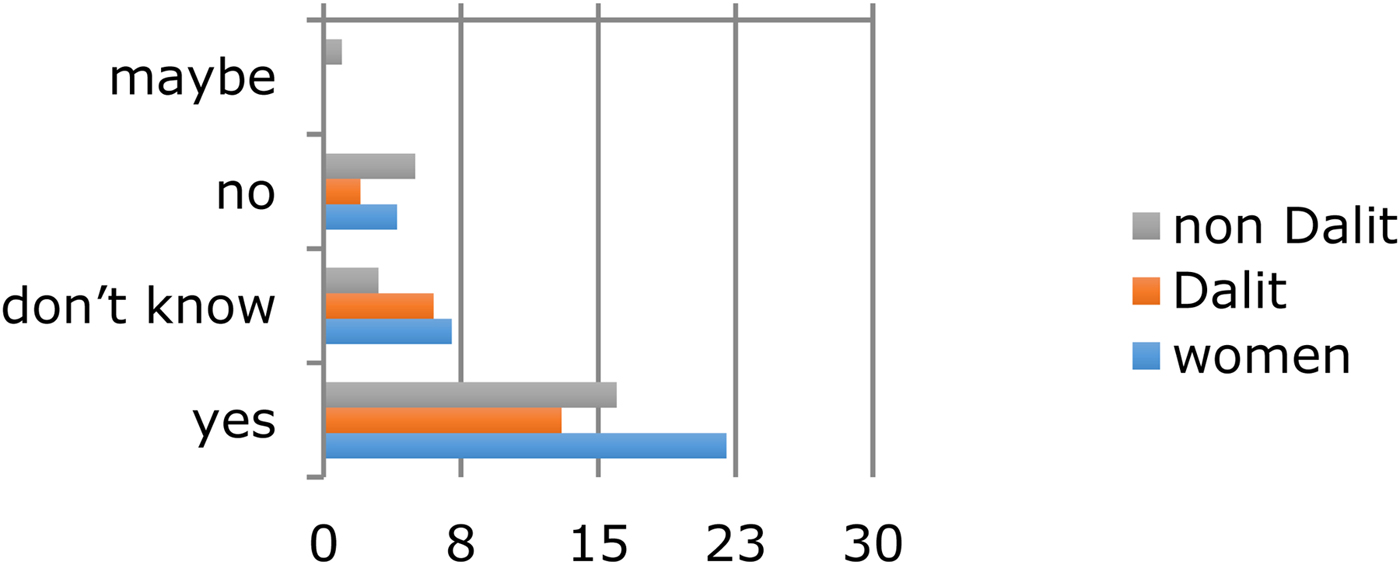
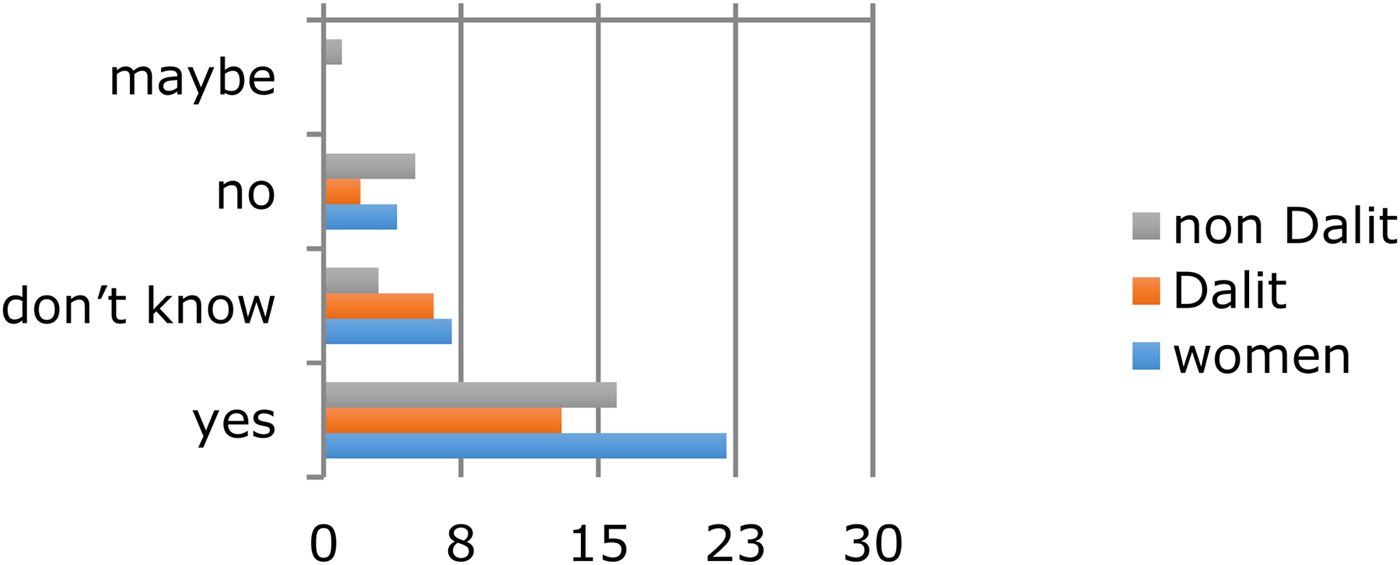
More women than men felt that the transfers positively affected their relationship with the state (see Figure 4). One Dalit said, ‘We are poor and yet get these allowances therefore our relationship with the government is good. We appreciate that the government is looking out for us.’ Beneficiaries were able to demonstrate that their sense of citizenship has changed as a result of being a cash transfer beneficiary, especially Dalits.
Do the cash transfers affect the relationship you have with the state? Source: The author.
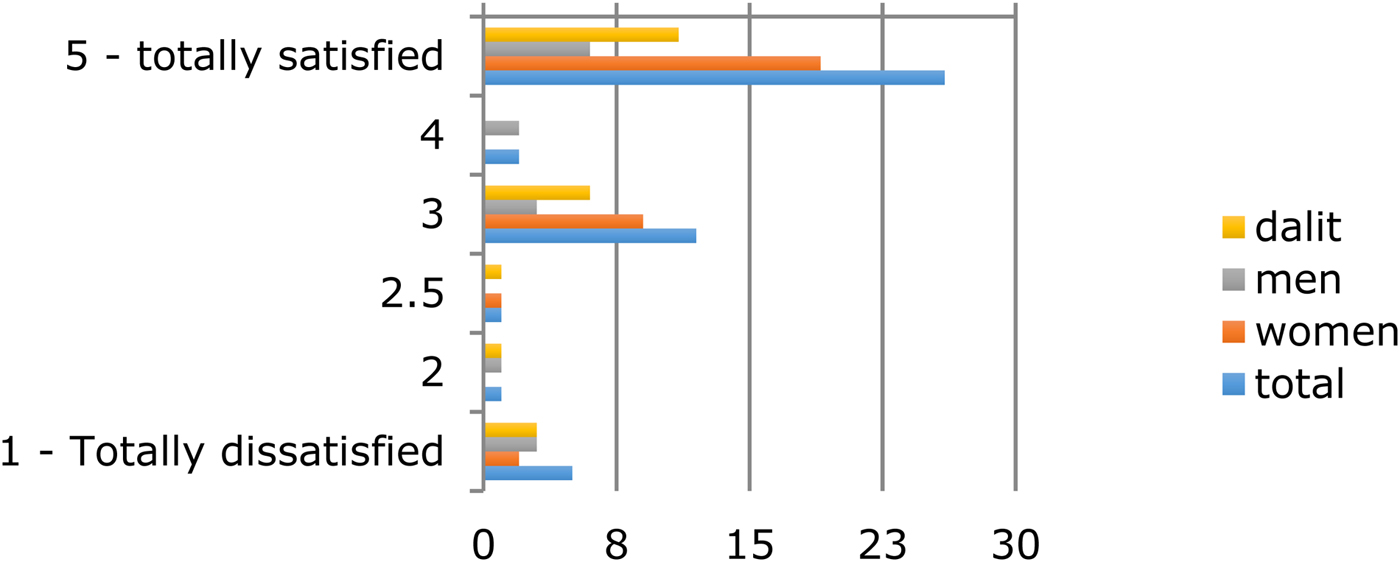
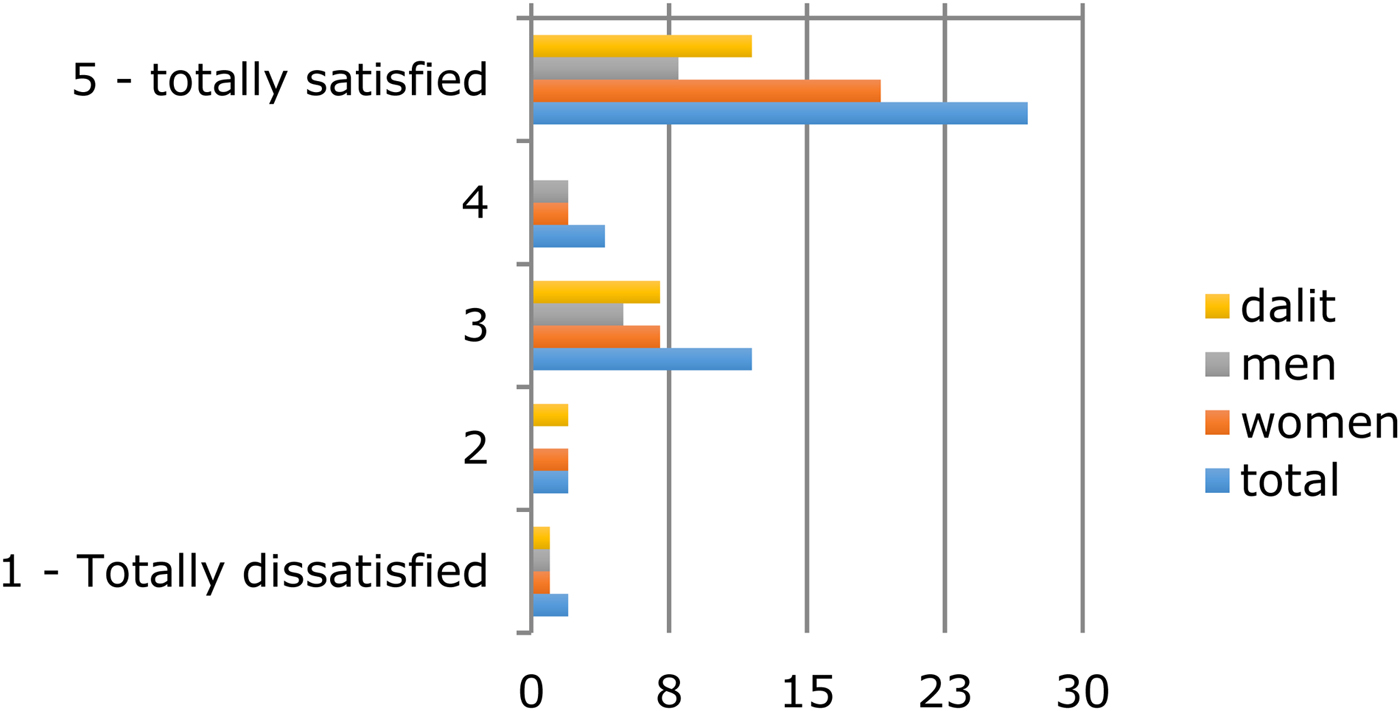
Participants rated state trustworthiness on a Likert scale. With hindsight, this question should have been separated into a sense of trust in local government and central government. Some respondents took the opportunity to suggest that they would score the central government higher than the local government.Footnote 98 Others indicated that they expected some misuse of their entitlements but still rated state trustworthiness highly (see Figure 5). Further research separating the central government from local officials is needed to understand how beneficiaries interpret state trustworthiness, especially because state responsiveness to complaints is a problem and Dalits perceive that the local government takes money from them. The definition of trust and the expectations people have of the government needs to be better understood to make sense of the responses.
Likert scale: How satisfied are you that the state is trustworthy? Source: The author.Footnote 99
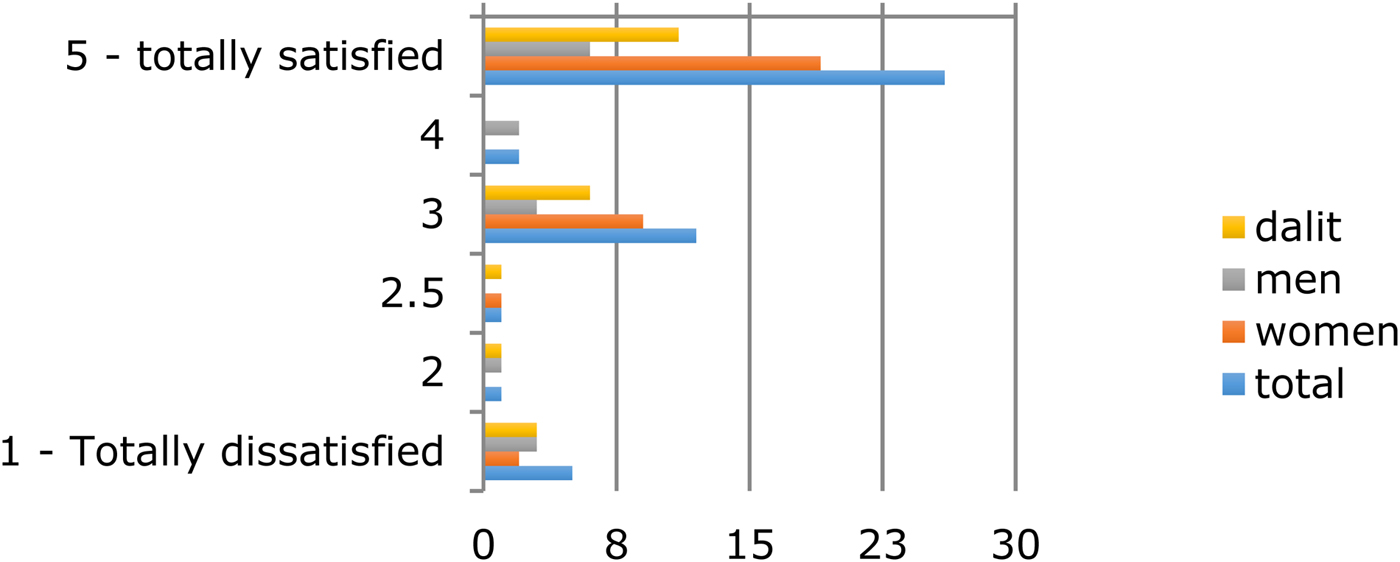
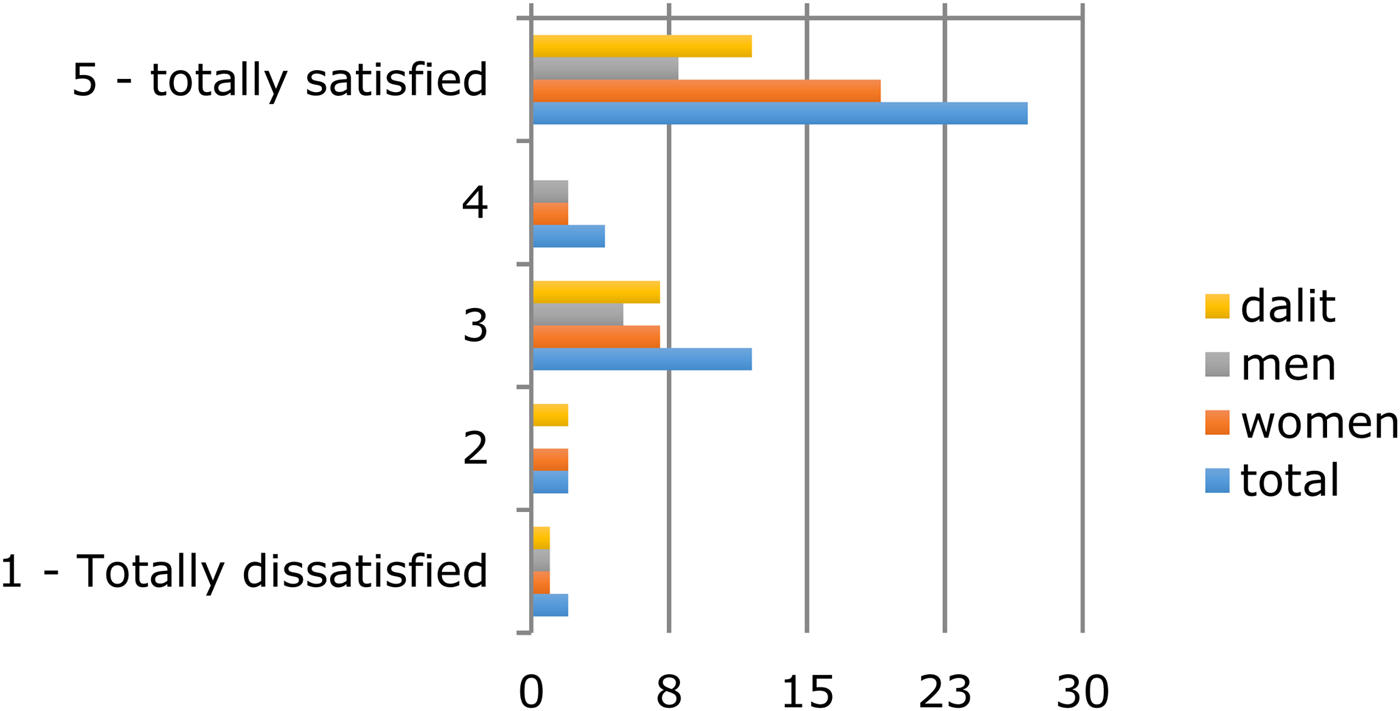
Despite all the misdemeanours cited in the case studies, people were mostly satisfied with the cash transfer system (see Figure 6). Of those who were dissatisfied, some gave comments to explain their score such as, ‘All Dalits should get it’ or ‘We should get more money.’ However, as many of the respondents had little prior contact with the state, it is unsurprising that they have few recommendations for improving the cash transfer system.
Likert scale: How satisfied are you with the cash transfer system? Source: The author.Footnote 100
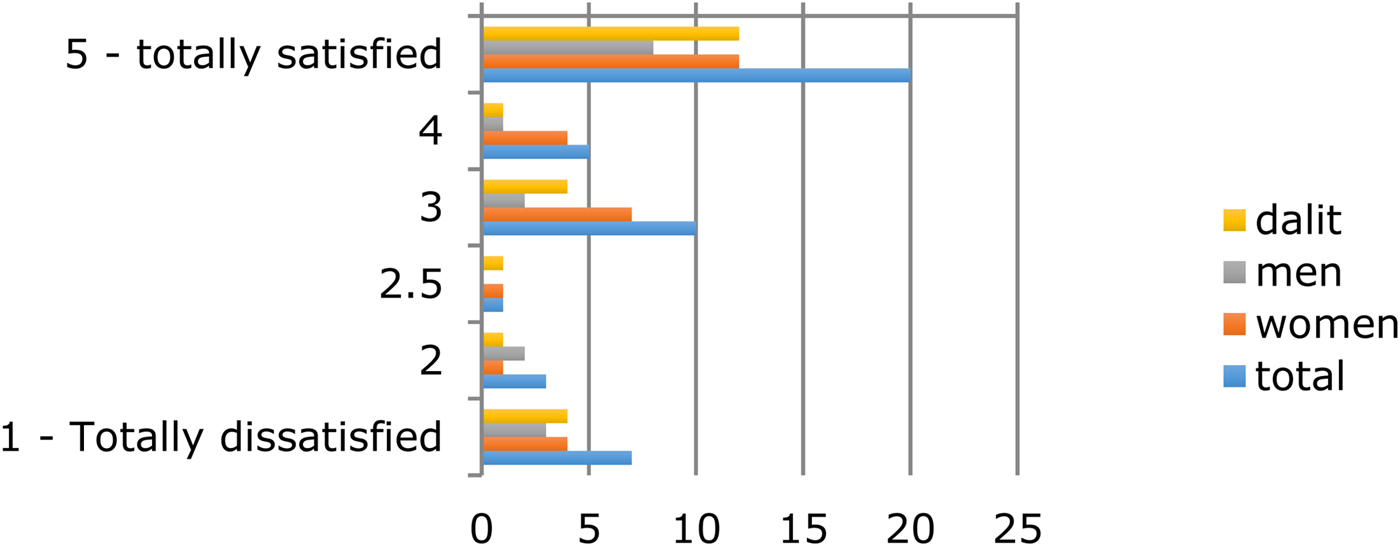
Beneficiaries were asked to rate how satisfied they were that the government looked after the poor (see Figure 7). The question of satisfaction with the cash transfer system came before this and may have influenced results; one person who scored a five said, ‘I'm still alive because I get money from the government.’
Likert scale: How satisfied are you with the way the government looks after the poor? Source: The author.Footnote 101
These state-related responses raise the question: are cash transfer beneficiaries satisfied with how the government looks after the poor because they see the alternative as worse or did they answer as if they were being watched and feared that the cash transfer would be removed if they answered too negatively? The latter seems less likely as some negative responses were received. Alternatively, state reach was previously so poor under the monarchy that misappropriations are overlooked when making an overall assessment of the current cash transfer system both because this is expected and because the beneficiaries feel that the state recognizes and reaches them now.
Additionally, a beneficiary's ability to assess their satisfaction with the way in which the government looks after the poor and the cash transfer system are restricted by their limited understanding of what makes for an effective state. None of the Dalit participants, and only four non-Dalit participants, could list any functions of the state, suggesting a low understanding of its role in the villagers’ lives.
For most Dalits, the misdemeanours of local government do not reflect the central state. In India, as patronage diminished, the state took on the role of the erstwhile upper-caste benefactors.Footnote 102 This may partly explain Dalit perceptions of the central state as benevolent, but it does not explain the differences that emerged between local government and central government. Corbridge et al. discuss the different faces of the development state that people encounter in their everyday lives.Footnote 103 Dalits see these different faces within the hierarchy in which they exist socially. The central state is higher and somehow better than their daily, local government, and they described the VDC secretary as having higher status than the education or health officers.
Access challenges
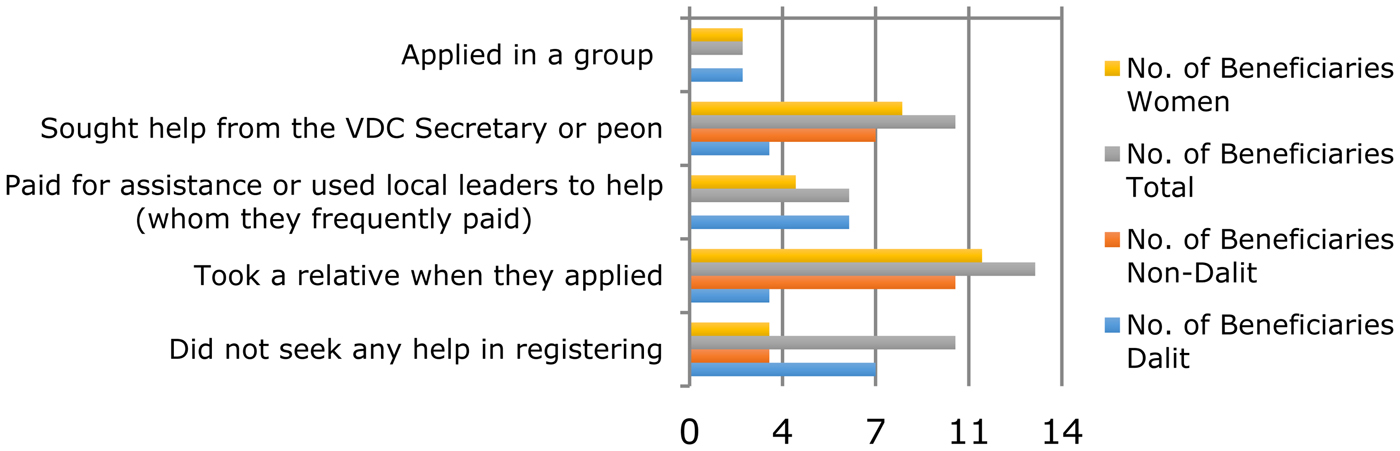
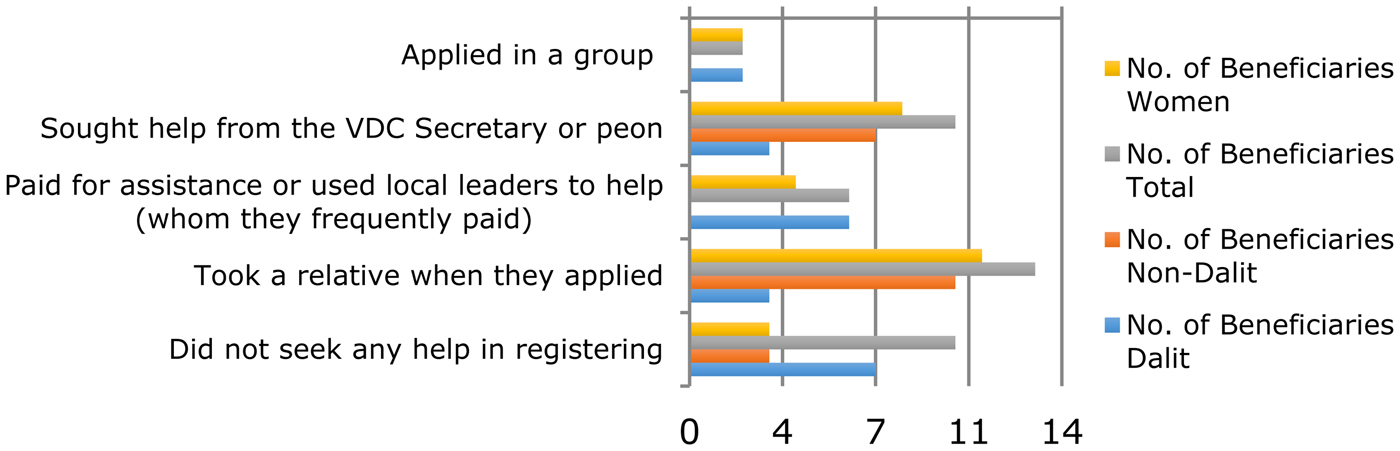
The case studies reveal the discriminatory nature of everyday life that Dalits experience because of their low status and exclusion. The research found that in all villages Dalits faced more challenges registering and accessing their benefits than other citizens, and they often enlisted paid assistance to overcome these barriers. Dalits lack social capital and status, and this affects how they apply for the cash transfer (see Figure 8). Despite being entitled to a cash transfer, Dalits are often unable to access the benefit unless a more influential or powerful person applies on their behalf. Dalits feel that unless they pay someone to mediate their interaction with the government, then the government will not ‘do their work’. In this way the cash transfer system encourages adverse incorporation and clientelism.
Research participants’ reported approaches to accessing cash transfers. Source: The author.
In reporting this back to Kathmandu respondents (mostly Brahmin-Chhetri middle class government officials and development workers), most explained that the Madhesh was unique in this respect as there they follow the Indian ‘broker’ model and, in addition, the Madhesh was known to be highly corrupt. Numerous anecdotes were given to support these assertions; however, this only reaffirms the stereotypes used by state officials and the Brahmin-Chhetri middle class to ostracize and neglect the Madhesh. For example, Sijapati writes about the Madheshi people's aspirations for autonomy and self-rule, and how political ignorance of their problems fuels their grievances against the ruling castes.Footnote 104 Lawoti explains how Nepal's sense of nationalism promotes certain caste and geographical values as normal and aspirational, and denigrates or makes deviant the characteristics of marginalized groups, or does not even recognize them as Nepalese (in the case of Madheshis).Footnote 105 This enables the government to ignore and blame the Madheshis themselves for their excluded status, when in fact it is fuelled by neglect and low accountability rather than Madheshi culture. Government spending on the Madhesh in 2009/2010 was almost four times less than that spent in the hill region, despite the significantly larger population in the former.Footnote 106
Identity books and registration for the cash transfers are meant to be free to beneficiaries, but around one-third of respondents paid for these. Less than half considered that this was a bribe and the rest thought they were meant to pay. Dalits were twice as likely to pay bribes and paid bigger bribes—NPR500–2,000 [US$5–20] compared to NPR140–400 [US$1.40–4] paid by non-Dalits—to access their cash transfers. Local officials and other leaders regard Dalits as ‘soft targets’ from whom they can generate revenue. The everyday experience of being a Dalit is not overcome by the implementation of cash transfers.
Dalits, in particular, lack networks that can correctly inform them about government procedures or help them challenge corruption. None of the Dalit Child Grant beneficiaries received an identity book, which is counter to the government's SSOPs. The majority of Dalits felt that the VDC secretary was taking money out of their transfers, but this could not be substantiated by the research.Footnote 107 Many illiterate Dalits who did receive an identity book commented that they did not know if they received the amount recorded there because they cannot read. The non-Dalit illiterate beneficiaries interviewed did not mention their illiteracy as a probable cause of deceit. There were many other examples heard that were contrary to the SSOP, highlighting the strong discretionary powers of the VDC.
Avenues of redress
The case studies show that Dalits are acutely aware of their low status. As a result, they tend not to complain about the cash transfers as it is ‘not worth the bother’ for some respondents. One Dalit explained that, ‘If you complain, then the next time you want the VDC secretary to do something for you he won't.’ Dalits discuss their grievances with their immediate community, at least initially, before lodging a complaint. Of the 11 beneficiaries who mentioned discussing their grievances, eight were Dalits who wanted to strategically plan solutions. A Dalit widow said, ‘Lots of times we have talked about complaining about the VDC secretary. He is no good. But no one wants to be the one to go and complain.’ This comment was not specific to cash transfers.
One Dalit admitted that it was hard to discuss the issue of cash transfer misappropriations in a group because the rich would ridicule them. When Dalits try to establish networks and build communities of support, the rich will undermine these efforts (see Case study five). Even at the local level, small-scale attempts at mobilization by Dalits are destabilized.
Six other beneficiaries said there was nowhere to complain. Yet of the four who did complain, surprisingly, three were Dalits. Two Dalits went to the DDC to complain but they were sent back to ‘sort it out with the VDC secretary’. A Dalit woman commented that, ‘Dalits always miss out on everything.’ One said, ‘If you can't buy political support, then you can't complain.’ Dalits have more grievances associated with the cash transfers than other beneficiaries and fewer formal avenues available to resolve them.
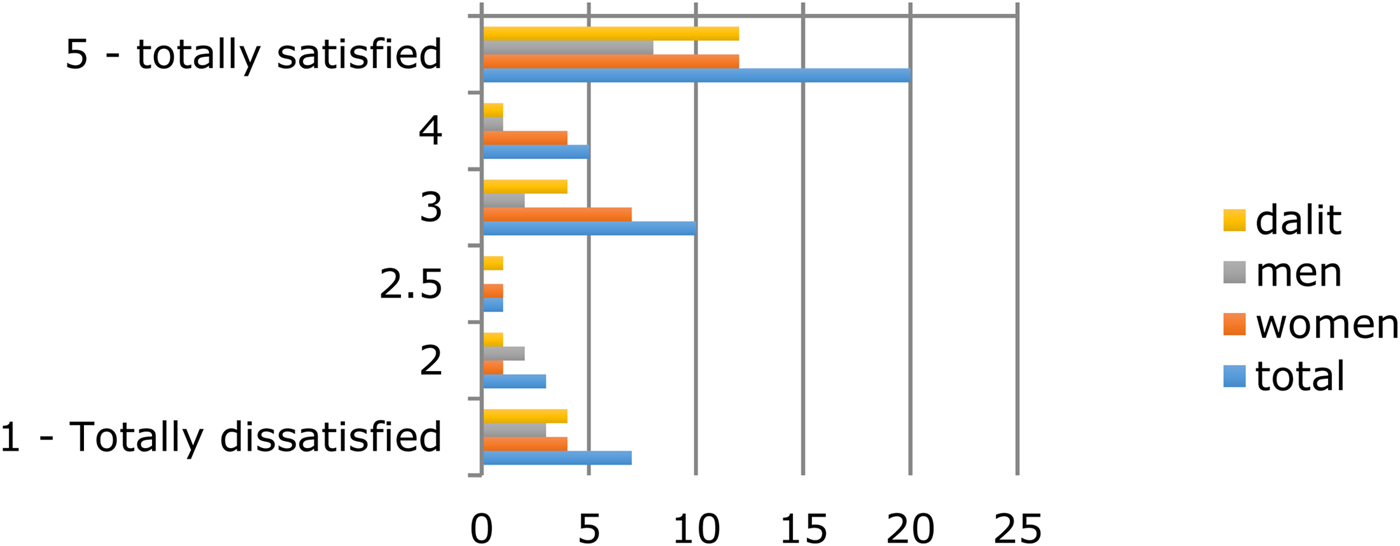
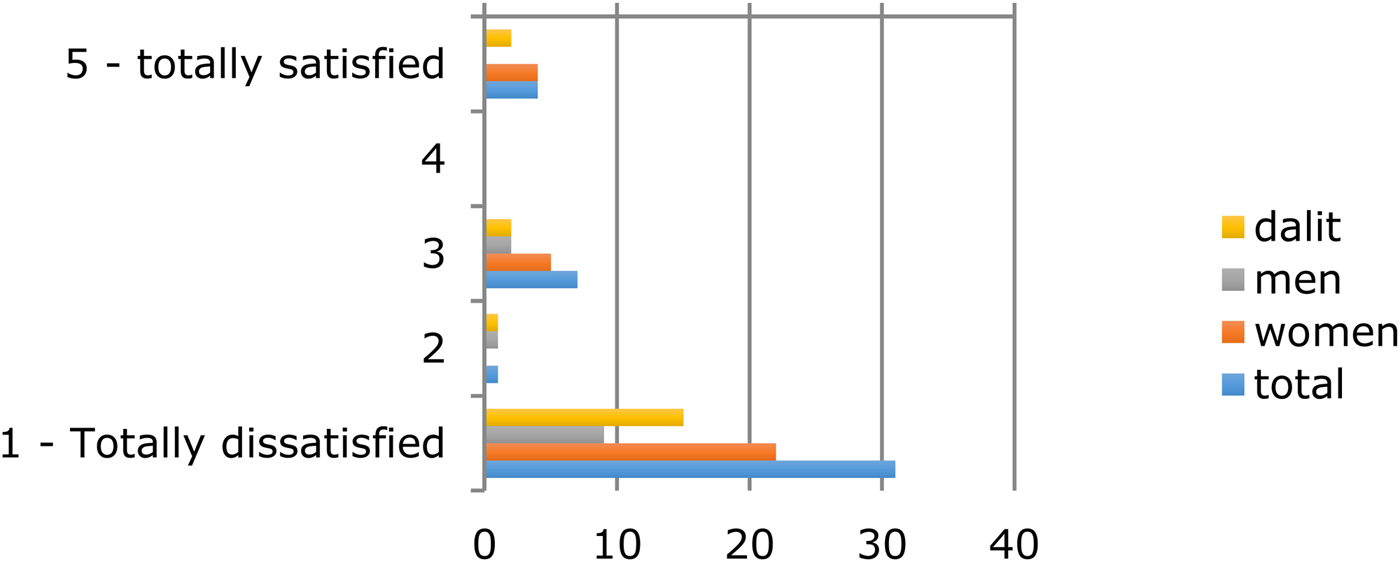
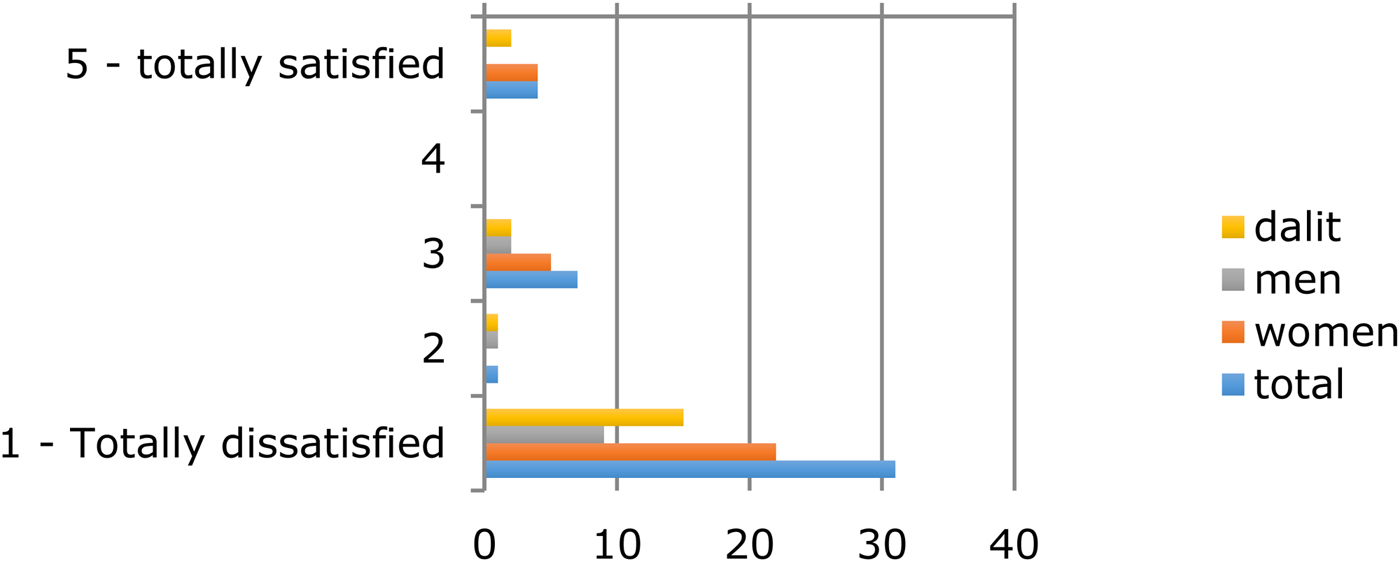
Figure 9 reveals that the majority of respondents are totally dissatisfied with the government's responsiveness to complaints. This implies that transformative social protection is unlikely in Nepal if people have little success in lobbying for their rightful entitlement. Yet responses on the benefits of cash transfers were positive and show signs of the cash transfers contributing to social inclusion. Perhaps having something to complain about is more transformative for Nepal's poor and excluded groups than the results of complaining.
Likert scale: How satisfied are you with the government's responsiveness to complaints? Source: The author.Footnote 108
As Chatterjee has shown, dramatic forms of protest are often the most effective for the marginalized, and the following story highlights the benefits that can come from complaining.Footnote 109 A Musahar mother-in-law complained at the VDC secretary's office that no one was receiving the Child Grant in her village. She was told, ‘Go away. Don't talk here.’ So a number of women from her village formed a group and sat for five days in protest at the VDC's office and when the VDC secretary failed to appear, they went to the district headquarters. It took them ten days to be allowed to meet with the chief district officer at the DDC, who confirmed they should receive the Child Grant and said should go back to the VDC secretary and ‘Ask him properly.’ They were so frustrated they assaulted the VDC secretary until he agreed to give them the grant. Four days after the assault the VDC secretary came with police protection and they all got an instalment of NPR900 (US$9). The following year they only received NPR400 (US$4) each, although they are entitled to NPR1,200 (US$12) Child Grant annually. Given that the state does not function effectively for them, excluded groups are forced to resort to tactics outside legitimate channels as this is where they have the most success.
Corbridge labels this as ‘citizenship as complaining’.Footnote 110 Even though it appeared to be ‘not worth the bother’ in terms of the outcome, it was ‘worth the bother’ in that it allowed some Dalits to demonstrate citizenship. As Nyamu-Musembi found, subalterns may be enticed to expand the possibility for action as the parameters to act as fuller citizens are reinterpreted by certain initiatives or actions.Footnote 111 The possibility for challenging injustice exists in ‘political society’Footnote 112, Footnote 113 Thus, activism leads to a sense of rights, status, and of belonging as a citizen of Nepal.
The questions this example raises are numerous. What part does the cash transfer play in creating the right to complain? Do Dalits complain about other government services by ‘taking matters into their own hands’? Would Dalits have complained prior to the end of the conflict? Is their active citizenship in any way linked to the Maoist government suggesting that anything is now possible in naya Nepal? The cash transfers help excluded groups to feel included and act like citizens, but many extraneous factors, aside from just the cash transfers, may contribute to this. As many of these factors are linked to the post-conflict setting, it does indicate that cash transfers given in such a context to formerly excluded groups would have a similar positive impact on notions of individual inclusion and citizenship. Cash transfers permit one to reimagine oneself as a citizen.
Conclusion
While some scholars have argued that cash transfers should not be delivered in clientelistic and unaccountable states, the evidence presented here suggests that they should. The state may ascribe citizenship rights through instruments such as cash transfers, and even when these amounts are small and irregularly given, they can promote inclusion and social justice. Cash transfers can be a state symbol that communicates messages to citizens about their significance. This renders cash transfers an important state-building tool.
Giving excluded citizens access to government benefits enables them to feel part of the system of the state and to have a relationship with the government. It gives them a sense of citizenship and consciousness of their rights, and of feeling included, respected, and cared for. Even if citizens start from a low base and even if local government officers breach their new rights, people's perceptions of their own inclusion and well-being survive. Outside the cash transfer system, Dalits have limited opportunities to change, protest, or even participate in local hierarchical relationships.
Insecurity in Nepal comes from not being seen by the state, from a lack of social capital, from not understanding government processes, among many other factors. Cash transfers, and social protection more broadly, may reinforce adverse incorporation and clientelism in states like Nepal; however, excluded citizens need first to be included or to be given rights in order to understand what it means to be a citizen. They must learn the rules of the game and they must be included in order to change them. Social inclusion is a process and caste/class mobility begins by interacting with the government.
Not being in a patron's sphere of influence and not being adversely included is worse still than the current ‘fully excluded’ status of Dalits. For highly excluded groups, patron clientelism cannot always be seen as a negative experience. Even when Dalits discussed misappropriations and local government discrimination, they still commented that ‘Everything is going right’ because they are acknowledged and seen by the state. Wood argues that having a patron brings a level of protection and a sense of security.Footnote 114 Dalits overlook the misdemeanours of frontline government service providers as they have learned from being in receipt of a cash transfer that they are protected because they have a powerful patron—the central monolithic state.
This article presents evidence of Dalits redefining state actions in a manner that is meaningful to them. Transformative social protection argues that poor people need to be seen as active citizens. How they see themselves in society and act in the construction of that society is important to their emancipation and inclusion. Because the cash transfers create new opportunities to engage with powerful segments of society, it presents new opportunities for Dalits to (re)negotiate their status within these relationships. Dalits are seeking to be included and there is evidence of them acting like citizens. Consequently, in Nepal, redistribution can lead to recognition for highly marginalized and excluded groups. Kabeer explains that because Dalits are culturally disadvantaged, their identity, and recognition of it, is mobilizing.Footnote 115 For Dalits, the gesture of receiving a cash transfer has value because status injustice requires recognition.Footnote 116
Cash transfers do not change the structural distribution of power and resources that keep people poor and excluded. Dalits still face more discrimination by the government than other social groups. What cash transfers can do, however, is empower people personally. Excluded groups have rarely had the opportunity to act—and be seen as acting—like citizens of the state. Transformational social protection must include individual forms of power and agency as well as structural forms, for with enough individual empowerment, people in Nepal will eventually shape the state in their own image. In line with Ferguson, this article highlights the importance of systems of distribution to contribute to more equitable outcomes.Footnote 117
Wood calls for a more universal conception of social policy that does not focus exclusively on the role of the state, but rather surveys the efficacy of relationships between different elements of an institutional landscape through which all people have to pursue livelihoods and survival.Footnote 118 The findings here support this. Despite it being difficult and time consuming, and sometimes ethically challenging, to collect beneficiaries’ views, this article demonstrates the value of making that effort and the insights that can be gained from doing so. The analytical value in collecting the views of beneficiaries is that the feelings and perceptions of excluded groups cannot be assumed. Citizenship formation is a complex and highly subjective experience, but understanding it is essential to overcoming exclusion.
States may promote a certain kind of citizenship through welfare programmes or social policies but, depending on how citizens encounter these schemes, it may result in a renegotiation of their sense of self as a citizen and their opinion of the state. Social protection in Nepal does not lead to dependency, instead it contributes to active citizenship. One can assume that at some point, once citizens are more empowered rights holders, the delivery of the cash transfers and misappropriations will become a bigger concern. Further research comparing cash transfers to other services delivered by the state would be needed to isolate the contribution that cash transfers make towards building an inclusive state, given the dramatic and sudden changes in post-conflict Nepal.
More research on cash transfer beneficiaries over time, perhaps via a regression analysis or a panel data set, is needed. The indicators used to measure inclusion are important and should involve individual empowerment and notions of citizenship, not just health and education indicators. Further research which compares Dalit cash transfer beneficiaries to non-Dalit cash transfer beneficiaries would be useful as many questions remain about Dalit-specific responses. Research on the Dalits of Nepal is minimal when compared to India. Research on the everyday experience of being Dalit in a state like Nepal, as it undergoes a process of transformation, would make a sound contribution to understanding social inclusion processes for highly marginalized groups.